Showing posts with label The CoDominium. Show all posts

Wednesday, 16 March 2016

The Arrival Of The Prince

This blog is currently juggling with three future histories:

Poul Anderson's History of Technic Civilization;

Jerry Pournelle's CoDominium History;

the Man-Kzin Wars period of Larry Niven's Known Space History (this period is a shorter history within the longer history).

Poul Anderson wrote the first and contributed to the second and third.

The purpose as always is to appreciate whichever work is currently under discussion while sooner or later returning to Andersonian themes or comparisons.

My copy of The Prince (CoDominium) has arrived. I hope that the image conveys some impression of its size. It has 1151 pages and collects four volumes but one of those was originally two volumes.

Meanwhile, however, I have become interested in Pournelle's and Stirling's contributions to Man-Kzin Wars, which connect with Anderson's, so I am not sure how soon I will return to the CoDominium.

Tuesday, 15 March 2016

Mankind In Spacetime And The Universe

HG Wells describes:

the experiences of space traveling and time traveling;

the far future of mankind and Earth;

Selenites in their environment;

Martians invading our environment;

political and military conflicts;

in one future, the transcendence of social problems and the emancipation of humanity but, in an alternative future, devolution into Morlocks and Eloi.

Poul Anderson describes:

many experiences in space;

the experience of time traveling;

the far future of AI on Earth and in the galaxy;

political and military conflicts on Earth and between interstellar empires;

imaginative alien life forms, e.g., in the Terran Empire.

Too much emphasis just on political and military conflicts is not really sf - maybe? Characters in Jerry Pournelle's CoDominium future history have such conflicts on Earth - and export them to space. Nuclear exchanges on a single planet are suicidal so let's have them between planets instead? Some people will draw the lesson that they need to build a society free of such conflicts and will use the Alderson drive to travel far enough away that they can make a fresh start without Imperial interference, like the McCormac rebels in Anderson's Technic History.

Monday, 14 March 2016

SM Stirling

See here and here.

We discuss SM Stirling's works on this blog because:

aspects of Stirling's and Poul Anderson's works are comparable (see the above links);

Stirling contributed to Anderson's Time Patrol series;

like Anderson, Stirling has contributed to Jerry Pournelle's CoDominium future history, one of several such series that in some ways parallel Anderson's Technic History;

Stirling has developed alternative histories further than Anderson did.

I expect shortly to begin reading the first of the two CoDominium novels co-written by Pournelle and Stirling. While discussing such works, it is usually possible to keep touching base with Poul Anderson and other future historians.

I should also track down Anderson's single contribution to the CoDominium History.

Now And Tomorrow

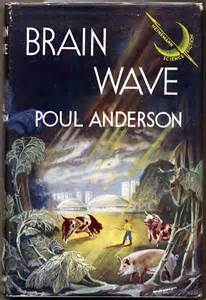
Science fiction can be contemporary or futuristic. Indeed, it can even be historical. See several works by Poul Anderson. However, the present and the future are the main concerns of sf. The future can mean any time from the day after tomorrow (Brain Wave) to beyond the end of the universe (Tau Zero).

The day after tomorrow may be the same as today except for a single technological innovation, as in "Life-Line" by Robert Heinlein. Brain Wave begins with a global increase in intelligence which generates every conceivable technological innovation, then the transcendence of humanity.

CS Lewis' Ransom Trilogy comprises two contemporary interplanetary novels and one "day after tomorrow" novel. Thus, Lewis presents the unusual but wholly appropriate sequence of Mars, Venus and Earth.

Reading American sf comics in the 1950s, I divided sf into before or after the invention of spaceships. The earliest future histories begin before space travel. Heinlein's Future History begins with "Life-Line." An escape velocity rocket fuel is not developed until the end of the fourth story.

In Anderson's Psychotechnic History, the opening story is set on a devastated Earth but the second begins on a colonized Mars. Anderson's Technic History and Larry Niven's Known Space future history begin with the exploration of the Solar System whereas Jerry Pournelle's CoDominium future history begins with regular interstellar travel. So there is some progress.

Wells' Time Traveler tells his dinner guests that he traveled through tomorrow, as if it were another country, then further into futurity. Thus, twenty four hours later, he and they have lived through the day that he traveled through while he traveled through it. Extraordinary.

Sunday, 13 March 2016

Single Or Multiple Authorship

Poul Anderson's future histories are written entirely by Poul Anderson whereas Star Trek is written by many script writers. These are two ways to generate fiction: basically, quality as against quantity. Anderson's output is enormous for a single author but, of course, he did not confine his attention to just one series and, in any case, could not have matched the sheer volume produced by multiple authorship.

The few Superman stories written by Alan Moore are part of the vast Superman canon but are also part of Moore's complete works and have been collected as such. Needless to say, they are way ahead of most other superhero fiction.

There is an intermediate position. Jerry Pournelle's CoDominium future history is additionally written or co-written by:

Larry Niven;
SM Stirling;
Jennifer Pournelle;
the contributors to the War World series, including Anderson.

This probably makes for unevenness in the quality of writing. There is unevenness in Anderson's Technic History because it was written over such a long period but multiple authorship almost certainly increases unevenness. However, I have yet to read the War World volumes. SM Stirling managed to pull together a consistently high quality for the Drakas! anthology.

Saturday, 12 March 2016

Barrier

I have been comparing Jerry Pournelle's CoDominium History to Poul Anderson's Technic History and to relevant works by Robert Heinlein and James Blish. So far, I have:

reread The Mote In God's Eye (with Larry Niven) although not agreed with Heinlein about it;

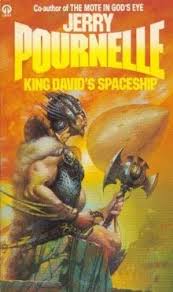
enjoyed rereading King David's Spaceship, which is recommended by Anderson;

appreciated the Prologue of The Mercenary and the future politics in the opening chapters.

However, I have encountered a barrier. The narrative suddenly jumps to Falkenberg, now a mercenary, on a colony planet with complicated social problems that I have not been able fully to engage with or get involved in. Pournelle is creating a political conflict so that Falkenberg will be able to apply military force to it. But, as CS Lewis and Brian Aldiss both said in different ways (see here), we do not go to other planets to find "The same old stuff we left behind..."

I remember a previous reading of The Mercenary and have also googled here and here. From these sources, I gather that:

the Falkenberg series has been collected and re-collected and now comprises a single compilation co-written by SM Stirling;

there are Patriotic Wars, Formation Wars, Secession Wars and a sub-series called "War World," which is longer and more complicated than I had realized;

the selling of military services becomes a major part of the interstellar economy;

unemployed populations make unreasonable demands on resources;

the view is expressed that such populations should be left to sink or swim;

Falkenberg orders a massacre.

I believe that the employed in an industrial/technological society can redirect production and resources away from warfare towards welfare which would mean the elimination of poverty whereas "Welfare" has come to mean its perpetuation and institutionalization! I might find myself too out of sync with the assumptions and ethos of Falkenberg and his colleagues to continue reading their history.

Some More Comparisons

Starting from Poul Anderson's eight (or nine) future histories, we have moved sideways in fictional time, finding interesting parallels with future history series by several other sf writers. Much of this discussion stays here on the Poul Anderson Appreciation blog because this is where it starts and because this is where page viewers come to. However, for further discussion of other future histories, please see the James Blish Appreciation and Science Fiction blogs, both linked to this one.

Here is another set of comparisons:

(i) In James Blish's Cities In Flight, Volume I, They Shall Have Stars, state security and secrecy stifle science whereas Jerry Pournelle's CoDominium goes even further by suppressing technologies with military applications, thus killing most research.

(ii) In Cities..., the USSR takes over the US whereas the CoDominium is a US-USSR alliance. I wondered where all the nationalism came from. It is a reaction against CD world domination. Blish's Bureaucratic State and its thought police go on to ban even fictional references to spaceflight as Unearthly Activities.

(iii) The CoDominium is succeeded by two interstellar Empires of Man. The Bureaucratic State is succeeded by some interstellar empires but mainly by the interstellar economy of the flying cities.

(iv) The CoDominium History culminates in First Contact with aliens whereas Cities... culminates in the mutual annihilation of two universes and the creation of several more:

"Creation began."
-James Blish, Cities In Flight (London, 1981), p. 596.

(v) Returning to our main man, Anderson shows cosmic beginnings in "Flight to Forever," Tau Zero and The Avatar whereas Pournelle concentrates on militarism - not an inherently science fictional theme.

Tuesday, 8 March 2016

Diversity

In Poul Anderson's Terran Empire, we expect - and find - immense diversity of religious traditions. Of course, this is helped by diversity of intelligent species. Some human members of Avalonian choths even practice the Ythrian Old Faith.

Jerry Pournelle's Second Empire of Man seems lass diverse. So far, I have found only Catholicism, Islam and (new) Himmism. Of course, this timeline so far has only one nonhuman intelligent species, not discovered until 3017. In fact, it was an effect of Motie technology that indirectly caused the founding of the Church of Him.

Protestantism seems to have disappeared. Churches separated for centuries have few doctrinal disagreements. When McKinnie installs a missionary Bishop in the Temple on Makassar, the Bishop styles himself "...His Ultimate Holiness, Primate of all Makassar, Vicar of Christ, and Archbishop of New Rome." (King David's Spaceship, p. 224) Surely those last two titles apply exclusively to His Holiness of New Rome?

The Bishop would say, and I think somewhere does say, that he has come for the good of men's souls. Many would respond simply that they believe neither in souls nor in any other supernatural entities such as a deity. So far, I agree with them. However, I also think that any society benefits from access to teachings about the value of reflection on mental states and motivations. This need not be linked to belief in the literal existence of supernatural beings although such beings remain central to much mythology, art, literature and fiction. I would not join the Bishop's flock but would welcome debate with him.

Sunday, 6 March 2016

The Technic And CoDominium Histories

Approximate Parallels?

(i) The hyperdrive; the Alderson Drive.
(ii) The Breakup; the Great Exodus.
(iii) The Solar Commonwealth; the CoDominium.
(iv) Falkayn; Falkenberg.
(v) The Time of Troubles; the Great Patriotic Wars.
(vi) The Principate phase of the Terran Empire; proclamation of the Empire of Man by Leonidas I of Sparta.
(vii) Civil war; Secession Wars.
(viii) The Dominate phase; proclamation of the Second Empire by Leonidas IV of Sparta.
(ix) Isolated colonized planets like Altai and Makassar.
(x) Fall of Empire, Long Night and later civilizations; no equivalents as yet.

Having enjoyed the Technic History, but also reread it several times by now, it is good to find something similar and enjoyable. Of the CoDominium History volumes that I have read so far, my definite favorite is King David's Spaceship.

Technological Levels And Prime Directives

How do human societies of different technological levels interact? An idea common to Star Trek, the Okies series and the CoDominium future history is a Prime Directive against interference in lower level societies although the only way to ensure no interference would be to prevent any interaction. By contrast, the Allied Planets of Poul Anderson's Technic History assess isolated planets in order to determine whether the attempt to recivilize them is worth the effort.

In King David's Spaceship, Jerry Pournelle shows the high tech Second Empire interacting with two isolated planets of different levels. The main difference seems to be that men on Prince Samual's World fight with guns whereas the inhabitants of Makassar use swords. The planets differ in other physical and sociological details and are realized in commendable detail.

I get the impression that the CoDominium History primarily comprises:

the Falkenberg series (4 vols);
War World (5);
the Second Empire (3) -

- which in turn correspond to three historical periods:

the CoDominium;
the Old Empire;
the New Empire and First Contact.

It is like a shorter alternative to the Technic History.

Saturday, 5 March 2016

Poul Anderson's Legacies

Time Travel
Can anyone top the Time Patrol? Audrey Niffenegger's The Time Traveler's Wife is at least an excellent circular causality novel.

Cosmic SF
I know that there is much post-Anderson cosmic sf, e.g., by Gregory Benford, but have not really kept up with it.

Alternative Histories
We have seen that SM Stirling has developed this sub-genre further than Anderson.

Future Histories...
...in which extrasolar colonies are isolated for centuries, then reincorporated into an interstellar civilization. We are currently finding that Jerry Pournelle's CoDominium future history fits well into this sub-sub-genre.

Hard Fantasy?

Thursday, 3 March 2016

Comparing American Future Histories

We will probably continue to compare American future histories while also continuing to emphasize, as has already been clearly demonstrated, that Poul Anderson is the master of this particular sf sub-genre. To this end, I must finish rereading Larry Niven's and Jerry Pournelle's The Mote In God's Eye, then perhaps read or reread more volumes in Pournelle's CoDominium History.

As it happens, I have copies of The Mercenary and King David's Spaceship. Since each of these works has been read maybe once and not recently, I am spared the trouble of seeking out other titles on Amazon for a while.

Since King David's Spaceship begins with a noisy crowd in the Blue Bottle and Imperial Navy officers buying drinks, we are in familiar territory, remembering, e.g., the opening passage of Anderson's "Sargasso of Lost Starships." Human beings cross interstellar distances faster than light, settle on terrestroid planets like Ansa or Prince Samual's World, build communities with hostelries like the Golden Planet or the Blue Beetle, then find that they are ruled by an Emperor in another planetary system, on Terra or Sparta.

Having enjoyed this fictional scenario in well-written works by Anderson, we expect to enjoy it again when it is re-presented by another writer - but the new writer must earn his keep. He does. 

Friday, 26 February 2016

Imaginative Aliens

Which of the future histories in the American sequence that we have been discussing presents the most imaginative aliens? It was clever of Niven and Pournelle to make their Moties asymmetrical. However, apart from that single important difference, a Motie's body is recognizably a humanoid form with two right arms and one right ear.

Niven's three-legged Puppeteers with their brains inside their bodies are definitely not humanoid. Nor are Poul Anderson's less well known Smokesmith the Reardonite or Rax.

One of Anderson's Didonians comprises three temporarily linked bodies. Although each of these bodies is comparable to a Terrestrial animal - rhino, goose and ape - their transient tripartite consciousnesses are entirely alien. See here.

Thus, here are five interesting alien intelligences appearing respectively in four future histories:

Pournelle's CoDominium series;
Niven's Known Space series;
Anderson's Psychotechnic History;
Anderson's Technic History.

Thursday, 25 February 2016

Survival And Diversity

On Earth, the inescapable result is the Great Patriotic Wars, the long-delayed Third World War that begins and ends with massive nuclear exchanges. Much of Earth is devastated; civilization collapses and much of the surface is rendered temporarily uninhabitable.
-copied from here.

I have copied this passage from the Wikipedia article on the CoDominium because it confirms my earlier deduction that the Great Patriotic Wars are a delayed World War III.

The purpose of American future histories seems to be to move human beings out of the Solar System! - although interstellar travel was only just beginning at the very end of Robert Heinlein's original five volume Future History.

There is no doubt that dispersing humanity through space is a sure way to racial survival. Even ex-convicts living on Welfare or isolated colonies reduced to barbarism are at least living human populations which would not be possible on the surface of a single devastated planet. However, Poul Anderson in several works goes further, seeing an interstellar diaspora as the way to ensure that cultural diversity which is the essence of humanity.

Saturday, 20 February 2016

Civil Strife

This Saturday afternoon, I neither read nor blogged but attended a community event described on another blog. This event turned out to be peaceful and harmonious although it had been organized in response to potential strife.

Such strife is an unfortunate aspect of contemporary society. Science fiction can show us utopias free from civil strife or dystopias where conflicts have intensified but how much sf presents street conflicts in future cities?

In Jerry Pournelle's CoDominium future history, John Christian Falkenberg's troops face street demonstrators and, in Poul Anderson's A Knight Of Ghosts And Shadows, a group of beings Merseian by species but not by loyalty marches on the Dennitzan Parliament, with Dominic Flandry and his fiancee hidden among their ranks. For me, that latter scene rings true.

However, maybe most fiction shows us the leaders and decision-makers at the top of a society rather than conflicts arising from below?