Time Travel
Can anyone top the Time Patrol? Audrey Niffenegger's The Time Traveler's Wife is at least an excellent circular causality novel.
Cosmic SF
I know that there is much post-Anderson cosmic sf, e.g., by Gregory Benford, but have not really kept up with it.
Alternative Histories
We have seen that SM Stirling has developed this sub-genre further than Anderson.
Future Histories...
...in which extrasolar colonies are isolated for centuries, then reincorporated into an interstellar civilization. We are currently finding that Jerry Pournelle's CoDominium future history fits well into this sub-sub-genre.
Hard Fantasy?
Showing posts with label Audrey Niffeneger. Show all posts
Saturday, 5 March 2016
Friday, 19 February 2016
Contemporary Fantasy And Science Fiction
On this blog, I discuss the works of Poul Anderson and of a few other authors, usually relating the latter to the former. While blogging, I have, on the recommendation of correspondent Sean M Brooks, also begun to read the alternative history novels of SM Stirling. However, there remain many current works of fantasy and sf with which I am still unfamiliar. For example, Sean has also mentioned the novels of John C Wright.
I would welcome any comments or contributions along the lines of:
if you like Anderson, you might like X;
X, like Anderson, writes in the tradition of Wells, Stapledon and Heinlein;
X is completely unlike Anderson but worth reading in any case.
Thus, Anderson's comprehensive canon functions as a lens through which to view the entire range of fantasy and sf. Possible lines of inquiry are:
Are any other space operas as substantial as the Dominic Flandry series?
How does Michael Moorcock's Multiverse compare with Anderson's Old Phoenix sequence?
Apart from Audrey Niffeneger's superb The Time Traveler's Wife, do any recent time travel novels match the contributions of Anderson or of Tim Powers?
How many authors write convincing accounts of remote futures of artificial intelligence and abundant wealth?
Who else writes good military sf?
What other trends is Shackley completely unaware of?
I would welcome any comments or contributions along the lines of:
if you like Anderson, you might like X;
X, like Anderson, writes in the tradition of Wells, Stapledon and Heinlein;
X is completely unlike Anderson but worth reading in any case.
Thus, Anderson's comprehensive canon functions as a lens through which to view the entire range of fantasy and sf. Possible lines of inquiry are:
Are any other space operas as substantial as the Dominic Flandry series?
How does Michael Moorcock's Multiverse compare with Anderson's Old Phoenix sequence?
Apart from Audrey Niffeneger's superb The Time Traveler's Wife, do any recent time travel novels match the contributions of Anderson or of Tim Powers?
How many authors write convincing accounts of remote futures of artificial intelligence and abundant wealth?
Who else writes good military sf?
What other trends is Shackley completely unaware of?
Monday, 5 January 2015
Two Problems About Time Travel
Time travel is a subject that it is possible to get horribly wrong. We could compile a long list of time travel errors but I will mention here only that one comic strip time travel story began with a caption saying, "Half an hour ago, at the end of time -" On the other hand, I do not agree with James Blish's opinion that every sf writer who had addressed time travel up until the time of our correspondence had made a mess of it, even Heinlein.
I suggest that there have been three peaks of time travel fiction:
Poul Anderson's two Time Patrol volumes;
Jack Finney's two Time novels;
Audrey Niffeneger's The Time Traveler's Wife.
For a while, there were two peaks, then The Time Traveler's Wife was published.
The following works are close seconds:
"By His Bootstraps" by Robert Heinlein;
The Anubis Gates by Tim Powers;
There Will Be Time by Poul Anderson.
As ever on any such lists, Anderson must appear at least twice. Even on these lists, only those works that confine themselves to the circular causality paradox avoid any logical problems.
I would like to find a fourth peak. Either it has not been published yet or it has been published but I do not know about it yet. I have been given an anthology of twenty five relatively recent time travel stories. However, another factor intervenes. Unless we are professional critics, we need to have some reason to think that a work of fiction might be worth reading before we are motivated to begin reading it. This does not involve prejudging anything. I never set out to read a formulaic Mills and Boon romantic novel although no doubt many of these are good at what they do and it remains possible, however unlikely, that one such will transcend its genre to become a fully rounded novel.
I have read some of the new time travel stories but am having trouble reading them all. In "Palely Loitering," Christopher Priest builds what seems to be an elaborate circular causality structure, then spoils it, in my opinion, with a sudden causality violation. The events described cannot fit into a single timeline but, if our hero has initiated and remained in a divergent timeline, then he cannot return home as he sets out to do at the very end because he is now in a timeline where his younger self's life went differently - although maybe we are supposed to realize this?
I continue to derive more aesthetic and intellectual pleasure from rereading and reassessing the Time Patrol than from reading most other accounts of time travel.
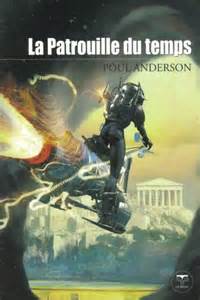
I suggest that there have been three peaks of time travel fiction:
Poul Anderson's two Time Patrol volumes;
Jack Finney's two Time novels;
Audrey Niffeneger's The Time Traveler's Wife.
For a while, there were two peaks, then The Time Traveler's Wife was published.
The following works are close seconds:
"By His Bootstraps" by Robert Heinlein;
The Anubis Gates by Tim Powers;
There Will Be Time by Poul Anderson.
As ever on any such lists, Anderson must appear at least twice. Even on these lists, only those works that confine themselves to the circular causality paradox avoid any logical problems.
I would like to find a fourth peak. Either it has not been published yet or it has been published but I do not know about it yet. I have been given an anthology of twenty five relatively recent time travel stories. However, another factor intervenes. Unless we are professional critics, we need to have some reason to think that a work of fiction might be worth reading before we are motivated to begin reading it. This does not involve prejudging anything. I never set out to read a formulaic Mills and Boon romantic novel although no doubt many of these are good at what they do and it remains possible, however unlikely, that one such will transcend its genre to become a fully rounded novel.
I have read some of the new time travel stories but am having trouble reading them all. In "Palely Loitering," Christopher Priest builds what seems to be an elaborate circular causality structure, then spoils it, in my opinion, with a sudden causality violation. The events described cannot fit into a single timeline but, if our hero has initiated and remained in a divergent timeline, then he cannot return home as he sets out to do at the very end because he is now in a timeline where his younger self's life went differently - although maybe we are supposed to realize this?
I continue to derive more aesthetic and intellectual pleasure from rereading and reassessing the Time Patrol than from reading most other accounts of time travel.
Sunday, 4 January 2015
Time Travel Fiction II
The previous post differentiated two kinds of time travel stories. Poul Anderson alone excels at both. I will omit titles on the ground that the page viewer already knows them or can find out or can ask.
Causality Violation
Mark Twain: a classic novel of attempted historical causality violation.
HG Wells: the classic time travel story with only a hint of "...anachronism and utter confusion..."
L Sprague de Camp: a definitive novel of deliberate historical causality violation.
Ward Moore: a definitive novel of accidental historical causality violation.
Jack Finney: nostalgic time travel in several short stories and in two long, illustrated novels presenting an unfortunately confused account of causality violation.
Circular Causality
HG Wells: understated circular causality.
Robert Heinlein: three definitive statements of circular causality in futuristic settings.
Harry Harrison: humorous historical circular causality.
Tim Powers: hard fantasy circular causality.
Richard Matheson: a romantic novel with circular causality.
Audrey Niffeneger: the same sub-genre as Matheson.
Poul Anderson
Three novels of historical circular causality.
A long series about a time travel organization preventing historical causality violations sometimes by closing causal circles.
Causality Violation
Mark Twain: a classic novel of attempted historical causality violation.
HG Wells: the classic time travel story with only a hint of "...anachronism and utter confusion..."
L Sprague de Camp: a definitive novel of deliberate historical causality violation.
Ward Moore: a definitive novel of accidental historical causality violation.
Jack Finney: nostalgic time travel in several short stories and in two long, illustrated novels presenting an unfortunately confused account of causality violation.
Circular Causality
HG Wells: understated circular causality.
Robert Heinlein: three definitive statements of circular causality in futuristic settings.
Harry Harrison: humorous historical circular causality.
Tim Powers: hard fantasy circular causality.
Richard Matheson: a romantic novel with circular causality.
Audrey Niffeneger: the same sub-genre as Matheson.
Poul Anderson
Three novels of historical circular causality.
A long series about a time travel organization preventing historical causality violations sometimes by closing causal circles.
Time Travel Fiction
Most new time travel fiction is at worst incoherent or at best unoriginal.
Incoherence
I have discussed illogicalities in time travel fiction here, here and here. It is pointless to readdress such issues at length every time they recur. The Mammoth Book Of Time Travel SF contains a four page story which I read to the end only because of its brevity. The surprise ending was that the story described an impossible time travel scenario only because its narrator was insane! Thus, this story is not sf. (But how many of its readers thought that it was making sense?)
If a time traveler departs now to change an event in my past and succeeds, then he generates a divergent timeline in which that event happened differently and in which I now remember it differently but I do not, in the original timeline, continue to remember the first version of the event only to discover that the event has "now" been changed so that it did not occur as I remember it!
Unoriginality
It is insufficient merely to (re)state the circular causality paradox although The Time Traveler's Wife demonstrates that it remains possible to present new and surprising implications of that paradox, as Poul Anderson had done in his three independent time travel novels.
It is necessary to spell out, preferably briefly, precisely which version of a divergent or multiple timelines scenario an author is using but not, of course, to present the mere idea as if it were a novelty. Anderson's Time Patrol series presents an extremely subtle mutable timeline theory which, I think, contains incoherencies as stated by the characters but which nevertheless warrants careful study and also makes for intriguing and haunting stories.
Incoherence
I have discussed illogicalities in time travel fiction here, here and here. It is pointless to readdress such issues at length every time they recur. The Mammoth Book Of Time Travel SF contains a four page story which I read to the end only because of its brevity. The surprise ending was that the story described an impossible time travel scenario only because its narrator was insane! Thus, this story is not sf. (But how many of its readers thought that it was making sense?)
If a time traveler departs now to change an event in my past and succeeds, then he generates a divergent timeline in which that event happened differently and in which I now remember it differently but I do not, in the original timeline, continue to remember the first version of the event only to discover that the event has "now" been changed so that it did not occur as I remember it!
Unoriginality
It is insufficient merely to (re)state the circular causality paradox although The Time Traveler's Wife demonstrates that it remains possible to present new and surprising implications of that paradox, as Poul Anderson had done in his three independent time travel novels.
It is necessary to spell out, preferably briefly, precisely which version of a divergent or multiple timelines scenario an author is using but not, of course, to present the mere idea as if it were a novelty. Anderson's Time Patrol series presents an extremely subtle mutable timeline theory which, I think, contains incoherencies as stated by the characters but which nevertheless warrants careful study and also makes for intriguing and haunting stories.
Saturday, 2 August 2014
Wells, Anderson And Niffeneger
Poul Anderson's Time Patrolmen are like HG Wells' Time Traveler in that they sit on their time machines. Audrey Niffeneger's Henry DeTamble is like Anderson's Jack Havig in that he time travels without a time machine. However, Detamble travels involuntarily to psychologically significant times and places - thus, the novel is neither historical nor futuristic but contemporary - and, logically, does not take his clothes with him. Arriving naked at unexpected destinations is a whole new problem for a time traveler.
DeTamble, like the Time Patrollers, space-time jumps instantaneously (from his own perspective) whereas Havig, like the Time Traveler, sees his environment fast forward or rewind. Niffeneger presents an intricate circular causality romantic novel. Thus, like several other writers, she develops one aspect of time travel where Anderson develops every aspect and can be compared favorably to authors as diverse as Wells, Asimov and Niffeneger.
Thursday, 27 March 2014
Three Culminations
I thought that Jack Finney's two Time novels and Poul Anderson's two-volume Time Patrol series were the two culminations of time travel fiction but Audrey Niffeneger's The Time Traveler's Wife (the one of these works that also happens to have been filmed) joined the list as soon as I had read it and I hope that there will be a sequel, The Time Traveler's Daughter.
Finney: nostalgic time travel to earlier decades in the United States;
Niffeneger: a contemporary novel of relationships involving time travel;
Anderson: historical periods and processes and futuristic speculations.
Niffeneger perfects the circular causality paradox. Thus, her novel needs to be compared with Anderson's three non-series time travel novels rather than with his Time Patrol series. Unlike the three by Anderson, Niffeneger's novel is a longer work, is neither historical nor futuristic but entirely contemporary and deals with personal relationships, not with any wider issues.
Henry tells Claire not to sign a drawing because he has seen it unsigned in the future but she signs it... But events remain consistent despite this. (She was right to trim off the signature because they want their known future to be their experienced future. A time traveler who sets out to change events might succeed in which case they will be in a different timeline, which is not what they want.) See here.
What I am saying here is that I recommend not only Poul Anderson's time travel works but also certain others for comparison and that these others definitely include The Time Traveler's Wife.
Finney: nostalgic time travel to earlier decades in the United States;
Niffeneger: a contemporary novel of relationships involving time travel;
Anderson: historical periods and processes and futuristic speculations.
Niffeneger perfects the circular causality paradox. Thus, her novel needs to be compared with Anderson's three non-series time travel novels rather than with his Time Patrol series. Unlike the three by Anderson, Niffeneger's novel is a longer work, is neither historical nor futuristic but entirely contemporary and deals with personal relationships, not with any wider issues.
Henry tells Claire not to sign a drawing because he has seen it unsigned in the future but she signs it... But events remain consistent despite this. (She was right to trim off the signature because they want their known future to be their experienced future. A time traveler who sets out to change events might succeed in which case they will be in a different timeline, which is not what they want.) See here.
What I am saying here is that I recommend not only Poul Anderson's time travel works but also certain others for comparison and that these others definitely include The Time Traveler's Wife.
Thursday, 13 March 2014
Knowing The Past
I recommend Audrey Niffenegger's The Time Traveler's Wife as a novel that ingeniously addresses the same kind of time travel paradoxes as Poul Anderson's There Will Be Time (New York, 1973).
In Anderson's novel, if a time traveler tries to change a known event, then something happens to prevent the attempted change so that the time traveler soon learns to stop trying. If he persists, then he might be stopped by a fatal accident. Thus, often, when an events occurs that a time traveler does not like, the only reason why he does not change it is because he does not try to change it. In these cases, there need not be any preventing event waiting in the wings to occur if necessary.
In the time travel fight described a few posts ago, if Havig had seen himself kill Mendoza, then he would have killed Mendoza but, because he does not see himself do this, he does not do it.
This does strain credulity and plausibility. Havig's group could conduct some controlled experiments in attempted causality violation, e.g., a time traveler tries to appear at a time and place at which it is known that he did not appear in order to find out what, if anything, will prevent him. If nothing prevents him, then they are instantly in a different scenario, more like that of the Time Patrol. They can never be completely sure that this will not occur.
If a lot of time travelers try to change a lot of known events, then the laws of probability will have to change to prevent them. For example, will a hundred time travelers each suffer a fatal heart attack just before setting off on a mission to change the past?
In Anderson's novel, if a time traveler tries to change a known event, then something happens to prevent the attempted change so that the time traveler soon learns to stop trying. If he persists, then he might be stopped by a fatal accident. Thus, often, when an events occurs that a time traveler does not like, the only reason why he does not change it is because he does not try to change it. In these cases, there need not be any preventing event waiting in the wings to occur if necessary.
In the time travel fight described a few posts ago, if Havig had seen himself kill Mendoza, then he would have killed Mendoza but, because he does not see himself do this, he does not do it.
This does strain credulity and plausibility. Havig's group could conduct some controlled experiments in attempted causality violation, e.g., a time traveler tries to appear at a time and place at which it is known that he did not appear in order to find out what, if anything, will prevent him. If nothing prevents him, then they are instantly in a different scenario, more like that of the Time Patrol. They can never be completely sure that this will not occur.
If a lot of time travelers try to change a lot of known events, then the laws of probability will have to change to prevent them. For example, will a hundred time travelers each suffer a fatal heart attack just before setting off on a mission to change the past?
Subscribe to:
Posts (Atom)


