On this blog, I discuss the works of Poul Anderson and of a few other authors, usually relating the latter to the former. While blogging, I have, on the recommendation of correspondent Sean M Brooks, also begun to read the alternative history novels of SM Stirling. However, there remain many current works of fantasy and sf with which I am still unfamiliar. For example, Sean has also mentioned the novels of John C Wright.
I would welcome any comments or contributions along the lines of:
if you like Anderson, you might like X;
X, like Anderson, writes in the tradition of Wells, Stapledon and Heinlein;
X is completely unlike Anderson but worth reading in any case.
Thus, Anderson's comprehensive canon functions as a lens through which to view the entire range of fantasy and sf. Possible lines of inquiry are:
Are any other space operas as substantial as the Dominic Flandry series?
How does Michael Moorcock's Multiverse compare with Anderson's Old Phoenix sequence?
Apart from Audrey Niffeneger's superb The Time Traveler's Wife, do any recent time travel novels match the contributions of Anderson or of Tim Powers?
How many authors write convincing accounts of remote futures of artificial intelligence and abundant wealth?
Who else writes good military sf?
What other trends is Shackley completely unaware of?
Showing posts with label Tim Powers. Show all posts
Friday, 19 February 2016
Wednesday, 23 September 2015
Related Reading
Tacitus' biography of his father-in-law, Agricola, is pure hagiography.
Guy Consolmagno and Paul Mueller (see here, here and here) rightly say that there are two creation stories in Genesis but also that there is another such story in Maccabees. I am not familiar with the latter. They mention some possible responses to the heat death of the universe but not the two that are posited in later works by Poul Anderson: AI expects to survive by utilizing the energy of particle decay or by - some even more obscure means, which I cannot remember.
SM Stiring's Under The Yoke resolutely refuses to arrive. There is almost a Draka stubbornness about this.
I have bought KW Jeter's Morlock Night, yet another sequel to You Know What. Jeter's text is well written and imaginative with many good qualities but simply not a continuation of Wells' narrative. I suggest that the Morlocks should have been kept out of the title. Poul Anderson's Time Patrol series, while certainly not a sequel, is an excellent conceptual successor to The Time Machine.
Jeter's book is introduced by Tim Powers, the author of one of the great circular causality novels of the universe. See here.
Guy Consolmagno and Paul Mueller (see here, here and here) rightly say that there are two creation stories in Genesis but also that there is another such story in Maccabees. I am not familiar with the latter. They mention some possible responses to the heat death of the universe but not the two that are posited in later works by Poul Anderson: AI expects to survive by utilizing the energy of particle decay or by - some even more obscure means, which I cannot remember.
SM Stiring's Under The Yoke resolutely refuses to arrive. There is almost a Draka stubbornness about this.
I have bought KW Jeter's Morlock Night, yet another sequel to You Know What. Jeter's text is well written and imaginative with many good qualities but simply not a continuation of Wells' narrative. I suggest that the Morlocks should have been kept out of the title. Poul Anderson's Time Patrol series, while certainly not a sequel, is an excellent conceptual successor to The Time Machine.
Jeter's book is introduced by Tim Powers, the author of one of the great circular causality novels of the universe. See here.
Sunday, 4 January 2015
Time Travel Fiction II
The previous post differentiated two kinds of time travel stories. Poul Anderson alone excels at both. I will omit titles on the ground that the page viewer already knows them or can find out or can ask.
Causality Violation
Mark Twain: a classic novel of attempted historical causality violation.
HG Wells: the classic time travel story with only a hint of "...anachronism and utter confusion..."
L Sprague de Camp: a definitive novel of deliberate historical causality violation.
Ward Moore: a definitive novel of accidental historical causality violation.
Jack Finney: nostalgic time travel in several short stories and in two long, illustrated novels presenting an unfortunately confused account of causality violation.
Circular Causality
HG Wells: understated circular causality.
Robert Heinlein: three definitive statements of circular causality in futuristic settings.
Harry Harrison: humorous historical circular causality.
Tim Powers: hard fantasy circular causality.
Richard Matheson: a romantic novel with circular causality.
Audrey Niffeneger: the same sub-genre as Matheson.
Poul Anderson
Three novels of historical circular causality.
A long series about a time travel organization preventing historical causality violations sometimes by closing causal circles.
Causality Violation
Mark Twain: a classic novel of attempted historical causality violation.
HG Wells: the classic time travel story with only a hint of "...anachronism and utter confusion..."
L Sprague de Camp: a definitive novel of deliberate historical causality violation.
Ward Moore: a definitive novel of accidental historical causality violation.
Jack Finney: nostalgic time travel in several short stories and in two long, illustrated novels presenting an unfortunately confused account of causality violation.
Circular Causality
HG Wells: understated circular causality.
Robert Heinlein: three definitive statements of circular causality in futuristic settings.
Harry Harrison: humorous historical circular causality.
Tim Powers: hard fantasy circular causality.
Richard Matheson: a romantic novel with circular causality.
Audrey Niffeneger: the same sub-genre as Matheson.
Poul Anderson
Three novels of historical circular causality.
A long series about a time travel organization preventing historical causality violations sometimes by closing causal circles.
Friday, 28 March 2014
Three Other Time Travel Novels
There are at least three time travel novels by other authors that should be read alongside Poul Anderson's six time travel volumes.
The Technicolor Time Machine by Harry Harrison: familiar Andersonian territory - Vinland, circular causality and humor;
The Anubis Gates by Tim Powers: circular causality and fantasy;
Bid Time Return/Somewhere In Time by Richard Matheson: like The Time Traveler's Wife, a romantic novel of time travel.
I said earlier that "the cleverest kind of time travel story" was one in which past events seem not to proceed as they should but then the author gets them back on track. Anderson does this in The Dancer From Atlantis but it is a technique perfected by Powers and Matheson.
In The Anubis Gates:
The Times reports a talk by Lord Byron on a particular date;
a coach party of time travelers, suitably attired in period costumes, arrives to hear the talk;
they have arrived a week too early!;
however, since Lord Byron is to hand and since so many people have traveled so far to hear him (!), he agrees to deliver the talk a week earlier than planned;
a journalist attends and takes notes;
this is the talk that is reported in The Times.
Later:
it is recorded that our hero's dead body was found on a particular date;
fighting his (magically generated) clone on the appointed date, he sustains a wound that was not recorded and suddenly realizes that it is the clone's body that is to be found;
passing the presumed date of his death, he happily regains the freedom of the unknown...
In Bid Time Return:
the central character, having read a hotel register decades later, knows exactly when he signed in at a hotel and which room he stayed in;
approaching the hotel lobby, he pauses in order not to arrive too soon, then hurries in order not to arrive too late, although it is impossible that he arrive any earlier or later than he did arrive;
the hotel clerk starts to give him the wrong room key and he must restrain himself from saying, "That's the wrong room!;"
a second clerk says, "That room has been booked," and the first clerk gives him the right key after all.
Ingenious. If I were on the Desert Island with only one work of fiction, it would be Time Patrol but, if I were to be allowed a few more volumes, then they would include a small time travel library.
The Technicolor Time Machine by Harry Harrison: familiar Andersonian territory - Vinland, circular causality and humor;
The Anubis Gates by Tim Powers: circular causality and fantasy;
Bid Time Return/Somewhere In Time by Richard Matheson: like The Time Traveler's Wife, a romantic novel of time travel.
I said earlier that "the cleverest kind of time travel story" was one in which past events seem not to proceed as they should but then the author gets them back on track. Anderson does this in The Dancer From Atlantis but it is a technique perfected by Powers and Matheson.
In The Anubis Gates:
The Times reports a talk by Lord Byron on a particular date;
a coach party of time travelers, suitably attired in period costumes, arrives to hear the talk;
they have arrived a week too early!;
however, since Lord Byron is to hand and since so many people have traveled so far to hear him (!), he agrees to deliver the talk a week earlier than planned;
a journalist attends and takes notes;
this is the talk that is reported in The Times.
Later:
it is recorded that our hero's dead body was found on a particular date;
fighting his (magically generated) clone on the appointed date, he sustains a wound that was not recorded and suddenly realizes that it is the clone's body that is to be found;
passing the presumed date of his death, he happily regains the freedom of the unknown...
In Bid Time Return:
the central character, having read a hotel register decades later, knows exactly when he signed in at a hotel and which room he stayed in;
approaching the hotel lobby, he pauses in order not to arrive too soon, then hurries in order not to arrive too late, although it is impossible that he arrive any earlier or later than he did arrive;
the hotel clerk starts to give him the wrong room key and he must restrain himself from saying, "That's the wrong room!;"
a second clerk says, "That room has been booked," and the first clerk gives him the right key after all.
Ingenious. If I were on the Desert Island with only one work of fiction, it would be Time Patrol but, if I were to be allowed a few more volumes, then they would include a small time travel library.
Sunday, 9 September 2012
"Hard Fantasy"
(I have copied this post from the Science Fiction blog because it was written as an introduction to some further comments on Poul Anderson's Operation Luna.)
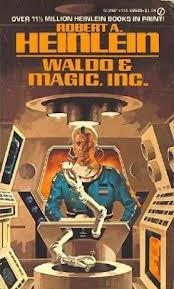
The premise of Robert Heinlein's "Magic, Inc." is that magic works and is practised like a set of technologies. Magical practice is based on the reality of supernatural entities and forces, not on any new theory, discovery or application of the natural sciences. Thus, "Magic, Inc." is fantasy, not science fiction (sf).
We might call it "hard fantasy" to indicate that the implications of the premise are deduced as rigorously as are the consequences of any new technology in hard sf.
Two other "hard fantasies":
in The Anubis Gates by Tim Powers, there is time travel to historical periods with circular causality as in an sf novel but here the time travel is one of several applications of magic;
in Black Easter/The Day After Judgement by James Blish, demons are real.
Blish wrote mostly hard sf. It is possible, when reading his fantasies, to forget that they are a different genre from his sf. Indeed, some of his characters find it hard to believe that their high technology coexists with demons. In fact, Black...Judgement is the second volume of a trilogy about the conflict between secularism and supernaturalism. Volumes I and III remain ambiguous but it is a premise of Volume II that demons exist and are neither technological nor extraterrestrial but supernatural.
The premise of Robert Heinlein's "Magic, Inc." is that magic works and is practised like a set of technologies. Magical practice is based on the reality of supernatural entities and forces, not on any new theory, discovery or application of the natural sciences. Thus, "Magic, Inc." is fantasy, not science fiction (sf).
We might call it "hard fantasy" to indicate that the implications of the premise are deduced as rigorously as are the consequences of any new technology in hard sf.
Two other "hard fantasies":
in The Anubis Gates by Tim Powers, there is time travel to historical periods with circular causality as in an sf novel but here the time travel is one of several applications of magic;
in Black Easter/The Day After Judgement by James Blish, demons are real.
Blish wrote mostly hard sf. It is possible, when reading his fantasies, to forget that they are a different genre from his sf. Indeed, some of his characters find it hard to believe that their high technology coexists with demons. In fact, Black...Judgement is the second volume of a trilogy about the conflict between secularism and supernaturalism. Volumes I and III remain ambiguous but it is a premise of Volume II that demons exist and are neither technological nor extraterrestrial but supernatural.
Subscribe to:
Posts (Atom)