Showing posts with label The Day After Judgement. Show all posts

Sunday, 20 March 2016

Doomsday And Judgment

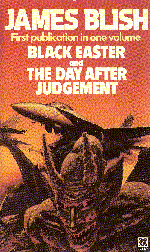
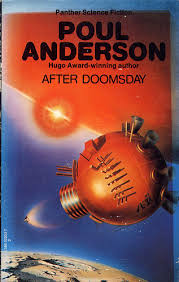
In Poul Anderson's After Doomsday, the crews of two interstellar spaceships have survived the genocidal sterilization of Earth. In James Blish's The Day After Judgement, mankind has survived a limited nuclear war. Thus, so far, two futuristic sf novels, each featuring a technological threat to all life on Earth. In Anderson's There Will Be Time, the civilization-destroying nuclear war is called the Judgment War. Thus, Anderson uses the terms "Doomsday" and "Judgment" in two similar secular contexts.

However, what I have not mentioned so far is that Blish's use of the term, "Judgment," is Biblical and apocalyptic. The nuclear exchange was just one aspect of Armageddon, which the demons have won. Thus, we are reading fantasy, not sf. On the other hand, it is what I have called "hard fantasy," reading very much like sf and, if its speculation that eternal life is full negative entropy were to be developed further, then it would return to the realm of sf with the angels and demons scientifically rationalized.

The Startegic Air Command attacks the demon fortress of Dis now manifested in the Valley of Death, Death Valley: science versus the supernatural, a concrete expression of the theme of Blish's After Such Knowledge Trilogy. Anderson presents scientific rationales of fantasy ideas in some works discussed recently on the blog.

Tuesday, 7 April 2015

Matter And Energy

A passage in James Blish's Black Easter and The Day After Judgment (London, 1972), pp. 173-17, is relevant to the discussion in the previous post. To paraphrase -

Baines: The conservation laws apply to matter and energy but demons are neither.

Satvje: They may be unified fields of electro-magnetico-gravitic energy with 100 per cent negative entropy.

Buelg: Completely negative entropy is impossible but stable negative entropy would be H(x)-Hy(x)=C+E.

Satvje: That would be eternal life.

Buelg: Eternal barring accidents. We ought to be able to disrupt the electromagnetic part of the system and thus to kill spirits.

However, I do not understand the equation.

Thursday, 28 February 2013

Judgement And Doomsday II

Having compared titles, let us also compare opening sentences.

"The fall of God put Theron Ware in a peculiarly unenviable position, though he was hardly alone." (James Blish, Black Easter and The Day After Judgement, London, 1981, p. 119)

" 'Earth is dead. They murdered our Earth!' " (Poul Anderson, After Doomsday, Frogmore, St Albans, Herts, 1975, p. 7)

The Day After Judgement is a sequel so it can begin with a casual reference to the death of God which had been announced by a demon at the end of Black Easter. The real existence of supernatural beings, God, angels and demons, makes these works fantasies.

After Doomsday is a single novel with a dramatic opening sentence. If "...our Earth..." is dead, then how can one of its inhabitants know this? He is in a spaceship that has just returned from outside the Solar System so this is a work of science fiction (sf).

A friend who borrowed my copy of After Doomsday thought it was bad but I cannot help agreeing with James Blish and the Lancaster sf bookseller Pete Pinto both of whom said effectively that something about it makes it a complete novel. Pete used the phrase "complete novel" and Jim Blish said much the same. I will elaborate in later posts. Like two other Anderson novels, Tau Zero and World Without Stars, After Doomsday starts with a very basic sf premise and derives what reads like a comprehensive set of consequences from that premise. Like many of Anderson's works, it could have initiated a series. I will shortly reread After Doomsday and comment further.

Judgement And Doomsday

Two titles, The Day After Judgement by James Blish and After Doomsday by Poul Anderson, sound almost interchangeable. However, Blish's "Judgement" is spiritual and supernatural, a literal Armageddon, whereas Anderson's "Doomsday" is secular and scientific, the sterilisation of Earth by aliens. In other words, Blish's novel is fantasy whereas Anderson's is science fiction (sf).

CS Lewis begins Perelandra by pointing out that we imagine non-human intelligences as either supernatural or extraterrestrial, then informs us that his character, Ransom, met on Mars beings that were both. That shook me when I read it.

A few other sf writers have had similar ideas. In two of Heinlein's novels, the Martian "Old Ones" are ghosts. In Ray Bradbury's The Martian Chronicles, Martian "Old Ones" are spiritually evolved Martians. In Brian Aldiss's Helliconia Trilogy, Helliconians have contact with their hereafter which contrasts strangely with the Terrestrial observation station in orbit above their planet. (When, in that station, orderly life broke down, Aldiss wrote an italicised descriptive passage including this marvelous sentence: "Everything depraved flourished.")

Starting with a reflection on two superficially similar but essentially contrasting titles, I have managed to draw a few parallels between six great names in sf: Blish; Anderson; Lewis; Heinlein; Bradbury; Aldiss. 

Sunday, 2 December 2012

Armageddon


Armageddon, with an unexpected outcome, occurs at the midpoint of James Blish's contemporary fantasy diptych, Black Easter/The Day After Judgement. (See here.) A contrastingly understated version of Armageddon, with a different unexpected outcome, is presented in the Epilogue of Poul Anderson's historical fantasy novel, The Merman's Children (London, 1981).

(i) Anderson's Armageddon is a fiction within the fiction because it is not an event in the novel but a hypothesis presented in a sermon by the character Father Tomislav.

(ii) Tomislav envisages the post-Armageddon repentance of Satan.

(iii) He also envisages the resurrection not only of the Christian dead but also of "...all that ever was, ever lived..." (p. 258) This would include the soulless merpeople who feature in the novel.

Tomislav's rationale for his vision is that Satanic repentance and universal resurrection would mean that nothing had been created in vain but he warns that what he has said "...could be heresy." (p. 258)

Immortality of the soul and resurrection of the body were two contrasting views of survival that merged in Christianity. Aristotle said that the soul was the form of the body but Plato had each soul transmigrating through many bodies. Greek philosophers laughed at St Paul for preaching bodily resurrection. Jehovah's Witnesses stand by the Biblical account of bodily resurrection, therefore rejecting the Pagan philosophical idea of immortal souls.

Some modern speculation, reflected in science fiction by Anderson and others, has artificial intelligence surviving and remembering the cosmos.

In the concluding Chapter XI, Tauno, a merman-human halfling, and his leman, a woman possessed by a ghost, do not (yet) experience Tomislav's hypothetical resurrection but they do achieve an acceptable apotheosis by sailing:

" 'Westward, maybe to Vinland or beyond. Whole vast realms of nature, Faerie, and man must be there, untouched by Christendom, open for our adventuring...we might become gods...Anything might happen, which is why we are going...' 'To know as much wonder as we can reach in whatever our spans may be...' " (p. 256)

- the kind of freedom that other Anderson characters gain by crossing interstellar space.

Thursday, 27 September 2012

Two Masters Of All The Genres

Poul Anderson mastered historical fiction, science fiction (sf) and fantasy and even set one novel in each of these genres in the fourteenth century with a minor connection between the historical novel, Rogue Sword, and the sf novel, The High Crusade. (See an earlier post, "Finding an Unexpected Connection" by Sean M Brooks, Wednesday, 9 May, 2012.)

James Blish, with a much smaller output, not only mastered these three genres but also went one step further than Anderson or any other author by writing a three genre Trilogy, After Such Knowledge:

in Volume I, Doctor Mirabilis (a historical novel), Roger Bacon, the founder of scientific method, is suspected of witchcraft and has a drug-induced vision of Armageddon;

in Volume II, (a) Black Easter and (b) The Day After Judgement (contemporary fantasies), magicians release and cannot recall demons who then wage and win Armageddon;

in Volume III, A Case Of Conscience (futuristic sf), experiences on an extra-solar planet oblige a Jesuit biologist to ask heretical questions about the relative powers of God and Satan and to fear an imminent Armageddon.

The Trilogy is thematic, not linear, so it does not matter that Armageddon happens in the late twentieth century yet is still to happen in the mid-twenty first century - although this discrepancy might be resolved by the conclusion of The Day After Judgement, when Satan/God undoes (at least some of) the damage caused by the conflict in order to initiate a long development of mankind towards Godhood. This development could still be occurring in Volume III although, as was the case after the Armageddon in Volume II, the characters' mind-sets have not progressed yet.

The unifying theme of the Trilogy is the question whether the desire for secular knowledge is evil. Blish, like Anderson or any other scientifically trained hard sf writer, answered "No" but he managed to write a Trilogy about the question.

Anderson addressed a single theme in different genres when he presented the original of Odin in a historical novel, a time traveller mistaken for Odin in an sf story and Odin in three fantasy novels. However, this single theme does not make these works a single series. Instead, the contrasting treatments differentiate them as distinct works.

I was reminded of Black Easter, the definitive novel of demonic conjuration, when I read Anderson's account of Queen Skuld's ritual cursing in Hrolf Kraki's Saga. Pagan witchcraft was followed by Christian witchcraft which led, in Blish's fantasy, to Armageddon.
Sunday, 9 September 2012

"Hard Fantasy"

(I have copied this post from the Science Fiction blog because it was written as an introduction to some further comments on Poul Anderson's Operation Luna.)

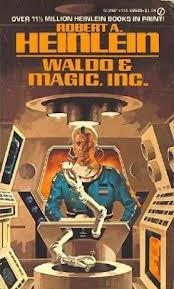
The premise of Robert Heinlein's "Magic, Inc." is that magic works and is practised like a set of technologies. Magical practice is based on the reality of supernatural entities and forces, not on any new theory, discovery or application of the natural sciences. Thus, "Magic, Inc." is fantasy, not science fiction (sf).

We might call it "hard fantasy" to indicate that the implications of the premise are deduced as rigorously as are the consequences of any new technology in hard sf.

Two other "hard fantasies":

in The Anubis Gates by Tim Powers, there is time travel to historical periods with circular causality as in an sf novel but here the time travel is one of several applications of magic;

in Black Easter/The Day After Judgement by James Blish, demons are real.

Blish wrote mostly hard sf. It is possible, when reading his fantasies, to forget that they are a different genre from his sf. Indeed, some of his characters find it hard to believe that their high technology coexists with demons. In fact, Black...Judgement is the second volume of a trilogy about the conflict between secularism and supernaturalism. Volumes I and III remain ambiguous but it is a premise of Volume II that demons exist and are neither technological nor extraterrestrial but supernatural.