Poul Anderson mastered historical fiction, science fiction (sf) and fantasy and even set one novel in each of these genres in the fourteenth century with a minor connection between the historical novel, Rogue Sword, and the sf novel, The High Crusade. (See an earlier post, "Finding an Unexpected Connection" by Sean M Brooks, Wednesday, 9 May, 2012.)
James Blish, with a much smaller output, not only mastered these three genres but also went one step further than Anderson or any other author by writing a three genre Trilogy, After Such Knowledge:
in Volume I, Doctor Mirabilis (a historical novel), Roger Bacon, the founder of scientific method, is suspected of witchcraft and has a drug-induced vision of Armageddon;
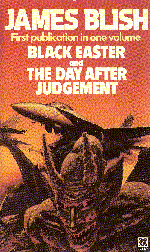
in Volume II, (a) Black Easter and (b) The Day After Judgement (contemporary fantasies), magicians release and cannot recall demons who then wage and win Armageddon;
in Volume III, A Case Of Conscience (futuristic sf), experiences on an extra-solar planet oblige a Jesuit biologist to ask heretical questions about the relative powers of God and Satan and to fear an imminent Armageddon.
The Trilogy is thematic, not linear, so it does not matter that Armageddon happens in the late twentieth century yet is still to happen in the mid-twenty first century - although this discrepancy might be resolved by the conclusion of The Day After Judgement, when Satan/God undoes (at least some of) the damage caused by the conflict in order to initiate a long development of mankind towards Godhood. This development could still be occurring in Volume III although, as was the case after the Armageddon in Volume II, the characters' mind-sets have not progressed yet.
The unifying theme of the Trilogy is the question whether the desire for secular knowledge is evil. Blish, like Anderson or any other scientifically trained hard sf writer, answered "No" but he managed to write a Trilogy about the question.
Anderson addressed a single theme in different genres when he presented the original of Odin in a historical novel, a time traveller mistaken for Odin in an sf story and Odin in three fantasy novels. However, this single theme does not make these works a single series. Instead, the contrasting treatments differentiate them as distinct works.
I was reminded of Black Easter, the definitive novel of demonic conjuration, when I read Anderson's account of Queen Skuld's ritual cursing in Hrolf Kraki's Saga. Pagan witchcraft was followed by Christian witchcraft which led, in Blish's fantasy, to Armageddon.
Showing posts with label Doctor Mirabilis. Show all posts
Thursday, 27 September 2012
Thursday, 6 September 2012
"Operation Changeling"
In Poul Anderson's Operation Chaos (New York, 1995), there is scientific proof of "...Divinity...absolute evil, atonement, and an afterlife..." but God has many partial manifestations so the religious options include Petrine Christianity, Johannine Christianity, mainstream Islam, the Muslim Caliphate sect and Unitarianism. (p. 137)
Are there some timelines with a hereafter and others without? If someone born in a timeline without a hereafter dies in a timeline with a hereafter, does s/he then enter that hereafter?
Because paraphysical forces work in the "Operation..." timeline, the 1960's message of love is preached by the "Johnnies," the Johannine Church, who believe that the age of the Holy Spirit is beginning. Readers of the works of Anderson's fellow fantasy, hard sf and historical fiction writer, James Blish, will remember, from Blish's historical novel, Doctor Mirabilis,that Roger Bacon, the founder of scientific method, was imprisoned as a Joachist schismatic because he believed that the Age of the Spirit had begun in 1261, seven hundred years earlier.
Bacon is referred back to both in Blish's contemporary fantasy novel, Black Easter, and in his futuristic end of the universe novel, The Triumph Of Time. Thus, Bacon becomes a sort of unofficial patron saint of science, hard sf and those falsely accused of practicing magic. Blish and Anderson resonate on several levels, the biggest difference being Anderson's bigger output.
Are there some timelines with a hereafter and others without? If someone born in a timeline without a hereafter dies in a timeline with a hereafter, does s/he then enter that hereafter?
Because paraphysical forces work in the "Operation..." timeline, the 1960's message of love is preached by the "Johnnies," the Johannine Church, who believe that the age of the Holy Spirit is beginning. Readers of the works of Anderson's fellow fantasy, hard sf and historical fiction writer, James Blish, will remember, from Blish's historical novel, Doctor Mirabilis,that Roger Bacon, the founder of scientific method, was imprisoned as a Joachist schismatic because he believed that the Age of the Spirit had begun in 1261, seven hundred years earlier.
Bacon is referred back to both in Blish's contemporary fantasy novel, Black Easter, and in his futuristic end of the universe novel, The Triumph Of Time. Thus, Bacon becomes a sort of unofficial patron saint of science, hard sf and those falsely accused of practicing magic. Blish and Anderson resonate on several levels, the biggest difference being Anderson's bigger output.
Subscribe to:
Posts (Atom)

