Gratillonius gives Mithras a bull on Lir's cliff under Taranis' sky during a thunderstorm and laughs at the Ysan Gods. One of his followers knows that:
"'Other Gods are angry.'"
-Poul and Karen Anderson, Dahut, Chapter VIII, section 3, p. 165.
-but another replies:
"'There is always war among Them.'" (ibid.)
"'...the common folk are with Grallon...is he not their wonderful King, on whose reign fortune has always smiled?'" (VII, section 4, p. 171)
For a politician, it is often enough to have the common people on his side, although not in the long run if his policies are economically or ecologically ruinous. Defiance of a literally existent Sea God is ecologically ruinous. James Blish's black magician says:
"'...the sciences don't accept that some of the forces of nature are Persons. Well, but some of them are. And without dealing with those Persons I shall never know any of the things I want to know.'"
-James Blish, After Such Knowledge (London, 1991), p. 365.
I find parallels between The King Of Ys and After Such Knowledge.
I wanted to find that statement by Theron Ware but had to reread a chunk of the book to find it but did so with pleasure.
Showing posts with label James Blish. Show all posts
Thursday, 19 May 2016
Thursday, 24 March 2016
Futures Reassess Pasts
HG Wells wrote history and future history: An Outline Of History and The Shape Of Things To Come are almost companion titles.
Olaf Stapledon's Last And First Men and Last Men In London are companion volumes. The first is a future history and the second is one Last Man's assessment of past history.
Poul Anderson's The Boat Of A Million Years combines historical sf with future history. As in James Blish's Cities In Flight, future history ceases to be generational when the characters become immortal but centuries continue to elapse nevertheless.
Anderson's Genesis summarizes past history before proceeding into a remote future. And that future restores primordial themes when a member of the new human race, perceiving artificial intelligences as gods and wizards, embarks on a Quest to help one AI against another. Meanwhile, the Terrestrial AI "emulates" (consciously simulates) historical periods and alternative histories.
Anderson's complete works include many historical fictions and fictional futures and several alternative histories.
According to Jerry Pournelle's and SM Stirling's "The Asteroid Queen," Marx, Charlemagne, Hitler and Brennan (the Belter who became a protector) were all members of the same ancient, secret, world-controlling Brotherhood. Not in our timeline! And maybe not in the Known Space timeline either? The Brotherhood suppresses knowledge and propagates:
"...slanted versions of past, present, and future." (Man-Kzin Wars V, p. 26) -
- so maybe it lies to itself about its own past?
Olaf Stapledon's Last And First Men and Last Men In London are companion volumes. The first is a future history and the second is one Last Man's assessment of past history.
Poul Anderson's The Boat Of A Million Years combines historical sf with future history. As in James Blish's Cities In Flight, future history ceases to be generational when the characters become immortal but centuries continue to elapse nevertheless.
Anderson's Genesis summarizes past history before proceeding into a remote future. And that future restores primordial themes when a member of the new human race, perceiving artificial intelligences as gods and wizards, embarks on a Quest to help one AI against another. Meanwhile, the Terrestrial AI "emulates" (consciously simulates) historical periods and alternative histories.
Anderson's complete works include many historical fictions and fictional futures and several alternative histories.
According to Jerry Pournelle's and SM Stirling's "The Asteroid Queen," Marx, Charlemagne, Hitler and Brennan (the Belter who became a protector) were all members of the same ancient, secret, world-controlling Brotherhood. Not in our timeline! And maybe not in the Known Space timeline either? The Brotherhood suppresses knowledge and propagates:
"...slanted versions of past, present, and future." (Man-Kzin Wars V, p. 26) -
- so maybe it lies to itself about its own past?
Sunday, 20 March 2016
Doomsday And Judgment
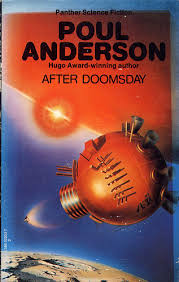
In Poul Anderson's After Doomsday, the crews of two interstellar spaceships have survived the genocidal sterilization of Earth. In James Blish's The Day After Judgement, mankind has survived a limited nuclear war. Thus, so far, two futuristic sf novels, each featuring a technological threat to all life on Earth. In Anderson's There Will Be Time, the civilization-destroying nuclear war is called the Judgment War. Thus, Anderson uses the terms "Doomsday" and "Judgment" in two similar secular contexts.
However, what I have not mentioned so far is that Blish's use of the term, "Judgment," is Biblical and apocalyptic. The nuclear exchange was just one aspect of Armageddon, which the demons have won. Thus, we are reading fantasy, not sf. On the other hand, it is what I have called "hard fantasy," reading very much like sf and, if its speculation that eternal life is full negative entropy were to be developed further, then it would return to the realm of sf with the angels and demons scientifically rationalized.
The Startegic Air Command attacks the demon fortress of Dis now manifested in the Valley of Death, Death Valley: science versus the supernatural, a concrete expression of the theme of Blish's After Such Knowledge Trilogy. Anderson presents scientific rationales of fantasy ideas in some works discussed recently on the blog.
However, what I have not mentioned so far is that Blish's use of the term, "Judgment," is Biblical and apocalyptic. The nuclear exchange was just one aspect of Armageddon, which the demons have won. Thus, we are reading fantasy, not sf. On the other hand, it is what I have called "hard fantasy," reading very much like sf and, if its speculation that eternal life is full negative entropy were to be developed further, then it would return to the realm of sf with the angels and demons scientifically rationalized.
The Startegic Air Command attacks the demon fortress of Dis now manifested in the Valley of Death, Death Valley: science versus the supernatural, a concrete expression of the theme of Blish's After Such Knowledge Trilogy. Anderson presents scientific rationales of fantasy ideas in some works discussed recently on the blog.
Earlier Empires
In Poul Anderson's History of Technic Civilization, Ythrians and Merseians get the hyperdrive from Terrans who invented it independently. However, it is known that there was a previous star traveling race and we learn that they were the telepathic Chereonites. How many such earlier races are there in sf? No doubt many. I think that there was a previous civilization in Ursula K Le Guin's future history although that is one that I have neither read recently nor reread.
We will refer to one other work by Anderson, four by Blish and one by Niven. In Anderson's After Doomsday, the FTL drive spreads like dandelion seeds among many intelligent species. It is not known whether it was discovered once or many times or by whom.
In James Blish's Cities In Flight, there have been four great civilizations in the Milky Way:
I ?;
II the Vegan Tyranny;
III the Earthman culture;
IV the Web of Hercules.
In Blish's Jack Loftus novels, the Heart Stars empire is much older than humanity and the energy beings called "Angels" knew several previous interstellar civilizations in other galaxies. (Blish, like Anderson, goes intergalactic a few times.) In Blish's "This Earth of Hours," the Terrestrial Matriarchy comes into conflict with an ancient telepathic Central Empire whereas, in his "A Style In Treason," High Earth's adversary, the Green Exarch, draws tithes from six fallen empires older than man.
In Larry Niven's Known Space History, the now extinct Thrintun ruled the galaxy three billion years ago and, like the Chereionites, left a telepathic legacy.
We will refer to one other work by Anderson, four by Blish and one by Niven. In Anderson's After Doomsday, the FTL drive spreads like dandelion seeds among many intelligent species. It is not known whether it was discovered once or many times or by whom.
In James Blish's Cities In Flight, there have been four great civilizations in the Milky Way:
I ?;
II the Vegan Tyranny;
III the Earthman culture;
IV the Web of Hercules.
In Blish's Jack Loftus novels, the Heart Stars empire is much older than humanity and the energy beings called "Angels" knew several previous interstellar civilizations in other galaxies. (Blish, like Anderson, goes intergalactic a few times.) In Blish's "This Earth of Hours," the Terrestrial Matriarchy comes into conflict with an ancient telepathic Central Empire whereas, in his "A Style In Treason," High Earth's adversary, the Green Exarch, draws tithes from six fallen empires older than man.
In Larry Niven's Known Space History, the now extinct Thrintun ruled the galaxy three billion years ago and, like the Chereionites, left a telepathic legacy.
Saturday, 19 March 2016
Parallel Histories II
Robert Heinlein's Prophets ban space flight but are overthrown by the Second American Revolution which establishes the Covenant.
Isaac Asimov's psychohistorians are unable to prevent the Fall of the Galactic Empire but plan to build a Second Empire in a thousand years. The Plan begins with a surviving center of civilization called the Foundation.
James Blish's Bureaucratic State bans space flight but cannot ban atomic research and is overthrown by the Exodus of the Cities after the independent rediscovery of antigravity. Flying cities overthrow the Vegan Tyranny and the Earth police suppress interstellar empires.
The Psychotechnic Institute of Poul Anderson's Solar Union is unable to prevent the Second Dark Ages and the Coordination Service of his Stellar Union is unable to prevent the Third Dark Ages. Unions and Dark Ages are succeeded by several Empires, then by a Galactic civilization.
Anderson's Solar Commonwealth becomes a corporate state but declines and is unable to resist invasions by the Gorzuni, barbarian slavers. However, Manuel Argos leads a slave revolt and founds the Terran Empire. Later, Dominic Flandry is unable to prevent the Fall of the Terran Empire but ensures that several centers of civilization survive.
Larry Niven's UN Earth-Moon government bans technologies with military applications but then uses such technologies against the invading kzinti, carnivorous slavers. The UN survives.
Jerry Pournelle's CoDominium bans technologies with military applications but is unable to prevent the Patriotic Wars which devastate Earth. However, the Exodus of the Fleet leads to the Formation Wars and the founding of the First Empire of Man. The Secession Wars are followed by the Second Empire of Man.
Isaac Asimov's psychohistorians are unable to prevent the Fall of the Galactic Empire but plan to build a Second Empire in a thousand years. The Plan begins with a surviving center of civilization called the Foundation.
James Blish's Bureaucratic State bans space flight but cannot ban atomic research and is overthrown by the Exodus of the Cities after the independent rediscovery of antigravity. Flying cities overthrow the Vegan Tyranny and the Earth police suppress interstellar empires.
The Psychotechnic Institute of Poul Anderson's Solar Union is unable to prevent the Second Dark Ages and the Coordination Service of his Stellar Union is unable to prevent the Third Dark Ages. Unions and Dark Ages are succeeded by several Empires, then by a Galactic civilization.
Anderson's Solar Commonwealth becomes a corporate state but declines and is unable to resist invasions by the Gorzuni, barbarian slavers. However, Manuel Argos leads a slave revolt and founds the Terran Empire. Later, Dominic Flandry is unable to prevent the Fall of the Terran Empire but ensures that several centers of civilization survive.
Larry Niven's UN Earth-Moon government bans technologies with military applications but then uses such technologies against the invading kzinti, carnivorous slavers. The UN survives.
Jerry Pournelle's CoDominium bans technologies with military applications but is unable to prevent the Patriotic Wars which devastate Earth. However, the Exodus of the Fleet leads to the Formation Wars and the founding of the First Empire of Man. The Secession Wars are followed by the Second Empire of Man.
Tuesday, 15 March 2016
Collaborative Fiction
Thus, when Robert Heinlein had written about a "generation ship" (a slower than light multi-generation interstellar spaceship), then so did Poul Anderson, Brian Aldiss and Clifford Simak. Aldiss even said, in a conversation at Eastercon 1970, "I thought I could do it better!"
Much later, collaboration was institutionalized:
"The franchise universe lives!"
-Larry Niven, Man-Kzin Wars II (London, 1991), p. vii.
Now, Poul Anderson, Jerry Pournelle, SM Stirling and others were able not only to write about militaristic, carnivorous, feline aliens but also to call them kzinti. Anderson's Man-Kzin Wars stories are:
"Iron" (also here, here and here)
"Inconstant Star" (also here, here, here, here and here);
"Pele" (also here).
We have been following Jerry Pournelle and SM Stirling as to some extent successors of Poul Anderson so we might be interested in rereading their co-written Man-Kzin Wars stories. Since the first of these, "The Children's Hour," is 171 pages long, I regard it as a novel.
Alternative Pasts, Presents And Futures
Whereas a future history becomes an alternative history as it recedes into the past, an alternative history becomes a future history if it is extended into the future. Thus, SM Stirling's Protracted Struggle between the Alliance for Democracy and the Domination of the Draka parallels the various UN/US-USSR/Cold War/World War III scenarios that we listed recently. In Stirling's The Stone Dogs, as in James Blish's They Shall Have Stars, Earth becomes a dictatorship but a few political refugees escape from the Solar System.
In fact, various other discontented groups also leave the Solar System in:
Robert Heinlein's Methuselah's Children;
the Breakup period of Poul Anderson's Technic History;
Anderson's Rustum History, The Boat Of A Million Years and Harvest Of Stars;
the Great Exodus period of Jerry Pournelle's CoDominium History.
Stirling's The Peshawar Lancers is an alternative history novel set in 2025 but does not feature space travel because, like Anderson's Maurai History, it recounts recovery from a global disaster.
The Ransom Trilogy, CS Lewis' reply to Wells' and Stapledon's future histories, also addresses the history of the future. Issues concerning the future of mankind on Earth are resolved in Volume III. In Volume II, the future is prophesied. Ten thousand years hence, Maleldil, Malacandra, Tor-Oyarsa-Perelendri and many hnau and eldila will descend, destroy the Moon and liberate Thulcandra (Earth) from its present hidden rulers -
- and you cannot get any more alternative than that.
In fact, various other discontented groups also leave the Solar System in:
Robert Heinlein's Methuselah's Children;
the Breakup period of Poul Anderson's Technic History;
Anderson's Rustum History, The Boat Of A Million Years and Harvest Of Stars;
the Great Exodus period of Jerry Pournelle's CoDominium History.
Stirling's The Peshawar Lancers is an alternative history novel set in 2025 but does not feature space travel because, like Anderson's Maurai History, it recounts recovery from a global disaster.
The Ransom Trilogy, CS Lewis' reply to Wells' and Stapledon's future histories, also addresses the history of the future. Issues concerning the future of mankind on Earth are resolved in Volume III. In Volume II, the future is prophesied. Ten thousand years hence, Maleldil, Malacandra, Tor-Oyarsa-Perelendri and many hnau and eldila will descend, destroy the Moon and liberate Thulcandra (Earth) from its present hidden rulers -
- and you cannot get any more alternative than that.
Sunday, 13 March 2016
Interplanetary And Interstellar
Interplanetary Periods
Heinlein: The Green Hills Of Earth
Asimov: I, Robot
Blish: They Shall Have Stars
Anderson, Psychotechnic: The Psychotechnic League; Cold Victory
Anderson, Technic: "The Saturn Game"
Niven: the Garner/Hamilton period
Pournelle: (straight to interstellar)
Blish's four volumes are respectively interplanetary, interstellar, intergalactic and inter-cosmic. Anderson also goes intergalactic and inter-cosmic although not in his future histories.
It seems to require an extra leap of the imagination for sf writers to get outside the galaxy. Asimov only just starts to think about it at the end of his future history. Having populated the Galaxy only with human beings and with robots whose behavior is constrained by their relationship to human beings, he begins to ask whether there might be other kinds of intelligences in other galaxies.
Saturday, 12 March 2016
Barrier
I have been comparing Jerry Pournelle's CoDominium History to Poul Anderson's Technic History and to relevant works by Robert Heinlein and James Blish. So far, I have:
reread The Mote In God's Eye (with Larry Niven) although not agreed with Heinlein about it;
enjoyed rereading King David's Spaceship, which is recommended by Anderson;
appreciated the Prologue of The Mercenary and the future politics in the opening chapters.
However, I have encountered a barrier. The narrative suddenly jumps to Falkenberg, now a mercenary, on a colony planet with complicated social problems that I have not been able fully to engage with or get involved in. Pournelle is creating a political conflict so that Falkenberg will be able to apply military force to it. But, as CS Lewis and Brian Aldiss both said in different ways (see here), we do not go to other planets to find "The same old stuff we left behind..."
I remember a previous reading of The Mercenary and have also googled here and here. From these sources, I gather that:
the Falkenberg series has been collected and re-collected and now comprises a single compilation co-written by SM Stirling;
there are Patriotic Wars, Formation Wars, Secession Wars and a sub-series called "War World," which is longer and more complicated than I had realized;
the selling of military services becomes a major part of the interstellar economy;
unemployed populations make unreasonable demands on resources;
the view is expressed that such populations should be left to sink or swim;
Falkenberg orders a massacre.
I believe that the employed in an industrial/technological society can redirect production and resources away from warfare towards welfare which would mean the elimination of poverty whereas "Welfare" has come to mean its perpetuation and institutionalization! I might find myself too out of sync with the assumptions and ethos of Falkenberg and his colleagues to continue reading their history.
reread The Mote In God's Eye (with Larry Niven) although not agreed with Heinlein about it;
enjoyed rereading King David's Spaceship, which is recommended by Anderson;
appreciated the Prologue of The Mercenary and the future politics in the opening chapters.
However, I have encountered a barrier. The narrative suddenly jumps to Falkenberg, now a mercenary, on a colony planet with complicated social problems that I have not been able fully to engage with or get involved in. Pournelle is creating a political conflict so that Falkenberg will be able to apply military force to it. But, as CS Lewis and Brian Aldiss both said in different ways (see here), we do not go to other planets to find "The same old stuff we left behind..."
I remember a previous reading of The Mercenary and have also googled here and here. From these sources, I gather that:
the Falkenberg series has been collected and re-collected and now comprises a single compilation co-written by SM Stirling;
there are Patriotic Wars, Formation Wars, Secession Wars and a sub-series called "War World," which is longer and more complicated than I had realized;
the selling of military services becomes a major part of the interstellar economy;
unemployed populations make unreasonable demands on resources;
the view is expressed that such populations should be left to sink or swim;
Falkenberg orders a massacre.
I believe that the employed in an industrial/technological society can redirect production and resources away from warfare towards welfare which would mean the elimination of poverty whereas "Welfare" has come to mean its perpetuation and institutionalization! I might find myself too out of sync with the assumptions and ethos of Falkenberg and his colleagues to continue reading their history.
Some More Comparisons
Starting from Poul Anderson's eight (or nine) future histories, we have moved sideways in fictional time, finding interesting parallels with future history series by several other sf writers. Much of this discussion stays here on the Poul Anderson Appreciation blog because this is where it starts and because this is where page viewers come to. However, for further discussion of other future histories, please see the James Blish Appreciation and Science Fiction blogs, both linked to this one.
Here is another set of comparisons:
(i) In James Blish's Cities In Flight, Volume I, They Shall Have Stars, state security and secrecy stifle science whereas Jerry Pournelle's CoDominium goes even further by suppressing technologies with military applications, thus killing most research.
(ii) In Cities..., the USSR takes over the US whereas the CoDominium is a US-USSR alliance. I wondered where all the nationalism came from. It is a reaction against CD world domination. Blish's Bureaucratic State and its thought police go on to ban even fictional references to spaceflight as Unearthly Activities.
(iii) The CoDominium is succeeded by two interstellar Empires of Man. The Bureaucratic State is succeeded by some interstellar empires but mainly by the interstellar economy of the flying cities.
(iv) The CoDominium History culminates in First Contact with aliens whereas Cities... culminates in the mutual annihilation of two universes and the creation of several more:
"Creation began."
-James Blish, Cities In Flight (London, 1981), p. 596.
(v) Returning to our main man, Anderson shows cosmic beginnings in "Flight to Forever," Tau Zero and The Avatar whereas Pournelle concentrates on militarism - not an inherently science fictional theme.
Here is another set of comparisons:
(i) In James Blish's Cities In Flight, Volume I, They Shall Have Stars, state security and secrecy stifle science whereas Jerry Pournelle's CoDominium goes even further by suppressing technologies with military applications, thus killing most research.
(ii) In Cities..., the USSR takes over the US whereas the CoDominium is a US-USSR alliance. I wondered where all the nationalism came from. It is a reaction against CD world domination. Blish's Bureaucratic State and its thought police go on to ban even fictional references to spaceflight as Unearthly Activities.
(iii) The CoDominium is succeeded by two interstellar Empires of Man. The Bureaucratic State is succeeded by some interstellar empires but mainly by the interstellar economy of the flying cities.
(iv) The CoDominium History culminates in First Contact with aliens whereas Cities... culminates in the mutual annihilation of two universes and the creation of several more:
"Creation began."
-James Blish, Cities In Flight (London, 1981), p. 596.
(v) Returning to our main man, Anderson shows cosmic beginnings in "Flight to Forever," Tau Zero and The Avatar whereas Pournelle concentrates on militarism - not an inherently science fictional theme.
Friday, 11 March 2016
To Space, To Fight
Science fiction heroes usually go to space willingly although James Blish's Crispin DeFord is press ganged by an Okie city. Jerry Pournelle's John Falkemberg seems to be in the same boat as DeFord, shuffling forward in a line of involuntary transportees but this turns out to have been a mistake. The Bureau of Relocation is authorized only to transport Falkenberg to Lunar Base because he has been appointed to CoDominium Navy Service. Should "...gangland youth..." on p. 15 of The Mercenary (London, 1977) have read "gangling youth"?
Thus, he goes willingly not only to space but also to fight, like Robert Heinlein's Matt Dodson joining the Space Patrol or Poul Anderson's Dominic Flandry joining the Terran Space Navy. The CD Navy is more akin to the Patrol than to the Terran Navy because it is charged not with defending an interstellar empire but with preventing nuclear war on Earth.
As in several future histories, humanity must survive the near future threat of nuclear annihilation if it is to have any longer term future in the galaxy. Unfortunately, in this fictitious history, the legacy of that threat follows mankind into space.
Thus, he goes willingly not only to space but also to fight, like Robert Heinlein's Matt Dodson joining the Space Patrol or Poul Anderson's Dominic Flandry joining the Terran Space Navy. The CD Navy is more akin to the Patrol than to the Terran Navy because it is charged not with defending an interstellar empire but with preventing nuclear war on Earth.
As in several future histories, humanity must survive the near future threat of nuclear annihilation if it is to have any longer term future in the galaxy. Unfortunately, in this fictitious history, the legacy of that threat follows mankind into space.
Ten Near Futures
When I reflected that several American future histories are interconnected, I knew that Jerry Pournelle's CoDominium series was part of the mix but did not expect to get into it in any detail but it is worth the effort. After reading about -
Robert Heinlein's World Federation,
Isaac Asimov's economy- and ecology-controlling positronic Brains,
James Blish's spaceflight-banning Bureaucratic State, Port Authority and two alternative UN governments (four scenarios here),
Poul Anderson's Solar Union and Solar Commonwealth (in his first two future histories),
Larry Niven's UN and Belt governments (in his single future history) -
- we now read about Pournelle's CoDominium of the United States and the Sovier Union.
Here are ten parallel near future regimes each preceding later historical developments. Try to fit all that into a single multiverse. Starting point: we are told that Heinlein's Rhysling and Anderson's van Rijn both visit Anderson's Old Phoenix inn - but please disregard Heinlein's The Number Of The Beast.
Pournelle's John Falkenberg is a substantial character in and of himself and in recent posts I found that, for me, he faintly echoed a couple of Anderson's characters. Onward.
Robert Heinlein's World Federation,
Isaac Asimov's economy- and ecology-controlling positronic Brains,
James Blish's spaceflight-banning Bureaucratic State, Port Authority and two alternative UN governments (four scenarios here),
Poul Anderson's Solar Union and Solar Commonwealth (in his first two future histories),
Larry Niven's UN and Belt governments (in his single future history) -
- we now read about Pournelle's CoDominium of the United States and the Sovier Union.
Here are ten parallel near future regimes each preceding later historical developments. Try to fit all that into a single multiverse. Starting point: we are told that Heinlein's Rhysling and Anderson's van Rijn both visit Anderson's Old Phoenix inn - but please disregard Heinlein's The Number Of The Beast.
Pournelle's John Falkenberg is a substantial character in and of himself and in recent posts I found that, for me, he faintly echoed a couple of Anderson's characters. Onward.
Space And Stars
Starman Jones by Robert Heinlein
A Life for The Stars by James Blish
The Game Of Empire by Poul Anderson
The Mercenary by Jerry Pournelle
These are the titles of:
a Scribner Juvenile by Heinlein;
the one Okie juvenile novel by Blish;
a Technic History novel by Anderson;
a CoDominium future history volume by Pournelle.
These four works also have in common early references to space travel and to a teenage protagonist, the right hooks to catch a certain kind of reader. Personally, if I read the first page, then I will continue to read. Anderson's character Diana sits under the sun Patricius and two moons in a place where the population drifts "...in and out on the tides of space." (Flandry's Legacy, p. 195)
Pournelle's fifteen year old character, John Christian Falkenberg, is in a spaceport and is described as "...a gangland youth..."
-Jerry Pournelle, The Mercenary (London, 1977), p. 15.
Many people glancing at these opening pages will read no further but some of us want to know about the tides of space and to accompany Falkenberg into a spaceship. I already know about Diana Crowfeather but let's learn more about this gangland youth.
A Life for The Stars by James Blish
The Game Of Empire by Poul Anderson
The Mercenary by Jerry Pournelle
These are the titles of:
a Scribner Juvenile by Heinlein;
the one Okie juvenile novel by Blish;
a Technic History novel by Anderson;
a CoDominium future history volume by Pournelle.
These four works also have in common early references to space travel and to a teenage protagonist, the right hooks to catch a certain kind of reader. Personally, if I read the first page, then I will continue to read. Anderson's character Diana sits under the sun Patricius and two moons in a place where the population drifts "...in and out on the tides of space." (Flandry's Legacy, p. 195)
Pournelle's fifteen year old character, John Christian Falkenberg, is in a spaceport and is described as "...a gangland youth..."
-Jerry Pournelle, The Mercenary (London, 1977), p. 15.
Many people glancing at these opening pages will read no further but some of us want to know about the tides of space and to accompany Falkenberg into a spaceship. I already know about Diana Crowfeather but let's learn more about this gangland youth.
Friday, 4 March 2016
Isolated Planets
an interstellar civilization or "Empire";
a post-Imperial period during which colonized extrasolar planets, isolated for several generations, are gradually rediscovered and recivilized by the few worlds that have retained or regained the capacity for interstellar travel.
This second scenario, Star Trek without the absurdity of identically humanoid beings independently evolved on innumerable planets, exists in:
Isaac Asimov's Second Foundation;
James Blish's Cities In Flight;
the Long Night and Allied Planets periods of Poul Anderson's Technic History;
Jerry Pournelle's A Spaceship For The King, expanded as King David's Spaceship.
Poul Anderson describes fictional planets in detail and always makes clear that human colonists would require dietary supplements, imported ecologies, biological readjustments etc. Another planet is not just another continent.
Thursday, 3 March 2016
Important People
Structurally, a future history has an earlier period and a later period and the earlier period has a pivotal character or characters who are builders of the future:
in HG Wells' The Shape Of Things To Come, Gustave de Windt, author of Social Nucleation (1942);
in Robert Heinlein's Future History, DD Harriman, "The Man Who Sold The Moon";
in Isaac Asimov's future history, Susan Calvin, robopsychologist;
in James Blish's Cities in Flight, Senator Bliss Wagoner, secretly behind the spindizzy and the antiagathics;
in Blish's The Seedling Stars, Jacob Rullman, inventor of pantropy, the science of human adaptation to extraterrestrial environments;
in Blish's Haertel Scholium, Adolph Haertel and also Thor Wald, inventor of the Dirac transmitter;
in Poul Anderson's Psychotechnic History, Valti and Fourre;
in Anderson's Technic History, Nicholas van Rijn, leader of the independents in the Polesotechnic League, and David Falkayn, discoverer of Mirkheim and Founder of Avalon;
in Jerry Pournelle's CoDominium future history, John Christian Falkenberg, mercenary.
Wells' Philip Raven dreams an "Outline of the Future" whereas Asimov's Hari "Raven" Seldon predicts the future. Raven's dreamed text includes a chapter on Karl Marx and Henry George.
in HG Wells' The Shape Of Things To Come, Gustave de Windt, author of Social Nucleation (1942);
in Robert Heinlein's Future History, DD Harriman, "The Man Who Sold The Moon";
in Isaac Asimov's future history, Susan Calvin, robopsychologist;
in James Blish's Cities in Flight, Senator Bliss Wagoner, secretly behind the spindizzy and the antiagathics;
in Blish's The Seedling Stars, Jacob Rullman, inventor of pantropy, the science of human adaptation to extraterrestrial environments;
in Blish's Haertel Scholium, Adolph Haertel and also Thor Wald, inventor of the Dirac transmitter;
in Poul Anderson's Psychotechnic History, Valti and Fourre;
in Anderson's Technic History, Nicholas van Rijn, leader of the independents in the Polesotechnic League, and David Falkayn, discoverer of Mirkheim and Founder of Avalon;
in Jerry Pournelle's CoDominium future history, John Christian Falkenberg, mercenary.
Wells' Philip Raven dreams an "Outline of the Future" whereas Asimov's Hari "Raven" Seldon predicts the future. Raven's dreamed text includes a chapter on Karl Marx and Henry George.
Tuesday, 1 March 2016
Why Empires? III
Just under three years ago, I posted about "Space Secret Service Stories" here. "A Style In Treason" by James Blish and the early pulp magazine Dominic Flandry stories by Poul Anderson are good examples of works that are enjoyable to read but not presented as plausible futures.
Blish's High Earth-dominated confederation served - or betrayed? - by a thousand year old "Traitors' Guild" confronts an alien interstellar empire called the Green Exarchy which:
"...drew tithes from six fallen empires older than man..."
-James Blish, Anywhen (New York, 1970), p. 19.
Anderson's Terran Empire, served by the heroic Dominic Flandry, confronts the green Merseians with their interstellar Empire and plans for galactic conquest.
In these works at least, neither Blish nor Anderson seriously proposed empires as probable forms of interstellar government. They were instead exotic settings for futuristic adventures. "Earth" is not enough. It must become High Earth or Terra. The language is colorful and, coincidentally, both sets of villains are green. Or, rather, the Merseians, like ERB's Tharks and Dan Dare's Treens, are green whereas the mysterious Exarch is "Green."
"A Style In Treason," in particular, reads more like an alternative universe fantasy than like hard sf. However, despite Flandry's pulp origins, Anderson was able to transform the Flandry series into a serious dramatization of the reasons for the rise and decline of civilizations. The series matures with its hero.
Blish's High Earth-dominated confederation served - or betrayed? - by a thousand year old "Traitors' Guild" confronts an alien interstellar empire called the Green Exarchy which:
"...drew tithes from six fallen empires older than man..."
-James Blish, Anywhen (New York, 1970), p. 19.
Anderson's Terran Empire, served by the heroic Dominic Flandry, confronts the green Merseians with their interstellar Empire and plans for galactic conquest.
In these works at least, neither Blish nor Anderson seriously proposed empires as probable forms of interstellar government. They were instead exotic settings for futuristic adventures. "Earth" is not enough. It must become High Earth or Terra. The language is colorful and, coincidentally, both sets of villains are green. Or, rather, the Merseians, like ERB's Tharks and Dan Dare's Treens, are green whereas the mysterious Exarch is "Green."
"A Style In Treason," in particular, reads more like an alternative universe fantasy than like hard sf. However, despite Flandry's pulp origins, Anderson was able to transform the Flandry series into a serious dramatization of the reasons for the rise and decline of civilizations. The series matures with its hero.
Saturday, 27 February 2016
Uniqueness
My two favorite kinds of science fiction are time travel and future history series: Wells and Heinlein.
Time Travel
There are two fundamental premises: the past either can or cannot be changed. Poul Anderson systematically examines both. In The Corridors Of Time and There Will Be Time, rival groups wage war throughout an immutable timeline by changing the significance of known events whereas, in the Time Patrol series, an organization prevents change in a mutable timeline.
Future History Series
Robert Heinlein wrote one Future History, although five early Scribner Juveniles share a background with each other and with the "Green Hills of Earth" period of the Future History. Thus, these five novels might count as a "Juvenile Future History."
James Blish wrote a four novel future history, Cities In Flight, a four story future history, The Seedling Stars, and the non-linear Haertel Scholium containing three distinct future historical sequences.
Larry Niven has the Known Space and the State/Smoke Ring histories.
I think that other future historians have one series each except Anderson who has at least eight. I am here counting the single novel, Genesis, as a series because its successive chapters cover geological ages. Anderson moves away from histories with FTL, aliens and interstellar empires towards histories with STL, no aliens and human/AI interactions.
These thorough treatments of time travel and future histories make Anderson unique among sf writers.
Time Travel
There are two fundamental premises: the past either can or cannot be changed. Poul Anderson systematically examines both. In The Corridors Of Time and There Will Be Time, rival groups wage war throughout an immutable timeline by changing the significance of known events whereas, in the Time Patrol series, an organization prevents change in a mutable timeline.
Future History Series
Robert Heinlein wrote one Future History, although five early Scribner Juveniles share a background with each other and with the "Green Hills of Earth" period of the Future History. Thus, these five novels might count as a "Juvenile Future History."
James Blish wrote a four novel future history, Cities In Flight, a four story future history, The Seedling Stars, and the non-linear Haertel Scholium containing three distinct future historical sequences.
Larry Niven has the Known Space and the State/Smoke Ring histories.
I think that other future historians have one series each except Anderson who has at least eight. I am here counting the single novel, Genesis, as a series because its successive chapters cover geological ages. Anderson moves away from histories with FTL, aliens and interstellar empires towards histories with STL, no aliens and human/AI interactions.
These thorough treatments of time travel and future histories make Anderson unique among sf writers.
Flying Mountains
In Larry Niven's and Jerry Pournelle's The Mote In God's Eye (London, 1959), an asteroid is described as a "...flying mountain." (p. 159) This evokes yet another Poul Anderson future history, although not one of the sequence of seven: Tales Of The Flying Mountains.
In ...Mountains, as in James Blish's Cities In Flight future history, space technology is based on control of gravity although in this case such technology facilitates asteroidal colonization but does not lead to an FTL drive.
I identified six future historical themes:
(i) near future technological advances and social changes;
(ii) a period of interplanetary travel;
(iii) an FTL drive;
(iv) extrasolar colonization;
(v) interstellar imperialism;
(vi) the rise and fall of civilizations -
- while acknowledging that not every future history addresses all of these themes. In fact, ...Mountains can alternatively be summarized as follows:
(i) and (ii) as above;
(iii) an STL drive;
(iv) the first extrasolar colonists still in flight.
...Mountains focuses on (ii) the interplanetary period and thus parallels:
Heinlein's The Green Hills Of Earth;
Asimov's I, Robot;
Blish's They Shall Have Stars;
Niven's Lucas Garner/Gil the Arm stories.
Anderson's other future histories also diverge from the (i)-(vi) model by omitting (iii) FTL and (v) interstellar imperialism.
In ...Mountains, as in James Blish's Cities In Flight future history, space technology is based on control of gravity although in this case such technology facilitates asteroidal colonization but does not lead to an FTL drive.
I identified six future historical themes:
(i) near future technological advances and social changes;
(ii) a period of interplanetary travel;
(iii) an FTL drive;
(iv) extrasolar colonization;
(v) interstellar imperialism;
(vi) the rise and fall of civilizations -
- while acknowledging that not every future history addresses all of these themes. In fact, ...Mountains can alternatively be summarized as follows:
(i) and (ii) as above;
(iii) an STL drive;
(iv) the first extrasolar colonists still in flight.
...Mountains focuses on (ii) the interplanetary period and thus parallels:
Heinlein's The Green Hills Of Earth;
Asimov's I, Robot;
Blish's They Shall Have Stars;
Niven's Lucas Garner/Gil the Arm stories.
Anderson's other future histories also diverge from the (i)-(vi) model by omitting (iii) FTL and (v) interstellar imperialism.
Star Trek And The Future Histories
David Birr explains this bizarre cover image in a comment here.
Star Trek TV series, films and novels have become a future history and a cultural reference point. When I told a friend about a "reality storm" in Neil Gaiman's The Sandman, he remarked that that sounded like something out of Star Trek, then laughed when I told him that one of the characters had said that that sounded like something out of Star Trek.
A narrator in Robert Heinlein's The Number Of The Beast compares the bridge of Lazarus Long's spaceship to the bridge of the Enterprise - although I would prefer not to refer to The Number Of The Beast.
Isaac Asimov scientifically advised Star Trek. James Blish adapted episodes as short stories and wrote the first Star Trek novel. At a Memorial evening for James Blish in London, Charles Monteith of Faber and Faber described Blish's Cities in Flight future history as "a higher and greater Star Trek."
Larry Niven adapted a Known Space story as a Star Trek animated episode. Niven and Jerry Pournelle place a Chief Engineer from New Scotland on a Navy spaceship and say that this ethnicity is common among Engineers.
If Kirk were in Intelligence and Vulcan were in the Klingon Empire, then Star Trek would parallel Poul Anderson's Flandry series. Many sf stories about spaceship crews exploring extrasolar planets could be adapted as Star Trek episodes.
Addendum: Are Moties like intelligent tribbles?
Star Trek TV series, films and novels have become a future history and a cultural reference point. When I told a friend about a "reality storm" in Neil Gaiman's The Sandman, he remarked that that sounded like something out of Star Trek, then laughed when I told him that one of the characters had said that that sounded like something out of Star Trek.
A narrator in Robert Heinlein's The Number Of The Beast compares the bridge of Lazarus Long's spaceship to the bridge of the Enterprise - although I would prefer not to refer to The Number Of The Beast.
Isaac Asimov scientifically advised Star Trek. James Blish adapted episodes as short stories and wrote the first Star Trek novel. At a Memorial evening for James Blish in London, Charles Monteith of Faber and Faber described Blish's Cities in Flight future history as "a higher and greater Star Trek."
Larry Niven adapted a Known Space story as a Star Trek animated episode. Niven and Jerry Pournelle place a Chief Engineer from New Scotland on a Navy spaceship and say that this ethnicity is common among Engineers.
If Kirk were in Intelligence and Vulcan were in the Klingon Empire, then Star Trek would parallel Poul Anderson's Flandry series. Many sf stories about spaceship crews exploring extrasolar planets could be adapted as Star Trek episodes.
Addendum: Are Moties like intelligent tribbles?
Friday, 26 February 2016
A Vast Space
I am mentally hovering over a vast conceptual space occupied by seven future histories written by six American sf authors. Beginning with Poul Anderson's monumental History of Technic Civilization and his earlier, shorter but surprisingly substantial Psychotechnic History, we look back to Anderson's predecessors, Heinlein, Asimov and Blish, and forward to his successors, Niven and Pournelle.
There are other future historians and other future histories by Anderson. However, these seven series can be considered as a group because four were edited by John W Campbell, two were written by Anderson and the last two incorporate collaborative writing, including contributions by Anderson. Anderson's Psychotechnic History addresses Heinleinian immortality and multi-generation interstellar spaceships and Asimovian robots and predictive social science. Pournelle's future history culminates in two novels co-written by Niven, with advice from Heinlein.
This makes the seven series sound like a single series. However, they remain seven distinct timelines. Common themes are:
(i) near future technological advances and social changes;
(ii) a period of interplanetary travel;
(iii) an FTL drive;
(iv) extrasolar colonization;
(v) interstellar imperialism;
(vi) the rise and fall of civilizations.
Heinlein, leading the way, concentrated more on (i) and (ii), reaching (iii) and (iv) only at the end of his original five volume Future History. (I do not accept any later volumes as valid continuations.)
Within this larger context, let me address two specific issues within Niven and Pournelle's The Mote In God's Eye (London, 1979). On p. 16, First Lieutenant Cargill, complaining about Engineer Sinclair's exaggerated Scottish accent, accuses him of speaking normally when he gets excited whereas, on p. 92, Cargill says that he sometimes cannot understand Sinclair when the latter is excited. So which way round is it?
P. 32 informs us that tramline end points are far from large masses whereas p. 97 informs us that the Alderson Point (presumably the same thing?) to a large star is within the star. (A spaceship's force field enables it to enter the star.)
There are other future historians and other future histories by Anderson. However, these seven series can be considered as a group because four were edited by John W Campbell, two were written by Anderson and the last two incorporate collaborative writing, including contributions by Anderson. Anderson's Psychotechnic History addresses Heinleinian immortality and multi-generation interstellar spaceships and Asimovian robots and predictive social science. Pournelle's future history culminates in two novels co-written by Niven, with advice from Heinlein.
This makes the seven series sound like a single series. However, they remain seven distinct timelines. Common themes are:
(i) near future technological advances and social changes;
(ii) a period of interplanetary travel;
(iii) an FTL drive;
(iv) extrasolar colonization;
(v) interstellar imperialism;
(vi) the rise and fall of civilizations.
Heinlein, leading the way, concentrated more on (i) and (ii), reaching (iii) and (iv) only at the end of his original five volume Future History. (I do not accept any later volumes as valid continuations.)
Within this larger context, let me address two specific issues within Niven and Pournelle's The Mote In God's Eye (London, 1979). On p. 16, First Lieutenant Cargill, complaining about Engineer Sinclair's exaggerated Scottish accent, accuses him of speaking normally when he gets excited whereas, on p. 92, Cargill says that he sometimes cannot understand Sinclair when the latter is excited. So which way round is it?
P. 32 informs us that tramline end points are far from large masses whereas p. 97 informs us that the Alderson Point (presumably the same thing?) to a large star is within the star. (A spaceship's force field enables it to enter the star.)
Subscribe to:
Comments (Atom)