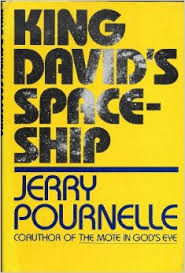
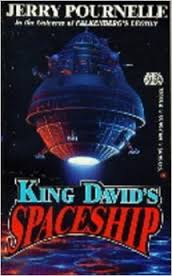
In Poul Anderson's Terran Empire, we expect - and find - immense diversity of religious traditions. Of course, this is helped by diversity of intelligent species. Some human members of Avalonian choths even practice the Ythrian Old Faith.
Jerry Pournelle's Second Empire of Man seems lass diverse. So far, I have found only Catholicism, Islam and (new) Himmism. Of course, this timeline so far has only one nonhuman intelligent species, not discovered until 3017. In fact, it was an effect of Motie technology that indirectly caused the founding of the Church of Him.
Protestantism seems to have disappeared. Churches separated for centuries have few doctrinal disagreements. When McKinnie installs a missionary Bishop in the Temple on Makassar, the Bishop styles himself "...His Ultimate Holiness, Primate of all Makassar, Vicar of Christ, and Archbishop of New Rome." (King David's Spaceship, p. 224) Surely those last two titles apply exclusively to His Holiness of New Rome?
The Bishop would say, and I think somewhere does say, that he has come for the good of men's souls. Many would respond simply that they believe neither in souls nor in any other supernatural entities such as a deity. So far, I agree with them. However, I also think that any society benefits from access to teachings about the value of reflection on mental states and motivations. This need not be linked to belief in the literal existence of supernatural beings although such beings remain central to much mythology, art, literature and fiction. I would not join the Bishop's flock but would welcome debate with him.
Showing posts with label King David's Spaceship. Show all posts
Tuesday, 8 March 2016
Heroes
"...stone figures, representing heroes of an Empire dead so long its very existence was legend, stared down at them."
-Jerry Pournelle, King David's Spaceship (London, 1984), p. 198.
The Old Empire ended three hundred and sixteen years previously, long enough ago to generate some legends. We know from a list given in the following volume that those "heroes" are a mixed bunch:
Caesar
Ivan the Terrible (the first Tsar)
Napoleon
Churchill
Stalin
Washington
Jefferson
Trotsky
Even the fact that the First Empire was preceded by a CoDominium of the United States and the Soviet Union does not account for the inclusion of both Stalin and Trotsky on the same list.
Poul Anderson's Terran Empire, basing itself primarily on the Roman Empire, does not require such ideological obfuscation of past history. Its heroes might be:
Aeneas
Romulus
Caesar
Augustus
Virgil
Argos
-Jerry Pournelle, King David's Spaceship (London, 1984), p. 198.
The Old Empire ended three hundred and sixteen years previously, long enough ago to generate some legends. We know from a list given in the following volume that those "heroes" are a mixed bunch:
Caesar
Ivan the Terrible (the first Tsar)
Napoleon
Churchill
Stalin
Washington
Jefferson
Trotsky
Even the fact that the First Empire was preceded by a CoDominium of the United States and the Soviet Union does not account for the inclusion of both Stalin and Trotsky on the same list.
Poul Anderson's Terran Empire, basing itself primarily on the Roman Empire, does not require such ideological obfuscation of past history. Its heroes might be:
Aeneas
Romulus
Caesar
Augustus
Virgil
Argos
Monday, 7 March 2016
Wedge II
"The army was formed as a wedge, spear and shield soldiers at the edges, the cavalry, archers, and supply wagons inside."
-Jerry Pournelle, King David's Spaceship (London, 1984), pp. 185-186.
Such a small disciplined wedge is able to sally forth from a besieged city, out into the midst of vastly greater numbers of besieging barbarians, to kill the besiegers in great numbers without being overwhelmed by them and to return to the safety of the city. The above link to a post about a Poul Anderson heroic fantasy novel reveals that, mythologically speaking, it was Odin who taught this military formation to mankind.
Am I interested in learning military tactics? Personally, not very. However, as with the seamanship in Chapter Twelve, it is always interesting to read an account of skilled activities by a writer who understands them. And it is good to see the demoralized men of a besieged city win a new kind of collective confidence.
-Jerry Pournelle, King David's Spaceship (London, 1984), pp. 185-186.
Such a small disciplined wedge is able to sally forth from a besieged city, out into the midst of vastly greater numbers of besieging barbarians, to kill the besiegers in great numbers without being overwhelmed by them and to return to the safety of the city. The above link to a post about a Poul Anderson heroic fantasy novel reveals that, mythologically speaking, it was Odin who taught this military formation to mankind.
Am I interested in learning military tactics? Personally, not very. However, as with the seamanship in Chapter Twelve, it is always interesting to read an account of skilled activities by a writer who understands them. And it is good to see the demoralized men of a besieged city win a new kind of collective confidence.
Battle On The Sand
Poul Anderson's Time Patrol series refers to seafarers, spacefarers and timefarers. In 976 BC, a battle at sea involves one contemporary ship and several far future timecycles. See here.
If space travelers colonize terrestroid planets, then those planets will have seas and seafarers. Anderson describes extrasolar battles at sea here and here.
Chapter Twelve of Jerry Pournelle's King David's Spaceship makes clear that its author understands sailing. Elsewhere, Pournelle tells us how he enlisted Poul Anderson as crew for his ocean racing sloop. (See Jerry Pournelle, "An Appreciation of Poul Anderson" IN Greg Bear and Gardner Dozois, Editors, Multiverse: Exploring Poul Anderson's Worlds (Burton MI, 2014), pp. 277-283 AT p. 280.)
Introducing superior sailing techniques to the backward planet, Makassar, the Samualites in their ship, Subao, outrun all but one of a pirate fleet. Makassar's two small close moons cause strong tides. Thus, when the tide races out of a shallow bay, Subao and her single remaining pursuer run aground and the two crews fight on the sand with swords, lances and crossbows. Subao has the advantage of two horsemen. When the tide returns in a single wave, one horseman gallops close enough to the pirates' ship to cut their anchor line so that their ship is cast onto the rocks.
If space travelers colonize terrestroid planets, then those planets will have seas and seafarers. Anderson describes extrasolar battles at sea here and here.
Chapter Twelve of Jerry Pournelle's King David's Spaceship makes clear that its author understands sailing. Elsewhere, Pournelle tells us how he enlisted Poul Anderson as crew for his ocean racing sloop. (See Jerry Pournelle, "An Appreciation of Poul Anderson" IN Greg Bear and Gardner Dozois, Editors, Multiverse: Exploring Poul Anderson's Worlds (Burton MI, 2014), pp. 277-283 AT p. 280.)
Introducing superior sailing techniques to the backward planet, Makassar, the Samualites in their ship, Subao, outrun all but one of a pirate fleet. Makassar's two small close moons cause strong tides. Thus, when the tide races out of a shallow bay, Subao and her single remaining pursuer run aground and the two crews fight on the sand with swords, lances and crossbows. Subao has the advantage of two horsemen. When the tide returns in a single wave, one horseman gallops close enough to the pirates' ship to cut their anchor line so that their ship is cast onto the rocks.
Makassar And Altai
Jerry Pournelle's colonized planet, Makassar, reminds me of Poul Anderson's colonized planet, Altai.
On Makassar:
horses and cattle, imported during the First Empire, run wild on the plains where they are hunted by predators unless protected by men;
some maris (barbarians) both ride and eat the moose-like native ayuks which live on the seven-inch-long, egg-laying hive-rats;
wood- and plant-eating hive-rats are not carnivorous but are vicious when trapped and hundreds will help one that is wounded;
most, though not all, native animal life is humanly edible, although lacking in essential vitamins, but native plants are metal-storing, therefore poisonous to human beings - the animals separate out the metal;
the maris, dependent on their ayuks, must move around the plains as the ayuks eat all the hive-rats in each locality.
"'It must be true, as the priests say, we came here from another star long ago, else why would God have put us where we cannot eat?'"
-Jerry Pournelle, King David's Spaceship (London, 1984), p. 108.
This reasoning, theistically expressed, is essentially correct. Human beings could not have evolved in an environment where they were unable to eat the plants.
On Makassar:
horses and cattle, imported during the First Empire, run wild on the plains where they are hunted by predators unless protected by men;
some maris (barbarians) both ride and eat the moose-like native ayuks which live on the seven-inch-long, egg-laying hive-rats;
wood- and plant-eating hive-rats are not carnivorous but are vicious when trapped and hundreds will help one that is wounded;
most, though not all, native animal life is humanly edible, although lacking in essential vitamins, but native plants are metal-storing, therefore poisonous to human beings - the animals separate out the metal;
the maris, dependent on their ayuks, must move around the plains as the ayuks eat all the hive-rats in each locality.
"'It must be true, as the priests say, we came here from another star long ago, else why would God have put us where we cannot eat?'"
-Jerry Pournelle, King David's Spaceship (London, 1984), p. 108.
This reasoning, theistically expressed, is essentially correct. Human beings could not have evolved in an environment where they were unable to eat the plants.
Sunday, 6 March 2016
The Technic And CoDominium Histories
Approximate Parallels?
(i) The hyperdrive; the Alderson Drive.
(ii) The Breakup; the Great Exodus.
(iii) The Solar Commonwealth; the CoDominium.
(iv) Falkayn; Falkenberg.
(v) The Time of Troubles; the Great Patriotic Wars.
(vi) The Principate phase of the Terran Empire; proclamation of the Empire of Man by Leonidas I of Sparta.
(vii) Civil war; Secession Wars.
(viii) The Dominate phase; proclamation of the Second Empire by Leonidas IV of Sparta.
(ix) Isolated colonized planets like Altai and Makassar.
(x) Fall of Empire, Long Night and later civilizations; no equivalents as yet.
Having enjoyed the Technic History, but also reread it several times by now, it is good to find something similar and enjoyable. Of the CoDominium History volumes that I have read so far, my definite favorite is King David's Spaceship.
(i) The hyperdrive; the Alderson Drive.
(ii) The Breakup; the Great Exodus.
(iii) The Solar Commonwealth; the CoDominium.
(iv) Falkayn; Falkenberg.
(v) The Time of Troubles; the Great Patriotic Wars.
(vi) The Principate phase of the Terran Empire; proclamation of the Empire of Man by Leonidas I of Sparta.
(vii) Civil war; Secession Wars.
(viii) The Dominate phase; proclamation of the Second Empire by Leonidas IV of Sparta.
(ix) Isolated colonized planets like Altai and Makassar.
(x) Fall of Empire, Long Night and later civilizations; no equivalents as yet.
Having enjoyed the Technic History, but also reread it several times by now, it is good to find something similar and enjoyable. Of the CoDominium History volumes that I have read so far, my definite favorite is King David's Spaceship.
Saturday, 5 March 2016
Aeneas And Prince Samual's World
Aeneas and Prince Samual's World are two princely names. Aeneas was a prince of Troy and ancestor of Romulus, the founder of Rome, the new Troy. Poul Anderson's character, Manuel Argos, founder of the Terran Empire, modeled his Empire on that of Rome. The planet Aeneas, after rebelling against the Argolid Empire, is occupied by Terran forces and administered by High Commissioner Desai.
In Jerry Pournelle's King David's Spaceship, the planet, Prince Samual's World, is incorporated into the Second Empire of Man and administered by High Commissioner Ackoff who lets a local dynasty believe that they will control a unified planet even though he knows that power will inevitably shift towards the imported Traders, technicians, diplomatic personnel and civil servants.
Thus, Pournelle, like Anderson, describes a plausibly complicated society on a colonized planet. Both planets have a University but Prince Samual's World is technologically backward.
In Jerry Pournelle's King David's Spaceship, the planet, Prince Samual's World, is incorporated into the Second Empire of Man and administered by High Commissioner Ackoff who lets a local dynasty believe that they will control a unified planet even though he knows that power will inevitably shift towards the imported Traders, technicians, diplomatic personnel and civil servants.
Thus, Pournelle, like Anderson, describes a plausibly complicated society on a colonized planet. Both planets have a University but Prince Samual's World is technologically backward.
Worlds Of War
(Sean M Brook's "Andersonian Themes and Tropes," which had remained on the top of our list for a week, is still with us here and can also be found on the companion blog here.)
(I have found confirmation that the Imperial Church in Jerry Pournelle's Second Empire of Man has not only a New Rome and Cardinals but also a Pope. There is a reference to "His Holiness" on p. 69 of King David's Spaceship (London, 1984).)
Poul Anderson writes extremely well, although not exclusively, about war. With some other writers, it is a more central theme. How can space travelers visit a planet where human beings wear armor and fight with swords? Quite easily. In King David's Spaceship -
Interstellar Secession Wars destroyed the Old Empire. In that Empire, Makassar had been a park world with few machines or power installations. The planet was bombarded, then isolated. Its few surviving former service workers were unable to build a sophisticated civilization. Native vegetation is inedible and Earth Stock crops require constant attention.
This determines a social structure:
cultivators;
barbarian raiders;
warriors to protect the cultivators;
military aristocrats unwilling to work in the fields and in any case fully occupied with fighting barbarians and each other;
constant warfare between barbarians, baronies and some cities.
A plausible rationale for continuing to write about warfare.
(I have found confirmation that the Imperial Church in Jerry Pournelle's Second Empire of Man has not only a New Rome and Cardinals but also a Pope. There is a reference to "His Holiness" on p. 69 of King David's Spaceship (London, 1984).)
Poul Anderson writes extremely well, although not exclusively, about war. With some other writers, it is a more central theme. How can space travelers visit a planet where human beings wear armor and fight with swords? Quite easily. In King David's Spaceship -
Interstellar Secession Wars destroyed the Old Empire. In that Empire, Makassar had been a park world with few machines or power installations. The planet was bombarded, then isolated. Its few surviving former service workers were unable to build a sophisticated civilization. Native vegetation is inedible and Earth Stock crops require constant attention.
This determines a social structure:
cultivators;
barbarian raiders;
warriors to protect the cultivators;
military aristocrats unwilling to work in the fields and in any case fully occupied with fighting barbarians and each other;
constant warfare between barbarians, baronies and some cities.
A plausible rationale for continuing to write about warfare.
Friday, 4 March 2016
Maps
As Brian Aldiss wrote somewhere, sf writers work hard for a living. A mainstream author writes a novel about a set of characters whereas an sf author devises a planetary system with its orbits, ecologies, life forms, inhabitants, societies etc, then writes a novel about a set of characters living in or visiting that system.
Poul Anderson's The Game Of Empire begins with maps of the Patrician System and of different areas on the surfaces of its two colonized planets. See here. Studying these maps enhances enjoyment of the novel and shows us how much work was put into devising the system. There are places that the characters do not visit where further stories could be set.
Jerry Pournelle's King David's Spaceship begins with maps of the planets, Prince Samual's World and Makassar. These have to be, and are, different from Earth and from each other. Again, we see the scenes of the action and also other places that are mentioned in the background information.
In both cases, these planets are made to seem like real places but are encountered only in this one novel whereas many other planets are presented in earlier and later volumes of the same future history. That is a lot of creative work.
Poul Anderson's The Game Of Empire begins with maps of the Patrician System and of different areas on the surfaces of its two colonized planets. See here. Studying these maps enhances enjoyment of the novel and shows us how much work was put into devising the system. There are places that the characters do not visit where further stories could be set.
Jerry Pournelle's King David's Spaceship begins with maps of the planets, Prince Samual's World and Makassar. These have to be, and are, different from Earth and from each other. Again, we see the scenes of the action and also other places that are mentioned in the background information.
In both cases, these planets are made to seem like real places but are encountered only in this one novel whereas many other planets are presented in earlier and later volumes of the same future history. That is a lot of creative work.
Changing Identities
How would you like to change your identity, nationality and profession? Some fictional immortals regularly do this over the centuries, either faking their deaths or simply departing and never returning, as appropriate. One of Poul Anderson's immortals, competent but unadventurous, is content to remain a record-keeper in successive civilizations.
Thanks to boosterspice, a character in Larry Niven's Known Space future history works for a normal life span on Earth, then goes in cold sleep to an extrasolar colony to begin a second career in a different profession there - although not also to change his identity.
Changing identities must be a feature of Intelligence work although Anderson's Dominic Flandry retains the same name and character throughout his career. He does sometimes play different roles and even changes his face once although that is merely a cosmetic exercise - one that would necessitate a change of actors if the Flandry series were filmed.
In Jerry Pournelle's King David's Spaceship, it is recorded that Colonel Nathan MacKinnie fought against the forces of King David at Lechfeld, surrendered to them after the battle and died of his wounds a few weeks later. Shortly after that, Trader Jameson MacKinnie manages King David's shares of an interstellar expedition. Imagine that: setting off with a new first name, a different profession and a new set of acquaintances. However, MacKinnie really goes as a spy. Intelligence is a branch of military work. Spies are soldiers out of uniform.
Thanks to boosterspice, a character in Larry Niven's Known Space future history works for a normal life span on Earth, then goes in cold sleep to an extrasolar colony to begin a second career in a different profession there - although not also to change his identity.
Changing identities must be a feature of Intelligence work although Anderson's Dominic Flandry retains the same name and character throughout his career. He does sometimes play different roles and even changes his face once although that is merely a cosmetic exercise - one that would necessitate a change of actors if the Flandry series were filmed.
In Jerry Pournelle's King David's Spaceship, it is recorded that Colonel Nathan MacKinnie fought against the forces of King David at Lechfeld, surrendered to them after the battle and died of his wounds a few weeks later. Shortly after that, Trader Jameson MacKinnie manages King David's shares of an interstellar expedition. Imagine that: setting off with a new first name, a different profession and a new set of acquaintances. However, MacKinnie really goes as a spy. Intelligence is a branch of military work. Spies are soldiers out of uniform.
Poul Anderson's Recommendation
"Jerry Pournelle at his best, with a colourful, fast-paced story that also gives the reader a great deal to think about."
POUL ANDERSON
-Jerry Pournelle, King David's Spaceship (London, 1984), back cover.
As when Anderson recommended SM Stirling's Under The Yoke, this is not empty praise but an accurate description of the book. The action moves quickly as MacKinnie is arrested by the secret police of his former enemies and pressed into the service of King David to face the common Imperial threat to their planet.
There are also colorful details:
"Stark looked around the chamber, noting the carved wooden furniture, and the crystalline rock formation patterns in the parts of the floor not covered by carpets woven in the Archipelago. 'Fancy quarters, uh, Trader, sir.'" (p. 43)
Fancy indeed. And a map shows us where Haven City and the Archipelago are on the surface of Prince Samual's World.
POUL ANDERSON
-Jerry Pournelle, King David's Spaceship (London, 1984), back cover.
As when Anderson recommended SM Stirling's Under The Yoke, this is not empty praise but an accurate description of the book. The action moves quickly as MacKinnie is arrested by the secret police of his former enemies and pressed into the service of King David to face the common Imperial threat to their planet.
There are also colorful details:
"Stark looked around the chamber, noting the carved wooden furniture, and the crystalline rock formation patterns in the parts of the floor not covered by carpets woven in the Archipelago. 'Fancy quarters, uh, Trader, sir.'" (p. 43)
Fancy indeed. And a map shows us where Haven City and the Archipelago are on the surface of Prince Samual's World.
Effects Of Isolation
On different planets in Poul Anderson's Technic History:
the meanings of words have changed so that communication problems cause conflicts with a newly arrived spaceship crew;
biology has changed so that, until they receive dietary help, males in one population can reach puberty only by practicing cannibalism and another population, exposed to high radiation, has become unable to interbreed with the rest of humanity;
psychology has changed so that an entire planetary population is saner than the human norm but goes collectively mad once a year.
"The Longest Voyage" and "Memory" are stories about isolated planets set outside the Technic History. In the former, a stranded astronaut is killed so that the isolated planetary population will be able to rediscover space technology for itself instead of losing its identity by being instantly absorbed into the interstellar civilization.
In Jerry Pournelle's King David's Spaceship, technology has declined so that a kingdom on Prince Samual's World must acquire a spaceship in order to be admitted to the Empire at a higher level.
Thus, four issues addressed are language, biology, psychology and technology.
the meanings of words have changed so that communication problems cause conflicts with a newly arrived spaceship crew;
biology has changed so that, until they receive dietary help, males in one population can reach puberty only by practicing cannibalism and another population, exposed to high radiation, has become unable to interbreed with the rest of humanity;
psychology has changed so that an entire planetary population is saner than the human norm but goes collectively mad once a year.
"The Longest Voyage" and "Memory" are stories about isolated planets set outside the Technic History. In the former, a stranded astronaut is killed so that the isolated planetary population will be able to rediscover space technology for itself instead of losing its identity by being instantly absorbed into the interstellar civilization.
In Jerry Pournelle's King David's Spaceship, technology has declined so that a kingdom on Prince Samual's World must acquire a spaceship in order to be admitted to the Empire at a higher level.
Thus, four issues addressed are language, biology, psychology and technology.
Isolated Planets
an interstellar civilization or "Empire";
a post-Imperial period during which colonized extrasolar planets, isolated for several generations, are gradually rediscovered and recivilized by the few worlds that have retained or regained the capacity for interstellar travel.
This second scenario, Star Trek without the absurdity of identically humanoid beings independently evolved on innumerable planets, exists in:
Isaac Asimov's Second Foundation;
James Blish's Cities In Flight;
the Long Night and Allied Planets periods of Poul Anderson's Technic History;
Jerry Pournelle's A Spaceship For The King, expanded as King David's Spaceship.
Poul Anderson describes fictional planets in detail and always makes clear that human colonists would require dietary supplements, imported ecologies, biological readjustments etc. Another planet is not just another continent.
Subscribe to:
Posts (Atom)