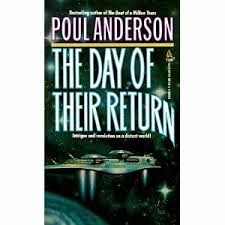
Showing posts with label The Day Of Their Return. Show all posts

Wednesday, 23 March 2016

Not Only Times But Also Places

A future history series should feature places where some of the characters live, work or spend time so that the reader vicariously experiences not only the passage of time, biographical, generational, historical - even geological and cosmological - but also a number of fully realized physical locations. History is temporal but historical events are spatiotemporal and sometimes contemporaneous. John Ridenour is on Freehold and Chunderban Desai is on Aeneas while Dominic Flandry pursues his career in Intelligence. Earlier, some Polesotechnic League stories had overlapped.

The Rebel Worlds introduces some locations on Aeneas, then most of The Day Of Their Return is set on that planet. Nicholas van Rijn has a penthouse in Chicago Integrate and Dominic Flandry has an apartment in Archopolis. However, these characters move around so much that what we get is a quick succession of places and planets although each of these is realized in detail. We see Flandry in his office at Intelligence Headquarters only once in his entire series.

In the Man-Kzin Wars series, Jerry Pournelle and SM Stirling take the trouble to establish the setting of Harold's Terran Bar which Anderson reuses. In one scene, we see this nightspot when it is empty in daylight. Only the proprietor and the bribe-accepting police chief meet and eat:

wurst;
egg and potato salad;
breads;
shrimp-on-rye;
gulyas soup -

- although the police chief has only a croissant and espresso. More for our food thread.

Sunday, 6 March 2016

Cosmenosis III

Sean Brooks asked me here whether I would agree with the philosophy of Cosmenosis as described in Poul Anderson's The Day Of Their Return. Before commenting afresh on this fictional philosophy, I searched the blog for "Cosmenosis" and the search result is here. (Scroll down.)

I will reread these earlier posts, then consider whether anything further needs to be said about Cosmenosis.

Addendum: I think that the earlier posts clarify where I would agree or disagree with Cosmenosis?

Saturday, 5 March 2016

Aeneas And Prince Samual's World

Aeneas and Prince Samual's World are two princely names. Aeneas was a prince of Troy and ancestor of Romulus, the founder of Rome, the new Troy. Poul Anderson's character, Manuel Argos, founder of the Terran Empire, modeled his Empire on that of Rome. The planet Aeneas, after rebelling against the Argolid Empire, is occupied by Terran forces and administered by High Commissioner Desai.

In Jerry Pournelle's King David's Spaceship, the planet, Prince Samual's World, is incorporated into the Second Empire of Man and administered by High Commissioner Ackoff who lets a local dynasty believe that they will control a unified planet even though he knows that power will inevitably shift towards the imported Traders, technicians, diplomatic personnel and civil servants.

Thus, Pournelle, like Anderson, describes a plausibly complicated society on a colonized planet. Both planets have a University but Prince Samual's World is technologically backward.

Aeneas

The text of this post is copied from here.

..a complicated colonial society. Seven centuries earlier, scientists wanting to study the unusual natives of the planet Dido which is unsuitable for human habitation colonized another planet in the same system, Aeneas, where they established a University that attracts human and non-human students from other systems. Survival in the sparse Aenean environment required cultivation of large land areas with both native and imported plants and animals. Horses and green six-legged stathas were imported as transport animals. During the Troubles, “Landfolk” relationships became semi-feudal and the University incorporated military training into its curriculum. Near the main University campus is a statue of Brian McCormac who cast out nonhuman invaders.

Later immigrants seeking a refuge or a new start are excluded from the tri-cameral legislature by a property qualification for the franchise but form subcultures: tinerans, Riverfolk, Orcans and highlanders. Orcans guard ruins left by space-traveling “Ancients.” “Lucks,” small pets kept in Tinerans’ caravans, are telepathic parasites left by the Ancients. Most Townfolk, belonging to ancient guilds, identify with scientists and squires. However, industrialization in the urban area known as the Web has produced manufacturers, merchants and managers whose interests are closer to those of the Empire which forcibly annexed Aeneas after the Troubles and re-occupied it after Hugh McCormac’s rebellion. Chunderban Desai, High Commissioner of the Virgilian system, consults Thane of the University and Jowett of the Web about McCormac’s Landfolk nephew who will inherit tri-cameral Speakership but meanwhile attacks Imperial troops, then hides among tinerans before traveling with Riverfolk to meet the new Orcan prophet.

I summarize Aenean society in order to convey the richness of detail in Anderson’s fictitious planets.

Thursday, 3 March 2016

Andersonian Themes and Tropes, by Sean M. Brooks

Dr. Paul Shackley's "Poul Anderson Appreciation Blog" focuses on the works of Poul Anderson.  And he has also discussed other writers whose own works he believes are appropriately compared to those of Anderson.  One of these writers is S.M. Stirling, whom Dr. Shackley rightly considers a worthy colleague and successor of Poul Anderson.  Mr. Stirling has sometimes left his own comments in the blog.  On January 30, 2016, in the combox for Dr. Shackley's "Wealth and Labor" piece, Stirling wrote: "It's pretty safe to assume themes and tropes from Poul's work carry over into mine--he was an inspiration, and we corresponded and occasionally visited for many years."

I have more than once found very Andersonian echoes, allusions, themes, tropes, and homages to Poul Anderson in Stirling's own works.  I felt the wish to point out some of these "echoes" myself.  For example,  one theme or trope to be found in both writers works is how they agreed all organized societies need to have SOME signs of respect or ceremonial for their leaders or states.  In Chapter 7 of Poul Anderson's novel THERE WILL BE TIME (Nelson-Doubleday: 1972, page 63) Caleb Wallis, Sachem of the Eyrie, said: "I am the founder and master of this nation.  We must have discipline, forms of respect.  I'm called 'sir.' "  Another example can be found in Chapter 7 of THE DAY OF THEIR RETURN (Nelson-Doubleday: 1973, page 54) after Tatiana Thane showed resentment at the idea of the planet Aeneas reestablishing its loyalty to the Terran Empire Commissioner Desai said: "The loyalty I speak of does not involve more than a few outward tokens of respect for the throne, as mere essential symbols.  It is loyalty to the Empire--above all, to its Pax, in an age when spacefleets can incinerate whole worlds and when the mutiny in fact took thousands of lives--it is that I mean, my lady.  It is that I am here about..."

Echoes and allusions of this Andersonian respect for due and proper ceremony can be found in Stirling's novel CONQUISTADOR (Roc: March 2004, pages 363 and 364), in Chapter Fourteen.  The Founder of the Commonwealth of New Virginia, John Rolfe VI, was formally greeted like this: "Adrienne stepped forward first, bowing low, taking his outstretched left hand in hers, and kissing it."  Then she said, in Italian: "Baciamo le mani."  Both Piet Botha and Roy Tully (with a slight shrug to Tom Christiansen by the latter) repeated the ceremony.  Tom felt embarassed and foolish, but he too performed the ritual.  The Chairman Emeritus, noticing Tom's discomfort said: "In any organized society there must be forms, gestures of respect. I am founder and master of this nation.  My fellow Virginian Washington followed a similar policy of emphasizing formal etiquette during his presidency, for much the same reason; I've often found his solutions useful when an analogous problem came up."  Notice how "I am founder and master of this nation" is nearly a word for word quote from THERE WILL BE TIME.  To say nothing of how close Stirling's "gestures of respect" is to Anderson's "forms of respect"!

In my letter of January 21, 1995 to Poul Anderson I discussed how the Later Roman Empire, in both West and East, developed increasingly elaborate and seemingly exaggerated gestures of respect for the Emperors. To such an extent that it seemed to me the Romans, even after they became Christians, gave their sovereigns virtually divine honors.  This disturbed me until I came across these texts in Thomas Hobbes LEVIATHAN (Collier Books: 1973), Chapter 45, on page 467: "The worship we exhibit for those we esteem to be but men, as to kings, and men in authority, is civil worship; but the worship we exhibit to that which we think to be God, whatsoever the words, ceremonies, gestures or other actions be, is divine worship.  To fall prostrate before a king, in him that thinks him but a man, is but civil worship: and he that putteth off his hat in the church, for this cause, that he thinketh it the house of God, worshippeth with divine worship."  And on page 469, in the same Chapter 45, I read: "To be uncovered, before a man of power and authority, before the throne of a prince, or in other such places as he ordaineth to that purpose in his absence, is to worship that man, or prince with civil worship; as being a sign, not of honouring the stool or place, but the person; and is not idolatry."

I then became convinced that the seemingly exaggerated respect shown by the Romans to their Emperors (or the New Virginians to their Chairmen) were merely gestures of respect meant to show patriotic loyalty to them. Which meant I could no longer scorn such rituals as the proskynesis or the kowtow.  In his reply letter of January 28, 1995, Anderson wrote: "On the matter of elaborate gestures of submission to royalty and the like, I suspect that, while the extreme forms of the late West Roman and the Byzantine Empires were theoretically just gestures of respect, in fact they reflected an attitude derived from the ancient Orient.  The distinction between a king or emperor who was a god and one who was God's anointed got somewhat blurred.  There was something supernatural about a crowned head--which didn't prevent some rather murderous changes of personnel!  I think that in our own time we have seen the same basic psychology at work in the--from your viewpoint or mine--obscene degree of adulation accorded Hitler and Stalin, even though in those cases all connection to the divine was disavowed."  The even more grotesque adulation shown to Mao Tse-tung, during his misrule of China, also comes to mind.

However theoretically unobjectionable the proskynesis or kowtow might be, such ceremonies still caused problems when ambassadors from foreign nations refused to perform them to the Emperor of China .  As Anderson wrote, from the same letter cited above: "It's a nice question whether the British ambassador to China in the 19th century did right when he refused to kowtow to the Emperor.  On the one hand, he definitely compromised his mission; on the other hand, as Queen Victoria's representative he was not going to admit, even symbolically, that any other monarch was superior to her.  If nothing else, that could have set an awkward precedent."

Poul Anderson then ended by saying he had no personal objection to such ceremonial gestures: "As a private citizen, I don't face such problems, and would in general go along with whatever forms and titles, such as "your Majesty" are customary.  Partly that's a matter of courtesy, partly respect for the office, especially within one's own country."  In the last part of that sentence Anderson was about to discuss the propriety of showing customary respect for Members of the U.S. Congress.

It was interesting to see a clear example from two of Poul Anderson's books, THERE WILL BE TIME and THE DAY OF THEIR RETURN, of "themes and tropes" carrying over to Stirling's  CONQUISTADOR.  I think this would have happened only if Stirling had agreed with Anderson on the desirability, even necessity, of a society's leaders being accorded some ceremonial respect and deference.  To again quote Anderson's letter of January 28, 1995: "Symbolism IS important.  It may act subtly, but it often has very practical consequences."  That is, I argue the ceremonial accorded a nation's leaders will reflect how that society regards its rulers and how power should be used.  I would even suggest that ceremonial SOFTENS the hard, sharp edges of the state's power, by helping to make sure, at least sometimes, that power is used only in  accordance with fixed laws, rules, and customs.

Friday, 1 January 2016

Films

A visit to the cinema can simultaneously update us on several familiar series. The other day:

a showing of Star Wars VII;

trailers for Star Trek, Captain America and X Men;

a poster advertising Batman v Superman.

While watching Star Wars, I tried to imagine that we were instead watching a film dramatization of Poul Anderson's The Day Of Their Return. In fact, imagine a serial adaptation of the entire History of Technic Civilization from "The Saturn Game" to "Starfog." There would have to be two actors for Dominic Flandry because he changes his face by biosculp between his second and third novels. Earlier, I posted suggestions for filming two small parts of the Technic History. See here and here.

The Star Trek and Star Wars series prove that hard sf series like Anderson's Technic History or James Blish's Cities In Flight could be filmed without encountering any insuperable technical difficulties. So let's see it.

(See here and here for discussion of proposed films based on works by Blish.)

Wednesday, 18 November 2015

Aenean And Indian Deserts

Poul Anderson excels at descriptions of planetary environments where human colonists survive or thrive but not always easily. See the Dreary and Poul Anderson's Cosmic Environments.

SM Stirling describes an Indian desert that should be identical with ours although it is in an alternative timeline. There are:

a large, bright moon;
stars like silver dust in a very black sky;
insects;
large, black, swarming, lethal scorpions;
lions;
gazelles, eaten by the lions;
wild red dogs;
cold air that is "...painfully dry, but...had an exhilarating cleanness."
-SM Stirling, The Peshawar Lancers (New York, 2003), Chapter Nineteen, p. 362.

Anderson imagines but, of course, cannot experience Aeneas. Stirling can experience Terrestrial deserts and surely writes from experience when he describes the desert air as painfully dry but exhilaratingly clean? That sounds like the voice of experience, not of imagination. And many of us could have been there but never described it as well as that.

Thursday, 23 July 2015

Foresight And Desert

SM Stirling, The Peshawar Lancers (New York, 2003), pp. 362-374.

Athelstane King's band fights nomads in the Thar, the Great Indian Desert. Yasmini responds to the nomads' movements from foresight, not from physical sight. Desert dwellers and foresight based on perception of multiple timelines recall Frank Herbert's Dune. However, the two works are otherwise dissimilar - apart from the use of the term Padishah, which further reminds us that both novels also present fictional empires.

As ever, reference to a work like Dune prompts from me the observation that Poul Anderson addressed such themes far better than some better known authors. See here.

Thursday, 11 December 2014

The Sky Cave Revisited

Rereading Poul Anderson's "Hunters of the Sky Cave"/We Claim These Stars!, I want to post about the cosmic setting of its dramatic conclusion but find that I have already done so here and here. There is not much more to be said.

This book cover illustrates the battle on the surface of the proto-planet but a more interesting image would have been that of a spaceship dwarfed by the caverns of the Sky Cave as it finds its way through and between them.

Reading some of his earlier and later stories in quick succession demonstrates Anderson's maturation as a writer. I think that "Duel on Syrtis," describing single combat between two beings in the Martian desert, is a better written work than its sequel, "War-Maid of Mars," with its chase scenes, escapes, armed agents in cars etc.

"Lord of a Thousand Suns" has features in common with the History of Technic Civilization - an interstellar civilization overthrown a million years ago, the idea of a helmet which, when worn, imposes the recorded pattern of a long dead personality onto a living brain. However, this story's Flash Gordon action-adventure fiction contrasts sharply with the subtlties of The Day Of Their Return, a novel that evokes the religious yearning of a planetary population awaiting deliverance by the Ancients when They return, soon...

Contradiction Resolution

"However, one friend, who prefers to remain anonymous, to whom I sent this essay made an interesting suggestion which helps at rationalizing the contradiction I found from comparing TDOTR with "Honorable Enemies." It was suggested that the reason why Imperial Naval Intelligence failed to inform Flandry and Chang-Lei of Aycharaych's telepathic powers was due to a bureaucratic obsession with guarding valuable information. This concern for security, legitimate in itself, was carried too far when the information about Aycharaych was not revealed at least to a few key field agents who NEEDED to know it, especially Terra's agents at the court of the Sartaz of Betelgeuse, at a time when it was likely the Chereionite master spy was going to be there."

Earlier today, Sean M Brooks added the above paragraph to his article, "An Unexpected Contradiction" (see here). This is a perfect resolution of the apparent contradiction. We were not told that Flandry knew, then that he did not know. We were told that others, who should have told Flandry, knew. But people do not always do what they should.

It is entirely plausible that Intelligence Chiefs would think, "We must prevent the Merseians from finding out that we know. Therefore, we must prevent our own people from knowing that we know!" But knowledge that is not acted on is useless.

James Blish shows us security stifling science, then democracy. See here, here, here and especially here:

The adverse effect of “security” on science is central to Blish’s They Shall Have Stars:
“…scientific method…depends on freedom of information, and we deliberately killed that.” 16

Tuesday, 9 December 2014

Textual Inconsistencies

I argue here that (what I call) the first four Captain Flandry stories form a coherent tetralogy. However, unusually for him, Poul Anderson also wrote a partly inconsistent prequel (see here). In The Day Of Their Return, set earlier, Terran Naval Intelligence learns of Aycharaych's telepathy even though, at the beginning of the second Captain Flandry story, Dominic Flandry, a Terran Naval Intelligence officer, does not know about it.

It is always possible - and enjoyable - to try to iron out even the most glaring inconsistencies in a fictional series as Holmesians, who included Poul Anderson, know. However, the simplest explanation of this particular inconsistency is just that, although Anderson did revise some of the Captain Flandry stories for later republication, it escaped his notice that the later written prequel necessitated one specific revision of "Honorable Enemies."

Some texts are finished products, perfect and complete with not a word out of place, whereas others remain works in progress even after publication. An example of the former is Pride And Prejudice, although even it was enhanced by gestures and facial expressions added in a high quality TV dramatization. An example of the latter is Hamlet which means whatever a theater company can make it mean in each performance. I have seen one short dialogue given diametrically opposed meanings without the alteration of a single word. Shakespeare revised plays between performances. However, as soon as as an author has died, his texts become fixed, although their interpretation and reinterpretation continue.

Any unfinished or on-going series is a permanent work in progress. Thus, in Anderson's Technic History, "Diana, Daughter of Dominic" remains a proto-series because Anderson needed time to write some less space operatic speculative fictions. So we can try to iron out the telepathy contradiction or can just accept that, massive though it is, the History of Technic Civilization remains a fascinating work in progress.

Sunday, 7 December 2014

Social Developments In The Technic History

"...in the Psychotechnic History stories we see early examples of Anderson speculating that drastic and radical advances in technology created so much wealth that even persons who lost their jobs due to technological changes were able to live reasonably well ("citizen's relief"). But the problem arose of how to solve the problem of many, many people feeling useless because the new, technologically advanced society had no place for them. As we saw, the anger, frustration, and despair this caused led to disasters like the Humanist Revolt (see also "Quixote and the Windmill").

"It's my belief that what became Technic Civilization avoided suffering a similar fate due to the invention of a FTL drive in the 2100's. The opening up of vast new frontiers acted as a safety valve for Earth, giving those who felt helpless and powerless an outlet. And, on many of the new colonial worlds the most modern technology simply wouldn't be practical for many years for a variety of reasons. Which means the technologically displaced could still do useful and necessary work. AND giving time for most humans in Technic Civilization to adapt to technological changes.

"And, yes, even so, we still see mention of regions inhabited by people who, for one reason or another, still failed. Such as the "sub-Lucifer" Aaron Snelund escaped from on Venus or the "Underground" mentioned by Admiral Fenross."

- copied from a comment by Sean M Brooks on the post "Underground on Terra." See here.

Let us back up Sean's point about life on extrasolar colonies in the Technic History with examples from Hermes, Aeneas and Dennitza.

"...a backwoods colony on Hermes...temporarily primitive because shipping space was taken by items more urgent than modern agro-machines."
-Poul Anderson, The Van Rin Method (New York, 2009), p. 96. 

"'To maintain humans, let alone research establishment, on planet as skimpy as this, you need huge land areas efficiently managed. Hence rise of Landfolk: squires, yeomen, tenants.'"
-Poul Anderson, Captain Flandry: Defender Of The Terran Empire (New York, 2010), p. 96.

The pioneers led to Denniza by Yovan Matavuly:

"'..weren't many, nor had the means to buy much equipment...
"'...did, for generations, have to put aside sophisticated technology. They lacked the capital...
"'The young Dennitzan industries needed labor.'"
-Poul Anderson, Sir Dominic Flandry: The Last Knight Of Terra (New York, 2012), pp. 399-400.

Thus, Anderson's History of Technic Civilization is complex yet coherent enough to be analyzed as if it were real history.

Wednesday, 12 November 2014

An Ythrian On The Wing

"The Ythrian passed overhead in splendor."
-Poul Anderson, Rise Of The Terran Empire (New York, 2011), p. 309.

"He went high above them, hovering, soaring, wheeling in splendor..."
-Poul Anderson, Captain Flandry: Defender Of The Terran Empire (New York, 2010), p. 139.

Poul Anderson has earned the right to write thus about Ythrians in flight. If we have read his History of Technic Civilization in chronological order of fictitious events, then we have learned what it means to see a flying Ythrian. The flapping wings pump oxygen directly into the blood, supercharging the metabolism, generating the energy necessary to lift an intelligent being's heavy body against gravity. Ythrians are and feel more alive while they fly and express this feeling in how they fly.

"He rode the wind like its conqueror." (Rise.... ibid.)

After first contact on Ythri, a human being watching the farewell dance:

"...cried through tears, 'To fly like that! To fly like that!'"
-Poul Anderson, The Van Rijn Method (New York, 2009), p. 102.

Sunday, 9 November 2014

Hell Rock

When Terra attacks Avalon, Ferune of Mistwood, the First Marchwarden, commands the defense forces from the super-dreadnought, Hell Rock, named after an ancient battle site on Ythri, with the Anglic translation of the name painted on her side.

Hell Rock, a giant sphere or artificial planetoid orbiting Avalon and attended by small spacecraft, has awesome firepower, instruments and computers. Enemy ships attack but do not damage her. When she turns off a screen to launch missiles, energy weapons defend her temporarily exposed surface. Rays cannot be held steady long enough to penetrate her heavy plates. Radiation from exploding bombs has to pass through so many layers that it does not seriously harm the crew within.

Hell Rock blasts so many small ships that the Terran Admiral sends five capital ships with their attendants to destroy her. Many of her compartments are burst open to space. She fights on automatically as her crew leave when her command capabilities are no longer needed because the Avalonians have lost so many craft.

The Admiral has sent his five capital ships into a trap, doing exactly as the Avalonians had wanted. A massive megatonage of missiles hidden underground is launched simultaneously.

"Avalon struck...The skies erupted in radiance."
-Poul Anderson, Rise Of The Terran Empire (New York, 2011), pp. 535, 537.

Terra defeats the entire Domain of Ythri, except this one planet, Avalon.

Monday, 29 September 2014

Dido And Aeneas

Dido and Aeneas, the third and fourth planets in the Virgilian system, are like a (barely) habitable Venus and a habitable Mars with no Earth between them. See here and here.

Dido has no moon but its eccentric orbit with average radius of one a.u., extreme axial tilt of 38 degrees and rapid rotation period of 8 hours, 47 minutes, cause turbulent seas and weather. Approaching the planet, Flandry sees dazzling, stormy white clouds on the dayside and aurora and lightning on the night side.

The oxygen-nitrogen atmosphere is unacceptably hot and dense, although breathable, but the tropics are lethal to unprotected human beings. Tectonic activity is intense. Vegetation is brown, red, purple and gold. The ground cover, "carpet weed," resembles small red-brown sponges.

Yet again, Poul Anderson imagines a planetary environment differing in fundamental details from the terrestrial: different colors and ground cover and a much shorter day - also, very dissimilar inhabitants. See here and here

Sunday, 28 September 2014

Gold And Cold

Poul Anderson again appeals to three senses in order to describe a natural scene:

gold sunset;
cold, whittering wind;
the sounds of horses being ridden -

- in Poul Anderson, Young Flandry (New York, 2010), p. 421.

The Imperial pretender, Hugh McCormac, rides out with his three sons by his first wife. The oldest, Colin, is to inherit the Firstmanship of Ilion and therefore, following family custom, has not joined the Navy. (Hugh is an Admiral but succeeded only because his older brother died childless.) Continuing to read, we learn that Hugh will be obliged to lead his family into exile. He will be succeeded as Firstman not by his first wife's oldest son but by his second wife's brother, whose heir and successor will be his son, Ivar Frederiksen.

Colin saw ordinary people lynch and beat to death political policemen. I understand that this does happen. When people overthrow a dictatorship, they kill the agents of the regime. I would want to be involved in ending a dictatorship but not in beating anyone to death. In practice, that means that I would give a lead in some situations but would not be in the forefront while a secret policeman was being chased down the street. But others would do this.

(This is probably the last post for this month, the 115th. Over the next few days, I have a few other activities planned. Also, the lap top now works only when I am sitting on the floor beside the router!)

Sunday, 14 September 2014

Re-Using Former Settings

In Poul Anderson's The Man Who Counts, Nicholas van Rijn is ship-wrecked on Diomedes. See here and here.

In Ensign Flandry, the Terran Emperor holds a birthday party at the Coral Palace. See here and here.

In A Circus Of Hells, Dominic Flandry visits Talwin. See here.

In The Day Of Their Return, there is speculation about the environment of Chereion. See here.

In "The Warriors from Nowhere," Flandry visits the Taurian Sector of the Terran Empire.

In A Knight Of Ghosts And Shadows, Flandry attends an Imperial bon voyage party at the Coral Palace, visits Diomedes, revisits Talwin and the Taurian Sector and attacks Chereion.

Saturday, 13 September 2014

Some Remaining Details Concerning Aeneas

Aeneas has a mixed ecology. Imported Terran oak and acacia, Llynathawrian rasmin and Ythrian hammerbranch grow beside native delphi and rahab. (The awkward names of the planet Llynathawr and its city, Catawrayannis, reflect the fact that the planet was discovered by, then purchased from, Cynthians.)

A delphi is described as "...low, gnarled trunk, grotto of branches and foliage."
-Poul Anderson, Captain Flandry: Defender Of The Terran Empire (New York, 2010), p. 76.

That grotto sounds inviting and Anderson's characters indeed make use of it. A man and a woman "...went into the moon-dappled grotto of the delphi. The luck [a pet] stayed outside, waiting." (p. 150)

When tinerans pass relics of La-Sarzen, the High Ones (Builders, Elders, Ancients, Old Shen, Foredwellers etc), they dismount from stathas, kneel, lift arms, chant, rise, cross themselves and spit. That last touch is a sacrificial act on the Dreary of Ironland as on Frank Herbert's Dune. This is entirely a pagan ritual except that they have incorporated the sign of the cross. However, the same author's Time Patrol series informs us that this sign was originally a Mithraic sun symbol. That origin would subsist across the timelines.

The king of a tineran band has to be of a certain family although not necessarily an eldest son. His women are chosen with a view to breeding and the heir apparent serves an apprenticeship in another Train. Individuals from different bands meet and marry at assemblies called Fairs. Kings, royal wives and concubines have orgiastic fertility rites in shrines and holy caves at the Fairs. Trains include Waybreak, Brotherband, Dark Stars, Gurdy Men, Magic Fathers and Glorious.

Ythrians

Recently, I discussed Poul Anderson's novel, The Day Of Their Return, set on the colony planet, Aeneas, and therefore posted links to two earlier posts summarizing information about that fictitious planet. Next, I discussed the alien race, the Merseians, and therefore posted a link to an earlier post summarizing information about their home planet, Merseia.

Another element in Anderson's History of Technic Civilization is the flying race that originated on the extrasolar planet, Ythri. Some Ythrians studied on Aeneas, then explored another planet, Gray. Later, many Ythrians colonized Gray, renamed Avalon. Later still, an Avalonian Ythrian confronted a Merseian agent on Aeneas.

Thus, the Ythrians are a further unifying factor in the History. Some data about their home planet are listed here and a lot more information about their colony on Avalon is presented here.

Thursday, 11 September 2014

Later In Sector Alpha Crucis

Avalon and Freehold successfully resist the Terran Empire; Ansa and Aeneas do not. Real history is complicated and so are Poul Anderson's fictitious histories. The Terran Empire need not oppress its subject planets but does forcibly annex some, like Ansa and Brae.

The Rebel Worlds and its sequel, The Day Of Their Return, are set in Sector Alpha Crucis of the Terran Empire. Thus, we see important events in the first novel and their aftermath in the second but this sub-series of the Technic History cannot continue indefinitely. However, we are given one more datum about Sector Alpha Crucis. In The Game Of Empire, a Merseian task force sent to Gorrazan passes through Imperial space and, for purposes of psychological warfare, allows itself to be detected just before the Alpha Crucis frontier, leaving Terran units no alternative but to engage it and to take some losses.

That is all. When we see a reference to this Sector, we want to know more about its inhabitants. Did the incorporation of Aeneas into the Empire proceed smoothly? Did Ivar Frederiksen, heir to the Firstmanship of Ilion, accept the difficult role that had been asked of him? Was closer communication established with the tripartite intelligences on the sister planet Dido? Did Llynathawr, the seat of the civil authority, attract more human settlers or instead remain mostly dark and empty?

We do not know. Space is big and the only additional information about Sector Alpha Crucis is that it became the scene of a very minor skirmish that had been carefully planned to have significant propaganda implications elsewhere.