Showing posts with label Jerry Pournelle. Show all posts

Wednesday, 6 April 2016

Googling Words And Phrases

"'...a Pournelle rapid-fire automatic...'" (The Man-Kzin Wars, p. 99)

I googled this phrase (see link) and found this phrase. I think this means that Poul Anderson has imagined a rifle named after Jerry Pournelle rather than there being a rifle named after Pournelle. Either way, a nice touch.

"...the glacier had gouged a deep, almost sheer-walled coulee..." (p. 100)

"The bottom was talus..." (ibid.)

"...wave patterns spreading from countless centers to form an ever-changing moire." (p. 109)

Sometimes a word is familiar but not its precise meaning. Sometimes even the word is unfamiliar. How can a writer wanting to imitate Poul Anderson acquire such a large vocabulary?

Tuesday, 22 March 2016

Three Temporal Dimensions

We experience one temporal and three spatial dimensions and imagine a second temporal dimension to accommodate parallel universes with alternative histories but I suggest that science fiction future histories can be represented as occupying three temporal dimensions. I have listed several series that can be viewed as parallels. For example, Asimov's Galactic Empire, Anderson's Terran Empire and Pournelle's Empire of Man are three interstellar empires built by human beings with faster than light drives. Thus, we can move sideways in time to compare these three empires. The Galactic Empire encounters no alien intelligences (or one if we count a single short story), the Empire of Man encounters one and the Terran Empire encounters many. These are differences within comparable scenarios.

However, Anderson introduces another temporal direction. His later future histories present not more parallels but a progressive examination of different kinds of future history:

if current civilization is destroyed by nuclear war, then a successor civilization might for a long time ban any technologies that would lead to a resumption of space travel;

if there is no faster than light drive, then interstellar colonization and trade, without any imperialism over such long distances, must occur at relativistic speeds;

and what if the other intelligences encountered by human beings are not alien but artificial?

Anderson present two parallels in his first two future histories but then transcends the parallels by soaring upwards in a different direction. 

Pseudo-Teleportation?

See Teleportation, "Beam Me Up" and here.

In Jerry Pournelle's and SM Stirling's "The Children's Hour," transfer booths are described as "...instantaneous transportation..." (Man-Kzin Wars II, p. 215) whereas, in the same authors' "The Asteroid Queen," the booths are referred to as "...lightspeed pseudo-teleporation." (Man-Kzin Wars III, p. 80)

Travel via the booths is subjectively instantaneous but objectively lightspeed but how is the teleportation "pseudo-"? I think that any kind of teleportation represents a much higher level of technology than is evidenced elsewhere in this period of the Known Space future history. Does Poul Anderson rationalize it in any way in his contributions to the series?

At present, I am regarding two Man-Kzin Wars trilogies, the first by Pournelle and Stirling and the second by Anderson, as a single sub-series to be analyzed as a unit. Anything said in one of these six works might reverberate in any of the others. The transfer booths are an obvious point to ask questions about. If Anderson had introduced the idea, then he would have devised an appropriate rationalization but how does he respond to transfer booths when they are already present in a shared scenario?

Monday, 21 March 2016

Seeing Far

Who wrote this?

A time traveler visits the far future;
men traverse interplanetary space;
Martians invade Earth;
there will be wars and revolutions;
an alternative history unfolds on a parallel Earth.

I have just summarized five major sf works by HG Wells - and also by Poul Anderson.

Moving on from Wells:

Stapledon gave us cosmic sf;

Capek gave us robots;

de Camp gave us a time traveler changing history;

Heinlein gave us a future history series, a generation ship, science fictional treatment of immortality, juvenile sf, elaborate circular causality and magic as technology;

Asimov gave us robotics and a predictive science of society;

Anderson developed all of these themes.

The blog has entered territory where we are comparing future histories, including several by Anderson, and assessing collaborative future histories. Thus:

Niven created a future history series that includes a period of wars between men and kzinti;
Pournalle and Stirling wrote stories set in this period;
Anderson wrote sequels to Pournelle's and Stirling's Man-Kzin Wars stories.

We have come a long way from Wells' Martians invading Earth but are clearly in the same literary tradition. We find Anderson seeing far because he stands on the shoulders of:

Wells
Stapledon
Capek
de Camp
Heinlein
Asimov
Niven
Pournelle
Stirling -

- and we have not yet mentioned Mary Shelley, creator of science fiction and of the Frankenstein theme developed further by Capek, Asimov and Anderson.

Saturday, 19 March 2016

Parallel Histories II

Robert Heinlein's Prophets ban space flight but are overthrown by the Second American Revolution which establishes the Covenant.

Isaac Asimov's psychohistorians are unable to prevent the Fall of the Galactic Empire but plan to build a Second Empire in a thousand years. The Plan begins with a surviving center of civilization called the Foundation.

James Blish's Bureaucratic State bans space flight but cannot ban atomic research and is overthrown by the Exodus of the Cities after the independent rediscovery of antigravity. Flying cities overthrow the Vegan Tyranny and the Earth police suppress interstellar empires.

The Psychotechnic Institute of Poul Anderson's Solar Union is unable to prevent the Second Dark Ages and the Coordination Service of his Stellar Union is unable to prevent the Third Dark Ages. Unions and Dark Ages are succeeded by several Empires, then by a Galactic civilization.

Anderson's Solar Commonwealth becomes a corporate state but declines and is unable to resist invasions by the Gorzuni, barbarian slavers. However, Manuel Argos leads a slave revolt and founds the Terran Empire. Later, Dominic Flandry is unable to prevent the Fall of the Terran Empire but ensures that several centers of civilization survive.

Larry Niven's UN Earth-Moon government bans technologies with military applications but then uses such technologies against the invading kzinti, carnivorous slavers. The UN survives.

Jerry Pournelle's CoDominium bans technologies with military applications but is unable to prevent the Patriotic Wars which devastate Earth. However, the Exodus of the Fleet leads to the Formation Wars and the founding of the First Empire of Man. The Secession Wars are followed by the Second Empire of Man.

Friday, 18 March 2016

A Multiversal Wavefront

Poul Anderson refers to Old Wilwidh on Merseia. Jerry Pournelle and SM Stirling refer to Old Kzin. We think of Old England. Evocative language. The use of this adjective with a capital initial conveys that its hearers or readers are aware of history, time and change.

One pocket universe comprises the Old Phoenix. Another might be a control room where an observer monitoring screens and instruments detects a multiversal wavefront with details manifesting alternately as Martians, Merseians, Moties, kzinti etc. Multi-dimensional patterns emerge. A Solar Commonwealth morphs into a CoDominium, each succeeded by a different First Empire:

"'Those two worlds - and many more, for all I know - are in some way the same. The same fight was being waged, here the Nazis and there the Middle World, but in both places, Chaos against Law, something old and wild and blind at war with man and the works of man. In both worlds it was the time of need for Denmark and France. So Ogier came forth in both of them, as he must.'"
-Poul Anderson, Three Hearts And Three Lions (London, 1977), p. 155.

The observer in my hypothetical control room must dispatch agents to crucial moments where they intervene to prevent inter-cosmic chaos. Although the observer knows of a single timeline protected by a Time Patrol, he oversees multiple timelines.

"'Once the crisis was past in both worlds, the job done...well, equilibrium had been re-established. There was no unbalanced force to send me across space-time. So I stayed.'" (ibid.)

Our history does not record Ogier opposing the Nazis - or the Merseians, kzinti etc - but what might occur without our knowledge?

Thursday, 17 March 2016

Slasher And Meteor

"His grandparents had considered emigrating to the Wunderland system...If they'd done it, he might have ended up as a conscript technician with the Fourth Fleet."
-Jerry Pournelle and SM Stirling, "The Children's Hour" IN Larry Niven, Ed., Man-Kzin Wars II (London, 1991), pp. 133-306 AT p. 184.

No, if his paternal (or maternal) grandparents' children had grown up in a different planetary system, then they would have had different children and he would not exist. Poul Anderson's Time Patrol series shows that the world would now be populated by different individuals if history had gone differently.

"The Slasher-class armed scout held three crewkzin in its delta-shaped control chamber, the commander forward and the Sensor and Weapons Operators behind..." (p. 184)

So the Slasher sounds like a Terran Imperial Meteor with its commander, fire control officer and engineer-computerman (Rise Of The Terran Empire, p. 478). Authors of military sf write with apparent familiarity about combat vehicles that do not exist yet and that, hopefully, will not have to exist.

A Bar With Food

A Bar With Food

Harold's Terran Bar. A World On Its Own. humans only -

- is in Munchen on the human colony planet of Wunderland in the Alpha Centauri System during the kzinti occupation of that system. It is a known underworld hangout with strictly human service. Human labor, displaced from kzinti estates, is cheap.

Food served includes dark green, many-eyed, translucent-shelled, grilled grumblies. You break off the head with your fingers and dip it in sauce.

We have documented hostelries and meals and might hear more from Harald's.

Wednesday, 16 March 2016

Three Master Races

Shwylt Shipsbane remarks, "'I suspect you actually like [Terrans].'" Brechdan Ironrede replies, "'Why, that's no secret...They were magnificent once. They could be again. I would love to see them our willing subjects...Unlikely, of course. They're not that kind of species. We might be forced to exterminate.'"
-Poul Anderson, Young Flandry (New York, 2010), p. 92.

Forced, indeed! You might be forced to reconsider, Brechdan.

Djana (human) is horrified when she overhears Ydwyr (Merseian) discussing her as if she were an animal:

"'A reconditioning. It improved her both physically and mentally.'" (p. 351)

Under Ydwyr's tutelage, she had begun to see him as her father and to imagine a Merseian Christ or even that the Merseians did not need redemption... A reconditioning.

Chuut-Riit (kzin) thinks:

"With a fully-domesticated human species at their disposal, his son's son's sons could even aspire to...no, unthinkable"
-Jerry Pournelle and SM Stirling, "The Children's Hour" IN Larry Niven, Ed., Man-Kzin Wars II (New York, 1991), pp. 133-306 AT p. 155.

I would have preferred if Chuut-Riit had completed that sentence, though. Finally, he sounds exactly like one of Stirling's Draka looking forward to the subordination of the rest of the human race.

The Arrival Of The Prince

This blog is currently juggling with three future histories:

Poul Anderson's History of Technic Civilization;

Jerry Pournelle's CoDominium History;

the Man-Kzin Wars period of Larry Niven's Known Space History (this period is a shorter history within the longer history).

Poul Anderson wrote the first and contributed to the second and third.

The purpose as always is to appreciate whichever work is currently under discussion while sooner or later returning to Andersonian themes or comparisons.

My copy of The Prince (CoDominium) has arrived. I hope that the image conveys some impression of its size. It has 1151 pages and collects four volumes but one of those was originally two volumes.

Meanwhile, however, I have become interested in Pournelle's and Stirling's contributions to Man-Kzin Wars, which connect with Anderson's, so I am not sure how soon I will return to the CoDominium.

"Witless Hordes"

In several of Poul Anderson's fictional futures, high technology maintains a large human population in comfort but raises questions about the meaning of life. This is a basic question addressed by science fiction.

In Jerry Pournelle's and SM Stirling's "The Children's Hour," Captain Jonah Matthieson, a Belter, thinks that flatlanders have nothing useful to do for most of their lives. Matthieson does something useful. In his small Dart spaceship, the UNSN Catskinner, he fights Kzinti Vengeful Slashers. (UN Darts sound like Terran Imperial Meteors.)

Matthieson thinks:

"Earth's witless hordes were of little help to Sol's military effort. Most of them were a mere drain on resources - not even useful as cannon fodder in a conflict largely fought in space." (Man-Kzin Wars II, p. 143)

It is understandable that a military man thinks like this. My response to Matthieson would be:

not all of the hordes are witless;
even the witless are human beings and can lead meaningful lives;
they are the people whom you are defending.

I think that a species like Larry Niven's kzinti or Poul Anderson's Merseians is highly implausible - aliens will be alien - but I certainly agree that mankind will have to be on its guard when there is First Contact. I CAN BE WRONG! (That needed to be written in capitals.) Questions about mass unemployment and the meaning of life have been discussed here before and will be again. In fact, I need to read more opinions differing from my own. Thank you to regular contributors. You know who you are.

Time Travel, Dilation And Stasis

We have learned three ways to:

"...survive the re-contraction of the primal monobloc and its explosion into a new cosmic cycle..."
-Jerry Pournelle and SM Stirling, "The Children's Hour" IN Larry Niven, Ed., Man-Kzin Wars II (London, 1991), pp. 133-306 AT p. 149 -

- by (i) time travel, (ii) time dilation and (iii) temporal stasis.

(i) In Poul Anderson's "Flight to Forever," one man in a "time projector," i.e., a kind of time machine, circumnavigates space-time. We owe the idea of a temporal vehicle or "time machine" to HG Wells and it is because of Wells that we retain such archaic terminology. I remember that, in the 1960s, a friend's grandfather used the phrase, "flying machine."

(ii) In Anderson's Tau Zero, the crew of an exponentially accelerating Bussard ramjet survives cosmic contraction and explosion. We owe the idea of an interstellar ramjet to Robert Bussard.

(iii) In "The Children's Hour," it is merely stated that a Slaver stasis field "...would probably survive..." (op. cit., p. 149) Stasis fields are an sf prop but we owe two very unpleasant species, the Slavers and the kzinti, to Larry Niven. Thank you, Mr Niven!

However, the current cosmological model is not cyclical. Anderson's Harvest Of Stars Tetralogy and Genesis ask whether consciousness can survive the heat death of a universe that does not re-contract and re-explode.

Interstellar Warfare

Larry Niven's Man-Kzin Wars is a war series with an interstellar setting. Thus, at least two kinds of contributions to this series are possible:

cosmological speculations;
stories based on an understanding of military history.

Poul Anderson's contributions (see here) feature the kind of scientific extrapolation about cosmic conditions that Anderson displays in "Pride" and "Starfog" whereas Jerry Pournelle's & SM Stirling's first Man-Kzin Wars story begins with a former bureaucrat, now a general, who had taught military history before first contact with the kzinti. The ratcats are not used to encountering military resistance but are learning from it and one of their commanders has written two works on strategy.

Thus, we expect Pournelle and Stirling, both specialists in military fiction, to emphasize this aspect of the series. Their approach and Anderson's are complementary and should generate a better rounded series than any single author would have been able to write. 

Tuesday, 15 March 2016

Collaborative Fiction

Science fiction is collaborative. James Blish said that sf writers practice what would be called plagiarism in any other genre. An author publishes a story with a new idea and a logical deduction from it. A second author publishes a story with an alternative consequence of the same idea. The second author is not condemned for plagiarizing the idea but commended for his new interpretation of it.

Thus, when Robert Heinlein had written about a "generation ship" (a slower than light multi-generation interstellar spaceship), then so did Poul Anderson, Brian Aldiss and Clifford Simak. Aldiss even said, in a conversation at Eastercon 1970, "I thought I could do it better!"

Much later, collaboration was institutionalized:

"The franchise universe lives!"
-Larry Niven, Man-Kzin Wars II (London, 1991), p. vii.

Now, Poul Anderson, Jerry Pournelle, SM Stirling and others were able not only to write about militaristic, carnivorous, feline aliens but also to call them kzinti. Anderson's Man-Kzin Wars stories are:

"Iron" (also here, here and here)
"Inconstant Star" (also here, here, here, here and here);
"Pele" (also here).

We have been following Jerry Pournelle and SM Stirling as to some extent successors of Poul Anderson so we might be interested in rereading their co-written Man-Kzin Wars stories. Since the first of these, "The Children's Hour," is 171 pages long, I regard it as a novel.

Mankind In Spacetime And The Universe

HG Wells describes:

the experiences of space traveling and time traveling;

the far future of mankind and Earth;

Selenites in their environment;

Martians invading our environment;

political and military conflicts;

in one future, the transcendence of social problems and the emancipation of humanity but, in an alternative future, devolution into Morlocks and Eloi.

Poul Anderson describes:

many experiences in space;

the experience of time traveling;

the far future of AI on Earth and in the galaxy;

political and military conflicts on Earth and between interstellar empires;

imaginative alien life forms, e.g., in the Terran Empire.

Too much emphasis just on political and military conflicts is not really sf - maybe? Characters in Jerry Pournelle's CoDominium future history have such conflicts on Earth - and export them to space. Nuclear exchanges on a single planet are suicidal so let's have them between planets instead? Some people will draw the lesson that they need to build a society free of such conflicts and will use the Alderson drive to travel far enough away that they can make a fresh start without Imperial interference, like the McCormac rebels in Anderson's Technic History.

Three Princes

Max Abrams recommends that Dominic Flandry read some Machiavelli (see here):

Machiavelli wrote The Prince;
Gramsci wrote The Modern Prince;
Jerry Pournelle and SM Stirling wrote The Prince.

Gramsci and Pournelle & Stirling based their titles on Machiavelli's. Thus, here we have two works of science fiction linked to two works of political theory. Pretty smart stuff, as I wrote recently about something else. See here.

I will be interested to compare Pournelle's and Stirling's political thinking in their The Prince with Abrams' advice to young Dominic.

Monday, 14 March 2016

SM Stirling

See here and here.

We discuss SM Stirling's works on this blog because:

aspects of Stirling's and Poul Anderson's works are comparable (see the above links);

Stirling contributed to Anderson's Time Patrol series;

like Anderson, Stirling has contributed to Jerry Pournelle's CoDominium future history, one of several such series that in some ways parallel Anderson's Technic History;

Stirling has developed alternative histories further than Anderson did.

I expect shortly to begin reading the first of the two CoDominium novels co-written by Pournelle and Stirling. While discussing such works, it is usually possible to keep touching base with Poul Anderson and other future historians.

I should also track down Anderson's single contribution to the CoDominium History.

Religion And Politics In Fiction

A novel can be written by a Catholic or about Catholics or both. In his hard sf, Poul Anderson respects his Catholic characters. In his fantasy novel, Three Hearts And Three Lions, the protagonist converts to Catholicism because of his experiences in another universe.

We could list other Catholics in sf and have already mentioned some. See here and here. However, the greatest possible respect for Catholicism is shown in Larry Niven's and Jerry Pournelle's fantasy novel, Escape From Hell, where Hell is reorganized in accordance with Vatican II! Can you Adam and Eve it? (The entertaining British rhyming slang.) Well, as a matter of fact, no, I do not believe it! But Niven and Pournelle have logic on their side. Dante wrote in accordance with the Catholic beliefs of his period. Therefore, if the beliefs change or develop, then so should the Inferno.

I can usually enjoy fiction despite disagreeing with the author's politics - always in the case of Poul Anderson. There are some sticking points with a few other writers, e.g.:

the later Heinlein lectures and hectors instead of entertaining;

Frederick Forsyth parodies a left wing College lecturer and makes unnecessary auctorial asides, on one occasion implying that, since some atheists are against the Bomb, all theists should be for it;

I have already mentioned a scene that I found problematic in Jerry Pournelle's CoDominium future history -

Falkenberg orders a massacre.
copied from here.

But these occasions are few and far between.

Now And Tomorrow

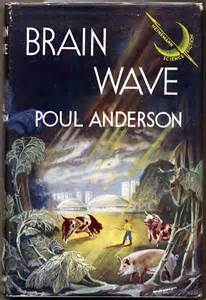
Science fiction can be contemporary or futuristic. Indeed, it can even be historical. See several works by Poul Anderson. However, the present and the future are the main concerns of sf. The future can mean any time from the day after tomorrow (Brain Wave) to beyond the end of the universe (Tau Zero).

The day after tomorrow may be the same as today except for a single technological innovation, as in "Life-Line" by Robert Heinlein. Brain Wave begins with a global increase in intelligence which generates every conceivable technological innovation, then the transcendence of humanity.

CS Lewis' Ransom Trilogy comprises two contemporary interplanetary novels and one "day after tomorrow" novel. Thus, Lewis presents the unusual but wholly appropriate sequence of Mars, Venus and Earth.

Reading American sf comics in the 1950s, I divided sf into before or after the invention of spaceships. The earliest future histories begin before space travel. Heinlein's Future History begins with "Life-Line." An escape velocity rocket fuel is not developed until the end of the fourth story.

In Anderson's Psychotechnic History, the opening story is set on a devastated Earth but the second begins on a colonized Mars. Anderson's Technic History and Larry Niven's Known Space future history begin with the exploration of the Solar System whereas Jerry Pournelle's CoDominium future history begins with regular interstellar travel. So there is some progress.

Wells' Time Traveler tells his dinner guests that he traveled through tomorrow, as if it were another country, then further into futurity. Thus, twenty four hours later, he and they have lived through the day that he traveled through while he traveled through it. Extraordinary.

Sunday, 13 March 2016

Single Or Multiple Authorship

Poul Anderson's future histories are written entirely by Poul Anderson whereas Star Trek is written by many script writers. These are two ways to generate fiction: basically, quality as against quantity. Anderson's output is enormous for a single author but, of course, he did not confine his attention to just one series and, in any case, could not have matched the sheer volume produced by multiple authorship.

The few Superman stories written by Alan Moore are part of the vast Superman canon but are also part of Moore's complete works and have been collected as such. Needless to say, they are way ahead of most other superhero fiction.

There is an intermediate position. Jerry Pournelle's CoDominium future history is additionally written or co-written by:

Larry Niven;
SM Stirling;
Jennifer Pournelle;
the contributors to the War World series, including Anderson.

This probably makes for unevenness in the quality of writing. There is unevenness in Anderson's Technic History because it was written over such a long period but multiple authorship almost certainly increases unevenness. However, I have yet to read the War World volumes. SM Stirling managed to pull together a consistently high quality for the Drakas! anthology.