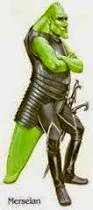
When, in Jerry Pournelle's and SM Stirling's "The Asteroid Queen," a kzinti Conservor of the Ancestral Past recites the Law, the astute reader might hear echoes of:
Merseian religion -
"As the God is Sire to the Patriarch..."
-Larry Niven, Ed., Man-Kzin Wars III (New York, 1990), p. 57.
Merseian social organization -
"...the officer is the hand of the Sire." (ibid.)
and Ythrian religion -
"...the Patriarch bares stomach to the fangs of the God..." (ibid.)
Also, a reference to "'...feral humans in the mountains...'" (p. 58) might remind us that the Draka describe free human beings as feral serfs.
My point of course is not that one work merely imitates the others but that all of these works are worthy of our attention. Kzinti are not just Merseians with feline features instead of green skins. Ythrian psychology and social organization reflect alien biology and physiology. And the Draka are what human beings might become! Read them all.
Showing posts with label Merseians. Show all posts
Sunday, 20 March 2016
Friday, 18 March 2016
Teleportation/Transportation/Transference
While we are paralleling future histories, we should include Star Trek. Merseians, kzinti and Klingons are obvious parallels. However, Star Trek has transporters and Known Space has transfer booths whereas the Technic History does not have teleportation.
An alien interstellar empire does have teleportation in Poul Anderson's "Interloper." However, the human societies in his Technic History do not develop such a mode of travel. But this makes the Technic History more plausible. How could a physical object or a human being be transported from one place to another without traversing the intervening space? Is it destroyed at the first place and reconstructed at the second? In that case, it is not transported - and could surely be duplicated at several places?
A civilization with sufficient knowledge and energy to practice teleportation would surely be capable of feats for beyond those that are otherwise displayed in either Star Trek or the Known Space History? In Clifford Simak's City, men in a dome on Jupiter can transform one of their number into an organism that can survive on the Jovian surface, then return him to human form. With that much knowledge and power, why do they huddle (Simak's own word) in a dome?
I think that Anderson's limited use of teleportation as an sf prop is a sign of his carefulness as an sf writer.
An alien interstellar empire does have teleportation in Poul Anderson's "Interloper." However, the human societies in his Technic History do not develop such a mode of travel. But this makes the Technic History more plausible. How could a physical object or a human being be transported from one place to another without traversing the intervening space? Is it destroyed at the first place and reconstructed at the second? In that case, it is not transported - and could surely be duplicated at several places?
A civilization with sufficient knowledge and energy to practice teleportation would surely be capable of feats for beyond those that are otherwise displayed in either Star Trek or the Known Space History? In Clifford Simak's City, men in a dome on Jupiter can transform one of their number into an organism that can survive on the Jovian surface, then return him to human form. With that much knowledge and power, why do they huddle (Simak's own word) in a dome?
I think that Anderson's limited use of teleportation as an sf prop is a sign of his carefulness as an sf writer.
Species With A Subordinate Sex
Merseian females are subordinate and confined to domestic roles, several wives to one male. Kzinti females are not intelligent, each successful male owning a harem! And -
"...the Sterile Ones...non-bearing females were kept as a rare privilege for Heroes whose accomplishments were not quite deserving of a mate of their own."
-Jerry Pournelle and SM Stirling, "The Children's Hour" IN Larry Niven, Ed., Man-Kzin Wars II (London, 1991), p. 206.
Kzinti are like Merseians but more so. They not only enslave other rational species but also eat them.
Niven's Pierson's Puppeteers have three sexes of which one is not intelligent and is really of a different species.
Merseian and kzinti females sound like how some male human beings think of women. A kzinti visitor to the inhabited Map of Kzin on the Ringworld is interested to find females who are intelligent.
"...the Sterile Ones...non-bearing females were kept as a rare privilege for Heroes whose accomplishments were not quite deserving of a mate of their own."
-Jerry Pournelle and SM Stirling, "The Children's Hour" IN Larry Niven, Ed., Man-Kzin Wars II (London, 1991), p. 206.
Kzinti are like Merseians but more so. They not only enslave other rational species but also eat them.
Niven's Pierson's Puppeteers have three sexes of which one is not intelligent and is really of a different species.
Merseian and kzinti females sound like how some male human beings think of women. A kzinti visitor to the inhabited Map of Kzin on the Ringworld is interested to find females who are intelligent.
A Multiversal Wavefront
Poul Anderson refers to Old Wilwidh on Merseia. Jerry Pournelle and SM Stirling refer to Old Kzin. We think of Old England. Evocative language. The use of this adjective with a capital initial conveys that its hearers or readers are aware of history, time and change.
One pocket universe comprises the Old Phoenix. Another might be a control room where an observer monitoring screens and instruments detects a multiversal wavefront with details manifesting alternately as Martians, Merseians, Moties, kzinti etc. Multi-dimensional patterns emerge. A Solar Commonwealth morphs into a CoDominium, each succeeded by a different First Empire:
"'Those two worlds - and many more, for all I know - are in some way the same. The same fight was being waged, here the Nazis and there the Middle World, but in both places, Chaos against Law, something old and wild and blind at war with man and the works of man. In both worlds it was the time of need for Denmark and France. So Ogier came forth in both of them, as he must.'"
-Poul Anderson, Three Hearts And Three Lions (London, 1977), p. 155.
The observer in my hypothetical control room must dispatch agents to crucial moments where they intervene to prevent inter-cosmic chaos. Although the observer knows of a single timeline protected by a Time Patrol, he oversees multiple timelines.
"'Once the crisis was past in both worlds, the job done...well, equilibrium had been re-established. There was no unbalanced force to send me across space-time. So I stayed.'" (ibid.)
Our history does not record Ogier opposing the Nazis - or the Merseians, kzinti etc - but what might occur without our knowledge?
One pocket universe comprises the Old Phoenix. Another might be a control room where an observer monitoring screens and instruments detects a multiversal wavefront with details manifesting alternately as Martians, Merseians, Moties, kzinti etc. Multi-dimensional patterns emerge. A Solar Commonwealth morphs into a CoDominium, each succeeded by a different First Empire:
"'Those two worlds - and many more, for all I know - are in some way the same. The same fight was being waged, here the Nazis and there the Middle World, but in both places, Chaos against Law, something old and wild and blind at war with man and the works of man. In both worlds it was the time of need for Denmark and France. So Ogier came forth in both of them, as he must.'"
-Poul Anderson, Three Hearts And Three Lions (London, 1977), p. 155.
The observer in my hypothetical control room must dispatch agents to crucial moments where they intervene to prevent inter-cosmic chaos. Although the observer knows of a single timeline protected by a Time Patrol, he oversees multiple timelines.
"'Once the crisis was past in both worlds, the job done...well, equilibrium had been re-established. There was no unbalanced force to send me across space-time. So I stayed.'" (ibid.)
Our history does not record Ogier opposing the Nazis - or the Merseians, kzinti etc - but what might occur without our knowledge?
Thursday, 17 March 2016
Parallel Histories
Future histories were not written to be read in parallel but can be. Larry Niven's kzinti are, under different aspects, comparable to:
Wells' Martians;
Anderson's Merseians, Ythrians and Imperial Terrans;
Stirling's Draka.
Slavery in different forms is common to these six cultures. Kzinti and Ythrians are intelligent carnivorous hunters, motivated by blood odors in their warships. Kzinti enslave human beings and eat some whereas the Martians would have enslaved human beings and drained the blood from some. Kzinti and Draka plan to spend generations taming enslaved populations. Merseians and kzinti are aggressive interstellar imperialists.
We can imagine a narrative in which these timelines are discussed in the Old Phoenix and another in which characters in a quantum ship jump between timelines trying to influence the outcomes of space battles described in the various future histories.
Wells' Martians;
Anderson's Merseians, Ythrians and Imperial Terrans;
Stirling's Draka.
Slavery in different forms is common to these six cultures. Kzinti and Ythrians are intelligent carnivorous hunters, motivated by blood odors in their warships. Kzinti enslave human beings and eat some whereas the Martians would have enslaved human beings and drained the blood from some. Kzinti and Draka plan to spend generations taming enslaved populations. Merseians and kzinti are aggressive interstellar imperialists.
We can imagine a narrative in which these timelines are discussed in the Old Phoenix and another in which characters in a quantum ship jump between timelines trying to influence the outcomes of space battles described in the various future histories.
Monday, 25 January 2016
The Draka In The Galaxy
SM Stirling's Draka begin to sound like Poul Anderson's Merseians. See here.
(i) The Archon anticipates:
"'...the galaxy under the Domination of the Race...'" (Drakon, p. 275)
(ii) - but recognizes that this will take a long time and that:
(iii) "'...interstellar government will never be very tightly centralized.'" (ibid.)
Thus, for the snakes, as for the gatortails, it is the Race, not any particular nation or state, that counts. Each extrasolar colony has its own Archon.
By "the Merseians," in this context, I mean the Wilwidh Roidhunate culture, not every member of that species. This culture envisages a transcendent but nevertheless racially partial deity (!) whereas the Draka eschew all religion, having failed to revive Norse polytheism.
The Merseians face many intelligent species in their version of our galaxy whereas the Draka are reasonably confident that there are no nearby technological civilizations in the galaxy of Earth/1. However, there are such civilizations in parallel timelines. The Director of Technics suggests that there might even be dinosaurs that (a) did not become extinct and that (b) did later become intelligent.
There might be. However, I do not believe that (b) follows from (a). Intelligence is not inevitable. If reptiles, both large and small, had continued to flourish without requiring the advantages of intelligence, then there would not have been any natural selection of intelligence.
But it is to be hoped that the Draka "'...run into more than we can handle...'" (p. 276)
(i) The Archon anticipates:
"'...the galaxy under the Domination of the Race...'" (Drakon, p. 275)
(ii) - but recognizes that this will take a long time and that:
(iii) "'...interstellar government will never be very tightly centralized.'" (ibid.)
Thus, for the snakes, as for the gatortails, it is the Race, not any particular nation or state, that counts. Each extrasolar colony has its own Archon.
By "the Merseians," in this context, I mean the Wilwidh Roidhunate culture, not every member of that species. This culture envisages a transcendent but nevertheless racially partial deity (!) whereas the Draka eschew all religion, having failed to revive Norse polytheism.
The Merseians face many intelligent species in their version of our galaxy whereas the Draka are reasonably confident that there are no nearby technological civilizations in the galaxy of Earth/1. However, there are such civilizations in parallel timelines. The Director of Technics suggests that there might even be dinosaurs that (a) did not become extinct and that (b) did later become intelligent.
There might be. However, I do not believe that (b) follows from (a). Intelligence is not inevitable. If reptiles, both large and small, had continued to flourish without requiring the advantages of intelligence, then there would not have been any natural selection of intelligence.
But it is to be hoped that the Draka "'...run into more than we can handle...'" (p. 276)
Wednesday, 7 October 2015
Aliens And Others
Poul Anderson presents plausible extraterrestrials. His Merseians and Ythrians are different from humanity and from each other. In particular, the Yhtrians' biology, as intelligent winged carnivores, determines their psychology, their social structures and even their theology.
SM Stirling presents a plausible alternative human culture. A Draka newspaper quotes a Security Strategos as saying that his skilled staff will keep captured Resistance fighters alive and screaming for weeks and the newspaper commentator wishes him well. One Resistance fighter warns the OSS agent not to regard Draka outrages as monstrous or inhuman. To think like that is to confirm the Drakas' own self-image as demons or gods. They are human beings.
While reading the Draka Saga, we can compare Communists, Nazis and Draka: three contending groups with different histories and destinies. The Draka, having separated their feelings for their families from their feelings for other human beings, must be about as bad as humanity can get.
SM Stirling presents a plausible alternative human culture. A Draka newspaper quotes a Security Strategos as saying that his skilled staff will keep captured Resistance fighters alive and screaming for weeks and the newspaper commentator wishes him well. One Resistance fighter warns the OSS agent not to regard Draka outrages as monstrous or inhuman. To think like that is to confirm the Drakas' own self-image as demons or gods. They are human beings.
While reading the Draka Saga, we can compare Communists, Nazis and Draka: three contending groups with different histories and destinies. The Draka, having separated their feelings for their families from their feelings for other human beings, must be about as bad as humanity can get.
Tuesday, 18 November 2014
Falkayn And Merseians
Anyone who starts to read Poul Anderson's History of Technic Civilization now can read the entire series in chronological order of fictitious events in Baen Books' seven-volume The Technic Civilization Saga, compiled by Hank Davis. Many of us in the past have of necessity read later installments before earlier installments. Anyone who followed the entire series as it was first published (before it was even recognized that many of its parts did belong to a single series) read of:
Dominic Flandry and Merseians in 1951;
Flandry's first encounter with Merseians in 1966;
David Falkayn's centuries-earlier encounter with Merseians in 1967.
Thus, when Falkayn conversed with Morruchan Long-Ax, the Hand of the Vach Dathyr, we were already familiar with Merseian personal names, nick-names, Vachs and Hands. It was as if an entire section of the Dominic Flandry/Terran Empire series had intersected with the Polesotechnic League/David Falkayn/trader team series whereas, to anyone reading the series chronologically now, this is their first knowledge of Merseians.
Morruchan has to be persuaded that the nearby supernova, Valenderay, poses a threat. He says:
"'The radiation, when it comes to us, will equal a mere one-third of what comes daily from Korych. And in some fifty-five days' (Terrestrial) 'it will have dwindled to half...'"
-Poul Anderson, David Falkayn: Star Trader (New York, 2010), p. 218.
The omniscient narrator intervenes awkwardly at this point. We know that Morruchan speaks Eriau whereas we read English. The author wants us to know that the radiation will be halved in the equivalent of fifty-five Terrestrial days even though "fifty-five" is not the number spoken by Morruchan. Another way to do this would have been for Morruchan to state the number of Merseian days and for Falkayn, the viewpoint character of this passage, to recalculate mentally.
Falkayn spells out the effects of radiation on electronics. And the story began with the omniscient narrator's account of the supernova and its generation of transuranic elements, including technetium, which may be appropriate for the Technic History?
Having said that, this is not really an omniscient narrator because he states:
"This was the first chance in our history to observe a new supernova." (p. 212)
Two words, "...our history...," make him one of us. He is someone living later in the Technic History and reflecting back on this period.
Dominic Flandry and Merseians in 1951;
Flandry's first encounter with Merseians in 1966;
David Falkayn's centuries-earlier encounter with Merseians in 1967.
Thus, when Falkayn conversed with Morruchan Long-Ax, the Hand of the Vach Dathyr, we were already familiar with Merseian personal names, nick-names, Vachs and Hands. It was as if an entire section of the Dominic Flandry/Terran Empire series had intersected with the Polesotechnic League/David Falkayn/trader team series whereas, to anyone reading the series chronologically now, this is their first knowledge of Merseians.
Morruchan has to be persuaded that the nearby supernova, Valenderay, poses a threat. He says:
"'The radiation, when it comes to us, will equal a mere one-third of what comes daily from Korych. And in some fifty-five days' (Terrestrial) 'it will have dwindled to half...'"
-Poul Anderson, David Falkayn: Star Trader (New York, 2010), p. 218.
The omniscient narrator intervenes awkwardly at this point. We know that Morruchan speaks Eriau whereas we read English. The author wants us to know that the radiation will be halved in the equivalent of fifty-five Terrestrial days even though "fifty-five" is not the number spoken by Morruchan. Another way to do this would have been for Morruchan to state the number of Merseian days and for Falkayn, the viewpoint character of this passage, to recalculate mentally.
Falkayn spells out the effects of radiation on electronics. And the story began with the omniscient narrator's account of the supernova and its generation of transuranic elements, including technetium, which may be appropriate for the Technic History?
Having said that, this is not really an omniscient narrator because he states:
"This was the first chance in our history to observe a new supernova." (p. 212)
Two words, "...our history...," make him one of us. He is someone living later in the Technic History and reflecting back on this period.
Saturday, 13 September 2014
Merseia
Since several recent posts have again focused on the Merseians, may I here refer to an earlier post about Merseia?
Originally introduced to be a standard collective continuing villain, the Merseians gained in complexity, becoming much better rounded and more multi-dimensional, after two of Poul Anderson's space opera series had merged into a long and solid future history. The greenskins or gatortails are helped in "Day of Burning," are resentful in Mirkheim, have become a rival empire and major threat by Dominic Flandry's time but are capable of much friendlier relationships in A Knight Of Ghosts And Shadows and must be very demoralized and disillusioned back on their home planet, albeit off-stage, during the Long Night.
As with the Ythrians, we want to know more.
Originally introduced to be a standard collective continuing villain, the Merseians gained in complexity, becoming much better rounded and more multi-dimensional, after two of Poul Anderson's space opera series had merged into a long and solid future history. The greenskins or gatortails are helped in "Day of Burning," are resentful in Mirkheim, have become a rival empire and major threat by Dominic Flandry's time but are capable of much friendlier relationships in A Knight Of Ghosts And Shadows and must be very demoralized and disillusioned back on their home planet, albeit off-stage, during the Long Night.
As with the Ythrians, we want to know more.
Monday, 19 May 2014
Merseians
Merseians:
are green, bald, tailed, oxygen-breathing bipeds;
sit on their tails;
ride the horned gwydh;
eat gwydh-milk cheese;
drink Terran-descended tea and a beer called telloch;
do not chatter but celebrate noisily;
touch tails as an amicable gesture;
separate "civilian" and "military" differently and less clearly than Terrans;
have a shorter history of industrialization and planetary unification;
thus, retain several unintegrated local cultures and languages;
are austere and traditionalist;
instinctively enjoy combat;
are dynamic when Terra is decadent;
value the Race above individuals or organizational forms;
recognize a rank of aristocrats who lead enterprises to expand the Race's frontier in any direction - scientific, economic, territorial etc;
placated elemental forces, then developed an intolerant monotheism.
are green, bald, tailed, oxygen-breathing bipeds;
sit on their tails;
ride the horned gwydh;
eat gwydh-milk cheese;
drink Terran-descended tea and a beer called telloch;
do not chatter but celebrate noisily;
touch tails as an amicable gesture;
separate "civilian" and "military" differently and less clearly than Terrans;
have a shorter history of industrialization and planetary unification;
thus, retain several unintegrated local cultures and languages;
are austere and traditionalist;
instinctively enjoy combat;
are dynamic when Terra is decadent;
value the Race above individuals or organizational forms;
recognize a rank of aristocrats who lead enterprises to expand the Race's frontier in any direction - scientific, economic, territorial etc;
placated elemental forces, then developed an intolerant monotheism.
Monday, 11 February 2013
Tails
What would an intelligent being do with a tail? Poul Anderson presents at least three answers. His Merseians sit on theirs and touch them as a greeting. When Dominic Flandry meets his opposite number, they shake hands in the Terran fashion but Flandry lacks a tail...
In Anderson's Fire Time (London, 1977), about his "Ishtarians":
"...legionaries and porters lay thoughtful, only switching their tails in the male sign for 'Thank you.'" (p. 152)
It makes sense that tail movements would be adapted as signs. Each Ishtarian has not only a tail but also a face and six limbs so their bodies can be very expressive and we are in fact informed that their art, including dance, is more subtle and complex than ours.
As quadrupeds, they effortlessly trot or run and can thus spread their activities over a far wider geographical area than human beings. Having imagined a differently shaped body, Anderson carefully works out all the consequent psychological and social differences.
Monday, 11 June 2012
Starfarers and Yonderfolk
Yes! In Starfarers, Poul Anderson imagined two kinds of alienness:
first, organic beings with a different kind of language, a different means of reproduction and the technological ability and collective motivation to spend millions of years remaking an artificially enclosed planet from molten core to atmosphere and hydrosphere so that their descendants will be able to inhabit it when their home planet, closer to its sun, has become uninhabitable;
secondly, matter and energy falling into a black hole interact with vacuum virtualities to generate quasi-stable quantum states mutated by uncertainty, perceiving sets of tensors as objects, in some cases intelligent and able to send information-bearing modulated photons past-wards through space-time warps caused by artificially large spinning nuclei, thus able to communicate with newly arrived human explorers because instructed by their future selves, possibly also imposing permanent traces on the vacuum, thus surviving death.
Finally, as an auctorial joke, the physical description of another starfaring race encountered by the Yonderfolk exactly corresponds to that of the Merseians, although with a different biology and sociology: this new race is thought to be descended from communal burrowing creatures with large numbers but few females.
I am rereading Starfarers to extract interesting details like these. Since I am about half way through, there should be more. In particular, the changed terrestrial society later in the novel should be compared with such societies in The Boat Of A Million Years and Brain Wave. But there are also fascinating surprises like the ingenious explanations for why von Neumann probes would not work.
I advise sf fans and anyone else who is interested in scientific and social extrapolation to reread Anderson.
first, organic beings with a different kind of language, a different means of reproduction and the technological ability and collective motivation to spend millions of years remaking an artificially enclosed planet from molten core to atmosphere and hydrosphere so that their descendants will be able to inhabit it when their home planet, closer to its sun, has become uninhabitable;
secondly, matter and energy falling into a black hole interact with vacuum virtualities to generate quasi-stable quantum states mutated by uncertainty, perceiving sets of tensors as objects, in some cases intelligent and able to send information-bearing modulated photons past-wards through space-time warps caused by artificially large spinning nuclei, thus able to communicate with newly arrived human explorers because instructed by their future selves, possibly also imposing permanent traces on the vacuum, thus surviving death.
Finally, as an auctorial joke, the physical description of another starfaring race encountered by the Yonderfolk exactly corresponds to that of the Merseians, although with a different biology and sociology: this new race is thought to be descended from communal burrowing creatures with large numbers but few females.
I am rereading Starfarers to extract interesting details like these. Since I am about half way through, there should be more. In particular, the changed terrestrial society later in the novel should be compared with such societies in The Boat Of A Million Years and Brain Wave. But there are also fascinating surprises like the ingenious explanations for why von Neumann probes would not work.
I advise sf fans and anyone else who is interested in scientific and social extrapolation to reread Anderson.
Subscribe to:
Posts (Atom)