Showing posts with label Time Patrol. Show all posts

Monday, 11 April 2016

More From "Pele"

A kzin says, "'Glory to the race!'" (Man-Kzin Wars III, p. 61)

Sounds familiar.

"Henrietta departed in the prograde direction...
"Caroline...was going retrograde..." (p. 64)

"...a hurtling hyperbolic trajectory." (p. 64)

"...monstrous plasmas..." (p. 66)

"...magnetic lines twisted around each other..." (p. 66)

"...main-sequence evolution..." (p. 66)

The explorers realize that a new planetary system must contain many metastable agglomerates easily volatilized by "'...solar input, impact energy, perhaps cumulative cosmic ray effects...'" (p. 54), thus all disrupted "'...long before intelligence evolves...'" (p. 54) They are surprised when an asteroid explodes in front of them but quickly deduce the cause. The captain wisely decides not to risk any more live crews in such unpredictable conditions.

Tyra starts a relationship with a guy who sets the readers teeth on edge - a bit like Wanda Tamberly's Time Patrol colleague in Beringia.

This post is occasioned by insomnia. It might be the last for a while.

Friday, 18 March 2016

A Multiversal Wavefront

Poul Anderson refers to Old Wilwidh on Merseia. Jerry Pournelle and SM Stirling refer to Old Kzin. We think of Old England. Evocative language. The use of this adjective with a capital initial conveys that its hearers or readers are aware of history, time and change.

One pocket universe comprises the Old Phoenix. Another might be a control room where an observer monitoring screens and instruments detects a multiversal wavefront with details manifesting alternately as Martians, Merseians, Moties, kzinti etc. Multi-dimensional patterns emerge. A Solar Commonwealth morphs into a CoDominium, each succeeded by a different First Empire:

"'Those two worlds - and many more, for all I know - are in some way the same. The same fight was being waged, here the Nazis and there the Middle World, but in both places, Chaos against Law, something old and wild and blind at war with man and the works of man. In both worlds it was the time of need for Denmark and France. So Ogier came forth in both of them, as he must.'"
-Poul Anderson, Three Hearts And Three Lions (London, 1977), p. 155.

The observer in my hypothetical control room must dispatch agents to crucial moments where they intervene to prevent inter-cosmic chaos. Although the observer knows of a single timeline protected by a Time Patrol, he oversees multiple timelines.

"'Once the crisis was past in both worlds, the job done...well, equilibrium had been re-established. There was no unbalanced force to send me across space-time. So I stayed.'" (ibid.)

Our history does not record Ogier opposing the Nazis - or the Merseians, kzinti etc - but what might occur without our knowledge?

Thursday, 17 March 2016

Slasher And Meteor

"His grandparents had considered emigrating to the Wunderland system...If they'd done it, he might have ended up as a conscript technician with the Fourth Fleet."
-Jerry Pournelle and SM Stirling, "The Children's Hour" IN Larry Niven, Ed., Man-Kzin Wars II (London, 1991), pp. 133-306 AT p. 184.

No, if his paternal (or maternal) grandparents' children had grown up in a different planetary system, then they would have had different children and he would not exist. Poul Anderson's Time Patrol series shows that the world would now be populated by different individuals if history had gone differently.

"The Slasher-class armed scout held three crewkzin in its delta-shaped control chamber, the commander forward and the Sensor and Weapons Operators behind..." (p. 184)

So the Slasher sounds like a Terran Imperial Meteor with its commander, fire control officer and engineer-computerman (Rise Of The Terran Empire, p. 478). Authors of military sf write with apparent familiarity about combat vehicles that do not exist yet and that, hopefully, will not have to exist.

Monday, 7 March 2016

Battle On The Sand

Poul Anderson's Time Patrol series refers to seafarers, spacefarers and timefarers. In 976 BC, a battle at sea involves one contemporary ship and several far future timecycles. See here.

If space travelers colonize terrestroid planets, then those planets will have seas and seafarers. Anderson describes extrasolar battles at sea here and here.

Chapter Twelve of Jerry Pournelle's King David's Spaceship makes clear that its author understands sailing. Elsewhere, Pournelle tells us how he enlisted Poul Anderson as crew for his ocean racing sloop. (See Jerry Pournelle, "An Appreciation of Poul Anderson" IN Greg Bear and Gardner Dozois, Editors, Multiverse: Exploring Poul Anderson's Worlds (Burton MI, 2014), pp. 277-283 AT p. 280.)

Introducing superior sailing techniques to the backward planet, Makassar, the Samualites in their ship, Subao, outrun all but one of a pirate fleet. Makassar's two small close moons cause strong tides. Thus, when the tide races out of a shallow bay, Subao and her single remaining pursuer run aground and the two crews fight on the sand with swords, lances and crossbows. Subao has the advantage of two horsemen. When the tide returns in a single wave, one horseman gallops close enough to the pirates' ship to cut their anchor line so that their ship is cast onto the rocks.

Saturday, 5 March 2016

Poul Anderson's Legacies

Time Travel
Can anyone top the Time Patrol? Audrey Niffenegger's The Time Traveler's Wife is at least an excellent circular causality novel.

Cosmic SF
I know that there is much post-Anderson cosmic sf, e.g., by Gregory Benford, but have not really kept up with it.

Alternative Histories
We have seen that SM Stirling has developed this sub-genre further than Anderson.

Future Histories...
...in which extrasolar colonies are isolated for centuries, then reincorporated into an interstellar civilization. We are currently finding that Jerry Pournelle's CoDominium future history fits well into this sub-sub-genre.

Hard Fantasy?

Of Time And Stars

In Poul Anderson's Solar Commonwealth, there is a Polesotechnic League; in Jerry Pournelle's Second Empire of Man, there is an Imperial Traders Association - two interstellar merchants' organizations.

Anderson's Time Patrol has an exile planet whereas the Second Empire has a prison world. It makes sense that an interstellar organization would isolate prisoners on an entire planet.

The Patrol preserves a single timeline whereas the Second Empire preserves interstellar peace against the threat of renewed nuclear wars that would devastate planets. Thus, two defensive organizations.

We learn that the Patrol guards history not just against time criminals but also against temporal changes resulting from quantum fluctuations in space-time energy. However, the consequences of such fluctuations can be experienced only by time travelers. Thus, both the Patrol and the Empire are responses to consequences of technology.

The Commonwealth, the Empire and the Patrol perform the functions of a state, preserving social order, whereas League and ITA members organize economic activities. We know that there are inter-temporal traders in the Time Patrol timeline but are told less about them.

Thursday, 18 February 2016

Memories

World Without Stars
The Boat Of A Million Years
For Love And Glory
Time Patrol and The Shield of Time

These three novels and one series are all very good hard sf by Poul Anderson. In each, human life-spans are extended indefinitely. The three novels address the problem that indefinitely accumulating memories would overwhelm a finite brain. In The Boat..., each of the immortals must somehow solve this problem for him- or herself whereas, in World... and FLAG, there is a technology that can selectively erase memories.

In FLAG, Torsten Hebo is about nine hundred Terran years old. Thus, he joins the ranks of:

Robert Heinlein's Lazarus Long;
Poul Anderson's Hugh Valland and Hanno;
James Blish's John Amalfi;
Larry Niven's Louis Wu.

Failures of memory put Hebo in a socially embarrassing situation and then nearly get him killed. He will return to Earth for memory editing and thus we, the readers, will see what has become of our home planet in that remote future.

FLAG's fifty four chapters fill only 290 pages so the chapters are short. Chapters I-VII, pp. 11-41, are set on a single planetary surface. In Chapter VIII, the spaceship Dagmar has returned Karl to his home planet, Gargantua, and will return three other beings to their home planet, Xanadu, before returning the human beings to their home planet, Asborg. Conversation on the ship informs us about the politics and economics of Asborg. The chapter ends by telling us that something important awaits Lissa on Asborg but we forget about this as soon as we turn to Chapter IX which begins with Hebo approaching Earth.

And I will now leave blog readers in suspense while I go about other business for a while...

Sunday, 7 February 2016

Relearning History

SM Stirling, Conquistador (New York, 2004).

Adrienne explains to Tom and Roy:

Alexander the Great (see image) did not die in 323 BC but lived for another forty years;

the Greeks assimilated the Jews, thus preventing Christianity;

Zoroastrianism died out;

some Scandinavians visited the American continents briefly but no one else;

Eurasia still has medieval technology;

Alexander is still worshiped as a son of Zeus.

Comments
Adrienne: "'The details don't matter.'" (p. 258)
me: They do! (But not from her practical pov.)

Adrienne: "'...our best guess is that the Industrial Revolution needed the equivalent of a toss coming up heads a thousand times in a row.'" (p. 259)
me: Is our history really that improbable?

Appendix Three: "Alexander the Great died in August of 280 B.C.E., in the summer capital of Ecbatanta..." (p. 589)
me: Is this the same as the Ecbatana visited by Time Patrolmen Manse Everard and Keith Denison?
me: When did Alexander die in Poul Anderson's "Eutopia"? Reading Stirling's alternative histories has persuaded me to reread Anderson's Old Phoenix stories and now his "Eutopia."

Sunday, 31 January 2016

Japan

Japan receives less coverage than China in Poul Anderson's works.

"The Shrine for Lost Children" is set in Japan.

Time Patrol members, Stephen and Helen Tamberly, holiday in archaic Japan. When Stephen is stranded in South America in 2937 BC, he becomes the Vesselmaker and produces the Valdivia ware so that he will be found by a time traveler investigating this mysteriously Japanese-like pottery.

Anything else?

I would love to include a reference to Japanese food but cannot think of any.

Addendum: I did not forget Trygve Yamamura for long and expected to find a comment about him when I switched the computer back on. The blog is always a work in progress.

Friday, 29 January 2016

"Custer Under The Baobab"

William Sanders' Draka story, "Custer Under The Baobab," begins by stating that baobab trees are remarkable and, having checked images on the Internet, I agree.

Sometimes, the moral of a time change story seems to be that people would reach the same end or destination even if by a different route. Thus, the Custer of the Domination timeline wisely avoids battle at Little Big Horn, is disgraced in the States, joins the Drakians and is killed by an arrow in Africa.

Historical outcomes can seem inevitable with the benefit of hindsight but can never be predicted in advance. Two straight lines leaving the same point at slightly different angles will eventually wind up in different galaxies. A different choice or chance event at a nexus point will change the direction and eventual outcomes of history, the most obvious example being if the Cuban Missile Crisis had become World War III. Thus, time travel in a mutable timeline would, after all, necessitate a Time Patrol.

Thursday, 28 January 2016

Crossovers

(Custer's Last Stand.)

As far as I can see at present, the Draka anthology, Drakas!, incorporates "crossovers," or meetings, between the Draka and five individual characters who had some, real or fictional, existence before the anthology was published:

General Custer;
Gordon of Khartoum;
Anson MacDonald/Robert Heinlein;
Anne Marie Talbott writes a story in which she meets two Draka (I think);
John Barnes' cross-time traveler, Mark Strang.

That is quite a list. There are at least two ways that Poul Anderson's characters could have encountered the Draka:

Manse Everard of the Time Patrol, finding himself in the Domination timeline, would travel pastward to delete that timeline;

Draka cross-time explorers might have found their way into the Old Phoenix but would then learn that they were allowed to recuperate there briefly but not to gain any knowledge that they could use to further their cause back in their own timeline.

Timelines And Time Patrol

The Draka are true to form in John Barnes' "Upon Their Backs To Bite 'Em." They pretend to negotiate with homo sapiens but only in order to find out how to enslave them. Knowing that the Draka will do this, the multiversal alliance called ATN (I still do not know what that means) is able to plant disinformation and hopefully to set the Draka and another interversal set of slavers against each other. Here at last is an adversary that understands the Draka and turns their own actions against them.

I knew nothing of Barnes' Timeline Wars series before reading "Upon Their Backs To Bite 'Em" but this story is an excellent introduction to that series so please let me advertise the series here:

Patton's Spaceship;
Washington's Dirigible;
Caesar's Bicycle;
Timeline Wars (omnibus).

Poul Anderson's Time Patrol battles to preserve a single timeline whereas Barnes' ATN battles between timelines. Both series share the premise that history might have gone differently at key points and that subsequent generations would have experienced very different worlds.

Timelines Overload

Get this sequence:

in Poul Anderson's mutable timeline, Neldorian time criminals help Hannibal to sack Rome and thus Carthage to win the Second Punic War but Time Patrol agents restore Roman victory;

however, in John Barnes' multiple timelines, descendants of the Carthaginians enslave more than a million timelines but are opposed by the ATN (meaning?) alliance who unite twice as many timelines;

ATN representatives visit and negotiate with SM Stirling's slave-owning Draka;

the Draka have conquered the Solar System and colonized several other planetary systems and are beginning to explore alternative timelines.

Thus, we have moved, conceptually, through four easy stages, from the Time Patrol to the Draka. I would not have believed that this was possible.

John Barnes' ATN-Draka story, "Upon Their Backs, To Bite 'Em," in Drakas!, is good but I have yet to read it to its conclusion.

Tuesday, 26 January 2016

Alternative History Fiction: Its Origins And A Culmination

My eyes have been opened by reading the Wiki article on Alternative Histories. Alternative history fiction itself has a long history - its earliest origins were historical, even Roman - although HG Wells may have been the first writer to describe travel between alternative histories.

The article rightly states that it is impossible to discuss separately from each other alternative history fiction and time travel fiction in which history is changed. Thus, the article appropriately refers both to Poul Anderson's Time Patrol series (time travelers changing history) and to his Old Phoenix stories (travelers between alternative histories).

However, here is at least one culmination of this sub-genre:

SM Stirling's Draka series recounts an alternative history from 1779 to 2445 and also describes travel between histories;

the series comprises four novels by Stirling and one anthology of twelve stories by other authors, edited by Stirling;

Poul Anderson is quoted on the back cover of the anthology as commenting "...an exciting, evocative [and] horrifying read."

The twelve contributors to the anthology, Drakas! are:

William Sanders, writer of fantasy and sf, including alternative histories;
John Miller, author of graphic novels and of stories set in George RR Martin's Wild Cards alternative history series;
Roland Green who has continued H Beam Piper's Great King's War alternative history;
David Drake, author of the Hammer's Slammers future war series;
Jane Lindskold, a former professor of English;
Lee Allred, author of alternative history fiction;
William Barton, author of When We Were Real;
Harry Turtledove, often called the master of alternative history;
Anne Marie Talbott, published here for the first time;
Markus Baur, a high tech sector worker resident in Vienna;
John Barnes, who introduces his crosstime-travel hero, Mark Strang, to the Draka; 
Severna Park, sf novelist.

Stirling explains the reasoning behind the series:

What were the good and bad consequences of European colonialism?
What if its worst consequence, slavery, had grown until it was unstoppable?

Thus, as I suspected, Draka world domination is part of the premise and has to be accepted as such.

Saturday, 23 January 2016

Freedom

SM Stirling contributed to Poul Anderson's Time Patrol series and it is unfortunate that Anderson did not likewise contribute to Stirling's Draka series. Both series share the premise that history might have diverged at an earlier stage with momentous consequences. Human sexual behavior varies enormously within a single timeline. How might it vary even more between timelines?

I am all for sexual freedom but between equals, not between masters and slaves. In Stirling's Drakon (New York, 2000), Chapter One, when the Draka Gwen visits a research station staffed entirely by homo servus, she is given flowers by an attractive adolescent boy and girl, the son and daughter of the Administrator and the head of research.

Later, Gwen's guardbeast scents and/or hears that someone is approaching her door. By sound and scent, she discerns who it is and answers the door naked. The boy and girl, naked except for flowers in their hair, present themselves with food and wine, apprehensive but excited. Gwen thinks that this is "'A charming gesture...'" (p. 13) The pleasure will be as intense as they can bear and enjoyable for her. As some of my countrymen would exclaim in disgust, "Charming!"

If drakensis and servus are on such trusting and intimate terms, can they not be equalized? After all, servus do scientific research with military applications:

"Back in the times of the Old Domination, when the Draka and their subjects had both been archaic-human, it had been impossible to entrust work like this to the underclasses. [Gwen] had seen the last of that herself, being the first generation of the New Race." (p. 16)

In a merely human society, there would certainly be a campaign to extend equal rights to subordinates who were both capable of and entrusted with advanced scientific research. However, the Draka have erected the barrier of species between themselves and their subordinates. The author is determined to pursue his dystopian premise all the way to its ghastly conclusion.

Saturday, 5 December 2015

Death

An OSS agent approaches the defector whom he has been sent to kill, ironically answers his greeting, pushes his hunting rifle into the man's stomach and fires twice. (Also ironically, the rifle was sold for hunting "bushmen," not animals.) SM Stirling graphically describes the physical effects of two shots inside the stomach. The assassin reflects:

"A whole universe inside a human skull, and then nothing."
-SM Stirling, The Stone Dogs (New York, 1990), p. 195.

I do not agree with that way of expressing it. We all perceive the same universe which is outside our skulls. Each of us sees, hears etc because of processes inside our skulls but that does not mean that the objects seen and heard are inside the skulls. We do not see the contents of our skulls but we do know that those contents are grey matter, not the universe, still less a different universe for each of us. But that is all about ways of expressing it.

Obviously, I do agree that something important happens at death. Each person's perception of the universe ceases. When discussing it like this, we seem to take for granted that there is no hereafter - and I do not expect one. (I have just met a group of Christians whose interpretation of the Bible is that consciousness ceases at death. Some individuals will be physically resurrected and others not but that is all.)

In Poul Anderson's Time Patrol series, Carl Farness quotes Pascal:

"'A little earth on our heads, and all is done with forever.'"
-Poul Anderson, "The Sorrow of Odin the Goth," 1935, IN Anderson, Time Patrol (New York, 2006), p. 343.

In Anderson's History of Technic Civilization, Dominic Flandry asks his dead Orthochristian fiancee, later canonized, for a sign but hears only the priest chanting behind the iconostasis. The chanter heard but not seen symbolizes a voice from another world but Flandry, and I, can only regard this as a myth.

Sunday, 15 November 2015

Pride, Pomp, Priesthood And Power

(Chandni Chowk, Old Delhi.)

"...Cyrus the Great King rode past with his chief courtiers Kobold, Croesus, and Harpagus, and the pride and pomp and priesthood of Persia followed."
-Poul Anderson, "Brave To Be A King" IN Anderson, Time Patrol (New York, 2006), pp. 55-112 AT p. 110.

"......the pride and pomp and power of the Mughals was the wonder of the world..."
-SM Stirling, The Peshawar Lancers (New York, 2003), Chapter Ten, p. 168.

A phrase in ...Lancers rang a bell although it turns out not to be identical.

Dare I say that I prefer Stirling's description of multi-ethnic Indian street life in ...Lancers to Kipling's in Kim? For page after page, Athelstane King and his companions ride through the outskirts and into the center of Old Delhi where Chandi Chowk, the Square of Silver Moonlight:

"...was a shoving, chattering mass of folk on foot, riders or rickshaws, oxcarts..." (ibid.)

Anderson's description of a multi-species market on an extra-solar planet in The Game Of Empire is comparable.

When Stirling refers to "...the First Men and the Tree of Life...," (p. 164) I think that that is a homage to Edgar Rice Burroughs' The Gods Of Mars?

Thursday, 5 November 2015

We Are Not Alone

A guy I know:

researches local history;

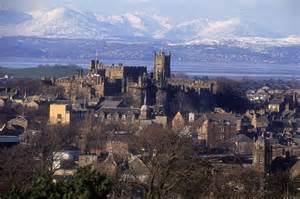
shows tourists around Lancaster Castle (see image);

has read Poul Anderson with pleasure;

specifically mentioned Tau Zero;

was disappointed on rereading Asimov later in life;

also mentioned CS Lewis' Ransom Trilogy and DC superhero comics;

knew some people at Lancaster University who, moving a glass between letters on a table, came across the name "Eric Blood-Axe," allegedly for the first time, and were told by the glass that Eric/Eiric is buried in a nearby town whereas Anderson has him lying where he fell at Stainmore.

Just another few facets of an always surprising universe, in the immortal words of Mainwethering of the Time Patrol.

Wednesday, 4 November 2015

Past-Future Synthesis

Poul Anderson presents historical processes:

in the past;
in the future;
in the past as experienced by time travelers from the future.

Thus, perhaps the Time Patrol series is a kind of synthesis of historical fiction with future history. I am currently rereading Mother Of Kings (historical fiction) and my early blog posts, many of them about the History of Technic Civilization (a future history).

This dual reading highlights the differences between historical fiction, especially when it incorporates elements of fantasy, and hard sf but also highlights the unity of Anderson's approach whether to the Holy Roman Empire or to the Terran Empire. He deploys encyclopedic knowledge of history, mythology, physics, chemistry, biology, astronomy, cosmology and cosmogony. Terrans have their crises and palace revolutions but are not just Romans splattered across the galaxy. For a start, they must understand and relate to intelligent beings adapted to extrasolar planetary environments: fliers; aquatics etc.

As Anderson comments in the title of one of his collections, this is All One Universe but it has many facets and his works focus on each facet, from a drow-haunted dolmen to a remote star cluster, in microscopic detail.

Tuesday, 20 October 2015

Futures And Pasts

A different future implies a different past. In Poul Anderson's Time Patrol history, the invention of time machines at a future date entails that there has already been considerable activity by time travelers in the past. Additionally, Sherlock Holmes, a fictional character in our timeline, is a historical figure in the Time Patrol timeline. Holmes' Adventures, narrated by Dr Watson but written by Conan Doyle in our timeline, are both written and narrated by Watson in the other timeline.

In terms of human activities, Anderson's History of Technic Civilization parts company with our history some time in the present century. However, in terms of other planetary evolutions and of Chereionite civilization, the two histories have differed for billions of years.

This means that everyone who is known to us as either a historical or a contemporary figure exists in two versions. One Alexander Solzhenitsyn existed in a timeline that would later include the Terran Empire and another Solzhenitsyn existed in our timeline that will include we do not know what.

Solzhenitsyn paints a favorable picture of an older fellow prisoner, a former Social Democrat who had known Lenin personally and who suffered imprisonment for his "...sixty-three years of honesty and doubts." (Chapter 5, p. 196) History is composed of such diverse individuals. Fiction must reflect this diversity and Anderson succeeds in his Technic History.