Showing posts with label For Love And Glory. Show all posts

Saturday, 9 April 2016

Limits On Interstellar Communication

"The 'instantaneous' pulses emitted by a ship in hyperdrive are detectable at an extreme range of about a light-year. They can be modulated to carry information. Unfortunately, within a few million kilometers quantum effects degrade the signal beyond recovery; even the simplest binary code becomes unintelligible."
-Poul Anderson, Flandry's Legacy (New York, 2012), p. 132.

However, the interstellar civilization in Anderson's For Love And Glory has an instantaneous hyperbeam. I remember that there was some limitation on the use of hyperbeam but not what it was.

In the Man-Kzin Wars period of Larry Niven's Known Space History:

"'Someday they'll miniaturize hyperwave equipment to the point where it'll fit into a spaceship.'"
-Poul Anderson, "Inconstant Star" IN Niven, Ed. Man-Kzin Wars III (New York, 1990), p. 211.

And, later in that history, Beowulf Shaeffer, exploring the galactic center alone in a spaceship, speaks to his puppeteer employer instantaneously by hyperphone. (Too easy.)

Anderson's Starfarers features an instantaneous and transtemporal communicator and Ursula Le Guin's future history has the instantaneous ansible. However, the true master of interstellar communication is James Blish:

his ultraphone is FTL but not instantaneous;

his CirCon radio and Dirac transmitter are instantaneous;

in one application of the Dirac transmitter, it receives messages from the past and future as well as from the present;

his Heart Stars empire and Angels also have instantaneous interstellar communication.

This is the kind of systematic treatment of a theme that we often find in Anderson's works.

Friday, 25 March 2016

Future Catholicisms

(St Peter's Cathedral, Lancaster.)

There is:

a Jerusalem Catholic Church in Poul Anderson's Technic History;

a Neocatholic Church in Anderson's For Love And Glory;

a Reform Catholic Church in Anderson's Starfarers;

a Reformed Catholic Church on Wunderland in Jerry Pournelle's and SM Stirling's "The Hall of the Mountain King";

an Imperial Church, recognizably Catholic, in Pournelle's CoDominium future history.

Anderson and Pournelle present the inner thoughts and points of view of characters who subscribe to their future versions of Catholicism whereas Pournelle & Stirling, at least in the passage to which I refer, merely mention that there is a Reformed Catholic church in a town among the Jotun Mountains. Nevertheless, this is enough to establish the existence of such a Church.

"The Hall of the Mountain King" is an installment of the Man-Kzin Wars sub-series of Larry Niven's Known Space future history. Thus, this single reference establishes the existence of a Reformed Catholic Church in the Known Space timeline. This denomination may never be referred to again. Alternatively, some contributor to the series could build a story around it. How was the Church "reformed"? Might a kzinti Kdaptist, believing that God made Man in His image, seek admittance to a Terrestrial religion? Etc. See here.

Sunday, 28 February 2016

Inter-Species Communication II

See Inter-Species Communication.

Poul Anderson
The relevant quotes are:

"The nonhuman remains nonhuman. He can only show us those facets of himself which we can understand. Thus he often seems to be a two-dimensional, even comic personality. But remember, we have the corresponding effect on him."
-Poul Anderson, The Van Rijn Method (New York, 2009), pp. 264-265.

"'[Nonhumans] are too unlike us. You probably know better than I how vastly their psychologies, instincts, drives, capabilities differ from ours, and from each other's...I think we interact with them, and they with us, only on a rather superficial level. Partnership is possible between human and alien, yes. Sometimes even what the human feels as friendship. But how does the alien feel it? That may be ultimately unknowable, on either side.'"
-Poul Anderson, For Love And Glory (New York, 2003), Chapter IX, p. 53.

Bob Shaw
Bob told me that he never had conversations between human beings and aliens but there was some conversation with hyper-dimensional beings in the Orbitsville Trilogy and maybe between souls of different species in the scientifically rationalized hereafter of The Palace Of Eternity? In old age, we try to remember works read literally decades ago.

Carl Sagan
Sagan suggests a means of communication. See here.

Niven and Pournelle
When, in Anderson's A Circus Of Hells, an alien on her own planet shakes her head in disbelief, we ask, "Would she do this?" whereas, when one of Niven's and Pournelle's Moties nods her head, we soon realize that this is because she is trying to converse with human beings and is learning fast.

I am definitely signing off till next month. Excelsior.

Tuesday, 23 February 2016

Designing Worlds

I strive to appreciate the physical settings of the fictional events in Poul Anderson's works, e.g.:

the city of Archopolis in Dominic Flandry's period;
the environments of planets like Diomedes, Avalon, Aeneas, Imhotep and Daedalus;
the city of Inga on the planet Asborg in For Love And Glory.

By taking notes on what we are told, I usually find that the characters move through a fully realized and consistent environment. In fact, the author has usually imagined more than we are shown in the action of a single novel. In prose fiction, the author must do all of this creative work himself, although he might acknowledge advisers.

Visual media are more collaborative. In a film adaptation, how many people would design the costumes worn in Archopolis? Dave Gibbons, who drew Alan Moore's Watchmen, writes:

"Whilst Alan was coming up with new character names and backgrounds, I thought about the ways Watchmen's alternate world differs from ours and presented him with notes about fashions, social and scientific changes, and so on. I mentioned the idea of pirate comics, reasoning that a world with real super heroes would have no need of them in comics."
-Dave Gibbons, Watching The Watchmen (London, 2008), unnumbered page.

This comparison of Anderson's prose novels with Moore's and Gibbons' graphic novel is not as fanciful as it may appear because Gibbons had written a few pages previously:

"I had an epiphany one day when I realized that Watchmen was not a super-hero book as such, but rather a work of science fiction, an alternate history."

Watchmen shows its readers an alternative New York just as an AI "emulation" in Anderson's Genesis immerses two of the characters in an alternative York.

Monday, 22 February 2016

The Green Of Earth And Home

Let us follow a chain of associations through the works of Robert Heinlein, Isaac Asimov, James Blish and Poul Anderson.

"We pray for one last landing
"On the globe that gave us birth;
"Let us rest our eyes on fleecy skies
"And the cool, green hills of Earth."
-Robert Heinlein, The Green Hills of Earth (London, 1967), p. 141.

Asimov: a story called "Mother Earth."

Blish: a novel called Earthman, Come Home and, in another work, sister planets called "Home" and "Rathe."

"...Homelike splashes of green."
-Poul Anderson, Young Flandry (New York, 2010), p. 273.

"...a longing seized her for the cool green hills of home."
-Poul Anderson, For Love And Glory (New York, 2003), p. 178.

I propose the Terrestrial tricolor:

blue for the oceans;
white for clouds;
green for life.

Further, alternative human traditions could be celebrated by an optional symbol in the lower corner of the green band. I favor a red star but expect blog readers to have other ideas.

Sunday, 21 February 2016

City Life II

See City Life.

Inga is described as "...a lively town." (FLAG, Chapter XXXII, p. 168) Torben Hebo, returning from Earth to Asborg after his memory editing, finds a small apartment and studies the public database on the black hole collision. Not finding a Neocatholic church, he occasionally attends Josephan.

Through the wall transparencies in his apartment, he sees the city lighting up at dusk while losing sight of the hills where he had walked during the day. Called by Romon Kaspersson Seafell on the screened telephone, he is invited to dinner at the Baltica, located in a clear dome on the top of one of the tallest towers with a view of city lights and of an Asborgan moon. Between the tables, designer flowers display multiple colors and sing.

The dinner conversation soon turns to business so that might be the end of our information about the lively town. We learn that a man changes one part of his name when he changes his patronage. Esker Harolsson Windholm has become Esker Harolsson Seafell. We already know of some of the underlying conflicts.

Large And Small

Poul Anderson, For Love And Glory (New York, 2003).

"As the judgment instant neared, you forgot your merely mortal quarrels." (Chapter XXV, p. 140)

Big problems chase out little problems. It is good to have big problems occasionally just to put the little ones in perspective. Sometimes, the bigger problems also can be transcended:

"They've forgotten their feud, Lissa thought. I have too. At least, it doesn't matter anymore. Probably it will again, when we are again among human beings. But today it's of no importance whatsoever." (Chapter XXVI, p. 143)

Passages in hard sf novels can relate to here and now experiences. In zazen, just sitting meditation, we do not prevent thoughts from arising but instead practice not thinking about them. Thus, any memory, image or phrase might arise but the practice is to let each of them pass like a cloud in the sky. Once, something that was bothering me kept entering my mind as expected during half an hour of meditation. However, when I had finished meditating and stood up, I was instantly elated. It was exactly like being in a plane under dark storm clouds when the plane suddenly ascended vertically into a clear blue sky full of light. I knew then that the place above the clouds existed, that I would soon return back down beneath the clouds and that that did not matter.

New Worlds And A New Cosmos?

Poul Anderson, For Love And Glory (New York, 2003), Chapter XXVI.

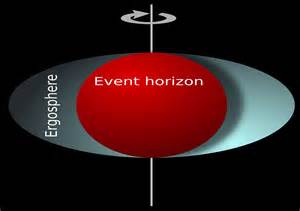
A rotating black hole has both an event horizon and an ergosphere. When two black holes meet, the energies released cause some gas clouds to exceed ergospheric escape velocity. Receding, the clouds hold together either because of magnetic bottle effects or because each has become the atmosphere surrounding a new planet-sized mass, as if the union of black holes had begotten worlds.

Meanwhile, during the microseconds of fusion, the ergospheres, the event horizons and spacetime are contorted:

"'For an instant, the gates stood open between entire universes.'
"'The hints alone should reveal a new cosmos to your minds...'" (p. 143)

Why "between" universes?
Is each singularity regarded as matching the singularity of a white hole in another universe?
(But the singularities were not uncovered during the collison.)
A new cosmos or a new understanding of this cosmos?

Either way, new worlds whether material or conceptual.

When Time Patrolman Manse Everard relates sagas and Eddic and skaldic poems to the Emperor Frederick in 1245alpha AD, the latter exults:

"'You open another whole universe!'" (The Shield Of Time, p. 396)

The Eddic universe is conceptual but certainly "other." I remember the imaginative impact the first time I read Encyclopedia articles about Norse mythology and about Buddhism. In the first, gods who will die; in the second, not a strange god but a compassionate man. This takes us away from black holes but it is all one in Poul Anderson's imagination.

Saturday, 20 February 2016

What Is A Weapon?

Any powerful technology can be used destructively. Larry Niven shows this in two short stories:

a hitchhiker holding a knife to a driver's throat is powerless when the driver, a professional actor, pretends to be suicidal and begins to drive dangerously, threatening to crash the car;

a kzinti telepath reports that a human spaceship has no weapons but then the human pilot aims his laser drive at the kzinti ship, fighting as he flees.

Similarly, weapon systems can be put to peaceful uses. In Poul Anderson's For Love And Glory:

antimissile screens can deflect solar flares;
warheads can excavate where shelters are needed;
energy beams drill through ice, giving access to the minerals beneath.

So does a ship carrying what look like weapons necessarily have belligerent intentions? Intelligence and diplomacy would be crucial in inter-species encounters.

Cosmic Conflicts

In Ensign Flandry, a rogue planet will strike a star, making it go nova, thus destroying its planetary system, including one planet with two intelligent species.

In For Love And Glory, two black holes will coalesce.

So far, these are collisions, not conflicts. It is consciousness that causes conflicts. Conscious beings seek to gain from knowledge of imminent cosmic collisions and therefore practice not only knowledge-seeking but also secrecy.

In Ensign Flandry, a Merseain Fodaich says in accented Anglic:

"'...interdicted region...Turn back at once.''" (Young Flandry, p. 174)

Captain Einarson replies:

"'His Majesty's government does not recognize interdictions in unclaimed space...'" (ibid.)

In FLAG, Dominator Ironbright says:

"'Your presence is inadmissable. This region is closed. Remove yourselves.'" (p. 124)

Captain Valen replies:

"'We are not aware of any such interdiction...By what right do you declare it? It seems to be in violation of treaty agreements and general custom.'" (p. 125)

It seems that it is easier to change fictional universes and alien species than to change the nature of political and military conflicts!

Two Black Holes Converge

Poul Anderson, For Love And Glory (New York, 2003), Chapters XX-XXI.

They look like two comets. Their manes, shading from intense gold to blood red, meet and roil. Their joint gravitation doubles the quantity of interstellar gas pulled in, blazing with radiation. The interacting accretion discs generate visible light, then increasingly hard X-rays.

In the shock front is a diamond pattern with intricate looping strands. Possibly the event horizons are distorted, affecting magnetic fields and charge distributions. The black holes outshine a nearby giant star. Although they graze rather than collide, their masses are expected to fuse.

A spaceship that can jump around through hyperspace near the convergence is able to record data from different angles and distances.

Friday, 19 February 2016

Going Hyper

When fictional characters travel in a jet plane, the technical parameters of their journey are laid down by factors external to the fictional text whereas, when an sf writer invokes "hyperspace," he can say what he wants. Thus:

in Poul Anderson's History of Technic Civilization, travelers take time to cross interstellar distances faster than light and cannot communicate by hyperspatial pulses across more than a light year;

in Anderson's For Love And Glory (New York, 2003), travelers take no time to jump across even greater distances and can communicate between planetary systems by hyperbeam;

Isaac Asimov, Larry Niven and others have their different versions of hyperspace - indeed, Niven rightly raises further questions about his version later in the Ringworld series.

In FLAG, a spaceship melodiously says:

"Stand by for hyperjump,'" (p. 88)

- and, in Ensign Flandry, a ship's captain announces:

"'Stand by for hyperdrive. Stand by for combat. Glory to the Emperor.'" (Young Flandry, p. 172)

But they are talking about different kinds of hyperspace.

Leadership

Poul Anderson, For Love And Glory (New York, 2003), Chapter XIV.

Here, we compared Poul Anderson's Nicholas van Rijn and SM Stirling's John Rolfe as different kinds of leaders. Now we find a third example. Lissa Davysdaughter Windholm thinks:

"'I'm only a planetarist. And even that title is a fake. I don't do geology, oceanography, atmospherics, chemistry, biology, ethology, or xenology. I dabble in them all, and then dare call myself a scientist." (p. 85)

So what is her contribution?

"I help get the specialists together, and keep them together, and sometimes keep them alive. That's my work. That justifies me being here..." (ibid.)

It does indeed. So that work must be generally acknowledged and respected? No:

"...though I had to force it every centimeter of the way." (ibid.)

Leadership indeed.

I googled "planetarist" but found a different meaning for it.

Forest And Ruins

Poul Anderson, For Love And Glory (New York, 2003), Chapter XIII, pp. 78-81.

In order to decide which memories to erase, Torsten Hebo travels around on the Earth. Over eight centuries ago, he was married in a church in a town where there is now a forest. He wonders where his first wife is. She might still be alive, like him. However, for practical purposes and even for survival, he needs to preserve his more recent memories. They must even be reconstructed and reordered.

But, on the other hand, the deleted memories will be recorded on crystal and given to him for playback. Some can be virtualized. Others will be mere words and indistinct images. When reading World Without Stars, we theorized that a character wrote an autobiographical journal precisely because his memories were periodically edited. FLAG presents superior technology capable not only of deleting but also of recording and playing back.

This chapter also discloses more about Earth. People who spend most of their time communing with AI's are more interested in the occasional sensory experience of nature than in the recollection of human history. However, the database can present history in virtuality or can even physically rebuild the Parthenon, Broadway, Cape Canaveral etc. (I think that that is what the text means.) The original state of an ancient structure must be half imagined but by immense artificial intelligences utilizing every recorded datum.

I think that I would be able to find a place in such a peaceful and intellectually active social environment.

Traditions And Institutions

Poul Anderson, For Love And Glory (New York, 2003).

An Asborgan is identified by a personal name, a patronymic and the name of a House. Thus, Romon Kasperson Seafell converses with Lissa Davysdaughter Windholm.

When Romon suggests that Lissa dislikes the Seafell approach, she replies:

"'I don't hate it. A matter of taste. The communal versus the corporate style? ...They say diversity makes for a healthy society.'" (p.45)

I took this to mean that Seafell was communal whereas Windholm was corporate. See here. But maybe I got them the wrong way round? Later, Lissa refers to:

"'...a clutch of reckless commercialists like the Seafell.'" (p. 60)

When reading about a fictitious future society, we do not already know any background details and are entirely dependent on the unfolding narrative. The author can hint, conceal, imply etc but must eventually tell us enough for complete comprehension - at least for the current narrative. A skilfully written sequel can overturn some of our impressions.

City Life

Poul Anderson, For Love And Glory (New York, 2003), Chapter X.

Asborg's largest "free city" (p.56) is Inga - "free" meaning that it is neither owned nor controlled by any of the landholding Houses? (maybe).

Inga has towers, slipways and a harbor with walls along the docks. Although the harbor is quiet at night, traffic, light and life continue in the city center.

The opening paragraph of Chapter X addresses three senses:

(i) because the dock walls block the city lights, some stars are visible and a rising moon lights the waves -

(ii) - which lap audibly against the piers despite the urban throb;

(iii) there are smells of salt, engines and cargo.

Thus, ancient human life continues on an extrasolar planet despite the changed conditions on Earth.

Thursday, 18 February 2016

Earth In FLAG

Poul Anderson, For Love And Glory (New York, 2003), Chapter IX.

The human population is about fifty million;

human, parahuman and quantum-net consciousnesses are linked, subtly and changeably, although "...not joined in one entity..." (p. 52);

cities have been replaced by a few buildings among gardens and woods;

there are only two hostels for extra-planetary visitors, one on Oahu;

Hebo has Hanauma Bay (see image) to himself and the coral has been rehabilitated;

extrasolar colonies preserve archaic societies and interact superficially with non-human beings;

a Beta Centaurian society sends an anthropological team to gain a better understanding of Earth than is possible through verbals, visuals or virtuals;

technological progress during Hebo's nine hundred year life span is shown by the fact that a scanner checks him for pathogens in about a minute whereas previously nanoprobes would have taken several hours;

extinct species of birds have been recreated from old records;

the space traffic control officer, a modified-human, converses by beamphone and might be a virtual;

the Enigma, a research instrument comprising curved girders surrounding a glowing core, has orbited in the asteroid belt for two centuries;

the basic physics equations were formulated several centuries ago;

"'A person on Earth today can at any instant attain any chosen emotional state...'" (p. 54);

a room in the hostel can have any virtual surroundings;

an interactive program, or possibly live human beings, will deal with Hebo at the memory editing clinic. 

And, if we feel nostalgic for the more populous Solar Commonwealth (and here) or Terran Empire, then we can revisit those settings in earlier works.

Asborg

When an sf novel involves regular FTL interstellar travel, I would like to be told:

the galactic positions of the inhabited planets;
the distances between them;
the velocity of the FTL drive.

In the opening chapters of Poul Anderson's For Love And Glory (New York, 2003), Lissa returns from Jonna to Asborg via Gargantua and Xanadu whereas Hebo returns directly from Jonna to Earth. Hebo's companion, a Rikhan, may have returned to her home planet. So where are all these planets and how far apart are they?

Asborg is Sunniva III, thus the third planet of a star called Sunniva, just as Earth is Sol III.

Lissa is Lissa Davysdaughter Windholm of Asborg. Her father, presumably David or Davy, "'...has a major voice in Windholm's space operations.'" (p. 44) Windholm, Seafell and other Houses hold land on Asborg and "'...share in its governance...'" (p. 45) So what form does that governance take? Houses have different traditions and styles. Seafell's is commercial whereas Windholm's is communal. We have not been told much but it has not become necessary as yet.

Memories

World Without Stars
The Boat Of A Million Years
For Love And Glory
Time Patrol and The Shield of Time

These three novels and one series are all very good hard sf by Poul Anderson. In each, human life-spans are extended indefinitely. The three novels address the problem that indefinitely accumulating memories would overwhelm a finite brain. In The Boat..., each of the immortals must somehow solve this problem for him- or herself whereas, in World... and FLAG, there is a technology that can selectively erase memories.

In FLAG, Torsten Hebo is about nine hundred Terran years old. Thus, he joins the ranks of:

Robert Heinlein's Lazarus Long;
Poul Anderson's Hugh Valland and Hanno;
James Blish's John Amalfi;
Larry Niven's Louis Wu.

Failures of memory put Hebo in a socially embarrassing situation and then nearly get him killed. He will return to Earth for memory editing and thus we, the readers, will see what has become of our home planet in that remote future.

FLAG's fifty four chapters fill only 290 pages so the chapters are short. Chapters I-VII, pp. 11-41, are set on a single planetary surface. In Chapter VIII, the spaceship Dagmar has returned Karl to his home planet, Gargantua, and will return three other beings to their home planet, Xanadu, before returning the human beings to their home planet, Asborg. Conversation on the ship informs us about the politics and economics of Asborg. The chapter ends by telling us that something important awaits Lissa on Asborg but we forget about this as soon as we turn to Chapter IX which begins with Hebo approaching Earth.

And I will now leave blog readers in suspense while I go about other business for a while...

Forerunner Technology

Poul Anderson, For Love And Glory (New York, 2003), Chapters I-IV, pp. 11-32.

The iridescent, intricately patterned, curved top of a twenty meters long artifact extends a meter above the surface of a river on an Earth-like extrasolar planet.

Although this technology has apparently been abandoned for ages, investigation reveals traces of power, maybe utilizing solar energy. The machine, self-growing, self-renewing and self-repairing, maintains homeostasis, extends roots and extracts minerals. It is thought to be "'...an observatory...'" (p. 31), recording environmental data maybe to the molecular level.

Someone who finds it and begins an investigation may be able to sell the information to a scientific institution. Thus, it may be possible to earn a living in a far future high tech civilization where, we are told, wars between species are unlikely although conflicts within species remain.