Wednesday, 6 April 2016
Poetry, Soft And Hard SF And The Sun
If Heinlein, Anderson, Niven etc are hard sf writers, then who are soft? At least Bradbury, Simak and Lewis. Bradbury surely writes poetry in prose rather than speculative fiction? Instead of studying the Sun from a safe distance with a spectroscope, Bradbury's characters fly close enough to scoop some matter out of it. The captain uses a "...robot Glove..." (The Golden Apples Of The Sun, London, 1970, p. 167), really a waldo although not named as such, to control the giant hand that moves the Cup.
"'What time is it?' asked someone." (p. 165)
Wittgenstein discussed the time on the sun philosophically.
A soft sf writer can write about a Cup scooping solar matter but how do hard sf writers treat it? Alan Moore has Earth people colonizing Sun spots but this is just an out there idea. In The Mote In God's Eye by Larry Niven and Jerry Pournelle, a spaceship protected by a force field flies into a star. In "Iron," Poul Anderson has kzinti in a refidgerated space tug called Sun Defier flying close to a red dwarf to scoop closely orbiting asteroids:
"'Damn near half the sky a boiling red glow...the cabin is a furnace you can barely endure...'" (The Man-Kzin Wars, pp. 148-149)
This is Anderson's hard sf equivalent of The Golden Apples...
Sunday, 13 March 2016
Single Or Multiple Authorship
The few Superman stories written by Alan Moore are part of the vast Superman canon but are also part of Moore's complete works and have been collected as such. Needless to say, they are way ahead of most other superhero fiction.
There is an intermediate position. Jerry Pournelle's CoDominium future history is additionally written or co-written by:
Larry Niven;
SM Stirling;
Jennifer Pournelle;
the contributors to the War World series, including Anderson.
This probably makes for unevenness in the quality of writing. There is unevenness in Anderson's Technic History because it was written over such a long period but multiple authorship almost certainly increases unevenness. However, I have yet to read the War World volumes. SM Stirling managed to pull together a consistently high quality for the Drakas! anthology.
Wednesday, 9 March 2016
Flandry, Bond And Two Others
(i) 007 endlessly, eternally, engages external enemies of freedom.
(ii) The Prisoner (maybe) frees himself by realizing that the ultimate enemy is internal, No 1 = I.
(iii) V, with help from others, (maybe) frees society: people who have become internally free will no longer allow themselves to be externally enslaved.
(iv) Flandry does not seek any internal or anarchic liberation but does recognize that his society is flawed whereas Bond does not.
007, No 6 and V form a conceptual sequence. It is good to find Flandry's place somewhere between 007 and V.
Tuesday, 23 February 2016
Designing Worlds
the city of Archopolis in Dominic Flandry's period;
the environments of planets like Diomedes, Avalon, Aeneas, Imhotep and Daedalus;
the city of Inga on the planet Asborg in For Love And Glory.
By taking notes on what we are told, I usually find that the characters move through a fully realized and consistent environment. In fact, the author has usually imagined more than we are shown in the action of a single novel. In prose fiction, the author must do all of this creative work himself, although he might acknowledge advisers.
Visual media are more collaborative. In a film adaptation, how many people would design the costumes worn in Archopolis? Dave Gibbons, who drew Alan Moore's Watchmen, writes:
"Whilst Alan was coming up with new character names and backgrounds, I thought about the ways Watchmen's alternate world differs from ours and presented him with notes about fashions, social and scientific changes, and so on. I mentioned the idea of pirate comics, reasoning that a world with real super heroes would have no need of them in comics."
-Dave Gibbons, Watching The Watchmen (London, 2008), unnumbered page.
This comparison of Anderson's prose novels with Moore's and Gibbons' graphic novel is not as fanciful as it may appear because Gibbons had written a few pages previously:
"I had an epiphany one day when I realized that Watchmen was not a super-hero book as such, but rather a work of science fiction, an alternate history."
Watchmen shows its readers an alternative New York just as an AI "emulation" in Anderson's Genesis immerses two of the characters in an alternative York.
Sunday, 21 February 2016
What Is A Weapon? II
-copied from here.
I have copied this passage from the Science Fiction blog in order to back up the point about technology and weapons. Skizz also says, although I am not about to look up the reference at this time of night, that his people have instruments that militaristic Earthmen would regard as weapons.
My point here was that I thought that Alan Moore displayed greater insight than Isaac Asimov. Moore, Niven and Anderson all make observations that break down the distinction between technologies designed to be used as weapons and technologies powerful enough to be used as weapons even though there intended purpose was, e.g., transport. Niven makes this point with both a car and a spaceship. Pretty smart stuff.
Saturday, 6 February 2016
A Lensman In The Old Phoenix
Here (scroll down) is where I have referred to EE Smith's Lensman series before. Here (see Comments) is where correspondent David Birr says that the:
"...large affable blond man in high boots and gray leather with an iridescent jewel on his wrist..." (Midsummer Tempest, p. 228) -
- must be from the Lensman series. So this is the only appearance of a Lensman in Poul Anderson's works and the Old Phoenix is probably the only appropriate setting. This single part of a sentence is better written than the entire seven-volume Lensman series.
Lensmen:
sound like and resemble superheroes;
specifically, are quite like the comic book superhero group, the Green Lantern Corps.
With superheroes, I have found that what matters is the script writer, not the character. Alan Moore and Neil Gaiman are able to do new things with old characters, even with Superman. Similarly, Poul Anderson would have been able to write a good Lensman novel even if the Lensmens' creator couldn't. I value that man in gray leather with an iridescent jewel on his wrist as Anderson's prose transmuting a cardboard space opera hero into a colorful and interesting character.
Wednesday, 25 November 2015
Poul Anderson And Alan Moore
(i) Although primarily a graphic novelist and comic strip script writer, Alan has also written prose fiction: some short stories, a novel, Voice Of The Fire, and a second novel, Jerusalem, to be published in Spring 2016.
(ii) Alan has written historical fiction (Voice Of The Fire) fantasy (Promethea) and sf (Halo Jones; Skizz). Voice Of The Fire features Romans ("Men of Roma") in Britain.
(iii) He received a Hugo award for Watchmen.
Differences
(i) PA and AM are at opposite ends of the political spectrum.
(ii) Whereas Anderson seemed sympathetic to the monotheist faiths, Alan practices magical rituals and worships the Roman snake god, Glycon. (He doesn't want his fans to copy his religion and I don't!)
(iii) Whereas I saw Anderson at a couple of sf cons, I have met Alan briefly a few times. (In fact, following clues in his published works, I found my way to his front door.)
(iv) Alan taught comic script writing to Neil Gaiman and I have found several parallels between Anderson and Gaiman, less between Anderson and Alan. Nevertheless, these three men are major modern imaginative writers.
Thursday, 1 October 2015
Draka Darkness
The sub-genre of military sf is not my preferred reading. I value sf for new horizons and cosmic perspectives, not for high tech replays of World War II. However, good sf writers, notably Poul Anderson and SM Stirling, write good military sf - or maybe sometimes "good naval sf," if we transfer marine terminology to space combat: spaceships have Captains; space fleets have Admirals etc.
Clearly, Robert Heinlein approves of the society that he describes in Starship Troopers. Equally clearly, SM Stirling cannot possibly approve of what he describes in the Draka History! However - like Alan Moore depicting in merciless detail what a superhero-turned-villain would do to London -, Stirling is prepared to follow a fictional premise all the way to its horrific conclusion. Moore looks beyond London to a Golden Age whereas I suspect that Stirling's continuing series delves deeper into the Draka darkness.
We know from Marching Through Georgia that the Draka enslave populations and plan world conquest. In Under The Yoke (New York, 1989), they treat prisoners of war dishonorably. It is frankly sickening. I cannot bring myself to describe in detail what they do. Avoiding details, defeated enemy leaders are not respected but paraded, derided and shot. The Draka deliberately eschew any humane values.
Security Strategos Vashon, remembering such a victory spectacle, reflects:
"...that had been a good time. A time to be at one with the Race, when they could relax from the long years of grinding effort and feel the pride of a great accomplishment. Limitless vistas of power and possibility opening out before them..." (p. 55)
Sounds good? Sure, if our "Race" is the human race and if "power" does not mean subjugation.
Vashon thinks that it is a "...self-evident lie that all men were created equal." (p. 57) We are unequal in abilities but can be equal before the law. Alfie Rouse was hanged not for murdering anyone important but for burning to death an unknown, and still unidentified, hitchhiker. The law would have treated Rouse no worse if he had assassinated the Prime Minister whereas serfs (euphemism for slaves) who attack Draka are impaled as examples.
A ten year old Citizen girl, armed with a knife, thinks that her mother should punish two uppity serfs. Her mother gives her the advice quoted in the second image. Sound, pragmatic advice to a slave-owner, no doubt. But not all Draka give orders that they know will be disobeyed. Serfs can become trusted domestic servants and friends, albeit still unsalaried and unfree. Individual compassion is possible even within an oppressive system. See Schindler.
Systematic cruelty often brings out the worst in those who climb one step up the ladder, e.g., serfs becoming security guards. That this does not have to be the case is shown by Yasmin who protects fellow serfs and deflates a bullying guard. Because she is owned by a powerful family, she can strike the guard but he cannot risk striking her back...
When the ten year old girl has become old enough to think about clothes, she also wants to buy a serf of her own with money saved from her allowance. Imagine bringing up a child to think like that! And what chance does she have of learning to think any differently? If only one global generation could be brought up free from the "muck of ages..." I believe that adults should tell children, "This is what I think but you might think differently when you have learned more." But this means that I disagree with all the parents who want their children's education to include religious instruction. And it would also be wrong for me to try to enforce my view through legislation. Intolerant secularism is no better than intolerant belief.
I have passed over two instances of torture, both enjoyed by Draka witnesses. Finnish Resistance fighters, waging all out war against the Draka invaders, call them "...the snakes..." (p. 40), a denial of their humanity - appropriate in the circumstances. We, in our timeline, do not face the Draka but do face comparable threats, even including neo-Nazis. Stirling simply presents a worst case scenario for the history that he and his readers live in.
I am too young to remember World War II but did attend three different talks by Holocaust survivor Leon Greenman, who stayed with us when he spoke at Lancaster Town Hall. Leon ended one question-and-answer session by saying, "If anyone here is a Nazi, do not do it! You will become a monster, hated by your fellow men." In the Draka timeline, some European refugees escape to Britain... (Ketlan and my daughter leafleted every afternoon showing of Schindler's List to build for the Greenman public meeting, which filled a large hall to capacity. Later, Holocaust deniers attacked and damaged Leon's house so I got my union branch to donate to his defense fund.)
In our timeline, EP Thompson wrote The Making Of The English Working Class and Eric Hobsbawm wrote The Age Of Revolution, The Age Of Capital, The Age Of Empire and The Age Of Extremes. In the Draka timeline, EP Hobsdown wrote The Age Of Domination.
A possible proofreading point: on p. 17, Andrew von Shrakenberg seems to change his name to Alfred and back again?
It is Wednesday. I am reading new works by Alan Moore and Neil Gaiman and drafting this post. As yet, I have read only a small part of Under The Yoke so there will be more posts about this novel. Stirling shows us oppressors who are credible human beings but who have become as accustomed to oppressing the serfs that outnumber them as we are to using twenty first century technology: unsettling but plausible.
Strategos Cynthia Carstairs informs Chiliarch Denford de Fourneault:
"...Security tells me there's another of those loony cults running through the factory compounds, claiming all the Draka are being spirited away by their master Satan."
-SM Stirling, Marching Through Georgia (New York, 1991), pp. 210-211.
So many of the Draka have gone to war that they must have been spirited away... Carstairs contemptuously refers to a "loony cult" but the factory serfs are deliberately isolated and kept in ignorance. Consequently, they can explain external events only by recourse to superstition: an appalling regime but one that the Draka must now maintain for their own survival.
Sunday, 16 August 2015
Oscar Wilde
In From Hell, written by Alan Moore and drawn by Eddie Campbell, a character at a party looks exactly like Oscar Wilde and indeed is introduced as such. When asked, "Oscar Wilde, the playwright?," Wilde responds, "Heavens, no! Can't stand the man! I'm Oscar Wilde, the Florist!"
What would Wilde say about SM Stirling's Domination of the Draka? Stirling tells us and we instantly recognize authenticity:
"'How did Oscar Wilde put it, after he settled in the Domination? The rest of the Anglo-Saxon world is convinced that the Draka are brutal, licentious, and depraved; the Draka are convinced that outlanders are prigs, hypocritical prudes, and weaklings, and both parties are right...'"
-SM Stirling, Marching Through Georgia (New York, 1991), p. 71.
As Puck said when watching Shakespeare's A Midsummer Night's Dream in Neil Gaiman's The Sandman: A Midsummer Night's Dream:
"It never happened; yet it is still true. What magic art is this?"
-Neil Gaiman, The Sandman: Dream Country (New York, 1995), p. 75.
Monday, 10 August 2015
As If
"Now and then an owl hooted, low, as if asking a question of an oracle." (Time Patrol, p. 539)
To the pure empiricism of an earlier age, appearance was reality. The sun went round the Earth. There would have been no perceived difference between an owl hooting as if asking a question and an owl asking a question. Thunder certainly sounds like Thor's chariot.
Alan Moore showed this well in the opening chapter of his novel, Voice Of The Fire. Where we would say that something on a hill that looked like a man turned out to be a tree, a retarded prehistoric youth says instead that the man on the hill turned into a tree.
By observing that an owl sounded as if it were consulting an oracle, Anderson reminds his readers that that was how people in the first century perceived reality. He remarks that "...even the most sophisticated Roman believed in omens, if nothing else." (p. 505) Heidhin tells Veleda, who speaks for the goddess, that, if she does not make peace with the sky gods, "'...they will withdraw victory from us.'" (p. 531) How does he know this? By every possible means:
"'I have read this in the stars, the weather, the flight of ravens, the bones I cast.'" (ibid.)
Well, that sounds convincing. But, just in case it does not convince, Heidhin also deploys a more practical argument based on empirical psychology:
"'And what if I am mistaken? The fear itself is real in men's hearts. They will begin to hang back in battle, and the foe will break them.'" (ibid.)
Thus, successful leaders did not rely only on oracles after all.
Friday, 24 July 2015
Socratic Fiction
In the European tradition, Thales, the first pre-Socratic philosopher, initiated natural philosophy, now called "science," by theorizing that "all is water." Socrates differentiated conceptual philosophy, now called "philosophy," by analyzing concepts like goodness and justice instead of theorizing about material substances.
Mary Shelley initiated science fiction by writing a novel about a natural philosopher who creates life. Thus, science fiction is already and essentially about philosophy in its original sense. Frankenstein is a successor of Thales.
In the futuristic sf of Alan Moore's Halo Jones, philosophy and horror fiction have been synthesized (not a serious suggestion!), thus generating titles like Frankenstein Meets Wittgenstein. That imaginary title is not as far-fetched as it might seem because, although Frankenstein and his Monster have become cinematic horror fiction characters, Frankenstein, or The Modern Prometheus by Mary Shelley is a reflection, full of Biblical, Miltonic and mythological references, on the consequences of natural philosophy. I suspect that Alan Moore was conscious of this when he wrote a throwaway line in Halo Jones.
Isaac Asimov addressed "the Frankenstein Complex." Poul Anderson's Genesis re-asked: Would it be right to (re-)create human life? Anderson's Starfarers summarizes modern scientific cosmogony, thus addressing the philosophical question of the nature of reality. Recent blog discussion of Anderson's Technic History and of SM Stirling's The Peshawar Lancers addressed the philosophical question of the nature of morality.
Thus, science fiction at its best is speculative or philosophical fiction. We might say "Socratic fiction," to preserve the initials. CS Lewis, who addressed theology and morality through science fiction, belonged to a Socratic Club, more properly a Christian Socratic Club, Christians debating with sceptics. The Club was "to follow the argument wherever it led them." However, natural philosophers have moved from mere argument to the scientific method. For the rest of us, important issues are decided by our total experience of life, including our ability to reason about it, but not by the abstract arguments of comfortable academics!
Anderson's characters learn about life by acting in the world. I am forever locating Anderson in appropriate traditions but this is the first time that I have traced science fiction back via science to Thales.
Tuesday, 21 July 2015
Oblique Commentaries
(i) In a British TV play with the premise that the Germans won World War II, a man making a TV drama about the War said, "I can't rewrite history..."
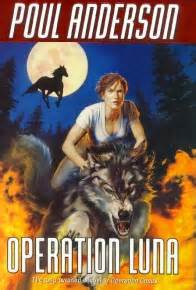
(ii) In Poul Anderson's Operation Luna, cooperation between Einstein and Planck released forces previously regarded as magical. What would have happened if they had continued to work separately?
(iii) In Alan Moore's Watchmen:
when a superhero has won the Vietnam War for the US, someone remarks that, if we had lost this war, we would have gone mad as a nation;
two journalists called Bernstein and Woodward are found dead;
the headline "RR to run for President?" is greeted with the question, "Who wants a cowboy actor in the White House?" Of course the headline refers to Robert Redford.
(iv) In SM Stirling's The Peshawar Lancers (New York, 2003), Warburton remarks that, if the Fall had not thrown back progress, then by 2025 the world would be beyond the possibility of a World War and might even have been united by the British Empire. Yasmini, a clairvoyant who sees alternative realities, stirs, then subsides... "Ask later, [King] thought." (p. 315)
Thursday, 11 June 2015
Fictions Within Fictions
(i) one fictional character referring to another, e.g., James Bond saying that he likes Nero Wolfe (Bond does say this);
(ii) fictions within the fiction.
(i) Usually, when a fictional character refers to, e.g., Sherlock Holmes, we understand that Holmes is as fictional to the character referring to him as he is to us. There are exceptions. For example, Holmes is real in Poul Anderson's Time Patrol series and in CS Lewis' Narnia Chronicles.
In SM Stirling's In The Courts Of The Crimson King, an archaeologist is unhappy when his exploits on Mars begin to resemble those of a certain whip-wielding cinematic archaeologist and, when held captive, he reflects that adventure fiction heroes locked in dungeons always escaped instead of having to be rescued...
(ii) Fictional characters can also refer to fictions that exist in their world but not in ours. Flandry says:
"'...an undertaking such as [Magnusson's] would be the most audacious ever chronicled outside of cloak-and-blaster fiction.'" -Poul Anderson, Flandry's Legacy (New York, 2012), pp. 450-451.
In a completer History of Technic Civilization, we would like to read:
one of their cloak-and-blaster novels;
media coverage of the Mirkheim crisis;
one of Andrei Simich's poems about a hero of Dennitza;
and a lot more.
Shakespeare presents more than one "play within the play." In Alan Moore's Watchmen, a comic about superheroes, a boy reads a pirate comic and we read it over his shoulder, becoming as involved with the fiction within the fiction as we are with the fiction. In our world, i.e., on Earth Real, Watchmen was dramatized as a feature film and the comic within the comic was dramatized as a short animated film. Following these Shakespearean and Moorean precedents, Anderson might have presented a cloak-and-blaster novel to be derided by Flandry for its inaccuracies and implausibilities.
Busy long weekend starting tomorrow so maybe less posts.
Wednesday, 10 June 2015
Question
Being able to overlap with either fantasy or sf connects horror to superheroes, which has also spun off as a separate genre. Whenever sf characters exercise a power like telepathy or teleportation, they approach superheroes territory. And they are always potentially close to horror although sf usually does not go there.
Any episode of The X-Files could be fantasy, sf or neither which is quite an achievement for a TV series. TV is usually genre-specific. But what of Poul Anderson? This blog has often listed his genres but has not included horror. There is a horror element in Volume IV of Poul and Karen Anderson's The Last King Of Ys (Later: Title slightly wrong. See first comment.) when a character who has died returns to kill others and has to be exorcised.
Regular readers might suspect that this question has been prompted by rereading some graphic fantasy horror by Alan Moore. Most questions can be related back to Poul Anderson in one way or another although sometimes the question might seem peripheral.
Following Lines Of Thought
We have had more posts on this blog today than I expected. One thought leads to another. Discussion of one Martian novel led to a discussion of Martian fiction in general which then led to brief posts on Venus, Jupiter and Mercury, sometimes interrupted by (I hope interesting) reports on local Lancastrian life.
I never know what is coming next. There has to be an angle but, as soon as there is an angle, there is always plenty to say or draw attention to. After a long stretch of reading prose, I like to escape into graphic fiction because the latter is visual as well as verbal. That means temporarily leaving Poul Anderson or SM Stirling for, e.g., Alan Moore, hence a recent link.
The present dilemma is whether to stay with Swamp Thing or return to ...Crimson Kings tonight. Either way, I will finish ...Crimson Kings soon and will receive the remaining "Lords of Creation" installment in September. Waterstones Bookshop tell me that they will get the Old Mars anthology merely because GRR Martin's name is on the cover...
Saturday, 6 June 2015
Chaotic Terrain
Poul Anderson would have welcomed human-alien contact but, with systematic thoroughness, wrote fictional accounts of interstellar exploration both with and without such contact. SM Stirling's "Lords of Creation" series, with its populated Venus and Mars, is wish fulfillment fiction. Alan Moore's post-organic, post-mortal character, Doctor Manhattan (see image), teleports to Mars where, when asked about the significance of life, says that he prefers:
chaotic terrain;
Mons Olympus;
the four miles deep, three thousand miles long, Valles Marineris, with day at one end and night at the other, where temperature differences cause shrieking winds to herd oceans of fog.
But then he is persuaded to value the thermodynamic miracle of each individual human birth.
Sunday, 24 May 2015
Today
Kilbirnie is killed when she pilots a boat too close to the accretion disk of the black hole;
Brent mutinies and thus does what I would have thought was impossible, reintroduces armed conflict between a handful of characters in an STL spaceship exploring a black hole thousands of light years away from Earth.
I have already posted about the quantum intelligences composed of virtual particles in the gravitationally distorted space near the black hole and also about social conditions back on Earth when the Envoy returns millennia later but will continue to reread the novel, expecting to notice some new details in the remaining 100+ pages.
I have also reread much of Alan Moore's Watchmen. Both of these very dissimilar authors are masters of several genres, albeit mainly in different media. I have listed Anderson's genres more than once before. It may be of interest to compare Moore's slightly different list:
Anderson
science fiction
fantasy
historical fiction
detective fiction
historical fantasy
heroic fantasy
historical sf
humorous sf
maybe two ghost stories?
Moore
science fiction
fantasy
horror
superheroes
fictional ads and political propaganda
a historical novel
a ghost story
pornography
contemporary fiction
a screen treatment
Someone will now tell me what I have missed from either list.
Saturday, 23 May 2015
Watchmen
I am rereading Alan Moore's Watchmen so I need an angle to discuss it on the Poul Anderson Appreciation blog. Easy. It is all in the alternative histories.
Poul Anderson gives us alternative histories in which:
the Carolingian myths were true;
William Shakespeare was not the Great Dramatist but the Great Historian;
technology was based not on science but on magic.
And Alan Moore gives us alternative histories in which:
when superhero comics inspired real life superheroes, comic books turned instead to pirates and, after the New York incident, to horror;
Superman and Captain Marvel were comic book characters but Mick Anglo's Marvelman was a parareality program and Moore's revived Marvelman was the real thing.
Absolutely Mind-blowing.
Saturday, 14 March 2015
Worlds And Words
Science fiction writers show words changing their meanings in the future. In Poul Anderson's There Will Be Time, Jack Havig, time traveling to his future, meets a young woman who, when asked what she does with her time, replies that she jokes a lot. An amateur comedienne? However, when she and he share a picnic with no one else present, she announces that she had figured they could joke after eating but why not before and after?
(Addendum, 15 Mar: Also highly relevant is Anderson's "A Tragedy of Errors." See comments.)
In Neil Gaiman's sequel to Alan Moore's Miracleman, "London" means an event as "Hiroshima" does for us and "Kidding" has become a swear word because of what the Kid did in London. (Alan Moore had asked, "What would someone with Superman's strength and speed but not his scruples do?" He then answered this question with extremely detailed instructions to a comic strip artist.)
In SM Stirling's "Shikari in Galveston," a Bengali trader surprises us by telling Eric King that the local savages "'...are a clean people...'" (p. 80) Clean? King has just complained of sweat, squalor, smoke, sewage and stink. However, the trader's use of the word "clean" does not refer to hygiene. He spells it out:
"'From the time of the Fall.'" (ibid.)
King understands:
"King nodded...that was one of the fundamental distinctions in the modern world, between those whose ancestors had eaten men in the terrible years after the hammer from the skies struck, and those who hadn't. The only more fundamental one was between those who still did, and the rest of humanity." (ibid.)
And I am certain that the use of the word "clean" would be extended in precisely this way in those circumstances.
Tomorrow there will be a family outing for Mothers' Day (we have two mothers in the household) so maybe not much time for posting. Before turning in this evening, I have had to stop reading Stieg Larsson in order to post and must now stop posting in order to watch Smallville. Retirement, as expected, is an endless choice between enjoyable activities.
Wednesday, 1 October 2014
Parallels
I may be alone either in reading both of these works or in being reminded of one by the other despite their manifold obvious differences. Summarized as above, Moore's fictitious planet, Ysm-Ault, sounds like a more fantastic version of Anderson's fictitious Chereion although I am sure that there is no connection.
I am enjoying both rereading Alan Moore's comic strips and starting to read the first Modesty Blaise novel. Meanwhile, I am at the uncomfortable pause between September and October. This note, written late on 30 September, will be saved and posted on 1 October.
Between the Young Flandry trilogy comprising Ensign Flandry, A Circus Of Hells and The Rebel Worlds and the Captain Flandry series starting with "Tiger By The Tail," there are two "Outposts of Empire" works, "Outpost of Empire" and The Day Of Their Return. These works follow the Young Flandry trilogy. "Outpost..." refers to Starkad. ...Return refers to Starkad, Talwin and the McCormac rebellion. ...Return also prefigures later Flandry works by introducing Aycharaych and Chunderban Desai.
John Ridenour is seen entirely externally in Ensign Flandry, where he addresses the title character curtly by his surname, but is the viewpoint character of some passages in "Outpost...," so these contrasting views of Ridenour are a possible subject for an October post.