Showing posts with label In The Courts Of The Crimson Kings. Show all posts

Sunday, 5 July 2015

Warm And Cold

Although I have not yet finished reading SM Stirling's Conquistador, I am now able to compare four fictional worlds created by Stirling: the Angrezi Raj and the Commonwealth of New Virginia, both set on (different versions of) Earth, retro-Venus and retro-Mars.

The first three are warm and sympathetic whereas the fourth is cold and unempathetic. One Martian expresses himself thus:

"'We might already be reveling in our seizure of a valuable ship and cargo, celebrating by absorbing costly essences and engaging in brutally non-consensual erotic entertainments of a type that I find deeply gratifying but which are difficult to arrange on a commercial basis. Why this delay?'"
-SM Stirling, In The Courts Of The Crimson Kings (New York, 2008), p. 86.

Which is worse, the sentiment expressed or the clinical dispassion with which it is expressed? Unfortunately, I know that some readers would be amused by this passage but I must beg to differ from them. Of course, I know that the author does not approve of these characters but nevertheless I find them rather unpleasant to read about.


Poul, Anderson and Poul Anderson

In the Lords of Creation timeline, a gathering of sf writers at the World Science Fiction Convention in Chicago, 1962, includes "Poul," who brings a case of Tuborg, likes boats and comments on a television transmission from Mars.

In the FirstSide timeline, Tom Christiansen and Adrienne Rolfe both like a number of writers, including "Anderson." In the New Virginia timeline, Adrienne's library includes Three Hearts And Three Lions and A Midsummer Tempest. Tom recognizes the titles so we know that they were imported from FirstSide.

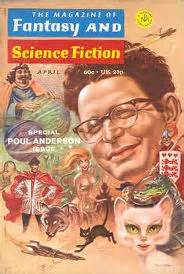
In our timeline, Poul Anderson (see image) wrote Three Hearts And Three Lions and A Midsummer Tempest.

Thus, here are three timelines containing respectively a Poul (presumably Anderson), a (presumably Poul) Anderson and a Poul Anderson but they are not exactly the same guy. The Poul of the Lords of Creation timeline lives in a detectably different Solar System whose history diverges drastically from ours after 1962. The Anderson of the FirstSide timeline lives on an Earth whose history diverges minimally from ours after 1617 and might diverge further later. I don't know yet.

But other activities call so that is the end of posting until this evening or maybe tomorrow.

Friday, 3 July 2015

Many Multiverses

There are several fictional multiverses:

Michael Moorcock's, disrupted by the Conjunction of the Million Spheres and adapted for comic books;

DC Comics', ended by the Crisis on Infinite Earths but restored with 52 universes in a later Crisis;

Arnold Schwarzenegger's in The Last Action Hero, doing for feature films what DC Comics does for comics;

Poul Anderson's several universes linked to the Old Phoenix Inn;

SM Stirling's several alternative universes, of which I have so far read three -

Alexander the Great survived into old age and a Gate opened from an Earth almost indistinguishable from ours (one novel);

in 1878, cometary fragments devastated Earth and a psychic senses alternative Earths (one story and one novel);

powerful aliens had terraformed Venus and Mars and later opened Gates to other places (one story and two novels).

Stirling also has two (?) multi-volume alternative history series that I have not tackled yet.

Friday, 26 June 2015

Poul Anderson And SM Stirling

I am informed that a character in Conquistador by SM Stirling is a Poul Anderson fan. Further, this novel shares a premise with a Poul Anderson short story. These are adequate reasons to discuss the novel on this blog but first I must buy and read a copy.

There have been two previous Anderson-Stirling connections.

(i) Both The Game Of Empire by Anderson and The Peshawar Lancers by Stirling refer to Kipling. This got me to read Kim for the first time.

(ii) Sf writers including Anderson cameo in the Prologue to Stirling's In The Courts Of The Crimson Kings. This prompted me to reflect on fictional versions of Mars in general and on Anderson's several versions in particular.

Comparisons with Wells, Stapledon and Heinlein are productive and Stirling is now definitely on this list.

Monday, 15 June 2015

Crimson Kings: Conclusion

I have read to the end of SM Stirling's In The Courts Of The Crimson Kings (New York, 2008) but confess to some confusion. Gates have opened to other worlds. How and why? Before that, I could not really engage with the unpleasant conflict for the Martian Imperial succession.

When an author makes a new contribution to an old theme, in this case the idea of an inhabited Mars, he should make us feel that his narrative is the true account whereas earlier stories or novels were at best approximations. Stirling does this. His characters must find their way through dark passages under a Martian city. On ERB's Barsoom, such passages were prowled by banths, the many-legged Martian equivalents of lions - although the banths too closely resembled African lions in one comic strip adaptation. Stirling's underground passages are inhabited by quite horrible and physically disgusting predatory life forms that I do not want to describe here and we feel that they have evolved as integral parts of the planetary ecology, unlike the unaccountable banths.

ERB, I think through a mere failure of imagination, did not indicate the presence of any children when describing Barsoomian society whereas Stirling can rationalize a Martian society with fewer children: Martians are long-lived, have dwindling resources and can control their fertility. The first two of these three points also applied to Barsoomians although ERB did not derive any conclusions from such premises. On the one hand, Barsoomians lived indefinitely without aging unless killed by accident or violence. On the other hand, they had a lot of violence all the time so they would have needed to keep replacing their population.

The Ruby Throne contains "...protein computers..." (p. 296). Protein, not electronic. Thus, maybe capable of duplicating, not merely simulating, brain functions? It would appear so. The Throne stores the conscious memories of previous Emperors. In fact, not mere memories: personalities that can converse with each other and with the current living ruler(s) in a virtual environment. Jeremy, the Terrestrial consort of the new Emperor, thinks:

"The people in front of him didn't exist, really. They thought they existed, and they had all the subjective experience of being alive; but all they really were was, as she'd said, memories - stored in the vast protein computers that were part of the Ruby Throne. One day he'd be nothing but memories here himself - or he'd be immortal, depending on whether you thought a perfect copy of something was the something or wasn't. He supposed it depended on the soul and that sort of thing. Most Emperors apparently died in communion with the Throne, and didn't experience any discontinuity; they went unconscious there and 'woke up' here, wherever here really was..." (p. 296)

Multiple issues here:

(i) Immortal? How long will the Ruby Throne last? Will its stored memories then be transferred somewhere else?

(ii) For a conscious being to think that it exists is for that being to exist, at least as a conscious being. Otherwise, it would not be able to think anything. When Jeremy thinks that they do not really exist, what he means is that their material basis is a protein computer, not a psychophysical organism. So they exist in a different way.

(iii) To have a subjective experience is to be a subject of consciousness and thus to exist as such a subject. "...alive..." is ambiguous. They no longer live as biological entities in the Martian environment although they are inside something composed of proteins. But "...being alive..." also means experiencing human life, i.e., seeing, hearing and interacting with other people. They are still doing this.

(iv) Since they are experiencing and responding to a present moment, they are not merely remembering past moments so they are not just memories - except insofar as each of us already is little more than the sum total of our conscious and recallable memories. To suffer complete and perpetually renewed amnesia would be to cease to be a conscious individual.

(v) Is a copy of something the something? A copy of Hamlet is Hamlet but not the original manuscript. If a dead Emperor had a soul, then that soul has entered the hereafter while his conscious memories have been recorded in the protein computer. But, if the existence of consciousness entails the existence of a soul, then a second soul has been generated in the computer just as the living Emperor's soul was generated in his body some time between its conception and its birth.

(vi) If an Emperor dies while away from the Throne, then there is discontinuity. He is revived with his memories until the moment when he left the Throne and has to be told what he did after that and how he died. Duplicates diverge, as Poul Anderson demonstrates in Genesis.

Next: NESFA Vol 4 has been ordered. Does anyone know how many such volumes there are?

Saturday, 13 June 2015

Mars And Stars

Comparing Poul Anderson with SM Stirling led to discussing Stirling's Mars novel, In The Courts Of The Crimson Kings. This led to discussing other science fictional treatments of Mars which in turn led to discussing other planets, the Solar System, the galaxy, the universe and the end of the universe. The universe and its end led back to earlier comparisons of Anderson with James Blish who in fact described Anderson's Tau Zero as the ultimate hard sf novel.

Tau Zero is:

sf because it is about an interstellar spaceship;
hard sf because its plot is fully consistent with the relativity theory and cosmology that were accepted when it was written;
a novel because it is a long prose narrative;
ultimate because it shows human beings surviving and human society continuing against the background of the universe.

This recalls CS Lewis' characterization of John Milton's Paradise Lost as the ultimate epic (a long narrative heroic poem):

Homer's epics were Primary because they showed incidents during the heroic age;
Virgil's epic was Secondary because it recounted a historical turning point, the founding of Rome;
Milton's epic is ultimate because it recounts Biblical history from before the Creation until after Armageddon.

Finally, I am glad of the increase in scientific knowledge and prefer to live in Anderson's universe.

Friday, 12 June 2015

Hibernation

Presumably extreme seasonal variations and natural selection could generate hibernation in intelligent beings? A few posts back, I learned that the Martians of Poul Anderson's Psychotechnic History survive their winters not only comatose but even with frozen blood. In Anderson's A Circus Of Hells, although hibernating Talwinians accidentally roused by a Merseian scientist instantly kill the scientist, the latter's colleagues do not retaliate, understanding that the reaction is automatic.

SM Stirling deduces a logical implication of his Martians' ability to hibernate. Martian jailers usually starve long term prisoners, thus forcing them to hibernate. Comatose prisoners are no trouble and cheaper. A doctor must warn jailers not to treat a Terrestrial prisoner in this way...

Thus, both authors think that hibernation makes sense on Mars and Stirling goes further by deducing how this might affect the behavior of intelligent beings.

Thursday, 11 June 2015

Fictions Within Fictions

Adventure fiction sometimes refers to adventure fiction. There are two ways to do this:

(i) one fictional character referring to another, e.g., James Bond saying that he likes Nero Wolfe (Bond does say this);

(ii) fictions within the fiction.

(i) Usually, when a fictional character refers to, e.g., Sherlock Holmes, we understand that Holmes is as fictional to the character referring to him as he is to us. There are exceptions. For example, Holmes is real in Poul Anderson's Time Patrol series and in CS Lewis' Narnia Chronicles.

In SM Stirling's In The Courts Of The Crimson King, an archaeologist is unhappy when his exploits on Mars begin to resemble those of a certain whip-wielding cinematic archaeologist and, when held captive, he reflects that adventure fiction heroes locked in dungeons always escaped instead of having to be rescued...

(ii) Fictional characters can also refer to fictions that exist in their world but not in ours. Flandry says:

"'...an undertaking such as [Magnusson's] would be the most audacious ever chronicled outside of cloak-and-blaster fiction.'" -Poul Anderson, Flandry's Legacy (New York, 2012), pp. 450-451.

In a completer History of Technic Civilization, we would like to read:

one of their cloak-and-blaster novels;
media coverage of the Mirkheim crisis;
one of Andrei Simich's poems about a hero of Dennitza;
and a lot more.

Shakespeare presents more than one "play within the play." In Alan Moore's Watchmen, a comic about superheroes, a boy reads a pirate comic and we read it over his shoulder, becoming as involved with the fiction within the fiction as we are with the fiction. In our world, i.e., on Earth Real, Watchmen was dramatized as a feature film and the comic within the comic was dramatized as a short animated film. Following these Shakespearean and Moorean precedents, Anderson might have presented a cloak-and-blaster novel to be derided by Flandry for its inaccuracies and implausibilities.

Busy long weekend starting tomorrow so maybe less posts.

Wednesday, 10 June 2015

Zhu Xi

"[The Martian Emperors'] official ideology - Sh'u Maz, roughly translatable as 'Sustained Harmony' - bears some resemblance to Zhu Xi's neo-Confucian synthesis, but it lacks the transcendentalist elements and is rigorously centered on 'this world,' expressing more modest aspirations."
-SM Stirling, In The Courts Of The Crimson Kings (New York, 2008), p. 210.

When reading this passage, I did not recognize the name "Zhu Xi," although I have probably encountered it before. When reading about Chinese philosophy, I am more interested in the Buddhist-Taoist synthesis that became Zen than in Confucianism but, as a former student of Hegelian philosophy, I am always interested in "synthesis." (A Religious Studies Professor at Lancaster University said that the only original thinker was Adam. Everyone else synthesizes.)

Like Poul Anderson, SM Stirling displays knowledge of Terrestrial religious philosophies. It is a major task to imagine equivalent traditions on another planet. Comparisons, as in this case with neo-Confucianism, are helpful but we must remember that the imaginary philosophy, in this case Sh'u Maz, is extraterrestrial.

Following Lines Of Thought

(I just did watch that Sin City dvd mentioned earlier. See here.)

We have had more posts on this blog today than I expected. One thought leads to another. Discussion of one Martian novel led to a discussion of Martian fiction in general which then led to brief posts on Venus, Jupiter and Mercury, sometimes interrupted by (I hope interesting) reports on local Lancastrian life.

I never know what is coming next. There has to be an angle but, as soon as there is an angle, there is always plenty to say or draw attention to. After a long stretch of reading prose, I like to escape into graphic fiction because the latter is visual as well as verbal. That means temporarily leaving Poul Anderson or SM Stirling for, e.g., Alan Moore, hence a recent link.

The present dilemma is whether to stay with Swamp Thing or return to ...Crimson Kings tonight. Either way, I will finish ...Crimson Kings soon and will receive the remaining "Lords of Creation" installment in September. Waterstones Bookshop tell me that they will get the Old Mars anthology merely because GRR Martin's name is on the cover...

Monday, 8 June 2015

ERB And SM Stirling

In his two "Lords of Creation" novels, SM Stirling follows his ERBian model to the letter.

Premise: both Mars and Venus are humanly habitable and inhabited.

Rationale (ERB did not need one): they were terraformed.

So far, so good. But Stirling goes further. The heroes of both his novels marry native princesses! This is at least possible if, as premised, the natives are not merely humanoid but fully human.

Stirling takes another step. He must combine his premise that the terraformed Mars was seeded from Earth with the tradition that Mars is an older planet. Simple:

"Although Mars was sterile until terraformed by the ancients two hundred million years ago, life on the Red Planet is, in a very real sense, 'older' than on Earth. It lacks the catastrophic mass extinction that followed the Yucatan asteroid impact of 65,000,000 mya..." (...Crimson Kings, p. 153)

Neat. I should not have to use that word but I am reduced to it.

"As a result of the uninterrupted evolutionary history, apart from a few subsequently introduced mammals, the lineages of most Martian species run back without interruption to the most successful of the late-Cretaceous introductions, birds, and the closely related therapod dinosaurs." (ibid.)

So they are older.

Poul Anderson occupies an intermediate stage: more scientifically oriented and accurate than ERB but not retro-ing like Stirling.

Sunday, 7 June 2015

Fictional Games

Poul Anderson's "The Saturn Game" focuses on a role-playing game. Anderson mentions chess twice, in "The White King's War," incorporated into A Circus Of Hells, and in "The Immortal Game," although only the latter describes the moves of a game.

(Addendum: Of course, Anderson "mentions" chess more than just twice. See comments.)

Science fiction provides opportunities for imagining new games or variations of games in the future or on other planets, although Anderson did not do this. We would expect the Merseians to play a combat-based board game. However, the winged Ythrians would not think in two dimensions.

Reading on, I have learned that SM Stirling's Martian board game, atanj, the Game of Life, can be played by up to eight and that its board is octagonal with sixty two squares on a side. These and other differences remove it far from any real comparison with chess. Another difference is that the Martians play it virtually all the time, hardly the case with chess. These Martians are unempathetic characters and I much prefer Stirling's Venus.

Iain M. Banks Culture novel, The Player Of Games, centers on extremely elaborate board games but we are not told any of their rules which I think we should be.

Saturday, 6 June 2015

Another Parallel

Stranded on Mars, James Blish's Adolph Haertel does not find an atmosphere plant sustaining a breathable atmosphere but does find the next best thing that helps to keep him alive. The Martian surface does have organisms that had not been detectable from Earth. The tumble-lichen has to crack both water vapor and oxygen out of the limonite sands in which it grows, then has to maintain both inside itself. Thus, when Dolph squeezes water from the plants back in his cabin, he also gets some oxygen - and can crack more from the water by electrolysis. Further, the resin from the lichen is edible and slows the metabolism.

A far cry from the ERBian Barsoom, to which Dolph refers for contrast. But each fictional Mars must be considered in the light of all the others. From SM Stirling's ...Crimson Kings, the readers mind may move either to other works by the same author or to other works set on Mars. Versions of the fourth planet recede away from us sideways in fictional time. Even CS Lewis, the theological sf writer, has a Mars with a humanly breathable atmosphere in a novel and a more realistic Mars in a short story.

Poul Anderson is not noted as a writer about Mars but does present several races of Martians and it makes sense to view his inhabitants of the red planet alongside everyone else's.

The Atmosphere Plant

One short phrase links:

Edgar Rice Burroughs' Mars;

SM Stirling's Mars;

several extrasolar planets described by Poul Anderson.

I have commented on this blog that Anderson often describes the equivalent of grass on habitable planets. Stirling does the same for his Mars:

"'...the atmosphere plant'...That low-growing, waxy-leaved plant was the Martian equivalent of grass..."
-SM Stirling, In The Courts Of The Crimson Kings (New York, 2008), p. 63.

However, it is more:

"...and also, ecologically, of oceanic plankton; it kept the oxygen content of the air. It had a fantastically efficient version of photosynthesis, flourished nearly everywhere, and stood at the bottom of nearly every food chain. An area too hostile for it was likely to be bleak indeed, even by this dying planet's standards." (ibid.)

Maintaining the oxygen supply, this plant must have been designed by the terraformers of Mars. Also, the current inhabitants use organic technology so maybe they too are partly responsible for the atmosphere plant's fantastic photosynthesis.

ERB's Mars, Barsoom, would already be dead if the red Martians did not artificially maintain its atmosphere with a factory called - the atmosphere plant!

Martian Crystal

"What does he know of England who only England knows?"

To appreciate Poul Anderson fully, we must also appreciate his contemporary sf writers. Personally, I prefer Anderson's hard sf to Ray Bradbury's soft sf. However, Bradbury is highly regarded, including by many hard sf writers. Further, I found considerably more in The Martian Chronicles when I reread it later in life. (Schoolboy opinions are not always trustworthy.)

"February

"1999

"YLLA

"They had a house of crystal pillars on the planet Mars, by the edge of an empty sea, and every morning you could see Mrs K eating the golden fruits that grew from the crystal walls, or cleaning the house with handfuls of magnetic dust which, taking all dirt with it, blew away on the hot wind."
-Ray Bradbury, The Martian Chronicles (London, 1977), p. 14.

This chapter heading and opening sentence display at least four interesting features.

(i) With its action beginning in 1999 (and continuing until 2026), The Martian Chronicles parallels SM Stirling's In The Courts Of The Crimson Kings, set on Mars in 2000 AD. However, ...Chronicles, copyright 1951, presents a future history whereas ...Crimson Kings, copyright 2008, presents an alternative history.

(ii) Bradbury consciously adopts an earlier narrative style that begins not with Mrs K's point of view but with an omniscient narrator directly informing the reader that the events of the story occur on the planet Mars.

(iii) Empty seas, dead sea bottoms, are familiar fictional Martian terrain.

(iv) Crystal is a Martian building material:

In "The U.S. Consulate...Robert Holmegard and his wife Dolores...gave a dinner for the explorers on a balcony of clear crystal supported by two curving braces of the same material shaped like slender snakes, a structure that seemed nerve-wrackingly fragile if you didn't know the strength of the stuff." (...Crimson Kings, p. 61)

That passage in ...Crimson Kings reminded me of Bradbury's opening sentence and thus initiated this post.

Human Martians

Most fictional Martians are not human beings. Indeed, how could they be? In fact, there are three exceptions. Poul Anderson's six or more Martian races are of course all aliens but Anderson's sf was preceded by, among others, the works of Edgar Rice Burroughs.

The first Martians encountered by ERB's John Carter - green, twelve foot, hairless, tusked, six limbed and egg-laying - sound more like giant insects. However, in any ERBian universe, the hero has to marry a Martian princess. Therefore, without any explanation or rationale, Carter soon encounters humanoid Martians. He not only marries the Princess of Helium but even gets her pregnant even though her metabolism is so different that, instead of giving live birth, she lays a large egg that will hatch their son. ERB's Mars, with its canals and thin but breathable atmosphere, was based on contemporary astronomical observations but his ideas about Martian life were off the wall.

Michael Moorcock pastiched ERB and rationalized human beings on Mars. His hero, Michael Kane, accessed Mars not by ERBian astral projection but by time travel into the far past. Thus, his Mars still had oceans, an atmosphere and a human race that had not yet migrated to Earth.

Thirdly, in SM Stirling's In The Courts Of The Crimson Kings (New York, 2008), mysterious beings with a higher technology have terraformed Mars and seeded (?) it with humanity originating on Earth. Thus, these tall, thin, dry humanoids are not products of extraterrestrial evolution but are related to us. I have started Chapter Two. So far, I am finding the text less accessible than that of the previous volume, The Sky People, because several passages are presented from the point of view of an unsympathetic Martian character whose historical and political context have not yet been fully explained.

A book on imagining extraterrestrials made the point that we have to imagine an organism that has originated and evolved elsewhere. Thus, a tall, thin, large-chested humanoid is not a Martian but a Terrestrial adapted to Mars. However, that is precisely what Stirling describes:

"...Highlanders even more eerily elongated than the standard Martians and barrel-chested..." (p. 53).

Friday, 5 June 2015

Marses

SM Stirling, In The Courts Of The Crimson Kings (New York, 2008).

"Martians called their planet Zho'da..." (p. 26).

Did they? We must take SM Stirling's word for it! I know Martians who call their planet Barsoom and others, speaking Solar, not Martian, who call it Malacandra. But there are many races of Martians... CS Lewis casually informs us that HG Wells' Martians are very different from the real Martians. Of course they are!

Zho'dans have several similarities to Barsoomians:

airships;
canals;
"...traveling silks and furs..." (p. 27);
swords;
an ancient civilization;
monarchical government;
human form.

(A longer list than I realized when I started to write it.)

How would Terrestrials seem to Martians? We should be able to deduce this but, of course, we need an imaginative writer, in this case SM Stirling, to tell us:

"'...they ooze. They're positively slick with water and mucus most of the time. You can feel it on their breath.'" (p. 24)

Earth is wet, Mars is dry... We should have been able to deduce that for ourselves.

How many Martian races does Poul Anderson present?

The War Of Two Worlds
Shield
"Duel on Syrtis" and its sequel
The Technic History
Are Martians mentioned in the Psychotechnic History? (I cannot remember off hand.) (Later: They are. See here.)

Chessmen Of Four Worlds

On Earth, when a red chess piece is moved onto a square already occupied by a white piece, the white piece is "taken," i.e. removed from the board.

On Wayland, in Poul Anderson's A Circus Of Hells, when an intelligent computer plays chess against itself, the large, robotic pieces fight for possession of squares.

On Barsoom, in ERB's The Chessmen Of Mars, jetan pieces (with 100, not 64, squares) take each other, except when the game is played with armed men who fight to the death.

On Zho'da, in SM Stirling's In The Courts Of The Crimson Kings, dice determine which atanj piece wins the fight for a square.

Thus, atanj combines skill with chance. Players can agree to throw dice on whether a Coercive piece will defect but we are also told that not exercising Coercives increases the odds of their defection - as if they had a mind of their own? Atanj also seems to include some role play. Three threes on the dice give the paratroops in a Flier Transport time to emerge and capture the Chief Coercive whose square they have invaded. Three ones mean that the paratroops have persuaded the Chief Coercive to turn against his Despot.

By moving together to another square, the Flier Transport and the defected Chief Coercive confront the Despot who must therefore either restore Sh'u Maz or abdicate. In the game described, he abdicates. Thus, the other Despot has proved his superior fitness both to perpetuate his lineage and to establish Sustained Harmony. Atanj pieces include Coercives, Clandestines, Blockade, Boycott, Flier Transport and Despot.

Barsoom and Zho'da are two fictional versions of Mars.

To Continue...

Life continues to interfere with Art. However -

We notice an Andersonian phrase given an entirely different meaning in SM Stirling's The Sky People (New York, 2007). The natives on Venus call a black woman from Earth "'...Night Face...'" (p. 58).

My copy of Stirling's second "Lords of Creation" novel, In The Courts Of The Crimson Kings (New York, 2008), arrived this morning. I have already read and quoted from its Prologue which is printed as a preview at the end of The Sky People. The Crimson Kings are, or were, rulers of Mars whereas "the Sky People" is what Terrestrials are called on Venus. A Martian calls Terrestrials "'...the vaz-Terranan...'" (p. 23), echoing the "vaz-Terran" of Starkadians in Anderson's Ensign Flandry.

The Prologues of the two "Lords of Creation" novels are set in 1962 when probes land on Venus, then Mars. The action of The Sky People occurs 1988-1990 whereas ...Crimson Kings begins in 2000. And now I really must read some of the novel before I can post anything more about it. Different planet, different characters, a new beginning.

Wednesday, 3 June 2015

The Sky People, Prologue

SM Stirling, The Sky People (New York, 2007).

The Prologue is six pages:

pp. 1-3 are headed VENUS June 14, 1962
pp. 4-6 are headed Baikonaur Cosmodrome, Kazakhstan, USSR June 14, 1962

"The morning sun was still low, casting the seven runners' shadows before them and turning the clouds to the color of raw gold." (p. 1)

"The land before the dozen-strong war party was gently rolling..." (p. 2)

"...a half-dozen figures pushed through the brush and stood staring at the probe." (p. 5)

Observations:

Knowing what we do both of space exploration in the 1960's and of Venus, we instantly recognize that this novel is set in an alternative Solar System. We do not even expect the Sun to be visible on the surface of Venus.

The number in this group seems to vary from seven to twelve to six? - although "half-dozen" could loosely mean "about six."

On pp. 5-6: the Yanki Martian probe will land next month. Thus, the sequel, In The Courts Of The Crimson Kings, will be simultaneous, not subsequent.

Words that we might need to google:

"...samovar..." (p. 4);
"...knobkerrie..." (p. 5);
"...prognathous..." (p. 5).

Any reader who does not immediately turn to Chapter One is not an sf fan.