Showing posts with label Rudyard Kipling. Show all posts

Friday, 14 August 2015

Sherlock Holmes And The Time Patrol

When Manse Everard reflects that Rudyard Kipling is still writing, he does not also mention Arthur Conan Doyle because the Time Patrol timeline has Dr John Watson instead!

"The private agent smiled sourly and watched [two disguised Time Patrolmen] with a narrow eye as they approached the mound; he was tall, thin, hawkfaced, and accompanied by a burly, mustached fellow with a limp who seemed a kind of amanuensis." (Time Patrol, p. 25)

Poul Anderson practices the art of understatement in this passage. Manse Everard, who is our viewpoint character and one of the two Patrolmen, knows very well that the burly, mustached, limping fellow is the private agent's amanuensis. It was reading that fellow's veiled reference to this incident that has brought Everard to 1894 in the first place.

The private agent asks Everard a sharp question after noiselessly approaching from behind. Everard has several paragraphs of conversation with Holmes who must be very carefully misdirected. The local Patrol office dare not employ him because he might learn too much. And later in Everard's career, the latter must secure the Altamont case.

Rudyard Kipling And The Time Patrol

How often does Poul Anderson mention Rudyard Kipling? Maybe twice in the Harvest of Stars tetralogy?
At least twice in the Time Patrol series. Both Manse Everard and Wanda Tamberly think of Kipling.

Everard in "Time Patrol":

"At this moment his mother had not been born, his grandparents were young couples just getting settled to harness, Grover Cleveland was President of the United States and Victoria was Queen of England, Kipling was still writing and the last Indian uprisings in America still to come... It was like a blow on the head." (Time Patrol, p. 24)

Wanda, narrating in the Galapagos in "The Year Of The Ransom":

"'Excellent loneliness.' Yes, Kipling could say it. I remember how those words of his rolled up and down my spine when I first heard them, Uncle Steve reading aloud to me." (p. 641)

The mere mention of an author's name evokes all of his works, with their similarities to and differences from Anderson's.

"The Year Of The Ransom" was first published not as a new Time Patrol story in The Magazine Of Fantasy And Science Fiction but as a short, illustrated, juvenile novel. We start not with Manse Everard but with the niece of a Time Patrolman although we do not know that yet. But before even the reference to "Uncle Steve" comes an appropriate two word quotation from Kipling.

Friday, 26 June 2015

Poul Anderson And SM Stirling

I am informed that a character in Conquistador by SM Stirling is a Poul Anderson fan. Further, this novel shares a premise with a Poul Anderson short story. These are adequate reasons to discuss the novel on this blog but first I must buy and read a copy.

There have been two previous Anderson-Stirling connections.

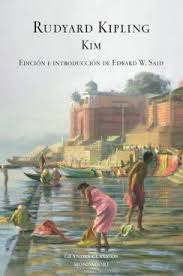
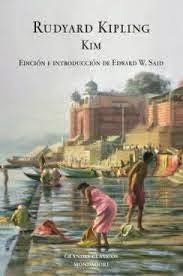
(i) Both The Game Of Empire by Anderson and The Peshawar Lancers by Stirling refer to Kipling. This got me to read Kim for the first time.

(ii) Sf writers including Anderson cameo in the Prologue to Stirling's In The Courts Of The Crimson Kings. This prompted me to reflect on fictional versions of Mars in general and on Anderson's several versions in particular.

Comparisons with Wells, Stapledon and Heinlein are productive and Stirling is now definitely on this list.

Tuesday, 2 June 2015

What To Reread

Reading Kim by Rudyard Kipling is entertaining and so far has generated five posts, including this one, so it seems worthwhile to continue, at least until SM Stirling's In The Courts Of The Crimson Kings arrives. Another option is to reread parts of Stirling's The Sky People in preparation for ...Crimson Kings. Despite having read The Sky People recently, I do not recall all of its events by any means. Most such information remains outside conscious memory, necessitating continual reference back to the relevant texts.

I think that the comparisons and connections that I make between Kipling and Poul Anderson are valid but, in any event, this is free composition where anything goes and the sky is the limit! It is good to read and discuss such works even if in the process Poul Anderson Appreciation becomes a more general literary appreciation. However, on this blog, other texts will usually be perceived insofar as they connect with or relate to Poul Anderson.

A List Description

Having frequently quoted and commended Poul Anderson's colorful and comprehensive list descriptions (scroll down) of busy street scenes, I have now found such a description in Rudyard Kipling's Kim (London, 2010) as could have been written by Anderson.

Kim and the lama enter the Kashmir Serai, a "...huge open square...surrounded with arched cloisters where the camel and horse-caravans put up on their return from Central Asia." (p. 17)

In the Serai, "...all manner of Northern folk..." (ibid.):

tend ponies and camels;
load and unload bales and bundles;
draw water;
pile grass for stallions;
cuff caravan dogs;
pay camel drivers;
engage grooms;
swear, shout, argue and chaffer.

In addition to the sounds of human voices, the well-windlasses creak and the stallions shriek. The four descriptions of conversations, "...swear..." etc, are particularly Andersonian, especially the chaffering. However, Anderson would also have listed:

the kinds of Northern folk;
more noises from animals and other sources;
the various, intermingling smells!

All The World(s) Going And Coming

Science fiction writers have sometimes based Terrestrial colonials and extraterrestrial natives on European colonials and Asian or African natives. Equally, an account, for example, of British-ruled India can seem so exotic as to remind the reader of a science fictional setting:

"'Look! Brahmins and chumars [or see], bankers and tinkers, barbers and bunnias, pilgrims and potters - all the world going and coming.'"
-Rudyard Kipling, Kim (London, 2010), p. 58.

And, on the extrasolar planet Imhotep, Diana Crowfeather sees, among the "...brawling, polyglot, multiracial population, much of it transient, drifting in and out on the tides of space..." (Poul Anderson, Flandry's Legacy, p. 195), Tigeries, a Donarrian, Irumclagians, Shalmuans and a Wodenite.

Religions on Imhotep are also as diverse as in Kipling's India. Whereas Tigeries are inchoate pagans and Diana sleeps in "...a ruinous temple..." (p. 196), the Wodenite, Francis Xavier Axor, is ordained in the Galilean Order of the Jerusalem Catholic Church. The orphan Diana guides Axor just as the orphan Kim had guided a Tibetan lama (see image).

Read Kipling, then Anderson (if you haven't already).

The Universal Quest In Kipling And Anderson

Kim's lama walks around North West India seeking his River of Enlightenment. Mad though this quest is, we are all on the same quest in different forms. My friends go to church. I sit facing a wall. None of us walks around England peering into every river or stream. But we will know Enlightenment when it finds us - or when He finds us if you are a theist. The lama and I refer to one Aryan Lord whereas my Anglican friends refer to their Hebrew Lord. The Ways transcend nation and race. (Malcolm X met white Muslims at Mecca.)

Poul Anderson's Fr Axor travels between planetary systems seeking evidence for the Universal Incarnation. Will he find it? He might, but we expect that many of his contemporaries will not accept his interpretation of the data.

The lama and Axor, clergy beings in their respective traditions, are equally sincere. However, seekers are as multifarious as the Truth is manifold.

"'Stand by. The Divine, in whatever form It manifests Itself to you, the Divine is with us.'" (Flandry's Legacy, p. 261)

Kim Again

I have read again Chapters 1 and 2 of Kim (London, 2010), with their references to the "...Peshawur brigades." (p. 38) It seems that the many faiths and castes traveling on the Indian trains are as diverse and exotic as the innumerable intelligent species in Poul Anderson's Terran Empire. Thus, Kipling's India feels very close to Anderson's extrasolar planets - and also to SM Stirling's alternative histories, especially of course to the history of the Angrezi Raj and The Peshawar Lancers.

However, since it is now past midnight and the 2nd of June, this post goes no further. I hope soon to post about Stirling's history in which explorers from Earth encounter exotic inhabitants of Mars and Venus.

Monday, 1 June 2015

Kamakura

Both Rudyard Kipling (here) and Poul Anderson (here) refer to Buddhism in Kamakura. However, Anderson's short story describes a visit to Japan whereas Kipling's novel is set in India.

Recent posts have discussed ancient mythology, scientific cosmology and a Kipling connection: essential Poul Anderson.

In his Japan-based story, Anderson also mentions:

the Temple of the Golden Pavilion;
Sumiyosi Taisha;
the Sengakuji;
the Forty-Seven Ronin;
Daibutsu;
the Hase district;
the Kannon Hall;
Sagami Bay;
Jizo;
Amida.

"The Shrine for Lost Children" was more coherent on rereading and contains a wealth of Japanese references. See links above.

Monday, 6 April 2015

New Connections

To anyone who may be interested in the Kipling connection, new correspondent, David Birr, has disclosed the source of Poul Anderson's title, "No Truce With Kings" (see Comment here).

And to anyone interested either in the Wells connection or in humorous sf&fantasy, David has drawn attention to a humorous story by Wells (see Comment here).

Thank you, David.

I had not known of the Kipling poem and had not remembered the Wells story so it is helpful to have these works drawn to our attention. There is bound to be more out there that other blog readers know about?

Monday, 9 March 2015

Religious Diversity

SM Stirling, like Rudyard Kipling, captures the religious diversity of India, which Poul Anderson reproduces in futuristic settings.

Kipling: his present;
Anderson: our future;
Stirling: an alternative future, in The Peshawar Lancers (New York, 2003).

Stirling's Bombay has a "...Parsi mayor..." (p. 355).

"Except for beef, Narayan Singh would cheerfully eat anything with anyone; Nanak Guru, the founder of the Sikh faith, had disliked caste and the ritual-purity rules about who could eat with whom." (p. 349)

This was part of the appeal of Christianity:

Roman imperialist oppression and uniformity necessitated a new message of universal hope, transcending local rituals. Displaced slaves needed to believe that their god was omnipresent, not local. The new message was that one dying and rising god saves all men with a perfect sacrifice which, re-enacted with bread and wine, supersedes complicated ritual cleanliness, repeated animal sacrifices and divisive dietary laws.
- copied from here

India preserves intact many features of the ancient world, including even Jainism - Mahavira is regarded as its reformer, not its founder!

Bradshaw

Bradshaw's Guide is consulted by:

Sherlock Holmes;

Mainwethering of Poul Anderson's Time Patrol London office;

a character in a ghost story by Rudyard Kipling;

Athelstane King in SM Stirling's The Peshawar Lancers (New York, 2003), p. 343;

Michael Portillo, former Conservative Member of the British Parliament (see image).

King has Bradshaw's Indian Imperial Railways by Newman's of Calcutta. Bradshaw himself died in 1853, well before the Fall.

Portillo, in a BBC TV series, traveled around Britain, and later Europe, guided by Bradshaw. His brief was to find out how much of Bradshaw's world still survived and how much had changed. For example:

the railway takes Portillo to the building that was the first factory (and here) in the world;
Bradshaw describes the Crystal Palace which burned down in 1936;
Birmingham will soon have a majority non-white population, unlike in Bradshaw's time! - there is a Central Mosque and many Indian restaurants and one restaurant owner intends to found a college to teach authentic Indian cooking.

It would have been remiss of either Anderson or Stirling not to mention Bradshaw but, of course, they both do.

Friday, 27 February 2015

In The Footsteps Of Kim

"And truly the Grand Trunk Road is a wonderful spectacle. It runs straight, bearing without crowding India's traffic for fifteen hundred miles - such a river of life as nowhere else exists in the world."
-Rudyard Kipling, Kim (London, 2010), p. 58.

"...the white crushed stone of the military highway that snaked down from the Khyber Pass to Peshawar...Right now the Grand Trunk Road was thronged with the returning men and beasts of the Charasia Field Force, following the path trodden by generations of fighting men..."
-SM Stirling, The Peshawar Lancers (New York, 2003), p. 1.

I have not yet read to the end of page 1 of The Peshawar Lancers, nor will I at 1:08 am, but we are already deep in Kipling territory. Poul Anderson reproduces aspects of Kim a thousand years hence on another planet whereas Stirling takes us back to the Grand Trunk Road in an alternative twenty first century. In the Terran Empire of Anderson's History of Technic Civilization, they say, "Glory to the Emperor!" I will learn what it would be appropriate to say in the Angrezi Raj of Stirling's alternative history.

Monday, 16 February 2015

Literary Lineages Etc

Are Rudyard Kipling, Poul Anderson and SM Stirling a kind of literary lineage? Having recently compared Anderson's The Game Of Empire to Kipling's Kim, I will shortly read Stirling's The Peshawar Lancers, to be discussed either on this blog or on the Science Fiction blog as appropriate. Of course, Stirling could be influenced by Kipling directly as well as, or instead of, via Anderson.

Returning to the present, it was unpredictable either that the second NESFA collection would include "Marque and Reprisal" or that this unexpected inclusion would generate further discussion of Gunnar Heim. Thus, the blog cannot possibly have any planned direction.

Continuing the summary from the previous post, the Aleriona artificial environment includes both a fountain and a bosket. Anderson cannot have expected his readers to understand every word that he used but did trust them to appreciate a vocabulary richer than usual in popular fiction. Over the course of nearly three years of blogging, I have learned to look out for:

words for which I need a dictionary;
uses of Latin;
moments when a character realizes without yet stating the solution to a problem;
equivalents of grass on extrasolar planets;
different means of faster than light travel;
the almost systematic application of alternative approaches to major themes like immortality, time travel, artificial intelligence and interstellar civilization.

In section 4 of "Marque and Reprisal," Gunnar Heim interviews another politician, the French minister for extraterrestrial affairs and chief representative in the World Parliament. That completes preliminary discussions. Heim will soon take action. Returning to a conversation listed in the previous post, I think that he is way too hard on his daughter.

Saturday, 14 February 2015

Multiple Comparisons

Poul Anderson's The Game Of Empire is comparable to the works of:

Robert Heinlein because it is a volume of a future history;

CS Lewis and James Blish because it addresses theological issues in science fiction;

Rudyard Kipling because it pays homage to Kipling and also because its young protagonist, an orphan in a multicultural society, is drawn into intelligence work on behalf one empire as against another while helping a pilgrim.

I am confident that this list does not exhaust the implications of Anderson's novel, which could easily be categorized as mere action-adventure fiction.

Thursday, 12 February 2015

"...it is enough that we are on our way"

Because I practice zazen, I tread the same path as Adzel and as Kim's lama although approaches differ, to say the least. Dogen, a pivotal figure in the Soto Zen lineage, wrote:

"It is futile to travel to other dusty countries, thus forsaking your own seat."
-Dogen, "Rules for Meditation," recited in Serene Reflection Meditation groups.

Adzel traveled because of his work as a planetologist but then retired to a monastery whereas the lama walks the length and breadth of Hind, supported by a mendicant-respecting culture.

More generally, society moves though it does not know where to:

"We do not know where we are going. Nor do most of us care. For us it is enough that we are on our way."
-Poul Anderson, The Van Rijn Method (New York, 2009), p. 556.

I do not know what will happen next with the blog - Anderson's Genesis, Kipling's Kim, Anderson's The Game Of Empire, then what?

See also here.

Time And Empire

(There are more beautiful Kim covers on the Internet than I will be able to use on the blog.)

British Empire versus Tsarist Empire reads like an earlier version of United States versus Soviet Union or Terran Empire versus Merseian Roidhunate. Must such imperial conflicts recur throughout history? Certainly not. The Roman Empire did not have a comparable opponent and Poul Anderson shows us future intelligences seeking knowledge, not power.

Some graffiti near here says that every revolution (read: major change) seems impossible beforehand and inevitable afterwards. Most people most of the time accept their status quo, then when it changes, accept their new status quo! Intelligent beings, whether human or not, are able to change their natural and social environments and to inhabit qualitatively different social environments.

In science fiction, we value future interstellar empires and civilizations that have transcended social conflicts.

Wednesday, 11 February 2015

Contemporary And Futuristic

A contemporary novel can be set in a society that is known to the author whereas a futuristic novel cannot. This means that the contemporary novel can embody a kind of verisimilitude that it is difficult or impossible to reproduce in the futuristic novel.

"All hours of the twenty-four are alike to Orientals..."
-Rudyard Kipling, Kim (London, 2010), p. 26.

"The escort, their heads tied up native fashion, fell in on either side of the cart, shuffling enormous clouds of dust." (p. 76)

"...every tale was told in the even, passionless voice of the native-born..." (p. 127)

"A very few white people, but many Asiatics, can throw themselves into a mazement as it were by repeating their own names over and over again to themselves, letting the mind go free upon speculation as to what is called personal identity." (p. 190)

"Even to-day, tickets and ticket-clipping are dark oppression to Indian rustics. They do not understand why, when they have paid for a magic piece of paper, strangers should punch great pieces out of the charm. So, long and furious are the debates between travellers and Eurasian ticket-collectors." (p. 202)

"...native police mean extortion to the native all India over." (p. 212)

Kim is full of Kipling's acute observations of the people of India. Obviously, Poul Anderson was not able to observe the colonists on Imhotep or Daedalus in just this way. Paradoxically, fictional verisimilitude might be more evident when, having fully realized another rational species like the Ythrians, Anderson introduces a new member of that species, a new unique individual who nevertheless behaves authentically as an Ythrian and not like an impossibly winged human being. We know how Ythrians live and die because Poul Anderson has told us in previous stories and, of course, there is no one to contradict him!

Old Books

The Wheel of Life, familiar in Buddhist iconography, (see here) is described in Kim (London, 1944), p. 274.

Lancashire Libraries have only one copy of Kim, which is seventy one years old, falling apart and missing four pages of text. Fortunately, I have meanwhile asked a second hand bookseller to track down a copy. The Secret Service aspect of the plot was, to me, unexpected. The Great Game feels like a great cause but all that they are really doing is maintaining the status quo.

Reading Kim has enabled me to reread Poul Anderson's The Game Of Empire from a fresh perspective - see recent posts - so I make no apology for discussing another author on Poul Anderson Appreciation. The context of a work is one aspect of the work.

Duty calls.

Tuesday, 10 February 2015

Religious Diversity

No one needs to be told that India is a land of many religions. Apart from the paths of Indian origin, there are episcopal St Thomas Christians and rabbinical Indian Jews although neither of these traditions has yet figured in Rudyard Kipling's Kim, which I am still reading. Strangers on trains inquire about each other's gods. A Tibetan Buddhist lama stays at an Indian Jain monastery and pays for Kim's European Catholic education whereas a Muslim horse-trader covertly working for British Intelligence pays for the many demonic invocations considered necessary to prepare Kim for his life on the Road. The begging lama has access to funds to be used for religious or charitable purposes though not for personal consumption. As in Europe, poverty for individual monks but wealth for monastic institutions.

Poul Anderson reproduces such religious diversity in his fictional Patrician System:

Diana Crowfeather hides her possessions, and sometimes sleeps, in a "...ruinous temple..." (Flandry's Legacy, p. 196);

the landlord at the Sign of the Golden Cockbeetle is called Hassan (p. 200), possibly a lapsed Muslim;

Tigeries are pagan;

there is a Jerusalem Catholic church on Daedalus;

Olaf Magnusson is a Neosufi who, to our surprise, invokes "'...the God...'" (p. 400) of the Merseians;

the Zacharians have their own creation myth;

Fr. FX Axor, the Wodenite Jerusalem Catholic priest, hopes that records of the Foredwellers will lead to "'...the very revelation of Christ's universality...'" (p. 403);

the announcement of the Magnusson insurrection ends: "'Stand by. The Divine, in whatever form It manifests Itself to you, the Divine is with us.'" (p. 261)

An eclectic proclamation for a multi-faith society.