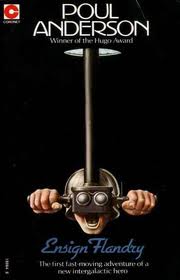
In spy fiction, how often does our hero's sexual prowess become one of the skills to be used in Intelligence work? En route to Merseia, Ensign Flandry has initiated an affair with Lord Hauksberg's mistress. On Mersia, Max Abrams acquires sensitive intelligence that must be transmitted to Earth without the knowledge of either Hauksberg or their Merseian hosts. Solution: arrange for Hauksberg to surprise Flandry with the mistress so that the Ensign can be sent home in disgrace... Later in his career, Flandry obtains important intelligence from a Resident's wife.
SMERSH baits a trap for James Bond by persuading Tatiana Romanova to contact British Intelligence with the story that she has fallen for Bond and will defect bringing with her important intelligence provided that it is he who comes to get her. Of course, Tatiana, like several other women on the other side, really does fall for Bond.
I am not sure how long this Flandry-Bond comparison will continue but, while it does, I find it as interesting as anything else.
Showing posts with label Ensign Flandry. Show all posts
Thursday, 10 March 2016
Lessons Learned
In his introductory novel, Ensign Flandry, Dominic Flandry has a mentor, Max Abrams. Flandry learns that human beings have a duty to act, that sometimes they do their best, a few times they succeed, and they dare not ask for more. Duties include resistance to aggression. On this basis, Flandry begins his career in Intelligence. He will succeed more than a few times.
In his introductory novel, Casino Royale, James Bond has no mentor and has already been working in Intelligence since before the War. Nevertheless, he now learns the lesson that will propel him through eleven more novels and two short story collections:
"He would go after the threat behind the spies, the threat that made them spy."
-Ian Fleming, Casino Royale (London, 1965), p. 189.
In an invented history, the Merseian threat can remain in place from Flandry's youth to his old age whereas Fleming, keeping each novel contemporary, had to acknowledge some real world changes. Thus, the focus shifted:
SMERSH under Beria (a historical figure);
SMERSH under G (a fictitious character);
SMERSH members joining Blofeld's SPECTRE after Krushchev has disbanded their organization.
Nevertheless, in his twelfth novel, Fleming, confessedly writing the same book over again, has reverted to the KGB under Semichastny (a historical figure). Flandry's equivalents of Beria etc are Brechdan Ironrede and Tachwyr the Dark. But Anderson also shows us Flandry aging and, beyond that, the rise and fall of civilizations, thus transcending Fleming's exclusive focus on the active career of a single individual whose earlier biography had to be revised to prevent him from reaching retirement during the series.
In his introductory novel, Casino Royale, James Bond has no mentor and has already been working in Intelligence since before the War. Nevertheless, he now learns the lesson that will propel him through eleven more novels and two short story collections:
"He would go after the threat behind the spies, the threat that made them spy."
-Ian Fleming, Casino Royale (London, 1965), p. 189.
In an invented history, the Merseian threat can remain in place from Flandry's youth to his old age whereas Fleming, keeping each novel contemporary, had to acknowledge some real world changes. Thus, the focus shifted:
SMERSH under Beria (a historical figure);
SMERSH under G (a fictitious character);
SMERSH members joining Blofeld's SPECTRE after Krushchev has disbanded their organization.
Nevertheless, in his twelfth novel, Fleming, confessedly writing the same book over again, has reverted to the KGB under Semichastny (a historical figure). Flandry's equivalents of Beria etc are Brechdan Ironrede and Tachwyr the Dark. But Anderson also shows us Flandry aging and, beyond that, the rise and fall of civilizations, thus transcending Fleming's exclusive focus on the active career of a single individual whose earlier biography had to be revised to prevent him from reaching retirement during the series.
Monday, 7 March 2016
Battle On The Sand
Poul Anderson's Time Patrol series refers to seafarers, spacefarers and timefarers. In 976 BC, a battle at sea involves one contemporary ship and several far future timecycles. See here.
If space travelers colonize terrestroid planets, then those planets will have seas and seafarers. Anderson describes extrasolar battles at sea here and here.
Chapter Twelve of Jerry Pournelle's King David's Spaceship makes clear that its author understands sailing. Elsewhere, Pournelle tells us how he enlisted Poul Anderson as crew for his ocean racing sloop. (See Jerry Pournelle, "An Appreciation of Poul Anderson" IN Greg Bear and Gardner Dozois, Editors, Multiverse: Exploring Poul Anderson's Worlds (Burton MI, 2014), pp. 277-283 AT p. 280.)
Introducing superior sailing techniques to the backward planet, Makassar, the Samualites in their ship, Subao, outrun all but one of a pirate fleet. Makassar's two small close moons cause strong tides. Thus, when the tide races out of a shallow bay, Subao and her single remaining pursuer run aground and the two crews fight on the sand with swords, lances and crossbows. Subao has the advantage of two horsemen. When the tide returns in a single wave, one horseman gallops close enough to the pirates' ship to cut their anchor line so that their ship is cast onto the rocks.
If space travelers colonize terrestroid planets, then those planets will have seas and seafarers. Anderson describes extrasolar battles at sea here and here.
Chapter Twelve of Jerry Pournelle's King David's Spaceship makes clear that its author understands sailing. Elsewhere, Pournelle tells us how he enlisted Poul Anderson as crew for his ocean racing sloop. (See Jerry Pournelle, "An Appreciation of Poul Anderson" IN Greg Bear and Gardner Dozois, Editors, Multiverse: Exploring Poul Anderson's Worlds (Burton MI, 2014), pp. 277-283 AT p. 280.)
Introducing superior sailing techniques to the backward planet, Makassar, the Samualites in their ship, Subao, outrun all but one of a pirate fleet. Makassar's two small close moons cause strong tides. Thus, when the tide races out of a shallow bay, Subao and her single remaining pursuer run aground and the two crews fight on the sand with swords, lances and crossbows. Subao has the advantage of two horsemen. When the tide returns in a single wave, one horseman gallops close enough to the pirates' ship to cut their anchor line so that their ship is cast onto the rocks.
Monday, 29 February 2016
Merseians And Moties
Poul Anderson's Ensign Flandry is the opening volume of the Dominic Flandry series, a major part of Anderson's History of Technic Civilization. In Ensign Flandry, the title character is given a guided tour of the planet Merseia but must leave in a hurry. Merseian supremacism threatens the Terran Empire. The problem is ideological.
Larry Niven's and Jerry Pournelle's The Mote In God's Eye is the opening volume of the Moties diptych, a major part of Pournelle's CoDominium future history. In Mote..., crew members and passengers from the human spaceship, MacArthur, are given a guided tour of the planet Mote Prime but must leave in a hurry. The Motie breeding cycle threatens the Second Empire of Man. This problem is biological.
I appreciate two works simultaneously without implying that there is any textual one-to-one correspondence. Both series are Heinleinian future histories although with a structural difference. Whereas Anderson's Psychotechnic History and, I think, Pournelle's CoDominium History were consciously modeled on Robert Heinlein's Future History, the Technic History grew into a vaster Heinleinian template by the fusion of two originally independent series.
A future history comprises several successive periods, e.g., -
Heinlein: technological advances, interplanetary imperialism, the Prophets, the Covenant, the first mature culture;
Asimov: Robots, Empire, Foundation;
Cities In Flight: the Vegan Tyranny, the Earthman culture, the Web of Hercules, new universes;
The Seedling Stars: Port Authority; extrasolar colonies; a far future "Watershed";
Psychotechnic: UN, Solar Union, Stellar Union, Galactic civilization;
Technic: several periods, including Commonwealth (van Rijn) and Empire (Flandry);
Niven: interplanetary exploration; UN and Belt, Man-Kzin Wars, Known Space, the Thousand Worlds;
Pournelle: CoDominium, First Empire, Secession Wars, Second Empire.
(Blog readers will recognize Asimov's as another fused future history.)
James Blish and Poul Anderson also link the future to the past -
After Such Knowledge:
Roger Bacon, possibly inspired by a demon, invents scientific method;
demons manifest in the twentieth century;
a Jesuit biologist suspects demonic influence on an extrasolar planet in the twenty first century.
The Boat Of A Million Years:
immortals live through history into an indefinite future.
Larry Niven's and Jerry Pournelle's The Mote In God's Eye is the opening volume of the Moties diptych, a major part of Pournelle's CoDominium future history. In Mote..., crew members and passengers from the human spaceship, MacArthur, are given a guided tour of the planet Mote Prime but must leave in a hurry. The Motie breeding cycle threatens the Second Empire of Man. This problem is biological.
I appreciate two works simultaneously without implying that there is any textual one-to-one correspondence. Both series are Heinleinian future histories although with a structural difference. Whereas Anderson's Psychotechnic History and, I think, Pournelle's CoDominium History were consciously modeled on Robert Heinlein's Future History, the Technic History grew into a vaster Heinleinian template by the fusion of two originally independent series.
A future history comprises several successive periods, e.g., -
Heinlein: technological advances, interplanetary imperialism, the Prophets, the Covenant, the first mature culture;
Asimov: Robots, Empire, Foundation;
Cities In Flight: the Vegan Tyranny, the Earthman culture, the Web of Hercules, new universes;
The Seedling Stars: Port Authority; extrasolar colonies; a far future "Watershed";
Psychotechnic: UN, Solar Union, Stellar Union, Galactic civilization;
Technic: several periods, including Commonwealth (van Rijn) and Empire (Flandry);
Niven: interplanetary exploration; UN and Belt, Man-Kzin Wars, Known Space, the Thousand Worlds;
Pournelle: CoDominium, First Empire, Secession Wars, Second Empire.
(Blog readers will recognize Asimov's as another fused future history.)
James Blish and Poul Anderson also link the future to the past -
After Such Knowledge:
Roger Bacon, possibly inspired by a demon, invents scientific method;
demons manifest in the twentieth century;
a Jesuit biologist suspects demonic influence on an extrasolar planet in the twenty first century.
The Boat Of A Million Years:
immortals live through history into an indefinite future.
Saturday, 20 February 2016
Cosmic Conflicts
In Ensign Flandry, a rogue planet will strike a star, making it go nova, thus destroying its planetary system, including one planet with two intelligent species.
In For Love And Glory, two black holes will coalesce.
So far, these are collisions, not conflicts. It is consciousness that causes conflicts. Conscious beings seek to gain from knowledge of imminent cosmic collisions and therefore practice not only knowledge-seeking but also secrecy.
In Ensign Flandry, a Merseain Fodaich says in accented Anglic:
"'...interdicted region...Turn back at once.''" (Young Flandry, p. 174)
Captain Einarson replies:
"'His Majesty's government does not recognize interdictions in unclaimed space...'" (ibid.)
In FLAG, Dominator Ironbright says:
"'Your presence is inadmissable. This region is closed. Remove yourselves.'" (p. 124)
Captain Valen replies:
"'We are not aware of any such interdiction...By what right do you declare it? It seems to be in violation of treaty agreements and general custom.'" (p. 125)
It seems that it is easier to change fictional universes and alien species than to change the nature of political and military conflicts!
In For Love And Glory, two black holes will coalesce.
So far, these are collisions, not conflicts. It is consciousness that causes conflicts. Conscious beings seek to gain from knowledge of imminent cosmic collisions and therefore practice not only knowledge-seeking but also secrecy.
In Ensign Flandry, a Merseain Fodaich says in accented Anglic:
"'...interdicted region...Turn back at once.''" (Young Flandry, p. 174)
Captain Einarson replies:
"'His Majesty's government does not recognize interdictions in unclaimed space...'" (ibid.)
In FLAG, Dominator Ironbright says:
"'Your presence is inadmissable. This region is closed. Remove yourselves.'" (p. 124)
Captain Valen replies:
"'We are not aware of any such interdiction...By what right do you declare it? It seems to be in violation of treaty agreements and general custom.'" (p. 125)
It seems that it is easier to change fictional universes and alien species than to change the nature of political and military conflicts!
Friday, 19 February 2016
Going Hyper
When fictional characters travel in a jet plane, the technical parameters of their journey are laid down by factors external to the fictional text whereas, when an sf writer invokes "hyperspace," he can say what he wants. Thus:
in Poul Anderson's History of Technic Civilization, travelers take time to cross interstellar distances faster than light and cannot communicate by hyperspatial pulses across more than a light year;
in Anderson's For Love And Glory (New York, 2003), travelers take no time to jump across even greater distances and can communicate between planetary systems by hyperbeam;
Isaac Asimov, Larry Niven and others have their different versions of hyperspace - indeed, Niven rightly raises further questions about his version later in the Ringworld series.
In FLAG, a spaceship melodiously says:
"Stand by for hyperjump,'" (p. 88)
- and, in Ensign Flandry, a ship's captain announces:
"'Stand by for hyperdrive. Stand by for combat. Glory to the Emperor.'" (Young Flandry, p. 172)
But they are talking about different kinds of hyperspace.
in Poul Anderson's History of Technic Civilization, travelers take time to cross interstellar distances faster than light and cannot communicate by hyperspatial pulses across more than a light year;
in Anderson's For Love And Glory (New York, 2003), travelers take no time to jump across even greater distances and can communicate between planetary systems by hyperbeam;
Isaac Asimov, Larry Niven and others have their different versions of hyperspace - indeed, Niven rightly raises further questions about his version later in the Ringworld series.
In FLAG, a spaceship melodiously says:
"Stand by for hyperjump,'" (p. 88)
- and, in Ensign Flandry, a ship's captain announces:
"'Stand by for hyperdrive. Stand by for combat. Glory to the Emperor.'" (Young Flandry, p. 172)
But they are talking about different kinds of hyperspace.
Tuesday, 19 January 2016
Hauksberg And Hayato
The purpose of military intelligence is to understand the psychology and motivations of an enemy. It would be fatal to treat compromising and uncompromising enemies identically. In Poul Anderson's Ensign Flandry, Lord Hauksberg assumes, without taking the trouble to find out, that there is a "reasonable" element among the Merseian High Command whereas Max Abrams of Naval Intelligence, having studied the Merseians, knows that they do not reason like Terrans and treats them accordingly. This makes Abrams a warhawk according to Hauksberg.
In SM Stirling's The Stone Dogs (New York, 1990), the Alliance plan is to demonstrate overwhelming power to the Draka, then to demand that they disarm and gradually reform. A Japanese scientists knows that:
the old Japanese military caste, if shown the power of nuclear weapons, would have surrendered and sacrificed themselves for the nation;
to the Draka, their caste is their nation - if that were to be destroyed, then they would destroy the world in retaliation.
So there is an important difference between the Japanese and the Draka. The scientists, knowing this, begin to act independently of their government. Another factor is that the Draka clearly have some comparable secret weapon and will not hesitate to use it. Delay is not an option.
Although we understand the reference to Japan, details differed in the Draka timeline:
"...the rain of fission weapons that had brought down the Japanese Empire towards the end of the Eurasian war was still a sensitive subject." (p. 413)
In SM Stirling's The Stone Dogs (New York, 1990), the Alliance plan is to demonstrate overwhelming power to the Draka, then to demand that they disarm and gradually reform. A Japanese scientists knows that:
the old Japanese military caste, if shown the power of nuclear weapons, would have surrendered and sacrificed themselves for the nation;
to the Draka, their caste is their nation - if that were to be destroyed, then they would destroy the world in retaliation.
So there is an important difference between the Japanese and the Draka. The scientists, knowing this, begin to act independently of their government. Another factor is that the Draka clearly have some comparable secret weapon and will not hesitate to use it. Delay is not an option.
Although we understand the reference to Japan, details differed in the Draka timeline:
"...the rain of fission weapons that had brought down the Japanese Empire towards the end of the Eurasian war was still a sensitive subject." (p. 413)
Friday, 4 December 2015
Stars
What does it mean to us when we see the stars?
(i) Astrology.
(ii) 1984.
(iii) They Shall Have Stars.
(iv) Ensign Flandry.
(v) A Knight Of Ghosts And Shadows.
(vi) The Stone Dogs.
(i) A friend who is an astrologer has made true statements based on horoscopes.
(ii) in George Orwell's 1984, the ultimate insanity of the Party is revealed when O'Brien claims that the stars are small lights a few kilometers away that could easily be reached if there were any reason to.
(iii) In James Blish's They Shall Have Stars:
"...the man and the woman went to the window, and looked past the discarded bulk of Jupiter at the near horizon, where there had always been visible a few stars."
-James Blish, Cities In Flight (London, 1981), p. 128.
Measurements made on the Jovian surface have made it possible for men and women to travel to the stars.
(iv) In Poul Anderson's Ensign Flandry:
"Fathers had taken their sons outdoors when twilight ended parades and feasts; they had pointed to the early stars and said, - Look yonder. Those are ours."
-Poul Anderson, Young Flandry (New York, 2010), p. 6.
Men from Earth have built the Terran Empire.
(v) In Anderson's A Knight Of Ghosts And Shadows:
"The chill struck full into Flandry. He raised his eyes to the fading stars. Sol would soon drive sight away from them, but they would remain where they were, waiting."
-Poul Anderson, Sir Dominic Flandry: The Last Knight Of Terra (New York, 2012), p. 391.
This time, the point is that the Terran Empire has dangerous enemies among those stars.
(vi) In SM Stirling's The Stone Dogs:
"Suddenly the stars were very cold; reptile eyes, staring down with ageless hunger."
SM Stirling, The Stone Dogs (New York, 1990), p. 133.
Again, the point is that men have taken their rivalries and weapons into space.
A vast universe; seemingly endless conflicts.
(i) Astrology.
(ii) 1984.
(iii) They Shall Have Stars.
(iv) Ensign Flandry.
(v) A Knight Of Ghosts And Shadows.
(vi) The Stone Dogs.
(i) A friend who is an astrologer has made true statements based on horoscopes.
(ii) in George Orwell's 1984, the ultimate insanity of the Party is revealed when O'Brien claims that the stars are small lights a few kilometers away that could easily be reached if there were any reason to.
(iii) In James Blish's They Shall Have Stars:
"...the man and the woman went to the window, and looked past the discarded bulk of Jupiter at the near horizon, where there had always been visible a few stars."
-James Blish, Cities In Flight (London, 1981), p. 128.
Measurements made on the Jovian surface have made it possible for men and women to travel to the stars.
(iv) In Poul Anderson's Ensign Flandry:
"Fathers had taken their sons outdoors when twilight ended parades and feasts; they had pointed to the early stars and said, - Look yonder. Those are ours."
-Poul Anderson, Young Flandry (New York, 2010), p. 6.
Men from Earth have built the Terran Empire.
(v) In Anderson's A Knight Of Ghosts And Shadows:
"The chill struck full into Flandry. He raised his eyes to the fading stars. Sol would soon drive sight away from them, but they would remain where they were, waiting."
-Poul Anderson, Sir Dominic Flandry: The Last Knight Of Terra (New York, 2012), p. 391.
This time, the point is that the Terran Empire has dangerous enemies among those stars.
(vi) In SM Stirling's The Stone Dogs:
"Suddenly the stars were very cold; reptile eyes, staring down with ageless hunger."
SM Stirling, The Stone Dogs (New York, 1990), p. 133.
Again, the point is that men have taken their rivalries and weapons into space.
A vast universe; seemingly endless conflicts.
Tuesday, 24 November 2015
Companion Volumes
Before Baen Books collected Poul Anderson's History of Technic Civilization as The Technic Civilization Saga, compiled by Hank Davis:
the van Rijn series ended with Mirkheim and the Flandry series began with Ensign Flandry;
between Mirkheim and Ensign Flandry were two companion volumes, The People Of The Wind and The Earth Book Of Stormgate;
the Earth Book contained twelve previously published works with twelve newly written introductions and one newly written conclusion;
the twelve previously published works are set earlier than The People Of The Wind whereas the thirteen newly published passages are a sequel to that novel;
eight of the twelve previously published works complete the history of the van Rijn period;
of the remaining four, two are set earlier than van Rijn and two later.
The Technic Civilization Saga presents the entire Technic History in chronological order of fictitious events although this means that twelve later written introductions and one later written conclusion are presented before the novel to which they are an extended sequel. The best way to read the History is to refer to the seven volumes of the Saga together with the Earth Book as a separate volume. The compilation and publication of the Earth Book by Hloch on Avalon is itself an event in the History occurring after the Terran War described in The People Of The Wind. Thus, "Margin of Profit," the earliest van Rijn story, can be read both as an earlier installment of the Technic History series and as a later disclosure presented by Hloch centuries after van Rijn's death.
the van Rijn series ended with Mirkheim and the Flandry series began with Ensign Flandry;
between Mirkheim and Ensign Flandry were two companion volumes, The People Of The Wind and The Earth Book Of Stormgate;
the Earth Book contained twelve previously published works with twelve newly written introductions and one newly written conclusion;
the twelve previously published works are set earlier than The People Of The Wind whereas the thirteen newly published passages are a sequel to that novel;
eight of the twelve previously published works complete the history of the van Rijn period;
of the remaining four, two are set earlier than van Rijn and two later.
The Technic Civilization Saga presents the entire Technic History in chronological order of fictitious events although this means that twelve later written introductions and one later written conclusion are presented before the novel to which they are an extended sequel. The best way to read the History is to refer to the seven volumes of the Saga together with the Earth Book as a separate volume. The compilation and publication of the Earth Book by Hloch on Avalon is itself an event in the History occurring after the Terran War described in The People Of The Wind. Thus, "Margin of Profit," the earliest van Rijn story, can be read both as an earlier installment of the Technic History series and as a later disclosure presented by Hloch centuries after van Rijn's death.
Sunday, 4 October 2015
The Pathetic Fallacy In Under The Yoke
"...the gardens shone with the cruelly indifferent beauty of nature.
"No, the nun thought. The pathetic fallacy. Nature is merely indifferent, it is the heart of fallen man that is cruel."
-SM Stirling, Under The Yoke (New York, 1989), p. 268.
I have often remarked on the pathetic fallacy in Poul Anderson's works so it is appropriate to find an explicit comment on it in this work by SM Stirling. But there seem to be two meanings of "pathetic fallacy." The nun means the mistake of attributing human feelings to nature whereas I mean the literary device of evoking human feelings by describing parallel natural phenomena: the sun shines when someone is happy etc.
The nun is all too aware of cruelty among her Draka owners. Stirling continues to surprise us by imagining just how depraved a human society might become:
"When the time comes to geld the Yankees an' hitch them to the plough, we'll cut off their balls with a knife they competed to sell us; an' while we rape their virgin cheerleader daughters, they'll still be whimperin' about contracts."
Minutes of the Supreme State Council
Archon Edwina Palme Presiding
Archona, Executive Building
July 10, 1947
MOST SECRET: LEVEL XIX PERSONNEL ONLY (p.311)
They would have to keep such minutes secret. But could any State Council express itself in such terms? Yes, the Nazis were able to plan technological genocide.
In this second Draka volume, Stirling makes more of an effort to convey Draka speech patterns and accents. A master to a serf:
"'...work bettah, and we'll all be happier.'" (p. 291)
This has the pleasing effect of distancing the self-styled "...brothers and sisters of the Dragon breed..." (p. 304) from the reader to a greater extent. In fact, they want to differentiate themselves from humanity:
"'...we never fo'get yo're human...It'd be mo' accurate to say we don't consider ourselves human in the usual sense; we're higher up the food chain. In terms of culture, if not biology, though the eugenics people are workin' on that...yo' farm the earth an' we farm yo'. Domesticated humans are much mo' profitable an' rewardin' than plants and animals...'" (p. 272)
And here is a suitable comparison with a non-human race:
"'Don' you worry though, little ones. Momma an' poppa are goin' give yo' the whole world fo' a toy.'" (p. 260)
On Merseia:
"The small being who lay on the furs wrapped a fist around the gnarled finger that stroked him. Brechdan Ironrede melted within himself. 'You will have stars for toys,' he crooned. 'Wudda, wudda, wudda.'"
-Poul Anderson, Young Flandry (New York, 2010), p. 28.
"No, the nun thought. The pathetic fallacy. Nature is merely indifferent, it is the heart of fallen man that is cruel."
-SM Stirling, Under The Yoke (New York, 1989), p. 268.
I have often remarked on the pathetic fallacy in Poul Anderson's works so it is appropriate to find an explicit comment on it in this work by SM Stirling. But there seem to be two meanings of "pathetic fallacy." The nun means the mistake of attributing human feelings to nature whereas I mean the literary device of evoking human feelings by describing parallel natural phenomena: the sun shines when someone is happy etc.
The nun is all too aware of cruelty among her Draka owners. Stirling continues to surprise us by imagining just how depraved a human society might become:
"When the time comes to geld the Yankees an' hitch them to the plough, we'll cut off their balls with a knife they competed to sell us; an' while we rape their virgin cheerleader daughters, they'll still be whimperin' about contracts."
Minutes of the Supreme State Council
Archon Edwina Palme Presiding
Archona, Executive Building
July 10, 1947
MOST SECRET: LEVEL XIX PERSONNEL ONLY (p.311)
They would have to keep such minutes secret. But could any State Council express itself in such terms? Yes, the Nazis were able to plan technological genocide.
In this second Draka volume, Stirling makes more of an effort to convey Draka speech patterns and accents. A master to a serf:
"'...work bettah, and we'll all be happier.'" (p. 291)
This has the pleasing effect of distancing the self-styled "...brothers and sisters of the Dragon breed..." (p. 304) from the reader to a greater extent. In fact, they want to differentiate themselves from humanity:
"'...we never fo'get yo're human...It'd be mo' accurate to say we don't consider ourselves human in the usual sense; we're higher up the food chain. In terms of culture, if not biology, though the eugenics people are workin' on that...yo' farm the earth an' we farm yo'. Domesticated humans are much mo' profitable an' rewardin' than plants and animals...'" (p. 272)
And here is a suitable comparison with a non-human race:
"'Don' you worry though, little ones. Momma an' poppa are goin' give yo' the whole world fo' a toy.'" (p. 260)
On Merseia:
"The small being who lay on the furs wrapped a fist around the gnarled finger that stroked him. Brechdan Ironrede melted within himself. 'You will have stars for toys,' he crooned. 'Wudda, wudda, wudda.'"
-Poul Anderson, Young Flandry (New York, 2010), p. 28.
Thursday, 24 September 2015
History And Science In Poul Anderson's Works
History
People live in it.
Immortals live through it.
Time travelers move through it.
It moves into the future -
- and into divergent timelines.
An AI consciously simulates it.
Anderson realizes historical periods and processes by deploying much detailed historical knowledge.
Science
People apply it.
With space technology, they explore the Solar and other Systems, continually confront the danger of the unknown, colonize terrestroid environments and render lifeless rocks habitable.
Anderson realizes interstellar exploration and colonization by deploying a vast knowledge of physics, chemistry and biology.
Synthesis
Historical and scientific knowledge converge when, for example, a declining Empire clashes with its expanding rival on a fully realized planet with two intelligent species, land-dwellers and sea-dwellers. The declining Empire, originally introduced as a conventional backdrop for space opera action-adventure, becomes instead the occasion for a serious discussion of cyclical patterns in the rise and fall of civilizations.
Thus, we read about the decline of Roma/Rome in a historical fantasy and about the decline of Terra/Earth in a future history although in the latter case, we also read about many planetary environments and their inhabitants.
People live in it.
Immortals live through it.
Time travelers move through it.
It moves into the future -
- and into divergent timelines.
An AI consciously simulates it.
Anderson realizes historical periods and processes by deploying much detailed historical knowledge.
Science
People apply it.
With space technology, they explore the Solar and other Systems, continually confront the danger of the unknown, colonize terrestroid environments and render lifeless rocks habitable.
Anderson realizes interstellar exploration and colonization by deploying a vast knowledge of physics, chemistry and biology.
Synthesis
Historical and scientific knowledge converge when, for example, a declining Empire clashes with its expanding rival on a fully realized planet with two intelligent species, land-dwellers and sea-dwellers. The declining Empire, originally introduced as a conventional backdrop for space opera action-adventure, becomes instead the occasion for a serious discussion of cyclical patterns in the rise and fall of civilizations.
Thus, we read about the decline of Roma/Rome in a historical fantasy and about the decline of Terra/Earth in a future history although in the latter case, we also read about many planetary environments and their inhabitants.
Monday, 17 August 2015
Literary Accounts Of War
My preferred reading is not war fiction but imaginative fiction, ancient myths or modern sf. However, imaginative fictioneers also describe wars. European literature starts with Homer. A long passage in the Iliad describes the fighting back and forth in front of Troy. CS Lewis wrote of his World War I experience:
"One imaginative moment seems now to matter more than the realities that followed. It was the first bullet I heard - so far from me that it 'whined' like a journalist's or a peacetime poet's bullet. At that moment there was something not exactly like fear, much less like indifference: a little quavering signal that said, 'This is War. This is what Homer wrote about.'"
-CS Lewis, Surprised By Joy (London, 1964), pp. 157-158)
And in the Hindu epic, the Mahabharata, Krishna teaches Arjuna in a chariot between two armies before the slaughter begins.
In Poul Anderson's The People Of The Wind and Ensign Flandry, I thoroughly enjoyed the accounts of battles in space. Now that I am reading Marching Through Georgia by SM Stirling, it is enjoyable to read about Draka forces attacking Germans though not about the Draka napalming noncombatants and shooting prisoners. However, we are not being asked to approve of the latter. We are simply learning what the Draka are like.
We, or at least I, also hope that such large scale slaughter and destruction can be prevented from recurring in future.
"One imaginative moment seems now to matter more than the realities that followed. It was the first bullet I heard - so far from me that it 'whined' like a journalist's or a peacetime poet's bullet. At that moment there was something not exactly like fear, much less like indifference: a little quavering signal that said, 'This is War. This is what Homer wrote about.'"
-CS Lewis, Surprised By Joy (London, 1964), pp. 157-158)
And in the Hindu epic, the Mahabharata, Krishna teaches Arjuna in a chariot between two armies before the slaughter begins.
In Poul Anderson's The People Of The Wind and Ensign Flandry, I thoroughly enjoyed the accounts of battles in space. Now that I am reading Marching Through Georgia by SM Stirling, it is enjoyable to read about Draka forces attacking Germans though not about the Draka napalming noncombatants and shooting prisoners. However, we are not being asked to approve of the latter. We are simply learning what the Draka are like.
We, or at least I, also hope that such large scale slaughter and destruction can be prevented from recurring in future.
Friday, 5 June 2015
To Continue...
Life continues to interfere with Art. However -
We notice an Andersonian phrase given an entirely different meaning in SM Stirling's The Sky People (New York, 2007). The natives on Venus call a black woman from Earth "'...Night Face...'" (p. 58).
My copy of Stirling's second "Lords of Creation" novel, In The Courts Of The Crimson Kings (New York, 2008), arrived this morning. I have already read and quoted from its Prologue which is printed as a preview at the end of The Sky People. The Crimson Kings are, or were, rulers of Mars whereas "the Sky People" is what Terrestrials are called on Venus. A Martian calls Terrestrials "'...the vaz-Terranan...'" (p. 23), echoing the "vaz-Terran" of Starkadians in Anderson's Ensign Flandry.
The Prologues of the two "Lords of Creation" novels are set in 1962 when probes land on Venus, then Mars. The action of The Sky People occurs 1988-1990 whereas ...Crimson Kings begins in 2000. And now I really must read some of the novel before I can post anything more about it. Different planet, different characters, a new beginning.
We notice an Andersonian phrase given an entirely different meaning in SM Stirling's The Sky People (New York, 2007). The natives on Venus call a black woman from Earth "'...Night Face...'" (p. 58).
My copy of Stirling's second "Lords of Creation" novel, In The Courts Of The Crimson Kings (New York, 2008), arrived this morning. I have already read and quoted from its Prologue which is printed as a preview at the end of The Sky People. The Crimson Kings are, or were, rulers of Mars whereas "the Sky People" is what Terrestrials are called on Venus. A Martian calls Terrestrials "'...the vaz-Terranan...'" (p. 23), echoing the "vaz-Terran" of Starkadians in Anderson's Ensign Flandry.
The Prologues of the two "Lords of Creation" novels are set in 1962 when probes land on Venus, then Mars. The action of The Sky People occurs 1988-1990 whereas ...Crimson Kings begins in 2000. And now I really must read some of the novel before I can post anything more about it. Different planet, different characters, a new beginning.
Monday, 18 May 2015
Interstellar Hazards
Poul Anderson, Starfarers (New York, 1999).
Kenri Shaun lists the hazards of interstellar travel:
"'...dark dwarf nebulae, black holes, or rogue planets.'" (p. 196)
Rogue planets play major roles in Anderson's "A Sun Invisible," Satan's World and Ensign Flandry; black holes in his "Kyrie" and For Love And Glory, but what is a dark dwarf nebula? Googling discloses dark dwarfs and dark nebulae but not dark dwarf nebulae. Is such a nebula one composed entirely of dark dwarf stars? That would indeed be a navigational hazard.
After some awesome detours (see recent posts), I am again rereading Starfarers and finding several linguistic and technical points to discuss, maybe in the next post.
Kenri Shaun lists the hazards of interstellar travel:
"'...dark dwarf nebulae, black holes, or rogue planets.'" (p. 196)
Rogue planets play major roles in Anderson's "A Sun Invisible," Satan's World and Ensign Flandry; black holes in his "Kyrie" and For Love And Glory, but what is a dark dwarf nebula? Googling discloses dark dwarfs and dark nebulae but not dark dwarf nebulae. Is such a nebula one composed entirely of dark dwarf stars? That would indeed be a navigational hazard.
After some awesome detours (see recent posts), I am again rereading Starfarers and finding several linguistic and technical points to discuss, maybe in the next post.
Monday, 9 February 2015
On Imhotep II
Unfortunately, we do not see anything of the Seafolk on Imhotep although Flandry had visited their undersea cities on Starkad. After being shown the human city of Olga's Landing in Chapter One of The Game Of Empire and the neighboring planet, Daedalus, in Chapter Two, we see Tigery territory in Chapter Three.
The densely-atmosphered Imhotepan lowland is a single green and gold forest with silver lakes and rivers beneath a deep blue three-mooned sky. Near the humanly occupied highlands, the Crystal River enters Dawnside Bay where the seafaring Kursoviki have built their town. Other Tigery societies have settled elsewhere in the lowlands.
Some old Tigeries believe that the dead go to the Land of Trees Beyond, which could almost be a description of the Imhotepan lowlands, but it must be difficult to maintain a literalist understanding of Starkadian myths after being transported across the galaxy. Targovi, son of Flandry's friend, Dragoika, "...was a pagan if he was anything..." (Flandry's Legacy, p. 255) and carries a charm. However, born on Imhotep, he is an interplanetary trader and spy for the Terran Empire so his perspective must be more cosmopolitan that that of his displaced elders.
"Kursovikian religion was a paganism more inchoate than any recorded from ancient Terra - the Tigery mind was less interested than the human in finding ultimate causes - but ritual was important."
-Poul Anderson, Young Flandry (New York, 2010), p. 37.
Dragoika stood at a totem and offered thanks after repelling Seatrolls with Flandry's help. See image.
The densely-atmosphered Imhotepan lowland is a single green and gold forest with silver lakes and rivers beneath a deep blue three-mooned sky. Near the humanly occupied highlands, the Crystal River enters Dawnside Bay where the seafaring Kursoviki have built their town. Other Tigery societies have settled elsewhere in the lowlands.
Some old Tigeries believe that the dead go to the Land of Trees Beyond, which could almost be a description of the Imhotepan lowlands, but it must be difficult to maintain a literalist understanding of Starkadian myths after being transported across the galaxy. Targovi, son of Flandry's friend, Dragoika, "...was a pagan if he was anything..." (Flandry's Legacy, p. 255) and carries a charm. However, born on Imhotep, he is an interplanetary trader and spy for the Terran Empire so his perspective must be more cosmopolitan that that of his displaced elders.
"Kursovikian religion was a paganism more inchoate than any recorded from ancient Terra - the Tigery mind was less interested than the human in finding ultimate causes - but ritual was important."
-Poul Anderson, Young Flandry (New York, 2010), p. 37.
Dragoika stood at a totem and offered thanks after repelling Seatrolls with Flandry's help. See image.
Sunday, 21 December 2014
Military Intelligence
Poul Anderson presents detailed descriptions of battles in space in Ensign Flandry, The People Of The Wind and The Game Of Empire, e.g., see here, here, here and here. Mirkheim gives us a tangential perspective on a similar battle.
The space navies of Babur and of the Solar Commonwealth clash at Mirkheim but our heroes are not in the battle. The consciousness-level computer-spaceship, Muddlin' Through, arrives just after hostilities have begun. Only one of her three crew members is human and none has Solar citizenship. Their job is to spy for a private company, Solar Spice & Liquors.
They destroy a missile launched towards them by a Solar craft and watch the battle without intervening. When a Baburite craft has been destroyed, they board it to gather information and evidence. How did the Baburites arm so quickly? Where did their space technology come from? The incompetent Solar Navy will probably not gather intelligence but the SSL crew, by reporting back to their employer, Nicholas van Rijn, might help to end the war.
The space navies of Babur and of the Solar Commonwealth clash at Mirkheim but our heroes are not in the battle. The consciousness-level computer-spaceship, Muddlin' Through, arrives just after hostilities have begun. Only one of her three crew members is human and none has Solar citizenship. Their job is to spy for a private company, Solar Spice & Liquors.
They destroy a missile launched towards them by a Solar craft and watch the battle without intervening. When a Baburite craft has been destroyed, they board it to gather information and evidence. How did the Baburites arm so quickly? Where did their space technology come from? The incompetent Solar Navy will probably not gather intelligence but the SSL crew, by reporting back to their employer, Nicholas van Rijn, might help to end the war.
Friday, 19 December 2014
The Technic History: Generations
Nicholas van Rijn meets Sandra Tamarin in The Man Who Counts so there is an Eric Tamarin in Mirkheim.
David Falkayn marries van Rijn's granddaughter, Coya Conyon, between "Lodestar" and Mirkheim so Nicholas Falkayn is born in Mirkheim, Nicholas' son, Nathaniel, is in "Wingless" and their descendant, Tabitha, is in The People Of The Wind.
Tabitha marries Christopher Holm, son of Daniel Holm and, we hypothesize, descendant of Ivar Holm who had appeared in "Rescue on Avalon."
Emperor Manuel I is succeeded by his son, name unknown, who is succeeded by his son, Manuel II.
Dominic Flandry meets Persis d'Io in Ensign Flandry so there is a Dominic Hazeltine in A Knight Of Ghosts And Shadows.
The Starkadian Dragoika appears in Ensign Flandry and her son, Targovi, in The Game Of Empire.
Because Hugh McCormac flees the Empire, his second wife's brother becomes Firstman of Ilion and will be succeeded by his son, Ivar Frederiksen.
Emperor Hans is succeeded by his son, Dietrich, who is succeeded by his brother, Gerhart, who will be succeeded by his son, Karl. Hans also has a granddaughter, Megan.
Flandry meets Maria Crowfeather between novels so there is a Diana Crowfeather in The Game Of Empire.
We see three widely separated generations of Vixenite Kittredges.
As usual when I set out to summarize information from Poul Anderson's History of Technic Civilization, it turns out to be slightly more complicated than expected. (In fact, I have had to return to the post to add data.) The History covers periods of such length that we eventually lose sight of any particular lines of descent.
David Falkayn marries van Rijn's granddaughter, Coya Conyon, between "Lodestar" and Mirkheim so Nicholas Falkayn is born in Mirkheim, Nicholas' son, Nathaniel, is in "Wingless" and their descendant, Tabitha, is in The People Of The Wind.
Tabitha marries Christopher Holm, son of Daniel Holm and, we hypothesize, descendant of Ivar Holm who had appeared in "Rescue on Avalon."
Emperor Manuel I is succeeded by his son, name unknown, who is succeeded by his son, Manuel II.
Dominic Flandry meets Persis d'Io in Ensign Flandry so there is a Dominic Hazeltine in A Knight Of Ghosts And Shadows.
The Starkadian Dragoika appears in Ensign Flandry and her son, Targovi, in The Game Of Empire.
Because Hugh McCormac flees the Empire, his second wife's brother becomes Firstman of Ilion and will be succeeded by his son, Ivar Frederiksen.
Emperor Hans is succeeded by his son, Dietrich, who is succeeded by his brother, Gerhart, who will be succeeded by his son, Karl. Hans also has a granddaughter, Megan.
Flandry meets Maria Crowfeather between novels so there is a Diana Crowfeather in The Game Of Empire.
We see three widely separated generations of Vixenite Kittredges.
As usual when I set out to summarize information from Poul Anderson's History of Technic Civilization, it turns out to be slightly more complicated than expected. (In fact, I have had to return to the post to add data.) The History covers periods of such length that we eventually lose sight of any particular lines of descent.
Monday, 1 December 2014
The Marines
"Everybody knows the Empire was won and is maintained by naked power, the central government is corrupt and the frontier is brutal and the last organization with high morale, the Navy, lives for war and oppression and anti-intellectualism."
-Poul Anderson, Young Flandry (New York, 2010), p. 6.
I wouldn't have said it was that bad. The Terran Imperial Navy includes Max Abrams, Ilya Kheraskov, Dominic Flandry and presumably some others like them.
But let's see some marines in action. It is their invariable rule to obliterate when one of their own is shot dead in an ambush. This happens while they are brutally annexing Brae. Buildings have been smashed, anti-Imperialists are being exiled and a collaborationist government is being installed. When a single marine is fatally wounded by a shot from a house:
another squad member instantly flips a tracer dart from his belt;
the dart follows a trace of ions to the front of the house;
a rover bomb is launched from a shoulder-borne rack;
the front wall of the house is destroyed;
the squad attacks with debris striking their helmets;
Flandry's marine escort, joining him around the dying man, look wistfully towards the sound of blasters and bombs.
So, yes, they do sound like guys who live for war, oppression and maybe also anti-intellectualism.
When someone in a crowd throws a missile at the police, it is the police's job to identify their assailant and to make their way through the crowd to arrest him, not to attack the crowd. We might say the same to these marines: attack your attacker; do not destroy an entire building with anyone else in or near it.
-Poul Anderson, Young Flandry (New York, 2010), p. 6.
I wouldn't have said it was that bad. The Terran Imperial Navy includes Max Abrams, Ilya Kheraskov, Dominic Flandry and presumably some others like them.
But let's see some marines in action. It is their invariable rule to obliterate when one of their own is shot dead in an ambush. This happens while they are brutally annexing Brae. Buildings have been smashed, anti-Imperialists are being exiled and a collaborationist government is being installed. When a single marine is fatally wounded by a shot from a house:
another squad member instantly flips a tracer dart from his belt;
the dart follows a trace of ions to the front of the house;
a rover bomb is launched from a shoulder-borne rack;
the front wall of the house is destroyed;
the squad attacks with debris striking their helmets;
Flandry's marine escort, joining him around the dying man, look wistfully towards the sound of blasters and bombs.
So, yes, they do sound like guys who live for war, oppression and maybe also anti-intellectualism.
When someone in a crowd throws a missile at the police, it is the police's job to identify their assailant and to make their way through the crowd to arrest him, not to attack the crowd. We might say the same to these marines: attack your attacker; do not destroy an entire building with anyone else in or near it.
Monday, 17 November 2014
To Compare Great Things To Small
Sometimes a phrase in a short story contains an idea that is developed at greater length in a novel.
In "The Problem of Pain," the Ythrian Enherrian is puzzled when the Aenean Peter Berg buries his wife because:
"On Ythri they cast them from a great height into wilderness."
-Poul Anderson, The Van Rijn Method (New York, 2009), p. 131.
And Ythrians still do this centuries later when they, together with a greater number of human beings, have colonized the planet that Enherrian and Berg were exploring. See here. A great height turns out to mean as high as Ythrians can fly.
In "How To Be Ethnic In One Easy Lesson," James Ching, hard at study, has told friends and colleagues that:
"...they shouldn't bother me about anything much less urgent than a rogue planet on a collision course." (p. 177)
A throwaway line. However, rogue planets play major roles in "A Sun Invisible," Satan's World and Ensign Flandry. In particular, in this third work, a rogue planet is on a collision course not indeed with Sol or Terra but with Saxo, the sun of the inhabited planet, Starkad. The consequences are such that they would make Ching think twice about making flippant remarks about rogue planets or collision courses...
In "The Problem of Pain," the Ythrian Enherrian is puzzled when the Aenean Peter Berg buries his wife because:
"On Ythri they cast them from a great height into wilderness."
-Poul Anderson, The Van Rijn Method (New York, 2009), p. 131.
And Ythrians still do this centuries later when they, together with a greater number of human beings, have colonized the planet that Enherrian and Berg were exploring. See here. A great height turns out to mean as high as Ythrians can fly.
In "How To Be Ethnic In One Easy Lesson," James Ching, hard at study, has told friends and colleagues that:
"...they shouldn't bother me about anything much less urgent than a rogue planet on a collision course." (p. 177)
A throwaway line. However, rogue planets play major roles in "A Sun Invisible," Satan's World and Ensign Flandry. In particular, in this third work, a rogue planet is on a collision course not indeed with Sol or Terra but with Saxo, the sun of the inhabited planet, Starkad. The consequences are such that they would make Ching think twice about making flippant remarks about rogue planets or collision courses...
Tuesday, 23 September 2014
To Be Previous
(Poul Anderson fans, please bear with me. This post is about Neil Gaiman, Paul Shackley and Dominic Flandry in that order - although why I belong in a list that starts with a successful writer and ends with a fictitious character remains to be demonstrated.)
Neil Gaiman...
...when first applying to work as a journalist, untruthfully claimed already to have worked for several well known magazines. He reasoned, first, that his prospective employer was unlikely to check and, secondly, that he would prove himself, or not, during his first few months of work. In fact, he then did work for all the named magazines within twelve months so was he lying or merely anticipating?
Me
When I was preparing to work as Master in Charge of Religious Education at Bentham Grammar School, my predecessor, a Church of England vicar, said that he had ordered a set of Good News Bibles for First Year classes, adding "...with which, of course, you're familiar?" What could I possibly reply but "Yes"? I was committing myself to become familiar with the Good News Bible as soon as possible. Twelve months later, having been made redundant from the school, I started to train as an RE Teacher. (Sometimes, England is Looking Glass Land.) A fellow student had heard that, although the Good News was not a good translation, it was good to use if you just wanted the story. After a year of working with that text, I knowledgeably responded, "Yes, the Good News is very readable." I had fulfilled the commitment that I had made to that vicar.
Dominic Flandry...
...says, "'I've been too busy working with Commander Abrams.' In point of fact he had done the detail chores of data correlation on a considerably lower level."
-Poul Anderson, Young Flandry (New York, 2010), p. 44.
Because the nineteen year old Ensign Flandry has brought new data, well organized, and a live prisoner, he has been temporarily assigned to Commander Abrams' Intelligence section and he describes this temporary assignment as "'...working with Commander Abrams...'" when talking to the beautiful Persis d'Io. But he very soon is busy working with Commander Abrams, first as his aide on a trip to Merseia, then on a crucial and dangerous Intelligence mission. Flandry, confident, competent and creative, both makes claims and delivers the goods.
Neil Gaiman...
...when first applying to work as a journalist, untruthfully claimed already to have worked for several well known magazines. He reasoned, first, that his prospective employer was unlikely to check and, secondly, that he would prove himself, or not, during his first few months of work. In fact, he then did work for all the named magazines within twelve months so was he lying or merely anticipating?
Me
When I was preparing to work as Master in Charge of Religious Education at Bentham Grammar School, my predecessor, a Church of England vicar, said that he had ordered a set of Good News Bibles for First Year classes, adding "...with which, of course, you're familiar?" What could I possibly reply but "Yes"? I was committing myself to become familiar with the Good News Bible as soon as possible. Twelve months later, having been made redundant from the school, I started to train as an RE Teacher. (Sometimes, England is Looking Glass Land.) A fellow student had heard that, although the Good News was not a good translation, it was good to use if you just wanted the story. After a year of working with that text, I knowledgeably responded, "Yes, the Good News is very readable." I had fulfilled the commitment that I had made to that vicar.
Dominic Flandry...
...says, "'I've been too busy working with Commander Abrams.' In point of fact he had done the detail chores of data correlation on a considerably lower level."
-Poul Anderson, Young Flandry (New York, 2010), p. 44.
Because the nineteen year old Ensign Flandry has brought new data, well organized, and a live prisoner, he has been temporarily assigned to Commander Abrams' Intelligence section and he describes this temporary assignment as "'...working with Commander Abrams...'" when talking to the beautiful Persis d'Io. But he very soon is busy working with Commander Abrams, first as his aide on a trip to Merseia, then on a crucial and dangerous Intelligence mission. Flandry, confident, competent and creative, both makes claims and delivers the goods.
Subscribe to:
Posts (Atom)