Showing posts with label The Mote In God's Eye. Show all posts

Wednesday, 6 April 2016

Poetry, Soft And Hard SF And The Sun

Some of us knew of "The Golden Apples of the Sun" by Ray Bradbury before we heard of "The Song of Wandering Aengus" by WB Yeats. The last line of Yeats' poem is the title of Bradbury's short story. It would be appropriate to bind both in a short volume with appropriate illustrations and some discussion of their content. A Lancaster comrade of Irish descent sings "Aengus" at parties.

If Heinlein, Anderson, Niven etc are hard sf writers, then who are soft? At least Bradbury, Simak and Lewis. Bradbury surely writes poetry in prose rather than speculative fiction? Instead of studying the Sun from a safe distance with a spectroscope, Bradbury's characters fly close enough to scoop some matter out of it. The captain uses a "...robot Glove..." (The Golden Apples Of The Sun, London, 1970, p. 167), really a waldo although not named as such, to control the giant hand that moves the Cup.

"'What time is it?' asked someone." (p. 165)

Wittgenstein discussed the time on the sun philosophically.

A soft sf writer can write about a Cup scooping solar matter but how do hard sf writers treat it? Alan Moore has Earth people colonizing Sun spots but this is just an out there idea. In The Mote In God's Eye by Larry Niven and Jerry Pournelle, a spaceship protected by a force field flies into a star. In "Iron," Poul Anderson has kzinti in a refidgerated space tug called Sun Defier flying close to a red dwarf to scoop closely orbiting asteroids:

"'Damn near half the sky a boiling red glow...the cabin is a furnace you can barely endure...'" (The Man-Kzin Wars, pp. 148-149)

This is Anderson's hard sf equivalent of The Golden Apples...

Tuesday, 8 March 2016

Heroes

"...stone figures, representing heroes of an Empire dead so long its very existence was legend, stared down at them."
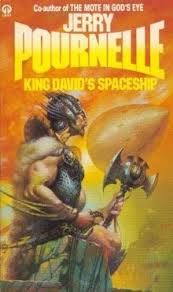
-Jerry Pournelle, King David's Spaceship (London, 1984), p. 198.

The Old Empire ended three hundred and sixteen years previously, long enough ago to generate some legends. We know from a list given in the following volume that those "heroes" are a mixed bunch:

Caesar
Ivan the Terrible (the first Tsar)
Napoleon
Churchill
Stalin
Washington
Jefferson
Trotsky

Even the fact that the First Empire was preceded by a CoDominium of the United States and the Soviet Union does not account for the inclusion of both Stalin and Trotsky on the same list.

Poul Anderson's Terran Empire, basing itself primarily on the Roman Empire, does not require such ideological obfuscation of past history. Its heroes might be:

Aeneas
Romulus
Caesar
Augustus
Virgil
Argos   

Thursday, 3 March 2016

Comparing American Future Histories

We will probably continue to compare American future histories while also continuing to emphasize, as has already been clearly demonstrated, that Poul Anderson is the master of this particular sf sub-genre. To this end, I must finish rereading Larry Niven's and Jerry Pournelle's The Mote In God's Eye, then perhaps read or reread more volumes in Pournelle's CoDominium History.

As it happens, I have copies of The Mercenary and King David's Spaceship. Since each of these works has been read maybe once and not recently, I am spared the trouble of seeking out other titles on Amazon for a while.

Since King David's Spaceship begins with a noisy crowd in the Blue Bottle and Imperial Navy officers buying drinks, we are in familiar territory, remembering, e.g., the opening passage of Anderson's "Sargasso of Lost Starships." Human beings cross interstellar distances faster than light, settle on terrestroid planets like Ansa or Prince Samual's World, build communities with hostelries like the Golden Planet or the Blue Beetle, then find that they are ruled by an Emperor in another planetary system, on Terra or Sparta.

Having enjoyed this fictional scenario in well-written works by Anderson, we expect to enjoy it again when it is re-presented by another writer - but the new writer must earn his keep. He does. 

Dilemma?

Poul Anderson's many fictional characters face moral issues, e.g., Nicholas van Rijn as a merchant and Dominic Flandry as an Intelligence officer. Anderson knew better than to treat such issues simplistically and there is one hypothetical moral dilemma that I do not think that he ever posed.

The dilemma goes: either you kill a lot of people now or you do nothing in which case many more people, maybe even including those that you would have killed, are instead killed by someone else. What do you do? I responded to one fictional example here.

How often does anyone face such a dilemma? How could anyone be sufficiently certain either that there were only two choices or that these were those two choices? In Larry Niven's and Jerry Pournelle's The Mote In God's Eye, Admiral Kutuzov sterilizes a planet in order to prevent a sector rebellion. Although the Imperial Parliament and Navy approve his action, surely Kutuzov is guilty of war crime and genocide by any civilized standard? What value is there in a peace bought entirely through force and intimidation? The Empire has surely forfeited its right to any loyalty from the population of that sector?

Wednesday, 2 March 2016

Aleriona, Moties And Draka

One Aleriona who is bred to think like human beings and not allowed to procreate, in order not to disrupt his own society, is lonely and tries to befriend the captured Heim, thus giving the latter an escape opportunity.
-copied from here.

This Aleriona sounds like Niven's and Pournelle's Motie Mediators who can go mad from identifying with human points of view. Mediators must be sterile so that they will not put the interests of their children over those of their Masters, like the idea of a celibate priesthood.

Anderson's Aleriona have a Final Society, like Stirling's Draka.

However, none of this should be interpreted to imply that The Star Fox by Poul Anderson, The Mote In God's Eye by Larry Niven and Jerry Pournelle and Drakon by SM Stirling are interchangeable works. On the contrary! Anyone who has not already read these three novels should be encouraged to do so and to appreciate their diversity.

All three works involve interstellar travel but in entirely different ways. Anderson and Niven & Pournelle present ingeniously imaginative aliens whereas Stirling speculates about what humanity might do to itself.

Souls

Poul Anderson's composite Didonians are one intelligent species who are constitutionally incapable of believing that they possess immortal souls. They already know that each individual consciousness is transient and that it has three constituents that can be combined with others to form consciousnesses with overlapping memories. Anderson's Ythrians of the New Faith believe that what matters is how they die, not that anything happens afterwards.

One of Niven's and Pournelle's Moties says that some Moties believe in souls and that others do not:

"'Like humans, Moties do not care to think their lives are purposeless. Or that they can and will be terminated.'"
-Larry Niven and Jerry Pournelle, The Mote In God's Eye (London, 1979), p. 79.

I think we are told that, in one Motie religion, an individual's soul is divided between her descendants? (Addendum: This is confirmed on p. 493 but it had first been mentioned earlier.)

As I understand it, what happened in human religion was this -

(i) We seem to leave the body and sometimes meet (dream about) the dead temporarily in sleep - therefore permanently in death. However, souls in Hades, Hel or Sheol were merely conscious of not being alive. This lingering on was unpleasant but unavoidable.

(ii) When society divided into classes, social stratification was projected into the hereafter: warriors in Valhalla and drowned sailors in Aegir's hall but everyone else in Hel.

(iii) Rightings of wrongs and social reversals in the hereafter. Thus, a happy hereafter for the righteous was a third and later stage of ideas about survival after death.

Comparing Empires

The more I learn about Niven and Pournelle's Empire of Man, the more I prefer Anderson's Terran Empire. In just one year:

there have been more revolts in the Trans-Coal Sack Sector;

a former colony and an armed outie system have allied against the Empire;

the population of the militarily occupied New Chicago resents Imperial paternalism;

the Viceroy must "...get on with the reconquest of Trans-Coalsack." (Mote, p. 455)

Must he? Why should outies oppose the Empire unless because the Empire threatens to incorporate them? Surely the purposes of extrasolar colonization are to:

travel far beyond the reach of any home-based tyranny;
preserve cultural identity;
reestablish freedom;
ensure human diversity;
spread humanity through so much space that it cannot possibly destroy itself or be destroyed.

The Terran Empire grows to a defensible size and no further whereas the Empire of Man aims to reunite all of humanity under one government by force if necessary. (p. 4)

From The Serious To The Humorous


We see Poul Anderson's Terran Empire annexing planets and suppressing rebellions but not on the scale of Larry Niven's and Jerry Pournelle's Second Empire of Man:

"...the Navy and Parliament officially approved of Kutozov's action in oredering the destruction of a rebel planet - the Imperial Council had determined that the drastic measure had prevented the revolt of an entire sector -..."
-Larry Niven and Jerry Pournelle, The Mote In God's Eye (London, 1979), p. 92.

Personally, if I knew that a sector, i.e., a number of inhabited planetary systems, wanted to rebel, then I would grant them independence, not destroy a planet. There seems to be a circular argument here:

"Humanity must be reunited into one government, by persuasion or force, so that the hundreds of years of Secession Wars could never happen again." (pp. 4-5)

But surely, if the Secession Wars resume, then they will have been caused by forcible reunification? Why are so many planets keen to rebel?

"A holdout rebel planet might be reduced to glittering lava fields..." (p. 4)

In Anderson's Technic History, the benefits of Imperial rule and protection are such that no planets are shown as rebelling even under the threat of reduction to lava.

From these serious issues, we proceed to some humor concerning Admiral Kutuzov:

"Rod and Sally were at the moment in conference with the Admiral. They met on the bridge: to the best of Rod's knowledge, no one but the Admiral and his steward had ever seen the inside of Kutuzov's cabin. Possibly not even the Admiral, as he seemed always to be on the bridge..." (p. 425)

"As Rod and Sally left the bridge, Commander Borman looked curiously at his Admiral. He wondered if he saw a grin. No, of course not. It simply wasn't possible." (p. 427)

Kutuzov always behaves correctly:

"If there had been an officer of higher rank than [Rod] present at the time, Kutuzov might have explained, but he would not discuss a captain - and future marquis - with Borman." (ibid.)

Of course not! Next, the omniscient narrator tells us what the Admiral "...might have said..." Rather than seeming like an awkward change of pov, this interruption kind of adds to the humor.

Tuesday, 1 March 2016

Life And Death

There are times when it is appropriate to debate religion and times when it is appropriate to be quiet and listen - or even to read the service.

Dominic Flandry:

"'Will the captain read the service?' she asked...
"She handed him the prayerbook. Me? he thought. But I never believed - She was watching. They all were. His finger stained the pages as he read aloud the majestic words."
-Poul Anderson, Young Flandry (New York, 2010), p. 444.

Rod Blaine:

"Do I believe any of this? Rod wondered."
-Larry Niven and Jerry Pournelle, The Mote In God's Eye (London, 1979).

Rod hears:

"'Eternal rest...'
"'I am the Resurrection...'
"'I heard a voice from Heaven...'
"'Day of wrath, and doom impending...'
"'Unto Almighty God we commend the souls...'" (pp. 390-391)

It is generally accepted in society that we attend marriages and funerals of friends and colleagues, irrespective of their religious tradition. This unites us - most of us. Only a few sectarians disagree.

Rod rightly questions but rightly keeps quiet during a funeral service. There are appropriate channels to continue questioning. One of the chaplains is his confessor. When Rod inwardly philosophizes:

"...there's got to be some purpose in this universe..." (p. 391)

- he begins a discussion in which I would argue otherwise. Our inner conflicts imply that we have evolved without any design or purpose.

Dominic Flandry is less reflective. His nearest approach to deep questioning is when he asks his dead fiancee to help him believe...and adds that he is sorry.

Red In The Morning

The novel ends: "Above the cliffs, a few eastern clouds turned red." (11)

This is mixed symbolism. Red is the color of sunsets. Something is ending. But these are eastern clouds. This is a morning. Something is beginning. We will see what when we turn to the next work in the History.
-copied from here.

I was reminded of the conclusion of Mirkheim by this passage:

"Murcheson's Eye had long since vanished. Now the east was blood-red in a sunrise that still startled Whitbread. Red sunrises were rare on inhabitable worlds."
-Larry Niven and Jerry Pournelle, The Mote In God's Eye (London, 1979), p. 372.

We have a saying:

"Red sky at night,
"Shepherd's delight.
"Red in the morning,
"Shepherd's warning." (See here.)

Dornford Yates used the phrase, "Red in the morning...," as the dramatic title of a novel.

By describing red sunrises, Anderson and Niven & Pournelle warn the reader of stormy weather ahead.

Searching the blog for sunrises and sunsets shows how often I have found occasion to praise Anderson's descriptions of nature.

Monday, 29 February 2016

Space Battleships

"Lenin's bridge was enormous."
-Larry Niven and Jerry Pournelle, The Mote In God's Eye (London, 1979), p. 319.

Through prose and screen science fiction, we have become very familiar with a kind of vehicle that might never in fact exist: large faster than light interstellar spacecraft, often used for combat. Destruction occurs on stellar scales.

Flandry and a few other survivors fight on in a wrecked hulk in Ensign Flandry. Kirk destroys the Enterprise. Captain Rod Blaine must watch his ship, MacArthur, destroyed from the bridge of Lenin.

"Space battles are lovely to see." (p. 320)

That might be a matter of taste. But we have all seen Star Wars so perhaps we can judge for ourselves?

(I meant to save a few draft posts to publish tomorrow but the immediate future of this lap top has become uncertain so let's have five posts today.)

Merseians And Moties

Poul Anderson's Ensign Flandry is the opening volume of the Dominic Flandry series, a major part of Anderson's History of Technic Civilization. In Ensign Flandry, the title character is given a guided tour of the planet Merseia but must leave in a hurry. Merseian supremacism threatens the Terran Empire. The problem is ideological.

Larry Niven's and Jerry Pournelle's The Mote In God's Eye is the opening volume of the Moties diptych, a major part of Pournelle's CoDominium future history. In Mote..., crew members and passengers from the human spaceship, MacArthur, are given a guided tour of the planet Mote Prime but must leave in a hurry. The Motie breeding cycle threatens the Second Empire of Man. This problem is biological.

I appreciate two works simultaneously without implying that there is any textual one-to-one correspondence. Both series are Heinleinian future histories although with a structural difference. Whereas Anderson's Psychotechnic History and, I think, Pournelle's CoDominium History were consciously modeled on Robert Heinlein's Future History, the Technic History grew into a vaster Heinleinian template by the fusion of two originally independent series.

A future history comprises several successive periods, e.g., -

Heinlein: technological advances, interplanetary imperialism, the Prophets, the Covenant, the first mature culture;
Asimov: Robots, Empire, Foundation;
Cities In Flight: the Vegan Tyranny, the Earthman culture, the Web of Hercules, new universes;
The Seedling Stars: Port Authority; extrasolar colonies; a far future "Watershed";
Psychotechnic: UN, Solar Union, Stellar Union, Galactic civilization;
Technic: several periods, including Commonwealth (van Rijn) and Empire (Flandry);
Niven: interplanetary exploration; UN and Belt, Man-Kzin Wars, Known Space, the Thousand Worlds;
Pournelle: CoDominium, First Empire, Secession Wars, Second Empire.

(Blog readers will recognize Asimov's as another fused future history.)

James Blish and Poul Anderson also link the future to the past -

After Such Knowledge:
Roger Bacon, possibly inspired by a demon, invents scientific method;
demons manifest in the twentieth century;
a Jesuit biologist suspects demonic influence on an extrasolar planet in the twenty first century.

The Boat Of A Million Years:
immortals live through history into an indefinite future. 

Substantial Reading

I am continuing to reread Larry Niven's and Jerry Pournelle's The Mote In God's Eye first because it has inspired reflections relevant to the blog and secondly because I have become sufficiently involved with the narrative to want to follow it to its conclusion, then maybe
tackle the sequel.

An sf novel gains substance when it is incorporated into a future history series. Spot the odd man out in this list:

an imminent cosmic collision is detected by the inhabitants of the spindizzy-powered planet, He, as it flies between galaxies;

the Ringworld is explored by a Puppeteer, a kzin, a man and a teela;

the Mote System is explored by the warships MacArthur and Lenin from the Second Empire of Man;

the planets Ythri and Gray/Avalon were discovered during the Grand Survey;

the planet Merseia, shielded from supernova radiation by agents of the Polesotechnic League, later became the principal adversary of the Terran Empire;

the planet Satan is exploited by the Solar Spice & Liquors Company;

the planet Mirkheim is exploited by the Supermetals Company until the Baburites go to war over it;

Avalon, jointly colonized by human beings and Ythrians, is attacked by Terran Imperials, including a Cynthian and a Jerusalem Catholic;

a Wodenite Jerusalem Catholic enters the Patrician System just before Admiral Magnusson, a Merseian sleeper, rebels against the Terran Empire;

the Cloud Universe is explored by a Ranger of the Commonalty;

Orbitsville is colonized by human beings from a future Earth.

Saturday, 27 February 2016

Space Age Theology

In Poul Anderson's History of Technic Civilization, Christian characters speculate about Ythrian theology and about the Universal Incarnation. In James Blish's A Case Of Conscience, a Jesuit biologist wonders whether God or Satan created the intelligent Lithians.

In Larry Niven's and Jerry Pournelle's The Mote In God's Eye (London, 1959):

"It was [Chaplain Hardy's] job to determine if Moties were human. Horvath's scientists only wondered if they were intelligent." (p. 161)

I am not clear about how Hardy is using the word "human" here. Obviously, Moties are not of the same species as homo sapiens.

"...it was quite possible that [God] had created intelligent beings with no souls..." (ibid.)

Not in the Christian doctrine I was taught! We were told that Cartesian mind-body dualism was both revealed truth and philosophically provable.

"They might even be a form of angel..." (ibid.)

No. Angels are meant to be immaterial.

If I had Hardy to debate with, I would need first to clarify his understanding of Christian theology and secondly to articulate my disagreements with it.

Addendum: For discussion of the theology of aliens, see here and here.

Flying Mountains

In Larry Niven's and Jerry Pournelle's The Mote In God's Eye (London, 1959), an asteroid is described as a "...flying mountain." (p. 159) This evokes yet another Poul Anderson future history, although not one of the sequence of seven: Tales Of The Flying Mountains.

In ...Mountains, as in James Blish's Cities In Flight future history, space technology is based on control of gravity although in this case such technology facilitates asteroidal colonization but does not lead to an FTL drive.

I identified six future historical themes:

(i) near future technological advances and social changes;
(ii) a period of interplanetary travel;
(iii) an FTL drive;
(iv) extrasolar colonization;
(v) interstellar imperialism;
(vi) the rise and fall of civilizations -

- while acknowledging that not every future history addresses all of these themes. In fact, ...Mountains can alternatively be summarized as follows:

(i) and (ii) as above;
(iii) an STL drive;
(iv) the first extrasolar colonists still in flight.

...Mountains focuses on (ii) the interplanetary period and thus parallels:

Heinlein's The Green Hills Of Earth;
Asimov's I, Robot;
Blish's They Shall Have Stars;
Niven's Lucas Garner/Gil the Arm stories.

Anderson's other future histories also diverge from the (i)-(vi) model by omitting (iii) FTL and (v) interstellar imperialism.

Friday, 26 February 2016

The Imperial Church

In Niven and Pournelle's Second Empire of Man, as in Poul Anderson's Terran Empire, English has become "Anglic." However, I think that, in another volume of the CoDominium future history, the word used is "Angelic," which is neat because the Empire of Man is officially Christian.

Three religions are mentioned:

Islam on the planet, Levant;
the Church of Him, founded on New Scotland in 2882;
the Imperial Church.

Again, in Anderson's Technic History, the Jerusalem Catholic Church is either a new denomination founded in the future or the Roman Catholic Church with its headquarters moved back to Jerusalem. It is probably the latter. For example, it has religious orders, e.g., the Galilean Order.

Unless the meaning of the word "Cardinal" has changed, the Church in the Empire of Man is Roman Catholic. A Cardinal blesses a spaceship and the Cardinals are the electoral college for the Papacy. I deduce that the Pope resides not on the devastated Earth but on the planet Sparta, of which he might be the Bishop or Archbishop.

Ceremony

one theme or trope to be found in both writers works is how they agreed all organized societies need to have SOME signs of respect or ceremonial for their leaders or states.
-copied from here.

Sean Brooks refers to Poul Anderson and SM Stirling. We find the same point made in The Mote In God's Eye (London, 1979) by Larry Niven and Jerry Pournelle.

All stand when the Imperial Viceroy enters the Council Chamber. Captain Blaine reflects that the Emperor and his Viceroy are only men:

"But they held responsibility for the destiny of the human race...someone had to act in the name of mankind...No, the ceremonial entrance wasn't exaggerated. Men who held that kind of power should be reminded of it." (p. 76)

I hope for a less top-down form of social organization in the future but agree that ceremony is a way to mark and enact important events. Niven and Pournelle with their Empire of Man, and Anderson with his Terran Empire, project ancient forms into a technological future. As society changes, we will find new ways to express what is important.

Thursday, 25 February 2016

Comparisons

A fictional galaxy can be empty of intelligent life, except on Earth, or full of humanoid beings or somewhere on a spectrum between these two extremes. For one James Blish future history, see here.

Poul Anderson's Terran Empire rules a volume of space inhabited by many humanoid, and some more exotic, beings whereas Larry Niven's and Jerry Pournelle's Second Empire of Man rules only human colony planets until there is First Contact with the Moties.

The purpose of comparing two works is not to denigrate the currently read work by comparison but rather to enjoy both works simultaneously, appreciating contrasts as well as parallels. Because of blogging and other activities, I am rereading Niven's and Pournelle's The Mote In God's Eye at a snail's pace. However, I remember from previous readings that the protagonist, Rod Blaine, loses his first command as does Anderson's Dominic Flandry in The Rebel Worlds. On the other hand, neither of these characters was destined to captain a spaceship. Blaine has aristocratic responsibilities and Flandry is better suited to Intelligence work.

I will continue to reread Mote, not specifically seeking comparisons with Anderson's Technic History, but probably continuing to find points of comparison with other future histories, including the several by Anderson. 

Wednesday, 24 February 2016

Comparative Chronologies II

I have found some more point of view discontinuities in Larry Niven's and Jerry Pournelle's The Mote In God's Eye but am not proposing to analyze them all right now.

I am interested in some chronological similarities and dissimilarites between the Technic and CoDominium Histories.

Hyperdrive is discovered in the twenty-second century whereas the Alderson drive is tested and perfected in 2008.

Extrasolar planets are colonized in the Breakup of the twenty-second century whereas, during the Codominium, extrasolar colonization begins in 2020 and mass out-system shipment of convicts begins in 2040.

The Time of Troubles brings down the Solar Commonwealth in the twenty-seventh century whereas the Great Patriotic Wars end the CoDominium in 2103.

Manuel Argos proclaims the Terran Empire about 2700 whereas Leonidas I proclaims the Empire of Man in 2250.

In the mid fourth millennium, the Long Night ends the Terran Empire, leading to war and piracy, whereas, in 2640, Secession Wars and Dark Ages end the First Empire, leading to piracy and brigandage.

The Allied Planets recivilize separated colonies in 4000 whereas Leonidas IV proclaims the Second Empire in 2903.

Dominic Flandry is on Starkad in 3019 whereas the Second Empire makes First Contact with the Moties in 3017.

(These are very approximate comparisons. I have taken the dates from Sandra Miesel's Chronology of Technic Civilization and from the Chronology in The Mote In God's Eye. For discussion of Miesel's Chronology, see here.)

Comparative Chronologies

In an sf future history series, which comes first: the stories or the time chart/chronology? In the case of Poul Anderson's Psychotechnic History, Anderson has told us that, following Robert Heinlein's example, he compiled a time chart, then wrote several stories that fitted into that chart, whereas, in the case of his Technic History, the stories, originally two independent series, came first; the Chronology of Technic Civilization has been compiled later by Sandra Miesel.

When future historian Jerry Pournelle created the CoDominium History, he had the fine examples of Heinlein and Anderson to follow if he wanted to. Pournelle's Chronology begins by clearly showing when his CoDominium timeline diverges from ours:

CHRONOLOGY

1969  Neil Armstrong sets foot on Earth's Moon.
1990  Series of treaties between United States and
          Soviet Union creates the CoDominium.

The Chronology continues with an interstellar drive in 2008 and interstellar colonies in 2020. This CoDominium timeline displays some parallels with James Blish's Okies timeline which has Colonials leaving the Solar System in 2021 and a Proclamation of US-USSR unification in 2027.

My rereading of Poul Anderson's For Love And Glory has been interrupted by rereading Alan Moore's Watchmen, which in turn has been interrupted by rereading Larry Niven's and Jerry Pournelle's The Mote In God's Eye (London, 1979). These works in turn have generated posts on World Wars and Chronologies. Reading or rereading, even if chaotic, usually provides material for blogging. However, this lap top is rapidly declining so there may be further technical delays.

Niven and Pournelle begin what feels like a substantial novel set in an interstellar empire comparable to Anderson's Terran Empire. In the first full paragraph on p. 17, the omniscient narrator tells us what the Imperial forces find on entering New Chicago and also how the New Chicago revolt had affected the Empire. The second paragraph presents Sally Fowler's point of view: she felt the Marines' eyes on her. The third paragraph recounts word for word what one Marine guard thinks about Sally. The fourth paragraph reverts to Sally's point of view: she felt nothing. This page is a bit too disjointed pov-wise.