Showing posts with label I Robot. Show all posts

Saturday, 27 February 2016

Flying Mountains

In Larry Niven's and Jerry Pournelle's The Mote In God's Eye (London, 1959), an asteroid is described as a "...flying mountain." (p. 159) This evokes yet another Poul Anderson future history, although not one of the sequence of seven: Tales Of The Flying Mountains.

In ...Mountains, as in James Blish's Cities In Flight future history, space technology is based on control of gravity although in this case such technology facilitates asteroidal colonization but does not lead to an FTL drive.

I identified six future historical themes:

(i) near future technological advances and social changes;
(ii) a period of interplanetary travel;
(iii) an FTL drive;
(iv) extrasolar colonization;
(v) interstellar imperialism;
(vi) the rise and fall of civilizations -

- while acknowledging that not every future history addresses all of these themes. In fact, ...Mountains can alternatively be summarized as follows:

(i) and (ii) as above;
(iii) an STL drive;
(iv) the first extrasolar colonists still in flight.

...Mountains focuses on (ii) the interplanetary period and thus parallels:

Heinlein's The Green Hills Of Earth;
Asimov's I, Robot;
Blish's They Shall Have Stars;
Niven's Lucas Garner/Gil the Arm stories.

Anderson's other future histories also diverge from the (i)-(vi) model by omitting (iii) FTL and (v) interstellar imperialism.

Thursday, 7 January 2016

Alternative Answers To Key Questions

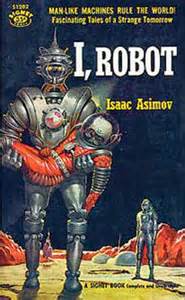
Isaac Asimov wrote the collection, I, Robot. Effectively, Poul Anderson replied with one story, "Quixote and the Windmill": the first unspecialized robot is unemployed; therefore, there is no need for a second robot - or for a sequel.

Robert Heinlein's Methuselah's Children and James Blish's They Shall Have Stars are about the search for immortality. Effectively, Anderson replied with "What Shall It Profit?": immortality, possible only by shielding from all radiation far underground, is a dead end. In this case, there is an implied need for a sequel because the story ends with the Director of the Institute for Human Biology asking:

"'What are we going to do?'" (Cold Victory, p. 223)

We can only infer that the Institute is destroyed and its discoveries lost during the ensuing Second Dark Ages. Later, Anderson presented different accounts of immortality in World Without Stars and The Boat Of A Million Years.

Asimov's Foundation Series is about a science of society whereas Heinlein's Orphans Of The Sky is about a multi-generation interstellar spaceship. In Anderson's "The Troublemakers," a science of society is applied to the crew of a generation ship. Psychotechnicians manipulate mutinous motivations, thus preventing the kind of breakdown that made Heinlein's Vanguard crew forget the universe outside their large spinning spaceship.

These are the Campbell future historians: Heinlein, Asimov, Blish and Anderson.

Sunday, 18 January 2015

Introducing Laurinda

Poul Anderson's Genesis (New York, 2001), pp. Chapter V, pp. 36-56, is 20 pages of text, divided into three numbered sections.

Space probes multiply wherever they find raw materials and will explore the whole galaxy in two or three million years. However, this chapter follows events on Earth. It begins in a green English countryside with hills, trees and a thousand year old church spire but no houses because the few dwellings are underground.

Isaac Asimov's I, Robot (London, 1986) concludes with the realization that "'Mankind...was always at the mercy of economic and sociological forces it did not understand. Now the Machines understand them...'" (p. 205). The Machines are large positronic brains following the First Law of Robotics, preventing harm to humanity, and therefore preserving themselves because they alone coordinate all the data that enables them to prevent global economic dislocations. (In the sequel, set two hundred years later, they have phased themselves out because they judged that self-determination was the highest human good! See here.)

In Genesis, Chapter V, "'...the decisions that matter come from the machine intelligences - at the summit, from Terra Central...'" because the world is, and always was, "'...too complex, too precarious, for mere humans to understand and control.'" (p. 41) Laurinda Ashcroft is an interface with Terra Central which/who converses with Laurinda vocally and offers to upload her mind and memories so that Laurinda's human experience can inform Terra Central's artificial intelligence. Thus, Laurinda's upload will remain on Earth whereas Christian Brannock's went into space. The upload will subsist as part of the whole for millions of years or more and can be resurrected in emulation although this phrase is not explained as yet.

Terra Central thinks that the human race is mad because of the conflict between instinct and intellect. In Anderson's first sf novel, Brain Wave, a general increase in intelligence enables human beings to overcome this conflict. See here.

Friday, 13 September 2013

Other Series

Recently for this blog, I:

reread Poul Anderson's contributions to the Medea and berserker series;

discovered that Anderson's For Love And Glory was based on his two contributions to the "Isaac's Universe" series;

was surprised to learn that his Cappen Varra stories crossover with Thieves' World.

Now I notice that his contribution to Isaac Asimov's Robots series is called "Plato's Cave" (Martin H Greenberg, Editor, Foundation's Friends, London, 1991) and therefore should be of interest to a Philosophy graduate. I will shortly reread it, having previously read it just once on purchasing Foundation's Friend when that was newly published.

As far as I remember, this story was a fully consistent addition to the series, featuring the United States Robots and Mechanical Men trouble shooters, Donovan and Powell, while referring to the robopsychologist, Susan Calvin, and the politician, Stephen Byerley.

I, Robot is perhaps Asimov's best work, beginning with experimental robots and culminating in a Stapledonian apotheosis when giant robotic Brains control the global ecology and economy for the human good. They apply what later came to be called the Zeroth (pre-First) Law of Robotics, preventing harm not to individual human beings but to humanity. Asimov surpassed himself in the sequel, "That Thou Art Mindful of Him," when the Brains, having judged that self-determination is the greatest human good, have phased themselves out but there is now a threat from another robot model called the Georges.

Foundation's Friends comprises:

one contribution each to the Black Widowers, Wendell Urth and thiotimoline series;

one sequel each to "Nightfall" and "The Dead Past";

two stories about Asimov, in the future and in an alternative present;

four non-future history Robot stories;

six contributions, totaling 241 pages, to Asimov's Robots and Empire future history, including "Plato's Cave."

I think that this future history was later diluted by too many new Hari Seldon novels by other authors but the idea of expanding Asimov's future history was new when Foundation's Friends was originally published in 1989.