Showing posts with label They Shall Have Stars. Show all posts

Tuesday, 15 March 2016

Alternative Pasts, Presents And Futures

Whereas a future history becomes an alternative history as it recedes into the past, an alternative history becomes a future history if it is extended into the future. Thus, SM Stirling's Protracted Struggle between the Alliance for Democracy and the Domination of the Draka parallels the various UN/US-USSR/Cold War/World War III scenarios that we listed recently. In Stirling's The Stone Dogs, as in James Blish's They Shall Have Stars, Earth becomes a dictatorship but a few political refugees escape from the Solar System.

In fact, various other discontented groups also leave the Solar System in:

Robert Heinlein's Methuselah's Children;
the Breakup period of Poul Anderson's Technic History;
Anderson's Rustum History, The Boat Of A Million Years and Harvest Of Stars;
the Great Exodus period of Jerry Pournelle's CoDominium History.

Stirling's The Peshawar Lancers is an alternative history novel set in 2025 but does not feature space travel because, like Anderson's Maurai History, it recounts recovery from a global disaster.

The Ransom Trilogy, CS Lewis' reply to Wells' and Stapledon's future histories, also addresses the history of the future. Issues concerning the future of mankind on Earth are resolved in Volume III. In Volume II, the future is prophesied. Ten thousand years hence, Maleldil, Malacandra, Tor-Oyarsa-Perelendri and many hnau and eldila will descend, destroy the Moon and liberate Thulcandra (Earth) from its present hidden rulers -

- and you cannot get any more alternative than that.

Saturday, 27 February 2016

Flying Mountains

In Larry Niven's and Jerry Pournelle's The Mote In God's Eye (London, 1959), an asteroid is described as a "...flying mountain." (p. 159) This evokes yet another Poul Anderson future history, although not one of the sequence of seven: Tales Of The Flying Mountains.

In ...Mountains, as in James Blish's Cities In Flight future history, space technology is based on control of gravity although in this case such technology facilitates asteroidal colonization but does not lead to an FTL drive.

I identified six future historical themes:

(i) near future technological advances and social changes;
(ii) a period of interplanetary travel;
(iii) an FTL drive;
(iv) extrasolar colonization;
(v) interstellar imperialism;
(vi) the rise and fall of civilizations -

- while acknowledging that not every future history addresses all of these themes. In fact, ...Mountains can alternatively be summarized as follows:

(i) and (ii) as above;
(iii) an STL drive;
(iv) the first extrasolar colonists still in flight.

...Mountains focuses on (ii) the interplanetary period and thus parallels:

Heinlein's The Green Hills Of Earth;
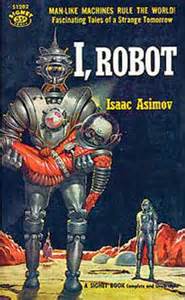
Asimov's I, Robot;
Blish's They Shall Have Stars;
Niven's Lucas Garner/Gil the Arm stories.

Anderson's other future histories also diverge from the (i)-(vi) model by omitting (iii) FTL and (v) interstellar imperialism.

Thursday, 7 January 2016

Alternative Answers To Key Questions

Isaac Asimov wrote the collection, I, Robot. Effectively, Poul Anderson replied with one story, "Quixote and the Windmill": the first unspecialized robot is unemployed; therefore, there is no need for a second robot - or for a sequel.

Robert Heinlein's Methuselah's Children and James Blish's They Shall Have Stars are about the search for immortality. Effectively, Anderson replied with "What Shall It Profit?": immortality, possible only by shielding from all radiation far underground, is a dead end. In this case, there is an implied need for a sequel because the story ends with the Director of the Institute for Human Biology asking:

"'What are we going to do?'" (Cold Victory, p. 223)

We can only infer that the Institute is destroyed and its discoveries lost during the ensuing Second Dark Ages. Later, Anderson presented different accounts of immortality in World Without Stars and The Boat Of A Million Years.

Asimov's Foundation Series is about a science of society whereas Heinlein's Orphans Of The Sky is about a multi-generation interstellar spaceship. In Anderson's "The Troublemakers," a science of society is applied to the crew of a generation ship. Psychotechnicians manipulate mutinous motivations, thus preventing the kind of breakdown that made Heinlein's Vanguard crew forget the universe outside their large spinning spaceship.

These are the Campbell future historians: Heinlein, Asimov, Blish and Anderson.

Wednesday, 21 October 2015

Future Slavery? II

See here.

It is good to discuss speculative fictions, historical texts and works of political theory together. All three kinds of writing address how society is and, whether explicitly or implicitly, how it might become. Tyranny on Earth coexisting with freedom in space is realized at the end of They Shall Have Stars by James Blish. If I were oppressed by the Bureaucratic State, then I would be glad to know that there was freedom elsewhere but would still want to overthrow the State!

A slave economy producing only for the consumption of the slave owners would be able to stagnate or even regress (owners have finite stomachs) whereas any economy that retains an external competitor must continue to expand. The USSR, like Stirling's Domination of the Draka, was engaged in strategic competition against the US and its allies, necessitating continual research and reinvestment in militarily applicable technology: atomics; rockets; computers; aircraft; hand weapons; surveillance; something destructive that no one else has ever thought of etc.

By contrast, the human beings who enslave an entire planetary population in Poul Anderson's The Peregine keep the location and even the existence of this planet secret from other space travelers. With no external enemies, they can afford to restrict technology in their planetary domain as long as they themselves retain sufficient coercive force to enable them to continue to extract immediately consumed wealth from the subjugated population.

Thus, there are different kinds even of slavery although that does not make any of them palatable.

Friday, 15 March 2013

Anderson-Blish Interaction


For a Poul Anderson fan who is also a James Blish fan, rereading Anderson's "Call Me Joe," set on Jupiter and Jupiter V, automatically led to rereading the "Jupiter V" chapters of Blish's They Shall Have Stars for comparison. This in turn led to rereading the "New York" chapters and "Washington" sections of They Shall Have Stars and the opening chapters of The Triumph Of Time so I am publishing some posts on the James Blish Appreciation blog.

The two novels mentioned are the opening and closing volumes of Blish's main future history which, considerably shorter than Anderson's History of Technic Civilization, is complete, with a beginning, a middle and an end, in just four volumes.

I recently posted remarks about Anderson's two intergalactic novels, Tau Zero and World Without Stars. Blish's equivalent, The Triumph Of Time, is set entirely outside the home galaxy. The flying city of New York has colonized the planet of New Earth in the Greater Magellanic Cloud and, from there, the New Earthmen, as they have become, have colonized other planets in the Cloud.

The moving planet of He leaves the Milky Way, crosses intergalactic space, passes through the Andromeda galaxy, then sets out to return to the Milky Way, passing through M-33 and both Magellanic Clouds en route. Meeting the New Earthmen, who advise them to avoid the home galaxy, now ruled by a new non-human empire, they propose to seek elsewhere for a solution to the problem that they had discovered in intergalactic space, " 'Nothing less...than the imminent coming to an end of time itself.' " (Blish, Cities In Flight, London, 1981, p. 505)

Mayor John Amalfi suggests making the million light year journey to NGC 6822 but a Hevian replies that:

" '...our ultimate destination must be the center of the metagalaxy, the hub of all the galaxies of space-time.'" (p. 508)

Only there can they hope to " '...escape or to modify the end...' " (p. 508)

Like World Without Stars, The Triumph Of Time postulates a faster than light means of intergalactic travel. Like Tau Zero, it presents human beings who survive until, then decide how to respond to, the end of the universe.