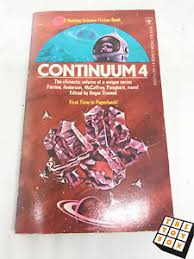
Whereas a future history becomes an alternative history as it recedes into the past, an alternative history becomes a future history if it is extended into the future. Thus, SM Stirling's Protracted Struggle between the Alliance for Democracy and the Domination of the Draka parallels the various UN/US-USSR/Cold War/World War III scenarios that we listed recently. In Stirling's The Stone Dogs, as in James Blish's They Shall Have Stars, Earth becomes a dictatorship but a few political refugees escape from the Solar System.
In fact, various other discontented groups also leave the Solar System in:
Robert Heinlein's Methuselah's Children;
the Breakup period of Poul Anderson's Technic History;
Anderson's Rustum History, The Boat Of A Million Years and Harvest Of Stars;
the Great Exodus period of Jerry Pournelle's CoDominium History.
Stirling's The Peshawar Lancers is an alternative history novel set in 2025 but does not feature space travel because, like Anderson's Maurai History, it recounts recovery from a global disaster.
The Ransom Trilogy, CS Lewis' reply to Wells' and Stapledon's future histories, also addresses the history of the future. Issues concerning the future of mankind on Earth are resolved in Volume III. In Volume II, the future is prophesied. Ten thousand years hence, Maleldil, Malacandra, Tor-Oyarsa-Perelendri and many hnau and eldila will descend, destroy the Moon and liberate Thulcandra (Earth) from its present hidden rulers -
- and you cannot get any more alternative than that.
Showing posts with label Rustum. Show all posts
Tuesday, 15 March 2016
Thursday, 16 April 2015
"Robin Hood's Barn"
The first story in the Rustum History was not called "Robin Hood's Barn," was it? I will check the next time I am in arm's reach of my copy of Orbit Unlimited. I started to read this story in NESFA Vol 3 and quickly realized what it was. (I have checked. It was called "Robin Hood's Barn" but I do not understand the significance of the title.)
It presents yet another routine use of an air-car, this time by a character whose house is raised above the sea on caissons.
Old Svoboda, a Government Commissioner, goes to a lot of trouble on behalf of his son:
his own reasoning and the books of a theoretician called Anker have convinced Svoboda that there is no hope for a better life on Earth in the foreseeable future;
so he wants to give Svoboda Junior a fresh start in a new world;
but this can happen only if there is a colony on an extrasolar planet;
and the colonists are most likely to succeed if they are able people who have left Earth voluntarily;
but such people will leave only if there is a problem on Earth that they cannot overcome;
so Svoboda Senior covertly hires the actor Laird to play the role of an orator who founds the Constitutionalist movement based on Anker's philosophy;
then he retires Laird with a new identity and a lavish pension;
when Laird is no longer around, having disappeared then drunk himself to death, the possibility that Svoboda has had him assassinated remains open;
Svoboda Junior, who has a rebellious temperament, becomes a Constitutionalist;
Svoboda Senior gets the Government to re-institute free public education and, as part of this, to close the independent Constitutionalist schools;
the Constitutionalists, including Svoboda Junior, can preserve their culture and way of life only by emigrating;
the Government sponsors their expedition because, while they remain on Earth, the many professionals and technical experts who are Constitutionalists threaten strikes, sabotage and insurrection;
these well-off people own property which they cannot take with them and which can therefore be sold to fund their expedition.
Results:
Government gets rid of Constitutionalists without having to imprison or massacre them;
Constitutionalists build the society that they want;
Svoboda Junior makes a fresh start in a new world.
But could any one person plausibly contrive all that?
It presents yet another routine use of an air-car, this time by a character whose house is raised above the sea on caissons.
Old Svoboda, a Government Commissioner, goes to a lot of trouble on behalf of his son:
his own reasoning and the books of a theoretician called Anker have convinced Svoboda that there is no hope for a better life on Earth in the foreseeable future;
so he wants to give Svoboda Junior a fresh start in a new world;
but this can happen only if there is a colony on an extrasolar planet;
and the colonists are most likely to succeed if they are able people who have left Earth voluntarily;
but such people will leave only if there is a problem on Earth that they cannot overcome;
so Svoboda Senior covertly hires the actor Laird to play the role of an orator who founds the Constitutionalist movement based on Anker's philosophy;
then he retires Laird with a new identity and a lavish pension;
when Laird is no longer around, having disappeared then drunk himself to death, the possibility that Svoboda has had him assassinated remains open;
Svoboda Junior, who has a rebellious temperament, becomes a Constitutionalist;
Svoboda Senior gets the Government to re-institute free public education and, as part of this, to close the independent Constitutionalist schools;
the Constitutionalists, including Svoboda Junior, can preserve their culture and way of life only by emigrating;
the Government sponsors their expedition because, while they remain on Earth, the many professionals and technical experts who are Constitutionalists threaten strikes, sabotage and insurrection;
these well-off people own property which they cannot take with them and which can therefore be sold to fund their expedition.
Results:
Government gets rid of Constitutionalists without having to imprison or massacre them;
Constitutionalists build the society that they want;
Svoboda Junior makes a fresh start in a new world.
But could any one person plausibly contrive all that?
Saturday, 28 July 2012
Politics On Rustum
In the concluding Rustum story (Poul Anderson, New America, New York, 1982, pp. 117-157), we read two political speeches about how the Rustumites should respond to a new wave of immigrants from Earth. Dan Coffin wins the argument that new immigrants should be welcomed but let us consider the counterargument, which is in part:
"...since they are alien, since there are bound to be offenses and clashes, they could become the victims of hatred, even outright persecution. We are not saints on Rustum. We are not immune to the ancient diseases of xenophobia, callousness, legalized robbery, and mob violence. Let us not inflict upon our home the same unhealable wound which was inflicted on Mother America.
"Lead us not into temptation." (p. 149)
The speaker cannot claim an academic neutrality. He is leading into temptation. By speaking as he does, he encourages the most xenophobic tendencies in Rustumite society. If both Coffin and O'Malley had welcomed immigration, then individuals who wanted to articulate xenophobia would have felt isolated and might have been silenced. Instead, O'Malley gives them the opportunity to argue, "We are not saints. There are bound to be clashes (so let's cause some). We cannot help hating aliens. We have support in the Constitutional Convention where O'Malley said, 'We are not immune...'"
Thus, O'Malley could have found his proposed exclusion policy supported by demonstrations expressing that xenophobia that he does not want to "...inflict." If that tendency does exist on Rustum, then it should be opposed, not appeased, and it should be the duty of Convention representatives to unite against it.
I am making a speech here but I think that Anderson's story (rightly) invites, or challenges, each of us to be clear about where we stand on this issue.
Friday, 27 July 2012
The Queen Of Air And Darkness
"The Queen Of Air And Darkness" (in The Queen Of Air And Darkness and other stories, London, 1977), potentially a major story by Poul Anderson, hits the reader with too many mixed messages, I think. The narrative is divided into unnumbered sections.
The first section contains several clues that it is set on another planet, the most obvious being a reference to "...the moons..." (p. 10), although the characters suggest fantasy:
two "...Outlings...," a flute-playing boy called Mistherd and a singing girl called Shadow-of-a-Dream, meet under a dolmen on Wolund's Barrow (p. 9);
a winged "pook" called "...Ayoch...," with a "...half-human face...," carries a stolen human child towards "...Carheddin under the mountains..." (pp. 9-10);
their Queen, variously addressed as "...Starmother...," "...Snowmaker..." and "...Lady Sky...," appears (pp. pp. 10-11).
Ayoch used "...dazedust..." to steal the child but not from "...yeomen...," instead from a camp where there were "...engines..." (p. 10) Thus, technology has somehow entered this (apparent) fantasy setting.
The second section also gives two messages but different ones. A woman called Barbro Cullen, whose son has been kidnapped, consults a high-cheeked, beak-nosed, pipe-smoking, unmarried private investigator living in an untidy, dusty apartment with laboratory equipment against one wall, who surprises her with information about herself which he then explains that he has deduced from her appearance. Thus, this Eric Sherrinford is based on Sherlock Holmes but the setting is science fictional because they are on the planet Roland to which he has traveled from the planet Beowulf.
So the first section presents apparent fantasy in an apparently extraterrestrial environment whereas the second section presents a detective story in an unequivocally extraterrestrial setting. The strands begin to converge when we learn that there are "...stories about the Outlings stealing human children..." and that the boy had disappeared from an exploratory camp where the dogs were drugged. (p.14)
The mystery is that there is no evidence of any present natives on Roland. But the reader has already seen the Outlings so we are already know the solution to the mystery that this literary descendant of Holmes is to solve! Thus, I think that the story fails to be the sf detective story that it could have been. There is more than this in the story so there will be some further posts.
The first section contains several clues that it is set on another planet, the most obvious being a reference to "...the moons..." (p. 10), although the characters suggest fantasy:
two "...Outlings...," a flute-playing boy called Mistherd and a singing girl called Shadow-of-a-Dream, meet under a dolmen on Wolund's Barrow (p. 9);
a winged "pook" called "...Ayoch...," with a "...half-human face...," carries a stolen human child towards "...Carheddin under the mountains..." (pp. 9-10);
their Queen, variously addressed as "...Starmother...," "...Snowmaker..." and "...Lady Sky...," appears (pp. pp. 10-11).
Ayoch used "...dazedust..." to steal the child but not from "...yeomen...," instead from a camp where there were "...engines..." (p. 10) Thus, technology has somehow entered this (apparent) fantasy setting.
The second section also gives two messages but different ones. A woman called Barbro Cullen, whose son has been kidnapped, consults a high-cheeked, beak-nosed, pipe-smoking, unmarried private investigator living in an untidy, dusty apartment with laboratory equipment against one wall, who surprises her with information about herself which he then explains that he has deduced from her appearance. Thus, this Eric Sherrinford is based on Sherlock Holmes but the setting is science fictional because they are on the planet Roland to which he has traveled from the planet Beowulf.
So the first section presents apparent fantasy in an apparently extraterrestrial environment whereas the second section presents a detective story in an unequivocally extraterrestrial setting. The strands begin to converge when we learn that there are "...stories about the Outlings stealing human children..." and that the boy had disappeared from an exploratory camp where the dogs were drugged. (p.14)
The mystery is that there is no evidence of any present natives on Roland. But the reader has already seen the Outlings so we are already know the solution to the mystery that this literary descendant of Holmes is to solve! Thus, I think that the story fails to be the sf detective story that it could have been. There is more than this in the story so there will be some further posts.
Subscribe to:
Posts (Atom)