We, or at least I, think of interstellar future histories as either FTL, e.g., Poul Anderson's Psychotechnic and Technic Histories, or STL, e.g., Anderson's Maurai, Flying Mountains, Rustum, Kith, Harvest Of Stars and Genesis histories or Larry Niven's Leshy Circuit series.
(The mostly Earth-bound Maurai History goes interstellar in the time travel novel, There Will Be Time.)
However, some future histories have an STL period followed by an FTL period:
Robert Heinlein's Future History has generation ships, then Libby's FTL drive;
the Psychotechnic History has a generation ship, then the hyperdrive;
in Larry Niven's Known Space History, the Thrintun had FTL but the Pak did not;
also in Known Space, the early Man-Kzin Wars were fought at sub-light speeds but men won decisively when they had acquired the hyperdrive.
In an STL period or history, interstellar journeys last for objective decades or centuries but the travelers benefit from time dilation which alters perceptions of aging and of social change.
Two kinds of -
- imaginative fiction: fantasy and sf;
- sf: hard and soft;
- future history: British and American;
- interstellar travel: STL and FTL;
- time travel: circular causality and causality violation.
Showing posts with label Harvest of Stars. Show all posts
Monday, 21 March 2016
Wednesday, 16 March 2016
Time Travel, Dilation And Stasis
We have learned three ways to:
"...survive the re-contraction of the primal monobloc and its explosion into a new cosmic cycle..."
-Jerry Pournelle and SM Stirling, "The Children's Hour" IN Larry Niven, Ed., Man-Kzin Wars II (London, 1991), pp. 133-306 AT p. 149 -
- by (i) time travel, (ii) time dilation and (iii) temporal stasis.
(i) In Poul Anderson's "Flight to Forever," one man in a "time projector," i.e., a kind of time machine, circumnavigates space-time. We owe the idea of a temporal vehicle or "time machine" to HG Wells and it is because of Wells that we retain such archaic terminology. I remember that, in the 1960s, a friend's grandfather used the phrase, "flying machine."
(ii) In Anderson's Tau Zero, the crew of an exponentially accelerating Bussard ramjet survives cosmic contraction and explosion. We owe the idea of an interstellar ramjet to Robert Bussard.
(iii) In "The Children's Hour," it is merely stated that a Slaver stasis field "...would probably survive..." (op. cit., p. 149) Stasis fields are an sf prop but we owe two very unpleasant species, the Slavers and the kzinti, to Larry Niven. Thank you, Mr Niven!
However, the current cosmological model is not cyclical. Anderson's Harvest Of Stars Tetralogy and Genesis ask whether consciousness can survive the heat death of a universe that does not re-contract and re-explode.
"...survive the re-contraction of the primal monobloc and its explosion into a new cosmic cycle..."
-Jerry Pournelle and SM Stirling, "The Children's Hour" IN Larry Niven, Ed., Man-Kzin Wars II (London, 1991), pp. 133-306 AT p. 149 -
- by (i) time travel, (ii) time dilation and (iii) temporal stasis.
(i) In Poul Anderson's "Flight to Forever," one man in a "time projector," i.e., a kind of time machine, circumnavigates space-time. We owe the idea of a temporal vehicle or "time machine" to HG Wells and it is because of Wells that we retain such archaic terminology. I remember that, in the 1960s, a friend's grandfather used the phrase, "flying machine."
(ii) In Anderson's Tau Zero, the crew of an exponentially accelerating Bussard ramjet survives cosmic contraction and explosion. We owe the idea of an interstellar ramjet to Robert Bussard.
(iii) In "The Children's Hour," it is merely stated that a Slaver stasis field "...would probably survive..." (op. cit., p. 149) Stasis fields are an sf prop but we owe two very unpleasant species, the Slavers and the kzinti, to Larry Niven. Thank you, Mr Niven!
However, the current cosmological model is not cyclical. Anderson's Harvest Of Stars Tetralogy and Genesis ask whether consciousness can survive the heat death of a universe that does not re-contract and re-explode.
Tuesday, 15 March 2016
Alternative Pasts, Presents And Futures
Whereas a future history becomes an alternative history as it recedes into the past, an alternative history becomes a future history if it is extended into the future. Thus, SM Stirling's Protracted Struggle between the Alliance for Democracy and the Domination of the Draka parallels the various UN/US-USSR/Cold War/World War III scenarios that we listed recently. In Stirling's The Stone Dogs, as in James Blish's They Shall Have Stars, Earth becomes a dictatorship but a few political refugees escape from the Solar System.
In fact, various other discontented groups also leave the Solar System in:
Robert Heinlein's Methuselah's Children;
the Breakup period of Poul Anderson's Technic History;
Anderson's Rustum History, The Boat Of A Million Years and Harvest Of Stars;
the Great Exodus period of Jerry Pournelle's CoDominium History.
Stirling's The Peshawar Lancers is an alternative history novel set in 2025 but does not feature space travel because, like Anderson's Maurai History, it recounts recovery from a global disaster.
The Ransom Trilogy, CS Lewis' reply to Wells' and Stapledon's future histories, also addresses the history of the future. Issues concerning the future of mankind on Earth are resolved in Volume III. In Volume II, the future is prophesied. Ten thousand years hence, Maleldil, Malacandra, Tor-Oyarsa-Perelendri and many hnau and eldila will descend, destroy the Moon and liberate Thulcandra (Earth) from its present hidden rulers -
- and you cannot get any more alternative than that.
In fact, various other discontented groups also leave the Solar System in:
Robert Heinlein's Methuselah's Children;
the Breakup period of Poul Anderson's Technic History;
Anderson's Rustum History, The Boat Of A Million Years and Harvest Of Stars;
the Great Exodus period of Jerry Pournelle's CoDominium History.
Stirling's The Peshawar Lancers is an alternative history novel set in 2025 but does not feature space travel because, like Anderson's Maurai History, it recounts recovery from a global disaster.
The Ransom Trilogy, CS Lewis' reply to Wells' and Stapledon's future histories, also addresses the history of the future. Issues concerning the future of mankind on Earth are resolved in Volume III. In Volume II, the future is prophesied. Ten thousand years hence, Maleldil, Malacandra, Tor-Oyarsa-Perelendri and many hnau and eldila will descend, destroy the Moon and liberate Thulcandra (Earth) from its present hidden rulers -
- and you cannot get any more alternative than that.
Friday, 22 January 2016
Human, Post-Human And Artificial Intelligences
If human beings create artificial intelligences, how will organic and post-organic consciousnesses interact? In the Harvest Of Stars Tetralogy and Genesis, Poul Anderson imagines individual human consciousnesses surviving physical death by their incorporation into self-maintaining and self-replicating AI systems whereas, in Drakon, SM Stirling instead imagines a later human species with indefinitely prolonged lifespans and implanted links to the AI Web.
I have discussed the two works by Anderson previously on this blog. Stirling's Homo drakensis are the immediate descendants of his "Draka" who had imposed a brutal dictatorship on the rest of humanity. Home drakensis seem to have transcended brutality but only by genetically engineering Homo servus to be permanently subservient - plus which their surviving human enemies are currently at an unattainable interstellar distance. Individual drakensis remain armed and lethal.
A drakensis stranded in the twentieth century of an alternative timeline and wanting to summon an invasion fleet wins a Greenpeace supporter to her cause by showing him pictures of the ecologically paradisal Earth of her era. Also controlled by her pheromones, he easily accepts that her society must be hierarchical if it is to be stable but he has not been told the historical origins of that society and can easily be manipulated to accept any killing that she deems necessary, starting with the murder of an employee who would have spoken to the press.
I will reread the passages about the Draka Final Society to compare its dystopian and apparently utopian elements. 1984 is an unrelieved dystopia. Brave New World is a dystopia disguised as a utopia. Drakon seems to be another of the latter.
I have discussed the two works by Anderson previously on this blog. Stirling's Homo drakensis are the immediate descendants of his "Draka" who had imposed a brutal dictatorship on the rest of humanity. Home drakensis seem to have transcended brutality but only by genetically engineering Homo servus to be permanently subservient - plus which their surviving human enemies are currently at an unattainable interstellar distance. Individual drakensis remain armed and lethal.
A drakensis stranded in the twentieth century of an alternative timeline and wanting to summon an invasion fleet wins a Greenpeace supporter to her cause by showing him pictures of the ecologically paradisal Earth of her era. Also controlled by her pheromones, he easily accepts that her society must be hierarchical if it is to be stable but he has not been told the historical origins of that society and can easily be manipulated to accept any killing that she deems necessary, starting with the murder of an employee who would have spoken to the press.
I will reread the passages about the Draka Final Society to compare its dystopian and apparently utopian elements. 1984 is an unrelieved dystopia. Brave New World is a dystopia disguised as a utopia. Drakon seems to be another of the latter.
Friday, 25 September 2015
Connecting Future Histories
The previous post linked Heinlein's Future History to Anderson's Psychotechnic History, Technic History and Harvest of Stars tetralogy. These four series are all "future histories" although Heinlein's is also the Future History. I already knew that the Psychotechnic History was modeled on the Future History and that the Technic History grew to be a longer Heinlein-model future history but was surprised to realize that the Harvest of Stars history could be seen as a conceptual successor to the Technic History.
Heinlein begins by asking how technological advances might affect society in the near future (the 1950s). Anderson winds up by presenting a subtle account of conflict between humanity and AI technology - the Frankenstein theme but in an almost unrecognizable form. Thus there is a continuous conceptual progression from Heinlein's opening story, "Lifeline," to Anderson's two-word concluding chapter:
"FENN WOKE."
-Poul Anderson, The Fleet Of Stars (New York, 1997), Chapter 32, p. 403.
At least two other future histories should be included in this sequence:
Larry Niven's Known Space series, with the exploration of the Solar System followed by social problems on Earth, is like an update of Heinlein;
Anderson's Genesis takes human-AI interactions in a different direction and billions of years further into the future.
(Imagine reading all these works in this order for the first time!)
Genesis (New York, 2001) concludes:
"...she will abide, waiting for the judgment from the stars." (p. 248)
Thus, after all that time, there is still more to come.
Heinlein begins by asking how technological advances might affect society in the near future (the 1950s). Anderson winds up by presenting a subtle account of conflict between humanity and AI technology - the Frankenstein theme but in an almost unrecognizable form. Thus there is a continuous conceptual progression from Heinlein's opening story, "Lifeline," to Anderson's two-word concluding chapter:
"FENN WOKE."
-Poul Anderson, The Fleet Of Stars (New York, 1997), Chapter 32, p. 403.
At least two other future histories should be included in this sequence:
Larry Niven's Known Space series, with the exploration of the Solar System followed by social problems on Earth, is like an update of Heinlein;
Anderson's Genesis takes human-AI interactions in a different direction and billions of years further into the future.
(Imagine reading all these works in this order for the first time!)
Genesis (New York, 2001) concludes:
"...she will abide, waiting for the judgment from the stars." (p. 248)
Thus, after all that time, there is still more to come.
Thursday, 24 September 2015
Successive And Progressive Future Histories
(i) Poul Anderson's first future history, the Psychotechnic History, was modeled directly on Robert Heinlein's Future History. Thus, a Time Chart listed near future conflicts followed by further future interstellar travel, then some stories were written to fit into the Chart.
(ii) His second future history, the History of Technic Civilization, grew organically but came to express a qualified cyclical theory of history. Thus, in any civilization, either a wrong decision leads to recognizable stages of decline followed by breakdown or the society remains in free growth. Technic Civilization broke down but hopefully the later and larger civilization represented by the Commonalty will remain in free growth.
(iii) In his last, Harvest of Stars, future history, technology advances to a level that seems to preclude any further decline or breakdown:
in the Solar System, a declining human population is entirely supported by self-evolving AI's;
in other systems, technology enables human colonists to -
- record their personalities as conscious AI's;
reincarnate the recorded personalities in newly grown organic bodies;
effortlessly produce any necessary artifacts without needing to distribute them through a market;
transform lifeless planets into habitable environments, each presided over by an AI nature deity based on a former human personality.
This sounds like:
abundantly overflowing social wealth that no longer needs to be hoarded, guarded or fought over;
ultimate free growth.
(ii) His second future history, the History of Technic Civilization, grew organically but came to express a qualified cyclical theory of history. Thus, in any civilization, either a wrong decision leads to recognizable stages of decline followed by breakdown or the society remains in free growth. Technic Civilization broke down but hopefully the later and larger civilization represented by the Commonalty will remain in free growth.
(iii) In his last, Harvest of Stars, future history, technology advances to a level that seems to preclude any further decline or breakdown:
in the Solar System, a declining human population is entirely supported by self-evolving AI's;
in other systems, technology enables human colonists to -
- record their personalities as conscious AI's;
reincarnate the recorded personalities in newly grown organic bodies;
effortlessly produce any necessary artifacts without needing to distribute them through a market;
transform lifeless planets into habitable environments, each presided over by an AI nature deity based on a former human personality.
This sounds like:
abundantly overflowing social wealth that no longer needs to be hoarded, guarded or fought over;
ultimate free growth.
Tuesday, 21 April 2015
Pollution Of Space?
Comments on the post "Mountebanks And Bacaudae" raised the question: can space be polluted? Googling "Pollution of Space" reveals some articles on the subject. See here. The passage in Poul Anderson's Orion Shall Rise (London, 1988) that I had in mind was:
"'...we will never, never see Earth turned into a residential garden supplied by industrial parks throughout the Solar System. It is in the nature of man that he fouls his own nest.'" (p. 337)
The first sentence says not that space will be polluted but that space industries will not be used to make a pollution-free environment on Earth. However, the second sentence does imply that mankind will generate waste and destruction in any environment, here or elsewhere. If parts of the Moon are colonized but others are used to dump nuclear waste, will these areas encroach on each other - especially if rival groups are involved? We need palaces, not slums, off Earth. Anderson gave us the example of the Selenarchs in Harvest Of Stars. His "Sunjammer" shows how orbiting instruments could be damaged by chemical contamination of near-Earth space.
"'...we will never, never see Earth turned into a residential garden supplied by industrial parks throughout the Solar System. It is in the nature of man that he fouls his own nest.'" (p. 337)
The first sentence says not that space will be polluted but that space industries will not be used to make a pollution-free environment on Earth. However, the second sentence does imply that mankind will generate waste and destruction in any environment, here or elsewhere. If parts of the Moon are colonized but others are used to dump nuclear waste, will these areas encroach on each other - especially if rival groups are involved? We need palaces, not slums, off Earth. Anderson gave us the example of the Selenarchs in Harvest Of Stars. His "Sunjammer" shows how orbiting instruments could be damaged by chemical contamination of near-Earth space.
Friday, 17 April 2015
Reviewing STL Future Histories
Here are three pieces of science fiction jargon:
sf;
STL;
future histories.
Poul Anderson's sf (science fiction) includes six STL future histories (fictitious histories assuming slower than light interstellar travel):
Flying Mountains, about asteroid colonization;
Rustum, about extrasolar colonization;
the Directorate, also about extrasolar colonization;
Kith, about interstellar trade and exploration;
the Harvest Of Stars tetralogy, about human-AI interaction:
Genesis, about human-AI interaction and post-human AI.
The arrival of the third NESFA collection of Poul Anderson's short works has diverted me from posting about Starfarers, the Kith future history novel. Instead, there have been posts on Rustum and Flying Mountains.
Tales Of The Flying Mountains is a single volume future history series comprising seven installments linked by a long introductory and interstitial conversation presented in a Prologue, six Interludes and an Epilogue. Four of these installments are re-presented in NESFA collections.
In NESFA Volume 2:
"The Rogue," with part of its introductory Interlude, under its original title, "Industrial Revolution";
"Say It With Flowers."
In NESFA Vol 3:
"Sunjammer";
"What'll You Give?" whose title had been translated into French for Tales...
That leaves only "Nothing Succeeds Like Failure," "Ramble With A Gamblin' Man," and "Recruiting Nation" which, I think, will not appear in any NESFA collections because they were first published in Tales... and therefore had not originally been published as "short works."
In "Sunjammer," which I have just reread, a sailship transports isonitrate to Earth whereas, in "What'll You Give?" a scoopship collects the ingredients for isonitrate from the Jovian atmosphere, so I will reread "What'll You Give?" next.
sf;
STL;
future histories.
Poul Anderson's sf (science fiction) includes six STL future histories (fictitious histories assuming slower than light interstellar travel):
Flying Mountains, about asteroid colonization;
Rustum, about extrasolar colonization;
the Directorate, also about extrasolar colonization;
Kith, about interstellar trade and exploration;
the Harvest Of Stars tetralogy, about human-AI interaction:
Genesis, about human-AI interaction and post-human AI.
The arrival of the third NESFA collection of Poul Anderson's short works has diverted me from posting about Starfarers, the Kith future history novel. Instead, there have been posts on Rustum and Flying Mountains.
Tales Of The Flying Mountains is a single volume future history series comprising seven installments linked by a long introductory and interstitial conversation presented in a Prologue, six Interludes and an Epilogue. Four of these installments are re-presented in NESFA collections.
In NESFA Volume 2:
"The Rogue," with part of its introductory Interlude, under its original title, "Industrial Revolution";
"Say It With Flowers."
In NESFA Vol 3:
"Sunjammer";
"What'll You Give?" whose title had been translated into French for Tales...
That leaves only "Nothing Succeeds Like Failure," "Ramble With A Gamblin' Man," and "Recruiting Nation" which, I think, will not appear in any NESFA collections because they were first published in Tales... and therefore had not originally been published as "short works."
In "Sunjammer," which I have just reread, a sailship transports isonitrate to Earth whereas, in "What'll You Give?" a scoopship collects the ingredients for isonitrate from the Jovian atmosphere, so I will reread "What'll You Give?" next.
Friday, 30 January 2015
Which?
Which would you have preferred to read?:
a Diana Crowfeather series and, in general, more about the Technic History or -
the Harvest of Stars tetralogy and Genesis.
Of course we would have preferred to have had more of all these series but, given that even a prolific author has a finite lifespan, I think that Poul Anderson made the right choice by creating new future histories instead of merely extending an already successful one.
(Even Genesis, a single volume, can be analyzed as a series since many of its chapters are set in different historical periods or, in some cases, in different geological epochs and could have been originally published as magazine installments, which was standard practice with much earlier sf.)
Faster than light interstellar travel and many alien races or slower than light interstellar travel and no alien races but artificial intelligence are diametrically opposed premises so Poul Anderson, a systematic writer, based major future histories on both sets of premises. Fortunately, he was able to write high quality prose quickly so that, for example, the later Harvest Of Stars became a tetralogy, not just a single novel, and Genesis, although short, is so compact that it must be read carefully to appreciate its content.
a Diana Crowfeather series and, in general, more about the Technic History or -
the Harvest of Stars tetralogy and Genesis.
Of course we would have preferred to have had more of all these series but, given that even a prolific author has a finite lifespan, I think that Poul Anderson made the right choice by creating new future histories instead of merely extending an already successful one.
(Even Genesis, a single volume, can be analyzed as a series since many of its chapters are set in different historical periods or, in some cases, in different geological epochs and could have been originally published as magazine installments, which was standard practice with much earlier sf.)
Faster than light interstellar travel and many alien races or slower than light interstellar travel and no alien races but artificial intelligence are diametrically opposed premises so Poul Anderson, a systematic writer, based major future histories on both sets of premises. Fortunately, he was able to write high quality prose quickly so that, for example, the later Harvest Of Stars became a tetralogy, not just a single novel, and Genesis, although short, is so compact that it must be read carefully to appreciate its content.
Sunday, 21 December 2014
Chaos And Order
Reflecting on the Solar Minister of Security's hostility to the Solar Spice & Liquors Company, David Falkayn thinks:
"He loathes us because we've never either joined or toadied to the coalition of cartels, politicians, and bureaucrats. To him, we represent Chaos."
-Poul Anderson, The Rise Of The Terran Empire (New York, 2011), pp. 167-168.
How many works by Anderson present this basic conflict between freedom, "Chaos," and control, "Security"? For once, I will not try to write a complete list. In Anderson's first future history, the Psychotechnic Institute opposes not freedom miscalled chaos but real chaos: insanity; nationalism; war; totalitarianism. Totalitarian plots to impose order merely compound chaos. The Institute, if it had succeeded, would have (genuinely) reeducated, not (merely) indoctrinated.
In other works, those who value security try to eliminate those who prefer unpredictability. The earlier form of this conflict is between bureaucrats on the one side and entrepreneurs or explorers on the other. The later form is between superhuman artificial intelligences on the one side and the whole of humanity on the other. The transition occurs in Harvest Of Stars. Humanity is extinct in, ironically, Genesis.
"He loathes us because we've never either joined or toadied to the coalition of cartels, politicians, and bureaucrats. To him, we represent Chaos."
-Poul Anderson, The Rise Of The Terran Empire (New York, 2011), pp. 167-168.
How many works by Anderson present this basic conflict between freedom, "Chaos," and control, "Security"? For once, I will not try to write a complete list. In Anderson's first future history, the Psychotechnic Institute opposes not freedom miscalled chaos but real chaos: insanity; nationalism; war; totalitarianism. Totalitarian plots to impose order merely compound chaos. The Institute, if it had succeeded, would have (genuinely) reeducated, not (merely) indoctrinated.
In other works, those who value security try to eliminate those who prefer unpredictability. The earlier form of this conflict is between bureaucrats on the one side and entrepreneurs or explorers on the other. The later form is between superhuman artificial intelligences on the one side and the whole of humanity on the other. The transition occurs in Harvest Of Stars. Humanity is extinct in, ironically, Genesis.
Sunday, 14 December 2014
Two Series
Poul Anderson's Time Patrol series is complete in two volumes, Time Patrol and The Shield Of Time. The former collects ten stories of different lengths, including one short novel, "Star of the Sea," which was originally published not as a separate volume but in the first edition of this collection, then entitled The Time Patrol (see image). That edition included only nine works but Time Patrol also includes the later short story, "Death and the Knight."
However, since the events of "Death and the Knight" occur immediately after the events of The Shield Of Time, I think that "Death..." should, in future editions, be republished at the end of The Shield..., not of Time Patrol. Then, since The Shield... is a tripartite novel, the complete series would comprise nine installments in the first volume and four in the second.
This makes for an interesting comparison with Anderson's Technic History series, which has been collected in seven volumes by Baen Books. Volume I is The Van Rijn Method although I suggest that a more appropriate title would be Rise Of The Polesotechnic League. This Volume collects eleven works although I think that the last two would be better placed in Volume II. In that case, Volume I would collect nine works, including one novel.
Differences Between The Proposed Time Patrol And The Proposed Rise Of The Polesotechnic League
(i) Manson Everard is in every Time Patrol story whereas Nicholas van Rijn is in only two of the nine works to be collected in Rise... (Despite Everard's ubiquity, his series also features in greater or lesser roles many other Time Patrollers.)
(ii) Time Patrol would be followed by four installments in one further volume whereas Rise... would be followed by thirty four installments in six further volumes.
Length is the most obvious difference. The Time Patrol is long but the Technic History is longer. But both are important. Two other substantial series are the Harvest of Stars tetralogy and the King of Ys tetralogy, the latter co-written with Karen Anderson. Any one of these series would have made Poul Anderson significant but, of course, his total output is vaster than the four combined.
However, since the events of "Death and the Knight" occur immediately after the events of The Shield Of Time, I think that "Death..." should, in future editions, be republished at the end of The Shield..., not of Time Patrol. Then, since The Shield... is a tripartite novel, the complete series would comprise nine installments in the first volume and four in the second.
This makes for an interesting comparison with Anderson's Technic History series, which has been collected in seven volumes by Baen Books. Volume I is The Van Rijn Method although I suggest that a more appropriate title would be Rise Of The Polesotechnic League. This Volume collects eleven works although I think that the last two would be better placed in Volume II. In that case, Volume I would collect nine works, including one novel.
Differences Between The Proposed Time Patrol And The Proposed Rise Of The Polesotechnic League
(i) Manson Everard is in every Time Patrol story whereas Nicholas van Rijn is in only two of the nine works to be collected in Rise... (Despite Everard's ubiquity, his series also features in greater or lesser roles many other Time Patrollers.)
(ii) Time Patrol would be followed by four installments in one further volume whereas Rise... would be followed by thirty four installments in six further volumes.
Length is the most obvious difference. The Time Patrol is long but the Technic History is longer. But both are important. Two other substantial series are the Harvest of Stars tetralogy and the King of Ys tetralogy, the latter co-written with Karen Anderson. Any one of these series would have made Poul Anderson significant but, of course, his total output is vaster than the four combined.
Monday, 28 October 2013
Four Tetralogies
Poul and Karen Anderson's The King Of Ys and Poul Anderson's Harvest Of Stars are tetralogies. Poul Anderson's Time Patrol series could also be packaged as such:
The Guardians Of Time
"Time Patrol"
"Brave To Be A King"
"The Only Game In Town"
"Delenda Est"
"Gibraltar Falls"
The Gods Of Time
"The Sorrow Of Odin The Goth"
"Star Of The Sea"
The Thieves of Time
"Year Of The Ransom"
"Ivory And Apes And Peacocks"
The Shield Of Time
The Shield Of Time
"Death And The Knight"
- as could his Psychotechnic History:
Un-Men
"Marius"
"Un-Man"
"The Sensitive Man"
"The Big Rain"
Solar Union
"Quixote And The Windmill"
"Holmgang"
"Cold Victory"
"What Shall It Profit?"
"The Troublemakers"
"The Snows Of Ganymede"
"Brake"
Stellar Union
"Gypsy"
"Star Ship"
"Green Thunb"
"The Acolytes"
Virgin Planet
Star Ways
"Teucan"
"The Pirate"
The Peregrine
"The Chapter Ends"
(The shorter version of "Virgin Planet" belongs in a volume of earlier, shorter versions of Anderson's works.)
The first two stories in the proposed Stellar Union collection are FTL but pre-Stellar Union and I have not yet read the third and fourth so that so far I have read only four of the six works set in the Stellar Union period.
Between them, these four tetralogies cover the historical and prehistorical pasts and three alternative futures.
I was pleased to find that Anderson's Psychotechnic History, like his Technic History, does the same kinds of things as Asimov's Foundation Trilogy but does them better. However, I hope that I have finished comparing Asimov unfavorably with Anderson. This issue has come up several times and each time has, to me, seemed fresh but cannot go on forever!
The Guardians Of Time
"Time Patrol"
"Brave To Be A King"
"The Only Game In Town"
"Delenda Est"
"Gibraltar Falls"
The Gods Of Time
"The Sorrow Of Odin The Goth"
"Star Of The Sea"
The Thieves of Time
"Year Of The Ransom"
"Ivory And Apes And Peacocks"
The Shield Of Time
The Shield Of Time
"Death And The Knight"
- as could his Psychotechnic History:
Un-Men
"Marius"
"Un-Man"
"The Sensitive Man"
"The Big Rain"
Solar Union
"Quixote And The Windmill"
"Holmgang"
"Cold Victory"
"What Shall It Profit?"
"The Troublemakers"
"The Snows Of Ganymede"
"Brake"
Stellar Union
"Gypsy"
"Star Ship"
"Green Thunb"
"The Acolytes"
Virgin Planet
Star Ways
"Teucan"
"The Pirate"
The Peregrine
"The Chapter Ends"
(The shorter version of "Virgin Planet" belongs in a volume of earlier, shorter versions of Anderson's works.)
The first two stories in the proposed Stellar Union collection are FTL but pre-Stellar Union and I have not yet read the third and fourth so that so far I have read only four of the six works set in the Stellar Union period.
Between them, these four tetralogies cover the historical and prehistorical pasts and three alternative futures.
I was pleased to find that Anderson's Psychotechnic History, like his Technic History, does the same kinds of things as Asimov's Foundation Trilogy but does them better. However, I hope that I have finished comparing Asimov unfavorably with Anderson. This issue has come up several times and each time has, to me, seemed fresh but cannot go on forever!
Wednesday, 18 September 2013
Recurrent Issues
Despite a recent post entitled "The Long Way Home: Conclusion," I find that I am still responding to this very rich novel by Poul Anderson. Having reread the novel to its conclusion, I understand why correspondent Sean Brooks regards it as an early approach to issues later addressed in Anderson's Harvest Of Stars.
One passage is similar to Isaac Asimov's The Caves Of Steel. The city Lora is "...a single integrated unit..." (The Long Way Home, St Albans, Herts, 1975, p. 61), all buildings connected and lower levels roofed over. Two thousand feet below the high towers and moving bridgeways of the Ministerial level, Commoners inhabit sunless, skyless metal corridors lacking slideways.
(Differences from The Caves Of Steel: all inhabitants of Asimov's Cities live entirely enclosed from birth to death, travel on moving "strips" and would experience agoraphobia if transported to the open countryside of robotic farms.)
Anderson conveys the confusion of an Asian city in Lora's lower levels:
air is fresh but pumping sounds are constant;
naked children run through the crowd;
booths sell cheap pottery and jewelry;
a porter carries machine parts;
two men play dice in the middle of the traffic;
there is a tavern and a sprawling drunk;
members of rival, uniformed guilds fight with their fists;
a streetwalker approaches a laborer;
a Ganymedean merchant talks to a local buyer;
servants clear a way for a rich man riding a small vehicle;
an apprentice carries a tool box behind his master;
a masked, knife-bearing assassins' guild member (!) passes;
a vendor pushing a food cart cries his wares.
But why must the Commoners spend their lives here? That question is discussed later in the novel.
One passage is similar to Isaac Asimov's The Caves Of Steel. The city Lora is "...a single integrated unit..." (The Long Way Home, St Albans, Herts, 1975, p. 61), all buildings connected and lower levels roofed over. Two thousand feet below the high towers and moving bridgeways of the Ministerial level, Commoners inhabit sunless, skyless metal corridors lacking slideways.
(Differences from The Caves Of Steel: all inhabitants of Asimov's Cities live entirely enclosed from birth to death, travel on moving "strips" and would experience agoraphobia if transported to the open countryside of robotic farms.)
Anderson conveys the confusion of an Asian city in Lora's lower levels:
air is fresh but pumping sounds are constant;
naked children run through the crowd;
booths sell cheap pottery and jewelry;
a porter carries machine parts;
two men play dice in the middle of the traffic;
there is a tavern and a sprawling drunk;
members of rival, uniformed guilds fight with their fists;
a streetwalker approaches a laborer;
a Ganymedean merchant talks to a local buyer;
servants clear a way for a rich man riding a small vehicle;
an apprentice carries a tool box behind his master;
a masked, knife-bearing assassins' guild member (!) passes;
a vendor pushing a food cart cries his wares.
But why must the Commoners spend their lives here? That question is discussed later in the novel.
Friday, 12 July 2013
Philosophy II
In Aycharaych's fiction, Elders and Others have opposite approaches to the heat death of the universe: attempted transcendence as against resigned acceptance. In the terminology that I suggested in "Philosophy," Elders back energy and consciousness whereas Others back inertia and unconsciousness. In this kind of context, first letters are often capitalized. Thus:
Energy and Consciousness;
Inertia and Unconsciousness.
Aycharaych's fiction also posits a next stage for individual consciousness. Might it be recorded, duplicated and merged so that what had been a discrete personality becomes instead just one set of memories and skills within a more comprehensive node of consciousness, so to say? In The Day Of Their Return, these questions are fictions within the fiction whereas, in Anderson's later works, the Harvest Of Stars tetralogy and Genesis, they are addressed as real issues for the characters. As I have said before, Anderson gives the impression of addressing every possibility.
Aycharaych's fiction has Elders and Others waging a cosmic conflict. I cannot help asking whether the cosmos is not vast enough to incorporate many ways, as our single planet is. His attempt to mislead and misdirect on a cosmic scale is similar to that of the Teramind in The Fleet Of Stars, although the latter would not have entailed violence.
In these posts, I try to mention every point, however minor, in Anderson's works that catches my attention, knowing that other readers would focus on different details. On Aeneas, the nord use of Anglic without articles extends to Ivar writing, "Noneless..." instead of "Nonetheless..." (Captain Flandry, Riverdale, NY, 2010, p. 211).
In a previous post, I missed one expression of Aenean religiosity. When Jao explains that Riverfolk coffins float down the river to the Sea of Orcus, she adds that a seer who is there now "'...will call back the Old Shen from the stars. Will our dead then rise from the waters?'" (p. 169)
"The sea will give up her dead..." No one else mentions resurrection in connection with the Return but Jao, like, it seems, every other Aenean, has a creative religious imagination.
Friday, 24 August 2012
Kipling, Guthrie And Fenn
In Poul Anderson's Harvest Of Stars Tetralogy, Rudyard Kipling is referred to by name in Volumes I and III and quoted without being named in Volumes II and IV. I don't really rate the Just So Stories, from the little that I know about them, but "...the old grey Widow-maker..." is a powerful poem.
In Volume IV, The Fleet Of Stars (New York, 1997), Chapter 3, download Anson Guthrie who had, as a human being, read Kipling was en route to Sol but in Chapters 4-16 we have seen only characters and events in the Inner Solar System. However, in Chapter 16, Guthrie's approach is announced, as it should be, as a dramatic event impacting the lives of some of those characters:
" 'Fenn,' she said, 'a ship from Alpha Centauri is approaching Proserpina.'
" Thunders rolled through his skull." (p. 206)
At this stage, only the reader knows who is in the ship. And, thanks to all the additional information provided by Anderson in subsequent chapters, we also know Fenn and his friends on Earth and Mars for whom Anson Guthrie's arrival will be a historical turning point. Guthrie, crossing the interstellar distance switched off, wakes at the beginning of Chapter 17...
In Volume IV, The Fleet Of Stars (New York, 1997), Chapter 3, download Anson Guthrie who had, as a human being, read Kipling was en route to Sol but in Chapters 4-16 we have seen only characters and events in the Inner Solar System. However, in Chapter 16, Guthrie's approach is announced, as it should be, as a dramatic event impacting the lives of some of those characters:
" 'Fenn,' she said, 'a ship from Alpha Centauri is approaching Proserpina.'
" Thunders rolled through his skull." (p. 206)
At this stage, only the reader knows who is in the ship. And, thanks to all the additional information provided by Anderson in subsequent chapters, we also know Fenn and his friends on Earth and Mars for whom Anson Guthrie's arrival will be a historical turning point. Guthrie, crossing the interstellar distance switched off, wakes at the beginning of Chapter 17...
Wednesday, 22 August 2012
Truly A Future History
At the beginning of Poul Anderson's Harvest Of Stars, there is a World Federation on Earth and an Avantist dictatorship in North America, there are adapted human beings, Lunarians, on the Moon and robots on the doomed planet Demeter in the Alpha Centaurian system. There is no artificial intelligence yet although a first step towards AI has been taken with the downloading of human personalities into artificial neural systems.
Three volumes later, AI dominates the "Synesis" that has replaced the Federation. There are colonies on Mars, in the Outer System and in four other systems although Demeter, after a thousand years of colonisation, has been destroyed by the predicted planetary collision.
Between these points, we have seen how:
the Fireball company opened up space;
the Lunarians originated, gained and lost independence on the Moon but spread to Alpha Centauri, Mars and the Kuiper Belt;
Fireball and the Lunarians overthrew the Avantists, although this strengthened the Federation which later made way for the Synesis;
the Demetrian colonists learned how to guide a newly introduced ecology by integrating a downloaded intelligence into it;
such presiding intelligences learned how re-incarnate downloaded personalities in newly grown human bodies on each newly terraformed planet;
the Demetrian plan to fill the cosmos with unpredictably diverse organic life comes into conflict with the terrestrial cybercosm's plan to understand and control the cosmos in order ultimately to survive and transcend it;
cybercosmic robotic probes in light speed ships spy on the extrasolar colonies, thus setting the scene for open conflict between organic and inorganic intelligences.
We have come a long way from the faster then light interstellar trade and imperialism of Anderson's Technic History. However, Anderson continues to address fundamental questions about the nature of life, humanity and society.
Three volumes later, AI dominates the "Synesis" that has replaced the Federation. There are colonies on Mars, in the Outer System and in four other systems although Demeter, after a thousand years of colonisation, has been destroyed by the predicted planetary collision.
Between these points, we have seen how:
the Fireball company opened up space;
the Lunarians originated, gained and lost independence on the Moon but spread to Alpha Centauri, Mars and the Kuiper Belt;
Fireball and the Lunarians overthrew the Avantists, although this strengthened the Federation which later made way for the Synesis;
the Demetrian colonists learned how to guide a newly introduced ecology by integrating a downloaded intelligence into it;
such presiding intelligences learned how re-incarnate downloaded personalities in newly grown human bodies on each newly terraformed planet;
the Demetrian plan to fill the cosmos with unpredictably diverse organic life comes into conflict with the terrestrial cybercosm's plan to understand and control the cosmos in order ultimately to survive and transcend it;
cybercosmic robotic probes in light speed ships spy on the extrasolar colonies, thus setting the scene for open conflict between organic and inorganic intelligences.
We have come a long way from the faster then light interstellar trade and imperialism of Anderson's Technic History. However, Anderson continues to address fundamental questions about the nature of life, humanity and society.
Sunday, 19 August 2012
Fenn
Before rereading Poul Anderson's "Harvest Of Stars" Tetralogy, I counted the pages to be read and noticed that Volume IV, The Fleet Of Stars (New York, 1997), ends with "(Chapter) 32: FENN WOKE." (p. 403)
At that time, I had no memory of who Fenn was. Now, I have reread to Chapter 2 which introduces this character. Chapter 2 ends "Fenn raged." (p. 24) We are back in the Solar System with the cybercosm subtly limiting human freedom and ending space travel. Fenn is one of the few for whom this is intolerable.
The reader wants not to rage with Fenn but to soar with Fenn's hero, Anson Guthrie. Chapter 1 describes incarnate Guthrie on Amaterasu, a colonized planet of Beta Hydri. Chapter 3 describes download Guthrie visiting the Lunarians in their orbiting stronghold of Zamok Sabely' at Alpha Centauri A. I would have welcomed one long novel in which Guthrie fared between stars and did not have to return to Sol to counteract an attempted deception by the cybercosm. Here, the cybercosm is not merely suppressing information, although that was bad enough, but is actively trying to mislead on a massive scale. Whatever the ultimate issues, the cybercosm puts itself outside the bounds of civilized, moral discourse by lying instead of engaging in dialogue.
But what I really want to see is Guthrie leading the colonization of the next planet after Amaterasu. Unfortunately, we would need downloaded or re-incarnated Anderson to write about it for us.
At that time, I had no memory of who Fenn was. Now, I have reread to Chapter 2 which introduces this character. Chapter 2 ends "Fenn raged." (p. 24) We are back in the Solar System with the cybercosm subtly limiting human freedom and ending space travel. Fenn is one of the few for whom this is intolerable.
The reader wants not to rage with Fenn but to soar with Fenn's hero, Anson Guthrie. Chapter 1 describes incarnate Guthrie on Amaterasu, a colonized planet of Beta Hydri. Chapter 3 describes download Guthrie visiting the Lunarians in their orbiting stronghold of Zamok Sabely' at Alpha Centauri A. I would have welcomed one long novel in which Guthrie fared between stars and did not have to return to Sol to counteract an attempted deception by the cybercosm. Here, the cybercosm is not merely suppressing information, although that was bad enough, but is actively trying to mislead on a massive scale. Whatever the ultimate issues, the cybercosm puts itself outside the bounds of civilized, moral discourse by lying instead of engaging in dialogue.
But what I really want to see is Guthrie leading the colonization of the next planet after Amaterasu. Unfortunately, we would need downloaded or re-incarnated Anderson to write about it for us.
The Fleet Of Stars II
Poul Anderson's Harvest Of Stars begins with an "Epilogue," almost incomprehensible on first reading, in which two Alpha Centaurian planets, uninhabited Phaethon and humanly colonized Demeter, begin to collide. At the end of that novel and throughout Volumes II and III of the series, the Demetrian colony exists although it is mostly off-stage as the narrative follows contemporaneous events back in the Solar System. By Chapter 3 of Volume IV, The Fleet Of Stars (New York, 1997), the collision has at last occurred, a thousand years after colonization.
An Anson Guthrie download, passing through the Alpha Centaurian system en route from Beta Hydri to Sol, sees Demeter, bigger than Earth, molten, glowing red, streaked black with smoke and slag, spinning crazily, racked by mountain-sized fire-geysers, surrounded by randomly orbiting rocks, some crashing down but many forming a ring or thickening into a Luna-sized moon. It sounds as if Demeter has not been destroyed but will reform into a possibly life-bearing planet?
Lunarians, human beings adapted to live and breed in lunar gravity, must spend their entire lives in artificial environments but have the creativity, ingenuity and technology to make their environments spacious and agreeable. They are extinct on Luna but flourish in the Outer Solar System and at Alpha Centauri where one habitat, Zamok Sabely', has spokes a hundred kilometers in length. As often when describing an imagined future society, Anderson conveys social wealth and dynamism although the term "bustling" is inappropriate for the quiet Lunarians. Inside Zamok Sabely':
"Arches opened on arcades, tier above tier, of shops, workplaces, taverns, gambling dens, recreation halls, foodsteads, joyhouses, establishments more esoteric, spacious and gracious or darkling and secretive, often screened by a living curtain or an induced aurora. A fire-fountain leaped and roared in the middle of a plaza. Birds trailing rainbow tails winged down a corridor of crystal." (p. 29)
It does not seem to matter that they must always live surrounded by vacuum.
An Anson Guthrie download, passing through the Alpha Centaurian system en route from Beta Hydri to Sol, sees Demeter, bigger than Earth, molten, glowing red, streaked black with smoke and slag, spinning crazily, racked by mountain-sized fire-geysers, surrounded by randomly orbiting rocks, some crashing down but many forming a ring or thickening into a Luna-sized moon. It sounds as if Demeter has not been destroyed but will reform into a possibly life-bearing planet?
Lunarians, human beings adapted to live and breed in lunar gravity, must spend their entire lives in artificial environments but have the creativity, ingenuity and technology to make their environments spacious and agreeable. They are extinct on Luna but flourish in the Outer Solar System and at Alpha Centauri where one habitat, Zamok Sabely', has spokes a hundred kilometers in length. As often when describing an imagined future society, Anderson conveys social wealth and dynamism although the term "bustling" is inappropriate for the quiet Lunarians. Inside Zamok Sabely':
"Arches opened on arcades, tier above tier, of shops, workplaces, taverns, gambling dens, recreation halls, foodsteads, joyhouses, establishments more esoteric, spacious and gracious or darkling and secretive, often screened by a living curtain or an induced aurora. A fire-fountain leaped and roared in the middle of a plaza. Birds trailing rainbow tails winged down a corridor of crystal." (p. 29)
It does not seem to matter that they must always live surrounded by vacuum.
Saturday, 18 August 2012
The Fleet Of Stars
Poul Anderson's The Fleet Of Stars, "Harvest Of Stars" Tetralogy Vol IV, is the first real sequel to Harvest Of Stars, Vol I. Its action begins not back in the Solar System during the later events of Harvest Of Stars but in the system of Beta Hydri which, like two other planetary systems, has been colonised from Alpha Centauri considerably later.
On the one hand, the continuing characters, whether downloaded into artificial neural networks or re-incarnated in newly grown human bodies, have moved even further away from Earth. On the other hand, there are first hints of interstellar interaction. A laser message beamed from Proserpina to the Lunarians at Alpha Centauri and relayed to Beta Hydri informs the colonists that the cybercosm on Earth:
may be suppressing data from a solar gravitational lens;
may have sabotaged a Proserpinan lens;
had stopped antimatter production on Mercury as no longer needed by the stabilised Earth-Luna economy;
but has restarted production, possibly to power interstellar craft (the Proserpinans have detected signs of such craft leaving and entering the Solar System).
The incarnate Anson Guthrie of Beta Hydri IV reflects further that the cybercosm may be spying on the extra-solar colonies with mini-robots and would be able to plant cybercosms in the galaxy faster than organic life can proliferate on an interstellar scale. The scene is set for a potentially galactic conflict albeit at sublight speeds. Guthrie has been working on a shipyard project while his partner visits one of their sons, his wife and children on another continent but a download Guthrie will now travel to Sol via Alpha Centauri to investigate.
Of course, this moves the story back to the Solar System after all but, meanwhile, the action has definitely progressed beyond the end of Harvest Of Stars. We are no longer reading of events that are contemporaneous with any that were described in a previous volume. Onward.
On the one hand, the continuing characters, whether downloaded into artificial neural networks or re-incarnated in newly grown human bodies, have moved even further away from Earth. On the other hand, there are first hints of interstellar interaction. A laser message beamed from Proserpina to the Lunarians at Alpha Centauri and relayed to Beta Hydri informs the colonists that the cybercosm on Earth:
may be suppressing data from a solar gravitational lens;
may have sabotaged a Proserpinan lens;
had stopped antimatter production on Mercury as no longer needed by the stabilised Earth-Luna economy;
but has restarted production, possibly to power interstellar craft (the Proserpinans have detected signs of such craft leaving and entering the Solar System).
The incarnate Anson Guthrie of Beta Hydri IV reflects further that the cybercosm may be spying on the extra-solar colonies with mini-robots and would be able to plant cybercosms in the galaxy faster than organic life can proliferate on an interstellar scale. The scene is set for a potentially galactic conflict albeit at sublight speeds. Guthrie has been working on a shipyard project while his partner visits one of their sons, his wife and children on another continent but a download Guthrie will now travel to Sol via Alpha Centauri to investigate.
Of course, this moves the story back to the Solar System after all but, meanwhile, the action has definitely progressed beyond the end of Harvest Of Stars. We are no longer reading of events that are contemporaneous with any that were described in a previous volume. Onward.
Friday, 17 August 2012
Harvest The Fire
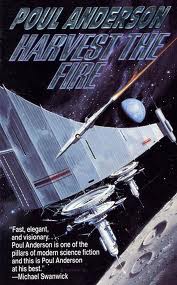
Incredibly, Poul Anderson keeps the series going. Despite the cosmic climax of Harvest of Stars and despite the comparable culmination of the succeeding volume, The Stars Are Also Fire, the future history presented in these two long novels provides sufficient background material to generate a narrative framework and what has by now become a familiar setting for two further novels. Of these two additional volumes, the first, Harvest The Fire (New York, 1995), begins:
"Once in his drifting to and fro across Earth, Jesse Nicol found a quivira left over from olden times." (p. 9)
Jesse Nicol is a new character but two features of this opening sentence are familiar: a future Earth on which there is freedom to drift and a virtual reality machine called a "quivira." Nicol generates a virtual interview with Jorge Luis Borges. The cybercosm scans databases "...to synthesize a personality and a setting..." (p. 16) The cybercosm is conscious but it is not made clear whether the simulated Borges has a temporary consciousness of being interviewed by Nicol. Generation of such a temporary consciousness does occur in virtual realities in other Anderson works.
Authentically, the virtual Borges gives Nicol a signed copy of one of his books. Nicol finds this "...heartbreaking.." and afterwards "...glanced down at his hand, as if it held a book." (pp. 29, 30) The cybercosm could have completed the illusion by printing a facsimile book with a forged signature.
Anderson readers are confident that, when this author extends, e.g., the "Harvest Of Stars" sequence or the earlier Technic History, the new work will be a substantial addition to the existing series whereas the appearance of the word Foundation or Dune in a new sf title signifies only the monotony of a recurring decimal.
"Once in his drifting to and fro across Earth, Jesse Nicol found a quivira left over from olden times." (p. 9)
Jesse Nicol is a new character but two features of this opening sentence are familiar: a future Earth on which there is freedom to drift and a virtual reality machine called a "quivira." Nicol generates a virtual interview with Jorge Luis Borges. The cybercosm scans databases "...to synthesize a personality and a setting..." (p. 16) The cybercosm is conscious but it is not made clear whether the simulated Borges has a temporary consciousness of being interviewed by Nicol. Generation of such a temporary consciousness does occur in virtual realities in other Anderson works.
Authentically, the virtual Borges gives Nicol a signed copy of one of his books. Nicol finds this "...heartbreaking.." and afterwards "...glanced down at his hand, as if it held a book." (pp. 29, 30) The cybercosm could have completed the illusion by printing a facsimile book with a forged signature.
Anderson readers are confident that, when this author extends, e.g., the "Harvest Of Stars" sequence or the earlier Technic History, the new work will be a substantial addition to the existing series whereas the appearance of the word Foundation or Dune in a new sf title signifies only the monotony of a recurring decimal.
Subscribe to:
Posts (Atom)