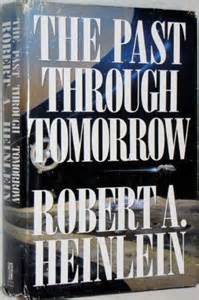
Future histories sometimes convey not only succession but also simultaneity, not only events occurring successively over historical periods of time but also some events occurring in different places simultaneously:
in Robert Heinlein's Future History, "Gentlemen, Be Seated" is a background event in "The Black Pits of Luna";
in Sandra Miesel's Chronology of Poul Anderson's Technic History, stories featuring van Rijn, Falkayn and others overlap in the 2420s and 2430s;
in Jerry Pournelle's King David's Spaceship, characters on Prince Samual's World know that something important is happening in the Trans-Coalsack...and, if we read Larry Niven's and Jerry Pournelle's The Mote In God's Eye, we know what.
Succession, or chronological linearity, generates series whereas simultaneity adds three dimensionality. Their combination confers narrative substantiality.
Showing posts with label The Future History. Show all posts
Thursday, 10 March 2016
Monday, 7 March 2016
The Future Through The Past
By reading science fiction, we learn how the future was viewed in the past:
a character in Robert Heinlein's Future History has a mobile phone but also shares the Solar System with Martians, Venerians, Callistans etc;
Dan Dare's timeline had a world government and an Interplanetary Space Fleet but neither Sterling decimalization nor inflation;
characters in Poul Anderson's The Star Fox/Fire Time diptych use "infotrieves" to access what we would call the internet but also travel in the ubiquitous "aircars" of much futuristic sf;
characters in Jerry Pournelle's CoDominium future history have multipurpose pocket computers but write on them with styluses.
Thus, sf, coming from our past, moves forwards but also sideways in time.
(In 1956, while the overweight spaceman, Nicholas van Rijn, was being introduced in Poul Anderson's "Margin of Profit," I was being introduced to sf by Dan Dare, which featured the overweight spaceman, Digby. Heinlein, Anderson and Pournelle are, of course, three successive American future historians.)
a character in Robert Heinlein's Future History has a mobile phone but also shares the Solar System with Martians, Venerians, Callistans etc;
Dan Dare's timeline had a world government and an Interplanetary Space Fleet but neither Sterling decimalization nor inflation;
characters in Poul Anderson's The Star Fox/Fire Time diptych use "infotrieves" to access what we would call the internet but also travel in the ubiquitous "aircars" of much futuristic sf;
characters in Jerry Pournelle's CoDominium future history have multipurpose pocket computers but write on them with styluses.
Thus, sf, coming from our past, moves forwards but also sideways in time.
(In 1956, while the overweight spaceman, Nicholas van Rijn, was being introduced in Poul Anderson's "Margin of Profit," I was being introduced to sf by Dan Dare, which featured the overweight spaceman, Digby. Heinlein, Anderson and Pournelle are, of course, three successive American future historians.)
Saturday, 27 February 2016
Uniqueness
My two favorite kinds of science fiction are time travel and future history series: Wells and Heinlein.
Time Travel
There are two fundamental premises: the past either can or cannot be changed. Poul Anderson systematically examines both. In The Corridors Of Time and There Will Be Time, rival groups wage war throughout an immutable timeline by changing the significance of known events whereas, in the Time Patrol series, an organization prevents change in a mutable timeline.
Future History Series
Robert Heinlein wrote one Future History, although five early Scribner Juveniles share a background with each other and with the "Green Hills of Earth" period of the Future History. Thus, these five novels might count as a "Juvenile Future History."
James Blish wrote a four novel future history, Cities In Flight, a four story future history, The Seedling Stars, and the non-linear Haertel Scholium containing three distinct future historical sequences.
Larry Niven has the Known Space and the State/Smoke Ring histories.
I think that other future historians have one series each except Anderson who has at least eight. I am here counting the single novel, Genesis, as a series because its successive chapters cover geological ages. Anderson moves away from histories with FTL, aliens and interstellar empires towards histories with STL, no aliens and human/AI interactions.
These thorough treatments of time travel and future histories make Anderson unique among sf writers.
Time Travel
There are two fundamental premises: the past either can or cannot be changed. Poul Anderson systematically examines both. In The Corridors Of Time and There Will Be Time, rival groups wage war throughout an immutable timeline by changing the significance of known events whereas, in the Time Patrol series, an organization prevents change in a mutable timeline.
Future History Series
Robert Heinlein wrote one Future History, although five early Scribner Juveniles share a background with each other and with the "Green Hills of Earth" period of the Future History. Thus, these five novels might count as a "Juvenile Future History."
James Blish wrote a four novel future history, Cities In Flight, a four story future history, The Seedling Stars, and the non-linear Haertel Scholium containing three distinct future historical sequences.
Larry Niven has the Known Space and the State/Smoke Ring histories.
I think that other future historians have one series each except Anderson who has at least eight. I am here counting the single novel, Genesis, as a series because its successive chapters cover geological ages. Anderson moves away from histories with FTL, aliens and interstellar empires towards histories with STL, no aliens and human/AI interactions.
These thorough treatments of time travel and future histories make Anderson unique among sf writers.
Thursday, 25 February 2016
An American Sequence
I have referred to an American sequences of future histories:
Heinlein
Anderson (2)
Niven
Pournelle
To complete the connections, we might consider a few parallels between Heinlein's Future History and Niven's Known Space History.
Heinlein begins with four stories describing technological advances in the second half of the twentieth century. Niven begins with four stories describing interplanetary exploration in the last quarter of the twentieth century.
In the Future History, a period of interplanetary expansion is ended by the Prophets. In the Known Space History, a Golden Age in the Solar System is ended by the kzinti.
In both Histories, there is then an interstellar civilization with FTL travel.
Heinlein
Anderson (2)
Niven
Pournelle
To complete the connections, we might consider a few parallels between Heinlein's Future History and Niven's Known Space History.
Heinlein begins with four stories describing technological advances in the second half of the twentieth century. Niven begins with four stories describing interplanetary exploration in the last quarter of the twentieth century.
In the Future History, a period of interplanetary expansion is ended by the Prophets. In the Known Space History, a Golden Age in the Solar System is ended by the kzinti.
In both Histories, there is then an interstellar civilization with FTL travel.
Friday, 29 January 2016
Daily Life
Someone said that Robert Heinlein's Future History gave the future a daily life. We should be shown every aspect of a fictitious society, e.g., not only what a public figure thinks but also how he is perceived and, most importantly, how people live.
I would like to know more about daily life in the Solar Commonwealth and the Terran Empire of Poul Anderson's Technic Civilization. Some details can be hypothesized by extrapolating from the lives of individual characters like Eric Wace.
When SM Stirling's Draka conquer a country, the inhabitants are killed, enslaved or, in a very small number of cases, offered Citizenship - if their technical or scientific knowledge can help to build the Domination. "Home Is Where The Heart Is" by William Barton is narrated by a German rocket scientist who recounts his memories, his thoughts of what might have been and how he copes with becoming the owner of a female serf who not only cooks and performs domestic chores but also ensures her own survival by pleasing her new owner in other ways. We have seen the Draka, their serfs and adversaries but this is a slightly different perspective.
Now I am starting to read about Gordon of Khartoum among the Draka. Regular readers might remember that, when I reach a large round number of posts near the end of a month, I start to think about taking a break until the beginning of the following month - but I am never sure about what will happen next. If there is a break, I hope that page viewers will find plenty to reread and maybe to comment on.
I would like to know more about daily life in the Solar Commonwealth and the Terran Empire of Poul Anderson's Technic Civilization. Some details can be hypothesized by extrapolating from the lives of individual characters like Eric Wace.
When SM Stirling's Draka conquer a country, the inhabitants are killed, enslaved or, in a very small number of cases, offered Citizenship - if their technical or scientific knowledge can help to build the Domination. "Home Is Where The Heart Is" by William Barton is narrated by a German rocket scientist who recounts his memories, his thoughts of what might have been and how he copes with becoming the owner of a female serf who not only cooks and performs domestic chores but also ensures her own survival by pleasing her new owner in other ways. We have seen the Draka, their serfs and adversaries but this is a slightly different perspective.
Now I am starting to read about Gordon of Khartoum among the Draka. Regular readers might remember that, when I reach a large round number of posts near the end of a month, I start to think about taking a break until the beginning of the following month - but I am never sure about what will happen next. If there is a break, I hope that page viewers will find plenty to reread and maybe to comment on.
Saturday, 2 January 2016
Ideas In Three Future Histories
Robert Heinlein's Future History covers:
psychodynamics;
longevity and immortality;
a "generation ship" (multi-generation interstellar spaceship).
Isaac Asimov's future history covers:
robots;
psychohistory (a mathematical science of society).
Poul Anderson's Psychotechnic History covers:
psychotechnics (a mathematical science of society);
immortality;
a robot;
a generation ship.
However, the Psychotechnic History is mainly about psychotechnics. The remaining three issues are addressed in one story each. Anderson makes an original contribution to each of these sf ideas and he uses the Psychotechnic History background for this purpose.
Next, it will be necessary to reread three of the four "political" stories in the Solar Union period in order to trace the history of political opposition. I reread one work, The Snows Of Ganymede, recently.
My birthday presents yesterday included the two remaining volumes about SM Stirling's Draka and I have yet to finish rereading Volume III of that series so these regrettable characters will have to return to the agenda. In the authentic sf manner, Stirling has created an original premise and presented its logical consequences, however unpleasant.
psychodynamics;
longevity and immortality;
a "generation ship" (multi-generation interstellar spaceship).
Isaac Asimov's future history covers:
robots;
psychohistory (a mathematical science of society).
Poul Anderson's Psychotechnic History covers:
psychotechnics (a mathematical science of society);
immortality;
a robot;
a generation ship.
However, the Psychotechnic History is mainly about psychotechnics. The remaining three issues are addressed in one story each. Anderson makes an original contribution to each of these sf ideas and he uses the Psychotechnic History background for this purpose.
Next, it will be necessary to reread three of the four "political" stories in the Solar Union period in order to trace the history of political opposition. I reread one work, The Snows Of Ganymede, recently.
My birthday presents yesterday included the two remaining volumes about SM Stirling's Draka and I have yet to finish rereading Volume III of that series so these regrettable characters will have to return to the agenda. In the authentic sf manner, Stirling has created an original premise and presented its logical consequences, however unpleasant.
Monday, 28 December 2015
Lunar Colonization
Why colonize the Moon?
"Military bases? No. Quite apart from the treaty forbidding them, they would have no usefulness that was not grotesquely outweighed by the expense and trouble."
-Poul Anderson, The Infinite Voyage: Man's Future In Space (London, 1969), p. 76.
That rules out the Space Patrol bases in Robert Heinlein's Future History or the Lunar Guard in Anderson's Psychotechnic History. However, nuclear missiles could instead be placed in Earth orbit.
"Scientific research?" (ibid.)
Yes. Anderson argues that machines cannot cope with the unforeseen whereas the purpose of exploration is precisely to discover (un-cover) what was previously unknown. Machines might become more sophisticated or might be remotely controlled but for the latter there would be a time lag. The purposes of exploration are many but Anderson articulates one that I had not encountered before. Maybe:
wind carried germs into the upper atmosphere;
light pressure drove them into space;
a few landed on the Moon;
some were protected from radiation by falling into cracks or mingling with dust;
there could be several hundred per year for over a billion years;
thus, the Moon might hold clues to the origins of life;
indeed, the Moon itself might have retained enough air and water to generate primitive organisms;
also, complex, pre-biological matter might have originated in the dust cloud that condensed into the Solar System;
the Moon will have vacuum-preserved any such earlier matter that landed on it.
So let's get some scientists onto the Moon.
"Military bases? No. Quite apart from the treaty forbidding them, they would have no usefulness that was not grotesquely outweighed by the expense and trouble."
-Poul Anderson, The Infinite Voyage: Man's Future In Space (London, 1969), p. 76.
That rules out the Space Patrol bases in Robert Heinlein's Future History or the Lunar Guard in Anderson's Psychotechnic History. However, nuclear missiles could instead be placed in Earth orbit.
"Scientific research?" (ibid.)
Yes. Anderson argues that machines cannot cope with the unforeseen whereas the purpose of exploration is precisely to discover (un-cover) what was previously unknown. Machines might become more sophisticated or might be remotely controlled but for the latter there would be a time lag. The purposes of exploration are many but Anderson articulates one that I had not encountered before. Maybe:
wind carried germs into the upper atmosphere;
light pressure drove them into space;
a few landed on the Moon;
some were protected from radiation by falling into cracks or mingling with dust;
there could be several hundred per year for over a billion years;
thus, the Moon might hold clues to the origins of life;
indeed, the Moon itself might have retained enough air and water to generate primitive organisms;
also, complex, pre-biological matter might have originated in the dust cloud that condensed into the Solar System;
the Moon will have vacuum-preserved any such earlier matter that landed on it.
So let's get some scientists onto the Moon.
Friday, 25 December 2015
Untold Stories?
An author might create more background material for a work of science fiction than appears in the text. For example, a planetary ecology requires more globally interacting geographical areas and local environments than the hero is likely to encounter while traversing the planetary surface. Thus, the Author's Note to Poul Anderson's Virgin Planet discloses details about an uninhabited continent that remains unvisited during the novel.
Robert Heinlein's Future History Time Chart presents data, like an Antarctican Revolution, that do not appear in any of the stories and even lists in brackets six "stories-to-be-told" that never did get told. Might there be some such untold stories in Anderson's Psychotechnic History? Of course, none are listed in the Chronology. However, Anderson tells us that he:
compiled a Heinleinian chart of story titles;
occasionally wrote a story corresponding to one of the titles;
eventually did not complete the series but merely gave it up.
So there might have been more titles on his original time chart? The opening story mentions but does not feature Valti, the founder of psychotechnics. The Traveler crew had many adventures before colonizing Harbor. One involved riding and talking with centauroids en route to attack their winged enemies' aerial city. This adventure is mentioned again but not recounted. We learn that the centauroids, birds and flying city were on the planet Aesgil IV. But we would like to read that adventure.
Robert Heinlein's Future History Time Chart presents data, like an Antarctican Revolution, that do not appear in any of the stories and even lists in brackets six "stories-to-be-told" that never did get told. Might there be some such untold stories in Anderson's Psychotechnic History? Of course, none are listed in the Chronology. However, Anderson tells us that he:
compiled a Heinleinian chart of story titles;
occasionally wrote a story corresponding to one of the titles;
eventually did not complete the series but merely gave it up.
So there might have been more titles on his original time chart? The opening story mentions but does not feature Valti, the founder of psychotechnics. The Traveler crew had many adventures before colonizing Harbor. One involved riding and talking with centauroids en route to attack their winged enemies' aerial city. This adventure is mentioned again but not recounted. We learn that the centauroids, birds and flying city were on the planet Aesgil IV. But we would like to read that adventure.
Tuesday, 22 December 2015
Chronology Of The Future
The contents page of Poul Anderson's Starship (New York, 1982) tells us that a "Chronology of the Future" begins on page 283 but, when we turn to that page, we find instead "A CHRONOLOGY OF THE PSYCHOTECHNIC SERIES."
There are two ways to construct such a fictitious chronology. In his Author's Note at the end of The Psychotechnic League, Anderson wrote:
"...I drew up a chart in the manner of Heinlein and, from time to time, completed a piece whose title was on it." (p. 284)
On this model, the chart listing fictional dates and titles preexisted the pieces corresponding to the titles. The opposite approach is to compile the chronological chart while writing a series. Thus, the chart hopefully prevents inconsistencies without prescribing what is to be written. It cannot become a straightjacket.
Doctor Who visited many historical and future periods. Script editors should have compiled a chart to keep the series consistent. However, Terrance Dicks, meeting fans at Lancaster Literature Festival, said that they did not keep it consistent. Fans were supposed either not to notice or not to care. But there are two kinds of fans. We value Heinlein's Future History and Anderson's future histories for several reasons, not least because of their detailed and careful consistency.
There are two ways to construct such a fictitious chronology. In his Author's Note at the end of The Psychotechnic League, Anderson wrote:
"...I drew up a chart in the manner of Heinlein and, from time to time, completed a piece whose title was on it." (p. 284)
On this model, the chart listing fictional dates and titles preexisted the pieces corresponding to the titles. The opposite approach is to compile the chronological chart while writing a series. Thus, the chart hopefully prevents inconsistencies without prescribing what is to be written. It cannot become a straightjacket.
Doctor Who visited many historical and future periods. Script editors should have compiled a chart to keep the series consistent. However, Terrance Dicks, meeting fans at Lancaster Literature Festival, said that they did not keep it consistent. Fans were supposed either not to notice or not to care. But there are two kinds of fans. We value Heinlein's Future History and Anderson's future histories for several reasons, not least because of their detailed and careful consistency.
Monday, 21 December 2015
Gaps
When the short story, "Gypsy," introduces the hyperdrive in Poul Anderson's Psychotechnic History, we are told that the principles of the drive involve multiple dimensions and discontinuous psi functions. Thus, this is not the multiple quantum jumps hyperdrive of the same author's later Technic History.
In a future history series, the author might develop a near future period and a further future period, leaving a chronological gap between them. In Robert Heinlein's Future History, "Logic of Empire" shows indentured servitude on Venus while a Prophet gains support in the US whereas the succeeding installment, "If This Goes On -," shows a US theocracy that has caused a hiatus in space travel. We have not seen the First Prophet come to power although we are about to see one of his successors overthrown. Perhaps seventy years - as well as three "stories-to-be-told" - occupy the gap between the two installments.
The gap in Poul Anderson's Psychotechnic History is much longer, 545 years according to the Chronology. In "Brake," human beings have spread through the Solar System but there is turmoil on Earth. In "Gypsy," human beings are spreading at faster then light speeds beyond the Solar System but the hyperspace ship, Traveler, is lost and its crew have settled on an Earth-like planet that they call "Harbor."
I am currently rereading "Gypsy" and have not yet found any internal evidence that it belongs in the same future history. In fact, when does the FTL period of the history make clear that it connects with the STL period?
The Chronology reads:
2270 "Brake"
2300 The Second Dark Ages
2600
2784 Hyperdrive invented
2815 "Gypsy"
Nomad culture develops
So what happened in 2600 that we are not told about? It must be something to do with the restoration of civilization after the Second Dark Ages but it is not the founding of the Stellar Union because that comes later:
2875 "Star Ship"
2900 Stellar Union and Coordination Service founded
The Coordinators begin less than a century after the Nomads.
In a future history series, the author might develop a near future period and a further future period, leaving a chronological gap between them. In Robert Heinlein's Future History, "Logic of Empire" shows indentured servitude on Venus while a Prophet gains support in the US whereas the succeeding installment, "If This Goes On -," shows a US theocracy that has caused a hiatus in space travel. We have not seen the First Prophet come to power although we are about to see one of his successors overthrown. Perhaps seventy years - as well as three "stories-to-be-told" - occupy the gap between the two installments.
The gap in Poul Anderson's Psychotechnic History is much longer, 545 years according to the Chronology. In "Brake," human beings have spread through the Solar System but there is turmoil on Earth. In "Gypsy," human beings are spreading at faster then light speeds beyond the Solar System but the hyperspace ship, Traveler, is lost and its crew have settled on an Earth-like planet that they call "Harbor."
I am currently rereading "Gypsy" and have not yet found any internal evidence that it belongs in the same future history. In fact, when does the FTL period of the history make clear that it connects with the STL period?
The Chronology reads:
2270 "Brake"
2300 The Second Dark Ages
2600
2784 Hyperdrive invented
2815 "Gypsy"
Nomad culture develops
So what happened in 2600 that we are not told about? It must be something to do with the restoration of civilization after the Second Dark Ages but it is not the founding of the Stellar Union because that comes later:
2875 "Star Ship"
2900 Stellar Union and Coordination Service founded
The Coordinators begin less than a century after the Nomads.
Wednesday, 16 December 2015
The Pact
Poul Anderson's "The Pirate," about Stellar Union Coordination Service field agent, Trevelyan Micah, is narrated a generation later by another Cordy who begins:
"We guard the great Pact: the young generation, the folk of the star frontier, so often do not understand."
-Poul Anderson, Starship (New York, 1982), p. 211.
What "Pact"? The Social Contract? A Constitution? A Pax? A Pax enforced by nuclear or other futuristic weapons? (Remember the Space Patrol in Robert Heinlein's Future History or the Lunar Guard earlier in Anderson's Psychotechnic History.)
In this story, a planetary population has been killed by radiation. The title character aims to get rich quick by selling the idyllic planet with its empty dwellings to would be colonists. The Cordies say no, first, scientists and scholars need as long as it takes to study the dead civilization. The story ends as its narrator explains what he meant by the Pact:
"We guard the great Pact, which is the heart of civilization, of society, and ultimately of life itself: the unspoken Pact between the living, the dead, and the unborn, that to the best of our poor mortal abilities they shall be kept one in the oneness of time. Without it, nothing would have meaning and it may be that nothing would survive. But the young generations so often do not understand." (p. 251)
Anderson had to put the narration into the mouth of another Cordy. The omniscient narrator would not have been able to preach or philosophize like this. Having read to the end, surely we realize that "The Pact" would have been a more appropriate title?
"We guard the great Pact: the young generation, the folk of the star frontier, so often do not understand."
-Poul Anderson, Starship (New York, 1982), p. 211.
What "Pact"? The Social Contract? A Constitution? A Pax? A Pax enforced by nuclear or other futuristic weapons? (Remember the Space Patrol in Robert Heinlein's Future History or the Lunar Guard earlier in Anderson's Psychotechnic History.)
In this story, a planetary population has been killed by radiation. The title character aims to get rich quick by selling the idyllic planet with its empty dwellings to would be colonists. The Cordies say no, first, scientists and scholars need as long as it takes to study the dead civilization. The story ends as its narrator explains what he meant by the Pact:
"We guard the great Pact, which is the heart of civilization, of society, and ultimately of life itself: the unspoken Pact between the living, the dead, and the unborn, that to the best of our poor mortal abilities they shall be kept one in the oneness of time. Without it, nothing would have meaning and it may be that nothing would survive. But the young generations so often do not understand." (p. 251)
Anderson had to put the narration into the mouth of another Cordy. The omniscient narrator would not have been able to preach or philosophize like this. Having read to the end, surely we realize that "The Pact" would have been a more appropriate title?
Tuesday, 24 November 2015
A Mixed Colony
Robert Heinlein wrote several short stories with a common future background, then compiled a Time Chart to keep the stories consistent. His editor, John W Campbell, published the Time Chart. Imitating Heinlein, Poul Anderson compiled a (different) Time Chart and set some stories in successive periods of it. Later, Anderson wrote several initially unconnected works that converged to form a third future history. Each installment in this "Technic History" is a substantial novel or short story. They are clearly not written to any formula despite what seems, when analyzed, to be a systematic approach to their subject-matters, e.g.:
Ythri discovered by human explorers;
Ythrians learning from humanity, going into space, later transporting van Rijn;
Gray, later renamed Avalon, explored by Ythrians and human beings;
Avalonian islands colonized by Ythrians and human beings;
an Avalonian continent colonized by Ythrians and human beings;
Avalonian Ythrians and human beings successfully resisting Terran imperialism;
much later, an Avalonian Ythrian spying for Ythri and Terra against a common enemy;
Dominic Flandry predicting that mixed species cultures like Avalon will build fascinating new civilizations.
Philippe Rochefort, a Lieutenant in the Terran Space Navy that attacks Avalon, disapproves of mixed colonies on the grounds that people should be what they are and stand by their own. Be what we are? But what can we become? On Avalon, Christopher Holm becomes, then is, Arinnian of Stormgate Choth - although he does experience some problems in making the transition. Tabitha Falkayn/Hrill, a third generation member of Highsky Choth brought up by Ythrians, has no problem about identifying with Ythri while acknowledging her humanity. She advises Arinnian:
"'...a man or woman who tries to be an Ythrian is a rattlewing.'"
-Poul Anderson, Rise Of The Terran Empire (New York, 2011), p. 502.
"'Can't have it on both wings, son.'" (p. 504)
I dislike Rochefort's idea of standing by your own. This seems to assume a conflict of interests with other groups. His ancestors on Terra suffered because of this attitude. He acknowledges that he is a human supremacist because mankind leads Technic civilization.
"'...my sort of people are the xenosophont's best friend. We simply don't want to imitate him.'" (p. 489)
What sort of people? Rochefort is under no obligation to imitate anyone but, if we makes it his business to disapprove of cultural mixing, then he is not the xenosophont's friend.
Ythri discovered by human explorers;
Ythrians learning from humanity, going into space, later transporting van Rijn;
Gray, later renamed Avalon, explored by Ythrians and human beings;
Avalonian islands colonized by Ythrians and human beings;
an Avalonian continent colonized by Ythrians and human beings;
Avalonian Ythrians and human beings successfully resisting Terran imperialism;
much later, an Avalonian Ythrian spying for Ythri and Terra against a common enemy;
Dominic Flandry predicting that mixed species cultures like Avalon will build fascinating new civilizations.
Philippe Rochefort, a Lieutenant in the Terran Space Navy that attacks Avalon, disapproves of mixed colonies on the grounds that people should be what they are and stand by their own. Be what we are? But what can we become? On Avalon, Christopher Holm becomes, then is, Arinnian of Stormgate Choth - although he does experience some problems in making the transition. Tabitha Falkayn/Hrill, a third generation member of Highsky Choth brought up by Ythrians, has no problem about identifying with Ythri while acknowledging her humanity. She advises Arinnian:
"'...a man or woman who tries to be an Ythrian is a rattlewing.'"
-Poul Anderson, Rise Of The Terran Empire (New York, 2011), p. 502.
"'Can't have it on both wings, son.'" (p. 504)
I dislike Rochefort's idea of standing by your own. This seems to assume a conflict of interests with other groups. His ancestors on Terra suffered because of this attitude. He acknowledges that he is a human supremacist because mankind leads Technic civilization.
"'...my sort of people are the xenosophont's best friend. We simply don't want to imitate him.'" (p. 489)
What sort of people? Rochefort is under no obligation to imitate anyone but, if we makes it his business to disapprove of cultural mixing, then he is not the xenosophont's friend.
Tuesday, 27 October 2015
Imperfect Consistency
"Perfect consistency is possible only to God Himself, and a close study of scripture will show that He doesn't always make it."
-Poul Anderson, "Concerning Future Histories" IN Bulletin Of The Science Fiction Writers Of America, Volume 14, Number 3, Fall 1979, p. 13.
There are four possible responses to an inconsistency in a work of fiction, e.g., between installments of a series. The reader:
does not notice;
does not care;
rationalizes the inconsistency;
regards the inconsistency as an irredeemable error.
Only the fourth response is a problem. It is called an "aesthetic interference condition," according to one of my lecturers in Aesthetics. The inconsistency interferes with or prevents aesthetic appreciation or satisfaction. Many apparent inconsistencies can be rationalized by reflecting that often the successive installments of a future history are written from different points of view. Thus, one character thinks that the Merseians are mammals whereas another thinks that they are not, etc.
Inconsistencies are not a major problem in Poul Anderson's works. I am reflecting on them here because I have been considering the works of James Blish who wrote two linear future histories but also several branching futures. Although Robert Heinlein compiled his Time Chart in order to keep his Future History consistent, he later wrote, in that same SFWA Bulletin, that he wanted each story to be internally consistent but not necessarily the entire series, which helps to explain why the gravity control discovered in one story is absent in later stories, although this inconsistency can also be rationalized.
Addendum: For discussion of one apparent contradiction in Anderson's Flandry series, see here.
-Poul Anderson, "Concerning Future Histories" IN Bulletin Of The Science Fiction Writers Of America, Volume 14, Number 3, Fall 1979, p. 13.
There are four possible responses to an inconsistency in a work of fiction, e.g., between installments of a series. The reader:
does not notice;
does not care;
rationalizes the inconsistency;
regards the inconsistency as an irredeemable error.
Only the fourth response is a problem. It is called an "aesthetic interference condition," according to one of my lecturers in Aesthetics. The inconsistency interferes with or prevents aesthetic appreciation or satisfaction. Many apparent inconsistencies can be rationalized by reflecting that often the successive installments of a future history are written from different points of view. Thus, one character thinks that the Merseians are mammals whereas another thinks that they are not, etc.
Inconsistencies are not a major problem in Poul Anderson's works. I am reflecting on them here because I have been considering the works of James Blish who wrote two linear future histories but also several branching futures. Although Robert Heinlein compiled his Time Chart in order to keep his Future History consistent, he later wrote, in that same SFWA Bulletin, that he wanted each story to be internally consistent but not necessarily the entire series, which helps to explain why the gravity control discovered in one story is absent in later stories, although this inconsistency can also be rationalized.
Addendum: For discussion of one apparent contradiction in Anderson's Flandry series, see here.
Sunday, 25 October 2015
Road Reflections... II
See here.
Retcons (i)
Of course, some of those "earlier" stories may be written later:
Heinlein's "Requiem" described old Harriman dying on the Moon, then his "The Man Who Sold The Moon" described how Harriman had put mankind on the Moon;
Heinlein described the heroic death of Space Patrolman John Dahlquist after he had shown the Patrol honoring this hero;
James Blish wrote a novel about the young Adolph Haertel after he had described the older Haertel conferring with the pilot who had successfully test flown the Haertel overdrive;
Anderson wrote a series of stories about Dominic Flandry, then the "Young Flandry" trilogy about the start of Flandry's career;
the story introducing Adzel as a student on Earth was written after the "later" story about Adzel joining the trader team - in fact the introductory story expands on a short dialogue in the "later" story;
and there are other examples.
Retcons (ii)
Also, a later work can present new information about earlier events. The peak of the pyramid can shine a spotlight on its base. For example, Methuselah's Children reveals that:
the Howard Families, bred for longevity, had existed secretly since the late nineteenth century;
thus, they had existed throughout the entire Future History to date;
in fact, one of their number had lived since the early twentieth century;
Andrew Libby was a Howard.
The History would have been better constructed if the reader had been able to recognize an earlier spear-carrying character as an alias of Lazarus Long.
Poul Anderson's The Game Of Empire reveals:
the existence of the Dakotian and Zacharian communities;
an old Merseian conspiracy involving Aycharaych, at last coming to fruition.
A future history is a work in progress. The author can always add and reassess. Larry Niven shows us that we really knew nothing about the Puppeteer Fleet of Worlds or the Ringworld.
Retcons (i)
Of course, some of those "earlier" stories may be written later:
Heinlein's "Requiem" described old Harriman dying on the Moon, then his "The Man Who Sold The Moon" described how Harriman had put mankind on the Moon;
Heinlein described the heroic death of Space Patrolman John Dahlquist after he had shown the Patrol honoring this hero;
James Blish wrote a novel about the young Adolph Haertel after he had described the older Haertel conferring with the pilot who had successfully test flown the Haertel overdrive;
Anderson wrote a series of stories about Dominic Flandry, then the "Young Flandry" trilogy about the start of Flandry's career;
the story introducing Adzel as a student on Earth was written after the "later" story about Adzel joining the trader team - in fact the introductory story expands on a short dialogue in the "later" story;
and there are other examples.
Retcons (ii)
Also, a later work can present new information about earlier events. The peak of the pyramid can shine a spotlight on its base. For example, Methuselah's Children reveals that:
the Howard Families, bred for longevity, had existed secretly since the late nineteenth century;
thus, they had existed throughout the entire Future History to date;
in fact, one of their number had lived since the early twentieth century;
Andrew Libby was a Howard.
The History would have been better constructed if the reader had been able to recognize an earlier spear-carrying character as an alias of Lazarus Long.
Poul Anderson's The Game Of Empire reveals:
the existence of the Dakotian and Zacharian communities;
an old Merseian conspiracy involving Aycharaych, at last coming to fruition.
A future history is a work in progress. The author can always add and reassess. Larry Niven shows us that we really knew nothing about the Puppeteer Fleet of Worlds or the Ringworld.
Road Reflections On Features Of Future Histories
While driving, we can remember and reflect but not read - although, of course, someone with an audio-book can listen. However, my reflections of today have merely reproduced the contents of earlier posts about Robert Heinlein's Future History and Poul Anderson's History of Technic Civilization.
Pyramids
A Heinlein-model future history has a pyramidal structure, i.e., earlier installments generate a base of background information on which the author then constructs his later installments. Thus, Methusaleh's Children, the fourth volume of Heinlein's Future History, refers to quite a lot:
Pinero the Charlatan
Road Cities
DD Harriman
Luna City
the Venerians
"The Green Hills of Earth"
the Prophets
the revolutionary Cabal
the Covenant
Coventry
Andrew Libby
the generation ship, the Vanguard
This novel is effectively the culmination of the History since the fifth and final volume, Orphans Of The Sky, recounting the fate of the lost Vanguard, is merely a coda.
In one story of Anderson's Technic History, Nicholas van Rijn forms his first trade pioneer crew, led by David Falkayn and including the Wodenite, Adzel. However, "before" this story, at least in terms of fictional chronology:
van Rijn had appeared in five stories and one novel;
Falkayn had appeared in two stories, first as an apprentice on Ivanhoe, then as a journeyman in van Rijn's company;
Adzel had appeared in one story;
one story recounted later events on Ivanhoe;
three stories had preceded any of these continuing characters.
Thus, the first trader team story was built on a base of thirteen earlier works. It in turn is followed by four works featuring the team and three set on a planet colonized by Falkayn. Both this planet and the flying species that jointly colonizes it with Falkayn's human beings were introduced in earlier stories. Thus, Anderson constructs a perfect pyramid.
Pyramids
A Heinlein-model future history has a pyramidal structure, i.e., earlier installments generate a base of background information on which the author then constructs his later installments. Thus, Methusaleh's Children, the fourth volume of Heinlein's Future History, refers to quite a lot:
Pinero the Charlatan
Road Cities
DD Harriman
Luna City
the Venerians
"The Green Hills of Earth"
the Prophets
the revolutionary Cabal
the Covenant
Coventry
Andrew Libby
the generation ship, the Vanguard
This novel is effectively the culmination of the History since the fifth and final volume, Orphans Of The Sky, recounting the fate of the lost Vanguard, is merely a coda.
In one story of Anderson's Technic History, Nicholas van Rijn forms his first trade pioneer crew, led by David Falkayn and including the Wodenite, Adzel. However, "before" this story, at least in terms of fictional chronology:
van Rijn had appeared in five stories and one novel;
Falkayn had appeared in two stories, first as an apprentice on Ivanhoe, then as a journeyman in van Rijn's company;
Adzel had appeared in one story;
one story recounted later events on Ivanhoe;
three stories had preceded any of these continuing characters.
Thus, the first trader team story was built on a base of thirteen earlier works. It in turn is followed by four works featuring the team and three set on a planet colonized by Falkayn. Both this planet and the flying species that jointly colonizes it with Falkayn's human beings were introduced in earlier stories. Thus, Anderson constructs a perfect pyramid.
Friday, 25 September 2015
Connecting Future Histories
The previous post linked Heinlein's Future History to Anderson's Psychotechnic History, Technic History and Harvest of Stars tetralogy. These four series are all "future histories" although Heinlein's is also the Future History. I already knew that the Psychotechnic History was modeled on the Future History and that the Technic History grew to be a longer Heinlein-model future history but was surprised to realize that the Harvest of Stars history could be seen as a conceptual successor to the Technic History.
Heinlein begins by asking how technological advances might affect society in the near future (the 1950s). Anderson winds up by presenting a subtle account of conflict between humanity and AI technology - the Frankenstein theme but in an almost unrecognizable form. Thus there is a continuous conceptual progression from Heinlein's opening story, "Lifeline," to Anderson's two-word concluding chapter:
"FENN WOKE."
-Poul Anderson, The Fleet Of Stars (New York, 1997), Chapter 32, p. 403.
At least two other future histories should be included in this sequence:
Larry Niven's Known Space series, with the exploration of the Solar System followed by social problems on Earth, is like an update of Heinlein;
Anderson's Genesis takes human-AI interactions in a different direction and billions of years further into the future.
(Imagine reading all these works in this order for the first time!)
Genesis (New York, 2001) concludes:
"...she will abide, waiting for the judgment from the stars." (p. 248)
Thus, after all that time, there is still more to come.
Heinlein begins by asking how technological advances might affect society in the near future (the 1950s). Anderson winds up by presenting a subtle account of conflict between humanity and AI technology - the Frankenstein theme but in an almost unrecognizable form. Thus there is a continuous conceptual progression from Heinlein's opening story, "Lifeline," to Anderson's two-word concluding chapter:
"FENN WOKE."
-Poul Anderson, The Fleet Of Stars (New York, 1997), Chapter 32, p. 403.
At least two other future histories should be included in this sequence:
Larry Niven's Known Space series, with the exploration of the Solar System followed by social problems on Earth, is like an update of Heinlein;
Anderson's Genesis takes human-AI interactions in a different direction and billions of years further into the future.
(Imagine reading all these works in this order for the first time!)
Genesis (New York, 2001) concludes:
"...she will abide, waiting for the judgment from the stars." (p. 248)
Thus, after all that time, there is still more to come.
Thursday, 24 September 2015
Successive And Progressive Future Histories
(i) Poul Anderson's first future history, the Psychotechnic History, was modeled directly on Robert Heinlein's Future History. Thus, a Time Chart listed near future conflicts followed by further future interstellar travel, then some stories were written to fit into the Chart.
(ii) His second future history, the History of Technic Civilization, grew organically but came to express a qualified cyclical theory of history. Thus, in any civilization, either a wrong decision leads to recognizable stages of decline followed by breakdown or the society remains in free growth. Technic Civilization broke down but hopefully the later and larger civilization represented by the Commonalty will remain in free growth.
(iii) In his last, Harvest of Stars, future history, technology advances to a level that seems to preclude any further decline or breakdown:
in the Solar System, a declining human population is entirely supported by self-evolving AI's;
in other systems, technology enables human colonists to -
- record their personalities as conscious AI's;
reincarnate the recorded personalities in newly grown organic bodies;
effortlessly produce any necessary artifacts without needing to distribute them through a market;
transform lifeless planets into habitable environments, each presided over by an AI nature deity based on a former human personality.
This sounds like:
abundantly overflowing social wealth that no longer needs to be hoarded, guarded or fought over;
ultimate free growth.
(ii) His second future history, the History of Technic Civilization, grew organically but came to express a qualified cyclical theory of history. Thus, in any civilization, either a wrong decision leads to recognizable stages of decline followed by breakdown or the society remains in free growth. Technic Civilization broke down but hopefully the later and larger civilization represented by the Commonalty will remain in free growth.
(iii) In his last, Harvest of Stars, future history, technology advances to a level that seems to preclude any further decline or breakdown:
in the Solar System, a declining human population is entirely supported by self-evolving AI's;
in other systems, technology enables human colonists to -
- record their personalities as conscious AI's;
reincarnate the recorded personalities in newly grown organic bodies;
effortlessly produce any necessary artifacts without needing to distribute them through a market;
transform lifeless planets into habitable environments, each presided over by an AI nature deity based on a former human personality.
This sounds like:
abundantly overflowing social wealth that no longer needs to be hoarded, guarded or fought over;
ultimate free growth.
Monday, 20 July 2015
A Literary Progression
I said earlier that the deeper we look into Poul Anderson's works the more we find there. This is also true of SM Stirling's works which resemble Anderson's in several respects although the main resemblance is originality, not imitation. However, there are also:
detailed descriptions;
substantial backgrounds;
solid characterization;
historical and technological knowledge;
plot developments logically derived from imaginative premises.
There is a literary progression from Robert Heinlein's concretely realized colonized Solar System through Anderson's Terran Empire to Stirling's Angrezi Raj. These three scenarios are respectively interplanetary, interstellar and alternative historical as sf writers extend and redirect the scope of speculative fiction.
Heinlein unfortunately addressed alternative histories during his steep decline whereas Anderson created several ingenious divergent histories and at least two of his successors, Harry Turtledove and SM Stirling, have elaborated this concept with even greater creativity and precision.
When I am immersed in a particular fictional world, it is a wrench to disengage from it. For this reason, I might stay with Stirling's Angrezi Raj for a while even if his first Draka volume arrives soon. I had set out to post about another detail of the Raj but that will have to wait.
detailed descriptions;
substantial backgrounds;
solid characterization;
historical and technological knowledge;
plot developments logically derived from imaginative premises.
There is a literary progression from Robert Heinlein's concretely realized colonized Solar System through Anderson's Terran Empire to Stirling's Angrezi Raj. These three scenarios are respectively interplanetary, interstellar and alternative historical as sf writers extend and redirect the scope of speculative fiction.
Heinlein unfortunately addressed alternative histories during his steep decline whereas Anderson created several ingenious divergent histories and at least two of his successors, Harry Turtledove and SM Stirling, have elaborated this concept with even greater creativity and precision.
When I am immersed in a particular fictional world, it is a wrench to disengage from it. For this reason, I might stay with Stirling's Angrezi Raj for a while even if his first Draka volume arrives soon. I had set out to post about another detail of the Raj but that will have to wait.
Tuesday, 14 July 2015
Future Histories And Time Travel
HG Wells' The Time Machine uses time travel to present a dystopian future whereas the same author's The Shape Of Things To Come uses a fictitious historical text book to present a utopian future. Thus, these two works remain distinct and separate whereas:
Olaf Stapledon's fictitious history, Last And First Men, culminates in the Neptunian Last Men who mentally time travel to earlier periods;
Robert Heinlein's Future History culminates in Lazarus Long who (unfortunately) physically time travels to the early twentieth century;
Isaac Asimov's incoherent time travel novel, The End Of Eternity, (unfortunately) connects with his Robots and Empire future history.
Although Poul Anderson's future history series, the History of Technic Civiliation, and his time travel series, the Time Patrol, remain distinct and separate, the same author's time travel novel, There Will Be Time, connects with his Maurai future history. As ever, Anderson explores both possibilities.
Although Larry Niven's Known Space future history contains one story that implies time travel, Niven develops the latter concept in other works, including his Svetz series. As yet, SM Stirling has written alternative, not future, histories, and therefore has written about alternative timelines, not about time travel.
Olaf Stapledon's fictitious history, Last And First Men, culminates in the Neptunian Last Men who mentally time travel to earlier periods;
Robert Heinlein's Future History culminates in Lazarus Long who (unfortunately) physically time travels to the early twentieth century;
Isaac Asimov's incoherent time travel novel, The End Of Eternity, (unfortunately) connects with his Robots and Empire future history.
Although Poul Anderson's future history series, the History of Technic Civiliation, and his time travel series, the Time Patrol, remain distinct and separate, the same author's time travel novel, There Will Be Time, connects with his Maurai future history. As ever, Anderson explores both possibilities.
Although Larry Niven's Known Space future history contains one story that implies time travel, Niven develops the latter concept in other works, including his Svetz series. As yet, SM Stirling has written alternative, not future, histories, and therefore has written about alternative timelines, not about time travel.
Monday, 13 July 2015
Heinlein, Anderson And Stirling
SM Stirling is a worthy successor of Poul Anderson who was a major successor of Robert Heinlein. Their highlights include:
Heinlein
The Future History
time travel (future circular causality)
juvenile sf (14 novels)
magic as technology (one novel)
Anderson
eight future histories
time travel (past and future circular causality and causality violation)
juvenile sf (a few short stories) (BUT see Comments)
magic as technology (a series)
alternative histories (interconnected stories and novels)
historical fiction and other genres
Stirling
alternative histories (many novels and series)
time travel (a contribution to Anderson's Time Patrol series)
Observations
Military or militaristic sf is one common theme.
Heinlein and Anderson were generalists whereas Stirling so far is a specialist.
Heinlein declined; Anderson did not; Stirling hopefully will not.
What theme can follow past, future and alternative history?
Heinlein
The Future History
time travel (future circular causality)
juvenile sf (14 novels)
magic as technology (one novel)
Anderson
eight future histories
time travel (past and future circular causality and causality violation)
juvenile sf (a few short stories) (BUT see Comments)
magic as technology (a series)
alternative histories (interconnected stories and novels)
historical fiction and other genres
Stirling
alternative histories (many novels and series)
time travel (a contribution to Anderson's Time Patrol series)
Observations
Military or militaristic sf is one common theme.
Heinlein and Anderson were generalists whereas Stirling so far is a specialist.
Heinlein declined; Anderson did not; Stirling hopefully will not.
What theme can follow past, future and alternative history?
Subscribe to:
Posts (Atom)