Showing posts with label Drakas!. Show all posts

Sunday, 13 March 2016

Single Or Multiple Authorship

Poul Anderson's future histories are written entirely by Poul Anderson whereas Star Trek is written by many script writers. These are two ways to generate fiction: basically, quality as against quantity. Anderson's output is enormous for a single author but, of course, he did not confine his attention to just one series and, in any case, could not have matched the sheer volume produced by multiple authorship.

The few Superman stories written by Alan Moore are part of the vast Superman canon but are also part of Moore's complete works and have been collected as such. Needless to say, they are way ahead of most other superhero fiction.

There is an intermediate position. Jerry Pournelle's CoDominium future history is additionally written or co-written by:

Larry Niven;
SM Stirling;
Jennifer Pournelle;
the contributors to the War World series, including Anderson.

This probably makes for unevenness in the quality of writing. There is unevenness in Anderson's Technic History because it was written over such a long period but multiple authorship almost certainly increases unevenness. However, I have yet to read the War World volumes. SM Stirling managed to pull together a consistently high quality for the Drakas! anthology.

Sunday, 31 January 2016

A Consistently Good Themed Anthology

SM Stirling, Ed., Drakas! (Riverdale, NY, 2000) has to be one of the best sf themed anthologies. It is consistently good. How often can that be said?

Of the twelve stories, the last four involve cross-time travel. In two of these, the Draka are defeated or outwitted. In "The Peacable Kingdom" by Severna Park, rebel servus allied with Samothracians prevent the drakensis from conquering another parallel Earth, although this story maybe raises more questions than it answers.

I am reading "The Big Lie" by Jane Lindskold. The narrator denigrates Eric von Shrakenberg but is he merely expressing Draka prejudice? I might have a better idea when I have finished reading.

This is definitely the last post for January. We will meet back here next month, maybe tomorrow.

"Written By The Wind"

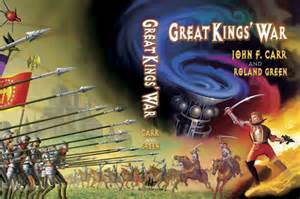
Great King's War is a sequel to H Beam Piper's Lord Kalvan Of Otherwhen. We are talking about some serious alternative history fiction here. Lord Kalvan... is one volume of Piper's Paratime series which, since it deals with the Paratime Police, is comparable to Poul Anderson's Time Patrol series.

Roland Green, co-author of Great King's War, also wrote the Drakas! story, "Written By The Wind, A Story Of The Draka." Two Draka observe a Japanese-Russian air-sea battle in 1905. The Japanese who are about to die are said to be approaching the Yasukuni Shrine, founded by Emperor Meiji, who is named in the story.

One Draka carries a crucifix and survives. The other carries a Thorshammer and doesn't. Dying, she holds out the hammer and says:

"'Take it - take it to a shrine. Or - or Ran's.'" (Drakas!, p. 119)

Ran was the wife of the sea giant, Aegir. See here. Welcoming the dead under the sea, she resembles Naerdha. At the end, the surviving Draka, holding the hammer, asks:

"'...if there is a shrine to Thor or Ran in the Empire?'" (p. 121)

Obviously, there is not. Equally obviously, his colleague meant that her amulet should be given to the sea.

The story is mainly about the deployment and effects of military hardware. Although most of us do not want to be in a land, sea, air or space battle, we often enjoy reading about them. See here and here.

Saturday, 30 January 2016

"The Greatest Danger"

"The Greatest Danger," Lee Allred's contribution to SM Stirling, Ed., Drakas! (Riverdale, NY, 2000), does these things for me:

moves Stirling's Draka onto British territory;
shows them in their true and full horror;
unexpectedly shows them suffering a local defeat;
presents philosophical/theological discussion of the superman and God.

That is quite a lot. I have three more Drakas! stories to read and have also started to reread Stirling's Conquistador. By the very nature of the premise, these characters from different Earths could meet in any new volume - but only if that generates a worthwhile narrative.

We read these works both on their own merits and for their place in an sf tradition. Thus, Robert Heinlein has showed up in Drakas! and Poul Anderson in The Stone Dogs.

British Territory

During World War II, 1939-'45, the Germans occupied the British Channel Islands.

During the Eurasian War, 1939-'46, the Draka ousted the Germans.

The official British observer of the Draka occupation of the Channel Islands was RAF Flight Lieutenant Sally Perkins - coincidentally the name of a neighbor of ours who died recently.

This information is in "The Greater Danger," Lee Allred's contribution to Drakas!, the anthology edited by the creator of the Draka, SM Stirling. Since I am still reading the story, I have yet to learn the significance of its title.

Poul Anderson's Manse Everard fought in World War II, then visited London 1944 as a Time Patrolman. That War ended four years before my birth but is still very present to its survivors and their descendants. 

Friday, 29 January 2016

Food In Khartoum

In "Hewn In Pieces For The Lord," Johm J Miller's contribution to the Drakas! anthology:

William Quantrill becomes a Merarch in the Draka Security Directorate;

Charles George Gordon agrees to negotiate with the Mahdi on behalf of the Domination of the Draka so that the Domination will agree to his, Gordon's, "Plan" for a Nile dam;

in Khartoum, Gordon eats a "delicious" meal that deserves to join our food thread -

small glasses of sugar-laden coffee like thick syrup;
honey-covered dates and pastries;
cold melon;
freshly caught Nile fish, picked free of bones;
cold meats;
dried figs. (p. 52)

Gordon's merchant host warns him that an attempt to talk to the Mahdi will mean Gordon's death. How far will events in the Domination timeline parallel events in ours?

Gordon is described as "...a devout fundamentalist Christian..." (p. 37) who believes that every man should be allowed to worship his own god in his own way, "...as long as he worshiped some god." (ibid.) That is not what fundamentalist Christians usually believe. And it is tolerant only of theists. The world also contains sincere secularists and practitioners of non-theistic spiritualities.

This story also contains some humor: Gordon must evade the overt sexuality of Draka women and must also prevent his grateful host from kneeling before him because:

"There was no telling if the rotund merchant would have been able to fight his way back up to his feet again." (p. 51)

Daily Life

Someone said that Robert Heinlein's Future History gave the future a daily life. We should be shown every aspect of a fictitious society, e.g., not only what a public figure thinks but also how he is perceived and, most importantly, how people live.

I would like to know more about daily life in the Solar Commonwealth and the Terran Empire of Poul Anderson's Technic Civilization. Some details can be hypothesized by extrapolating from the lives of individual characters like Eric Wace.

When SM Stirling's Draka conquer a country, the inhabitants are killed, enslaved or, in a very small number of cases, offered Citizenship - if their technical or scientific knowledge can help to build the Domination. "Home Is Where The Heart Is" by William Barton is narrated by a German rocket scientist who recounts his memories, his thoughts of what might have been and how he copes with becoming the owner of a female serf who not only cooks and performs domestic chores but also ensures her own survival by pleasing her new owner in other ways. We have seen the Draka, their serfs and adversaries but this is a slightly different perspective.

Now I am starting to read about Gordon of Khartoum among the Draka. Regular readers might remember that, when I reach a large round number of posts near the end of a month, I start to think about taking a break until the beginning of the following month - but I am never sure about what will happen next. If there is a break, I hope that page viewers will find plenty to reread and maybe to comment on.

"Hunting The Snark"

Markus Baur's Draka story, "Hunting The Snark," reintroduces Gwendolyn Ingolfsson although she is perceived from a completely different and unexpected angle. However, the story implies that, while Gwen was running IngolfTech, she was accompanied by a male Draka. Surely this is inconsistent with SM Stirling's Drakon?

One possible answer to that question is that, given innumerable (infinite?) timelines, this story is set in a timeline differing in this one respect from the timeline of Drakon. However, I think that this would be an unhelpful answer. Installments of a series should be mutually consistent. Alternative timelines are a valid fictional premise but not an excuse for inconsistencies. As Larry Niven implies in "All The Myriad Ways," if everything happens, then nothing matters. Why should we make the right choice, if all that happens is that we split into two with the other guy making the wrong choice?

"Custer Under The Baobab"

William Sanders' Draka story, "Custer Under The Baobab," begins by stating that baobab trees are remarkable and, having checked images on the Internet, I agree.

Sometimes, the moral of a time change story seems to be that people would reach the same end or destination even if by a different route. Thus, the Custer of the Domination timeline wisely avoids battle at Little Big Horn, is disgraced in the States, joins the Drakians and is killed by an arrow in Africa.

Historical outcomes can seem inevitable with the benefit of hindsight but can never be predicted in advance. Two straight lines leaving the same point at slightly different angles will eventually wind up in different galaxies. A different choice or chance event at a nexus point will change the direction and eventual outcomes of history, the most obvious example being if the Cuban Missile Crisis had become World War III. Thus, time travel in a mutable timeline would, after all, necessitate a Time Patrol.

Thursday, 28 January 2016

"The Tradesmen"

"The Tradesmen" is an ironic title for David Drake's Draka story. Drake shows us the horror of life - or should I say death - in a Draka War Zone. When the enemy have been driven back, irregulars are paid with gold coins to kill civilians so that the land can be cleared for Draka settlement. One Draka woman, with no estate back home, has already moved her family into the Zone and is hunting and killing noncombatant men, women and children to hasten the process. She has staked her claim to some of the land and is enriching herself at the same time.

A colonel tells her:

"'Good Christ, woman!...We have to do this; we don't have to like it!'" (Drakas!, p. 132)

They have to do it?

A neat story focusing not on military action but mainly on heated exchanges when it is disclosed that the Powers That Be have reduced the bounty for each left ear (proof of killing) from one hundred to sixty aurics.

The Draka lady's response is:

"'The hell you say, lardbelly!...The hell you say.'" (p. 134)

An irregular is even less ladylike:

"'No fucking way I let you Draka bastards cheat me!...No fucking way.'" (p. 137)

However, the moral of the story is that economic realism wins the day. This is quite a good story, although I do not fully understand the joke at the end.

Crossovers

(Custer's Last Stand.)

As far as I can see at present, the Draka anthology, Drakas!, incorporates "crossovers," or meetings, between the Draka and five individual characters who had some, real or fictional, existence before the anthology was published:

General Custer;
Gordon of Khartoum;
Anson MacDonald/Robert Heinlein;
Anne Marie Talbott writes a story in which she meets two Draka (I think);
John Barnes' cross-time traveler, Mark Strang.

That is quite a list. There are at least two ways that Poul Anderson's characters could have encountered the Draka:

Manse Everard of the Time Patrol, finding himself in the Domination timeline, would travel pastward to delete that timeline;

Draka cross-time explorers might have found their way into the Old Phoenix but would then learn that they were allowed to recuperate there briefly but not to gain any knowledge that they could use to further their cause back in their own timeline.

Experience Of War

I have not experienced war but am confident that it is as described by Harry Turtledove in "The Last Word." Men scream. Anyone who says afterwards that he was not terrified is either a liar or a psychopath.

"War was always the same: not a neat affair of lines across maps, nor a hallooing gallantry, but men who gasped and sweated and bled in bewilderment."
-Poul Anderson, "Delenda Est" IN Anderson, Time Patrol (Riverdale, NY, 2006), pp. 173-228 AT p. 223.

("Delenda Est" is the story about Carthaginian victory in the Second Punic War. Thus, a single text presents both historical speculation and authentic experience.)

In "The Last Word," Janissary Sergeant Hans lives and dies for war. His grandfathers defended Reich and Fuhrer against Draka and lost so now he leads a squad for the Draka - and does not worry about it. He recognizes that his chance of living long enough to retire is low but shrugs. Having led his men into a Yankee holdout ambush, he knows that he will be court-martialled and wonders how he had missed those Yankee bastards but:

"Then a grenade burst half a meter in front of his face, and such questions became academic." (Drakas!, p. 255)

Hans must die instantaneously. Thus, he does not know that the explosion was caused by a grenade and does not reflect that his questions have become academic. All or most of the quoted sentence is not Hans' point of view but the voice of the omniscient narrator.

Anson MacDonald (Robert Heinlein) finds ground combat even more chaotic, frightening and frightful than expected. Heinlein is shown adhering to his principles while experiencing, and accepting, what happens to the infantry. He refers to the starship, New America, whose captain, we know, is Anderson... Thus, both of these seminal sf writers are in different ways involved in the war against the Draka.

What a pity that MacDonald was not booby-trapped to take his Draka captor with him.

POVs And Deaths

When a viewpoint character dies, three things can happen:

we follow the character into a hereafter (this can happen in fantasy);
the narrative ends abruptly, even in mid-sentence;
the omniscient narrator continues the narrative, however briefly.

Thus, when Chen dies:

"Impact. Nothing."
-SM Stirling, Drakon (New York, 2000), p. 372.

Chen feels the impact, then the narrator informs us that there was nothing.

When Gwendolyn Ingolfsson dies:

"A moment of white light. Nothing." (p. 391)

Gwen sees the white light, then the narrator informs us that there was nothing.

Harry Turtledove describes Anson MacDonald's last moment:

"The poison worked almost as fast as they'd promised. He nodded before everything faded. He'd even got the last word."
-Harry Turtledove, "The Last Word" IN SM Stirling, Ed., Drakas! (Riverdale, NY, 2000), pp. 249-293 AT p. 293.

MacDonald reflects that he got the last word before everything fades.

When Rugo, the last native on a colonized extrasolar planet, drowns:

"He wondered if his mother would come for him."
-Poul Anderson, "Terminal Quest" IN Anderson, Alight In The Void (New York, 1993), pp. 1-28 AT p. 28.

Then a concluding paragraph describes the river flowing:

"...down in the valley, where the homes of men are built." (ibid.)

Men have conquered the planet.

There must by many other moments of death in Anderson's works?

Wednesday, 27 January 2016

Another Literary Reference

SM Stirling, Ed., Drakas! (New York, 2000).

(See image. "INGSOC" is Newspeak for "English Socialism.")

And here is another literary reference, on the second page of "The Last Word" by Harry Turtledove in Drakas!:

"What had that Englishman called the Snakes? A boot in the face of mankind forever - something like that, anyhow." (p. 250)

And that is how O'Brien of the Thought Police describes the future to Winston Smith in George Orwell's 1984:

He is entirely honest about the brutal cynicism of the Party; the Party does not seek power to do anything good, but simply to revel in that power: "Always, Winston, at every moment, there will be the thrill of victory, the sensation of trampling on an enemy who is helpless. If you want a picture of the future, imagine a boot stomping on a human face — forever."
-copied from here.

Very appropriate for the Draka: Orwell would have said it of them in their timeline.

In HG Wells' The Time Machine, bourgeoisie and proletarians devolve into different species. In Orwell's 1984, a Party makes a revolution, then freezes society into a new dictatorship forever. Turtledove's MacDonald refers to Orwell as "...that Englishman..." and Poul Anderson's Caleb Wallis refers to Wells as "'...a young Englishman in the '90's...'"
-Poul Anderson, There Will Be Time (New York, 1973), p. 73.

The Last Word

SM Stirling, Ed., Drakas! (New York, 2000).

Harry Turtledove can't fool me! (And I am sure that he is not trying to.)

On the opening page of The Day After Tomorrow (New York, 1951) by Robert Heinlein:

Whitey Ardmore asks, "What the hell goes on here?";

the other men present ignore him as they watch a television;

the TV announcer reports that Washington was completely destroyed before the government could escape and that Manhattan is in ruins;

the TV is switched off and a man says, "That's that...the United States is washed up."

On the opening page of "The Last Word," Turtledove's contribution to Drakas!:

Anson MacDonald asks, "'What's the latest?'" (p. 249);

the others present ignore him as they watch a televisor;

the TV announcer reports that San Francisco has been vaporized, that the government did not escape and that Manhattan and Washington have also been destroyed;

the televisor is switched off and a man says, "'That's that...The Alliance for Democracy is washed up.'"

Further, Anson MacDonald was a pen-name of Robert Heinlein, composed of his own middle name and his mother's maiden name, and the physical description of MacDonald in Turtledove's story matches the physical appearance of Heinlein (see second image). So here we have a story by Turtledove edited by Stirling featuring Heinlein. We are embedded in the history of American science fiction.

Worlds Within Worlds

Two Observations About Alternative Histories

(i) Persons and events that are fictions in one history may be realities in another. Thus, Poul Anderson's A Midsummer Tempest is set in the seventeenth century of an Earth where Shakespeare was the Great Historian, not the Great Dramatist. Figures as diverse as Sherlock Holmes, Huckleberry Finn, Winston Churchill, Nicholas van Rijn and the Prince Rupert of the Rhine from the Shakespearean history congregate in the Old Phoenix, an inn between the worlds.

(ii) Every work of fiction is set in an alternative history, one that did not contain the author imagining its events. For example, SM Stirling imagined one of his Draka:

"...loose in our world. Or at least something very like our timeline; one without an S.M. Stirling, who imagined the Draka." (Drakas!, p. 284)

DC Comics had fun with a multiverse including:

Earth 2, inhabited by the original versions of the superheroes;
Earth 1, inhabited by the current versions of the superheroes;
Earth X, conquered by Nazis resisted by super-powered Freedom Fighters;
other Earths inhabited by superheroes bought from former competitors;
Earth Prime, inhabited by comic book writers mentally tuning in to the other Earths.

In Drakas!, edited by SM Stirling, Anne Marie Talbott contributes a story in which Stirling's Draka character Gwen crosses to an Earth where Drakas are fictions and indeed seems to meet the author of this story.

Light In The Darkness

Because of the pessimism of SM Stirling's Draka series, I could not be confident that the fourth novel, Drakon, would have a conventional happy ending. It does, although the Epilogue reveals that the Draka's clone has escaped - potential sequel territory or just a reminder that history continues. Current experience is only the latest installment.

Stirling's premise:

"What...if a fragment of [the South Atlantic system of slaves and plantations] had fallen on fertile ground, and grown?" (Drakas!, p. 3)

- obliged him to show us the Draka conquering the whole Earth and building their Final Society. However, they can be defeated. First, they are prevented from annexing Earth/2. Secondly, the Archon informs Gwen that:

"'The Samothracians attacked, with moleholes in place. We stopped them, but only just." (Drakon, p. 358)

Only just! But the Draka intend to continue conquering indefinitely. That means that it is only a matter of time before they "'...run into more than [they] can handle...'" (p. 276) They have no unrealistic belief in their own undefeatability and their computers must be able to calculate how soon they are likely to experience defeat. Anyone else would ask: how can we start to avoid conflicts in order to increase the probability of our long term survival? But mere survival is of no interest to the Draka.

They will be cautious in paratemporal explorations because they know that there are post-industrial civilizations in nearby timelines. Nevertheless, such civilizations might explore cross-time and find the Draka.

They are fairly sure that there are no technological species nearby in the galaxy but:

they intend to conquer the entire galaxy;
it is possible that there are nearby civilizations whose electromagnetic signals have not yet reached the Solar System.

Thus:

no guarantee of success in any given conflict;
increasing probability of defeat over time;
no possibility that the Draka will reform themselves or pull back.

The Defeat of the Domination seems to be a long term probability and thus a possible sequel. But, in any case, this series could continue indefinitely in both space and time.

Tuesday, 26 January 2016

The Structures Of Series

Frank Herbert's six Dune novels are not two trilogies but a trilogy, a sequel and an unfinished second trilogy.

SM Stirling's four Draka novels are not a tetralogy but a trilogy and a sequel.

Stirling's New Virginia history is in one novel.
His Angrezi Raj history is in one novel and one story.
His Lords of Creation history is in two novels and one story.
His Domination history is in four novels and one anthology.
His other series I have yet to read.

Stirling explains the rationale of the Domination well in the Introduction to SM Stirling, Ed., Drakas (Riverdale, NY, 2000). I am not big on themed anthologies but will see how I manage with Drakas. Poul Anderson was a major contributor to themed anthologies and, of course, I appreciate, e.g., his Man-Kzin Wars stories and his Robot story as parts of his complete works.

Look at that Draka's face!