Showing posts with label Alight In The Void. Show all posts

Thursday, 28 January 2016

POVs And Deaths

When a viewpoint character dies, three things can happen:

we follow the character into a hereafter (this can happen in fantasy);
the narrative ends abruptly, even in mid-sentence;
the omniscient narrator continues the narrative, however briefly.

Thus, when Chen dies:

"Impact. Nothing."
-SM Stirling, Drakon (New York, 2000), p. 372.

Chen feels the impact, then the narrator informs us that there was nothing.

When Gwendolyn Ingolfsson dies:

"A moment of white light. Nothing." (p. 391)

Gwen sees the white light, then the narrator informs us that there was nothing.

Harry Turtledove describes Anson MacDonald's last moment:

"The poison worked almost as fast as they'd promised. He nodded before everything faded. He'd even got the last word."
-Harry Turtledove, "The Last Word" IN SM Stirling, Ed., Drakas! (Riverdale, NY, 2000), pp. 249-293 AT p. 293.

MacDonald reflects that he got the last word before everything fades.

When Rugo, the last native on a colonized extrasolar planet, drowns:

"He wondered if his mother would come for him."
-Poul Anderson, "Terminal Quest" IN Anderson, Alight In The Void (New York, 1993), pp. 1-28 AT p. 28.

Then a concluding paragraph describes the river flowing:

"...down in the valley, where the homes of men are built." (ibid.)

Men have conquered the planet.

There must by many other moments of death in Anderson's works?

Thursday, 1 August 2013

Two Collections

Poul Anderson wrote many short stories. Many of them have been collected. As its American title suggests, Seven Conquests (New York, 1984)/Conquests (London, 1981) collects seven short stories. Alight In The Void (New York, 1993) contains six works but the sixth is a poem. Thus, these two volumes contain twelve stories.

Four of them need not be in these volumes:

"Wildcat" in Conquests and "Flight to Forever" in Alight In The Void are time travel stories and as such are included in Past Times, a (mainly) time travel collection;

"Cold Victory" in Conquests is an installment of Anderson's first future history series and as such is collected in, indeed is the title story of, one volume of that history;

"Son of the Sword" in Alight In The Void is historical fiction, therefore, I argue, should be included with at least four other stories set in diverse past periods in a relevant collection that could be called Many Times.

Conquests is a collection on the theme of war. Thus, since, e.g., "Wildcat" is about both war and time travel, there is some rationale for its appearing in two differently themed collections. However, what is needed now is a complete multi-volume collection, without duplication, of all of Poul Anderson's short stories. Seven Conquests/Conquests can either lose the Seven from its title or, probably, gain two relevant stories from among those that are still uncollected.

I have recently discussed the five stories in Alight In The Void. "Wildcat" is discussed briefly under "Limits on Time Travel" in the earlier post, "Time Travel And Poul Anderson," dated Tuesday, 24 April, 2012 (see here), but will warrant further discussion later (indeed has already been discussed (see here and here) because the order of these posts has been shuffled between drafting and publishing).

Monday, 29 July 2013

Flight To Forever

Poul Anderson's "Flight to Forever" occupies eighty pages of his collection, Alight In The Void (New York, 1993, pp. 161-240). Despite its less than novelistic length, it is, in the pulp tradition, divided into six titled chapters:

I No Return
II Belgotai of Syrtis
III Trapped in the Time-Stream
IV End of Empire
V Attack of the Anvardi
VI Flight Without End

"Trapped in the Time-Stream" and "End of Empire" are particularly pulp sf titles.

Anderson's time travelers set out twenty three years into the future, in 1973, and one of the years that they visit is 2013. For me, there is a sense of following in HG Wells' footsteps. The characters travel by stages into the future so what will they find? Some of the futurians that they meet are almost as decadent as the Eloi. The Time Traveler travels to the end of life on Earth whereas Anderson's character, Saunders, travels beyond the end of the universe.

One difference is that the Time Traveler, from the seat of the Time Machine, sees the world flash past whereas Saunders and Hull, through the porthole of the time projector, see only grayness until they stop. Also, the Time Machine risks materializing inside an object and exploding whereas the time projector's mass-sensitive circuits prevent it from halting inside anything solid.

There are a few notable passages in this rather crude early story:

"The important thing was change, an unending flux out of which all could come." (p. 167)

"Men lived in their own times, a brief flash of light ringed with an enormous dark, and it was not in their nature to think beyond that little span of years. He began to realize why time travel had never been common." (p. 182)

"Man's works were so horribly impermanent; he thought with a sadness of the cities and civilizations he had seen rise and spend their little hour and sink back into the night and chaos of time." (p. 191)

Sunday, 28 July 2013

Previous Posts

I have been reading Poul Anderson's Alight In The Void which collects:

"Terminal Quest"
"Earthman, Beware!"
"The Star Beast"
"Son of the Sword"
"Flight To Forever"

I have commented on the first four in recent posts and posted a two-part Chronology of "Flight to Forever" on June 30 and July 1, 2012. "Flight to Forever" is, appropriately, the culminating story of Anderson's time travel collection, Past Times. Therefore, when Anderson's short story collections are rationalized, it need not also appear in any other volume such as Alight In The Void.

When discussing "Earthman, Beware!," (here) I referred to an earlier post on Anderson's Brain Wave. That was "The Galactic Connection," June 15, 2012.

"The Star Beast" raises the issue of the social consequences of universally distributed abundant wealth. This and similar or related issues were discussed in earlier posts:

April, 2012
"Issues In Mirkheim"
"Something Is Rotten In Technic Culture?"
"Interstellar Wealth"
"Organic And Post-Organic"
"The Commonalty"

June, 2012
"Thulean Economics"
"Serious Issues"
"Judgment Day Economics"
"Starfarers Economics"

August, 2012
"Demetrian Economics And Ecology"
"Questions And Comments"

Saturday, 27 July 2013

Terminal Quest

"Terminal Quest," the first story in Poul Anderson's collection, Alight In The Void (New York, 1993, pp. 1-28), is another that I seem not to have read before. This story takes its time about telling us where it is set and what is happening. A character called Rugo, who has been sleeping in the open, awakes and mourns for his mother who had left him, and not returned, when they lived in a cave.

Rugo is a quadruped with a big scaly head so he sounds like a Wodenite in Anderson's Technic Civilization History or like similar "xenosophonts" in other science fiction (sf) works by Anderson. Reading this story so far, we are not yet sure that it is sf although that would be a reasonable guess. Rugo's mother would have come to grief when she "...met the Strangers..." (p. 2)

We learn that the Strangers are in possession of the land, also that Rugo has hands and a tail and is old. One Stranger is referred to as "...a man..." so it is a safe bet that they are human beings. Indeed, the following paragraph refers to "...men from Earth itself..." (p. 4) The next revelations are that Rugo's people had been hunted with vehicles and weapons, that the Strangers had been the hunters and that Rugo is now reduced to begging from them.

It took human beings forty years to reach Tau Ceti and colonize New Terra. The natives agreed that they could stay but then opposed them. Possibly, the native counselors had thought that they were agreeing to more explorers, not to settlers. The natives were "...huge and scaled and black..." (p. 6) but the colonists had guns, bombs and a plague virus. Thus, Rugo is the last surviving native.

A good touch is that:

"None of the beasts from Earth could stand the sight and smell of him; they knew he was not of their world and a primitive terror rose in them." (p. 8)

Rugo is driven back into the wilderness by a rifle-wielding farmer and stoned by children led by the farmer's son but befriended by an educated tramp and two children. However, he drowns saving the farmer's son. Sinking, "[h]e wondered if his mother would come for him." (p. 28) This is possible because, when he was old, "...she often came back at night." (p. 2)

Since the entire story until his dying thought has been narrated from Rugo's point of view, the text could have ended with: "He wondered if his mother would come for him." (p. 28)

However, there is one more paragraph, showing New Terra at last without even one surviving Gunnur:

"A few miles further down, the river flows broad and quiet between gentle hills. Trees grow there, and the last sunlight streams through their leaves to glisten on the surface. This is down in the valley, where the homes of man are built." (p. 28)

Maybe Rugo's body goes where the river flows? Quiet river and gentle hills symbolize the end of conflict. The last sunlight symbolizes the end of Rugo's life and race. The narrative ends with "...the homes of man..." because this is now a human world. The title had told us that Rugo's quest would end in death.

Wednesday, 24 July 2013

Street Life


Whenever Poul Anderson's characters move, or often, as here, flee for their lives, along city streets, Anderson always shows us the busy street life going on around them:

"Thebes had wakened from its slumber and all the city was out on its various business. Merchants cried their sleazy wares from bazaars like caves in the clay-brick walls; porters hurried by, gasping under their loads; beggars and harlots plied their shrill trades; the narrow, twisting streets brawled with life, they were like rivers shouting between grimy walls..."

(Poul Anderson, "Son of the Sword" IN Anderson, Alight In The Void, New York, 1993, p. 124)

Yes, this is life, displayed by Anderson in many ages, both past and future. It is difficult to close the quotation marks but we cannot transcribe an entire story.

A reader of the pulp magazine in which this story first appeared would have read on quickly to find out how the characters evade their pursuers or whether they are apprehended without pausing to appreciate the image of a busy street as a shouting river. An ephemeral short story preserved by book publication is like a video that we can pause and rewind to notice its details.

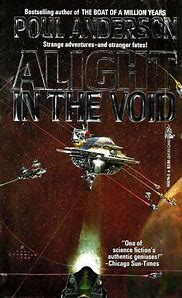
Alight In The Void

Poul Anderson's Alight In The Void (New York, 1991, 1993) collects pulp magazine short stories originally published in Super Science Stories, 1950, 1951, or in Adventure Magazine, 1951. Thus, the collection is a nostalgic period piece.

Anderson's Introduction, "Tell Me a Story," discusses the importance of story and ends:

"Herewith a sample of my own contributions to the [pulp] era as it neared its end. Afterward I learned how to write better, but the visions are no more clear, the dreams no more bright - and maybe less so, now - than they were when all the world was young." (p. xiii)

The collection is worth possessing both for the stories that it preserves and for this evocative writing. The world seemed young when we were. One of the British comics writers wrote, "Remember the first Superman movie when the world was young and dinosaurs walked the Earth...?" My daughter was in a push chair at the time of the first Superman movie but took me to the recent Man Of Steel for Fathers' Day.

I am focusing on Alight In The Void for its single work of historical fiction, "Son of the Sword." (Adventure Magazine, 1951) This is one story that I had not read before, despite possessing the collection from time immemorial. Its first page displays yet another example of Anderson's extensive vocabulary: "...shadoof..." (p. 103). (I had to google it.)

The central character is Ankhsenamen, daughter of Akhnaton and widow of Tutankhamen. I admit to not having heard of her before. However, her Wikipedia article reveals how Anderson weaves historical data into his fictional account and also discloses that Ankhsenamen is celebrated in many works of fiction although, unfortunately, this Anderson short story is not mentioned.

Like some others among Anderson shorter works, including "Flight to Forever," which follows it in this collection, "Son of the Sword" is divided into chapters. We are on familiar territory when, in Chapter II, a hired Cypriat merchant fights his way out of the palace with Ankhsenamen who has hired foreign help because she fears assassination. Now read on...