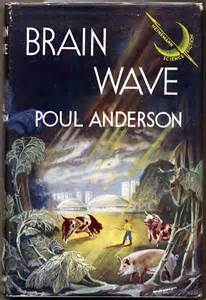
Showing posts with label Brain Wave. Show all posts

Monday, 14 March 2016

Now And Tomorrow

Science fiction can be contemporary or futuristic. Indeed, it can even be historical. See several works by Poul Anderson. However, the present and the future are the main concerns of sf. The future can mean any time from the day after tomorrow (Brain Wave) to beyond the end of the universe (Tau Zero).

The day after tomorrow may be the same as today except for a single technological innovation, as in "Life-Line" by Robert Heinlein. Brain Wave begins with a global increase in intelligence which generates every conceivable technological innovation, then the transcendence of humanity.

CS Lewis' Ransom Trilogy comprises two contemporary interplanetary novels and one "day after tomorrow" novel. Thus, Lewis presents the unusual but wholly appropriate sequence of Mars, Venus and Earth.

Reading American sf comics in the 1950s, I divided sf into before or after the invention of spaceships. The earliest future histories begin before space travel. Heinlein's Future History begins with "Life-Line." An escape velocity rocket fuel is not developed until the end of the fourth story.

In Anderson's Psychotechnic History, the opening story is set on a devastated Earth but the second begins on a colonized Mars. Anderson's Technic History and Larry Niven's Known Space future history begin with the exploration of the Solar System whereas Jerry Pournelle's CoDominium future history begins with regular interstellar travel. So there is some progress.

Wells' Time Traveler tells his dinner guests that he traveled through tomorrow, as if it were another country, then further into futurity. Thus, twenty four hours later, he and they have lived through the day that he traveled through while he traveled through it. Extraordinary.

Wednesday, 25 November 2015

The Day After Tomorrow

Futuristic sf includes "day after tomorrow" scenarios where everything is as it is now but then one thing changes. CS Lewis' That Hideous Strength, published 1945 but set "after the War," is in this category as is Poul Anderson's Brain Wave. HG Wells' Time Traveler tells his dinner guests that that morning he had set off on his Time Machine and passed through "tomorrow." Despite spending several days in the future, he has returned to the day of his departure so that he still has the same "tomorrow."

I mention all this here because today and tomorrow I will be visiting a friend in Birmingham (see image) and will be away from my lap top. Thank you all for over 320 page views so far today with the best part of an hour still to go. I managed to post a lot about Anderson's The People Of The Wind yesterday. A return to that fictitious world, and in such detail, was completely unplanned and unpredicted. Anderson's texts are inexhaustible. All that is exhausted, temporarily, is my ability to focus on new aspects of a particular text.

I do not know what will come next but something will.

Addendum: 330 page views by the end of the day.

Saturday, 13 June 2015

Changing Motivations

What could be stranger than to look inside yourself and to realize that your basic motivations are changing even as you look at them? This does not happen often either in reality or in fiction but I know of a few examples.

(i) In Poul Anderson's Brain Wave, the intelligence of every animal and human being on Earth suddenly increases many times. Rabbits escape from traps. Apes speak. Morons become normal. Normals become geniuses. IQ's go off the scale. This alone changes motivations. Someone who previously was content to work as an unskilled manual laborer now wants to do Doctoral research at University.

Many people abandon all responsibility in favor of more interesting activities but some realize the importance of cooperating to keep society functioning. They cease to pursue selfish or sectional interests. A former union organizer's role is to help maintain local administration, not any longer to represent employees to management.

(ii) Also in Brain Wave, a second change soon follows. As in HG Wells' In The Days Of The Comet, intellect and will gain conscious control of instinct and emotion. That is indeed a fundamental transformation of motivations, one that we work towards in yoga and meditation. In Brain Wave, as in Tau Zero, Anderson develops his premise to its ultimate conclusion. The two developments are respectively inner and outer.

(iii) Of all the bizarre events in the Smallville TV series, the strangest is when Lionel Luthor realizes that he is no longer motivated merely to increase his own wealth and power at the expense of others. But Lionel needs to learn how to be a good guy. For a while, out of habit, he still uses the discreditable means of manipulation and blackmail although now towards more admirable ends!

(iv) To move from fiction to reality, after thirty years of practicing zazen, I can see some of my own motivations starting to change. A peculiar experience. (Addendum, 27 July 2017: This inner process is real but is also much longer and more complicated than it sometimes appears.)

Monday, 20 April 2015

Emotion And Intelligence In Four Universes

So many connections keep presenting themselves that I feel as though I will soon become one with the Poul Anderson multiverse and will express it all in one Last Post before disappearing into Valhalla - unless I am already there but do not realize it yet?

What do I have to say about "Emotion and Intelligence in Four Universes"?

(i) In The Time Patrol Universe
"The first part of instruction was physical and psychological. Everard had never realized how his own life had crippled him, in body and mind; he was only half the man he could be. It came hard, but in the end it was a joy to feel the utterly controlled power of muscles, the emotions which had grown deeper for being disciplined, the swiftness and precision of conscious thought."
-Time Patrol (New York, 2006), p. 12.

(ii) In The Immortals' Universe
"'I have the art of controlling sorrow.'"
-The Boat Of A Million Years (London, 1991), p. 63.

(iii) In The Brain Wave Universe
See here and, more generally, here.

(iv) In The "Flight to Forever" Universe
"'...what I saw in both your minds was good - brave and honest, under the little neuroses which all beings at your level of evolution cannot help accumulating. I will be pleased to remove those from you, if you wish.'
"'No thanks,' said Belgotai. 'I like my little neuroses.'"
-Past Times (New York, 1984), p. 261.

Comments
What an amazing collection of fictional universes!

We all need Time Patrol training.

One immortal has learned emotional self-control over twelve hundred years.

The enhanced humanity of Brain Wave takes psycho-physical self-control further than any of the other groups of characters.

I do not like my neuroses.

I would have preferred if one of the time travelers had accepted the telepath's help.

We would then have learned what difference it made.

Wednesday, 27 August 2014

Galactic Mission

Poul Anderson, Brain Wave (London, 1977).

One omission: Anderson does not tell us how organized religions respond to the "change." However, I think that it is predictable:

first, that they would split;

secondly, that every possible judgment ("It's good," "It's bad," "We don't know") would be made;

thirdly, that some groups would have to acknowledge that, after the period of transition, the problem of moral evil in human beings had been resolved - this could be interpreted as the arrival, or return, of a Savior in an unexpected form.

What of other races? When an intelligent race has changed its environment, it does not need to develop any greater intelligence, especially since it can augment its intellectual abilities with writing and computers. Because Earth entered the inhibitor field before intelligence had emerged, Terrestrial organisms compensated for the field and therefore became more intelligent when their planet had left the field. Human beings might meet a few other such species but they are like an Elder Race to most of the intelligent beings that they encounter. They will come neither as gods nor as guides but as givers - of opportunity (p. 187).

Some Details

Poul Anderson, Brain Wave (London, 1977).

The conspirators (see previous posts) assemble on an island but, before that happens, Poul Anderson summarizes that island's history for two full pages.

Coral polyps build an island in the mid-Pacific, near the equator, far from future shipping or airline routes. Seeds blew and coconuts floated. Polynesians, paddling for a thousand miles, steering by stars and currents, found the island and gave sacrifice to Nan (who is incorporated into a Trinity in the alternative timeline of Anderson's Maurai Federation). Returning with women and pigs, the Polynesians built a thatch village and fished.

White men brought smallpox, measles, TB, copra planters, Christianity, imperialism, tobacco and trade. They moved the natives elsewhere to use the island as a naval base or experimental station, then later abandoned it. Wind, rain and vines demolished their buildings. Gulls hovered, fish leaped and a shark patrolled. Then the conspirators arrived. What a fascinating history.

Certain characters or groups of characters appear only once, demonstrating distinct stages of the "change":

the boy who invents differential calculus;
Wato the witch doctor, M'Wanzi the leader and an armed ape;
Vladimir Ivanovitch Panyushkin the resistance fighter, an inventive priest and Fyodor Alexandrovitch the Sensitive;
Wang Kao the villager and Wu Hsi the prophet;
the supermarket attendant who lectures Brock about property;
the people with problems dealt with by Mandelbaum;
most of the conspirators.

The novel ends on p. 189 but begins on p. 9, has blank pages between chapters and empty spaces at the ends of chapters so I think that it could be more compactly packaged with just 160 pages of text - but how much is in those pages.

In his Introduction, Brian Aldiss rightly says that the opening vignette of the rabbit in the trap encapsulates the kernel of the novel.

Longer Term Changes

Poul Anderson, Brain Wave (London, 1977).

Children are quieter.
Vehicles run on powercast - the air is clean.
New York is quiet and almost empty.
A long silent metal shape passes overhead - antigravity?
People converse in apparent gibberish.
Artificial light pervades the walls or the air within buildings.
Washrooms are now mixed.
Not everyone is clothed.
Sensitives make the postal service obsolete.
With necessities met, those who choose to remain scientists can work on whatever they want and can easily acquire materials.
A small group secretly plots to reverse the change but is easily apprehended by Observers.

Other Planets

Poul Anderson, Brain Wave (London, 1977).

Here is another logical conclusion from the premise of this novel. Increased intelligence entails early development of a faster than light drive and exploration of other planets.

Venus - wind, sand and a poisonous surface;
Mars - plant life;
extrasolar planets -
green-furred humanoid city dwellers;
tailed barbarian swamp-dwellers;
a gentle gray race growing symbolically significant flowers;
a global atomic war;
centauroids with local interplanetary flight;
three intelligent, hydrogen-breathing species on a gas giant;
an inflexible global civilization where routine is replacing thought;
"...a tropical paradise of idleness..." (p. 140), based on plants specialized to meet all needs;
a nation on a ringed planet pursuing art instead of wealth or power.

None of these races is more intelligent than pre-change humanity. Here is the beginning of an answer to the question: how should mankind use its increased intelligence?

Troubleshooter

Poul Anderson, Brain Wave (London, 1977).

Competent men derive satisfaction from completing necessary tasks. Felix Mandelbaum, former union organizer, has become a general troubleshooter, coordinator and policy-maker for New York City Council:

when farmers are reluctant to accept (admittedly worthless) city scrip, he gets them to accept four council seats with veto powers on rural policy;

when a port organizer and a political theorist claim to be under-represented, he suggests that they form an alliance to strengthen their respective cases, knowing that they will stab each other in the back;

when the governor wants to reunite the state, he has to argue that, by the time that can be done, the old forms of government will be irrelevant in any case;

between interviews, he must consider the new rationing system, the plans for reintegrating outer Jersey and the latest report on the water situation;

when food factory workers want more leisure time for intellectual activity, he arranges to beamcast lectures, symphonies etc to them at work;

when scientific equipment and materials are being bought, then hidden, he authorizes more Observers to investigate.

The irony is that he knows that all these problems are transitional and temporary. Changes in the people themselves will soon end pettiness and power-seeking. Society is changing rapidly. The city that owes the farmers may no longer exist in a few years. Robots will replace food factory workers. He himself will move his headquarters into the country when the weather-turning force-screens are in full production.

Tuesday, 26 August 2014

The New Psychology

Poul Anderson, Brain Wave (London, 1977).

Psychology and psychiatry change when human nature changes. Certain types adjust more easily to enhanced intelligence:

the strong willed;
those with interests directed outward;
those who already think a lot.

Pre-change, Sheila Corinth's life was unintellectual and sheltered. Post-change, she sees through her former world-view but has not found a new one. Worry about her physiological symptoms increases them. She has neither children nor struggle to turn her attention outward. Therefore, Peter departing on an interstellar expedition might be good for her. Her psychiatrist gives her drills on logical processes and general semantics. She is now intelligent enough to deceive him that she is improving.

Many people use their new intellectual power to rationalize old superstitions, prejudices and hatreds. Then the Third Ba'al tells them to abandon thought in favor of an emotional orgy. But these are transitional problems.

The Range Of The Blog

I decision-made as to whether to discuss another author, Greg Bear, on Poul Anderson Appreciation. This was a good move because:

Bear's Eon was definitely worth reading;

there was additionally (secondary point) plenty of scope for comparisons with Anderson and Wells;

the common theme of changing human nature unexpectedly led to a serious rereading of Anderson's Brain Wave.

Human beings change their environments. Science fiction writers speculate about how they might do this in future by:

remaking the Earth;
terraforming other planets;
building space habitats;
creating universes;
etc.

But what could be more important than changing ourselves? Anderson imagines a spontaneous increase in intelligence but then demonstrates that people would need to learn how to use that gift intelligently. Bear asks the moral question whether people should be changed for their good even without their consent. Excellent question...

Reasons For Me To Like Poul Anderson's Brain Wave

Poul Anderson, Brain Wave (London, 1977). 

(i) I enjoy imaginative and speculative fiction.

(ii) I am interested in discussions about how society might be reorganized for the better.

(iii) I do not have enhanced intelligence! - but am an impractical, theoretical intellectual.

(iv) I meditate.

(iv) is relevant. Anderson's characters must cope with an inner change that makes each of them see himself and his life more clearly - clearly enough either to be horrifying or to open new possibilities. Meditation has precisely these effects. I am going through a similar process to Anderson's characters but without any help from an improved intellect.  

Corinth makes the point that:

"'...the IQ concept is only valid within a limited range; to speak of an IQ of 400 doesn't really make sense, intelligence on that level may not be intelligence at all as we know it now, but something else.'" (p. 43)

A quantitative change becomes a qualitative change, exactly as Hegel said. And we see that Corinth and others learn how to use their minds to control their instincts, which is the direction in which meditation takes us although, for most of us, at a much slower rate.

Condensation

Poul Anderson, Brain Wave (London, 1977).

Brain Wave might be Poul Anderson's most condensed text. By "condensed," I mean much content in few words. Entire chapters are summaries of consequences of the novel's premise. My summaries are hyper-condensations.

Quicker, intenser neuronic interactions increase intelligence. Do they also increase ESP, assuming the latter exists? Yes. Sensitives provide military intelligence during revolutions in Soviet countries. American researchers no longer doubt that telepathy exists and will have to be investigated.

When a "prophet" arrives on p. 119, we expect another fanatic like the earlier prophet of the Third Ba'al. Instead, a scholar has studied and taught others how to use their enhanced minds:

to keep blood flowing warmly even when the ground is covered with snow;
to make wounds stop hurting and bleeding;
to communicate with and befriend animals;
to remember every detail of every experience;
to control feelings and wishes;
to talk without speech;
to reason accurately.

This is yoga, meditation, telepathy and philosophy. Corinth learns control of feelings because of a shock in space. He realizes that others will also learn it and this chapter tells us that some already had.

Master Works

My copy of Poul Anderson's Brain Wave is a New English Library SF Master Series edition, published in 1977. My copy of Greg Bear's Eon is a Gollancz SF Masterworks edition, published in 2002. These are two attempts to keep before the public what are regarded as "classic" works. The blurb for Brain Wave says, "This now-classic novel..." A real classic is, of course, a work that is always in print, usually in multiple editions. Sf classics include The Time Machine.

It may be thought that an sf paperback read for pleasure must be a light and trivial work. I hope that my synopses and analyses of these novels demonstrate that they are dense and serious works. In Brain Wave, there is a single premise and an extremely long list of ingenious deductions from that premise.

New York After The Change

Poul Anderson, Brain Wave (London, 1977).

New York is protected from missile attack by a force field.

The prophet of the Third Ba'al has been captured.

Gang war between Portmen and Dynapsychists has been suppressed.
 
At night, the city is dark with few vehicles or pedestrians.

A cafe interior is illuminated by a blue twilight generated by a new principle of fluorescence.

Tables are arranged in a spiral minimizing the distance from dining room to kitchen.

A wheeled machine extends a slate and stylus for orders, then serves food.

There is still a food shortage and little meat.

Previously famous musicians play in the orchestra.

There are some new musical instruments, no conductor and a new form of music.

Customers are from different social groups, now equal, starting afresh.

Corinth now thinks that the Rubaiyat is childish!

Corinth's and Helga's communication is mainly non-verbal, shown in brackets.

This description conveys both that the general level of intelligence has increased and that there was a time of troubles but it has passed. The novel has moved from the present day (at the time of publication) into a future that is different from any of Poul Anderson's other fictitious futures. Not the world but its inhabitants have changed.

Monday, 25 August 2014

Effects Of The Intelligence Revolution IV

Poul Anderson, Brain Wave (London, 1977).

The dog Joe begins to understand English and nods to express comprehension.
The former moron, Archie Brock, talks to Joe and begins to educate him.
In the local town:

there is no longer a money economy;
the supermarket attendant lectures Brock on property;
the local community has seen through the "self-deception" of property;
farmers have moved into deserted town houses;
the mechanically inclined devise machines to do most of the agricultural work;
the community evolves social reforms to match their new personalities;
the attendant cannot explain to Brock what they do;
final decisions rest with the Council and the Societist;
they are unlikely to help or trade with Brock unless he joins their society;
there is danger outside the community, e.g., from escaped circus animals.

Brock and Joe are attacked by pigs and a bull but rescued by two chimpanzees with a gun riding an elephant. These new animals join them in running the farm.

Effects Of The Intelligence Revolution III

Poul Anderson, Brain Wave (London, 1977).

Animals learn to keep pushing fences.
A former moron is left in charge of a farm because its owner goes to Washington to address national problems while other workers leave to pursue personal agendas or to escape rebellious animals. 
Many factory workers suddenly see the inadequacy of their lives, the triviality of their work and the limits of their beliefs and resign, enough of them to disrupt technological civilization.
Many realize that the laws are arbitrary and break the ones that they do not like.
Language becomes telegrammic as comprehension increases.
But psychology changes so that people no longer understand each other.
Large scale government becomes temporarily impossible.
Some capable business and union leaders begin to work for the survival of society rather than for sectional interests.
A witch doctor theorizes that "'...magic obeys the rule of universal causality.'" (p. 67)
Cunning elephants raid farms.
An African leader uses his new intelligence not only to unite the tribes but also to converse with and arm the apes - the brothers of the forest seek common cause with the brothers of the field.
The Third Ba'al is orgiastic and anti-scientific, telling people that it is alright to throw off their new burden of thought.
Many use their new intelligence to rationalize their existing prejudices.
Volunteers run power stations and electricity is rationed.
A scientist uses newly invented but more efficient symbols.
It may be possible to generate atomic energy from any material.

The world is turned upside down.

Effects Of The Intelligence Revolution II

Poul Anderson, Brain Wave (London, 1977).

The characters discuss the consequences of their author's premise and thus anticipate some of the later events in the novel. Human reactions are quicker so road accidents are down but some might get bored with the speed limit so that accidents, when they do happen, would be worse.

Sheila: "'But if people are smarter...they'll know enough to -'" (p. 45)
Mandelbaum: "'Sorry, no...Basic personality does not change, right?'" (pp. 45-46)

Does Mandelbaum mean that basic personality cannot change or just that it has not (yet) changed along with the increase in intelligence? Everyone's personality, like everything else, has already undergone the greatest possible change, from non-existence to existence. Physical changes in the brain, which is what happens in the novel, can certainly change personality.

Lewis sees a bit further:

"'Eventually, no doubt, increased intelligence would affect the total personality, but right now you're not removing anyone's weaknesses, ignorance, prejudices, blind spots, or ambitions; you're just giving him more power, of energy and intelligence, to indulge them - which is one reason why civilization is cracking up.'" (p. 46)

Later in the novel, intelligence not only increases but also overcomes instinct and changes human nature.

Effects Of The Intelligence Revolution

Poul Anderson, Brain Wave (London, 1977).

The stock market falls.
Danger of recession.
Chinese troops mutiny.
Communist government declares emergency.
New religion in LA: thousands attend meeting of the Third Ba'al.
Politicians discuss world government.
Rebellion of mental patients.
Riot in Alabama.
Unified field theory announced: interstellar travel theoretically possible.
Revolutions in Soviet countries, possibly with new weapons and military concepts.
World economic crisis.
Food riots in major cities.
Thousands leave work.
Street fighting.
Tiger escapes: maybe all dangerous animals in captivity should be killed.
People react faster so traffic accidents are down.

People think faster but not necessarily straight.

Corinth's IQ has gone from 160 to 200 in a week. He plays chess better, thinks new thoughts and finds his former professional problems ridiculously easy but also wanders off into fantastic trains of thought and is nervous and afraid. Lewis predicts IQ's of 400 within a week and that the change will drive many insane.

Unpredictable

Reading, and writing or blogging about reading, is kind of organic and also unpredictable. Reading Poul Anderson's works led to reading the Poul Anderson memorial anthology, Multiverse. In Multiverse, I read three other writers' Time Patrol stories, which led to rereading some of Anderson's Time Patrol stories. In Multiverse, I also read Greg Bear's account of Andersonian influence on his novel, Eon. This led to reading Eon, which in turn unexpectedly led to currently rereading Anderson's Brain Wave because there is a common theme.

Reading Eon also revealed that it is the opening volume of a trilogy so I have ordered the second volume, Eternity - although an on-line review did not make Eternity sound like a sequel to Eon or to anything else. I have no idea what will come after Brain Wave and the Way Trilogy.