Showing posts with label Multiverse: Exploring Poul Anderson's Worlds. Show all posts

Monday, 24 August 2015

Exploring "A Slip In Time" III

See here.

SM Stirling exactly reproduces Manse Everard's way of thinking about variable realty. Trapped and imprisoned in the 1926 of a divergent history, Manse thinks:

"Either a Patrol rescue team would arrive to break him out...or he'd vanish when this world was cancelled." (Multiverse, p. 77)

(For convenience, I am referring to the Patrol timeline and the divergent timeline as timelines 1 and 2, respectively.)

"...when..." does not refer to any temporal coordinate within timeline 2. Timeline 2 either does or does not exist. Since Manse is in it, it does exist. It is a continuum with one temporal and three spatial dimensions. Its spatial dimensions extend to the edge of the universe or around the curve of space or etc. There is no reason to suppose that its temporal dimension does not extend pastward to a Big Bang and futureward to a heat death of the universe. If this timeline ends prematurely before the heat death, then its premature ending is a random event not caused by the activities of any time travelers.

If a time traveler prevents the prevention of the Sarajevo assassination, then the consequence will not be that timeline 2 exists until sometime in or after 1926, then ceases to exist. The consequence will instead be the creation in a second temporal dimension of another four dimensional continuum, this one containing the history guarded by the Patrol. It will be timeline 3, differing in only a few unimportant details from timeline 1.

From the point of view of the inhabitants of timeline 2, timeline 3 exists/will exist (a Temporal language tense is needed) in the future not of timeline 2 but of a second temporal dimension at right angles to timeline 2. Each moment of the second temporal dimension contains a four dimensional continuum just as each moment of the first temporal dimension contains a three dimensional universe.

The continued existence of timeline 2 after its version of 1926 is confirmed on p. 71 when Wanda travels two centuries, then another two centuries, futureward. If Manse is not rescued, then he will not "vanish" but will live the rest of his life in timeline 2. Of course, people in timeline 3 will have no access to Manse and might consider that he has vanished but there will have been no vanishing from his point of view.

Sunday, 23 August 2015

Exploring "A Slip In Time" II

See here.

Manse is captured in 1926, timeline 2, whereas Wanda has fled through time and space to 180 AD, pre-divergence. She thinks:

"Other agents would be heading futureward 'now', for a value of 'now' that only the Temporal language could express, across the wave-front of actuating upheaval. They'd see the altered future; some of them would flit straight back downtime. They'd gather, assess the situation, and then they'd act."
-SM Stirling, "A Slip In Time" IN Greg Bear and Gardner Dozois, Multiverse: Exploring Poul Anderson's Worlds (New York, 2014), pp. 63-91 AT p. 73.

I disagree. Most, possibly all, time travelers, including Time Patrollers, who traveled from the post-1914 timeline 1 into pre-1914 eras returned futureward into timeline 1. Wanda herself has done this several times, as has Manse etc. Two possibilities:

if no one has traveled futureward into timeline 2, then Wanda and Manse are alone in knowing about that altered timeline - apart from the time criminal who caused it, of course;

if say one or two Time Patrol agents have traveled into timeline 2, then they should act as Wanda thinks they will and enlist help from some other agents in the past while trying not to disrupt the course of events too much in the process.

There is one other factor here. If, e.g., one Patrol agent traveled futureward into timeline 2, then s/he did not return as planned to timeline 1 so some colleagues should have investigated and might have identified the problem?

However, no agents setting out to travel pastwards along timeline 1 from a post-1914 date to an earlier post-1914 should have arrived in timeline 2.

Exploring "A Slip In Time"

Rereading "A Slip In Time" by SM Stirling, I am again struck by what I think is an inconsistency alluded to here. When discussing the Time Patrol universe, we must get used to referring to more than one timeline even if we buy into the Patrol idea that only one exists. Some other timelines are remembered and have a causal relationship to whatever is regarded as the current/existent timeline.

In this sense, "A Slip In Time" refers to at least two timelines. In the timeline guarded by the Patrol (timeline 1):

in 1914, there is an assassination in Sarajevo;
in 1926, Vienna is part of a Europe in which World War I had ended eight years previously;
in 2332, Venus has been terraformed and colonized.

In the second timeline (timeline 2):

in 1914, there is no assassination in Sarajevo;
in 1926, Vienna is part of an Austro-Hungarian Empire that had not had a World War I;
in 2332, Venus has not been terraformed or colonized.

In Poul Anderson's Time Patrol series, and I think that this also makes sense logically, Manse and Wanda Everard would be able to travel from the 2332 of timeline 1 to a pre-1914 date in timeline 1, then futureward to the 1926 of timeline 2. Instead, however, Stirling has them traveling directly from the 2332 of timeline 1 to the 1926 of timeline 2. If they travel pastward from 2332, timeline 1, and stop in 1926, then it should be the 1926 of timeline 1, not 2.

Saturday, 1 August 2015

Marching Through Georgia

This blog is mainly about the works of Poul Anderson but has also covered:

one Anderson-themed anthology;
two novels by Greg Bear;
three alternative histories by SM Stirling.

I have just received Marching Through Georgia (New York, 1991), Volume I of Stirling's Draka alternative history tetralogy, but it will be a while before I post much on this novel because I am still involved in rereading Anderson's Time Patrol series.

As in some of his other works, Stirling ends this book with brief appendices explaining the background of the specific alternative history. To avoid confusion, in these appendices, the author directly addresses the reader, contrasting "...our history..." (p. 372) with the fictional one. Thus the appendices are not written as from within the fictional history although that approach might have generated greater verisimilitude. On the other hand, the appendices could turn out to be narrated by a fictional observer of the Draka timeline who is based in a world more like ours. However, such a revelation would have to be made in a further volume and is not necessary for the plot of this novel.

I hope to get inside the Draka world as I previously got into Stirling's Angrezi Raj, Commonwealth of New Virginia and Lords of Creation Solar System but meanwhile I expect to find more to write about Anderson's Time Patrol.

Monday, 25 August 2014

Unpredictable

Reading, and writing or blogging about reading, is kind of organic and also unpredictable. Reading Poul Anderson's works led to reading the Poul Anderson memorial anthology, Multiverse. In Multiverse, I read three other writers' Time Patrol stories, which led to rereading some of Anderson's Time Patrol stories. In Multiverse, I also read Greg Bear's account of Andersonian influence on his novel, Eon. This led to reading Eon, which in turn unexpectedly led to currently rereading Anderson's Brain Wave because there is a common theme.

Reading Eon also revealed that it is the opening volume of a trilogy so I have ordered the second volume, Eternity - although an on-line review did not make Eternity sound like a sequel to Eon or to anything else. I have no idea what will come after Brain Wave and the Way Trilogy.

Thursday, 14 August 2014

Other Time Patrols?

In Robert Silverberg's Time Patrol story in Multiverse, the Danellians found a "Time Patrol II" in a divergent timeline even while requiring the remnants of the original Time Patrol to restore the preferred timeline. But Silverberg merely refers to "Time Patrol II" without developing this idea.

Poul Anderson twice refers to the idea of an alternative Time Patrol.

"'...Christianity never arises. Therefore, the entire world that brought you and me into being is a phantom, a might-have-been, which, conceivably, an alternate Time Patrol keeps suppressed.'"
-The Shield Of Time (New York, 1991), p. 76.

"'There'd never have been a you or a me, a United States, a Danellian destiny, a Time Patrol...unless [the Exaltationists] organized one of their own to protect the misshapen history they brought into being.'"
-Time Patrol (New York, 2006), p. 718.

Several points here:

(i) It would not be the Exaltationists but one last Exaltationist because we know, Raor tells Everard, that they would fight among themselves after eliminating the Danellians and the Patrol.

(ii) The Exaltationists would create a "...misshapen history..." but other "time criminals" might create improvements on the standard model?

(iii) Are there any survivors of alternative Time Patrols in the Danellian timeline?

(iv) There could be survivors of the Danellians' Time Patrol in the Carthaginian, Tacitus Two, alpha or beta timelines. By traveling far enough pastward, then returning futureward, such lost Patrolmen would be able to re-enter their home timeline but they might not have access to temporal vehicles or some of them might be happy where they are. I imagine a tavern for displaced time travelers further along the Carthaginian timeline.

Tuesday, 15 July 2014

Stirling And Bear On Anderson

Greg Bear and Gardner Dozois, Editors, Multiverse: Exploring Poul Anderson's Worlds (Burton, MI, 2014).

The King of Ys anticipates the Dark Ages, but we know what comes after that.
Dominic Flandry anticipates the Long Night, but we know what comes after that.
The Time Patrol will oversee another million years of human history, but we know that something good will come after that.

The two themes are doom and hope. As SM Stirling writes, "...hope and tragic stoicism..." (p. 91).

Greg Bear writes:

"For both Eon and The Forge of God, Poul helped me design the right orbits for astronomical objects. Karen supplied me with tips on history and various Greek usages and words." (p. 10)

And:

"The Broken Sword strongly influenced my vision of the Sidhe in Songs of Earth and Power." (p. 11)

Hard sf, informed by history and Greek, and fantasy. Orbits and the Sidhe. Would I be wandering too far off the reservation if I acquired these three works by Greg Bear and posted about them here? While appreciating Bear's novels on their own merits, I would also be looking out for any Anderson influences, comparisons or parallels because the blog is and remains Poul Anderson Appreciation.

There will be delay. The immediate future comprises:

driving friends and family where they need to go;
a funeral on Friday afternoon;
a meditation day and evening moot on Saturday;
Bruges, Monday to Friday;
a family visit with a barbeque, a trip to the Lake District and an evening pub meal, Saturday to Saturday.

Meanwhile, I will try to get one or two of those books.

"Crisscrossed With Paradoxes"

Robert Silverberg, "Christmas in Gondwanaland" IN Greg Bear and Gardner Dozois, Multiverse: Exploring Poul Anderson's Worlds (Burton, MI, 2014), pp. 215-244.

Time Patrol agents reconnoiter the scene of a causality violation that they must prevent:

"'We've been over the data and over it and over it again, until we've got the whole damned place crisscrossed with paradoxes, and we'll have to clean all that garbage out of the system later on, though of course that will create some paradoxes too, but to hell with that right now.'" (p. 238)

Having restored the preferred timeline, why should they return and mess further with the crucial events? The preferred timeline that they restore is not an original timeline without extratemporal interventions but a later timeline full of criminal interventions and Patrol counterinterventions, "...crisscrossed with paradoxes..." How would they eliminate the paradoxes? Kill their younger selves and the younger terrorists? Kidnap them and put them somewhere else, thus duplicating all those people?

In The Shield Of Time, a disguised Patrol agent gives a Russian soldier a forged ancient document that, it is hoped, will lure the Exaltationists still at large into a trap. When the Exaltationists have been arrested, the Patrol eliminates the false evidence. Thus, no Patrol agent gives the soldier the document. How was this done? I theorize that the agent with the document set off to meet the soldier in Afghanistan, 1987, from the far past. When the capture of the Exaltationists had been completed, that agent waiting to set off from the far past was sent a message instructing him to travel futureward not to 1987 but to his home era in the further future. But does eliminating the evidence not also eliminate the luring of the Exaltationists into the trap?

We are told that deleting a timeline deletes any time travelers who have traveled into it. So, if the timeline containing the fake evidence has been deleted, have the Exaltationists who saw and acted on the evidence also been deleted? But will such actions by the Patrol not also delete their own members?

"We're Setting Up A Causal Loop!"

Robert Silverberg, "Christmas in Gondwanaland" IN Greg Bear and Gardner Dozois, Editors, Multiverse: Exploring Poul Anderson's Worlds (Burton, MI, 2014), pp. 215-244.

Manson Everard, an experienced Unattached Agent of the Time Patrol, is far too naive in this story by Robert Silverberg. He rightly asks why, if the founding of the Time Patrol has been prevented, the twentieth century remains unchanged but he lets a fellow Patrolman palm him off with the story that a single timeline contains both a murdered Founding Convocation back in Gondwanaland and an unchanged twentieth century because they and two other colleagues are going to prevent the murder of the Founders. Hopefully they will but that will be in another timeline.

Later, he says that Gonzalez and he, by mingling with the Founders when they were not Founders, are "'...setting up a causal loop!'" (p. 235)

No, they are not. They are simply visiting the past and reconnoitering for a mission as they always do. Where is the loop? And, even if there were one, it would be necessary to prevent a violation.

"There were rules about causal loops, causal vortices, interventions within interventions..." (ibid.)

Anderson did use the term "causal vortices" and I wish that he had elucidated it further. At the end of "The Only Game in Town," Everard, fleeing the Mongols on horseback, reduces his speed when he hears a storm behind him. That is Everard returning with a storm-making machine. The Patrol disapproves of a Patrolmen escaping, then helping himself to escape (causal loop or circle) but, in this case, it is justified because it is necessary to save Sandoval's life and is not absolutely necessary for Everard's escape. But why should they disapprove of it?

Changing Timelines

Robert Silverberg, "Christmas in Gondwanaland" IN Greg Bear and Gardner Dozois, Editors, Multiverse: Exploring Poul Anderson's Worlds (Burton, MI, 2014), pp. 215-244.

In Prague, 1910, of the Time Patrol II timeline, Nakamura departs to Gondwanaland and returns with a prisoner.

Spallanzani does the same.

Gonzalez does the same.

Ben-Eytan does the same.

Everard departs last. When he apprehends the last terrorist, thus preventing the assassination of the Founders of the original Time Patrol, he restores the original timeline. Therefore, when he travels futureward with his prisoner, he arrives in the Prague, 1910, of the original timeline. He does not rejoin his four colleagues because they were in the Time Patrol II timeline and were deleted with it.

I do not mean that Silverberg intended this outcome. I mean that I think it follows logically from the premises of the Time Patrol series.

The New Time Criminals II

Robert Silverberg, "Christmas in Gondwanaland" IN Greg Bear and Gardner Dozois, Editors, Multiverse: Exploring Poul Anderson's Worlds (Burton, MI, 2014), pp. 215-244.

"'...the terrorists...are nihilists of some sort, unscrupulous adventurers, criminals, madmen - whatever.'" (p. 231)

Whatever. In other words, convenient villains for a work of fiction. Admittedly, the Patrol agents must concentrate on stopping, not understanding, the terrorists, but, since these "nihilists" are caught alive, hopefully a start will now be made on understanding, not just condemning, their motives. Rational men, not just madmen, often have reasons to go to war and also often fail to understand their enemies.

"'Perhaps something like the Exaltationists or the Neldorians, but they seem to be a different group not previously known to us." (ibid.)

Exaltationists and Neldorians differ considerably so lumping them together is unhelpful. At least three factors make this new group significant:

they were previously unknown;
they initially succeed so that a remnant of the Patrol must mount a counter-intervention as with the Neldorians in the Second Punic War;
they can time travel without time machines.

Ben-Eytan says of the first captured terrorist:

"'...take this character to Patrol Command. They'll find some appropriately unpleasant detention dimension to store him in." (p. 240)

It used to be an exile planet, not a detention dimension. And surely, at least until they complete their mission, these Patrol agents are in the alternative timeline with no access to anyone else in their Patrol?

Everard's arrest of the fifth terrorist becomes a page-long fight scene, prose space that might instead have been used to tell us more about the terrorists? The last scene is Everard's meeting with Wanda with the fear, on our part, that she might have been changed somehow when history was changed and changed back again but, of course, we have a happy ending.

Crushing a poison capsule seems a strange way to deactivate it?

The New Time Criminals

Robert Silverberg, "Christmas in Gondwanaland" IN Greg Bear and Gardner Dozois, Editors, Multiverse: Exploring Poul Anderson's Worlds (Burton, MI, 2014), pp. 215-244.

"Let one member of the gang evade capture and the whole process could be undone if the one who remained at large struck back by creating a causal loop that would leave Ben-Eytan and his team hung up in some limbo of unreality." (p. 239)

Limbo of unreality? What does that mean? Poul Anderson's Time Patrol series uses no such terminology. The Patrol, trying to preserve a linear timeline, must prevent both paradoxes, not only causality violation (certainly that) but also circular causality - except when  closing a causal circle is the only way to prevent a causality violation.

(i) Stane steals a time machine and tries to change history. Time Patrolmen arrive, kill Stane and retrieve the stolen machine but leave behind the shielded box containing its radioactive fuel because that box, buried with Stane, will alert the Patrol to his extratemporal activities in post-Roman Britain.

(ii) Carl Farness, mistaken for Odin while visiting the Goths, must either enact their account of Odin's betrayal of his followers or return to a changed twentieth century.

In both these cases, the paradox of circular causality is preferable to the paradox of causality violation but how could the former leave anyone in a limbo of unreality? Anyone involved in such a circle lives through it just once and continues to live in linear time afterwards. Carl is not forever betraying his followers in some unreal realm. When discussing odd events in an sf novel, one fan seemed to think that the phrase "causal loop" was sufficient explanation. This could mean either circular causality as in (i) and (ii) above or a closed circular timeline, which might constitute a "limbo" by contrast with the open-ended universe but how would it be possible to enter such a timeline? And no such limited timeline is suggested anywhere in the Time Patrol series.

Monday, 14 July 2014

A Pocket Continuum?

Robert Silverberg, "Christmas in Gondwanaland" IN Greg Bear and Gardner Dozois, Editors, Multiverse: Exploring Poul Anderson's Worlds (Burton, MI, 2014), pp. 215-244.

"'So the five of us have been pinched off into a pocket continuum of our own,' [Everard] said. 'The whole original Patrol has.'" (p. 230)

This is the sort of statement that appears in sf and that readers think they understand but I do not understand it, at least not in this context. The original Time Patrol is not in its own "pocket continuum" but is/was in the space-time continuum of a deleted timeline whereas Everard and his four colleagues are, unaccountably, in the current timeline.

Everard continues:

"'...our world-line descends from the Alpha Point Convocation; the Patrol that's running things now descends from a different one.'" (ibid.)

Each person has or is a "world-line" extending or enduring from his/her birth to his/her death. Five people do not share a common "world-line" descending from the founding of an organization to which they belong. But at least Everard's statements acknowledge that the five agents are not the versions of themselves that were born in the second timeline as Lora Spallanzani implies on p. 229.

When Everard and Gonzalez see their younger selves, Everard wonders:

"Why didn't we see ourselves before?" (p. 237)

and answers:

"Because we weren't there before..." (ibid.)

But they were. This is time travel. My understanding of the Time Patrol scenario is that, except in certain circumstances, the current timeline always acts like the single timeline of the kind of story (e.g., three novels by Anderson, three works by Heinlein, The Technicolor Time Machine, The Anubis Gates, The Time Traveler's Wife etc) that allows for the circular causality paradox though not the causality violation paradox. In such a scenario, if a time traveler's older self sees his younger self, then the younger can also see the older. They are in the same timeline, the one and only timeline, not in different timelines.

The "certain circumstances" are when the course of events is diverted either by the action of a pastward time traveler or by a random fluctuation in space-time-energy. Then, in that case, there is an alternative timeline in which, again, circular causality is possible and there seems to be only a single timeline, except to someone who, having traveled pastward along the original timeline, returns futureward through the moment of change into the alternative timeline.

"Christmas in Gondwanaland" is rich in discussion points about time travel and I will continue to reread it to find more.

Alternative Everards II

Robert Silverberg, "Christmas in Gondwanaland" IN Greg Bear and Gardner Dozois, Editors, Multiverse: Exploring Poul Anderson's Worlds (Burton, MI, 2014), pp. 215-244.

From our vantage point entirely outside a fictional universe, we can observe any continuity changes within that universe. Thus, we can make the otherwise absurd statement that Clark Kent, who originally came to Earth in the early 1920's, now arrived instead in the 1990's but it would make no sense whatsoever to tell a Clark Kent who remembers having grown up in the 1920's that he now grew up in the 1990's. These are alternative Clark Kents.

Similarly, when Time Patrol agent Lora Spallanzani, informing fellow agent Manson Everard about an alternative timeline, says, "'...we five still get born,'" (p. 229), she refers to alternative versions of Everard, of herself and of three other colleagues. The Spallanzani who is speaking and the Everard whom she is addressing were not born in the alternative timeline so why do they exist in it? According to the rules of time travel expounded in Poul Anderson's Time Patrol series, someone originating in an earlier timeline can survive into a later timeline only by traveling pastward along the earlier timeline, then returning futureward through the moment of change into the later timeline. But Everard certainly has not done this and the others probably have not.

The five are:

Manson Everard, mid-20th century;
Elio Gonzalez, late 21st century;
Lora Spallanzani, 24th century;
Daniel Ben-Eytan, 28th century;
Hideko Nakamura, post-human, 80th century.

Knowing precisely when each of the five lethal gas-containing capsules was activated by one of the terrorists (see previous posts), each Patrol agent arrives four minutes earlier, decommissions the capsule and waits to apprehend the arriving terrorist, even though in at least three of the cases this involves a fight that could have gone either way. Unlike the Patrol agents, the terrorists have some way of arriving and departing almost immediately without using a time machine.

The Time Patrol Founders, whose lives the agents are saving, must surely notice all this activity, which is out in the open in broad daylight in the central courtyard of their camp, but must also have been forewarned not to interfere. Time Patrol II (see previous posts) does not intervene but why should it even know that for a few weeks in Gondwanaland there was a Founding Convocation for an alternative Patrol?

Alternative Everards

Robert Silverberg, "Christmas in Gondwanaland" IN Greg Bear and Gardner Dozois, Editors, Multiverse: Exploring Poul Anderson's Worlds (Burton, MI, 2014), pp. 215-244.

In the alternative timeline guarded by Time Patrol II:

"'...we five still get born.'" (p. 229)

So the alternative timeline contains a Manson Everard who may or may not be recruited by Time Patrol II. But the Everard in the story is the original Everard who remembers having worked for Time Patrol I. That Everard can survive into the alternative timeline only if he has traveled further pastward than the moment of change at Alpha Point, then traveled forward again. But we are told that Everard has never traveled pastward as far as Gondwanaland. Therefore, he cannot exist here - and the same probably applies to his four colleagues.

I have only just reasoned that out. Time travel logic is subtle. I will return to this point but am in haste right now.

Time Patrol Villains

Poul Anderson's Time Patrol series presents:

two individual time criminals, Stane and Charles Whitcomb;
a collective villain, the Neldorians;
a continuing collective villain, the Exaltationists;
a continuing individual villain, Merau Varagan of the Exaltationists.

All these characters appear in only five of the thirteen Time Patrol stories. After them, it emerges that the ultimate problem that the Patrol has to address is not an intelligent opponent but chaos, random changes in space-time-energy, which can be manifested through a personal causal nexus, an individual whose world-line interacts with so many others that small fluctuations in his life events can alter the course of history. Unknowingly, his activities have similar effects to those of a time criminal.

The three Time Patrol stories in Multiverse (see recent posts) introduce new villains:

unknowns who prevent the assassination of an Archduke at Sarajevo in 1914;
the last Exaltationist;
green-skinned terrorists from about 9999 AD, early in the Chorite Heresiarchy, who murder the Founders of the Time Patrol.

Multiverse: Gondwanaland IV

Robert Silverberg, "Christmas in Gondwanaland" IN Greg Bear and Gardner Dozois, Editors, Multiverse: Exploring Poul Anderson's Worlds (Burton, MI, 2014), pp. 215-244.

The Time Patrol Founding Convocation camp at Alpha Point in Gondwanaland comprises a large administration dome, an inner courtyard and a semicircle of tents temporarily housing the Patrol's fifty or sixty greatest leaders. A group of terrorists from around 9999 AD, making millisecond leaps, sticks five capsules containing a toxic substance around the camp, then, on a second series of leaps, touches off the capsules, the fifth potentiating the rest, thus releasing a lethal gas.

Five Patrol members plan to counter the attack:

Daniel Ben-Eytan;
Manson Everard;
Elio Gonzalez;
Hideko Nakamura;
Lora Spallanzani.

First, Ben-Eytan and Nakamura, visiting Alpha Point several times just before the attack, detect the barely discernible microleaps. Secondly, all five make surveillance trips during the two or three days preceding the attack in order to pinpoint the planting of the capsules. Approaching by air on a two-seat time hopper, Everard and Gonzalez land, enter the camp and walk unobtrusively around looking for "'...a blur.'" (p. 237) For each surveillance, they must leave the camp, time jump on the hopper according to a schedule and re-enter the camp. How can they avoid being noticed by the Founders? Unless the Danellians have notified the Founders that these guys wandering around the camp are a legitimate Patrol activity? Surely it would occur to some of the Founders that security is necessary to prevent any hostile extratemporal interventions in the Convocation?

On their fourth jump, Everard notices a blur and Gonzalez records the spot with a scanner. Leaving and making another jump, they return ten minutes earlier, seeing their slightly younger selves, and Gonzalez, properly prepared, records the spatiotemporal coordinates of the blur. The blurs are so brief that surely many visits would be necessary to detect even one and the courtyard would become crowded with multiple visits by the five Patrol members?

They must avoid detection by any "'...Patrol II surveillance team...'" (p. 238) but none such appear and it would be an odd situation, two Time Patrols fighting each other, one Patrol protecting the assassination of the Founders of the other, when both work for the same Danellians. But no Patrol II members show. Patrol II is a deus ex machina, used to answer an awkward question but not otherwise involved in the narrative.

Reconnaissance completed and the times of planting and detonation known, the next task is to neutralize the capsules and capture the terrorists but, since time has passed here, that will be discussed in another post.

Sunday, 13 July 2014

Multiverse: Gondwanaland III

Robert Silverberg, "Christmas in Gondwanaland" IN Greg Bear and Gardner Dozois, Multiverse: Exploring Poul Anderson's Worlds (Burton, MI, 2014), pp. 215-244.

Robert Silverberg's Time Patrol story:

contains a major prima facie contradiction (see recent posts);
addresses the contradiction through a question asked by the viewpoint character, Everard;
at first presents a contradictory response - "We exist and we don't exist" (p. 218);
then presents another response, inconsistent with the first and implausible in itself.

First response:

"'...[the Danellians] want things put back to rights at Alpha Point, and they have chosen the five of us to fix the damage, and the fact that you and I are sitting here talking right now is proof that we will succeed in doing so.'" (p. 221)

A timeline in which the founding of the Patrol was prevented back at Alpha Point and a timeline in which the damage has been fixed so that Everard and Ben-Eytan can meet in 1920s Paris are two different timelines. They can meet in the second timeline only after, not before, they have deleted the first.

Second response:

"'...[the Danellians] gather an entirely different set of Founders...and that group works out the governing principles of what we here are calling Time Patrol II. That Patrol proceeds to carry out all the fixes that the original Patrol did, or enough of them...so that the world...closely resembles the one that we used to live in.'" (pp. 229-230)

So Everard and Ben-Eytan are sitting in Paris because there is a Time Patrol II at work, not because they will necessarily succeed in their mission.

Mr Silverberg, if you are anywhere near this blog, I am enjoying engaging with your story but must go out for an important meeting right now!

Multiverse: Gondwanaland II

Robert Silverberg, "Christmas in Gondwanaland" IN Greg Bear and Gardner Dozois, Editors, Multiverse: Exploring Poul Anderson's Worlds (Burton, MI, 2014), pp. 215-244.

Because of my interest in time travel, I turned first to the three Time Patrol stories in Multiverse. I was reluctant to continue reading "Christmas...," after its opening pages, because it seemed that its events could not happen. If it is impossible for a time traveler to proceed directly from the Gondwanaland of a "timeline 2" to the Prague, 1910, of a "timeline 1," then why continue to read about such impossible events?

I read the other short stories before returning to "Christmas...," then found that the explanation given ("We exist and we don't exist" (p. 218) etc) did not make sense. However, I continued to read because it is always interesting to try to unravel time travel stories. After appreciating Silverberg's description of Prague, I was surprised to find a different explanation. I do not yet know whether this second explanation is fully coherent but it is at least not immediately and obviously self-contradictory.

Although, in Patrol terminology, "deleted" timelines are said to be simply nonexistent, they nevertheless have a temporal relationship to each other and to whatever is regarded as the current timeline. Thus, there was an original timeline in which there was time travel and there were Danellians although there was not yet a Time Patrol. The Danellians knew that a temporal change, whether deliberate, accidental or random, could prevent their existence. To preserve that existence, they made one change, the establishment of a Patrol to prevent any further temporal changes, thus to guard a timeline leading to the Danellians.

The original timeline is said not to exist but can also be described as having existed before the Patrol timeline. In other words, it is in the past of a second temporal dimension. It cannot be accessed by time travelers going back and forth along the current timeline but nor did it at any stage cease to exist from the point of view of anyone living within it. Its denizens or inhabitants all lived from their births until their deaths and did not cease to exist at any intermediate moment.

Ben-Eytan tells Everard that the Danellians who were to attend the Founding Convocation, somehow knowing that the attack was coming, either exited before the attack or arranged not to be there in the first place. Either way, there are Danellians still at large. In any case, Ben-Eytan claims that human evolution and history will lead to Danellians whatever happens. It follows that the Danellians had some other reason to organize the Patrol! The Danellians want Ben-Eytan, Everard and three other agents to rectify events in Gondwanaland.

But, and this is the alternative explanation that I have been working my way back to, the Danellians have organized a Time Patrol II, with a Founding Convocation in an (unknown) other time and place, to ensure that, despite the catastrophe in Gondwanaland, the timeline remains indistinguishable from the one that had been guarded by the first Time Patrol! By trying to prevent the massacre in Gondwanaland, Everard etc will be working against Time Patrol II but they accept that their sworn duty is to restore their version of the timeline, including their version of the Patrol. But why do the Danellians want them to do this? Continuing to read will make everything either clearer or unclearer.

Multiverse: Gondwanaland

Robert Silverberg, "Christmas in Gondwanaland" IN Greg Bear and Gardner Dozois, Multiverse: Exploring Poul Anderson's Worlds (Burton, MI, 2014), pp. 215-244.

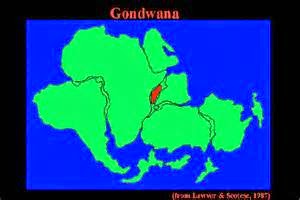
I have read some very good science fiction by Robert Silverberg (see image) but I always have problems with his time travel, sometimes big problems (see here). In Silverberg's Time Patrol story, Manse Everard and Daniel Ben-Eytan of the Time Patrol fly above a Gondwanaland on which every human being attending the Founding Convocation of the Patrol has been assassinated early during the Convocation. It follows that:

Everard and Ben-Eytan are in a timeline without a Patrol;
futureward along this timeline, a million years of history, unprotected by the Patrol, are altered out of recognition by time criminals;
therefore, by traveling futureward along this timeline, they cannot possibly arrive in a Prague, 1910, that they will recognize.

Yet they do precisely that. In Prague, they meet a team of colleagues with whom they will try to prevent the mass assassination. According to Anderson's stories, such a team would have to meet at a time before the event that they aim to prevent. If and only if they succeed will they be able to travel futureward into the familiar timeline protected by the Patrol.

Silverberg writes that, as Everard looked down on the scene of the assassination:

"...he knew that if the horrific event that had taken place in this convocation-hall at the dawn of time was allowed actually to happen, everything that he thought of as the history of the world was going to be altered." (p. 224)

But if he is in a timeline where "...the horrific event...had taken place...," then he is in a timeline where the horrific event had actually happened (he is not looking at a simulation) so he is in a timeline with an altered history. He can, if he travels back to a time before the horrific event, try to prevent that event but he cannot, from a time when he is looking at the accomplished event, travel futureward into his familiar timeline. And, if he could do that, then why would there be any need to prevent the horrific event?

I know that more than this is said in the story but I am deliberately focusing on one point at a time because everything gets too confused otherwise. Ben-Eytan says things like, "We exist and we don't exist." (p. 218) What does that mean? Each of us exists in a timeline in which we are born, live and die. Each of us does not exist in a timeline in which we are not born, the one exception (in the Time Patrol series) being that a time traveler might travel pastward, then return futureward into an altered timeline in which his birth has been prevented so that now he does exist in a timeline in which he was not born. But "We exist and we don't exist" is meaningless.

When Everard and Ben-Eytan were in Paris before traveling to Gondwanaland, Everard thought that Ben-Eytan's account:

"...didn't sound right. It was too glib. It sounded like the sort of thing that an instructor would tell a bothersome trainee at the Academy to shut him up when it was necessary to get on with the day's lesson. If the Patrol had been removed at its point of origin in the Cambrian, how could anything, anything at all, still be remotely the same here in twentieth century Paris? That bothered him very much." (p. 219)

Here, Silverberg states the problem with his own account. Saying that it bothers even Everard might be intended to reassure the readers that they are not alone in being bothered - if they are. A lot of readers don't seem to be bothered and even think that this sort of time travel narrative, e.g., in Doctor Who, makes perfect sense!

My impression of the Time Patrol Academy is that it is a place where instructors try to instruct trainees, not to shut them up. If this sort of question were dismissed glibly, then how would the Patrol function and what would the day's lesson be about?