Weoch-Captain and his crew are as good as dead on p. 290 of Larry Niven, Ed., Man-Kzin Wars III. However, Poul Anderson's "Inconstant Star" continues until p. 310 because three loose ends need to be tied up:
(i) future history continuity;
(ii) personal relationships between our hero, his wife and the new female character;
(iii) who was the kzinti's intelligence source on Wunderland?
We will take the first one first.
(i) A prequel must not contradict later continuity. In Niven's Known Space future history, neither the kzinti nor the Earthmen acquired a tnuctipun weapon enabling them to win a decisive victory in the Man-Kzin Wars. Yet representatives of both species have discovered such a weapon in "Inconstant Star." Captain Saxtorph (human) has given Weoch-Captain (kzin) and his crew a lethal dose of radiation so it looks as if Saxtoroh's crew have sole control of the weapon. But they have not. Weoch's last defiant act is to propel the weapon with himself on it into hyperspace. The Rover crew "...saw their prize disappear." (p. 294)
That concluding phrase of Chapter XIX represents a literary tradition that is Wellsian or older. Except when alternative histories are invoked, it is a literary convention that fictional events occurred in the world as it is known to us. Thus, a Tolstoyan character can contemplate assassination of Napoleon but decides against it - and, if he did attempt it, would not succeed. The Cavorite sphere disappears into space and the Selenites kill Cavor before he can transmit the formula back to Earth. The Time Traveler does not return from his second expedition. On a more trivial level, in the 1950's, a weekly comic strip had cavemen discovering that the Moon is made of cheese, pulling it down to Earth and eating it. I said that the following installment must explain why there is a Moon today. Someone said, "Don't be stupid. It's only fiction." But, sure enough, the next installment explained how the Moon had been replaced.
That disappearing tnuctipun weapon follows in the proud footsteps of the disappearing Time Machine and Cavorite sphere.
Showing posts with label The Time Machine. Show all posts
Sunday, 10 April 2016
Monday, 14 March 2016
Now And Tomorrow
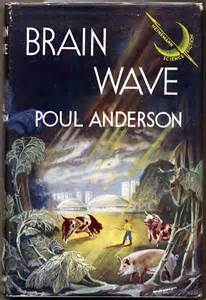
Science fiction can be contemporary or futuristic. Indeed, it can even be historical. See several works by Poul Anderson. However, the present and the future are the main concerns of sf. The future can mean any time from the day after tomorrow (Brain Wave) to beyond the end of the universe (Tau Zero).
The day after tomorrow may be the same as today except for a single technological innovation, as in "Life-Line" by Robert Heinlein. Brain Wave begins with a global increase in intelligence which generates every conceivable technological innovation, then the transcendence of humanity.
CS Lewis' Ransom Trilogy comprises two contemporary interplanetary novels and one "day after tomorrow" novel. Thus, Lewis presents the unusual but wholly appropriate sequence of Mars, Venus and Earth.
Reading American sf comics in the 1950s, I divided sf into before or after the invention of spaceships. The earliest future histories begin before space travel. Heinlein's Future History begins with "Life-Line." An escape velocity rocket fuel is not developed until the end of the fourth story.
In Anderson's Psychotechnic History, the opening story is set on a devastated Earth but the second begins on a colonized Mars. Anderson's Technic History and Larry Niven's Known Space future history begin with the exploration of the Solar System whereas Jerry Pournelle's CoDominium future history begins with regular interstellar travel. So there is some progress.
Wells' Time Traveler tells his dinner guests that he traveled through tomorrow, as if it were another country, then further into futurity. Thus, twenty four hours later, he and they have lived through the day that he traveled through while he traveled through it. Extraordinary.
The day after tomorrow may be the same as today except for a single technological innovation, as in "Life-Line" by Robert Heinlein. Brain Wave begins with a global increase in intelligence which generates every conceivable technological innovation, then the transcendence of humanity.
CS Lewis' Ransom Trilogy comprises two contemporary interplanetary novels and one "day after tomorrow" novel. Thus, Lewis presents the unusual but wholly appropriate sequence of Mars, Venus and Earth.
Reading American sf comics in the 1950s, I divided sf into before or after the invention of spaceships. The earliest future histories begin before space travel. Heinlein's Future History begins with "Life-Line." An escape velocity rocket fuel is not developed until the end of the fourth story.
In Anderson's Psychotechnic History, the opening story is set on a devastated Earth but the second begins on a colonized Mars. Anderson's Technic History and Larry Niven's Known Space future history begin with the exploration of the Solar System whereas Jerry Pournelle's CoDominium future history begins with regular interstellar travel. So there is some progress.
Wells' Time Traveler tells his dinner guests that he traveled through tomorrow, as if it were another country, then further into futurity. Thus, twenty four hours later, he and they have lived through the day that he traveled through while he traveled through it. Extraordinary.
Tuesday, 16 February 2016
Cosmic Comparisons
SM Stirling's Conquistador explicitly acknowledges its sources here, including two titles by Poul Anderson. Let us therefore consider the following sequence:
Anderson, Three Hearts And Three Lions
Anderson, A Midsummer Tempest
Stirling, Conquistador
- three novels of cross-time travel.
However, the two Anderson titles are fantasies, involving supernatural beings and magic, whereas Conquistador by contrast is science fiction, assuming only:
an infinite series of parallel universes with identical physical laws;
a technological means of travel between them.
Adrienne Rolfe's experience differs from ours in just one respect: in the existence of the Gate and of what lies beyond it. However, what is beyond the Gate is an Earth where history went differently, not where myths are true. Thus, Three Hearts... and ...Tempest are as fantastic to Adrienne as they are to us.
Her literary predecessors also include the group of extra-temporal exiles in HG Wells' Men Like Gods but these characters are hardly major players in the history of sf. One major predecessor of many science fictional space and time explorers is the original Time Traveler, who could well have encountered a sabre-tooth as the New Virginians do at the end of Conquistador. In the Epilogue to The Time Machine, the outer narrator speculates that the Time Traveler has gone to:
the Stone Age;
the Cretaceous Sea;
the Jurassic Age;
the Triassic Age -
- so we can legitimately imagine him among prehistoric animals even though Wells never wrote a sequel.
Anderson, Three Hearts And Three Lions
Anderson, A Midsummer Tempest
Stirling, Conquistador
- three novels of cross-time travel.
However, the two Anderson titles are fantasies, involving supernatural beings and magic, whereas Conquistador by contrast is science fiction, assuming only:
an infinite series of parallel universes with identical physical laws;
a technological means of travel between them.
Adrienne Rolfe's experience differs from ours in just one respect: in the existence of the Gate and of what lies beyond it. However, what is beyond the Gate is an Earth where history went differently, not where myths are true. Thus, Three Hearts... and ...Tempest are as fantastic to Adrienne as they are to us.
Her literary predecessors also include the group of extra-temporal exiles in HG Wells' Men Like Gods but these characters are hardly major players in the history of sf. One major predecessor of many science fictional space and time explorers is the original Time Traveler, who could well have encountered a sabre-tooth as the New Virginians do at the end of Conquistador. In the Epilogue to The Time Machine, the outer narrator speculates that the Time Traveler has gone to:
the Stone Age;
the Cretaceous Sea;
the Jurassic Age;
the Triassic Age -
- so we can legitimately imagine him among prehistoric animals even though Wells never wrote a sequel.
Wednesday, 27 January 2016
Another Literary Reference
SM Stirling, Ed., Drakas! (New York, 2000).
(See image. "INGSOC" is Newspeak for "English Socialism.")
And here is another literary reference, on the second page of "The Last Word" by Harry Turtledove in Drakas!:
"What had that Englishman called the Snakes? A boot in the face of mankind forever - something like that, anyhow." (p. 250)
And that is how O'Brien of the Thought Police describes the future to Winston Smith in George Orwell's 1984:
He is entirely honest about the brutal cynicism of the Party; the Party does not seek power to do anything good, but simply to revel in that power: "Always, Winston, at every moment, there will be the thrill of victory, the sensation of trampling on an enemy who is helpless. If you want a picture of the future, imagine a boot stomping on a human face — forever."
-copied from here.
Very appropriate for the Draka: Orwell would have said it of them in their timeline.
In HG Wells' The Time Machine, bourgeoisie and proletarians devolve into different species. In Orwell's 1984, a Party makes a revolution, then freezes society into a new dictatorship forever. Turtledove's MacDonald refers to Orwell as "...that Englishman..." and Poul Anderson's Caleb Wallis refers to Wells as "'...a young Englishman in the '90's...'"
-Poul Anderson, There Will Be Time (New York, 1973), p. 73.
(See image. "INGSOC" is Newspeak for "English Socialism.")
And here is another literary reference, on the second page of "The Last Word" by Harry Turtledove in Drakas!:
"What had that Englishman called the Snakes? A boot in the face of mankind forever - something like that, anyhow." (p. 250)
And that is how O'Brien of the Thought Police describes the future to Winston Smith in George Orwell's 1984:
He is entirely honest about the brutal cynicism of the Party; the Party does not seek power to do anything good, but simply to revel in that power: "Always, Winston, at every moment, there will be the thrill of victory, the sensation of trampling on an enemy who is helpless. If you want a picture of the future, imagine a boot stomping on a human face — forever."
-copied from here.
Very appropriate for the Draka: Orwell would have said it of them in their timeline.
In HG Wells' The Time Machine, bourgeoisie and proletarians devolve into different species. In Orwell's 1984, a Party makes a revolution, then freezes society into a new dictatorship forever. Turtledove's MacDonald refers to Orwell as "...that Englishman..." and Poul Anderson's Caleb Wallis refers to Wells as "'...a young Englishman in the '90's...'"
-Poul Anderson, There Will Be Time (New York, 1973), p. 73.
Wednesday, 2 December 2015
The Stages Of The Time Journey
Poul Anderson, "Flight to Forever" IN Anderson, Past Times (New York, 1984), pp. 207-288.
(i) Saunders and Hull easily jump from 1973 to 2073.
(ii) They laboriously struggle back decade by decade by half decade to 2008 but no further, while remaining within the pit that had been their underground workshop.
(iii) Saunders, accompanied at first by Hull but mostly by Belgotai, traverses an entire period of interplanetary conflict, then the entire rise and fall of the First Galactic Empire, then, by applying his imported time travel technology to space combat, helps to initiate the Second Empire.
(iv) Saunders alone travels around the circle of time, and between the end and beginning of the universe, back to 1973.
Saunders' "Flight Without End," after 50,000 AD, corresponds to the Time Traveler's "Further Vision," after 802,701 AD. Cosmic time as a circle is common to this mini-future history and to Olaf Stapledon's novel-length future history, Last And First Men.
(i) Saunders and Hull easily jump from 1973 to 2073.
(ii) They laboriously struggle back decade by decade by half decade to 2008 but no further, while remaining within the pit that had been their underground workshop.
(iii) Saunders, accompanied at first by Hull but mostly by Belgotai, traverses an entire period of interplanetary conflict, then the entire rise and fall of the First Galactic Empire, then, by applying his imported time travel technology to space combat, helps to initiate the Second Empire.
(iv) Saunders alone travels around the circle of time, and between the end and beginning of the universe, back to 1973.
Saunders' "Flight Without End," after 50,000 AD, corresponds to the Time Traveler's "Further Vision," after 802,701 AD. Cosmic time as a circle is common to this mini-future history and to Olaf Stapledon's novel-length future history, Last And First Men.
Moving In Time
Poul Anderson, "Flight to Forever" IN Anderson, Past Times (New York, 1984), pp. 207-288.
There is a big difference between space-time machines, like the TARDIS or the Time Patrol timecycles, and mere time machines, like the Time Traveler's Time Machine or Martin Saunders' time projector. The latter remain in the same position on the Earth's surface. The Time Traveler returns to a different part of his laboratory because the Morlocks had moved the Time Machine into the White Sphinx. Saunders had departed from the underground workshop of a house on a hill but returned to a point half way up the hill because the projector had been moved at Brontothor.
Eve and MacPherson who had remained at the house are surprised to see not the projector returning in the basement but Saunders walking into the house - but why does he say that he is "'...a little early.'"? (p. 288)
After the Morlocks and Eloi in 802, 701 AD, the Time Traveler has "The Further Vision" of a darkening, dying Earth under a red giant sun. After Brontothor in 50,000 AD, Saunders has a "Flight Without End," beyond the end of the universe. To return home, the Time Traveler turns back whereas Saunders can only "GO ON..." (p. 281)
The location of the time projector changes from an underground workshop to:
a ruined basement;
a pit;
the top of a low hill;
"...a small cobbled courtyard between high houses with shuttered and darkened windows..." (p. 222);
radioactive, blackened, fused rock;
a vitrified crater;
a forest;
a lawn between buildings of the American College;
etc.
Three times, Saunders and Belgotai arrive to find a spaceship parked nearby.
Saunders' first companion, Hull, is killed by the Armageddonists in 2500 AD. In 3000 AD, Belgotai, a mercenary, joins Saunders because "...mercenary companies were helpless before the organized levies of the rising nations..." (p. 228) Belgotai hopes to find an era where he can still fight as a "'...free comrade...'" (ibid.) He is a helpful companion for Saunders because of his military skills but is he a good guide to the future? He is able to tell Saunders, in general terms, what has happened in the Solar System between 1973 and 3000 and this might be of some assistance in preparing to face further periods of interplanetary travel. Nevertheless, he knows no more about periods post-3000 than Saunders.
Earth had suffered from:
"...the onslaughts of barbarians from the outer planets..." (p. 227)
Anderson did a good job of rationalizing barbarians with spaceships in his History of Technic Civilization but is interplanetary barbarism a likely development in the Solar System?
There is a big difference between space-time machines, like the TARDIS or the Time Patrol timecycles, and mere time machines, like the Time Traveler's Time Machine or Martin Saunders' time projector. The latter remain in the same position on the Earth's surface. The Time Traveler returns to a different part of his laboratory because the Morlocks had moved the Time Machine into the White Sphinx. Saunders had departed from the underground workshop of a house on a hill but returned to a point half way up the hill because the projector had been moved at Brontothor.
Eve and MacPherson who had remained at the house are surprised to see not the projector returning in the basement but Saunders walking into the house - but why does he say that he is "'...a little early.'"? (p. 288)
After the Morlocks and Eloi in 802, 701 AD, the Time Traveler has "The Further Vision" of a darkening, dying Earth under a red giant sun. After Brontothor in 50,000 AD, Saunders has a "Flight Without End," beyond the end of the universe. To return home, the Time Traveler turns back whereas Saunders can only "GO ON..." (p. 281)
The location of the time projector changes from an underground workshop to:
a ruined basement;
a pit;
the top of a low hill;
"...a small cobbled courtyard between high houses with shuttered and darkened windows..." (p. 222);
radioactive, blackened, fused rock;
a vitrified crater;
a forest;
a lawn between buildings of the American College;
etc.
Three times, Saunders and Belgotai arrive to find a spaceship parked nearby.
Saunders' first companion, Hull, is killed by the Armageddonists in 2500 AD. In 3000 AD, Belgotai, a mercenary, joins Saunders because "...mercenary companies were helpless before the organized levies of the rising nations..." (p. 228) Belgotai hopes to find an era where he can still fight as a "'...free comrade...'" (ibid.) He is a helpful companion for Saunders because of his military skills but is he a good guide to the future? He is able to tell Saunders, in general terms, what has happened in the Solar System between 1973 and 3000 and this might be of some assistance in preparing to face further periods of interplanetary travel. Nevertheless, he knows no more about periods post-3000 than Saunders.
Earth had suffered from:
"...the onslaughts of barbarians from the outer planets..." (p. 227)
Anderson did a good job of rationalizing barbarians with spaceships in his History of Technic Civilization but is interplanetary barbarism a likely development in the Solar System?
Tuesday, 1 December 2015
Time Traveling Companions
Poul Anderson, "Flight to Forever" IN Anderson, Past Times (New York, 1984), pp. 207-288.
HG Wells' Time Traveler travels alone on a one-man vehicle, almost like a bicycle.
The Time Patrol has timecycles for one or more than one and also larger time shuttles.
The Doctor, with his TARDIS larger inside than out, has had innumerable implausible "companions." (At last one has died. That is going to happen if untrained and unprepared personnel are continually taken into danger.)
In Poul Anderson's The Dancer From Atlantis, a malfunctioning temporal vehicle collects unwilling passengers en route.
In "Flight to Forever," Martin Saunders' time projector is almost the opposite of the TARDIS. Most of its thirty feet of length house the dimensional projector and battery banks. Two men squeeze into the small forward cabin. Saunders embarks with Sam Hull, later travels with Belgotai of Syrtis and ends his journey alone. Like the Doctor, he changes his companion, although not as often. So what becomes of Hull and Belgotai? Time will tell but probably not tonight.
HG Wells' Time Traveler travels alone on a one-man vehicle, almost like a bicycle.
The Time Patrol has timecycles for one or more than one and also larger time shuttles.
The Doctor, with his TARDIS larger inside than out, has had innumerable implausible "companions." (At last one has died. That is going to happen if untrained and unprepared personnel are continually taken into danger.)
In Poul Anderson's The Dancer From Atlantis, a malfunctioning temporal vehicle collects unwilling passengers en route.
In "Flight to Forever," Martin Saunders' time projector is almost the opposite of the TARDIS. Most of its thirty feet of length house the dimensional projector and battery banks. Two men squeeze into the small forward cabin. Saunders embarks with Sam Hull, later travels with Belgotai of Syrtis and ends his journey alone. Like the Doctor, he changes his companion, although not as often. So what becomes of Hull and Belgotai? Time will tell but probably not tonight.
Wellsian And Stapledonian Anderson
In Poul Anderson's The Shield Of Time, an expedition from the far future travels to the Egyptian Eighteenth Dynasty in search of cultural inspiration. Similarly, I find inspiration among the blog posts of 2012 and 2013, which I currently revisit for "blog maintenance," a worthwhile and enjoyable but also time-consuming behind-the-scenes activity.
I find that I have referred to, but still have never read, The Infinite Voyage by Poul Anderson. See here. That volume has now been ordered. I have read slightly different accounts of its theme but will soon know.
An early work by Anderson that combines pulp absurdities with cosmic grandeur is "Flight to Forever," which is both Wellsian and Stapledonian, a claim often made on this blog. HG Wells introduced the idea of a scientist who invents a temporal vehicle, then sets off into the complete unknown of the future - tomorrow, the day after that and everything beyond them. The author is limited only by his imagination and by what he might extrapolate from history and from his contemporary period. After the introductory passages, the story could move in any direction. Different authors asked to extrapolate from the same opening section of a time travel story would create entirely dissimilar and unrelated narratives.
In "Flight to Forever," Martin Saunders and Sam Hull follow in the Time Traveler's footsteps, starting not from the author's "present" in 1950 but from his near future in 1973. Like the Time Traveler, Saunders returns at the end of the story to the day of his departure. However, like the narrator of Stapledon's Star Maker, Saunders has seen more than the future and end of life on Earth. He also been on a cosmic journey through time and space to the end of the universe. And, unlike Stapledon's narrator, he brings back the memory of a woman, Taury the Red. "Flight to Forever" ends with a sense of cosmic and personal completion.
I find that I have referred to, but still have never read, The Infinite Voyage by Poul Anderson. See here. That volume has now been ordered. I have read slightly different accounts of its theme but will soon know.
An early work by Anderson that combines pulp absurdities with cosmic grandeur is "Flight to Forever," which is both Wellsian and Stapledonian, a claim often made on this blog. HG Wells introduced the idea of a scientist who invents a temporal vehicle, then sets off into the complete unknown of the future - tomorrow, the day after that and everything beyond them. The author is limited only by his imagination and by what he might extrapolate from history and from his contemporary period. After the introductory passages, the story could move in any direction. Different authors asked to extrapolate from the same opening section of a time travel story would create entirely dissimilar and unrelated narratives.
In "Flight to Forever," Martin Saunders and Sam Hull follow in the Time Traveler's footsteps, starting not from the author's "present" in 1950 but from his near future in 1973. Like the Time Traveler, Saunders returns at the end of the story to the day of his departure. However, like the narrator of Stapledon's Star Maker, Saunders has seen more than the future and end of life on Earth. He also been on a cosmic journey through time and space to the end of the universe. And, unlike Stapledon's narrator, he brings back the memory of a woman, Taury the Red. "Flight to Forever" ends with a sense of cosmic and personal completion.
Wednesday, 25 November 2015
The Day After Tomorrow
Futuristic sf includes "day after tomorrow" scenarios where everything is as it is now but then one thing changes. CS Lewis' That Hideous Strength, published 1945 but set "after the War," is in this category as is Poul Anderson's Brain Wave. HG Wells' Time Traveler tells his dinner guests that that morning he had set off on his Time Machine and passed through "tomorrow." Despite spending several days in the future, he has returned to the day of his departure so that he still has the same "tomorrow."
I mention all this here because today and tomorrow I will be visiting a friend in Birmingham (see image) and will be away from my lap top. Thank you all for over 320 page views so far today with the best part of an hour still to go. I managed to post a lot about Anderson's The People Of The Wind yesterday. A return to that fictitious world, and in such detail, was completely unplanned and unpredicted. Anderson's texts are inexhaustible. All that is exhausted, temporarily, is my ability to focus on new aspects of a particular text.
I do not know what will come next but something will.
Addendum: 330 page views by the end of the day.
I mention all this here because today and tomorrow I will be visiting a friend in Birmingham (see image) and will be away from my lap top. Thank you all for over 320 page views so far today with the best part of an hour still to go. I managed to post a lot about Anderson's The People Of The Wind yesterday. A return to that fictitious world, and in such detail, was completely unplanned and unpredicted. Anderson's texts are inexhaustible. All that is exhausted, temporarily, is my ability to focus on new aspects of a particular text.
I do not know what will come next but something will.
Addendum: 330 page views by the end of the day.
Thursday, 24 September 2015
Hypothetical Sequels
My ideas for a sequel to The Time Machine are here.
How might Poul Anderson have continued his Time Patrol series? Manse Everard would have had to leave that New York apartment and to move elsewhere/when and his relationship with Wanda Tamberly would have had to go somewhere, possibly towards marriage, as in SM Stirling's "A Slip In Time." (see here.)
Beyond that, each Time Patrol installment has been unique and unpredictable. For present purposes, I will count The Shield Of Time as three installments. Thus, the entire series comprises thirteen installments of two kinds:
those in which the Patrol contends with human villains/time criminals;
those in which the Patrol must address some other kind of problem generated by time travel.
The stories with villains are a minority and maybe develop the idea as far as it will go:
an individual villain (one story);
a collective villain (one story);
a more sophisticated collective villain (three stories).
For readers who enjoy heroic detective work followed by heroes versus villains action, there is plenty of that in these stories. In the remaining eight installments:
Patrol Specialist Keith Denison unintentionally becomes Cyrus the Great;
the Mongols threaten to invade North America;
a Patrol agent saves the life of a colleague who, according to the records, never returned home;
a Patrol agent mistaken for Wodan must betray his followers to preserve history;
a Patrol agent unintentionally inspires a pagan prophetess who will change history unless the Patrol counterintervenes;
a Patrol agent intervenes to help the Beringians;
a medieval man is a personal causal nexus;
an indiscreet Patrolman is arrested by the Knights Templar.
Any fourteenth installment would probably have been of the second kind but there is no way to project either its plot or its historical setting.
How might Poul Anderson have continued his Time Patrol series? Manse Everard would have had to leave that New York apartment and to move elsewhere/when and his relationship with Wanda Tamberly would have had to go somewhere, possibly towards marriage, as in SM Stirling's "A Slip In Time." (see here.)
Beyond that, each Time Patrol installment has been unique and unpredictable. For present purposes, I will count The Shield Of Time as three installments. Thus, the entire series comprises thirteen installments of two kinds:
those in which the Patrol contends with human villains/time criminals;
those in which the Patrol must address some other kind of problem generated by time travel.
The stories with villains are a minority and maybe develop the idea as far as it will go:
an individual villain (one story);
a collective villain (one story);
a more sophisticated collective villain (three stories).
For readers who enjoy heroic detective work followed by heroes versus villains action, there is plenty of that in these stories. In the remaining eight installments:
Patrol Specialist Keith Denison unintentionally becomes Cyrus the Great;
the Mongols threaten to invade North America;
a Patrol agent saves the life of a colleague who, according to the records, never returned home;
a Patrol agent mistaken for Wodan must betray his followers to preserve history;
a Patrol agent unintentionally inspires a pagan prophetess who will change history unless the Patrol counterintervenes;
a Patrol agent intervenes to help the Beringians;
a medieval man is a personal causal nexus;
an indiscreet Patrolman is arrested by the Knights Templar.
Any fourteenth installment would probably have been of the second kind but there is no way to project either its plot or its historical setting.
Wednesday, 23 September 2015
The Time Machine And The Time Patrol
(i) HG Wells' The Time Machine is a novel about a scientist exploring the future whereas Poul Anderson's Time Patrol is a series about an organization preserving the past.
(ii) The Time Machine and the Patrol timecycles are open temporal vehicles that the traveler sits on, not in.
(iii) The Patrol message shuttles recall the Time Traveler's model Time Machine.
(iv) In both cases, time travel is technological, not magical or supernatural.
(v) Humanity devolves into Morlocks and Eloi or evolves into Danellians.
(vi) In both cases, other periods are described colorfully and vividly.
(vii) The Time Machine hints at "...curious possibilities of anachronism and of utter confusion..." (see here) whereas the Time Patrol series examines time travel paradoxes with subtlety and ingenuity.
In a completely different way, The Time Machine and The War Of The Worlds are forerunners of Doctor Who:
The Time Traveller = the Doctor;
The Time Machine = the TARDIS;
Weena = companion;
Morlocks and Eloi = Daleks and Thals;
Martians (evolved beings in tripod vehicles) = Daleks (mutated beings in protective machines);
Martians invading Earth = Daleks invading Earth.
(ii) The Time Machine and the Patrol timecycles are open temporal vehicles that the traveler sits on, not in.
(iii) The Patrol message shuttles recall the Time Traveler's model Time Machine.
(iv) In both cases, time travel is technological, not magical or supernatural.
(v) Humanity devolves into Morlocks and Eloi or evolves into Danellians.
(vi) In both cases, other periods are described colorfully and vividly.
(vii) The Time Machine hints at "...curious possibilities of anachronism and of utter confusion..." (see here) whereas the Time Patrol series examines time travel paradoxes with subtlety and ingenuity.
In a completely different way, The Time Machine and The War Of The Worlds are forerunners of Doctor Who:
The Time Traveller = the Doctor;
The Time Machine = the TARDIS;
Weena = companion;
Morlocks and Eloi = Daleks and Thals;
Martians (evolved beings in tripod vehicles) = Daleks (mutated beings in protective machines);
Martians invading Earth = Daleks invading Earth.
Monday, 7 September 2015
Levels Of Complexity
A descriptive paragraph mentions foothills and forest and ends:
"Southward the Caucasus walled heaven with snowpeaks."
-Poul Anderson, The Shield Of Time (New York, 1991), p. 277.
I have returned to this earlier episode of Keith Denison's adventures both for the beauty of Poul Anderson's prose and for the appropriateness of the attached image - which is in fact of the Caucasus.
Any blog reader who has been following Denison's adventures through my summaries might prefer to learn what happens next in Paris rather than to revisit the Caucasus. However, Anderson does not give us a direct account of Denison's captivity under Albin. The author juggles with three characters:
Denison, as we have seen, is captured in the alpha timeline;
Wanda Tamberly remains free in that timeline and decides to explore it before returning downtime;
Manse Everard, back in 18,244 BC, is informed of the alpha timeline and marshals his resources to restore the timeline guarded by the Patrol.
All this is far more sophisticated than "Delenda Est," the original culmination of the Time Patrol series. All that happened there was that Everard and van Sarawak entered a divergent timeline and had some adventures there/then before returning downtime to rectify the situation. And they succeeded on the first attempt, which Everard does not do in The Shield Of Time. "Deleting" the alpha timeline generates a beta timeline...
Wells' The Time Machine, Anderson's The Guardians Of Time and Anderson's The Shield Of Time are three successive levels of complexity in time travel fiction.
"Southward the Caucasus walled heaven with snowpeaks."
-Poul Anderson, The Shield Of Time (New York, 1991), p. 277.
I have returned to this earlier episode of Keith Denison's adventures both for the beauty of Poul Anderson's prose and for the appropriateness of the attached image - which is in fact of the Caucasus.
Any blog reader who has been following Denison's adventures through my summaries might prefer to learn what happens next in Paris rather than to revisit the Caucasus. However, Anderson does not give us a direct account of Denison's captivity under Albin. The author juggles with three characters:
Denison, as we have seen, is captured in the alpha timeline;
Wanda Tamberly remains free in that timeline and decides to explore it before returning downtime;
Manse Everard, back in 18,244 BC, is informed of the alpha timeline and marshals his resources to restore the timeline guarded by the Patrol.
All this is far more sophisticated than "Delenda Est," the original culmination of the Time Patrol series. All that happened there was that Everard and van Sarawak entered a divergent timeline and had some adventures there/then before returning downtime to rectify the situation. And they succeeded on the first attempt, which Everard does not do in The Shield Of Time. "Deleting" the alpha timeline generates a beta timeline...
Wells' The Time Machine, Anderson's The Guardians Of Time and Anderson's The Shield Of Time are three successive levels of complexity in time travel fiction.
Sunday, 23 August 2015
Two Kinds Of Critique
I should clarify that, when I critique a work of time travel fiction, I may be making one of two diametrically opposite points about it:
that the work is incoherent and should not have been published;
that the work is aesthetically and intellectually absorbing and that part of the pleasure is precisely to engage with its conceptual content.
The latter is certainly true of HG Wells' The Time Machine. The introductory section in which the dinner guests merely discuss the concept of "time traveling" is like a good Platonic dialogue. The Time Traveler contradicts himself several times but we learn a great deal by continuing the discussion.
I hope that it is clear that Poul Anderson's Time Patrol series, including the addition by SM Stirling, is also in the second category. This is Wellsian science fiction. However, needing a break from prose fiction and abstract thought, I will now instead reread Black Orchid by Neil Gaiman and Dave McKean.
that the work is incoherent and should not have been published;
that the work is aesthetically and intellectually absorbing and that part of the pleasure is precisely to engage with its conceptual content.
The latter is certainly true of HG Wells' The Time Machine. The introductory section in which the dinner guests merely discuss the concept of "time traveling" is like a good Platonic dialogue. The Time Traveler contradicts himself several times but we learn a great deal by continuing the discussion.
I hope that it is clear that Poul Anderson's Time Patrol series, including the addition by SM Stirling, is also in the second category. This is Wellsian science fiction. However, needing a break from prose fiction and abstract thought, I will now instead reread Black Orchid by Neil Gaiman and Dave McKean.
Tuesday, 28 July 2015
Points Of View In Time Travel Fiction
In The Time Machine, HG Wells describes a journey from London 1895 to 802,703 and beyond from the Time Traveler's point of view with first person narration. In "Time Patrol," Poul Anderson describes journeys from New York 1955 to the American Oligocene, Victorian Britain, post-Roman Britain and London 1944 from a Time Patrolman's point of view with third person narration.
Differences:
country and century of origin;
direction of travel;
number of journeys;
a single time traveler, the Time Traveler, as against a member of a time traveling organization, a Time Patrolman;
first as against third person narration;
mere time travel as against space-time travel;
subjective travel time as against instantaneous transition;
implicit as against explicit paradoxes.
Similarities:
a temporal vehicle that the traveler sits on, not in;
vivid descriptions of visited periods;
the time traveler's point of view.
Anderson's first two Time Patrol collections were Guardians Of Time (four stories), expanded to The Guardians Of Time (five stories), and Time Patrolman (two stories).
The first four stories are narrated from the point of view of Patrolman Manse Everard. The fifth is narrated from the point of view of Patrolman Tom Nomura. The sixth returns to Everard. The seventh alternates between the point of view of Patrolman Carl Farness and the collective viewpoint of the Goths visited by Farness. At last, a time travel story presents not only the point of view of a time traveler but also that of the people he visits.
Differences:
country and century of origin;
direction of travel;
number of journeys;
a single time traveler, the Time Traveler, as against a member of a time traveling organization, a Time Patrolman;
first as against third person narration;
mere time travel as against space-time travel;
subjective travel time as against instantaneous transition;
implicit as against explicit paradoxes.
Similarities:
a temporal vehicle that the traveler sits on, not in;
vivid descriptions of visited periods;
the time traveler's point of view.
Anderson's first two Time Patrol collections were Guardians Of Time (four stories), expanded to The Guardians Of Time (five stories), and Time Patrolman (two stories).
The first four stories are narrated from the point of view of Patrolman Manse Everard. The fifth is narrated from the point of view of Patrolman Tom Nomura. The sixth returns to Everard. The seventh alternates between the point of view of Patrolman Carl Farness and the collective viewpoint of the Goths visited by Farness. At last, a time travel story presents not only the point of view of a time traveler but also that of the people he visits.
Saturday, 25 July 2015
Desert Island Book
There is a radio program called Desert Island Discs. Do they have it in the States? A guest says which ten or so pieces of music s/he would want on a desert island, plus one book other than the Bible or Shakespeare. My book would have to be Time Patrol. I would reread this omnibus volume from cover to cover, looking for previously unnoticed details on each page, like:
the admirable economy and skill with which Anderson introduces the doubly complex concept of a time travel organization in a mutable timeline;
physical descriptions of locations in diverse periods;
discussions of divergent timelines and the creation of such a timeline in "Delenda Est;"
the increasing subtlety, sophistication and complexity of the series when the author returns to it after a decade-long interval (I am additionally thinking of The Shield Of Time which, by the rules of Desert Island Discs, I would not also have on the island);
comparisons and contrasts with The Time Machine, which ideally I would also have smuggled onto the island.
It is invidious to ask which is the "best" of an author's works. Tau Zero is a classic of hard sf but A Midsummer Tempest is equally excellent in the very different category of literary fantasy. If I were to be allowed not just one volume but two entire series, then they would have to be the Time Patrol and the Technic History, totaling nine long volumes. Each series contains several individual works of extremely high quality. In the Time Patrol, Manson Everard has a protege, Wanda Tamberly. In the Technic History, Nicholas van Rijn has a protege, David Falkayn, and Dominic Flandry is succeeded by his daughter, Diana Crowfeather. And there are others. Two series give us many characters.
Returning to SM Stirling whom I have been reading as a worthy successor of Anderson and in any case worth reading in his own right, I can rank the four novels that I have read so far in order of preference:
The Peshawar Lancers
Conquistador
The Sky People
In The Courts Of The Crimson Kings
And Marching Through Georgia is in the trans-Atlantic post.
the admirable economy and skill with which Anderson introduces the doubly complex concept of a time travel organization in a mutable timeline;
physical descriptions of locations in diverse periods;
discussions of divergent timelines and the creation of such a timeline in "Delenda Est;"
the increasing subtlety, sophistication and complexity of the series when the author returns to it after a decade-long interval (I am additionally thinking of The Shield Of Time which, by the rules of Desert Island Discs, I would not also have on the island);
comparisons and contrasts with The Time Machine, which ideally I would also have smuggled onto the island.
It is invidious to ask which is the "best" of an author's works. Tau Zero is a classic of hard sf but A Midsummer Tempest is equally excellent in the very different category of literary fantasy. If I were to be allowed not just one volume but two entire series, then they would have to be the Time Patrol and the Technic History, totaling nine long volumes. Each series contains several individual works of extremely high quality. In the Time Patrol, Manson Everard has a protege, Wanda Tamberly. In the Technic History, Nicholas van Rijn has a protege, David Falkayn, and Dominic Flandry is succeeded by his daughter, Diana Crowfeather. And there are others. Two series give us many characters.
Returning to SM Stirling whom I have been reading as a worthy successor of Anderson and in any case worth reading in his own right, I can rank the four novels that I have read so far in order of preference:
The Peshawar Lancers
Conquistador
The Sky People
In The Courts Of The Crimson Kings
And Marching Through Georgia is in the trans-Atlantic post.
Tuesday, 14 July 2015
Future Histories And Time Travel
HG Wells' The Time Machine uses time travel to present a dystopian future whereas the same author's The Shape Of Things To Come uses a fictitious historical text book to present a utopian future. Thus, these two works remain distinct and separate whereas:
Olaf Stapledon's fictitious history, Last And First Men, culminates in the Neptunian Last Men who mentally time travel to earlier periods;
Robert Heinlein's Future History culminates in Lazarus Long who (unfortunately) physically time travels to the early twentieth century;
Isaac Asimov's incoherent time travel novel, The End Of Eternity, (unfortunately) connects with his Robots and Empire future history.
Although Poul Anderson's future history series, the History of Technic Civiliation, and his time travel series, the Time Patrol, remain distinct and separate, the same author's time travel novel, There Will Be Time, connects with his Maurai future history. As ever, Anderson explores both possibilities.
Although Larry Niven's Known Space future history contains one story that implies time travel, Niven develops the latter concept in other works, including his Svetz series. As yet, SM Stirling has written alternative, not future, histories, and therefore has written about alternative timelines, not about time travel.
Olaf Stapledon's fictitious history, Last And First Men, culminates in the Neptunian Last Men who mentally time travel to earlier periods;
Robert Heinlein's Future History culminates in Lazarus Long who (unfortunately) physically time travels to the early twentieth century;
Isaac Asimov's incoherent time travel novel, The End Of Eternity, (unfortunately) connects with his Robots and Empire future history.
Although Poul Anderson's future history series, the History of Technic Civiliation, and his time travel series, the Time Patrol, remain distinct and separate, the same author's time travel novel, There Will Be Time, connects with his Maurai future history. As ever, Anderson explores both possibilities.
Although Larry Niven's Known Space future history contains one story that implies time travel, Niven develops the latter concept in other works, including his Svetz series. As yet, SM Stirling has written alternative, not future, histories, and therefore has written about alternative timelines, not about time travel.
Monday, 25 May 2015
From Wells To Anderson; From One To Many
HG Wells wrote one classic, definitive time travel novel merely hinting at the paradoxes whereas Poul Anderson presents multiple fictions:
in the Old Phoenix sequence, many timelines coexist;
in the Time Patrol series, one mutable timeline exists because time travelers can change past events;
in The Corridors Of Time and There Will Be Time, one immutable timeline exists because time travelers cannot change past events;
in Starfarers, one immutable timeline exists because physical time travel is impossible.
Vast, systematic and comprehensive. And don't forget Wells.
in the Old Phoenix sequence, many timelines coexist;
in the Time Patrol series, one mutable timeline exists because time travelers can change past events;
in The Corridors Of Time and There Will Be Time, one immutable timeline exists because time travelers cannot change past events;
in Starfarers, one immutable timeline exists because physical time travel is impossible.
Vast, systematic and comprehensive. And don't forget Wells.
Sunday, 4 January 2015
For Non-SF Readers
In his Guest of Honor speech at the World Science Fiction Convention in Heidelberg in 1970, EC Tubb asked: which sf book would you recommend to someone who doesn't read sf? John Brunner replied, "Philip K Dick's The Man In The High Castle because everyone has heard of World War II." On the back of Poul Anderson's The Time Patrol (New York, 1991), David Drake is quoted as saying:
"This is my answer to the question, 'What book would I give to a friend who doesn't read SF?'"
Again, everyone has heard of history.
A retired teacher of English and part-time second hand bookseller admires The Time Machine, in particular the almost poetic description of the Time Traveler's return. He recognized the name Asimov, of course, and may also have recognized Poul Anderson. Needless to say, I recommended the latter but, if asked, which book should I suggest that he read first? Not a Dominic Flandry collection, good though these are both as hard sf action-adventure fiction and when read as the middle period of Flandry's career which is part of the History of Technic Civilization which is one of Anderson's several future history series.
A Midsummer Tempest is an obvious starting place for a man who appreciates literature and it would be interesting to find out whether he noticed the peculiar nature of the text. The Time Patrol might work as a second volume although it is never possible to anticipate how another reader will respond to a text. The guy in question disliked CS Lewis' The Great Divorce and my son-in-law did not enthuse about the Time Patrol series.
"This is my answer to the question, 'What book would I give to a friend who doesn't read SF?'"
Again, everyone has heard of history.
A retired teacher of English and part-time second hand bookseller admires The Time Machine, in particular the almost poetic description of the Time Traveler's return. He recognized the name Asimov, of course, and may also have recognized Poul Anderson. Needless to say, I recommended the latter but, if asked, which book should I suggest that he read first? Not a Dominic Flandry collection, good though these are both as hard sf action-adventure fiction and when read as the middle period of Flandry's career which is part of the History of Technic Civilization which is one of Anderson's several future history series.
A Midsummer Tempest is an obvious starting place for a man who appreciates literature and it would be interesting to find out whether he noticed the peculiar nature of the text. The Time Patrol might work as a second volume although it is never possible to anticipate how another reader will respond to a text. The guy in question disliked CS Lewis' The Great Divorce and my son-in-law did not enthuse about the Time Patrol series.
Saturday, 3 January 2015
Facts And Opinions
Some of the following numbered statements are facts.
Others are my opinions.
The status of each should be obvious.
(i) Poul Anderson is a major successor to HG Wells.
(ii) In particular, the Time Patrol series and There Will Be Time are conceptual sequels to The Time Machine.
(iii) There are perhaps half a dozen literal sequels to The Time Machine.
(iv) None of these is by Anderson (fact) and none is any good (opinion) - except The Space Machine by Christopher Priest which is more of a sequel to The War Of The Worlds.
(v) Some authors do not do sequels.
(vi) Wells did connect a few of his works but does not seem to have considered sequels to his major novels.
(vii) The disappearance of the Time Traveler, like the loss of the Cavorite sphere, was intended to complete and close a narrative, not to open the possibility of a continuation.
(viii) The nature of time travel suggests that, since the Time Traveler did not return immediately, he does not return period.
(ix) The Mammoth Book Of Time Travel SF (see here) includes "The Truth About Weena" by David J Lake.
(x) This title implies a literal sequel - although I also thought that The Time Traveler's Wife did.
(xi) I will read this newer (1998) story and possibly comment.
(xii) However, I need a lot of convincing that a new time travel story, whether or not it is a literal Time Machine sequel, is a good idea. (Either do it really well or don't do it.)
Later, on "The Truth About Weena": I would not have done it that way but then I cannot write fiction. My two attempts are here and here. For some ideas on a sequel to The Time Machine, see here.
Others are my opinions.
The status of each should be obvious.
(i) Poul Anderson is a major successor to HG Wells.
(ii) In particular, the Time Patrol series and There Will Be Time are conceptual sequels to The Time Machine.
(iii) There are perhaps half a dozen literal sequels to The Time Machine.
(iv) None of these is by Anderson (fact) and none is any good (opinion) - except The Space Machine by Christopher Priest which is more of a sequel to The War Of The Worlds.
(v) Some authors do not do sequels.
(vi) Wells did connect a few of his works but does not seem to have considered sequels to his major novels.
(vii) The disappearance of the Time Traveler, like the loss of the Cavorite sphere, was intended to complete and close a narrative, not to open the possibility of a continuation.
(viii) The nature of time travel suggests that, since the Time Traveler did not return immediately, he does not return period.
(ix) The Mammoth Book Of Time Travel SF (see here) includes "The Truth About Weena" by David J Lake.
(x) This title implies a literal sequel - although I also thought that The Time Traveler's Wife did.
(xi) I will read this newer (1998) story and possibly comment.
(xii) However, I need a lot of convincing that a new time travel story, whether or not it is a literal Time Machine sequel, is a good idea. (Either do it really well or don't do it.)
Later, on "The Truth About Weena": I would not have done it that way but then I cannot write fiction. My two attempts are here and here. For some ideas on a sequel to The Time Machine, see here.
Wellsian And Andersonian Time Travel
Jack Havig in There Will Be Time is like the Time Traveler without the Time Machine. (see also here.)
In The Corridors Of Time, time travel is technological but through literal corridors rotated onto the temporal axis, not on or in temporal vehicles, although the latter are developed later. There is a future period divided between urban Rangers and rural Wardens (see also here) but also a further vision (see also here) beyond that period - plus well realized past periods. See also here.
The Dancer From Atlantis has a temporal vehicle moving not only backwards in time but also around the Earth rather than remaining stationary in space.
In "Flight To Forever," as in The Time Machine, a modern man with a temporal vehicle travels far enough forward to be able to discern the future history of mankind.
"The Nest" and "The Little Monster" are Wellsian in their technological approaches to time travel and in their realizations of the periods visited.
In The Corridors Of Time, time travel is technological but through literal corridors rotated onto the temporal axis, not on or in temporal vehicles, although the latter are developed later. There is a future period divided between urban Rangers and rural Wardens (see also here) but also a further vision (see also here) beyond that period - plus well realized past periods. See also here.
The Dancer From Atlantis has a temporal vehicle moving not only backwards in time but also around the Earth rather than remaining stationary in space.
In "Flight To Forever," as in The Time Machine, a modern man with a temporal vehicle travels far enough forward to be able to discern the future history of mankind.
"The Nest" and "The Little Monster" are Wellsian in their technological approaches to time travel and in their realizations of the periods visited.
Subscribe to:
Posts (Atom)