Showing posts with label The Shield of Time. Show all posts

Thursday, 18 February 2016

Memories

World Without Stars
The Boat Of A Million Years
For Love And Glory
Time Patrol and The Shield of Time

These three novels and one series are all very good hard sf by Poul Anderson. In each, human life-spans are extended indefinitely. The three novels address the problem that indefinitely accumulating memories would overwhelm a finite brain. In The Boat..., each of the immortals must somehow solve this problem for him- or herself whereas, in World... and FLAG, there is a technology that can selectively erase memories.

In FLAG, Torsten Hebo is about nine hundred Terran years old. Thus, he joins the ranks of:

Robert Heinlein's Lazarus Long;
Poul Anderson's Hugh Valland and Hanno;
James Blish's John Amalfi;
Larry Niven's Louis Wu.

Failures of memory put Hebo in a socially embarrassing situation and then nearly get him killed. He will return to Earth for memory editing and thus we, the readers, will see what has become of our home planet in that remote future.

FLAG's fifty four chapters fill only 290 pages so the chapters are short. Chapters I-VII, pp. 11-41, are set on a single planetary surface. In Chapter VIII, the spaceship Dagmar has returned Karl to his home planet, Gargantua, and will return three other beings to their home planet, Xanadu, before returning the human beings to their home planet, Asborg. Conversation on the ship informs us about the politics and economics of Asborg. The chapter ends by telling us that something important awaits Lissa on Asborg but we forget about this as soon as we turn to Chapter IX which begins with Hebo approaching Earth.

And I will now leave blog readers in suspense while I go about other business for a while...

Sunday, 20 December 2015

Philosophical Fiction: Heraclitus

A work of science fiction can be about a particular science. Thus, there can be biological, psychological, sociological or cosmological fiction. I think that some of Poul Anderson's works may count as philosophical fiction.

In Europe, Thales initiated "natural philosophy," which developed into empirical science, whereas Socrates initiated conceptual philosophy, which we call "philosophy." Thales and his immediate successors, including Heraclitus, were the "Pre-Socratic philosophers."

A Time Patrol Specialist says:

"'...Heraclitus was approximately contemporary with the Buddha, and some of his thought shows close parallels.'"
-Poul Anderson, The Shield Of Time (New York, 1991), p. 53.

Heraclitus said, "Everything flows."

Manse Everard of the Patrol thinks:

"All is flux." (p. 99)

Everard also compares time to a river (see image) and history to a stream.

Heraclitus seems to be the philosopher of the Patrol, although he knows of "flowing" only in the first temporal dimension. In the Patrol's cosmology, the river not only flows but also can change course.

Monday, 12 October 2015

Past, Present And Future

What are past, present and future to a time traveler? Indeed, what are they to anyone? Any moment is "now" to conscious beings that exist in that moment just as any place is "here" by the same criterion. Many locations, e.g., in intergalactic space, will never be "here" to anyone just as there was no "now" before there was consciousness.

"The present" can mean either a durationless instant dividing the entire timeline into a past and a future or a period, "the present period," which can last for millennia.

Throughout Poul Anderson's Time Patrol series, Manse Everard's "present" is a period from 1954, when he is recruited to the Time Patrol, until 1990, at which time he is still living in his New York apartment. We in 2015 are in his future and indeed beyond the end of his "milieu." He can visit his future and we understand that he does so but we do not see him doing it because the entire focus of the series is on the past.

The most recent past year that Everard visits is 1944, close enough to be regarded as "the present" by a younger Everard who, however, can safely be left to his own devices. From 1988, Everard and Wanda Tamberly have a date in Paris, 1925. Born in different parts of the century, they have different attitudes to blood sports. When Everard visits 1902, we are made very aware of how much change there has been in much less than a hundred years.

Tempora mutantur nos et mutamur in illis. "Times change and we change with them."

Saturday, 10 October 2015

Two Copies

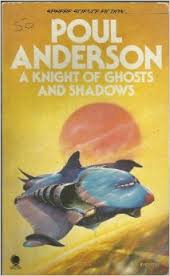
I own two copies of the 436-page paperback Poul Anderson, The Shield Of Time (New York, 1991) (see image). Copy (i) was bought in 1991; (ii) considerably later, although it is another copy of exactly the same edition, published in July of that year.

(i) has a worn cover and very yellowed pages, is held together by sellotape and has just had more sellotape added to pages that had come apart. At one stage of rereading, I thought that (i) was disintegrating. Pages were not only separating but becoming dust.

(ii) was bought because of the state of (i). However, (ii) stays on the shelf whereas (i), still legible, continues to be used for rereading and references. (ii) will be preserved as long as possible. This is the only book for which I have thought it necessary to buy a second copy.

Today, when (i) had been left downstairs but I was upstairs, I took (ii) from the shelf to reread part of Guion's second dialogue with Everard. Undamaged, white pages made this a different reading experience, more appropriate to the content.

Important Individuals

See here.

In absolute terms, every individual human being is important. In practice, some are regarded and treated as more important than others. Sometimes, there is a primus inter pares, a "first among equals."

Guion explains to Manse Everard that some people are important because of the contribution they make but that others may be even more important because of what happens to them. Everard and Wanda Tamberly are important for both reasons. They are highly skilled Patrol operatives and their world-lines appear to impinge on many others.

Guion investigates operatives who are important for the second reason and also "'...anomalous variations in reality.'" (Time Patrol, p. 261) He has almost defined the unpredictable chaos that he is trying to guard against. Most anomalous variations do not affect "'...the structure of the plenum, which we strive to preserve.'" (ibid.) However, if an individual's world-line impinges on many others, then minor changes in his life can change history. Hence, Lorenzo de Conti, whose influence will be counteracted by none other than - Manse Everard and Wanda Tamberly.

The Dreyfus Affair

"'Sometimes, however, individuals have a significance far beyond their ostensible worth...as an illustration of the general principle, take, oh, Alfred Dreyfus. He was a competent and conscientious officer, an asset to France. But it was because of what happened to him that great events came about.'

"Everard scowled. 'Do you mean he was...an instrument of destiny?'

"'You know very well there is no such thing as destiny. There is the structure of the plenum, which we strive to preserve.'"
-Poul Anderson, The Shield Of Time (New York, 1991), pp. 260-261.

Of Dreyfus, I had known only that he was falsely accused, then exonerated. The Wiki article presents a lengthy account, including the involvement of Zola who, I gather, followed Balzac as Anderson and others later followed Heinlein.

Is there no such thing as destiny? Although history seems to be a series of accidents, individuals sometimes discern patterns in their lives. A friend found that, when he strove to build his business and gained new customers, old customers fell away whereas, when he relaxed and let the business tick over, he kept existing customers. He concluded that he was not meant to become rich in this life. My life has reached a happy ending, a comfortable retirement, due to at least four lucky accidents and despite my own best efforts at sabotage. But everyone's life does not work out right so it is impossible to generalize.

Friday, 9 October 2015

"I only work here."

"'Have you gotten any word since your first report?'
"'Yes. I have not passed it on, because it is very incomplete. Better to assemble a coherent picture first, I assume.' As a matter of fact, it was not, but Everard didn't press the point."
-Poul Anderson, The Shield Of Time (New York, 1991), p. 327.

This quotation highlights a few points. First, much of what the Time Patrol does is Intelligence work. Patrolmen gather intelligence not about other countries but about other times or timelines but it is Intelligence work nevertheless. Secondly, work in any large organization requires continual cooperation, coordination and checking of what colleagues are doing, especially when they have moved away from their own original area of expertise. A historian waits for a coherent picture whereas an Intelligence officer welcomes every single datum as soon as he can get it.

After all the training and induction, we still have finite, fallible human beings working with or around but hopefully not against each other. How much bad practice is out there? Think of some of the teachers you endured. I think about some of the teaching and other services that I provided...

A third point is that we can know that someone is wrong but also that it would not be helpful to challenge him about it right away. In a staff meeting, my boss answered a question by saying, "Paul's dealing with that." I wasn't but it would not have been right to contradict him in front of others.

Finally, Everard has the best attitude to work that I have come across:

"The universe isn't for the likes of me to understand. I only work here." (p. 261)

Saturday, 3 October 2015

Nazis And The Draka

"...Hitler hadn't come to power until 1932, not much time to prepare for war, and even then had not dared to squeeze the German people the way the Domination could the rightless chattel who made up nine-tenths of its population. Occupied Europe could have made the difference, if the National Socialists had waited a generation or so, but no, they had to throw for double or nothing...At least the Race knows enough not to bite off more than we can chew. I hope."
-SM Stirling, Under The Yoke (New York, 1989), p. 210.

Is anything worse than Nazis? In fiction at least, yes. I am reading Volume II of SM Stirling's Draka Tetralogy. The self-styled "Race" has not industrialized genocide but only because it has not yet wanted to. Anyone who resists enslavement is killed painfully as a matter of policy. Conquered France is renamed "'...the Province of Burgundia, under the Domination...'" (p. 19)

"...such education as there was in the Domination was in English only; writing in other tongues was forbidden on pain of death." (p. 187)

To write in French or German is a capital offense! Displaced serfs of mixed nationalities will learn English as their lingua franca and French will become a dead language. We are grateful that our history did not take that course. Global warming is a lesser evil.

Apart from the fact that I want to see the Draka overthrown, I do not believe that such a regime can survive indefinitely - but what is to happen in the remaining volumes? In The Shield Of Time, Poul Anderson showed us timelines in which the Industrial Revolution never happened whereas Stirling instead shows us "'...the perfect Industrial Age empire.'" (p. 115)

Thursday, 24 September 2015

Hypothetical Sequels

My ideas for a sequel to The Time Machine are here.

How might Poul Anderson have continued his Time Patrol series? Manse Everard would have had to leave that New York apartment and to move elsewhere/when and his relationship with Wanda Tamberly would have had to go somewhere, possibly towards marriage, as in SM Stirling's "A Slip In Time." (see here.)

Beyond that, each Time Patrol installment has been unique and unpredictable. For present purposes, I will count The Shield Of Time as three installments. Thus, the entire series comprises thirteen installments of two kinds:

those in which the Patrol contends with human villains/time criminals;
those in which the Patrol must address some other kind of problem generated by time travel.

The stories with villains are a minority and maybe develop the idea as far as it will go:

an individual villain (one story);
a collective villain (one story);
a more sophisticated collective villain (three stories).

For readers who enjoy heroic detective work followed by heroes versus villains action, there is plenty of that in these stories. In the remaining eight installments:

Patrol Specialist Keith Denison unintentionally becomes Cyrus the Great;
the Mongols threaten to invade North America;
a Patrol agent saves the life of a colleague who, according to the records, never returned home;
a Patrol agent mistaken for Wodan must betray his followers to preserve history;
a Patrol agent unintentionally inspires a pagan prophetess who will change history unless the Patrol counterintervenes;
a Patrol agent intervenes to help the Beringians;
a medieval man is a personal causal nexus;
an indiscreet Patrolman is arrested by the Knights Templar.

Any fourteenth installment would probably have been of the second kind but there is no way to project either its plot or its historical setting.

Wednesday, 23 September 2015

Everard's Apartment IV


See here.

How often do we see Manse Everard alone in his New York apartment? After returning from the Time Patrol Academy, he must read a dozen newspapers a day to look for indications of unauthorized time travel. What indications? He has been trained to spot them but we are not told what they are. Is unauthorized time travel that common? Or is he being given make-work until he initiates the sequence of events that will cause him to be promoted to Unattached status? He is alone and restless in his apartment when, instead of the newspapers, he reads the "...collection of Victorian and Edwardian stories..." (Time Patrol, p. 18) that does in fact generate his first job.

We learn that the apartment includes a study where a dummy computer conceals Patrol technology that seems to be voice-controlled:

"'Give me the file to present date on Specialist Wanda May Tamberly,' he ordered, adding sufficient information to identify." (The Shield Of Time, p. 177)

This passage presents nearly three pages of Everard alone in the apartment whereas usually when we see him there he is receiving a guest and, when that guest is Carl Farness, Carl narrates so that we cannot before or afterwards see Everard alone. By phone, Everard arranges to meet Wanda in San Francisco at three o'clock the following afternoon. Next day, he works till dusk in the apartment before going to city headquarters to check out a hopper and jump back in time to three o'clock in San Francisco. However, we are not told the nature of the work that kept him in his apartment into the evening.

Tuesday, 22 September 2015

Change

Yet another Time Patrolman surrounds himself with artifacts from previous decades. In Shalten's Paris flat:

"The clutter around him, furniture, hangings, pictures, books, busts, bric-a-brac, declared a solidity that had endured and accumulated since the Congress of Vienna." (The Shield Of Time, p. 119)

-thus for eighty seven years. Yet again, Poul Anderson shows us the quiet before the storm.

The quiet:

"...under trees where green had begun turning yellow and brown, people thronged the sidewalks. Cafes, boutiques, boulangeries, patisseries did lively trade. The noise that rolled in was full of cheer." (ibid.)

The storm:

"Everard tried not to remember that in a dozen years this world would crash to ruin." (ibid.)

The chapter is headed 1902 A. D. Visiting Paris in that year, Everard reflects that:

"...California, 1987...was quite another world, remote as a dream - a nightmare?" (pp. 119-120)

The entire Time Patrol series is about change, even before humanity. The pouring of the Atlantic into the Mediterranean:

"...would move the planet from its Miocene to its Pliocene epoch." (Time Patrol, p. 119)

"...now had begun a hundred years of thunder. When that was done, nothing would ever be the same again." (p. 114)

Sunday, 20 September 2015

An Understated Time War

Poul Anderson's The Corridors Of Time is explicitly about the great time war between the Wardens and the Rangers. However, a potentially even more destructive time war, between the Time Patrol and the Exaltationists, is almost hidden in Anderson's Time Patrol series. (The attached image shows an Exaltationist and a Patrolman.)

The four battles in this second war are to be found in just two of the ten stories in Time Patrol and in just one of the six Parts of The Shield Of Time. The War against the Exaltationists could have filled a volume in its own right although that is hardly necessary.

Three times a squadron of Patrol timecycles attacks an Exaltationist position and three times the leading Exaltationist, Merau Varagan, expounds his views in dialogue with a Patrolman.

Manse Everard almost captures Varagan in Colombia and Peru and does in Phoenicia and at last captures Varagan's clone mate in Bactria. End of Exaltationists but we might not appreciate how long the pursuit has been.

Saturday, 19 September 2015

Wanda Tamberly

OK. What does Wanda do when she is not with Everard? -

- works as a tourist guide in the Galapagos;
is kidnapped by Castelar and fights back;
deduces where/when the Patrol can find Castelar;
completes Patrol training;
studies the Beringian ecology;
intervenes in Beringian pre-history;
investigates the alpha timeline;
rescues Keith Denison;
lures Lorenzo de Conti to a secluded location where Everard can intervene to avert the beta timeline.

Busy weekend ahead. Maybe a rest from posting.

Friday, 18 September 2015

The Bookshop

Poul Anderson, The Shield Of Time (New York, 1991).

Anachronistic hotels (pp. 283, 430) are appropriate meeting places for time travelers and a high quality second hand bookshop (pp. 178-179) in San Francisco is an appropriate front for the Time Patrol. Timecycles can materialize unobserved downstairs and agents can arrange to meet in Nick the proprietor's book-cluttered office. Nick, a small, solemn man with thick glasses, sounds stereotypical.

"Nick was a genuine bibliophile; perhaps his main reason for serving the Patrol in this small but vital capacity was the ability he gained to go questing in other milieus. Some recent acquisitions, Victorian to judge by their appearance..." (p. 179)

But does Nick acquire books in earlier periods to sell them now? Surely not. How would he explain a book that was published a hundred years ago but that still looked new? Presumably, the shop handles genuinely old books but Nick, as a perk of Patrol membership, is able to acquire for his private perusal such books when they were still new. However, this paragraph as I reread it does imply that the recent acquisitions were found in the Victorian milieu and that they might be sold to a collector if Nick does not keep them himself.

Nick just makes it into continuing character status because it is he who has phoned Everard to offer him a new assignment in "Death And The Knight." We feel that the series should have continued beyond this point.

Manse Everard And Wanda Tamberly III

Poul Anderson, The Shield Of Time (New York, 1991).

Dates in heavy type are chapter headings.

In 1987 A.D. (pp. 26-33), Everard explains time travel to Wanda.

In 1988 A.D. (pp. 95-101), he reassures her before she begins Time Patrol training.

In 1925 (p.180), they have dinner in Paris after her graduation and he sees her back to her parents' house in 1988.

In 1990 A.D. (pp. 176-186), she asks him for help with her Beringia assignment.

In 1990 A.D. (pp. 252-255), they meet after her disciplinary hearing.

In 18,244 B.C. I, (pp. 293-299), they finish their vacation at the Pleistocene lodge and agree to meet in "New York HQ, noon, Thursday the tenth of April, 1987..." (p. 297).
 
In 18,244 B.C., (pp. 358-368), they meet back at the lodge after Everard's mission to avert the alpha timeline.
 
In 1989beta (pp. 369-373), they explore the beta timeline with fellow Patrol agent, Karel Novak.
 
In 1137 A.D. (pp. 374-380), they discuss the beta timeline with fellow Patrol agent, Emil Volstrup.
 
In 1146 A.D. I (pp. 414-417), they discuss the personal causal nexus, Lorenzo de Conti, by radio.
 
In 1146 A.D. II (pp. 417-429), they take action to avert the beta timeline.
 
In 1990 A.D. (pp. 430-436), they meet after averting the beta timeline.

In San Francisco, Thursday, 8 March 1990 (Time Patrol, pp. 746-752), they are on vacation.

Reflections On The Twentieth Century

Does a Danellian regard the world in exactly the same way as a late twentieth century American? Of course not. Throughout his works, Poul Anderson successfully presents alternative world views among his characters, particularly in the political novel, Mirkheim.

A Danellian says:

"'...the death, maiming and destruction of the Second World War were evil; so were the new tyrannies it seeded; and yet the breaking of Hitler and his allies was necessary.'" (The Shield Of Time, p. 434)

Was nothing else evil in the world or in the international order? I am confident that there would have been strategic conflict between Eastern and Western powers even if the former had not been tyrannies. Also, of course, democracies and dictatorships can make economic and strategic alliances. Thus, the issue was never as simple as: there are democracies and there are dictatorships so there must be conflict between them. Of course, the Danellian does not exactly say that. Perhaps he tailors his remarks to his audience? His observation is of more general significance than this specific example.

Referring to other relevant fiction, the recent The Man From UNCLE film presents a good fictional explanation of how, despite the Cold War, a Brit (Waverley) wound up commanding a Yank (Solo) and an Ivan (Kuryakin) against common threats (corporate crime and neo-Nazism.)

Thursday, 17 September 2015

Neat Endings

A major difference between real life and fiction is neat endings in the latter. Poul Anderson was particularly good at pulling everything together with a happy ending all round.

"The Bronze Age, the new age was coming."
-Poul Anderson, The Corridors Of Time (St Albans, Herts, 1975), p. 204.

There will be galactic futures in The Boat Of A Million Years and Starfarers and a cosmic future in the Harvest of Stars tetralogy.

Even deaths can be transformed. In The Shield Of Time, Aryuk dies happy because he has driven the invaders from his people's land and the leader of the invaders is happy because his people go to a New World. If Lorenzo de Conti had not died quickly fighting Manse Everard, he would have died slowly of sickness on the Crusade. If Fulk de Buchy, Knight of the Temple, had not died quickly fighting Manse Everard, he would have been tortured and possibly also burned alive by the Inquisition.

Can we see a pattern developing here? It is also possible to write fiction that follows a group of viewpoint characters through their life and work without always showing how each case was closed or issue resolved. I think that one American police procedural did this? A British novel and TV series about Members of Parliament showed Government Ministers waiting in suspense to hear the outcome of a special forces assault on terrorists holding hostages but did not show us the military action. A graphic work about a press photographer in the Marvel Universe showed him covering superhero fights without necessarily knowing who was on which side or what the outcome was. Thus, there is scope for the fiction of life without neat endings and Poul Anderson would also have been able to master that approach.

Wind And Sea

I have referred several times to the pathetic fallacy in Poul Anderson's works. Is it always negative: the sun sets as an empire declines, it rains while someone weeps, war and a storm approach together etc? I have found one ambiguous example:

"'For what you did, be neither arrogant nor guilt-laden; be glad.'
 "The wind cried, the sea growled nearer." (The Shield of Time, p. 434)

Wind and sea are elemental forces, personified in myths. Their crying and growling sound threatening. But Everard and Wanda have just "'...overcome doom itself.'" (p. 435) Thus, there is a threat but they are holding it at bay?

"'Has the universe therefore brought forth sentience, in order to protect and give purpose to its own existence? That is not an answerable question.'" (ibid.)

The question is answerable. Before sentience, nothing occurred "in order to" bring about anything else. There cannot have been purpose before there was purpose. Purpose itself cannot have been a purpose. But now that conscious beings do exist, their purposes can include the protection of existence. And, indeed, the Patrol exists as a stabilizing element.

Free Growth

See here.

After the "proto-series" about Diana Crowfeather, there is one about Roan Tom, a legendary hero or brigand during the post-Imperial "Long Night" period, and another about Daven Laure, a Ranger of the Commonalty.

Hopefully, the galactic spiral-spanning civilization represented by the Commonalty is in "free growth" without any collective "wrong decision" leading to "breakdown." Hopefully, also, the Time Patrol will continue to protect the Danellian timeline from temporal chaos.

The Danellian "rabbi" or "sensei" (see here) says:

"'Perhaps it is not the best course, but we are no gods to impose anything different when we know that it does at last take us beyond what our animal selves could have imagined.'" (The Shield Of Time, p. 435)

There is no "Perhaps..." about it. However, the Danellians are not human beings in "free growth" but super-human beings. I will return to the philosophical implications of the rabbi/sensei's discourse.

Cartels And Chaos

The Polesotechnic League
Nicholas van Rijn's protege, David Falkayn, is a series character in his own right, with one story set before he works for van Rijn's company, another before he meets van Rijn, four about the trader team led by Falkayn and a grand conclusion.

The Terran Empire
Dominic Flandry acquires a protege, his own daughter, Diana Crowfeather, who stars in what I call a "proto-series," i.e., a single work that was potentially the opening installment of a new series.

The Time Patrol
Manse Everard's protege, Wanda Tamberly, becomes a new continuing character in The Shield Of Time.

League, Empire and Patrol each confront their external opponents, most notably:

the Merseian Roidhunate aims to destroy the Terran Empire;
Neldorians and Exaltationists try to change the history guarded by the Time Patrol.

However, civilizations face not only external threats to their continued existence but also internal causes of their own decline. Chunderban Desai tells Dominic Flandry that:

"'...wrong decisions bring breakdown...Technic civilization started on that road when the Polesotechnic League changed from a mutual-aid organization of free entrepreneurs to a set of cartels. Tonight we are far along the way.'"
-Poul Anderson, Sir Dominic Flandry: The Last Knight Of Terra (New York, 2012), pp. 388-389.

We last saw van Rijn and Falkayn trying to hold the League together for a while after the fatal wound inflicted by cartelization. What had seemed to be an external threat had really been engineered by one cartel.

The most fundamental threat to the Patrol is internal not merely to the time-traveling civilization but to the cosmos: quantum chaos changes history unpredictably. We last see Everard and Wanda shortly after they have counteracted one accidental quirk in the temporal flux.