Showing posts with label The Boat Of A Million Years. Show all posts

Friday, 1 April 2016

Multiple Genres

Poul Anderson wrote fantasy, historical fiction, detective fiction, science fiction, non-fiction and poetry, including a perfect haiku in an sf novel. Some of his fantasy and sf has historical settings.

A supernatural or extraterrestrial being should not make its frst appearance on the last page of a historical novel unless the text has built towards such a conclusion. A medieval monk can display detective skills but again should not do so for the first time on the last page. (All such generalizations are vulnerable to a writer doing something original that works.)

History past and future is a single process as Poul Anderson shows in his time travel novels and in The Boat Of A Million Years. Also, history might be not only Terrestrial but also galactic. Anderson's Terran Empire is modeled on the Roman Empire and incorporates remnants of an Ancient interstellar civilization. In Larry Niven's Known Space future history:

Terrestrial human beings are mutated Pak breeder colonists of a former Slaver food planet;
Slaver artifacts and even a live Slaver are retrieved from statis fields;
Jerry Pournelle and SM Stirling add another live Slaver and a tnuctipun rebel;
Anderson adds a tnuctipun weapon comprising an enclosed black hole.

Past and future interact as do sf writers.

Friday, 25 March 2016

Futures Reassess Pasts II

(Roman remains, Lancaster.)

See here.

If we are to understand a fictitious future, then we must understand its, very different, perspective on our present and past. A character in William Morris' News From Nowhere refers to "...those poor wretches of the twentieth century."

Poul Anderson's Time Patrol series has time travelers active throughout history whereas his The Boat Of A Million Years has a small group of immortals surviving through history into an indefinite future. Jerry Pournelle's and SM Stirling's "The Hall of the Mountain King" has "the Brotherhood" surviving through history into the period of the Man-Kzin Wars. We learn that Frederick Barbarossa and Lenin were members who rebelled and were crushed.

I would have appreciated a historical novel by Anderson featuring a character whom the reader recognizes as a time traveler or an immortal but only from having read other works. Historical novels assuming the active presence of the Brotherhood would certainly present a different perspective!

Thursday, 24 March 2016

Futures Reassess Pasts

HG Wells wrote history and future history: An Outline Of History and The Shape Of Things To Come are almost companion titles.

Olaf Stapledon's Last And First Men and Last Men In London are companion volumes. The first is a future history and the second is one Last Man's assessment of past history.

Poul Anderson's The Boat Of A Million Years combines historical sf with future history. As in James Blish's Cities In Flight, future history ceases to be generational when the characters become immortal but centuries continue to elapse nevertheless.

Anderson's Genesis summarizes past history before proceeding into a remote future. And that future restores primordial themes when a member of the new human race, perceiving artificial intelligences as gods and wizards, embarks on a Quest to help one AI against another. Meanwhile, the Terrestrial AI "emulates" (consciously simulates) historical periods and alternative histories.

Anderson's complete works include many historical fictions and fictional futures and several alternative histories.

According to Jerry Pournelle's and SM Stirling's "The Asteroid Queen," Marx, Charlemagne, Hitler and Brennan (the Belter who became a protector) were all members of the same ancient, secret, world-controlling Brotherhood. Not in our timeline! And maybe not in the Known Space timeline either? The Brotherhood suppresses knowledge and propagates:

"...slanted versions of past, present, and future." (Man-Kzin Wars V, p. 26) -

- so maybe it lies to itself about its own past?

Tuesday, 15 March 2016

Alternative Pasts, Presents And Futures

Whereas a future history becomes an alternative history as it recedes into the past, an alternative history becomes a future history if it is extended into the future. Thus, SM Stirling's Protracted Struggle between the Alliance for Democracy and the Domination of the Draka parallels the various UN/US-USSR/Cold War/World War III scenarios that we listed recently. In Stirling's The Stone Dogs, as in James Blish's They Shall Have Stars, Earth becomes a dictatorship but a few political refugees escape from the Solar System.

In fact, various other discontented groups also leave the Solar System in:

Robert Heinlein's Methuselah's Children;
the Breakup period of Poul Anderson's Technic History;
Anderson's Rustum History, The Boat Of A Million Years and Harvest Of Stars;
the Great Exodus period of Jerry Pournelle's CoDominium History.

Stirling's The Peshawar Lancers is an alternative history novel set in 2025 but does not feature space travel because, like Anderson's Maurai History, it recounts recovery from a global disaster.

The Ransom Trilogy, CS Lewis' reply to Wells' and Stapledon's future histories, also addresses the history of the future. Issues concerning the future of mankind on Earth are resolved in Volume III. In Volume II, the future is prophesied. Ten thousand years hence, Maleldil, Malacandra, Tor-Oyarsa-Perelendri and many hnau and eldila will descend, destroy the Moon and liberate Thulcandra (Earth) from its present hidden rulers -

- and you cannot get any more alternative than that.

Thursday, 18 February 2016

Memories

World Without Stars
The Boat Of A Million Years
For Love And Glory
Time Patrol and The Shield of Time

These three novels and one series are all very good hard sf by Poul Anderson. In each, human life-spans are extended indefinitely. The three novels address the problem that indefinitely accumulating memories would overwhelm a finite brain. In The Boat..., each of the immortals must somehow solve this problem for him- or herself whereas, in World... and FLAG, there is a technology that can selectively erase memories.

In FLAG, Torsten Hebo is about nine hundred Terran years old. Thus, he joins the ranks of:

Robert Heinlein's Lazarus Long;
Poul Anderson's Hugh Valland and Hanno;
James Blish's John Amalfi;
Larry Niven's Louis Wu.

Failures of memory put Hebo in a socially embarrassing situation and then nearly get him killed. He will return to Earth for memory editing and thus we, the readers, will see what has become of our home planet in that remote future.

FLAG's fifty four chapters fill only 290 pages so the chapters are short. Chapters I-VII, pp. 11-41, are set on a single planetary surface. In Chapter VIII, the spaceship Dagmar has returned Karl to his home planet, Gargantua, and will return three other beings to their home planet, Xanadu, before returning the human beings to their home planet, Asborg. Conversation on the ship informs us about the politics and economics of Asborg. The chapter ends by telling us that something important awaits Lissa on Asborg but we forget about this as soon as we turn to Chapter IX which begins with Hebo approaching Earth.

And I will now leave blog readers in suspense while I go about other business for a while...

Saturday, 30 January 2016

China

Tomorrow, Lancaster will celebrate Chinese New Year, complete with street procession and dancing dragon. It is good to live in a multicultural society.

China is a big country that maybe does not get a lot of attention in Poul Anderson's works?

In "How To Be Ethnic In One Easy Lesson," the large quadrupedal alien, Adzel, performs the Chinese dragon in street parades while he is a student on Earth.

In The Broken Sword, the supernatural beings of different national traditions coexist and (I think that) Chinese beings are mentioned.

In Rogue Sword, Lucas has returned from Cathay.

China is more civilized than Europe here.

In The Boat Of A Million Years, one of the immortals is Chinese. See here. Thus, his introductory chapter is set in China.

In "SOS," Pitar Cheng leads a Great Asian space fleet.

Finally, not to ignore our ever-growing food thread, in exchange for his dragon performances, Adzel:

"...has an unlimited meal ticket at the Silver Dragon Chinese Food and Chop Suey Palace."
-Poul Anderson, "How To Be Ethnic In One Easy Lesson" IN Anderson, The Technic Civilization Saga: The Van Rijn Method, compiled by Hank Davis (Riverdale, NY, 2009), pp. 175-197 AT p. 195.

What have I missed? (See comments.)

Thursday, 7 January 2016

Alternative Answers To Key Questions

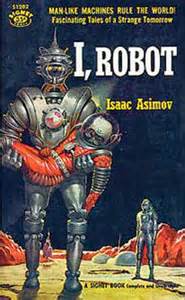
Isaac Asimov wrote the collection, I, Robot. Effectively, Poul Anderson replied with one story, "Quixote and the Windmill": the first unspecialized robot is unemployed; therefore, there is no need for a second robot - or for a sequel.

Robert Heinlein's Methuselah's Children and James Blish's They Shall Have Stars are about the search for immortality. Effectively, Anderson replied with "What Shall It Profit?": immortality, possible only by shielding from all radiation far underground, is a dead end. In this case, there is an implied need for a sequel because the story ends with the Director of the Institute for Human Biology asking:

"'What are we going to do?'" (Cold Victory, p. 223)

We can only infer that the Institute is destroyed and its discoveries lost during the ensuing Second Dark Ages. Later, Anderson presented different accounts of immortality in World Without Stars and The Boat Of A Million Years.

Asimov's Foundation Series is about a science of society whereas Heinlein's Orphans Of The Sky is about a multi-generation interstellar spaceship. In Anderson's "The Troublemakers," a science of society is applied to the crew of a generation ship. Psychotechnicians manipulate mutinous motivations, thus preventing the kind of breakdown that made Heinlein's Vanguard crew forget the universe outside their large spinning spaceship.

These are the Campbell future historians: Heinlein, Asimov, Blish and Anderson.

Friday, 4 September 2015

Longevity And Memory

(i) In Poul Anderson's The Boat Of A Million Years, mutant immortals must find within themselves an inner discipline to stave off insanity caused by endlessly accumulating memories.

(ii) In Anderson's World Without Stars, immortal beneficiaries of an antithanatic regularly have their memories artificially edited. Thus, at any one time, an immortal retains the general pattern of his identity and a single lifetime's worth of memories but nothing more. This may be why they write journals.

(iii) In Anderson's Time Patrol series, Time Patrol agents have anti-senescence treatment and can also have selected memories erased:

"When this hunt ended...the Patrolman would be almost sorry to have those trills and purrs [of the Exaltationists' language] scrubbed from his brain." (The Shield Of Time, p. 83)

"Eventually, when they had no further use for the knowledge, it would be wiped from them to make room for something else." (p. 203)

In both these cases, the reference is to linguistic knowledge that has been artificially implanted in the first place. Nevertheless, if some memories can be erased, then why not others? Thus, the Time Patrol might have the same solution to the problem of accumulating memories as one set of Anderson's immortals, which would make their perception of time even weirder.

Monday, 18 May 2015

Changing Gods

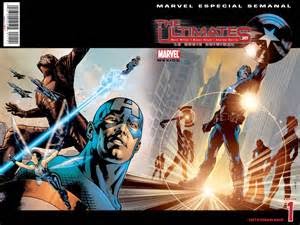
Last night, for a change from Latin verse or American English prose, I reread parts of the graphic work, The Ultimates by Mark Millar and Bryan Hitch, a superior version of the Marvel Comics superhero team, the Avengers. Of course, I found a parallel with Poul Anderson: the Ultimates include Thor.

However, this is a New Age Thor who defends anti-war demonstrators against the police and calls the US a new Roman Empire! The reference to the Roman Empire is a second parallel. But is the Ultimates Thor inauthentic? He is certainly un-Eddaic but, as I pointed out here, our gods have grown up with us. Poul Anderson, of course, shows us the process in "Star of the Sea." See in particular "The Evolving Goddess," and "Anses And Wanes."

Addendum: For authentic comic strip adaptations of Odin and Thor, see Neil Gaiman's The Sandman: Season Of Mists.

Wednesday, 6 May 2015

"Bid Time Return"

Years ago, a British astronomer told me that any time gained from time dilation on an outward journey would be repaid on the return journey so that there would be no difference at the end of a round trip. However:

How does the universe know the difference between an outward and a return journey?

If the equations entail his conclusion, then why does anyone think otherwise?

This is where Poul Anderson fans would benefit from a scientific education. But there must be blog readers out there with informed opinions on this matter? The astronomer's view would not affect works, like Tau Zero or The Boat Of A Million Years, in which there is no return journey but would invalidate the Rustum and Kith Histories and "Time Lag" - although, on the other hand, all hard sf reflects the scientific understanding of the time when it was written.

Regular readers might have noticed that this blog averaged eight posts per day for the first five days of May. This rate of productivity cannot possibly be sustained. I happened to be rereading The Boat Of A Million Years which is long and full of condensed information so that post followed post very easily. We have now returned to a more sedate pace.

Living Through History

When I first saw the Time Chart in Robert Heinlein's The Man Who Sold the Moon, I noticed that one character's life extended throughout the entire History from before its beginning until after its end. That seemed odd, especially since no explanation was given in this opening volume of the Future History.

That long-lived character came on-stage three volumes later in Methusaleh's Children, which is effectively the culminating volume of the History. (Orphans Of The Sky is a short appendix about events elsewhere that does not advance the History. Time Enough For Love and any subsequent volumes are not to me acceptable continuations of the History.)

Heinlein missed a trick. We learn that, like other Howards, Woodrow Wilson Smith/Lazarus Long had used many aliases during his extended lifetime. One or two of these aliases could have been used for spear-carrying characters in earlier installments. We know that Lazarus was present throughout the entire History but it would be good to catch glimpses of him on rereading.

Poul Anderson's equivalent character is Hanno in The Boat Of A Million Years. Already over six hundred years old when the novel begins in 310 BC, he is not on-stage in every chapter but is still alive and active when the novel ends many centuries in our future. In fact, he aims for another million years plus. Hanno and the seven other Survivors have somehow mastered the potentially debilitating accumulation of memory and are able to maintain their sense of personal identity and continuity throughout the millennia. Another approach for a novelist would be to show a character who, although alive a million years later, did not remember anything from his earliest centuries and therefore was effectively a new character.

In Anderson's Starfarers, the crew of the Envoy are alive but absent throughout the future history because they are traveling to or returning from a remote destination and undergoing time dilation. There is a monument to them as though they were dead although it is known that they will return...

Anderson's Manse Everard of the Time Patrol is present throughout history not because he lives through it but because he time travels backwards and forwards. Immortals, time travelers and time dilated space travelers have a certain amount in common.

Tuesday, 5 May 2015

Back To Starfarers

What prompted me to reread Poul Anderson's The Boat Of A Million Years in such depth? However, it was worthwhile. So many details in such a dense text are too easily forgotten, especially when some important information is imparted just once in dialogue. Boat is like a summary of fifty novels. Chapter XIX alone presents:

the technology and economics of the civilization on Earth and in the Solar System;

the eight immortals, now called "Survivors," at last working together as a team;

how their interstellar ramjet works;

their virtual reality experiences;

the inhabited planet that they visit;

the spacefarers with their rendezvous points;

AI's congregating at the mysterious places of the galaxy;

the usual fate of high tech cultures;

the new civilization that the Survivors, helped by the Alloi, will build.

I now return to the interrupted rereading of Starfarers, which also features a small group making an STL interstellar crossing but the two scenarios could not be more different. Starfarers has already given me some idea of how creation works. See also here. The actualization of the potential - we used to discuss this in Hegelian philosophy.

Episodic Fiction

Poul Anderson, The Boat Of A Million Years (London, 1991).

Golden Age sf began as magazine stories, series and serials before being republished in books. Depending on its content, such a book could be classed as a collection, as a collected series or as a novel, although the "novel," when analyzed, could turn out to be composite. Thus, Poul Anderson's The Star Fox is not simply a single novel but is more accurately the collected and edited three-part Gunnar Heim series, or maybe serial.

Anderson's much later The Boat Of A Million Years is a long novel but constructed on the original model although, in this case, only one of its chapters had previously been published in Analog. The work could first have been presented as a series, or serial, before being collected as a past-present-future trilogy.

Instead, the public was presented with a single long volume encompassing an amazing breadth of content. Two readers known to me expressed dissatisfaction with the concluding futuristic chapter. They had enjoyed the historical fiction of the earlier chapters and regarded the unexpected futuristic sf as discordant whereas I have found Chapter XIX to be packed with content as I hope that recent posts have demonstrated.

The reader needs to appreciate this work for what it is, effectively a long series beginning on Earth in 310 BC but ending in space in an indefinite future. Each chapter needs to be read, and in some cases carefully reread, not dismissed because it differs from what went before. The entire work is about living with change.

Explanations

Poul Anderson, The Boat Of A Million Years (London, 1991).

Sometimes a work of science fiction ends by explaining why the world remains unchanged despite a fictional invention or discovery.

Thus:

time travel has not been confirmed because the Time Traveler never returned;

there is no interplanetary travel because Cavor remained on the Moon and the Cavorite sphere was lost;

the Mongols did not conquer North America because the Time Patrol prevented them;

Boat presents an excellent example -

"There is simply a radius, on the order of a light-century or two, beyond which it is unprofitable to search farther. Having foreseen this, you have never built self-multiplying von Neumann machines." (p. 596)

So, yes, there are extrasolar intelligences but, no, no robotic explorers from their civilizations have ever entered the Solar System. Starfarers, to which I will return shortly, describes von Neumanns mutating and thus never completing their missions.

AI II

Poul Anderson, The Boat Of A Million Years (London, 1991).

Usually, STL interstellar travel is unsuitable/inappropriate/impractical/expensive/unprofitable/inadvisable for organic beings. Robot probes are sent until the data that they transmit becomes overwhelming or its time lag becomes too great. Robots meet other robots at black holes, galactic center etc. Back home, AI absorbs most of its creators because it has become their superior.

"When the original thinking animals live on, as happens occasionally, it is because they too have turned their concerns elsewhere, inward, searching for joys and fulfillments or possibly imaginary enlightenments toward which no machine can aid them, realms quite outside the universe of the stars." (p. 597)

I disagree with the quoted paragraph. Some people can stay physically at home in the Solar System yet study the cosmos as they do at present. At any rate, in Boat, the Alloi, the Survivors and the handful of other spaceship crews are:

"'...left-overs, malcontents, atavisms, outcasts." (p. 598)

- and thus are a new stage of evolution. See the previous post.

AI

Poul Anderson, The Boat Of A Million Years (London, 1991).

Boat introduces the theme of human-AI interaction which Anderson developed further later.

The Boat Of A Million Years, Chapter XIX, section 33, is about organic-AI coexistence.

The Harvest of Stars Tetralogy is about organic-AI conflict.

Genesis, Part Two, is about conflict between post-organic AI's when one such AI re-creates organic intelligences.

In Boat:

"'...the advanced, independent robots are no threat to us.'" (p. 597)

Organics explore space and colonize new planets while AI's develop mathematics and aesthetics. Yet the Harvest AI's regard the mere existence of unpredictably active organic intelligences as a threat to their ideal of cosmic order. This perceived conflict is not only unnecessary but also maybe somewhat implausible?

In Boat, the Alloi value humanity and will accompany the Survivors to the Earth-like planet that they plan to colonize, thus ensuring their success. When the new planet is populated, there will be more space travel. In most high-tech civilizations, organics are eventually integrated into AI but a few races remain organic and continue to explore.

Hanno speculates:

fish that were not doing well in water crawled onto land - or at least, I would say, learned to survive when tidally stranded;

reptiles' ancestors were forced out of amphibians' swamps;

birds were forced into the air;

mammals found niches away from the dinosaurs;

some apes were forced out of the trees;

Phoenicians, holding only a thin strip of land, took to the sea;

European outcasts went to America or Australia;

the Survivors were no longer at home on Earth.

However, it seems strange for an Anderson hero to acknowledge that he is of a line of descent that could not compete.

Death At Sea

Poul Anderson, The Boat Of A Million Years (London, 1991).

We think that Dominic Flandry of the Terran Space Navy is going to die in space near the end of A Stone In Heaven and that Hanno, the immortal Phoenician sailor, is going to die in a storm at sea on another planet near the end of A Boat Of A Million Years. However, we are surprised and relieved when both Flandry and Hanno are rescued.

 In Flandry's period, human beings have colonized many extrasolar planets whereas Hanno thinks:

"If the stars held no New America, they offered what was infinitely more." (p. 587)

- new experiences and knowledge.

"The universe held as many surprises as it did stars. No more. That was its glory. But someday one of them was bound to kill you." (p. 589)

Hanno hopes to live for another million years but knows that he will not live forever - and his death might wait in a sea on yet another planet.

Addendum: Should "No more" above read "No, more"? (There are some typos in my edition of Boat.)

Non-Humanoid Aliens

Poul Anderson, The Boat Of A Million Years (London, 1991).

Although Poul Anderson's sf contains many humanoid aliens, it also presents several non-humanoid species. The Alloi have two arms and two legs but there the resemblance ends. Instead of a body, Anderson describes a green stalk supported by two thin flexible limbs with bifurcated digits. The upper limbs fork dendritically. Two wings or membranes have a span equal to the height.

The hair-like smallest fingers cling by molecular wringing and are many times tactilely richer than human fingers. The wings regulate body temperature, excrete gaseous waste and sense, e.g., light. Their light-sensitive organs are simpler but more numerous and diverse than eyes. There is no single equivalent of a brain.

The trisexual Ithagene have four-legged, headless barrel bodies covered by large scales that lift for fluid intake, excretion and sensing with, at the top, four retractable eye-stalks and four tentacles each with four digits stiffenable by turgor. On the assumption that the Ithagene would find a pink, scaleless body repulsive, the Survivors never appear naked in front of them.

There is no conflict between either of these races and human beings.

Monday, 4 May 2015

At Tritos II

Poul Anderson, The Boat Of A Million Years (London, 1991).

"Some cosmic accident must have caused..." the eccentric orbit of the Xenogaian moon (p. 554). How many cosmic accidents and eccentric orbits are there in Anderson's hard sf? For some, see here.

The Allosan mother ship, orbiting well beyond the moon, has a living interior. Hanno and Yukiko reside there long term as guests of the Alloi for study and exploration. The Alloi preserve a simulated vista of a planet with rainbow rings where they left colonists. Meanwhile, the other six Survivors build the settlement of Hestia on Xenogaia where they farm, explore, start families and interact with the Ithagene, exchanging objects and ideas. Each of these posts reads as if it summarizes an entire novel.

Anderson uses the word, "'...the sapients...,'" for intelligent beings on p. 562 and "'...sapience...'" for intelligence on p. 577 but also reverts to "'...the sentients...'" for intelligent beings on p. 577.

To catch up with more of Anderson's rich vocabulary, we find:

malapert on p. 550;
calyx on p. 569;
coralline on p. 578.

Both Hanno and Yukiko have "...an intuition that often overleaped jumbled, fragmentary data to reach a scheme that gave meaning." (p. 557)

Anderson lists earlier individuals who had gone straight to inexplicably explanatory and predictive insights:

Newton
Planck
Einstein
Darwin
de Vries
Oparin
"perhaps," Gautama Buddha (p. 557)

I have linked the two names with which I was unfamiliar.

At Tritos

Poul Anderson, The Boat of A Million Years (London, 1991).

The Survivors must invent some new terminology:

Star Three becomes "Tritos;"
its inhabited second planet is "Xenogaia;"
the beings who have traveled to Tritos are "the Alloi" (singular: Allos; adjective: "Allosan");
the star in Pegasus from which the Alloi came is "Pegasi;"
native Xenogaians are "Ithagene."

The Alloi have not colonized the Tritos system but are merely exploring it and will soon go elsewhere. Alloi and Ithagene are non-humanoid, as are a third race one of whose ships has signaled that it will travel to Tritos after spending a few years at "'...the closest rendezvous, 147 light-years yonder.'" (p. 573)

In Poul Anderson's The Peregrine (New York, 1979), Rendezvous is the name of "...a planet beyond the edge of the known..." (p. 1), used as a meeting place by the human interstellar traders called Nomads. In Boat, rendezvous's are stations orbiting certain stars, to which space explorers of different species report their discoveries. Each such station relays information to the others. Thus, "'...nodes of knowledge grow...'" (p. 574) (not AI "nodes," as in Anderson's Genesis). The Alloi have made a transmitter orbiting Tritos. Since, before the Survivors' departure, the Solar System had an orbiting receiver called the Web, humanity might, when it receives broadcasts from Tritos, join the interstellar community.

Unlike the Survivors, the Alloi and the approaching race do not boost continuously between stars, thus saving anti-matter and gaining hull size although losing some time dilation. They have not been detected from Sol because their few ships emit radiation only briefly at the beginning and end of a voyage. Each Allos lives for at least thirty thousand years. They left Pegasi fifteen thousand years ago and know of explorations that had been going on in different directions for one and a half million years.

One Allos speculates that impatient and hasty human beings might traverse and unite the galaxy in less than a million years. His reference to "'...this tiny segment of the galaxy that we have reached...'" (p. 576) remind us of similar phrases in Anderson's History of Technic Civilization although the characters in that series have FTL.