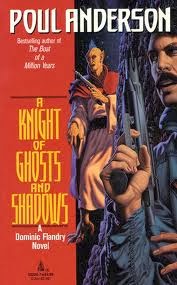
Poul Anderson wrote fantasy, historical fiction, detective fiction, science fiction, non-fiction and poetry, including a perfect haiku in an sf novel. Some of his fantasy and sf has historical settings.
A supernatural or extraterrestrial being should not make its frst appearance on the last page of a historical novel unless the text has built towards such a conclusion. A medieval monk can display detective skills but again should not do so for the first time on the last page. (All such generalizations are vulnerable to a writer doing something original that works.)
History past and future is a single process as Poul Anderson shows in his time travel novels and in The Boat Of A Million Years. Also, history might be not only Terrestrial but also galactic. Anderson's Terran Empire is modeled on the Roman Empire and incorporates remnants of an Ancient interstellar civilization. In Larry Niven's Known Space future history:
Terrestrial human beings are mutated Pak breeder colonists of a former Slaver food planet;
Slaver artifacts and even a live Slaver are retrieved from statis fields;
Jerry Pournelle and SM Stirling add another live Slaver and a tnuctipun rebel;
Anderson adds a tnuctipun weapon comprising an enclosed black hole.
Past and future interact as do sf writers.
Showing posts with label The Terran Empire. Show all posts
Friday, 1 April 2016
Thursday, 10 March 2016
Singhs In Space
It is easy to increase our knowledge of a fictional world. The author needs only to write something new. Anderson's last novel to feature Dominic Flandry reveals for the first time the prior existence of two communities, the Dakotians and the Zacharians, and also tells us how earlier events in the Technic History had affected a man named Magnusson. Thus, earlier history is recapitulated and re-presented from a different perspective.
So far, I had found only three religions in Jerry Pournelle's Second Empire of Man. However, nowhere in the texts was it stated that there were only three religions and the sudden appearance of a man named Singh raises the possibility that this history also incorporates Sikhs. But not necessarily: googling the surname (here) reveals that it is not after all exclusive to Sikhs. Thus, although Pournelle has raised a possibility, he remains free to develop the hint in any direction he wants. (He probably does not intend to pursue the issue of Singhs but you never know!)
Tuesday, 8 March 2016
Diversity
In Poul Anderson's Terran Empire, we expect - and find - immense diversity of religious traditions. Of course, this is helped by diversity of intelligent species. Some human members of Avalonian choths even practice the Ythrian Old Faith.
Jerry Pournelle's Second Empire of Man seems lass diverse. So far, I have found only Catholicism, Islam and (new) Himmism. Of course, this timeline so far has only one nonhuman intelligent species, not discovered until 3017. In fact, it was an effect of Motie technology that indirectly caused the founding of the Church of Him.
Protestantism seems to have disappeared. Churches separated for centuries have few doctrinal disagreements. When McKinnie installs a missionary Bishop in the Temple on Makassar, the Bishop styles himself "...His Ultimate Holiness, Primate of all Makassar, Vicar of Christ, and Archbishop of New Rome." (King David's Spaceship, p. 224) Surely those last two titles apply exclusively to His Holiness of New Rome?
The Bishop would say, and I think somewhere does say, that he has come for the good of men's souls. Many would respond simply that they believe neither in souls nor in any other supernatural entities such as a deity. So far, I agree with them. However, I also think that any society benefits from access to teachings about the value of reflection on mental states and motivations. This need not be linked to belief in the literal existence of supernatural beings although such beings remain central to much mythology, art, literature and fiction. I would not join the Bishop's flock but would welcome debate with him.
Jerry Pournelle's Second Empire of Man seems lass diverse. So far, I have found only Catholicism, Islam and (new) Himmism. Of course, this timeline so far has only one nonhuman intelligent species, not discovered until 3017. In fact, it was an effect of Motie technology that indirectly caused the founding of the Church of Him.
Protestantism seems to have disappeared. Churches separated for centuries have few doctrinal disagreements. When McKinnie installs a missionary Bishop in the Temple on Makassar, the Bishop styles himself "...His Ultimate Holiness, Primate of all Makassar, Vicar of Christ, and Archbishop of New Rome." (King David's Spaceship, p. 224) Surely those last two titles apply exclusively to His Holiness of New Rome?
The Bishop would say, and I think somewhere does say, that he has come for the good of men's souls. Many would respond simply that they believe neither in souls nor in any other supernatural entities such as a deity. So far, I agree with them. However, I also think that any society benefits from access to teachings about the value of reflection on mental states and motivations. This need not be linked to belief in the literal existence of supernatural beings although such beings remain central to much mythology, art, literature and fiction. I would not join the Bishop's flock but would welcome debate with him.
Wednesday, 16 December 2015
The Psychotechnic History II
See The Psychotechnic History. In Poul Anderson's Psychotechnic History, clones (not yet called that) are grown exogenetically, not in a host mother.
On reflection, this History should definitely be collected in two omnibus volumes:
Vol I, THE SOLAR UNION - the entire contents of The Psychotechnic League and Cold Victory plus The Snows Of Ganymede;
Vol II, THE STELLAR UNION - the entire contents of Starship plus "The Acolytes," "The Green Thumb," the longer version of "Virgin Planet" and The Peregrine but maybe minus "The Chapter Ends."
For comparison, the first three omnibus volumes of the Technic History should be:
RISE OF THE POLESOTECHNIC LEAGUE;
DECLINE OF THE POLESOTECHNIC LEAGUE;
RISE OF THE TERRAN EMPIRE -
- and we know that the political framework of the League is the Solar Commonwealth. Thus, in Anderson's first future history, the Solar Union is succeeded by the Stellar Union whereas, in his second, the Solar Commonwealth is succeeded by the (interstellar) Terran Empire.
Recently, when I began to reread this future history, I became entirely focused on the future historical content of its opening three stories:
Etienne Fourre;
Stefan Rostomily;
political gangsterism;
the protean enemy;
the Pacific Colony;
the three class education system.
However, this post-World War III period is dwarfed by the much vaster context of two Dark Ages and two periods of interstellar civilization. The Un-man, Naysmith, flies his air boat to the Rockies; the Stellar Union Coordination Service field agent (Cordy), Trevelyan, flies his air car to that same mountain range but over a thousand years later in a different civilization facing different problems.
Naysmith identified the UN's protean enemy as man himself. This "enemy" destroys the Solar Union. Trevelyan, psychologically integrated, instead confronts the external problem of cosmic complexity overwhelming any cerebral or computational attempt to coordinate it. This problem destroys the Stellar Union.
Tuesday, 18 August 2015
Servi, Serfs And Servants
In Poul Anderson's History of Technic Civilization, we find a Terran Empire based on the Roman Empire, even including the restoration of slavery and occasional use of Latin phrases.
In SM Stirling's Draka History, we find a small militarized society reviving Classical military terminology, e.g., "Centurion," and dominating a much larger population of serfs differing only in name from slaves (Latin: servi). The status of the Draka's serfs is approximately that of slaves:
"...under Roman law: pro nullis, pro mortis, pro quadrupedis: 'as nothing, as one who is dead, like a beast.'" (Marching Through Georgia, p. 407)
They were called indentured servants or "bondservants" until the colloquial term "serfs" was legalized in the 1880s.
it is remarkable that, in our timeline, a single word-root has survived essentially unchanged through three historical eras:
Roman servi, property;
feudal serfs, tied to the land;
modern servants, wage-earning workers.
Economic systems change but language preserves history.
In SM Stirling's Draka History, we find a small militarized society reviving Classical military terminology, e.g., "Centurion," and dominating a much larger population of serfs differing only in name from slaves (Latin: servi). The status of the Draka's serfs is approximately that of slaves:
"...under Roman law: pro nullis, pro mortis, pro quadrupedis: 'as nothing, as one who is dead, like a beast.'" (Marching Through Georgia, p. 407)
They were called indentured servants or "bondservants" until the colloquial term "serfs" was legalized in the 1880s.
it is remarkable that, in our timeline, a single word-root has survived essentially unchanged through three historical eras:
Roman servi, property;
feudal serfs, tied to the land;
modern servants, wage-earning workers.
Economic systems change but language preserves history.
Friday, 24 July 2015
Aristocracy And Humanity
Rome was a monarchy, then a republic, then an Empire. The world still contains monarchies, republics and accusations of imperialism. Poul Anderson presents a future Terran Empire modeled on the Roman Empire. SM Stirling presents a New British Empire in an alternative timeline where:
"The physician stared in appalled wonder at the work ahead of him, then darted forward, ignoring the King-Emperor for the more seriously wounded behind him and calling for his assistants and their supplies.
"Charles glanced after him. 'I like that chap's priorities,' he said."
-SM Stirling, The Peshawar Lancers (New York, 2003), p. 454.
Charles is the King-Emperor. I also like the MO's priorities. In Britain today, if a Duke and his valet are trapped inside a burning building, then, to the Fire Brigade, they are two living bodies, both to be rescued as quickly as possible. Physical danger removes the distinction between nobility and commoners. It is good to see a King-Emperor who knows that, when others are in greater need of medical treatment, his rank counts for nothing.
Civilization can, of course, be reorganized without such ranks. But, as long as the ranks exist, they must be recognized as social conventions and nothing more.
"The physician stared in appalled wonder at the work ahead of him, then darted forward, ignoring the King-Emperor for the more seriously wounded behind him and calling for his assistants and their supplies.
"Charles glanced after him. 'I like that chap's priorities,' he said."
-SM Stirling, The Peshawar Lancers (New York, 2003), p. 454.
Charles is the King-Emperor. I also like the MO's priorities. In Britain today, if a Duke and his valet are trapped inside a burning building, then, to the Fire Brigade, they are two living bodies, both to be rescued as quickly as possible. Physical danger removes the distinction between nobility and commoners. It is good to see a King-Emperor who knows that, when others are in greater need of medical treatment, his rank counts for nothing.
Civilization can, of course, be reorganized without such ranks. But, as long as the ranks exist, they must be recognized as social conventions and nothing more.
Tuesday, 21 July 2015
Barfi And Samosas
Fiction and life interact. Today, Lancaster Muslims, celebrating the end of Ramadan, shared food with their Christian, Buddhist, Wiccan or secularist neighbors. Some years, it is plates of curry; this time, a box of barfi.
In SM Stirling's The Peshawar Lancers (New York, 2003), the diplomat, Henri, enjoys "...the spicy deep-fried vegetables..." (p. 220) of a samosa while really wanting what he, a Frenchman (not an Englishman!), regards as a real breakfast.
Samosas have become the staple diet at multi-faith meetings. At one such gathering in County Hall, a large plate at the end of a long table held a tall pile of samosas but a longer queue stretched around the table so I did not get one. On a more spiritual level, our local Cathedral hosted a ceremony at which we heard readings from the Veda, the Torah, the Fourth Gospel and the Koran.
I hope that we in this generation can approach the pluralism to be found in SM Stirling's Angrezi Raj and in Poul Anderson's Terran Empire.
Addendum: For references to local places of worship, see post and comments here.
In SM Stirling's The Peshawar Lancers (New York, 2003), the diplomat, Henri, enjoys "...the spicy deep-fried vegetables..." (p. 220) of a samosa while really wanting what he, a Frenchman (not an Englishman!), regards as a real breakfast.
Samosas have become the staple diet at multi-faith meetings. At one such gathering in County Hall, a large plate at the end of a long table held a tall pile of samosas but a longer queue stretched around the table so I did not get one. On a more spiritual level, our local Cathedral hosted a ceremony at which we heard readings from the Veda, the Torah, the Fourth Gospel and the Koran.
I hope that we in this generation can approach the pluralism to be found in SM Stirling's Angrezi Raj and in Poul Anderson's Terran Empire.
Addendum: For references to local places of worship, see post and comments here.
Saturday, 27 June 2015
Other Planets
Apart from Earth, what other planets are important in Flandry's time?
Merseia
Ythri
Aeneas
Dido
Ifri
Llynathawr
Shalmu
Hermes
Gorrazan
Starkad
Daedalus
Imhotep
Freehold
Alfzar
Irumclaw
Jupiter
Vixen
It is a trip to revisit the Terran Empire period of Poul Anderson's History of Technic Civilization. The seventeen planets listed represent no less than six different interstellar realms:
the Terran Empire
the Merseian Roidhunate
the Domain of Ythri
the Betelgeusean empire
the Gorrazanian remnant
the Dispersal of Ymir
I am pleased to find that the blogs already contain at least some information on each of the listed planets.
I will close June with this 105th post unless I can draft 5 or preferably 10 more before the end of Tuesday. SM Stirling's Conquistadors has arrived but I am also rereading Swamp Thing.
Addenda (in response to comment):
Scotha
Dennitza
Chereion
Talwin
Nyanza
Brae
Kraken
Ramnu
Altai
Diomedes
Merseia
Ythri
Aeneas
Dido
Ifri
Llynathawr
Shalmu
Hermes
Gorrazan
Starkad
Daedalus
Imhotep
Freehold
Alfzar
Irumclaw
Jupiter
Vixen
It is a trip to revisit the Terran Empire period of Poul Anderson's History of Technic Civilization. The seventeen planets listed represent no less than six different interstellar realms:
the Terran Empire
the Merseian Roidhunate
the Domain of Ythri
the Betelgeusean empire
the Gorrazanian remnant
the Dispersal of Ymir
I am pleased to find that the blogs already contain at least some information on each of the listed planets.
I will close June with this 105th post unless I can draft 5 or preferably 10 more before the end of Tuesday. SM Stirling's Conquistadors has arrived but I am also rereading Swamp Thing.
Addenda (in response to comment):
Scotha
Dennitza
Chereion
Talwin
Nyanza
Brae
Kraken
Ramnu
Altai
Diomedes
Sunday, 17 May 2015
The Roman Tradition
The Aeneid, with which I currently struggle, is the epic of the Roman myth. As such, it explains the wars between Rome and Carthage as originating in the personal conflict between Aeneas and Dido. (Not trade rivalry but mythical founders explain everything.)
Thus, the Aeneid is variously relevant to Poul Anderson's works:
the originals of Odin and Thor escaped from Roman slavery;
the Time Patrol ensured Roman victory against Carthage, kept Germania in the Empire despite the pagan prophetess preaching the destruction of Rome and prevented a post-Roman-British-European world civilization;
the last King of Ys was a Roman centurion;
Manuel Argos based his Terran Empire on the Roman Empire.
Thus, Anderson's antecedents are considerably older than Wells, Stapledon or Heinlein.
Have I said that I detect parallels between Classical and Biblical traditions?
Homer and the poets, like Moses and the prophets, were regarded as divinely inspired authorities on theology and morality;
Greek "philo-sophia" is love of wisdom and the Hebrew Writings include Wisdom literature;
Virgil's poetry of the Augustan Age is like a pagan New Testament;
the Fourth Gospel identifies Jesus with the Word that was in the Beginning, an idea adapted from Greek philosophy, while Virgil's Aeneid has Caesar's soul in Hades waiting to be born long before the founding of Rome;
the promise to Abraham and the promise of everlasting Roman greatness are fulfilled in a single church - if you see it that way, of course! (And Anderson appropriately speculates on the future of that church.)
Thus, the Aeneid is variously relevant to Poul Anderson's works:
the originals of Odin and Thor escaped from Roman slavery;
the Time Patrol ensured Roman victory against Carthage, kept Germania in the Empire despite the pagan prophetess preaching the destruction of Rome and prevented a post-Roman-British-European world civilization;
the last King of Ys was a Roman centurion;
Manuel Argos based his Terran Empire on the Roman Empire.
Thus, Anderson's antecedents are considerably older than Wells, Stapledon or Heinlein.
Have I said that I detect parallels between Classical and Biblical traditions?
Homer and the poets, like Moses and the prophets, were regarded as divinely inspired authorities on theology and morality;
Greek "philo-sophia" is love of wisdom and the Hebrew Writings include Wisdom literature;
Virgil's poetry of the Augustan Age is like a pagan New Testament;
the Fourth Gospel identifies Jesus with the Word that was in the Beginning, an idea adapted from Greek philosophy, while Virgil's Aeneid has Caesar's soul in Hades waiting to be born long before the founding of Rome;
the promise to Abraham and the promise of everlasting Roman greatness are fulfilled in a single church - if you see it that way, of course! (And Anderson appropriately speculates on the future of that church.)
Friday, 27 March 2015
Terrans, Venusians And Spoilers
SM Stirling, The Sky People (New York, 2006).
Terrans meet Venusians. (My computer recognizes neither of those nouns.) I would prefer to write that Earthmen or Terrestrials meet Venerians but must quote the terminology used in the particular text that I am reading. (My computer recognizes neither "Earthmen" nor "Venerians.")
"Terran" is a piece of jargon exclusive to sf (I think?) although Poul Anderson invested it with considerable authority by writing about a Terran Empire. However, his "Terran" is a translation from Anglic and can equally be rendered as "Terrestrial." Further, his Empire began as a conventional setting for pulp space opera but became instead the subject of serious speculation about the decline of civilizations. See here. Thus, Anderson transformed the Terran Empire - just as Alan Moore changed the Swamp Thing from a conventional monster to a plant elemental and also changed Marvelman from a conventional superhero to a Nietzschean Messiah. Creative writers transform received ideas, either avoiding cliches or changing them into their opposites.
"Venusian" is like "Marsian" or "Jupiterian," not taking into account the Latin roots; Vener-, Mart-, Jov-. (Although I critique some of Stirling's terminological usages, his contributions to alternative history fiction are highly original, as I hope these posts show.)
I post as I read, taking us well into Spoiler Alert territory.
(i) Excruciatingly Etonian Christopher turns out to be French spy, Christophe. (We can usually rely on humanity to export its imperialisms.)
(ii) We are told that there are Martians as well as Venusians (p. 93).
(iii) We learn that one group of natives has access to higher tech and, as part of this, we read something that reminds us of The Peshawar Lancers:
"'The Cave Master can show you what has been, and what will be - and what might be.'" (p. 91)
Indeed. An alternative history fiction can merely be set inside an alternative history or can also refer to alternative histories. The Sky People has begun to do the latter.
Terrans meet Venusians. (My computer recognizes neither of those nouns.) I would prefer to write that Earthmen or Terrestrials meet Venerians but must quote the terminology used in the particular text that I am reading. (My computer recognizes neither "Earthmen" nor "Venerians.")
"Terran" is a piece of jargon exclusive to sf (I think?) although Poul Anderson invested it with considerable authority by writing about a Terran Empire. However, his "Terran" is a translation from Anglic and can equally be rendered as "Terrestrial." Further, his Empire began as a conventional setting for pulp space opera but became instead the subject of serious speculation about the decline of civilizations. See here. Thus, Anderson transformed the Terran Empire - just as Alan Moore changed the Swamp Thing from a conventional monster to a plant elemental and also changed Marvelman from a conventional superhero to a Nietzschean Messiah. Creative writers transform received ideas, either avoiding cliches or changing them into their opposites.
"Venusian" is like "Marsian" or "Jupiterian," not taking into account the Latin roots; Vener-, Mart-, Jov-. (Although I critique some of Stirling's terminological usages, his contributions to alternative history fiction are highly original, as I hope these posts show.)
I post as I read, taking us well into Spoiler Alert territory.
(i) Excruciatingly Etonian Christopher turns out to be French spy, Christophe. (We can usually rely on humanity to export its imperialisms.)
(ii) We are told that there are Martians as well as Venusians (p. 93).
(iii) We learn that one group of natives has access to higher tech and, as part of this, we read something that reminds us of The Peshawar Lancers:
"'The Cave Master can show you what has been, and what will be - and what might be.'" (p. 91)
Indeed. An alternative history fiction can merely be set inside an alternative history or can also refer to alternative histories. The Sky People has begun to do the latter.
Wednesday, 4 March 2015
The Terran And Second British Empires
Graffiti in a pedestrian underpass near Lancaster Bus station three decades ago:
"ONCE WE HAD AN EMPIRE. NOW WE HAVE A SLUM."
Would you like to live in an Empire? I wouldn't, although the country in which I do live retains imperial trappings like an annual honor called "Order of the British Empire."
However, a civilization of any kind is preferable to savagery or cannibalism. A franchise limited to male property owners is preferable to no franchise for anyone, especially since it immediately raises the issues of extending the franchise and votes for women. Medicine so expensive that the majority cannot afford it is preferable to no medicine, especially since...etc. An empire can be founded by imposing an order that is preferable to the preceding chaos.
Thus, in Poul Anderson's History of Technic Civilization, Manuel I founded the Terran Empire in order to end the barbarism of the Time of Troubles. Thus also, in SM Stirling's The Peshawar Lancers, Victoria I founded the Second British Empire in response to the physical devastation caused by the Fall. Both Empires are influenced by the populations that they control.
Because the Terran Empire is interstellar, many extrasolar planets are incorporated into Greater Terra and many individual nonhuman beings gain full citizenship. Because the Second British Empire is in India and ruled from Delhi:
in 2025, the eldest son and daughter of the King-Emperor and Queen-Empress are called Charles and Sita;
the Raj celebrates Hindu festivals;
"...the modern upper-caste Angrezi belief [is] that God had ten thousand faces, all true, and that any road truly followed led to the Unknowable at last..."
-SM Stirling, The Peshawar Lancers (New York, 2003), p. 132.
Thus, Hindu philosophy has supplanted Christian theology. (Krishna in the Gita: "...bow to the countless gods that are only my million faces." 9.23)
The Second British Empire deserves to be the setting of a future history, not just a single novel.
"ONCE WE HAD AN EMPIRE. NOW WE HAVE A SLUM."
Would you like to live in an Empire? I wouldn't, although the country in which I do live retains imperial trappings like an annual honor called "Order of the British Empire."
However, a civilization of any kind is preferable to savagery or cannibalism. A franchise limited to male property owners is preferable to no franchise for anyone, especially since it immediately raises the issues of extending the franchise and votes for women. Medicine so expensive that the majority cannot afford it is preferable to no medicine, especially since...etc. An empire can be founded by imposing an order that is preferable to the preceding chaos.
Thus, in Poul Anderson's History of Technic Civilization, Manuel I founded the Terran Empire in order to end the barbarism of the Time of Troubles. Thus also, in SM Stirling's The Peshawar Lancers, Victoria I founded the Second British Empire in response to the physical devastation caused by the Fall. Both Empires are influenced by the populations that they control.
Because the Terran Empire is interstellar, many extrasolar planets are incorporated into Greater Terra and many individual nonhuman beings gain full citizenship. Because the Second British Empire is in India and ruled from Delhi:
in 2025, the eldest son and daughter of the King-Emperor and Queen-Empress are called Charles and Sita;
the Raj celebrates Hindu festivals;
"...the modern upper-caste Angrezi belief [is] that God had ten thousand faces, all true, and that any road truly followed led to the Unknowable at last..."
-SM Stirling, The Peshawar Lancers (New York, 2003), p. 132.
Thus, Hindu philosophy has supplanted Christian theology. (Krishna in the Gita: "...bow to the countless gods that are only my million faces." 9.23)
The Second British Empire deserves to be the setting of a future history, not just a single novel.
Wednesday, 26 November 2014
Historical Achievements
Dardanus migrated from Italy and founded Troy.
When Troy fell, Aeneas migrated to Italy where his descendent, Romulus, founded Rome and Augustus Caesar founded the Empire.
As the Roman Empire declined, Gaius Valerius Gratillonius built defensive systems that would become feudalism.
As the Solar Commonwealth and the Polesotechnic League declined, David Falkayn founded Avalon.
After the Commonwealth had fallen, Manuel Argos founded the Terran Empire.
As the Terran Empire declined, Dominic Flandry prolonged its existence and strengthened certain planets that would hopefully survive its Fall.
After the Terran Empire had fallen, Roan Tom formed an alliance of Kraken, Sassania and Nike.
While the Commonalty was still strong, Daven Laure opened up the Cloud Universe whose owners will command more wealth than many civilizations.
Thus, after three declines and subsequent periods of impoverishment, Poul Anderson's History of Technic Civilization ends with a period of expansion and enrichment.
When Troy fell, Aeneas migrated to Italy where his descendent, Romulus, founded Rome and Augustus Caesar founded the Empire.
As the Roman Empire declined, Gaius Valerius Gratillonius built defensive systems that would become feudalism.
As the Solar Commonwealth and the Polesotechnic League declined, David Falkayn founded Avalon.
After the Commonwealth had fallen, Manuel Argos founded the Terran Empire.
As the Terran Empire declined, Dominic Flandry prolonged its existence and strengthened certain planets that would hopefully survive its Fall.
After the Terran Empire had fallen, Roan Tom formed an alliance of Kraken, Sassania and Nike.
While the Commonalty was still strong, Daven Laure opened up the Cloud Universe whose owners will command more wealth than many civilizations.
Thus, after three declines and subsequent periods of impoverishment, Poul Anderson's History of Technic Civilization ends with a period of expansion and enrichment.
Wednesday, 18 June 2014
Projected Dates For The Fall Of Empire
Information about Poul Anderson's fictitious planet, Altai, continues to be posted here, here, here and here.
The unreliability of projected dates for the Fall of the Terran Empire is also shown by another consideration. At least twice during Dominic Flandry's lifetime, the Empire could have fallen suddenly and unexpectedly - if the Terran fleet had been destroyed at Starkad or if a jihad had been launched from Aeneas.
These possibilities preexisted the computer projection quoted by Aycharaych to Flandry. Nevertheless, they demonstrate the instability and unpredictability of the period. And an even less predictable possibility arose shortly afterwards. If a Merseian sleeper had become Terran Emperor, then the Empire would not have fallen but have been incorporated into the Roidhunate.
Chunderban Desai thinks that what he calls the Empire's anarchic phase will last for another eighty years, although modern technology, nonhuman influences and interstellar distances could change that time scale.This will be followed by a "rise," then the final collapse, but there is no absolute inevitability and the development is often cut short by foreign conquest. By leading an armada to Sector Spica to quell the barbarians, Emperor Hans risks losing the throne to an insurrection at home, especially since Aycharaych knows how to foment civil wars.
Thus, even Desai's predicted dates could easily be overturned.
The unreliability of projected dates for the Fall of the Terran Empire is also shown by another consideration. At least twice during Dominic Flandry's lifetime, the Empire could have fallen suddenly and unexpectedly - if the Terran fleet had been destroyed at Starkad or if a jihad had been launched from Aeneas.
These possibilities preexisted the computer projection quoted by Aycharaych to Flandry. Nevertheless, they demonstrate the instability and unpredictability of the period. And an even less predictable possibility arose shortly afterwards. If a Merseian sleeper had become Terran Emperor, then the Empire would not have fallen but have been incorporated into the Roidhunate.
Chunderban Desai thinks that what he calls the Empire's anarchic phase will last for another eighty years, although modern technology, nonhuman influences and interstellar distances could change that time scale.This will be followed by a "rise," then the final collapse, but there is no absolute inevitability and the development is often cut short by foreign conquest. By leading an armada to Sector Spica to quell the barbarians, Emperor Hans risks losing the throne to an insurrection at home, especially since Aycharaych knows how to foment civil wars.
Thus, even Desai's predicted dates could easily be overturned.
Monday, 16 June 2014
Retro-History
In Ensign Flandry, the Terran Emperor was Georgios. In subsequent volumes, his successors were:
Josip;
unnamed short-live Imperial relative (added, 17 June '14);
Hans;
Dietrich;
Gerhart -
- and Gerhart's heir will be Karl.
In The Game Of Empire, when Olaf Magnusson tries to depose Gerhart, we are given some retroactive history involving four already familiar names:
as Georgios was dying, Josip's favorites gained power;
when Josip succeeded, atrocities became routine in the outer Empire;
Captain Erik Magnusson of Kraken traded with Merseia;
some Merseians sensed Magnusson's disaffection from the Empire and referred his case to Brechdan Ironrede;
Brechdan and human subjects of the Roidhun converted Captain Magnusson;
Magnusson left his son Olaf to be educated on Merseia;
Aycharaych completed Olaf's conditioning.
The Game Of Empire also introduces the Zacharians whose retro-history goes back to the Polesotechnic League period and even further to the earliest interstellar travel of the twenty second century. There is always more to be learned about the past.
Josip;
unnamed short-live Imperial relative (added, 17 June '14);
Hans;
Dietrich;
Gerhart -
- and Gerhart's heir will be Karl.
In The Game Of Empire, when Olaf Magnusson tries to depose Gerhart, we are given some retroactive history involving four already familiar names:
as Georgios was dying, Josip's favorites gained power;
when Josip succeeded, atrocities became routine in the outer Empire;
Captain Erik Magnusson of Kraken traded with Merseia;
some Merseians sensed Magnusson's disaffection from the Empire and referred his case to Brechdan Ironrede;
Brechdan and human subjects of the Roidhun converted Captain Magnusson;
Magnusson left his son Olaf to be educated on Merseia;
Aycharaych completed Olaf's conditioning.
The Game Of Empire also introduces the Zacharians whose retro-history goes back to the Polesotechnic League period and even further to the earliest interstellar travel of the twenty second century. There is always more to be learned about the past.
Sunday, 26 January 2014
Associations And Parallels
Contemplating Virgil's celebration of the founding of the Roman Empire reminded me of Poul Anderson's account of the founding of the Terran Empire - although these are not exact parallels. The Roman Empire grew from a Republic that had replaced a monarchy whereas the Terran Empire was built in the ruins of a collapsed Commonwealth.
The founding of the Terran Empire recalled its Fall and our last sight of its capital, Archopolis. However, we last see Archopolis not in ruins, like Asimov's Trantor or Anderson's Sol City, but in its heyday during the lifetime of the Empire's last great defender, Dominic Flandry.
This, in turn, led to a search for whatever accounts there are of Archopolis, and also of the Coral Palace, during that period. The texts present a certain amount of information although it is necessary to reread carefully to identify the details.
One other part of the global Terran conurbation that is described is Admiralty Center in the Rocky Mountains:
"A metropolis in its own right..." - Poul Anderson, Young Flandry (New York, 2010), p. 379;
multicolored walls so high that their lower levels must always be lit;
tangled elevated ways;
"...pinnacles crowned with clouds and sunlight" (pp. 379-380);
noiseless ground and air vehicles;
dense, electronically controlled air traffic among the towers;
tunnels and chambers beneath the foundations;
an endless beehive hum and underground growl;
junior technicians, admirals and scientists, not all of them human;
entry flanges on the Naval Intelligence tower;
"...the nexus of Imperial strength..." (p. 380).
There are similar scenes in a couple of the Star Trek films.
The founding of the Terran Empire recalled its Fall and our last sight of its capital, Archopolis. However, we last see Archopolis not in ruins, like Asimov's Trantor or Anderson's Sol City, but in its heyday during the lifetime of the Empire's last great defender, Dominic Flandry.
This, in turn, led to a search for whatever accounts there are of Archopolis, and also of the Coral Palace, during that period. The texts present a certain amount of information although it is necessary to reread carefully to identify the details.
One other part of the global Terran conurbation that is described is Admiralty Center in the Rocky Mountains:
"A metropolis in its own right..." - Poul Anderson, Young Flandry (New York, 2010), p. 379;
multicolored walls so high that their lower levels must always be lit;
tangled elevated ways;
"...pinnacles crowned with clouds and sunlight" (pp. 379-380);
noiseless ground and air vehicles;
dense, electronically controlled air traffic among the towers;
tunnels and chambers beneath the foundations;
an endless beehive hum and underground growl;
junior technicians, admirals and scientists, not all of them human;
entry flanges on the Naval Intelligence tower;
"...the nexus of Imperial strength..." (p. 380).
There are similar scenes in a couple of the Star Trek films.
Thursday, 23 January 2014
Archopolis
Reflecting on the founding of the Terran Empire has made me think again about its Fall. As I said in some earlier posts, I think that it would be more appropriate if the Technic Civilization History were to be collected not in seven volumes of uniform length but in eight volumes that would more accurately reflect the stages of the series even though two would of necessity be considerably shorter.
The concluding two would be:
Children Of Empire, the last three novels featuring Dominic Flandry;
After the Empire, the four shorter works set after the Fall.
The Imperial capital, Archopolis, merely one region of an almost entirely urbanized Earth, is beautifully described in (what I call) the Children novels and I quoted these descriptions earlier. By contrast, the post-Empire works are set not only much later in time but also far away in space. Although Asimov describes the ruined Galactic Imperial capital, Trantor, in his future history and Anderson shows us the ruined First Empire capital, Sol City, in his earlier future history, we never see the ruined Archopolis.
What I do value, however, is the glimpses of the still powerful and vibrant Archopolis that we are given in the concluding Flandry novels and I might reread these passages to appreciate the details when I have completed current reading.
The concluding two would be:
Children Of Empire, the last three novels featuring Dominic Flandry;
After the Empire, the four shorter works set after the Fall.
The Imperial capital, Archopolis, merely one region of an almost entirely urbanized Earth, is beautifully described in (what I call) the Children novels and I quoted these descriptions earlier. By contrast, the post-Empire works are set not only much later in time but also far away in space. Although Asimov describes the ruined Galactic Imperial capital, Trantor, in his future history and Anderson shows us the ruined First Empire capital, Sol City, in his earlier future history, we never see the ruined Archopolis.
What I do value, however, is the glimpses of the still powerful and vibrant Archopolis that we are given in the concluding Flandry novels and I might reread these passages to appreciate the details when I have completed current reading.
Wednesday, 22 January 2014
Dynastic Loyalty And Legitimacy?
If the current Terran Emperor is as capable as the Founder (is believed to have been), then all well and good. If not, then it is the responsibility of others to cope as well as possible.
Any given planetary government may be anything but imperialistic. However, every such government can pay a modest tribute for Imperial protection on an interstellar scale.
I like to think that the Founder, Manuel Argos, would:
distribute in a popular edition Virgil's Aeneid translated into Anglic;
encourage scholars to study both contemporary physics and the Classics;
display before his palaces statues of Aeneas, Romulus, Julius, Augustus and himself.
Imperial power is based on universally applicable technology whereas Imperial values are derived from Terrestrial history. Manuel I's Jerusalem Catholic subjects might also revere Constantine who Chritianized the Roman Empire while his Buddhist subjects might instead revere the Indian Emperor Asoka who waged a war but then, after witnessing the mass deaths caused by the war, converted to Buddhism and became a philanthropical ruler. Confucians, if they still exist, might prefer the Chinese mythical Yellow Emperor, credited with originating civilized arts. (These are all Terrestrial Emperors.)
Some scholars might aspire towards a synthesis of human and other value systems. However, even some monotheisms, human, Ythrian and Merseian, are irreconcilably antithetical.
Any given planetary government may be anything but imperialistic. However, every such government can pay a modest tribute for Imperial protection on an interstellar scale.
I like to think that the Founder, Manuel Argos, would:
distribute in a popular edition Virgil's Aeneid translated into Anglic;
encourage scholars to study both contemporary physics and the Classics;
display before his palaces statues of Aeneas, Romulus, Julius, Augustus and himself.
Imperial power is based on universally applicable technology whereas Imperial values are derived from Terrestrial history. Manuel I's Jerusalem Catholic subjects might also revere Constantine who Chritianized the Roman Empire while his Buddhist subjects might instead revere the Indian Emperor Asoka who waged a war but then, after witnessing the mass deaths caused by the war, converted to Buddhism and became a philanthropical ruler. Confucians, if they still exist, might prefer the Chinese mythical Yellow Emperor, credited with originating civilized arts. (These are all Terrestrial Emperors.)
Some scholars might aspire towards a synthesis of human and other value systems. However, even some monotheisms, human, Ythrian and Merseian, are irreconcilably antithetical.
Tuesday, 21 January 2014
Timeo Danaos
I will describe what happened today, then place it in an Andersonian context. First, because of an illness, we did not go to Preston (see previous post). Secondly, because we did not go to Preston, I was able to attend a Latin class in the afternoon and therefore spent the morning preparing for it.
After St Columba's encounter with the Loch Ness Monster and two short extracts from the Latin New Testament, we started Virgil! We even read, "...timeo Danaos et dona ferentes." (II, 49) ("I fear the Greeks, even bearing gifts.")
Virgil celebrated the Roman Empire which, in diverse timelines, is:
served by the King of Ys;
guarded by the Time Patrol;
the inspiration for the Terran Empire.
Virgil described the Greeks at Troy as "...fracti bello fatisque repulsi..." (II, 13) ("...shattered by war, rejected by the fates...") and this reflected his own experience of living through the Roman Civil Wars. It may also remind us of Poul Anderson's many descriptions of past and future wars. Virgil thanked Augustus for establishing an Imperial pax/peace. We can imagine Terrans reading Virgil while thanking Manuel Argos.
After St Columba's encounter with the Loch Ness Monster and two short extracts from the Latin New Testament, we started Virgil! We even read, "...timeo Danaos et dona ferentes." (II, 49) ("I fear the Greeks, even bearing gifts.")
Virgil celebrated the Roman Empire which, in diverse timelines, is:
served by the King of Ys;
guarded by the Time Patrol;
the inspiration for the Terran Empire.
Virgil described the Greeks at Troy as "...fracti bello fatisque repulsi..." (II, 13) ("...shattered by war, rejected by the fates...") and this reflected his own experience of living through the Roman Civil Wars. It may also remind us of Poul Anderson's many descriptions of past and future wars. Virgil thanked Augustus for establishing an Imperial pax/peace. We can imagine Terrans reading Virgil while thanking Manuel Argos.
Friday, 20 April 2012
Interstellar Wealth
With a wealth of colorful details, Poul Anderson describes the production of immense wealth on an interstellar scale. He asks us to compare and contrast Classical, Western and Technic civilizations. Terrestrials sailing out among the stars partially resemble Greeks colonizing the Mediterranean littoral or Europeans overrunning America. The Polesotechnic League partially resembles medieval European mercantile guilds. However, its continual contact with and incorporation of extraterrestrials changes it unpredictably.
One spokesperson for the League says:
"We do not know where we are going. Nor do most of us care. For us it is enough that we are on our way." (1)
The first story of Nicholas van Rijn tells us that they were on their way to a universal civilization and a lasting Pax although, as Anderson knew and demonstrated later in the series, nothing lasts indefinitely. The reader might vicariously enjoy the ostentatious wealth of a merchant prince:
"It was an anachronism to have a human receptionist in this hall of lucent plastic, among machines that winked and talked between jade columns soaring up into vaulted dimness..." (2)
Van Rijn unnecessarily pays a human receptionist's salary - and she turns out to be armed in case of kidnapping or assassination attempts. The visiting trade union Lodgemaster reflects that her contract probably has a personal fealty clause - a return to princedom, indeed. Inside van Rijn's domain, the ostentation continues:
"The office was big, an entire side transparent, overlooking a precipitous vista of Djakarta's towers, green landscape hot with tropical gardens, and the molten glitter of the Java sea. The other walls were lined with the biggest datacom Torres had ever seen, with shelves of extraterrestrial curios, and, astonishingly, a thousand or more codex-type books whose leather bindings showed signs of wear. Despite its expanse, the desktop was littered, close to maximum entropy." (3)
That is where van Rijn works but where does he live?
"A mansion among those belonging to Nicholas van Rijn lay on the peak of Kilimanjaro, up among the undying snows. It was an easy place to defend, just in case, and a favorite for conferences." (4)
At a conference, live waiters serve drinks, snacks and smokes to merchants of different species. Van Rijn also has a penthouse, with a live butler and a luxury-cluttered living room, where:
"...van Rijn's idea of a small dinner took a couple of hours, from the first beluga caviar to the last magnificently decadent cheese...A Mozart sonata lilted them welcome; tankards of beer stood beside icy muglets of akvavit and a dozen varieties of smoked seafood; incense from Tai-Tu drifted subtle on the air." (4)
It is probably unnecessary to multiply quotations demonstrating van Rijn's capacity to consume wealth.
The sense of the vast wealth that would exist on an interstellar scale continues in the Imperial period. Duke Alfred plans to detach the Taurian Sector from the Empire and to become an independent ruler of - how many planets?
"The audience hall was huge, and earlier dukes had furnished it with a luxury of gold and tapestry which was somewhat overwhelming." (5)
Yet the planets and populations ruled are so numerous that only a small tax on each subject would generate immense wealth for a sector ruler.
"A cento or two per subject per year, diverted from Imperial taxes, won't hurt any individual so badly he'll make trouble. But it will build a fortune to satisfy any normal greed. He'd retire in time to a life of luxury." (6)
The point here is simply the size of the populations involved. But there is another reason why wealth would be vast. One piece of dialogue lets the cat out of the bag about the potentialities for unlimited wealth in unlimited space in an indefinite future:
" 'Why?...A whole galaxy. A whole universe, a technology that could make every last livin' bein' rich - why are we and they locked in this senseless feud?'
" 'Because both our sides have governments...' " (7) (my emphasis)
Can't we overthrow the governments and share out the wealth between us? Of course, we need to keep generating the wealth by controlling the technology but surely we can do that without hoarding, fighting and imperialism? As an Alan Moore character says:
"When technology has reached...a certain level...weapons are redundant. When you already have...all that you need, then...why fight?" (8)
I set out to write an appreciation of Anderson's descriptions of vast wealth but could not help ending with that last question, especially since, as it turned out, an Anderson character, Flandry's daughter, had already asked it.
(1) Poul Anderson, Trader to the Stars, St Albans, Herts, 1967, p. 7.
(2) Poul Anderson, "Margin of Profit" IN Anderson, The Earthbook Of Stormgate, New York, 1978, pp. 70-100 AT p. 70.
(3) ibid., p. 71.
(4) ibid., p. 78.
(5) Poul Anderson, "Warriors from Nowhere" IN Anderson, Agent of the Terran Empire, London, 1977, pp. 37-56 AT p. 47.
(6) Poul Anderson, The Rebel Worlds, London, 1972, p. 21.
(7) Poul Anderson, The Game of Empire, New York, 1985, p. 166.
(8) Alan Moore and Jim Baikie, Skizz, Oxford: Rebellion, 2005, p. 58.
(2) Poul Anderson, "Margin of Profit" IN Anderson, The Earthbook Of Stormgate, New York, 1978, pp. 70-100 AT p. 70.
(3) ibid., p. 71.
(4) ibid., p. 78.
(5) Poul Anderson, "Warriors from Nowhere" IN Anderson, Agent of the Terran Empire, London, 1977, pp. 37-56 AT p. 47.
(6) Poul Anderson, The Rebel Worlds, London, 1972, p. 21.
(7) Poul Anderson, The Game of Empire, New York, 1985, p. 166.
(8) Alan Moore and Jim Baikie, Skizz, Oxford: Rebellion, 2005, p. 58.
Three Integrated Series
Poul Anderson's History of Technic Civilisation began when Anderson, on impulse, made Dominic Flandry, the hero of one series, refer to Nicholas van Rijn, the hero of another series now to be regarded as set not in an unrelated timeline but in an earlier period of the same timeline. However, the History is more than these two series strung together. It incorporates other works, including a third series. Two stories describe early human contact with winged Ythrians. Two further stories plus one novel are set on the joint human-Ythrian colony planet of Avalon. Thus, this "Ythrian" series comprises:
"Wings of Victory"
"The Problem of Pain"
"Wingless"
"Rescue on Avalon"
The People of the Wind
"The Problem of Pain"
"Wingless"
"Rescue on Avalon"
The People of the Wind
Then:
the entire period of the Polesotechnic League, including "The Problem of Pain" and the life of van Rijn, occurs between "Wings of Victory" and "Wingless";
the entire period of the later Terran Empire, including the life of Flandry, occurs after The People of the Wind;
one story of early interplanetary exploration precedes "Wings of Victory";
two stories covering the founding and early days of the Terran Empire are set between "Rescue on Avalon" and The People of the Wind;
four works are set after the Empire.
the entire period of the later Terran Empire, including the life of Flandry, occurs after The People of the Wind;
one story of early interplanetary exploration precedes "Wings of Victory";
two stories covering the founding and early days of the Terran Empire are set between "Rescue on Avalon" and The People of the Wind;
four works are set after the Empire.
Thus:
"The Saturn Game"
"Wings of Victory"
the Polesotechnic League, including "The Problem of Pain"
"Wingless"
"Rescue on Avalon"
two stories of the early Empire
The People of the Wind
the later Empire
four works set post-Empire
"Wings of Victory"
the Polesotechnic League, including "The Problem of Pain"
"Wingless"
"Rescue on Avalon"
two stories of the early Empire
The People of the Wind
the later Empire
four works set post-Empire
Thus, the Ythrian series provides a framework around which the rest of the History is constructed. Van Rijn and contemporaries of Flandry meet Ythrians. Further, a collection, The Earth Book of Stormgate, begins with the first two Ythrian stories, ends with the third and fourth Ythrian stories and between them includes eight works set in the Polesotechnic League period. A fictitious Ythrian editor comments on the stories even revealing that some were (fictitiously) written on Avalon. Thus, an Avalonian Ythrian perspective is allowed to inform about half the narrative of the Polesotechnic League, including "Lodestar" about the planet Mirkheim, which is a turning point for the League, and "Day of Burning," which describes a turning point for the planet Merseia, the later rival of the Empire. Ythrians, although less prominent than either van Rijn or Flandry, are a major component of the fabric of the History.
We learn that:
van Rijn's protege Falkayn founded the Avalonian colony;
another protege, Dalmady, moved to Avalon where his daughter wrote one Earth Book story about Dalmady's encounter with van Rijn and another about Falkayn's grandson on Avalon;
the Ythrian editor and his human collaborator wrote the accounts of Mirkheim and Merseia from material provided by van Rijn and Falkayn.
van Rijn's protege Falkayn founded the Avalonian colony;
another protege, Dalmady, moved to Avalon where his daughter wrote one Earth Book story about Dalmady's encounter with van Rijn and another about Falkayn's grandson on Avalon;
the Ythrian editor and his human collaborator wrote the accounts of Mirkheim and Merseia from material provided by van Rijn and Falkayn.
Anderson's skilful integration of disparate elements into a single fictitious history is more effective than Asimov's clumsy bringing together of Robots and Foundation:
Anderson
Ythrians
League
Terran Empire
Ythrians
League
Terran Empire
Asimov
Robots
Galactic Empire
Foundation
Robots
Galactic Empire
Foundation
| |
Subscribe to:
Posts (Atom)