Whereas a future history becomes an alternative history as it recedes into the past, an alternative history becomes a future history if it is extended into the future. Thus, SM Stirling's Protracted Struggle between the Alliance for Democracy and the Domination of the Draka parallels the various UN/US-USSR/Cold War/World War III scenarios that we listed recently. In Stirling's The Stone Dogs, as in James Blish's They Shall Have Stars, Earth becomes a dictatorship but a few political refugees escape from the Solar System.
In fact, various other discontented groups also leave the Solar System in:
Robert Heinlein's Methuselah's Children;
the Breakup period of Poul Anderson's Technic History;
Anderson's Rustum History, The Boat Of A Million Years and Harvest Of Stars;
the Great Exodus period of Jerry Pournelle's CoDominium History.
Stirling's The Peshawar Lancers is an alternative history novel set in 2025 but does not feature space travel because, like Anderson's Maurai History, it recounts recovery from a global disaster.
The Ransom Trilogy, CS Lewis' reply to Wells' and Stapledon's future histories, also addresses the history of the future. Issues concerning the future of mankind on Earth are resolved in Volume III. In Volume II, the future is prophesied. Ten thousand years hence, Maleldil, Malacandra, Tor-Oyarsa-Perelendri and many hnau and eldila will descend, destroy the Moon and liberate Thulcandra (Earth) from its present hidden rulers -
- and you cannot get any more alternative than that.
Showing posts with label Methuselah's Children. Show all posts
Tuesday, 15 March 2016
Thursday, 7 January 2016
Alternative Answers To Key Questions
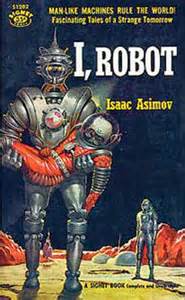
Isaac Asimov wrote the collection, I, Robot. Effectively, Poul Anderson replied with one story, "Quixote and the Windmill": the first unspecialized robot is unemployed; therefore, there is no need for a second robot - or for a sequel.
Robert Heinlein's Methuselah's Children and James Blish's They Shall Have Stars are about the search for immortality. Effectively, Anderson replied with "What Shall It Profit?": immortality, possible only by shielding from all radiation far underground, is a dead end. In this case, there is an implied need for a sequel because the story ends with the Director of the Institute for Human Biology asking:
"'What are we going to do?'" (Cold Victory, p. 223)
We can only infer that the Institute is destroyed and its discoveries lost during the ensuing Second Dark Ages. Later, Anderson presented different accounts of immortality in World Without Stars and The Boat Of A Million Years.
Asimov's Foundation Series is about a science of society whereas Heinlein's Orphans Of The Sky is about a multi-generation interstellar spaceship. In Anderson's "The Troublemakers," a science of society is applied to the crew of a generation ship. Psychotechnicians manipulate mutinous motivations, thus preventing the kind of breakdown that made Heinlein's Vanguard crew forget the universe outside their large spinning spaceship.
These are the Campbell future historians: Heinlein, Asimov, Blish and Anderson.
Robert Heinlein's Methuselah's Children and James Blish's They Shall Have Stars are about the search for immortality. Effectively, Anderson replied with "What Shall It Profit?": immortality, possible only by shielding from all radiation far underground, is a dead end. In this case, there is an implied need for a sequel because the story ends with the Director of the Institute for Human Biology asking:
"'What are we going to do?'" (Cold Victory, p. 223)
We can only infer that the Institute is destroyed and its discoveries lost during the ensuing Second Dark Ages. Later, Anderson presented different accounts of immortality in World Without Stars and The Boat Of A Million Years.
Asimov's Foundation Series is about a science of society whereas Heinlein's Orphans Of The Sky is about a multi-generation interstellar spaceship. In Anderson's "The Troublemakers," a science of society is applied to the crew of a generation ship. Psychotechnicians manipulate mutinous motivations, thus preventing the kind of breakdown that made Heinlein's Vanguard crew forget the universe outside their large spinning spaceship.
These are the Campbell future historians: Heinlein, Asimov, Blish and Anderson.
Sunday, 20 December 2015
Idyllic Planets?
Space explorers come to an extrasolar planet that is superficially idyllic but essentially problematic:
Methuselah's Children by Robert Heinlein (Future History);
A Case Of Conscience by James Blish (After Such Knowledge);
"Tiger Ride" by James Blish and Damon Knight;
The Peregrine by Poul Anderson (Psychotechnic History);
The Night Face by Poul Anderson (Technic History);
more than one Star Trek episode.
Obviously, these works differ considerably. Nevertheless, there is a discernible common theme. The two Anderson novels could even be adapted as Star Trek episodes although they would be considerably diminished in the process. As I wrote about the Blish/Knight collaboration (see above):
Knight writes that the story asks, “What is a man?” Like Star Trek, though not as tritely, it answers that men need the conflict of unsatisfied desire.
Methuselah's Children by Robert Heinlein (Future History);
A Case Of Conscience by James Blish (After Such Knowledge);
"Tiger Ride" by James Blish and Damon Knight;
The Peregrine by Poul Anderson (Psychotechnic History);
The Night Face by Poul Anderson (Technic History);
more than one Star Trek episode.
Obviously, these works differ considerably. Nevertheless, there is a discernible common theme. The two Anderson novels could even be adapted as Star Trek episodes although they would be considerably diminished in the process. As I wrote about the Blish/Knight collaboration (see above):
Knight writes that the story asks, “What is a man?” Like Star Trek, though not as tritely, it answers that men need the conflict of unsatisfied desire.
Subscribe to:
Posts (Atom)