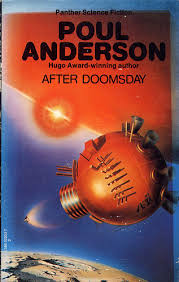
In Poul Anderson's After Doomsday, the crews of two interstellar spaceships have survived the genocidal sterilization of Earth. In James Blish's The Day After Judgement, mankind has survived a limited nuclear war. Thus, so far, two futuristic sf novels, each featuring a technological threat to all life on Earth. In Anderson's There Will Be Time, the civilization-destroying nuclear war is called the Judgment War. Thus, Anderson uses the terms "Doomsday" and "Judgment" in two similar secular contexts.
However, what I have not mentioned so far is that Blish's use of the term, "Judgment," is Biblical and apocalyptic. The nuclear exchange was just one aspect of Armageddon, which the demons have won. Thus, we are reading fantasy, not sf. On the other hand, it is what I have called "hard fantasy," reading very much like sf and, if its speculation that eternal life is full negative entropy were to be developed further, then it would return to the realm of sf with the angels and demons scientifically rationalized.
The Startegic Air Command attacks the demon fortress of Dis now manifested in the Valley of Death, Death Valley: science versus the supernatural, a concrete expression of the theme of Blish's After Such Knowledge Trilogy. Anderson presents scientific rationales of fantasy ideas in some works discussed recently on the blog.
Showing posts with label There Will Be Time. Show all posts
Sunday, 20 March 2016
Thursday, 3 March 2016
Andersonian Themes and Tropes, by Sean M. Brooks
Dr. Paul Shackley's "Poul Anderson Appreciation Blog" focuses on the works of Poul Anderson. And he has also discussed other writers whose own works he believes are appropriately compared to those of Anderson. One of these writers is S.M. Stirling, whom Dr. Shackley rightly considers a worthy colleague and successor of Poul Anderson. Mr. Stirling has sometimes left his own comments in the blog. On January 30, 2016, in the combox for Dr. Shackley's "Wealth and Labor" piece, Stirling wrote: "It's pretty safe to assume themes and tropes from Poul's work carry over into mine--he was an inspiration, and we corresponded and occasionally visited for many years."
I have more than once found very Andersonian echoes, allusions, themes, tropes, and homages to Poul Anderson in Stirling's own works. I felt the wish to point out some of these "echoes" myself. For example, one theme or trope to be found in both writers works is how they agreed all organized societies need to have SOME signs of respect or ceremonial for their leaders or states. In Chapter 7 of Poul Anderson's novel THERE WILL BE TIME (Nelson-Doubleday: 1972, page 63) Caleb Wallis, Sachem of the Eyrie, said: "I am the founder and master of this nation. We must have discipline, forms of respect. I'm called 'sir.' " Another example can be found in Chapter 7 of THE DAY OF THEIR RETURN (Nelson-Doubleday: 1973, page 54) after Tatiana Thane showed resentment at the idea of the planet Aeneas reestablishing its loyalty to the Terran Empire Commissioner Desai said: "The loyalty I speak of does not involve more than a few outward tokens of respect for the throne, as mere essential symbols. It is loyalty to the Empire--above all, to its Pax, in an age when spacefleets can incinerate whole worlds and when the mutiny in fact took thousands of lives--it is that I mean, my lady. It is that I am here about..."
Echoes and allusions of this Andersonian respect for due and proper ceremony can be found in Stirling's novel CONQUISTADOR (Roc: March 2004, pages 363 and 364), in Chapter Fourteen. The Founder of the Commonwealth of New Virginia, John Rolfe VI, was formally greeted like this: "Adrienne stepped forward first, bowing low, taking his outstretched left hand in hers, and kissing it." Then she said, in Italian: "Baciamo le mani." Both Piet Botha and Roy Tully (with a slight shrug to Tom Christiansen by the latter) repeated the ceremony. Tom felt embarassed and foolish, but he too performed the ritual. The Chairman Emeritus, noticing Tom's discomfort said: "In any organized society there must be forms, gestures of respect. I am founder and master of this nation. My fellow Virginian Washington followed a similar policy of emphasizing formal etiquette during his presidency, for much the same reason; I've often found his solutions useful when an analogous problem came up." Notice how "I am founder and master of this nation" is nearly a word for word quote from THERE WILL BE TIME. To say nothing of how close Stirling's "gestures of respect" is to Anderson's "forms of respect"!
In my letter of January 21, 1995 to Poul Anderson I discussed how the Later Roman Empire, in both West and East, developed increasingly elaborate and seemingly exaggerated gestures of respect for the Emperors. To such an extent that it seemed to me the Romans, even after they became Christians, gave their sovereigns virtually divine honors. This disturbed me until I came across these texts in Thomas Hobbes LEVIATHAN (Collier Books: 1973), Chapter 45, on page 467: "The worship we exhibit for those we esteem to be but men, as to kings, and men in authority, is civil worship; but the worship we exhibit to that which we think to be God, whatsoever the words, ceremonies, gestures or other actions be, is divine worship. To fall prostrate before a king, in him that thinks him but a man, is but civil worship: and he that putteth off his hat in the church, for this cause, that he thinketh it the house of God, worshippeth with divine worship." And on page 469, in the same Chapter 45, I read: "To be uncovered, before a man of power and authority, before the throne of a prince, or in other such places as he ordaineth to that purpose in his absence, is to worship that man, or prince with civil worship; as being a sign, not of honouring the stool or place, but the person; and is not idolatry."
I then became convinced that the seemingly exaggerated respect shown by the Romans to their Emperors (or the New Virginians to their Chairmen) were merely gestures of respect meant to show patriotic loyalty to them. Which meant I could no longer scorn such rituals as the proskynesis or the kowtow. In his reply letter of January 28, 1995, Anderson wrote: "On the matter of elaborate gestures of submission to royalty and the like, I suspect that, while the extreme forms of the late West Roman and the Byzantine Empires were theoretically just gestures of respect, in fact they reflected an attitude derived from the ancient Orient. The distinction between a king or emperor who was a god and one who was God's anointed got somewhat blurred. There was something supernatural about a crowned head--which didn't prevent some rather murderous changes of personnel! I think that in our own time we have seen the same basic psychology at work in the--from your viewpoint or mine--obscene degree of adulation accorded Hitler and Stalin, even though in those cases all connection to the divine was disavowed." The even more grotesque adulation shown to Mao Tse-tung, during his misrule of China, also comes to mind.
However theoretically unobjectionable the proskynesis or kowtow might be, such ceremonies still caused problems when ambassadors from foreign nations refused to perform them to the Emperor of China . As Anderson wrote, from the same letter cited above: "It's a nice question whether the British ambassador to China in the 19th century did right when he refused to kowtow to the Emperor. On the one hand, he definitely compromised his mission; on the other hand, as Queen Victoria's representative he was not going to admit, even symbolically, that any other monarch was superior to her. If nothing else, that could have set an awkward precedent."
Poul Anderson then ended by saying he had no personal objection to such ceremonial gestures: "As a private citizen, I don't face such problems, and would in general go along with whatever forms and titles, such as "your Majesty" are customary. Partly that's a matter of courtesy, partly respect for the office, especially within one's own country." In the last part of that sentence Anderson was about to discuss the propriety of showing customary respect for Members of the U.S. Congress.
It was interesting to see a clear example from two of Poul Anderson's books, THERE WILL BE TIME and THE DAY OF THEIR RETURN, of "themes and tropes" carrying over to Stirling's CONQUISTADOR. I think this would have happened only if Stirling had agreed with Anderson on the desirability, even necessity, of a society's leaders being accorded some ceremonial respect and deference. To again quote Anderson's letter of January 28, 1995: "Symbolism IS important. It may act subtly, but it often has very practical consequences." That is, I argue the ceremonial accorded a nation's leaders will reflect how that society regards its rulers and how power should be used. I would even suggest that ceremonial SOFTENS the hard, sharp edges of the state's power, by helping to make sure, at least sometimes, that power is used only in accordance with fixed laws, rules, and customs.
I have more than once found very Andersonian echoes, allusions, themes, tropes, and homages to Poul Anderson in Stirling's own works. I felt the wish to point out some of these "echoes" myself. For example, one theme or trope to be found in both writers works is how they agreed all organized societies need to have SOME signs of respect or ceremonial for their leaders or states. In Chapter 7 of Poul Anderson's novel THERE WILL BE TIME (Nelson-Doubleday: 1972, page 63) Caleb Wallis, Sachem of the Eyrie, said: "I am the founder and master of this nation. We must have discipline, forms of respect. I'm called 'sir.' " Another example can be found in Chapter 7 of THE DAY OF THEIR RETURN (Nelson-Doubleday: 1973, page 54) after Tatiana Thane showed resentment at the idea of the planet Aeneas reestablishing its loyalty to the Terran Empire Commissioner Desai said: "The loyalty I speak of does not involve more than a few outward tokens of respect for the throne, as mere essential symbols. It is loyalty to the Empire--above all, to its Pax, in an age when spacefleets can incinerate whole worlds and when the mutiny in fact took thousands of lives--it is that I mean, my lady. It is that I am here about..."
Echoes and allusions of this Andersonian respect for due and proper ceremony can be found in Stirling's novel CONQUISTADOR (Roc: March 2004, pages 363 and 364), in Chapter Fourteen. The Founder of the Commonwealth of New Virginia, John Rolfe VI, was formally greeted like this: "Adrienne stepped forward first, bowing low, taking his outstretched left hand in hers, and kissing it." Then she said, in Italian: "Baciamo le mani." Both Piet Botha and Roy Tully (with a slight shrug to Tom Christiansen by the latter) repeated the ceremony. Tom felt embarassed and foolish, but he too performed the ritual. The Chairman Emeritus, noticing Tom's discomfort said: "In any organized society there must be forms, gestures of respect. I am founder and master of this nation. My fellow Virginian Washington followed a similar policy of emphasizing formal etiquette during his presidency, for much the same reason; I've often found his solutions useful when an analogous problem came up." Notice how "I am founder and master of this nation" is nearly a word for word quote from THERE WILL BE TIME. To say nothing of how close Stirling's "gestures of respect" is to Anderson's "forms of respect"!
In my letter of January 21, 1995 to Poul Anderson I discussed how the Later Roman Empire, in both West and East, developed increasingly elaborate and seemingly exaggerated gestures of respect for the Emperors. To such an extent that it seemed to me the Romans, even after they became Christians, gave their sovereigns virtually divine honors. This disturbed me until I came across these texts in Thomas Hobbes LEVIATHAN (Collier Books: 1973), Chapter 45, on page 467: "The worship we exhibit for those we esteem to be but men, as to kings, and men in authority, is civil worship; but the worship we exhibit to that which we think to be God, whatsoever the words, ceremonies, gestures or other actions be, is divine worship. To fall prostrate before a king, in him that thinks him but a man, is but civil worship: and he that putteth off his hat in the church, for this cause, that he thinketh it the house of God, worshippeth with divine worship." And on page 469, in the same Chapter 45, I read: "To be uncovered, before a man of power and authority, before the throne of a prince, or in other such places as he ordaineth to that purpose in his absence, is to worship that man, or prince with civil worship; as being a sign, not of honouring the stool or place, but the person; and is not idolatry."
I then became convinced that the seemingly exaggerated respect shown by the Romans to their Emperors (or the New Virginians to their Chairmen) were merely gestures of respect meant to show patriotic loyalty to them. Which meant I could no longer scorn such rituals as the proskynesis or the kowtow. In his reply letter of January 28, 1995, Anderson wrote: "On the matter of elaborate gestures of submission to royalty and the like, I suspect that, while the extreme forms of the late West Roman and the Byzantine Empires were theoretically just gestures of respect, in fact they reflected an attitude derived from the ancient Orient. The distinction between a king or emperor who was a god and one who was God's anointed got somewhat blurred. There was something supernatural about a crowned head--which didn't prevent some rather murderous changes of personnel! I think that in our own time we have seen the same basic psychology at work in the--from your viewpoint or mine--obscene degree of adulation accorded Hitler and Stalin, even though in those cases all connection to the divine was disavowed." The even more grotesque adulation shown to Mao Tse-tung, during his misrule of China, also comes to mind.
However theoretically unobjectionable the proskynesis or kowtow might be, such ceremonies still caused problems when ambassadors from foreign nations refused to perform them to the Emperor of China . As Anderson wrote, from the same letter cited above: "It's a nice question whether the British ambassador to China in the 19th century did right when he refused to kowtow to the Emperor. On the one hand, he definitely compromised his mission; on the other hand, as Queen Victoria's representative he was not going to admit, even symbolically, that any other monarch was superior to her. If nothing else, that could have set an awkward precedent."
Poul Anderson then ended by saying he had no personal objection to such ceremonial gestures: "As a private citizen, I don't face such problems, and would in general go along with whatever forms and titles, such as "your Majesty" are customary. Partly that's a matter of courtesy, partly respect for the office, especially within one's own country." In the last part of that sentence Anderson was about to discuss the propriety of showing customary respect for Members of the U.S. Congress.
It was interesting to see a clear example from two of Poul Anderson's books, THERE WILL BE TIME and THE DAY OF THEIR RETURN, of "themes and tropes" carrying over to Stirling's CONQUISTADOR. I think this would have happened only if Stirling had agreed with Anderson on the desirability, even necessity, of a society's leaders being accorded some ceremonial respect and deference. To again quote Anderson's letter of January 28, 1995: "Symbolism IS important. It may act subtly, but it often has very practical consequences." That is, I argue the ceremonial accorded a nation's leaders will reflect how that society regards its rulers and how power should be used. I would even suggest that ceremonial SOFTENS the hard, sharp edges of the state's power, by helping to make sure, at least sometimes, that power is used only in accordance with fixed laws, rules, and customs.
Wednesday, 2 December 2015
Time Wars
Poul Anderson, "Flight to Forever" IN Anderson, Past Times (New York, 1984), pp. 207-288.
There are perhaps two "Time Wars" in "Flight to Forever."
(i) In the twenty third century, the Martian colonies revolted against the Terrestrial Directorate. A defeated Directorate army leaped to the twenty fourth century and attempted reconquest but was smashed.
(ii) In 50,000 AD, when the Anvardi attack Sol, the Imperial ship Vengeance travels three days back in time, calculates the exact position of the Anvardian flagship seventy two hours hence, travels to that position and rematerializes beside the flagship simultaneously bombarding it with vortex cannon, blasters, gravity snatchers, atomic shells and torpedoes etc while the rest of the Imperial fleet, only one tenth the size of its enemy, attacks the Anvardi fleet which then recoils and breaks up when assaulted from within and without.
These are low key affairs when compared with the time wars between:
Wardens and Rangers in The Corridors of Time;
Havig's group and the Eyrie in There Will Be Time;
the Patrol and the Exaltationists in the Time Patrol series.
I have seen an anthology called Time Wars including Anderson's Time Patrol story, "Delenda Est," (Patrol versus Neldorians) and have read references to a series called Time Wars created but not written by Poul Anderson. I would be grateful for any information on the latter.
There are perhaps two "Time Wars" in "Flight to Forever."
(i) In the twenty third century, the Martian colonies revolted against the Terrestrial Directorate. A defeated Directorate army leaped to the twenty fourth century and attempted reconquest but was smashed.
(ii) In 50,000 AD, when the Anvardi attack Sol, the Imperial ship Vengeance travels three days back in time, calculates the exact position of the Anvardian flagship seventy two hours hence, travels to that position and rematerializes beside the flagship simultaneously bombarding it with vortex cannon, blasters, gravity snatchers, atomic shells and torpedoes etc while the rest of the Imperial fleet, only one tenth the size of its enemy, attacks the Anvardi fleet which then recoils and breaks up when assaulted from within and without.
These are low key affairs when compared with the time wars between:
Wardens and Rangers in The Corridors of Time;
Havig's group and the Eyrie in There Will Be Time;
the Patrol and the Exaltationists in the Time Patrol series.
I have seen an anthology called Time Wars including Anderson's Time Patrol story, "Delenda Est," (Patrol versus Neldorians) and have read references to a series called Time Wars created but not written by Poul Anderson. I would be grateful for any information on the latter.
Saturday, 19 September 2015
The Temporal Empire
Recently, when writing about the Time Patrol and the Terran (or Terrestrial) Empire, I mistakenly typed "Temporal Empire" but corrected it before publishing. But what an evocative phrase! What would a Temporal Empire be like? Many periods ruled from a single period? Would Temporal Imperialists conquer their ancestors, their descendants or both? Would they rule overtly or covertly? Might some of the wealth generated in ancient empires have been extra-temporally appropriated?
Of course, time travelers can remove goods from buildings about to be destroyed without disrupting history and can even take a hand in the destruction if they are sufficiently unscrupulous. In fact, in There Will Be Time, agents of the Eyrie plunder the past and try to control their future so maybe they are Temporal Imperialists?
Neldorians are less ambitious, aiming merely to change the past in order to enrich themselves. Exaltationists aim to eliminate the Patrol, then to fight time change wars between themselves until their last survivor reigns supreme - but s/he would then be able to rule Earth in a single period without needing to conquer earlier or later periods. A Temporal Empire would be a complicated project indeed.
Of course, time travelers can remove goods from buildings about to be destroyed without disrupting history and can even take a hand in the destruction if they are sufficiently unscrupulous. In fact, in There Will Be Time, agents of the Eyrie plunder the past and try to control their future so maybe they are Temporal Imperialists?
Neldorians are less ambitious, aiming merely to change the past in order to enrich themselves. Exaltationists aim to eliminate the Patrol, then to fight time change wars between themselves until their last survivor reigns supreme - but s/he would then be able to rule Earth in a single period without needing to conquer earlier or later periods. A Temporal Empire would be a complicated project indeed.
Friday, 4 September 2015
Successor Of Heinlein
Three ways in which Poul Anderson succeeds Robert Heinlein:
future histories;
magic as technology;
time travel.
We have discussed all these before but let's revisit time travel. Heinlein wrote two short stories and one novel about what I call the ornamental garden of the circular causality paradox but nothing about causality violation whereas Anderson wrote three novels about circular causality, a long series about causality violation and enough other time travel short stories to fill a collection; thus, six volumes including one long novel and one omnibus collection.
Heinlein's circular causality works are ingenious but do not go anywhere or rather each goes in its own circle whereas, of Anderson's three circular causality novels:
The Corridors Of Time presents an intriguing new means of time travel, also vivid details of contemporary, past and future locations;
There Will Be Time connects with past history, Anderson's Maurai future history and a further future of interstellar travel;
The Dancer From Atlantis connects with Atlantis, Theseus and the Minotaur and characters from different historical periods and is one of three novels of different genres set BC.
future histories;
magic as technology;
time travel.
We have discussed all these before but let's revisit time travel. Heinlein wrote two short stories and one novel about what I call the ornamental garden of the circular causality paradox but nothing about causality violation whereas Anderson wrote three novels about circular causality, a long series about causality violation and enough other time travel short stories to fill a collection; thus, six volumes including one long novel and one omnibus collection.
Heinlein's circular causality works are ingenious but do not go anywhere or rather each goes in its own circle whereas, of Anderson's three circular causality novels:
The Corridors Of Time presents an intriguing new means of time travel, also vivid details of contemporary, past and future locations;
There Will Be Time connects with past history, Anderson's Maurai future history and a further future of interstellar travel;
The Dancer From Atlantis connects with Atlantis, Theseus and the Minotaur and characters from different historical periods and is one of three novels of different genres set BC.
Tuesday, 1 September 2015
At The Academy
While contemplating temporal paradoxes and historical periods, we must also remember Poul Anderson's descriptions of nature, including pre-human nature:
"Light streamed golden across a prairie reaching beyond sight. Wildflower-starred, grass rippled and, she knew, rustled under the wind. In places, a grove or a thicket interrupted immensity, and in the distance trees lined a great brown river. She knew also how its water and its mud surged with life, larvae, insects, fish, frogs, snakes, waterfowl, herds of rooting merycoidodon like giant hogs or small slender hippopotami. Wings filled heaven." (The Shield Of Time, pp. 129-130)
(I remember "High is heaven and holy" in another Anderson series.)
The following paragraph describes the Time Patrol Academy on an elevation reinforced against floods. Gardens, lawns, bowers and low subtly curved buildings of changing colors have stood for millennia and will be carefully demolished fifty millennia hence. Next, of course, we read that Cadet Wanda Tamberly breathes mild, rich air with odors of growth, soil and herbs - so nothing is missing from an Andersonian appreciation of natural beauty.
We read of the "...great brown river..." and the low, curved buildings of shifting colors when Everard was at the Academy (Time Patrol, p. 6) and Havig's main base in another time travel scenario is similar although in the Pleistocene:
"It stood on a wooded hill, and through the valley below ran a mighty river which...shone in the sunlight like bronze."
-Poul Anderson, There Will Be Time (New York, 1973), p. 157.
The Patrol Academy is in the Oligocene and the Patrol also has a lodge in the Pleistocene.
"Light streamed golden across a prairie reaching beyond sight. Wildflower-starred, grass rippled and, she knew, rustled under the wind. In places, a grove or a thicket interrupted immensity, and in the distance trees lined a great brown river. She knew also how its water and its mud surged with life, larvae, insects, fish, frogs, snakes, waterfowl, herds of rooting merycoidodon like giant hogs or small slender hippopotami. Wings filled heaven." (The Shield Of Time, pp. 129-130)
(I remember "High is heaven and holy" in another Anderson series.)
The following paragraph describes the Time Patrol Academy on an elevation reinforced against floods. Gardens, lawns, bowers and low subtly curved buildings of changing colors have stood for millennia and will be carefully demolished fifty millennia hence. Next, of course, we read that Cadet Wanda Tamberly breathes mild, rich air with odors of growth, soil and herbs - so nothing is missing from an Andersonian appreciation of natural beauty.
We read of the "...great brown river..." and the low, curved buildings of shifting colors when Everard was at the Academy (Time Patrol, p. 6) and Havig's main base in another time travel scenario is similar although in the Pleistocene:
"It stood on a wooded hill, and through the valley below ran a mighty river which...shone in the sunlight like bronze."
-Poul Anderson, There Will Be Time (New York, 1973), p. 157.
The Patrol Academy is in the Oligocene and the Patrol also has a lodge in the Pleistocene.
Saturday, 1 August 2015
Time Rovers
Recently, I posted about "Time Patrol Collections" but neglected to mention that The Guardians Of Time (New York, 1981) also includes "Of Time And The Rover," an Afterword by Sandra Miesel, although I had mentioned this Afterword here and here.
Miesel starts by observing that Anderson had roved past, future and alternative time for over three decades. We must now say for over five decades.
She uses the phrases, "Translation in time..." (p. 245) and "...time transit..." (p. 246), convenient labels for different treatments of time in fantasy and sf, e.g., she mentions, among other examples:
"The Man Who Came Early" (time travel);
Three Hearts And Three Lions (travel between timelines);
Tau Zero (space travel but with time dilation).
These three works are respectively historical sf, heroic fantasy and hard sf.
Miesel argues that:
temporal transitions challenge fictional characters;
"...response to challenge is Anderson's quintessential theme..." (p. 245);
both space travel and time travel "...offer the extension of mastery through knowledge and the enlargement of being through experience..." (ibid.);
also, Anderson saw "...the supreme knowledge [as] that gained through experience." (ibid.);
whereas archaic societies ignore or deny history, modern civilization searches for roots and speculates about growth;
Anderson's historically based fiction addresses this need.
I try to paraphrase but sometimes Miesel's succinct prose is already a summary. I merely summarize because I do not disagree. For discussion of James Blish on his quintessential theme of "knowledge," see here.
In one paragraph on p. 248, Miesel compares Anderson's Time Patrol series with five time travel works and with two parallel timeline novels. Of the five time travel works, I value only Ward Moore's Bring The Jubilee. For discussion of inconsistencies in some time travel fiction, see here. A better comparison for the "Two characters [who] escape to the more congenial nineteenth century..." would have been with Jack Finney's nostalgic time travel fiction.
The parallel timeline novels are mentioned in order to compare Anderson's Time Patrol with Piper's Para-Time Police and Norton's Crosstime Service. However, the Patrol polices pastwards and futurewards travel along a single mutable timeline whereas the other two organizations police present-moment sideways travel between many parallel timelines. Norton's title, The Crossroads Of Time, is unusually evocative and it would be good to read a novel worthy of such a title, e.g., a narrative about two intersecting timelines or an account of a real historical turning point like World War I but with insight into how events could have taken a different course.
Miesel lists four of Anderson's works that have "...Holmesian aspects..." (p. 250) but, of these, "Time Patrol" is surely the best both in its presentation of Holmes on a case mentioned but not recounted by Watson and as a new work in its own right. This single story must introduce the variable timeline, the Nine, the Danellians, the Patrol, its Academy, its Temporal language, Manse Everard, his first trips to the past, our first sight of a time criminal, Everard's promotion to Unattached status and his New York apartment that will become a familiar setting as the series progresses.
Miesel also writes:
"Besides composing interesting alternate history scenarios, [Anderson] achieves the subtler feat of historical transubstantiation: in 'Brave to Be a King' events remain the same but the reason they occur changes." (p. 249)
Well, recorded history remains the same although many unrecorded details differ: another man plays the role of Cyrus the Great. "Historical transubstantiation" might better describe some of the stunts pulled in There Will Be Time, with its invariable timeline. A time travel group recruits a handful of prospects, including Havig and Boris, in Jerusalem on the estimated day of the Crucifixion. Later on his world-line, Havig works against that group and sends Boris to Jerusalem to infiltrate it... Thus, we might say that, in Havig's experience, Boris' presence in Jerusalem is transubstantiated. No discernible detail can be or has been altered but the significance of Boris' trip to Jerusalem is inwardly transformed.
Reasons for traveling to the day of the Crucifixion:
to witness the Crucifixion;
to try to prevent it;
to meet other time travelers;
to recruit time travelers;
to infiltrate the group recruiting time travelers.
Boris turns out to have the fifth, not the first, reason.
Miesel rightly states that, although The Guardians Of Time "...is only one book...it reflects [Anderson's] essential principles..." (p. 251) - as also does There Will be Time, which she mentions but does not have space to discuss here:
the Patrol conserves whereas Havig's group liberates;
the Patrol prevents Neldorians, Exaltationists, individual time criminals and quantum fluctuations from changing the past whereas Havig's group prevents the Eyrie from dominating the future;
Patrol agents ride streamlined updates of Wells' Time Machine whereas Havig shares the Time Traveler's experience of external events flickering past;
Patrollers can change past events whereas Havig cannot but instead must ingeniously change their significance;
the Patrol leads to the Danellians whereas Havig's group leads to the Star Masters;
Everard learns that the Patrol, even though it too changes the past, is "The Only Game In Town" (story title) while Havig's recruits learn that "...Havig's was the only game in town." (There Will be Time, New York, 1973, p. 156)
Miesel characterizes Anderson's four time travel volumes to date:
the Time Patrol employs well-briefed agents;
The Corridors Of Time shows "...unprepared people hurled into strangeness..." (p. 246);
There Will Be Time shows time travel by "...psi talent" (p. 247);
The Dancer From Atlantis "...recreat[es] a real historical milieu..." (pp. 247-248).
The Dancer... is more directly about unprepared people hurled into a strange past and The Corridors... also shows well-briefed agents of time traveling organizations. Five time travel stories are mentioned among several other "time transit" works. Thus, "Of Time And The Rover" is a brief but comprehensive survey.
Miesel starts by observing that Anderson had roved past, future and alternative time for over three decades. We must now say for over five decades.
She uses the phrases, "Translation in time..." (p. 245) and "...time transit..." (p. 246), convenient labels for different treatments of time in fantasy and sf, e.g., she mentions, among other examples:
"The Man Who Came Early" (time travel);
Three Hearts And Three Lions (travel between timelines);
Tau Zero (space travel but with time dilation).
These three works are respectively historical sf, heroic fantasy and hard sf.
Miesel argues that:
temporal transitions challenge fictional characters;
"...response to challenge is Anderson's quintessential theme..." (p. 245);
both space travel and time travel "...offer the extension of mastery through knowledge and the enlargement of being through experience..." (ibid.);
also, Anderson saw "...the supreme knowledge [as] that gained through experience." (ibid.);
whereas archaic societies ignore or deny history, modern civilization searches for roots and speculates about growth;
Anderson's historically based fiction addresses this need.
I try to paraphrase but sometimes Miesel's succinct prose is already a summary. I merely summarize because I do not disagree. For discussion of James Blish on his quintessential theme of "knowledge," see here.
In one paragraph on p. 248, Miesel compares Anderson's Time Patrol series with five time travel works and with two parallel timeline novels. Of the five time travel works, I value only Ward Moore's Bring The Jubilee. For discussion of inconsistencies in some time travel fiction, see here. A better comparison for the "Two characters [who] escape to the more congenial nineteenth century..." would have been with Jack Finney's nostalgic time travel fiction.
The parallel timeline novels are mentioned in order to compare Anderson's Time Patrol with Piper's Para-Time Police and Norton's Crosstime Service. However, the Patrol polices pastwards and futurewards travel along a single mutable timeline whereas the other two organizations police present-moment sideways travel between many parallel timelines. Norton's title, The Crossroads Of Time, is unusually evocative and it would be good to read a novel worthy of such a title, e.g., a narrative about two intersecting timelines or an account of a real historical turning point like World War I but with insight into how events could have taken a different course.
Miesel lists four of Anderson's works that have "...Holmesian aspects..." (p. 250) but, of these, "Time Patrol" is surely the best both in its presentation of Holmes on a case mentioned but not recounted by Watson and as a new work in its own right. This single story must introduce the variable timeline, the Nine, the Danellians, the Patrol, its Academy, its Temporal language, Manse Everard, his first trips to the past, our first sight of a time criminal, Everard's promotion to Unattached status and his New York apartment that will become a familiar setting as the series progresses.
Miesel also writes:
"Besides composing interesting alternate history scenarios, [Anderson] achieves the subtler feat of historical transubstantiation: in 'Brave to Be a King' events remain the same but the reason they occur changes." (p. 249)
Well, recorded history remains the same although many unrecorded details differ: another man plays the role of Cyrus the Great. "Historical transubstantiation" might better describe some of the stunts pulled in There Will Be Time, with its invariable timeline. A time travel group recruits a handful of prospects, including Havig and Boris, in Jerusalem on the estimated day of the Crucifixion. Later on his world-line, Havig works against that group and sends Boris to Jerusalem to infiltrate it... Thus, we might say that, in Havig's experience, Boris' presence in Jerusalem is transubstantiated. No discernible detail can be or has been altered but the significance of Boris' trip to Jerusalem is inwardly transformed.
Reasons for traveling to the day of the Crucifixion:
to witness the Crucifixion;
to try to prevent it;
to meet other time travelers;
to recruit time travelers;
to infiltrate the group recruiting time travelers.
Boris turns out to have the fifth, not the first, reason.
Miesel rightly states that, although The Guardians Of Time "...is only one book...it reflects [Anderson's] essential principles..." (p. 251) - as also does There Will be Time, which she mentions but does not have space to discuss here:
the Patrol conserves whereas Havig's group liberates;
the Patrol prevents Neldorians, Exaltationists, individual time criminals and quantum fluctuations from changing the past whereas Havig's group prevents the Eyrie from dominating the future;
Patrol agents ride streamlined updates of Wells' Time Machine whereas Havig shares the Time Traveler's experience of external events flickering past;
Patrollers can change past events whereas Havig cannot but instead must ingeniously change their significance;
the Patrol leads to the Danellians whereas Havig's group leads to the Star Masters;
Everard learns that the Patrol, even though it too changes the past, is "The Only Game In Town" (story title) while Havig's recruits learn that "...Havig's was the only game in town." (There Will be Time, New York, 1973, p. 156)
Miesel characterizes Anderson's four time travel volumes to date:
the Time Patrol employs well-briefed agents;
The Corridors Of Time shows "...unprepared people hurled into strangeness..." (p. 246);
There Will Be Time shows time travel by "...psi talent" (p. 247);
The Dancer From Atlantis "...recreat[es] a real historical milieu..." (pp. 247-248).
The Dancer... is more directly about unprepared people hurled into a strange past and The Corridors... also shows well-briefed agents of time traveling organizations. Five time travel stories are mentioned among several other "time transit" works. Thus, "Of Time And The Rover" is a brief but comprehensive survey.
Saturday, 4 July 2015
Superman In Public Consciousness And Popular Culture
reread Rick Veitch's (sequel to Alan Moore's) Swamp Thing;
been reading for the first time SM Stirling's Conquistador;
been enjoying these texts while also spotting any connections with the works of Poul Anderson.
Our theme for today is references to Superman. In a work of fiction, any reference to Supes implies either that he is a real guy out there somewhere or that the fictional characters share with their readers a popular culture in which this now mythical figure has become a permanent fixture. Veitch gives us the first; the others the second.
Veitch
Swampy goes to Metropolis to kill Lex Luthor who is protected both by his own security system and by Superman. Veitch, like Moore and Gaiman, applies a new insight to an over-familiar character.
Lois Lane: Clark?...Why is it when I'm talking to you, you always seem to be listening to something else?
Lois Lane: There you go again! I start talking and you stare off into space!
Clark Kent: Huh? Oh, uh...Just enjoying the view, Lois. You can see the whole city from up here.
Lois Lane: Yoo hoo! Earth to Clark. Come in, Clark!
-Rick Veitch, Swamp Thing: Infernal Triangles (New York, 2006), pp. 56, 58, 61.
Anderson
See here.
Stirling
"'Brother, with the amount of money RM and M had to throw around, you could bribe Superman'...'Ten million dollars,' the Man says. 'No, no, I am Superman!' Then it's thirty million. 'No, no, I stand for Truth, Justice and the American Way!' So then it's fifty million, and Superman comes back: 'I'll kill anyone you want!...'"
-SM Stirling, Conquistador (New York, 2004), p. 298.
Of course, the real (?) Superman is incorruptible. (In one version, Luthor, formerly the most powerful man in Metropolis, tries but fails to buy Supes as soon as the latter comes on the scene.) But Stirling's character is making a point. Rolfe Mining and Minerals is one of many front organizations for the Commonwealth of New Virginia which has been secretly exploiting another Earth for decades. By any ordinary standards, their funds are unlimited and "Rich enough to bribe even Superman" is a powerful way to say this.
Wednesday, 1 July 2015
Soap Bubbles II
See Soap Bubbles.
Although I argue that a time traveler who prevents his own birth does not cease to exist, time travelers would nevertheless need to proceed with extreme caution. How can they know which kind of scenario they are in? -
(i) you cannot prevent your birth because your timeline is single and continuous;
(ii) you can prevent your birth because your timeline is single but discontinuous;
(iii) you can prevent your birth because timelines are multiple and divergent.
If a group of people found themselves in what seemed to be their own California long ago and if they wanted to return to their remembered version of the twentieth/twenty first century, then they would have to be very careful not to change the course of events in any way. Rolfe tests whether the Gate has taken him to the past:
"'The first time I came through, I carved numbers on rocks in places I could locate on both sides - boulders, cliff faces - carved them deep enough to last for thousands of years. There's no trace of them back on our side of the Gate, where we know it's 1946. I'm still going to get some astronomers to look at pictures of the night sky - the stars change with time, you know - but I'm pretty certain this is the same time as back in California, the spring of 1946.'" (pp. 26-27)
So he is in the present of an alternative timeline, not in the past of his original timeline although, even here, he was taking a risk. He might have been changing the past/initiating a divergent timeline by carving on those rocks.
Poul Anderson's The Corridors Of Time and There Will Be Time are set in scenario (i). His Time Patrol series is ambiguous between (ii) and (iii).
Although I argue that a time traveler who prevents his own birth does not cease to exist, time travelers would nevertheless need to proceed with extreme caution. How can they know which kind of scenario they are in? -
(i) you cannot prevent your birth because your timeline is single and continuous;
(ii) you can prevent your birth because your timeline is single but discontinuous;
(iii) you can prevent your birth because timelines are multiple and divergent.
If a group of people found themselves in what seemed to be their own California long ago and if they wanted to return to their remembered version of the twentieth/twenty first century, then they would have to be very careful not to change the course of events in any way. Rolfe tests whether the Gate has taken him to the past:
"'The first time I came through, I carved numbers on rocks in places I could locate on both sides - boulders, cliff faces - carved them deep enough to last for thousands of years. There's no trace of them back on our side of the Gate, where we know it's 1946. I'm still going to get some astronomers to look at pictures of the night sky - the stars change with time, you know - but I'm pretty certain this is the same time as back in California, the spring of 1946.'" (pp. 26-27)
So he is in the present of an alternative timeline, not in the past of his original timeline although, even here, he was taking a risk. He might have been changing the past/initiating a divergent timeline by carving on those rocks.
Poul Anderson's The Corridors Of Time and There Will Be Time are set in scenario (i). His Time Patrol series is ambiguous between (ii) and (iii).
Monday, 25 May 2015
From Wells To Anderson; From One To Many
HG Wells wrote one classic, definitive time travel novel merely hinting at the paradoxes whereas Poul Anderson presents multiple fictions:
in the Old Phoenix sequence, many timelines coexist;
in the Time Patrol series, one mutable timeline exists because time travelers can change past events;
in The Corridors Of Time and There Will Be Time, one immutable timeline exists because time travelers cannot change past events;
in Starfarers, one immutable timeline exists because physical time travel is impossible.
Vast, systematic and comprehensive. And don't forget Wells.
in the Old Phoenix sequence, many timelines coexist;
in the Time Patrol series, one mutable timeline exists because time travelers can change past events;
in The Corridors Of Time and There Will Be Time, one immutable timeline exists because time travelers cannot change past events;
in Starfarers, one immutable timeline exists because physical time travel is impossible.
Vast, systematic and comprehensive. And don't forget Wells.
Saturday, 25 April 2015
Down Through The Past To The Present
Here, I quote a page of Poul Anderson's There Will Be Time (New York, 1973) on which the time travelers traverse geological epochs, then stop "...for a last rest in the house of a young farmer..." (p. 158). They began their journey with glaciers, then arrived near the period that we regard as our present.
A similar effect is generated by the first 257 pages of Anderson's The Boat Of A Million Years (London, 1991). The novel began in 310 BC (not quite as far back) and has progressed through AD 19, 359, 641, 998, 1050, 1072, 1221, 1239, 1570, 1640 and 1710 to Chapter XIII, set in 1855, when newly introduced characters have the kinds of names with which we are familiar like Matthew and Jane Edmonds. We are approaching our "present," in this case 1975, and after that will continue into an indefinite future.
In mainstream fiction, no single character or group of characters would be able to survive through all these periods but both immortals and time travelers can.
A similar effect is generated by the first 257 pages of Anderson's The Boat Of A Million Years (London, 1991). The novel began in 310 BC (not quite as far back) and has progressed through AD 19, 359, 641, 998, 1050, 1072, 1221, 1239, 1570, 1640 and 1710 to Chapter XIII, set in 1855, when newly introduced characters have the kinds of names with which we are familiar like Matthew and Jane Edmonds. We are approaching our "present," in this case 1975, and after that will continue into an indefinite future.
In mainstream fiction, no single character or group of characters would be able to survive through all these periods but both immortals and time travelers can.
Wednesday, 22 April 2015
A Crucial Event
When Lugo/Hanno discloses that he was born BC, a natural question from a Christian is, "'You seen the Savior?'" (Boat, p. 63) However, Lugo was doing business in Britannia during the reign of Augustus.
In Anderson's There Will Be Time, Jack Havig was in Jerusalem on the estimated day of the Crucifixion but never told Robert Anderson whether he saw Jesus. Carl Farness of the Time Patrol, mistaken for the Wanderer (Odin), said that he could not defend a paganism that he knew was going under but nor could he in honesty argue for Christ.
The Time Patrol would know what happened in Jerusalem. Their Specialists observe and record every crucial/critical/pivotal/axial event so that their guardian section can defend such events from either extra-temporal interference or quantum fluctuations in space-time-energy. That particular period would be extremely unstable with the danger that even remote observation would affect what was being observed. In fact, Anderson tells us that this is the case in the immediately subsequent period of the Jewish War. Events then are unstable as far away as barbarian Germania. However, as to what happened after an execution in Jerusalem, although Anderson's fictional narratives span history and the cosmos, they leave some major questions unanswered.
This morning, Rogue Sword and There Will Be Time have joined the list of other Anderson works referenced while discussing The Boat Of A Million Years. See here.
In Anderson's There Will Be Time, Jack Havig was in Jerusalem on the estimated day of the Crucifixion but never told Robert Anderson whether he saw Jesus. Carl Farness of the Time Patrol, mistaken for the Wanderer (Odin), said that he could not defend a paganism that he knew was going under but nor could he in honesty argue for Christ.
The Time Patrol would know what happened in Jerusalem. Their Specialists observe and record every crucial/critical/pivotal/axial event so that their guardian section can defend such events from either extra-temporal interference or quantum fluctuations in space-time-energy. That particular period would be extremely unstable with the danger that even remote observation would affect what was being observed. In fact, Anderson tells us that this is the case in the immediately subsequent period of the Jewish War. Events then are unstable as far away as barbarian Germania. However, as to what happened after an execution in Jerusalem, although Anderson's fictional narratives span history and the cosmos, they leave some major questions unanswered.
This morning, Rogue Sword and There Will Be Time have joined the list of other Anderson works referenced while discussing The Boat Of A Million Years. See here.
Friday, 10 April 2015
Very Short Future Histories
Literary Stages
(i) Two very short unrelated "future histories," Maurai (three stories) and Kith (two stories), short enough to fit into a single collection.
(ii) The Maurai history acquires a long novel, Orion Shall Rise, and is incorporated into the time travel novel, There Will Be Time.
(iii) Kith acquires one new story, "The Tale of the Cat," which would fit between the existing stories, "Ghetto" and "The Horn of Time the Hunter."
(iv) A future historical novel, Starfarers, incorporates "Ghetto" and "The Tale of the Cat" though not "The Horn of Time the Hunter."
Observations
The Maurai are one period in a time travel history as the Kith are one period in the Starfarers history.
As a tidying up and gathering together exercise, the Maurai and Kith collection should become just a Maurai collection and "The Horn of Time the Hunter" should be included as an appendix in Starfarers.
There would then be four volumes where there were previously just five short stories.
"Ghetto" is a harrowing story of class conflict destroying a personal relationship and I am not sure that I want to reread it.
However, I will reread "The Tale of the Cat" and maybe some other chapters of Starfarers for discussion on this blog.
(i) Two very short unrelated "future histories," Maurai (three stories) and Kith (two stories), short enough to fit into a single collection.
(ii) The Maurai history acquires a long novel, Orion Shall Rise, and is incorporated into the time travel novel, There Will Be Time.
(iii) Kith acquires one new story, "The Tale of the Cat," which would fit between the existing stories, "Ghetto" and "The Horn of Time the Hunter."
(iv) A future historical novel, Starfarers, incorporates "Ghetto" and "The Tale of the Cat" though not "The Horn of Time the Hunter."
Observations
The Maurai are one period in a time travel history as the Kith are one period in the Starfarers history.
As a tidying up and gathering together exercise, the Maurai and Kith collection should become just a Maurai collection and "The Horn of Time the Hunter" should be included as an appendix in Starfarers.
There would then be four volumes where there were previously just five short stories.
"Ghetto" is a harrowing story of class conflict destroying a personal relationship and I am not sure that I want to reread it.
However, I will reread "The Tale of the Cat" and maybe some other chapters of Starfarers for discussion on this blog.
Saturday, 14 March 2015
Worlds And Words
SM Stirling, "Shikari in Galveston" IN Worlds That Weren't (New York, 2003), pp. 63-148.
Science fiction writers show words changing their meanings in the future. In Poul Anderson's There Will Be Time, Jack Havig, time traveling to his future, meets a young woman who, when asked what she does with her time, replies that she jokes a lot. An amateur comedienne? However, when she and he share a picnic with no one else present, she announces that she had figured they could joke after eating but why not before and after?
(Addendum, 15 Mar: Also highly relevant is Anderson's "A Tragedy of Errors." See comments.)
In Neil Gaiman's sequel to Alan Moore's Miracleman, "London" means an event as "Hiroshima" does for us and "Kidding" has become a swear word because of what the Kid did in London. (Alan Moore had asked, "What would someone with Superman's strength and speed but not his scruples do?" He then answered this question with extremely detailed instructions to a comic strip artist.)
In SM Stirling's "Shikari in Galveston," a Bengali trader surprises us by telling Eric King that the local savages "'...are a clean people...'" (p. 80) Clean? King has just complained of sweat, squalor, smoke, sewage and stink. However, the trader's use of the word "clean" does not refer to hygiene. He spells it out:
"'From the time of the Fall.'" (ibid.)
King understands:
"King nodded...that was one of the fundamental distinctions in the modern world, between those whose ancestors had eaten men in the terrible years after the hammer from the skies struck, and those who hadn't. The only more fundamental one was between those who still did, and the rest of humanity." (ibid.)
And I am certain that the use of the word "clean" would be extended in precisely this way in those circumstances.
Tomorrow there will be a family outing for Mothers' Day (we have two mothers in the household) so maybe not much time for posting. Before turning in this evening, I have had to stop reading Stieg Larsson in order to post and must now stop posting in order to watch Smallville. Retirement, as expected, is an endless choice between enjoyable activities.
Science fiction writers show words changing their meanings in the future. In Poul Anderson's There Will Be Time, Jack Havig, time traveling to his future, meets a young woman who, when asked what she does with her time, replies that she jokes a lot. An amateur comedienne? However, when she and he share a picnic with no one else present, she announces that she had figured they could joke after eating but why not before and after?
(Addendum, 15 Mar: Also highly relevant is Anderson's "A Tragedy of Errors." See comments.)
In Neil Gaiman's sequel to Alan Moore's Miracleman, "London" means an event as "Hiroshima" does for us and "Kidding" has become a swear word because of what the Kid did in London. (Alan Moore had asked, "What would someone with Superman's strength and speed but not his scruples do?" He then answered this question with extremely detailed instructions to a comic strip artist.)
In SM Stirling's "Shikari in Galveston," a Bengali trader surprises us by telling Eric King that the local savages "'...are a clean people...'" (p. 80) Clean? King has just complained of sweat, squalor, smoke, sewage and stink. However, the trader's use of the word "clean" does not refer to hygiene. He spells it out:
"'From the time of the Fall.'" (ibid.)
King understands:
"King nodded...that was one of the fundamental distinctions in the modern world, between those whose ancestors had eaten men in the terrible years after the hammer from the skies struck, and those who hadn't. The only more fundamental one was between those who still did, and the rest of humanity." (ibid.)
And I am certain that the use of the word "clean" would be extended in precisely this way in those circumstances.
Tomorrow there will be a family outing for Mothers' Day (we have two mothers in the household) so maybe not much time for posting. Before turning in this evening, I have had to stop reading Stieg Larsson in order to post and must now stop posting in order to watch Smallville. Retirement, as expected, is an endless choice between enjoyable activities.
Thursday, 5 February 2015
Continuing Comparisons
Having just compared Robert Heinlein's and Poul Anderson's future histories and multiverses, let's look again at their time travel. Whereas Heinlein presents three ingenious statements of the circular causality paradox in futuristic sf settings, Anderson presents many more statements of the two time travel paradoxes, circular causality and causality violation, not only in futuristic but also in historical settings.
Anderson's The Corridors Of Time, There Will Be Time and The Dancer From Atlantis all contain that historical dimension that is absent from Heinlein's The Door Into Summer, "By His Bootstraps" and " -All You Zombies." (The Door Into Summer hints that Leonardo da Vinci was Leonard Vincent, Time Traveler, but does not dramatize this.) Anderson's Time Patrol series not only ranges throughout history but also presents a unique and subtle perspective on causality violation whereas Heinlein's works do not address that paradox.
Thus, Heinlein and Anderson resemble Newton and Einstein: the latter incorporates the former in a wider context.
Anderson's The Corridors Of Time, There Will Be Time and The Dancer From Atlantis all contain that historical dimension that is absent from Heinlein's The Door Into Summer, "By His Bootstraps" and " -All You Zombies." (The Door Into Summer hints that Leonardo da Vinci was Leonard Vincent, Time Traveler, but does not dramatize this.) Anderson's Time Patrol series not only ranges throughout history but also presents a unique and subtle perspective on causality violation whereas Heinlein's works do not address that paradox.
Thus, Heinlein and Anderson resemble Newton and Einstein: the latter incorporates the former in a wider context.
Saturday, 3 January 2015
Facts And Opinions
Some of the following numbered statements are facts.
Others are my opinions.
The status of each should be obvious.
(i) Poul Anderson is a major successor to HG Wells.
(ii) In particular, the Time Patrol series and There Will Be Time are conceptual sequels to The Time Machine.
(iii) There are perhaps half a dozen literal sequels to The Time Machine.
(iv) None of these is by Anderson (fact) and none is any good (opinion) - except The Space Machine by Christopher Priest which is more of a sequel to The War Of The Worlds.
(v) Some authors do not do sequels.
(vi) Wells did connect a few of his works but does not seem to have considered sequels to his major novels.
(vii) The disappearance of the Time Traveler, like the loss of the Cavorite sphere, was intended to complete and close a narrative, not to open the possibility of a continuation.
(viii) The nature of time travel suggests that, since the Time Traveler did not return immediately, he does not return period.
(ix) The Mammoth Book Of Time Travel SF (see here) includes "The Truth About Weena" by David J Lake.
(x) This title implies a literal sequel - although I also thought that The Time Traveler's Wife did.
(xi) I will read this newer (1998) story and possibly comment.
(xii) However, I need a lot of convincing that a new time travel story, whether or not it is a literal Time Machine sequel, is a good idea. (Either do it really well or don't do it.)
Later, on "The Truth About Weena": I would not have done it that way but then I cannot write fiction. My two attempts are here and here. For some ideas on a sequel to The Time Machine, see here.
Others are my opinions.
The status of each should be obvious.
(i) Poul Anderson is a major successor to HG Wells.
(ii) In particular, the Time Patrol series and There Will Be Time are conceptual sequels to The Time Machine.
(iii) There are perhaps half a dozen literal sequels to The Time Machine.
(iv) None of these is by Anderson (fact) and none is any good (opinion) - except The Space Machine by Christopher Priest which is more of a sequel to The War Of The Worlds.
(v) Some authors do not do sequels.
(vi) Wells did connect a few of his works but does not seem to have considered sequels to his major novels.
(vii) The disappearance of the Time Traveler, like the loss of the Cavorite sphere, was intended to complete and close a narrative, not to open the possibility of a continuation.
(viii) The nature of time travel suggests that, since the Time Traveler did not return immediately, he does not return period.
(ix) The Mammoth Book Of Time Travel SF (see here) includes "The Truth About Weena" by David J Lake.
(x) This title implies a literal sequel - although I also thought that The Time Traveler's Wife did.
(xi) I will read this newer (1998) story and possibly comment.
(xii) However, I need a lot of convincing that a new time travel story, whether or not it is a literal Time Machine sequel, is a good idea. (Either do it really well or don't do it.)
Later, on "The Truth About Weena": I would not have done it that way but then I cannot write fiction. My two attempts are here and here. For some ideas on a sequel to The Time Machine, see here.
Wellsian And Andersonian Time Travel
Jack Havig in There Will Be Time is like the Time Traveler without the Time Machine. (see also here.)
In The Corridors Of Time, time travel is technological but through literal corridors rotated onto the temporal axis, not on or in temporal vehicles, although the latter are developed later. There is a future period divided between urban Rangers and rural Wardens (see also here) but also a further vision (see also here) beyond that period - plus well realized past periods. See also here.
The Dancer From Atlantis has a temporal vehicle moving not only backwards in time but also around the Earth rather than remaining stationary in space.
In "Flight To Forever," as in The Time Machine, a modern man with a temporal vehicle travels far enough forward to be able to discern the future history of mankind.
"The Nest" and "The Little Monster" are Wellsian in their technological approaches to time travel and in their realizations of the periods visited.
In The Corridors Of Time, time travel is technological but through literal corridors rotated onto the temporal axis, not on or in temporal vehicles, although the latter are developed later. There is a future period divided between urban Rangers and rural Wardens (see also here) but also a further vision (see also here) beyond that period - plus well realized past periods. See also here.
The Dancer From Atlantis has a temporal vehicle moving not only backwards in time but also around the Earth rather than remaining stationary in space.
In "Flight To Forever," as in The Time Machine, a modern man with a temporal vehicle travels far enough forward to be able to discern the future history of mankind.
"The Nest" and "The Little Monster" are Wellsian in their technological approaches to time travel and in their realizations of the periods visited.
Wednesday, 26 November 2014
More Earlier Information
See here.
For inter-galactic travel by:
Bussard ramjet, see here;
T-machine, see here;
many instantaneous space jumps, see here.
I made a link to the "In Space" post because it imparts information on space in the Cloud Universe. However, it also refers to asteroidal, interstellar and inter-galactic space so I considered it appropriate to add further links to posts covering these aspects of space.
On the issue of inter-galactic travel, as with the end of the universe (see here), AI (see here), future histories (see here) and time travel (see here), Poul Anderson once again seems systematically to address every possible aspect of the topic. Bussard ramjets and T-machines are theoretically possible now. Although, in World Without Stars, the characters visit only a single planetary system in inter-galactic space, instantaneous jumps combined with the antithanatic suggest the intriguing possibilities of visiting every galaxy and of traveling to the relativistic edge of the universe if it has one.
Similarly, in There Will Be Time, two concepts creatively combine: STL + time travel = FTL.
For inter-galactic travel by:
Bussard ramjet, see here;
T-machine, see here;
many instantaneous space jumps, see here.
I made a link to the "In Space" post because it imparts information on space in the Cloud Universe. However, it also refers to asteroidal, interstellar and inter-galactic space so I considered it appropriate to add further links to posts covering these aspects of space.
On the issue of inter-galactic travel, as with the end of the universe (see here), AI (see here), future histories (see here) and time travel (see here), Poul Anderson once again seems systematically to address every possible aspect of the topic. Bussard ramjets and T-machines are theoretically possible now. Although, in World Without Stars, the characters visit only a single planetary system in inter-galactic space, instantaneous jumps combined with the antithanatic suggest the intriguing possibilities of visiting every galaxy and of traveling to the relativistic edge of the universe if it has one.
Similarly, in There Will Be Time, two concepts creatively combine: STL + time travel = FTL.
Wednesday, 20 August 2014
Corridors And Time
Greg Bear, Eon (London, 2002).
It had not occurred to me to compare the cosmic corridor in Greg Bear's Eon with the temporal corridors in Poul Anderson's The Corridors Of Time. However, there is a clear parallel:
"'She said the corridor moves forward in time about one year every thousand kilometers.'" (p. 322)
Thus, a spatial interval inside the corridor corresponds to a temporal interval outside it, e.g., leave the corridor through a gate and emerge in 2000 AD; return to the corridor, travel 1,000 kilometers north to another gate and emerge in 2001 or south and emerge in 1999. In Corridors..., the width of a human body corresponds to a couple of months, with is not the relativistic space-time equivalence.
Differences
In Corridors..., many two thousand year long corridors stretch in straight lines along a single, immutable timeline on Earth whereas, in Eon, a single (so far) apparently infinite corridor extending from one end of a slower than light interstellar spacecraft curves between universes. Although the spacecraft pulling the corridor behind it has returned to the Solar System of a different timeline, the characters still speak as if people encountered in the past are direct ancestors of the spaceship crew, not analogues of those ancestors.
Another Parallel
Poul Anderson's There Will Be Time also combines slower than light interstellar travel with time travel: time travelers moving futureward, then pastward, within an STL ship can report the outcome of the journey before the ship's departure.
It had not occurred to me to compare the cosmic corridor in Greg Bear's Eon with the temporal corridors in Poul Anderson's The Corridors Of Time. However, there is a clear parallel:
"'She said the corridor moves forward in time about one year every thousand kilometers.'" (p. 322)
Thus, a spatial interval inside the corridor corresponds to a temporal interval outside it, e.g., leave the corridor through a gate and emerge in 2000 AD; return to the corridor, travel 1,000 kilometers north to another gate and emerge in 2001 or south and emerge in 1999. In Corridors..., the width of a human body corresponds to a couple of months, with is not the relativistic space-time equivalence.
Differences
In Corridors..., many two thousand year long corridors stretch in straight lines along a single, immutable timeline on Earth whereas, in Eon, a single (so far) apparently infinite corridor extending from one end of a slower than light interstellar spacecraft curves between universes. Although the spacecraft pulling the corridor behind it has returned to the Solar System of a different timeline, the characters still speak as if people encountered in the past are direct ancestors of the spaceship crew, not analogues of those ancestors.
Another Parallel
Poul Anderson's There Will Be Time also combines slower than light interstellar travel with time travel: time travelers moving futureward, then pastward, within an STL ship can report the outcome of the journey before the ship's departure.
Saturday, 2 August 2014
Original Time Travel Ideas
Poul Anderson's Original (Or As Near As Damn It) Time Travel Ideas
(i) Mutant time travelers.
(ii) Time corridors.
(iii) A usually stable but occasionally mutable timeline.
(iv) Random space-time-energy fluctuations.
(i) and (ii) are unusual means of time travel, both incompatible with the Time Patrol series, in which conventional (!) temporal vehicles are used. (Wells' Time Traveler would recognize them as improvements on his contraption.)
(iii) is the premise of the series. A mutable timeline necessitates a temporal police force. (iv), a new idea introduced at the culmination of the series, turns out to be the meaning of the Patrol. Even if no time traveler ever deliberately or accidentally changed the timeline, an organization of time travelers would still be necessary to counteract random changes.
(i) and (ii) are each the premise of a novel exploring elaborate circular causality paradoxes in an immutable timeline. As ever, Poul Anderson is systematically comprehensive.
(i) Mutant time travelers.
(ii) Time corridors.
(iii) A usually stable but occasionally mutable timeline.
(iv) Random space-time-energy fluctuations.
(i) and (ii) are unusual means of time travel, both incompatible with the Time Patrol series, in which conventional (!) temporal vehicles are used. (Wells' Time Traveler would recognize them as improvements on his contraption.)
(iii) is the premise of the series. A mutable timeline necessitates a temporal police force. (iv), a new idea introduced at the culmination of the series, turns out to be the meaning of the Patrol. Even if no time traveler ever deliberately or accidentally changed the timeline, an organization of time travelers would still be necessary to counteract random changes.
(i) and (ii) are each the premise of a novel exploring elaborate circular causality paradoxes in an immutable timeline. As ever, Poul Anderson is systematically comprehensive.
Subscribe to:
Posts (Atom)


