Showing posts with label Tau Zero. Show all posts

Wednesday, 16 March 2016

Time Travel, Dilation And Stasis

We have learned three ways to:

"...survive the re-contraction of the primal monobloc and its explosion into a new cosmic cycle..."
-Jerry Pournelle and SM Stirling, "The Children's Hour" IN Larry Niven, Ed., Man-Kzin Wars II (London, 1991), pp. 133-306 AT p. 149 -

- by (i) time travel, (ii) time dilation and (iii) temporal stasis.

(i) In Poul Anderson's "Flight to Forever," one man in a "time projector," i.e., a kind of time machine, circumnavigates space-time. We owe the idea of a temporal vehicle or "time machine" to HG Wells and it is because of Wells that we retain such archaic terminology. I remember that, in the 1960s, a friend's grandfather used the phrase, "flying machine."

(ii) In Anderson's Tau Zero, the crew of an exponentially accelerating Bussard ramjet survives cosmic contraction and explosion. We owe the idea of an interstellar ramjet to Robert Bussard.

(iii) In "The Children's Hour," it is merely stated that a Slaver stasis field "...would probably survive..." (op. cit., p. 149) Stasis fields are an sf prop but we owe two very unpleasant species, the Slavers and the kzinti, to Larry Niven. Thank you, Mr Niven!

However, the current cosmological model is not cyclical. Anderson's Harvest Of Stars Tetralogy and Genesis ask whether consciousness can survive the heat death of a universe that does not re-contract and re-explode.

Monday, 14 March 2016

Now And Tomorrow

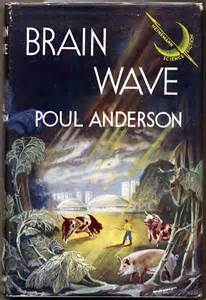
Science fiction can be contemporary or futuristic. Indeed, it can even be historical. See several works by Poul Anderson. However, the present and the future are the main concerns of sf. The future can mean any time from the day after tomorrow (Brain Wave) to beyond the end of the universe (Tau Zero).

The day after tomorrow may be the same as today except for a single technological innovation, as in "Life-Line" by Robert Heinlein. Brain Wave begins with a global increase in intelligence which generates every conceivable technological innovation, then the transcendence of humanity.

CS Lewis' Ransom Trilogy comprises two contemporary interplanetary novels and one "day after tomorrow" novel. Thus, Lewis presents the unusual but wholly appropriate sequence of Mars, Venus and Earth.

Reading American sf comics in the 1950s, I divided sf into before or after the invention of spaceships. The earliest future histories begin before space travel. Heinlein's Future History begins with "Life-Line." An escape velocity rocket fuel is not developed until the end of the fourth story.

In Anderson's Psychotechnic History, the opening story is set on a devastated Earth but the second begins on a colonized Mars. Anderson's Technic History and Larry Niven's Known Space future history begin with the exploration of the Solar System whereas Jerry Pournelle's CoDominium future history begins with regular interstellar travel. So there is some progress.

Wells' Time Traveler tells his dinner guests that he traveled through tomorrow, as if it were another country, then further into futurity. Thus, twenty four hours later, he and they have lived through the day that he traveled through while he traveled through it. Extraordinary.

Saturday, 12 March 2016

Some More Comparisons

Starting from Poul Anderson's eight (or nine) future histories, we have moved sideways in fictional time, finding interesting parallels with future history series by several other sf writers. Much of this discussion stays here on the Poul Anderson Appreciation blog because this is where it starts and because this is where page viewers come to. However, for further discussion of other future histories, please see the James Blish Appreciation and Science Fiction blogs, both linked to this one.

Here is another set of comparisons:

(i) In James Blish's Cities In Flight, Volume I, They Shall Have Stars, state security and secrecy stifle science whereas Jerry Pournelle's CoDominium goes even further by suppressing technologies with military applications, thus killing most research.

(ii) In Cities..., the USSR takes over the US whereas the CoDominium is a US-USSR alliance. I wondered where all the nationalism came from. It is a reaction against CD world domination. Blish's Bureaucratic State and its thought police go on to ban even fictional references to spaceflight as Unearthly Activities.

(iii) The CoDominium is succeeded by two interstellar Empires of Man. The Bureaucratic State is succeeded by some interstellar empires but mainly by the interstellar economy of the flying cities.

(iv) The CoDominium History culminates in First Contact with aliens whereas Cities... culminates in the mutual annihilation of two universes and the creation of several more:

"Creation began."
-James Blish, Cities In Flight (London, 1981), p. 596.

(v) Returning to our main man, Anderson shows cosmic beginnings in "Flight to Forever," Tau Zero and The Avatar whereas Pournelle concentrates on militarism - not an inherently science fictional theme.

Thursday, 5 November 2015

We Are Not Alone

A guy I know:

researches local history;

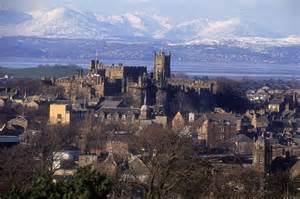
shows tourists around Lancaster Castle (see image);

has read Poul Anderson with pleasure;

specifically mentioned Tau Zero;

was disappointed on rereading Asimov later in life;

also mentioned CS Lewis' Ransom Trilogy and DC superhero comics;

knew some people at Lancaster University who, moving a glass between letters on a table, came across the name "Eric Blood-Axe," allegedly for the first time, and were told by the glass that Eric/Eiric is buried in a nearby town whereas Anderson has him lying where he fell at Stainmore.

Just another few facets of an always surprising universe, in the immortal words of Mainwethering of the Time Patrol.

Saturday, 25 July 2015

Desert Island Book

There is a radio program called Desert Island Discs. Do they have it in the States? A guest says which ten or so pieces of music s/he would want on a desert island, plus one book other than the Bible or Shakespeare. My book would have to be Time Patrol. I would reread this omnibus volume from cover to cover, looking for previously unnoticed details on each page, like:

the admirable economy and skill with which Anderson introduces the doubly complex concept of a time travel organization in a mutable timeline;

physical descriptions of locations in diverse periods;

discussions of divergent timelines and the creation of such a timeline in "Delenda Est;"

the increasing subtlety, sophistication and complexity of the series when the author returns to it after a decade-long interval (I am additionally thinking of The Shield Of Time which, by the rules of Desert Island Discs, I would not also have on the island);

comparisons and contrasts with The Time Machine, which ideally I would also have smuggled onto the island.

It is invidious to ask which is the "best" of an author's works. Tau Zero is a classic of hard sf but A Midsummer Tempest is equally excellent in the very different category of literary fantasy. If I were to be allowed not just one volume but two entire series, then they would have to be the Time Patrol and the Technic History, totaling nine long volumes. Each series contains several individual works of extremely high quality. In the Time Patrol, Manson Everard has a protege, Wanda Tamberly. In the Technic History, Nicholas van Rijn has a protege, David Falkayn, and Dominic Flandry is succeeded by his daughter, Diana Crowfeather. And there are others. Two series give us many characters.

Returning to SM Stirling whom I have been reading as a worthy successor of Anderson and in any case worth reading in his own right, I can rank the four novels that I have read so far in order of preference:

The Peshawar Lancers
Conquistador
The Sky People
In The Courts Of The Crimson Kings

And Marching Through Georgia is in the trans-Atlantic post.

Saturday, 13 June 2015

Two Ways To The End Of The Universe

In Tau Zero by Poul Anderson, a spaceship accelerates relativistically between groups of groups of groups of galaxies while the universe collapses and re-expands. By entering the new universe, the ship becomes able to decelerate so that its crew can colonize a planet.

In The Triumph Of Time by James Blish, a planet flies at many times light speed to the place from which the monobloc exploded to become the groups of metagalaxies that still spiral back toward that center. By occupying the Metagalactic Center, the planet will temporarily survive a collision between this universe and its anti-matter counterpart and a specially prepared group of "Survivors" will each be able to create a new universe from his or her own body.

Would you prefer to be in Anderson's spaceship or on Blish's planet?

Friday, 8 May 2015

Between Galaxies

Reflecting on intergalactic sf (previous post) suggested one further author who can be compared in some respects, although by no means all, to Poul Anderson. Fred Hoyle was a British scientist who wrote some Wellsian hard sf, mainly in collaboration with his son, Geoffrey Hoyle. Fred Hoyle's output was, of course, much smaller than Anderson's and he never invoked FTL, not even with a scientific rationale. Alien intelligences affected Earth in other ways. For example, an intelligent gas cloud entered the Solar System and, in a later novel, another star with its planetary attendants passed through.

Hoyle Senior wrote a stage play called Rockets In Ursa Major. I knew someone who had seen it performed. Both Hoyles novelized the play, near future sf assuming regular interplanetary spaceflight. They then wrote a sequel, Into Deepest Space, in which the familiar characters embark on an STL relativistic time dilation intergalactic journey like the one in Tau Zero. Instead of surviving into the next cyclical universe, they pass through (something like) a black hole-white hole system into our flip side universe. (I am relying on memory for this summary.)

Hoyle continues the British Wellsian tradition. CS Lewis wrote anti-Wellsian and anti-Stapledonian sf. James Blish wrote Wellsian sf but also post-Lewisian fantasy and sf. Philip Pullman has written anti-Lewisian fantasy. Hoyle was definitely pro-Wellsian philosophically although he did not explicitly refer to Lewis. Poul Anderson, unlike Hoyle, had a sympathetic understanding of religious belief.

Wednesday, 26 November 2014

More Earlier Information

See here.

For inter-galactic travel by:

Bussard ramjet, see here;
T-machine, see here;
many instantaneous space jumps, see here.

I made a link to the "In Space" post because it imparts information on space in the Cloud Universe. However, it also refers to asteroidal, interstellar and inter-galactic space so I considered it appropriate to add further links to posts covering these aspects of space.

On the issue of inter-galactic travel, as with the end of the universe (see here), AI (see here), future histories (see here) and time travel (see here), Poul Anderson once again seems systematically to address every possible aspect of the topic. Bussard ramjets and T-machines are theoretically possible now. Although, in World Without Stars, the characters visit only a single planetary system in inter-galactic space, instantaneous jumps combined with the antithanatic suggest the intriguing possibilities of visiting every galaxy and of traveling to the relativistic edge of the universe if it has one.

Similarly, in There Will Be Time, two concepts creatively combine: STL + time travel = FTL.

Friday, 29 August 2014

A Progressive Novel

Poul Anderson's Brain Wave changes as we read it. It is successively:

a contemporary novel of enhanced intelligence;
a near future novel of technological advances, including interstellar exploration;
an ultimate vision of a cosmic future.

This progression and conclusion put Brain Wave alongside other Anderson novels, like Tau Zero, World Without Stars and After Doomsday, that place mankind in a galactic or cosmic setting. In fact, despite the novel's pedestrian beginning, the intelligence inhibitor field emanating from the galactic center had already given it an interstellar context before any of its characters left the atmosphere.

Another hard sf writer who did this was Fred Hoyle. Extrasolar influences reached Earth even though Hoyle's characters stayed on the ground.

Friday, 22 August 2014

Characters And Cosmos

Greg Bear, Eon (London, 2002).

No character has ever been more developed than Pavel Mirsky. In the first place, he is killed and resurrected. I know that this happens regularly in a certain kind of fiction - superheroes are, at worst, "currently dead" - but Mirsky suffers more than that. The loss of half of his original brain means that his psychology cannot be reconstructed with total accuracy. But he copes. Even more than that, after a lifetime of state indoctrination, he gains unlimited access to a high tech library and learns. He realizes that he has been lied to about history. He opts out of the power struggle among his fellow Russian survivors of a nuclear war. He opts into a near light speed cosmic journey instead of returning to Earth.

He writes, "So much to learn, and so much change to look forward to...I am free." (p. 495)

There is hope for humanity as long as there are people like Pavel Mirsky.

That cosmic journey is a peculiar one. Instead of traveling through space between super-clusters of galaxies, as in Poul Anderson's Tau Zero, Greg Bear's characters travel along an infinite corridor beyond the domain of the super-sets of our external universes. Mirsky writes:

"Even were we to stop now and open gates to the 'outside,' whatever that may be, we would encounter realms without matter, perhaps without form or order; it is highly doubtful we would find anything familiar." (p. 492)

Mirsky writes more about what is "outside" but it is highly abstract. I would like to see these "realms" dramatized somehow. Otherwise, what is their role in a novel?

Tuesday, 18 March 2014

Journeys

Jules Verne wrote fifty four Extraordinary Voyages. Reflecting on recent posts, I have noticed how many very different kinds of journeys Poul Anderson recounts:

the intergalactic and inter-cosmic space journey in Tau Zero;
 
Jack Havig's long return from the Pleistocene near the end of There Will Be Time;

Manson Everard's walk through medieval Sicily in The Shield Of Time;

an alternative first journey to the Moon, also a supernatural journey to Yggdrasil, in Operation Luna;

and, in The Corridors Of Time:

a car trip from Copenhagen to west Jutland in 1964 AD;

a walk through a Jutish forest in 1827 BC;

a time journey involving transfers between corridors;

another that is just in and out of opposite ends of a single gate;
 
by Warden spaceship between hemispheres, by gravity belt through an Atlantic storm, on foot and by belt through Niyorek to Brann's tower.

 And now someone will tell me what I have missed?

Friday, 31 January 2014

A Science Myth

Science has myths as well as fiction. A myth is a meaningful story that recurs in fiction but is independent of any text. Thus, we all know of the Flood whether or not we have read the Biblical account of it. In that myth, the universe was created by separating the waters. The Flood undid the creation and thus was an interval between the Adamic and Noachian universes. A third universe is created in the last Biblical book.

A cyclical universe is a feature of ancient Oriental and modern scientific cosmologies. In the scientific myth, cosmic expansion is slowed, then reversed, by gravity; there is a collapse to a point from which re-expansion begins.

This myth is in at least three of Poul Anderson's works:

in Tau Zero (hard sf), a continuously accelerating relativistic spaceship carries its crew, like Noah's Ark, into the next cosmic cycle;

in "Flight to Forever" (hard sf), a time machine carries its occupant into the next cosmic cycle;

in "Pact" (humorous fantasy, not Anderson's best), a demon compelled by a compact carries an astronomer's soul into the next cosmic cycle.

By "myth," I do not, in this case, mean a falsehood. Thus, the cyclical universe, in Stapledon's, Anderson's and other sf, could remain both a meaningful story and a current scientific theory. However, the cosmic expansion is not slowing but accelerating due to the as yet not understood "dark energy" which has the potential to generate new myths.

Sunday, 17 November 2013

Connections With Fiction II

In Poul Anderson's Is There Life On Worlds? (New York, 1963):

The Technic Civilization History

(i) "It may be possible to make a very large number of small quantum jumps per second." (p. 166)
This is the kind of "hyperspace" used in the Technic History, thus it is not a fourth spatial dimension.

(ii) "[Interstellar] Commerce will deal mostly in luxuries and curiosa." (p. 168)
Hence, Nicholas van Rijn's Solar Spice & Liquors Company.

(iii) "...hydrogen and oxygen breathers can have little to trade with each other and perhaps little to say to each other once some scientific questions have been answered." (p. 168)
Thus, the Dispersal of Ymir (hydrogen breathers, colonizing Jovoid planets) occupies the same space as the Terran Empire and the Merseian Rhoidunate (oxygen breathers, colonizing terrestroid planets).

(iv) "Joint colonization is not unthinkable, and could lead to some extraordinarily interesting societies." (p. 188)
This one sentence makes me want to reread the two short stories and one novel set on the joint human-Ythrian colony planet Avalon. Anderson systematically presents colonization of the islands, colonization of the continent and resistance to Terran imperialism.

Tau Zero

(v) "Alternatively, the gas of space might be scooped up and used as fuel and ram jet reaction mass.This would permit...velocities very close indeed to c." (p. 198)
This is the Bussard ram jet, used in Tau Zero and in some other works of sf. In Tau Zero, the spaceship approaches c with spectacular results. Unfortunately, Anderson adds, "...I am not sure that it is really feasible." (ibid.)

(vi) "Interstellar navigation will be difficult." (p. 199)
Anderson mentions the Doppler effect, aberration and imprecise location of destination. In Tau Zero, the ship at near light speed must navigate in the dark between clusters of galaxies. New sciences must effectively be created for this purpose.

(To be continued.)

Monday, 11 March 2013

Cosmic Histories

Olaf Stapledon wrote:

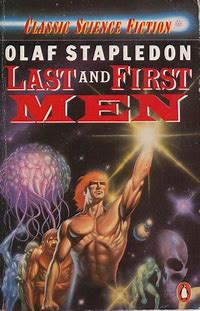
a future history, Last And First Men;

a futuristic perspective on past history, Last Men In London;

an unfinished cosmic history, Nebula Maker;

a completed cosmic history, Star Maker;

a contemporary science fiction (sf) novel linked to Last Men and Star Maker, Odd John;

a short story set in one of the sonic universes created by the experimenting Star Maker, "A World of Sound."

Martians invade Earth. Terrestrials invade Venus and Neptune where they become Venerians and Neptunians, respectively. Neptunians mentally time travel. The Solar System is a different place after the catastrophe that led to the colonization of Neptune. The galactic mind briefly reviews Solar history, then merges into the cosmic mind which glimpses the Star Maker and his ultimate cosmos to which ours is related as a single particle.

Stapledon presents four Wellsian themes, time travel, space travel, Martian invasion and future history, in the first Last Men volume. Further, his fictitious history summarizes the entire human future whereas his predecessor, Wells, had initiated future histories by recounting two centuries including a major turning point. Stapledon, the ultimate sf writer according to Brian Aldiss, and also in my opinion, was at home in places that most people do not know about.

In my experience of reading sf, Stapledon's main successor is Poul Anderson. Readers of more recent cosmic-scale authors will have to tell me whether they think that those authors write as well as Wells, Stapledon or Anderson.

Anderson's much greater body of work includes several future histories. An outline of a cosmic history emerges from his Tau Zero, with significant input from "Pride" (IN Anderson, Space Folk, New York, 1989):

Sol's brown dwarf ("half-star" (p. 1); "sub-sun" (p. 20)) companion, Nemesis, has several large planets, one bearing life;

Nemesis' orbit intersects the Oort cloud, disrupting cometary orbits, thus causing some comets to fall towards the Sun;

cometary impacts kill many Terrestrial species, including dinosaurs, ammonites and Miocene mammals;

homo sapiens becomes dominant on Earth;

there are nuclear wars in the late twentieth century;

entrusted with maintaining world peace, Sweden becomes the single super power for at least two centuries;

Antarctica, the Moon and Mars are colonized;

a Bussard spaceship, Anna Lovinda, makes the four light year round trip to Nemesis, thus establishing that the four light year one way trip to Alpha Centauri is feasible;

Bussard spaceship crews explore and colonize several extrasolar planets;

one spaceship, Leonora Christine, accelerates uncontrollably until the universe contracts and re-expands;

the Leonora Christine crew colonizes a terrestroid planet in the new universe;

their descendants might become the Elder Race of that universe.

Anderson has no Stapledonian observer overseeing cosmic history but does present a continuous narrative from Nemesis in the far past to a human universe in an immeasurable future.

Despite the conceptual link between them, Anderson's Tau Zero and World Without Stars cannot occupy the same timeline because, in the latter novel, the early twenty first century is dominated not by Sweden in the aftermath of nuclear warfare but by the imminent production of the antithanatic. In any case, Tau Zero presents a relativistic universe where one character dismisses the notion of faster than light travel as a fantasy whereas a premise of World Without Stars is the possibility of instantaneous intergalactic jumps. These are two different and independent cosmic novels.

Sunday, 10 March 2013

"Pride"

Early references to spacemen of different nationalities speaking Swedish, to Stockholm as their capital city and to the Control Authority keeping world peace establish that Poul Anderson's "Pride" (IN Anderson, Space Folk, New York, 1989, pp. 1-28) is set in the same future timeline as his Tau Zero. Otherwise, "Pride" would have been simply an independent story of space exploration. I suppose that any number of stories set in space could be linked into a radial series if their texts were to incorporate such common background references.

The spaceship Anna Lovinda has two purposes:

to test the Bussard drive that might be used for interstellar journeys - and is in Tau Zero;

to investigate "Nemesis, long-unseen companion of Sol..." (p. 5), a "brown dwarf" (intermediate in mass between a star and a planet), and even to land smaller craft on some of its planet-sized satellites.

Nemesis is so called because it is the body whose passage through the Oort cloud disturbs the comets so that some fall towards Sol with catastrophic consequences if they hit the inhabited inner planet. James Blish's unfinished novel King Log features Beta Solis, the long unseen white dwarf companion of Sol, and its planets, including one that is inhabited.

My Anderson agenda has become:

to finish rereading "Pride" because of its connection to Tau Zero and because it is interesting in itself;

to return to rereading the fascinating World Without Stars, which is a companion volume to Tau Zero since both are transgalactic in scope;

to reread "Call Me Joe" because it is a further Anderson work set on Jupiter;

maybe to reread "A Bicycle Built For Brew" and one or two other early works with common backgrounds.

Rereading just became more complicated.

Thursday, 7 March 2013

Remote Galaxies

We are used to interplanetary or interstellar travel in science fiction. In Tau Zero, Poul Anderson, defining "families" as clusters of galaxies and "clans" as clusters of clusters, presents both inter-family and inter-clan travel at relativistic speeds. In World Without Stars (New York, 1966), he presents intergalactic travel by instantaneous jumps.

A remote galaxy is said to have a relative velocity that is "...a goodly fraction of c." (p. 7) Surely even remoter galaxies have relative velocities just under c? A ship in galaxy 1 accelerates to the relative velocity of galaxy 2, then jumps to galaxy 2 where it can rest and resupply in a starport. From this base of observation, it can establish the position and relative velocity of galaxy 3, then accelerate enough to jump to galaxy 3. Thus, the entire universe is accessible. With aging ended by the antithanatic, a spaceman might visit every galaxy? Unfortunately, Anderson does not develop this idea further, writing only this one novel about an expedition to a planet in intergalactic space.

The crew of the Meteor (as identified in Chapters III and IV):

Felipe Argens, captain;
Hugh Valland, gunner, second deck officer;
Yo Rorn, electronician;
Enver Smeth, chemist;
Alen Galmer;
Chu Bren;
Galt Urduga;
two others.

Like Robert Heinlein's Lazarus Long, Valland is probably the oldest member of the human race. Like Heinlein's Jetman Rhysling, he is both a spaceman and a singer. He discloses that, five centuries previously, he had composed a song that is known to Argens. Differences from Rhysling: Valland is not blind and plays an "omnisonor," not an accordion. Cover artists have depicted the omnisonor.

Unfortunately, Heinlein went on to write hundreds of pages of drivel about Long. Also unfortunately, Anderson wrote nothing more about Valland, although he did give us another immortal, Hanno, in The Boat Of A Million Years. Hanno crosses interstellar distances at relativistic speeds and agrees to meet fellow immortals again in another million years. Even Anderson was not able to envisage such a meeting.

Wednesday, 6 March 2013

Through Space


Very often in science fiction, interesting events occur on another planet and space is merely the distance that has had to be traveled, or the void that has had to be traversed, in order to reach that planet. If events do occur en route, then they usually occur entirely within the closed environment of the spaceship. It is rare that space itself is presented as an environment where events can occur or where there is the equivalent of a landscape with distinctive features that can be discovered by traveling between them.

As can be expected, Poul Anderson does more than once focus on what space travelers see and fly past outside their ship while they are traveling. In "Starfog," we learn that, millennia earlier, a ship fleeing from a conflict had traversed two spiral arms and passed through a dark nebula before colonizing a planet in a bright opaque cluster. Descendants of those colonists, traveling in an experimental interstellar ship, emerge from their cluster into what is to them the unfamiliar environment of dark space where stars are distant points light years instead of light months apart.

Remembering legendary accounts of space as dark and sighting the distant Dragon's Head nebula, they reason that their ancestors might have passed through such an even darker region in order to evade pursuit so they steer towards and through the nebula. There, on the far side of the nebula, they locate an industrialized colony planet by detecting its neutrino emissions and manage to reach it before running out of fuel. Thus, the journey itself has involved passing through physically different regions and steering by the landmark of the nebula.

In Tau Zero, a spaceship making an interstellar journey but accelerating uncontrollably must fly into the space between clusters of galaxies to attempt repairs but must then fly between clusters of clusters to effect the repairs, steers across a hundred million light years of dark and empty space to the next "clan" (cluster of clusters) but, unable to stop, keeps going between and through clans until the universe contracts at which point the ship orbits around the new monobloc until that explodes into a new universe.

The ship's crew colonizes a planet in the new universe but, obviously, the main point of the story has been how they got there.

Stars Between Galaxies

In Poul Anderson's Tau Zero, a spaceship crossing intergalactic space passes a red dwarf star with planets. The astronomer on the ship does not know whether the red dwarf had originated in the normal way within a galaxy or in some unknown way between galaxies.

Anderson's World Without Stars (New York, 1966) answers this question:

hydrogen clouds condensed into galaxies;
smaller condensations became intergalactic star clusters which, however, did not endure because -

(i) their giants went supernova,
(ii) cosmic expansion dispersed matter, thus preventing any further star formation,
(iii) galactic gravitation broke the clusters up;

thus, only the long living red dwarfs were left.

Captain Argens, en route to a planet of such a star, explains all this to his two new crew members and thus to us. I thought that two spacemen would not need to be told how stars formed. Sure enough, Rorn complains:

" 'Please...Valland and I do know elementary astrophysics.' " (p. 19)

Valland agrees that he does but is beginning to realize the implications in intergalactic space: old stars and planets that are metal-poor because supernova enrichment stopped early but with lighter elements and life, including intelligent races that might have needed millions of years to industrialize and therefore have learned different things along the way.

These Yonderfolk can travel only to the galactic rim and then only with heavy radiation screening because the radiation level within any galaxy would kill them. Valland wonders whether they have natural immortality but Argens points out that quantum processes, viruses and chemicals can also mutate cells. Valland's speculation echoes Anderson's story "What Shall It Profit?" in which a man is made immortal by shielding him from all radiation in a very restricted environment deep underground. He is physically immortal but mentally undeveloped, an experimental dead end.

Tuesday, 5 March 2013

World Without Stars

Thematically, Poul Anderson's World Without Stars is like a detail from his Tau Zero. In the latter novel, a spaceship on a cosmic journey flashes past a solitary star with planets in intergalactic space. The main action of the former is set on a planet of such a star.

Conceptually, the two novels are set in different universes. Tau Zero is entirely relativistic whereas World Without Stars is yet another faster than light (FTL) scenario. It has to be to allow its protagonists to travel from their civilisation to intergalactic space and back again in a reasonable time. The STL ship of Tau Zero simply never returns home.

Recently, this blog noted three different Andersonian rationalisations of FTL:

the many instantaneous quantum jumps of the Technic History;

the closed spatial curve allowing limitless acceleration in The Star Fox/Fire Time series (for which I suggest the title Star Time);

the interference fringes of standing waves in After Doomsday.

Now we have:

gravity is too weak and slow to explain cosmic cohesion;

every point is equivalent to every other in the intrinsic unity of space;

locations are distinguished only by the coordinates of the mass present in them;

matter-energy field configurations described by these coordinates can be altered artificially;

then the mass instantaneously jumps to the other location;

it retains its momentum plus or minus the difference in gravitational potential;

energy differentials must be made up in stages;

hence the need for time-consuming spatial journeys between jumps;

but really remote galaxies can be accessed by a series of jumps.

As I said about After Doomsday, it is a pity that there is not an entire series set in this scenario.

Myth And Science


Life is:

beginnings, endings and new beginnings;
birth, growth, death and regrowth.

Myths reflect life:

Ginnungagap and Ragnarok;
death and renewal;
a new heaven and a new earth;
old gods and new gods.

Science confirms cosmic beginnings and endings:

monobloc and heat death;
between them, stellar condensations and destruction;
second generation stars and planets, including life on Earth reflected in myths.

Thus, myths are a major part of human life which is a very small part of the cosmic process.

Science fiction generates modern myths out of a scientific worldview. In the Preface to what science fiction readers call his "future history," Last And First Men (Harmondsworth, Middlesex, England, 1972), Olaf Stapledon writes that this novel is neither prophecy nor futuristic historiography, nor does he aim merely "...to create aesthetically admirable fiction." (p. 11) Instead, the book "...is an essay in myth creation." (p. 12)

"A true myth is one which, within the universe of a certain culture (living or dead), expresses richly, and often perhaps tragically, the highest admirations possible within that culture." (p. 11)

Several of Poul Anderson's works are Stapledonian in their scale and scope:

" 'The universe - the whole universe - it's dying.' " (Tau Zero, London, 1973, p. 170)

" 'I propose we go on to the next cycle of the cosmos.' " (ibid, p. 174)

Here is the ultimate death and renewal. The child born in "...the ship of man..." will not be called Eve or Embla because her parents do not want her to be a symbol but, by mentioning these names at this crucial point, Anderson closes the circle between the old myths and this new story. (pp. 180, 181)