In Poul Anderson's After Doomsday, the crews of two interstellar spaceships have survived the genocidal sterilization of Earth. In James Blish's The Day After Judgement, mankind has survived a limited nuclear war. Thus, so far, two futuristic sf novels, each featuring a technological threat to all life on Earth. In Anderson's There Will Be Time, the civilization-destroying nuclear war is called the Judgment War. Thus, Anderson uses the terms "Doomsday" and "Judgment" in two similar secular contexts.
However, what I have not mentioned so far is that Blish's use of the term, "Judgment," is Biblical and apocalyptic. The nuclear exchange was just one aspect of Armageddon, which the demons have won. Thus, we are reading fantasy, not sf. On the other hand, it is what I have called "hard fantasy," reading very much like sf and, if its speculation that eternal life is full negative entropy were to be developed further, then it would return to the realm of sf with the angels and demons scientifically rationalized.
The Startegic Air Command attacks the demon fortress of Dis now manifested in the Valley of Death, Death Valley: science versus the supernatural, a concrete expression of the theme of Blish's After Such Knowledge Trilogy. Anderson presents scientific rationales of fantasy ideas in some works discussed recently on the blog.
Showing posts with label After Doomsday. Show all posts
Sunday, 20 March 2016
Friday, 29 August 2014
A Progressive Novel
Poul Anderson's Brain Wave changes as we read it. It is successively:
a contemporary novel of enhanced intelligence;
a near future novel of technological advances, including interstellar exploration;
an ultimate vision of a cosmic future.
This progression and conclusion put Brain Wave alongside other Anderson novels, like Tau Zero, World Without Stars and After Doomsday, that place mankind in a galactic or cosmic setting. In fact, despite the novel's pedestrian beginning, the intelligence inhibitor field emanating from the galactic center had already given it an interstellar context before any of its characters left the atmosphere.
Another hard sf writer who did this was Fred Hoyle. Extrasolar influences reached Earth even though Hoyle's characters stayed on the ground.
a contemporary novel of enhanced intelligence;
a near future novel of technological advances, including interstellar exploration;
an ultimate vision of a cosmic future.
This progression and conclusion put Brain Wave alongside other Anderson novels, like Tau Zero, World Without Stars and After Doomsday, that place mankind in a galactic or cosmic setting. In fact, despite the novel's pedestrian beginning, the intelligence inhibitor field emanating from the galactic center had already given it an interstellar context before any of its characters left the atmosphere.
Another hard sf writer who did this was Fred Hoyle. Extrasolar influences reached Earth even though Hoyle's characters stayed on the ground.
Monday, 18 August 2014
A New Eon VII
Greg Bear, Eon (New York, 2002).
The major nuclear exchange has begun. Patricia Vasquez is inside the orbiting Stone where pictures from Earth are viewed on a wide-screen video but -
"Patricia did not look at the video screen. She had seen satellite and lunar telescope pictures of the conflagration in the Thistledown City library. Somewhere on Earth...copies of those pictures were being embraced by the destruction they depicted, an ouroboros of doom." (p. 200)
Well, not quite. Thistledown City is inside the Stone which has come from the future but also from a different timeline. I use the terminology of "timeline 1" and "timeline 2" for convenience although that terminology is not used in this novel. The war in timeline 2 has started slightly later than the war in timeline 1 and involves the Stone which had not been present in this period of timeline 1 so this war is not identical with the one depicted in the Thistledown City library.
Occasionally, the title of one sf novel appears as a significant phrase in the text of another. Thus, here we have:
"No rest, no end, even after doomsday." (p. 202)
- another Anderson echo.
Patricia realizes that she can access a universe where her parents still live because the war did not happen. However, she would need to find a universe, or timeline, in which her parents lived but she had died if she wanted to step into her own shoes in that universe.
The major nuclear exchange has begun. Patricia Vasquez is inside the orbiting Stone where pictures from Earth are viewed on a wide-screen video but -
"Patricia did not look at the video screen. She had seen satellite and lunar telescope pictures of the conflagration in the Thistledown City library. Somewhere on Earth...copies of those pictures were being embraced by the destruction they depicted, an ouroboros of doom." (p. 200)
Well, not quite. Thistledown City is inside the Stone which has come from the future but also from a different timeline. I use the terminology of "timeline 1" and "timeline 2" for convenience although that terminology is not used in this novel. The war in timeline 2 has started slightly later than the war in timeline 1 and involves the Stone which had not been present in this period of timeline 1 so this war is not identical with the one depicted in the Thistledown City library.
Occasionally, the title of one sf novel appears as a significant phrase in the text of another. Thus, here we have:
"No rest, no end, even after doomsday." (p. 202)
- another Anderson echo.
Patricia realizes that she can access a universe where her parents still live because the war did not happen. However, she would need to find a universe, or timeline, in which her parents lived but she had died if she wanted to step into her own shoes in that universe.
Sunday, 26 January 2014
If Ever I Forget Thee...
This may be the last post of this month. I like to work in round numbers and 30 is a respectable number for a 31 day month. Page views increase when posts increase but I can't increase them all the time!
I have just attended an Inter-Faith Holocaust Memorial Day Service at Lancaster Priory Church, where the choir sang from Psalm 137, "If I forget thee, O Jerusalem..."
As always happens, I cannot put my hand on Poul Anderson's After Doomsday when I want to refer to it. However, in that novel, all life on Earth has recently been destroyed, the only human survivors being the crews of two exploratory interstellar spaceships. The leader of the American crew is not Jewish or specifically religious but, when the memory of what has been lost hits him, he expresses that loss with the heartfelt cry, "If ever I forget thee, O Jerusalem..."
And that seems an appropriate place to finish for this month.
I have just attended an Inter-Faith Holocaust Memorial Day Service at Lancaster Priory Church, where the choir sang from Psalm 137, "If I forget thee, O Jerusalem..."
As always happens, I cannot put my hand on Poul Anderson's After Doomsday when I want to refer to it. However, in that novel, all life on Earth has recently been destroyed, the only human survivors being the crews of two exploratory interstellar spaceships. The leader of the American crew is not Jewish or specifically religious but, when the memory of what has been lost hits him, he expresses that loss with the heartfelt cry, "If ever I forget thee, O Jerusalem..."
And that seems an appropriate place to finish for this month.
Friday, 1 March 2013
God And Dog
Back to the ballad of the battle of Brandobar: I said earlier that any screen adaptation would require one voice for the narrative lines, one for the repeating lines and one for the annotations. However, the narrative includes four speakers (Vorlak, Monwaing wisemen, Tarkamat and the wanderer chief) as well as a narrator so there should be seven voices in total.
Two of the repeating lines change.
"(New centuries scream in birth)" (pp. 128, 129, 130, 131, 132, 133)
- becomes at the end:
"(New centuries sing in birth)" (p. 133).
"(A bugle: the gods defied!)" (pp. 127, 128, 129, 131, 132, 133)
- becomes in the middle:
"(A bugle: the dogs defied!)" (p. 130),
but I imagine that this second change was a mistake?
There is one slight possibility that it makes some sense (but I don't think so). I characterised the alien races in After Doomsday as respectively avian, wolverine, arachnid, humanoid and centauroid. The Vorlakka, whom I called "wolverine" "...were supposed to be humanoid..." (p. 55). They are bipedal but covered in fur and their faces are "...bluntly dog-like, black-nosed, with carnivore teeth." (p. 55) So maybe "canine" would have been a more accurate description? - though not as implying quadrupedalism. So they might conceivably be the "dogs" that are being defied by Kandemir on p. 130?
A god-dog appears at least twice in European literature. Socrates, not wanting to take any god's name in vain, swore instead "by the dog" and was accused of introducing strange gods! He thus unwittingly introduced an anagram in English though not, of course, in Greek. (I remember a school acquaintance who would say, "I swear to God!", when all that he meant by this was, "I want you to believe what I am saying!" I prefer Socrates' caution against misusing divine names.)
I do not have this reference to hand but the hero of Aldous Huxley's Eyeless In Gaza, sunbathing on a flat roof with his girl friend, remarks, when a small private plane flies overhead, "They'll have a God's eye view of us," just before a dog falls from the plane. Spattered with blood, the character screams spontaneously, then, quickly recovering his customary ironic detachment, drawls, "Yet another reason to dislike dogs," thus souring his relationship with the girl friend.
When this novel was televised, my mother, who knew that I had read and liked the book, asked me, "What was the significance of the dog?" God's judgement on a shallow relationship? In any case, an ironic inversion of the hero's casual reference to God. The reader, or viewer, is never shown what had happened in that plane so that could be an incident in another novel.
But this has been a long digression from a probable typing error in Poul Anderson's novel so I will end it there.
Two of the repeating lines change.
"(New centuries scream in birth)" (pp. 128, 129, 130, 131, 132, 133)
- becomes at the end:
"(New centuries sing in birth)" (p. 133).
"(A bugle: the gods defied!)" (pp. 127, 128, 129, 131, 132, 133)
- becomes in the middle:
"(A bugle: the dogs defied!)" (p. 130),
but I imagine that this second change was a mistake?
There is one slight possibility that it makes some sense (but I don't think so). I characterised the alien races in After Doomsday as respectively avian, wolverine, arachnid, humanoid and centauroid. The Vorlakka, whom I called "wolverine" "...were supposed to be humanoid..." (p. 55). They are bipedal but covered in fur and their faces are "...bluntly dog-like, black-nosed, with carnivore teeth." (p. 55) So maybe "canine" would have been a more accurate description? - though not as implying quadrupedalism. So they might conceivably be the "dogs" that are being defied by Kandemir on p. 130?
A god-dog appears at least twice in European literature. Socrates, not wanting to take any god's name in vain, swore instead "by the dog" and was accused of introducing strange gods! He thus unwittingly introduced an anagram in English though not, of course, in Greek. (I remember a school acquaintance who would say, "I swear to God!", when all that he meant by this was, "I want you to believe what I am saying!" I prefer Socrates' caution against misusing divine names.)
I do not have this reference to hand but the hero of Aldous Huxley's Eyeless In Gaza, sunbathing on a flat roof with his girl friend, remarks, when a small private plane flies overhead, "They'll have a God's eye view of us," just before a dog falls from the plane. Spattered with blood, the character screams spontaneously, then, quickly recovering his customary ironic detachment, drawls, "Yet another reason to dislike dogs," thus souring his relationship with the girl friend.
When this novel was televised, my mother, who knew that I had read and liked the book, asked me, "What was the significance of the dog?" God's judgement on a shallow relationship? In any case, an ironic inversion of the hero's casual reference to God. The reader, or viewer, is never shown what had happened in that plane so that could be an incident in another novel.
But this has been a long digression from a probable typing error in Poul Anderson's novel so I will end it there.
Human Superiority
Before returning to the theme of human superiority in Poul Anderson's After Doomsday (St Albans, Herts, 1975), let us pause to consider a splendid example of inferiority as expressed in perhaps the longest, most obsequious, "thank you" anywhere in literature. A Vorlakkan adviser asks:
" 'My captain...dare this worm express thanks for your graciousness in heeding his prayer, or should he accept it in silence as the winter earth accepts vernal sunshine?'" (p. 121)
Elsewhere in Anderson's works, only Pum, the ancient Tyrean recruited to the Time Patrol, has such a gift for exaggerated flattery and self-abasement.
Elsewhere in the same conversation, the human leader, Donnan, advises the Vorlakkan leader, Hlott:
" '...if a massive scientific-technological effort can be mounted. If the best Vorlakka and allied minds can work together. And that's the real technique we Earthlings have got that you don't. A feudal society like yours, or a nomadic culture like Kandemir, or a coalition of fragments like Monwaing, isn't set up to innovate on purpose. We can tell you how to mount a development project.' " (p. 123)
But Donnan must reinforce this argument by warning that he has also spoken to other Councillors who will cooperate if their current president, Hlott, does not. The moral is drawn at the end of the chapter:
"Practical politics was another art which had been more highly developed on Earth than it was here." (p. 126)
(In Anderson's History of Technic Civilization, Dominic Flandry easily subverts the Scotani Empire when he becomes their prisoner.)
Is there anything at which human beings do not excel? Apparently not. In the following chapter, vassals of Kandemir are offered independence and assistance in return for helping to overthrow their nomadic oppressors:
"Soon allied agents were being smuggled onto those planets, to disseminate propaganda and organize underground movements along lines familiar to Earth's history." (p. 134)
And, in the chapter after that:
"Vorlak and Monwaing command ships by the thousands and troops by the million, but they listen to Carl Donnan with deepest respect...The newly freed planets...are already a great power...their deliberative assembly is presided over by a human." (p. 138)
(European feudal barons preside among extrasolar races in Anderson's The High Crusade.)
- while, in another civilization-cluster, the Earthwomen:
" '...ve got rich fast. In a few more years, Terran Traders, Inc., would have been the greatest power in that galactic region.' " (p. 139)
Finally, when it is revealed that a Monwaingi Society had sterilised Earth, the Monwaingi Ramri sets out to cleanse his race by civil war and, when the human beings remind him that his people lead the cluster, he replies, " 'You must succeed us.' " (p. 158)
But are human beings always superior in Anderson's science fiction? No. Anderson explored every possibility. The Ishtarians in his Fire Time are superior in many ways and one of his many collections is on the theme of alien races that are more advanced or more intelligent than humanity.
" 'My captain...dare this worm express thanks for your graciousness in heeding his prayer, or should he accept it in silence as the winter earth accepts vernal sunshine?'" (p. 121)
Elsewhere in Anderson's works, only Pum, the ancient Tyrean recruited to the Time Patrol, has such a gift for exaggerated flattery and self-abasement.
Elsewhere in the same conversation, the human leader, Donnan, advises the Vorlakkan leader, Hlott:
" '...if a massive scientific-technological effort can be mounted. If the best Vorlakka and allied minds can work together. And that's the real technique we Earthlings have got that you don't. A feudal society like yours, or a nomadic culture like Kandemir, or a coalition of fragments like Monwaing, isn't set up to innovate on purpose. We can tell you how to mount a development project.' " (p. 123)
But Donnan must reinforce this argument by warning that he has also spoken to other Councillors who will cooperate if their current president, Hlott, does not. The moral is drawn at the end of the chapter:
"Practical politics was another art which had been more highly developed on Earth than it was here." (p. 126)
(In Anderson's History of Technic Civilization, Dominic Flandry easily subverts the Scotani Empire when he becomes their prisoner.)
Is there anything at which human beings do not excel? Apparently not. In the following chapter, vassals of Kandemir are offered independence and assistance in return for helping to overthrow their nomadic oppressors:
"Soon allied agents were being smuggled onto those planets, to disseminate propaganda and organize underground movements along lines familiar to Earth's history." (p. 134)
And, in the chapter after that:
"Vorlak and Monwaing command ships by the thousands and troops by the million, but they listen to Carl Donnan with deepest respect...The newly freed planets...are already a great power...their deliberative assembly is presided over by a human." (p. 138)
(European feudal barons preside among extrasolar races in Anderson's The High Crusade.)
- while, in another civilization-cluster, the Earthwomen:
" '...ve got rich fast. In a few more years, Terran Traders, Inc., would have been the greatest power in that galactic region.' " (p. 139)
Finally, when it is revealed that a Monwaingi Society had sterilised Earth, the Monwaingi Ramri sets out to cleanse his race by civil war and, when the human beings remind him that his people lead the cluster, he replies, " 'You must succeed us.' " (p. 158)
But are human beings always superior in Anderson's science fiction? No. Anderson explored every possibility. The Ishtarians in his Fire Time are superior in many ways and one of his many collections is on the theme of alien races that are more advanced or more intelligent than humanity.
Credible Aliens? II
In Poul Anderson's After Doomsday (St Albans, Herts, 1975), after avians, wolverines, arachnids and humanoids, we encounter the centauroid Xoans: quadrupedal body the size of a Shetland pony with arms, comb and proboscis. How many intelligent quadrupeds does Anderson have? Xoans, Ishtarians, Donarrians, Wodenites and two sets of Jovians at least, I think.
Despite his alien body, the Xoan has familiar body language:
"The Xoan seemed nervous, shuffling his feet and twitching his proboscis." (p. 112)
It seems that a Xoan ship sold doomsday devices to two Terrestrial nations and this might explain the sterilization of Earth, the Doomsday of the title. This Xoan has an interesting opinion of humanity:
" 'The whole race was mad. Best they did die, before their lunacy threatened everyone else.' " (p. 114)
(Another parallel with comic book superhero fiction: in 1989, an Alien Alliance, deciding that Earth was a galactic threat because it had so many super-powered beings, invaded, planting a beachhead in Australia, and demanded the surrender of all superheroes, who would be incarcerated in an orbiting prison. Several superheroes on Earth are aliens and one couple continued to defend Earth although their home planet was in the Alliance.)
The idea that Terrestrials are somehow unique among intelligent species is common in Campbellian sf, having been encouraged by Campbell himself. Here we are told that:
" '...they had more individual variability than Xoans; more than any two members of one given Monwaingi Society.' " (p. 115)
- and the human leader will come to lead an alliance against Kandemir.
Despite his alien body, the Xoan has familiar body language:
"The Xoan seemed nervous, shuffling his feet and twitching his proboscis." (p. 112)
It seems that a Xoan ship sold doomsday devices to two Terrestrial nations and this might explain the sterilization of Earth, the Doomsday of the title. This Xoan has an interesting opinion of humanity:
" 'The whole race was mad. Best they did die, before their lunacy threatened everyone else.' " (p. 114)
(Another parallel with comic book superhero fiction: in 1989, an Alien Alliance, deciding that Earth was a galactic threat because it had so many super-powered beings, invaded, planting a beachhead in Australia, and demanded the surrender of all superheroes, who would be incarcerated in an orbiting prison. Several superheroes on Earth are aliens and one couple continued to defend Earth although their home planet was in the Alliance.)
The idea that Terrestrials are somehow unique among intelligent species is common in Campbellian sf, having been encouraged by Campbell himself. Here we are told that:
" '...they had more individual variability than Xoans; more than any two members of one given Monwaingi Society.' " (p. 115)
- and the human leader will come to lead an alliance against Kandemir.
Escape!
It is a convention of action-adventure fiction that our hero and his friends are often captured by their enemies but always escape. The classic example is James Bond held at gun-point by Donovan Grant, Chief Executioner of SMERSH. Grant, pointing his gun at Bond's heart, will fire as soon as the Orient Express enters a tunnel. Meanwhile, he talks...
Somewhere earlier on this blog, I listed perhaps three occasions when one of Poul Anderson's heroes escaped from enemy territory by surreptitiously holding one of those enemies at gun- or sword-point. After Doomsday (St Albans, Herts, 1975) presents a further example. Human prisoners of the Kandemirians have been constructing new equipment for their captors. The Kandemirian physicist arrives with armed guards to escort some of the Earthmen from their cell to a laboratory to test the equipment. Suddenly the human leader pulls a gun, that should not be in his possession, and orders the physicist to conduct all of them out of there. Of course, after some violence, the men escape. The novel would have been chopped off at its mid-point if they had failed.
Anderson excelled at such action heroics but fortunately his novels offer us a lot more than this. And there is some ingenuity in how the Earthmen faked the gun. They had persuaded their captors to allow them to practise together on a piece of experimental equipment in their cell. They then constructed parts of the chassis in such a way that they could later remove a hollow cyclinder, a scrap of metal and other parts and quickly reassemble these into a mock-up of a rifle. So, while enjoying the exciting escape sequence, we can also appreciate the intelligence with which the author had constructed it.
Somewhere earlier on this blog, I listed perhaps three occasions when one of Poul Anderson's heroes escaped from enemy territory by surreptitiously holding one of those enemies at gun- or sword-point. After Doomsday (St Albans, Herts, 1975) presents a further example. Human prisoners of the Kandemirians have been constructing new equipment for their captors. The Kandemirian physicist arrives with armed guards to escort some of the Earthmen from their cell to a laboratory to test the equipment. Suddenly the human leader pulls a gun, that should not be in his possession, and orders the physicist to conduct all of them out of there. Of course, after some violence, the men escape. The novel would have been chopped off at its mid-point if they had failed.
Anderson excelled at such action heroics but fortunately his novels offer us a lot more than this. And there is some ingenuity in how the Earthmen faked the gun. They had persuaded their captors to allow them to practise together on a piece of experimental equipment in their cell. They then constructed parts of the chassis in such a way that they could later remove a hollow cyclinder, a scrap of metal and other parts and quickly reassemble these into a mock-up of a rifle. So, while enjoying the exciting escape sequence, we can also appreciate the intelligence with which the author had constructed it.
Credible Aliens?
Are the Kandemirians in Poul Anderson's After Doomsday (St Albans, Herts, 1975) credible aliens? Because of the kind of science fiction (sf) that he wrote, Anderson was continually obliged to invent new rational species for his human characters to interact with.
So far already in this novel we have had avian Monwaingi, wolverine Vorlakka and arachnid Mayastans although I am confident that, if there are any real aliens, then they will not resemble any Terrestrial organisms. Having for the time being exhausted animal resemblances, a Kandemirian is a seven-foot humanoid with broad shoulders, narrow waist, ovoid head, greenish-blue eyes, slit pupils, a small nose, large pointed ears, much hair, glabrous skin, scent organs in two mobile tendrils on the upper lip and six-fingered hands with black nails. Wearing austere clothes in subdued colours, he strides down a rubbery-floored corridor or squats at a legless desk under the leaves of a large plant.
Tarkamat of Askunzhol who speaks for the Baikush Clan and for the field command of the Grand Fleet smiles and speaks courteously in fluent Uru from his squatting position to a human prisoner of war, addressing him as "shipmaster" (p. 75). Does Tarkamat sound like a large samurai? It is enjoyable to read almost a World War II scenario projected onto an interstellar scale with entire new rational species replacing Terrestrial nationalities but Anderson's later sf recognised that this was unlikely.
There is a rationale for the situation in After Doomsday and other earlier sf novels. If (If) the galaxy is full of intelligent species, then those that have nothing in common will simply disregard each other. However, parallel evolution in similar environments will bring it about that several species are similar enough to communicate and interact. Hence, a squatting Kandemirian smiling and offering a drink to a captured Earthman.
So far already in this novel we have had avian Monwaingi, wolverine Vorlakka and arachnid Mayastans although I am confident that, if there are any real aliens, then they will not resemble any Terrestrial organisms. Having for the time being exhausted animal resemblances, a Kandemirian is a seven-foot humanoid with broad shoulders, narrow waist, ovoid head, greenish-blue eyes, slit pupils, a small nose, large pointed ears, much hair, glabrous skin, scent organs in two mobile tendrils on the upper lip and six-fingered hands with black nails. Wearing austere clothes in subdued colours, he strides down a rubbery-floored corridor or squats at a legless desk under the leaves of a large plant.
Tarkamat of Askunzhol who speaks for the Baikush Clan and for the field command of the Grand Fleet smiles and speaks courteously in fluent Uru from his squatting position to a human prisoner of war, addressing him as "shipmaster" (p. 75). Does Tarkamat sound like a large samurai? It is enjoyable to read almost a World War II scenario projected onto an interstellar scale with entire new rational species replacing Terrestrial nationalities but Anderson's later sf recognised that this was unlikely.
There is a rationale for the situation in After Doomsday and other earlier sf novels. If (If) the galaxy is full of intelligent species, then those that have nothing in common will simply disregard each other. However, parallel evolution in similar environments will bring it about that several species are similar enough to communicate and interact. Hence, a squatting Kandemirian smiling and offering a drink to a captured Earthman.
Quotations
Apart from Chapter Thirteen: The Battle of Brandobar, Annotated English version, every chapter in Poul Anderson's After Doomsday (St Albans, Herts, 1975) starts with an italicized quotation. Some are memorable.
One: "For man also knoweth not his time..." etc, Ecclesiastes, ix, 12.
Two: "It is the business of the future to be dangerous." Whitehead.
Three: "The horror of the human condition - any human condition - is that one soon grows used to it." Sanders.
Seven: "Then endure for a while, and live for a happier day." Virgil.
Ten: "A nation, to be successful, must change its tactics every ten years." Napoleon.
Eleven: "Kine die, kinfolk die..." etc. Elder Edda.
Fourteen: "Then I saw there was a way to Hell, even from the gates of Heaven." Bunyan.
Does anyone out there know whether the Sanders of Chapter Three is a real person? Or is he Poul Anderson using his occasional pen name of Winston P Sanders?
One: "For man also knoweth not his time..." etc, Ecclesiastes, ix, 12.
Two: "It is the business of the future to be dangerous." Whitehead.
Three: "The horror of the human condition - any human condition - is that one soon grows used to it." Sanders.
Seven: "Then endure for a while, and live for a happier day." Virgil.
Ten: "A nation, to be successful, must change its tactics every ten years." Napoleon.
Eleven: "Kine die, kinfolk die..." etc. Elder Edda.
Fourteen: "Then I saw there was a way to Hell, even from the gates of Heaven." Bunyan.
Does anyone out there know whether the Sanders of Chapter Three is a real person? Or is he Poul Anderson using his occasional pen name of Winston P Sanders?
The Second Civilization-Cluster
By the first civilization-cluster, I mean the one that includes Earth. By the second, I mean the one where some Earthwomen trade temporarily. We know comparatively less about the second civilization-cluster but let us assemble the little that we know:
it is dominated by "...raw capitalism..." (Poul Anderson, After Doomsday, St Albans, Herts, 1975, pp. 84-85);
robotics are highly developed,including "...thousands of kinds of automaton..." and even "...body-waldos"; (p. 84)
Uru is "...the interstellar auxiliary language..." as in several other clusters, including the first; (p. 83)
after visiting only two clusters, the women heard rumors of this one, "..a free enterprise economy at a stage of pioneering and expansion...," that suits their plan to become rich enough to hire ships to search the galaxy for other human beings; (p. 86)
Terran Traders, run by the Earthwomen and helped by native investors, introduces "...profit sharing, systems analysis and motivational research among outworld cultures...," just as the Earthmen are meanwhile introducing new applications of paragravitics in the first civilization-cluster; (p. 85)
Terran Traders trade amicably with the sha-Eykza of Zatlokoopa but their innovations upset the Forsi, the "...second most powerful race in this cluster...," who respond by kidnapping one of the women, using the body-waldos. (pp. 85-86)
This is all taken from a single ten page chapter. As usual, when all the information has been gathered together, it turns out to be a lot more than might have been expected.
it is dominated by "...raw capitalism..." (Poul Anderson, After Doomsday, St Albans, Herts, 1975, pp. 84-85);
robotics are highly developed,including "...thousands of kinds of automaton..." and even "...body-waldos"; (p. 84)
Uru is "...the interstellar auxiliary language..." as in several other clusters, including the first; (p. 83)
after visiting only two clusters, the women heard rumors of this one, "..a free enterprise economy at a stage of pioneering and expansion...," that suits their plan to become rich enough to hire ships to search the galaxy for other human beings; (p. 86)
Terran Traders, run by the Earthwomen and helped by native investors, introduces "...profit sharing, systems analysis and motivational research among outworld cultures...," just as the Earthmen are meanwhile introducing new applications of paragravitics in the first civilization-cluster; (p. 85)
Terran Traders trade amicably with the sha-Eykza of Zatlokoopa but their innovations upset the Forsi, the "...second most powerful race in this cluster...," who respond by kidnapping one of the women, using the body-waldos. (pp. 85-86)
This is all taken from a single ten page chapter. As usual, when all the information has been gathered together, it turns out to be a lot more than might have been expected.
Thursday, 28 February 2013
Contrasts And Comparisons
Poul Anderson's After Doomsday assumes FTL and contact with many alien races and describes the destruction of all life on Earth. The same author's Tau Zero assumes STL and contact with no alien races and describes the end of the universe. Thus, opposite premises and two very different "end of the world" scenarios, although both are scientifically based.
(F/STL= faster/slower than light interstellar travel.)
What have these novels in common? Each takes a simple science fictional premise and explores its unexpected possibilities:
what if an interstellar expedition returned to find that all life on Earth had been destroyed in its absence?;
what if an STL spaceship accelerated indefinitely so that its crew aged only months while their ship passed between clusters of clusters of galaxies and oulasted the universe?
In both novels, the hero must lead what may be the last remnant of humanity, must keep himself and his fellow human beings sane, must motivate them to do whatever it takes to survive and must look towards a better future even when there might not be one. Heroism indeed. These two central characters have much in common.
(F/STL= faster/slower than light interstellar travel.)
What have these novels in common? Each takes a simple science fictional premise and explores its unexpected possibilities:
what if an interstellar expedition returned to find that all life on Earth had been destroyed in its absence?;
what if an STL spaceship accelerated indefinitely so that its crew aged only months while their ship passed between clusters of clusters of galaxies and oulasted the universe?
In both novels, the hero must lead what may be the last remnant of humanity, must keep himself and his fellow human beings sane, must motivate them to do whatever it takes to survive and must look towards a better future even when there might not be one. Heroism indeed. These two central characters have much in common.
Civilization-Clusters
Let us try to summarize the recent history of our immediate civilization-cluster since, in Poul Anderson's After Doomsday (St Albans, 1975), that is the only possible kind of galactic history.
On Kandemir, vast, fertile plains enabled nomads to domesticate animals, to sustain government, literacy and technology and to dominate the cities, where subject races labor in immobile industries like mining. T'sjudan space travelers arrived and began to trade. Kandemirian nomadism became an interstellar empire subordinating even T'sjuda but opposed by a coalition led by the Dragar of Vorlak, a warrior class who had displaced the Vorlakka imperium when space travelers reached Vorlak.
Monwaing which has spread through space by peaceful colonization, not by military aggression, supports the coalition but without joining the war. Other space-traveling races in the civilization-cluster are too weak to intervene. Like the Chereionites in Anderson's History of Technic Civilization, Monwaingi are descended from flightless birds but the latter are more avian in appearance, with beaks and feathers. I am reminded of Tomar Re in the Green Lantern Corps. Monwaingi introduce Terrestrials to space travel, then Earth is destroyed and Kandemir is suspected.
While American men fight for Vorlak against Kandemir, European women found Terran Traders, Inc. on Zatlokopa in a capitalist civilization-cluster. By the end of the novel, Terrestrials will have upset the balance of power in both civilization-clusters but, of course, the estimated million other civilization-clusters in the galaxy will not be affected.
On Kandemir, vast, fertile plains enabled nomads to domesticate animals, to sustain government, literacy and technology and to dominate the cities, where subject races labor in immobile industries like mining. T'sjudan space travelers arrived and began to trade. Kandemirian nomadism became an interstellar empire subordinating even T'sjuda but opposed by a coalition led by the Dragar of Vorlak, a warrior class who had displaced the Vorlakka imperium when space travelers reached Vorlak.
Monwaing which has spread through space by peaceful colonization, not by military aggression, supports the coalition but without joining the war. Other space-traveling races in the civilization-cluster are too weak to intervene. Like the Chereionites in Anderson's History of Technic Civilization, Monwaingi are descended from flightless birds but the latter are more avian in appearance, with beaks and feathers. I am reminded of Tomar Re in the Green Lantern Corps. Monwaingi introduce Terrestrials to space travel, then Earth is destroyed and Kandemir is suspected.
While American men fight for Vorlak against Kandemir, European women found Terran Traders, Inc. on Zatlokopa in a capitalist civilization-cluster. By the end of the novel, Terrestrials will have upset the balance of power in both civilization-clusters but, of course, the estimated million other civilization-clusters in the galaxy will not be affected.
The Ballad Of Brandobar
I envisage at least three passages by Poul Anderson adapted to screen:
the opening section of "The Game of Glory" (see an earlier post);
the introduction and conclusion of The Earthbook Of Stormgate;
The Battle of Brandobar from After Doomsday (St Albans, Herts, 1975, pp. 127-135).
James Blish commended how, having built up to a major space battle, Anderson then described that battle in a ballad written after the event.
The ballad comprises thirty five quatrains, rhyming abcb. Thus, the opening quatrain reads:
"Three kings rode out on the way of war
"(The stars burn bitterly clear):
"Three in league against Tarkamat
"Master of Kandemir." (p. 127)
(The ballad of John Barleycorn begins with "Three kings...")
The second line of each quatrain in the Ballad of Brandobar is:
"(The stars burn bitterly clear):",
"(The stormwinds clamour their grief)",
"(A bugle: the gods defied!)",
"(New centuries scream in birth)"
- or, in the concluding quatrain:
"(New centuries sing in birth)" (p. 133)
Anderson gives us the "Annotated English version" since the original was in Uru. The annotations are explanatory prose passages inserted between some of the quatrains, e.g.:
"Militechnicians can see from the phrasing alone..." (p. 129)
"The reference here is, of course, to the highly developed interferometric paragravity detectors..." (p. 130) etc.
Thus, I think there should be three voices:
one chanting the first, third and fourth line of each quatrain;
a second interrupting with each second line;
a third solemnly intoning the annotations.
We need sound effects for stormwinds, bugle, screaming and singing, visuals for "stars" and for the narrative, I think static graphics or brief animations to illustrate the story which includes:
"For the world called Earth was horribly slain..." (p. 128)
- and ends with:
" 'Have done, have done; make an end of war
" (New centuries sing in birth)
"And an end of woe and of tyrant rule -
"In the name of living Earth!' " (p. 133)
How dramatic is that?
The first quatrain is preceded by two paragraphs explaining that the ballad is "...the first important work of art...composed in Uru." (p. 127) Previously, this interstellar language had been use only for "...factual records, scientific treaties, or translations from planetary languages..." (p. 127) Should that have read, "...factual records, scientific treatises, political treaties, or translations..."? (I have noticed quite a few typos in my edition of After Doomsday.)
the opening section of "The Game of Glory" (see an earlier post);
the introduction and conclusion of The Earthbook Of Stormgate;
The Battle of Brandobar from After Doomsday (St Albans, Herts, 1975, pp. 127-135).
James Blish commended how, having built up to a major space battle, Anderson then described that battle in a ballad written after the event.
The ballad comprises thirty five quatrains, rhyming abcb. Thus, the opening quatrain reads:
"Three kings rode out on the way of war
"(The stars burn bitterly clear):
"Three in league against Tarkamat
"Master of Kandemir." (p. 127)
(The ballad of John Barleycorn begins with "Three kings...")
The second line of each quatrain in the Ballad of Brandobar is:
"(The stars burn bitterly clear):",
"(The stormwinds clamour their grief)",
"(A bugle: the gods defied!)",
"(New centuries scream in birth)"
- or, in the concluding quatrain:
"(New centuries sing in birth)" (p. 133)
Anderson gives us the "Annotated English version" since the original was in Uru. The annotations are explanatory prose passages inserted between some of the quatrains, e.g.:
"Militechnicians can see from the phrasing alone..." (p. 129)
"The reference here is, of course, to the highly developed interferometric paragravity detectors..." (p. 130) etc.
Thus, I think there should be three voices:
one chanting the first, third and fourth line of each quatrain;
a second interrupting with each second line;
a third solemnly intoning the annotations.
We need sound effects for stormwinds, bugle, screaming and singing, visuals for "stars" and for the narrative, I think static graphics or brief animations to illustrate the story which includes:
"For the world called Earth was horribly slain..." (p. 128)
- and ends with:
" 'Have done, have done; make an end of war
" (New centuries sing in birth)
"And an end of woe and of tyrant rule -
"In the name of living Earth!' " (p. 133)
How dramatic is that?
The first quatrain is preceded by two paragraphs explaining that the ballad is "...the first important work of art...composed in Uru." (p. 127) Previously, this interstellar language had been use only for "...factual records, scientific treaties, or translations from planetary languages..." (p. 127) Should that have read, "...factual records, scientific treatises, political treaties, or translations..."? (I have noticed quite a few typos in my edition of After Doomsday.)
Another Means Of FTL
We have seen hyperspace as a series of quantum jumps in the History of Technic Civilization and have encountered the Mach hypothesis in The Star Fox/Fire Time. See here. Now, in After Doomsday (St Albans, Herts, 1975), we have a third means of faster than light travel (FTL).
The superlight drive is based on:
"The mathematical depiction of space as having a structure equivalent to a set of standing waves in an n-dimensional continuum." (p. 29)
(The "Standing Wave" is one of James Blish's means of FTL along with his Haertel overdrive, Arpe Drive and Imaginary Drive. Blish preferred to avoid the cliche of "hyperspace.")
In After Doomsday, where the waves interfere, a spaceship can move between them. In interstellar space, where gravitational distortion is minimal, interference fringes are sufficiently close that spaceships can skip most of the straight-line distance to their destination. Whereas galaxies recede as intergalactic space is generated, a superlight ship exploits zones where space is cancelled out - except that the field physicist winces at this summary by a mechanical engineer.
More interesting is the kind of interstellar society that Anderson imagines in this, and only this, novel. It is not known whether superlight ships were invented once or more than once. Explorers found primitives, civilizations not interested in space travel or those that were able to learn and apply superlight, which thus spread not like a cone of light but like dandelion seeds. Each space-traveling species deals regularly only with other species in its own civilization-cluster because there are too many for regular contact elsewhere. The galaxy is too big for any single Federation or Empire. No one can have an overview or know the full history. This makes sense and would have been a perfect premise for a series of novels.
The superlight drive is based on:
"The mathematical depiction of space as having a structure equivalent to a set of standing waves in an n-dimensional continuum." (p. 29)
(The "Standing Wave" is one of James Blish's means of FTL along with his Haertel overdrive, Arpe Drive and Imaginary Drive. Blish preferred to avoid the cliche of "hyperspace.")
In After Doomsday, where the waves interfere, a spaceship can move between them. In interstellar space, where gravitational distortion is minimal, interference fringes are sufficiently close that spaceships can skip most of the straight-line distance to their destination. Whereas galaxies recede as intergalactic space is generated, a superlight ship exploits zones where space is cancelled out - except that the field physicist winces at this summary by a mechanical engineer.
More interesting is the kind of interstellar society that Anderson imagines in this, and only this, novel. It is not known whether superlight ships were invented once or more than once. Explorers found primitives, civilizations not interested in space travel or those that were able to learn and apply superlight, which thus spread not like a cone of light but like dandelion seeds. Each space-traveling species deals regularly only with other species in its own civilization-cluster because there are too many for regular contact elsewhere. The galaxy is too big for any single Federation or Empire. No one can have an overview or know the full history. This makes sense and would have been a perfect premise for a series of novels.
After Doomsday
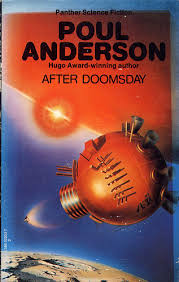
The premise of Poul Anderson's After Doomsday (St Albans, Herts, 1975) is that an American spaceship crew returns from interstellar exploration to find that Earth has been sterilised in their absence. Anderson is well up to the tasks of describing both the murdered Earth and the crew members' responses.
On Earth:
the crust shook;
mountains broke;
volcanoes were born;
oceans cooled back down from boiling;
winds swept "...black stone continents which had lately run molten..." (p. 7);
ash, smoke, acid rain, sulphurous clouds, lightning.
Of the crew:
the field physicist/detector officer ran to the far end of the ship, hitting bulkheads en route;
the executive officer lay on the deck, drew up his knees and covered his face;
the astronomer and the planetographer concentrated on their instruments as if trying to find a malfunction;
the captain went into a trance;
the mechanical engineer kept his head and eventually had to replace the captain.
As usual, Anderson excels both at physical descriptions and at characterisation.
On Earth:
the crust shook;
mountains broke;
volcanoes were born;
oceans cooled back down from boiling;
winds swept "...black stone continents which had lately run molten..." (p. 7);
ash, smoke, acid rain, sulphurous clouds, lightning.
Of the crew:
the field physicist/detector officer ran to the far end of the ship, hitting bulkheads en route;
the executive officer lay on the deck, drew up his knees and covered his face;
the astronomer and the planetographer concentrated on their instruments as if trying to find a malfunction;
the captain went into a trance;
the mechanical engineer kept his head and eventually had to replace the captain.
As usual, Anderson excels both at physical descriptions and at characterisation.
Judgement And Doomsday II
Having compared titles, let us also compare opening sentences.
"The fall of God put Theron Ware in a peculiarly unenviable position, though he was hardly alone." (James Blish, Black Easter and The Day After Judgement, London, 1981, p. 119)
" 'Earth is dead. They murdered our Earth!' " (Poul Anderson, After Doomsday, Frogmore, St Albans, Herts, 1975, p. 7)
The Day After Judgement is a sequel so it can begin with a casual reference to the death of God which had been announced by a demon at the end of Black Easter. The real existence of supernatural beings, God, angels and demons, makes these works fantasies.
After Doomsday is a single novel with a dramatic opening sentence. If "...our Earth..." is dead, then how can one of its inhabitants know this? He is in a spaceship that has just returned from outside the Solar System so this is a work of science fiction (sf).
A friend who borrowed my copy of After Doomsday thought it was bad but I cannot help agreeing with James Blish and the Lancaster sf bookseller Pete Pinto both of whom said effectively that something about it makes it a complete novel. Pete used the phrase "complete novel" and Jim Blish said much the same. I will elaborate in later posts. Like two other Anderson novels, Tau Zero and World Without Stars, After Doomsday starts with a very basic sf premise and derives what reads like a comprehensive set of consequences from that premise. Like many of Anderson's works, it could have initiated a series. I will shortly reread After Doomsday and comment further.
"The fall of God put Theron Ware in a peculiarly unenviable position, though he was hardly alone." (James Blish, Black Easter and The Day After Judgement, London, 1981, p. 119)
" 'Earth is dead. They murdered our Earth!' " (Poul Anderson, After Doomsday, Frogmore, St Albans, Herts, 1975, p. 7)
The Day After Judgement is a sequel so it can begin with a casual reference to the death of God which had been announced by a demon at the end of Black Easter. The real existence of supernatural beings, God, angels and demons, makes these works fantasies.
After Doomsday is a single novel with a dramatic opening sentence. If "...our Earth..." is dead, then how can one of its inhabitants know this? He is in a spaceship that has just returned from outside the Solar System so this is a work of science fiction (sf).
A friend who borrowed my copy of After Doomsday thought it was bad but I cannot help agreeing with James Blish and the Lancaster sf bookseller Pete Pinto both of whom said effectively that something about it makes it a complete novel. Pete used the phrase "complete novel" and Jim Blish said much the same. I will elaborate in later posts. Like two other Anderson novels, Tau Zero and World Without Stars, After Doomsday starts with a very basic sf premise and derives what reads like a comprehensive set of consequences from that premise. Like many of Anderson's works, it could have initiated a series. I will shortly reread After Doomsday and comment further.
Judgement And Doomsday
Two titles, The Day After Judgement by James Blish and After Doomsday by Poul Anderson, sound almost interchangeable. However, Blish's "Judgement" is spiritual and supernatural, a literal Armageddon, whereas Anderson's "Doomsday" is secular and scientific, the sterilisation of Earth by aliens. In other words, Blish's novel is fantasy whereas Anderson's is science fiction (sf).
CS Lewis begins Perelandra by pointing out that we imagine non-human intelligences as either supernatural or extraterrestrial, then informs us that his character, Ransom, met on Mars beings that were both. That shook me when I read it.
A few other sf writers have had similar ideas. In two of Heinlein's novels, the Martian "Old Ones" are ghosts. In Ray Bradbury's The Martian Chronicles, Martian "Old Ones" are spiritually evolved Martians. In Brian Aldiss's Helliconia Trilogy, Helliconians have contact with their hereafter which contrasts strangely with the Terrestrial observation station in orbit above their planet. (When, in that station, orderly life broke down, Aldiss wrote an italicised descriptive passage including this marvelous sentence: "Everything depraved flourished.")
Starting with a reflection on two superficially similar but essentially contrasting titles, I have managed to draw a few parallels between six great names in sf: Blish; Anderson; Lewis; Heinlein; Bradbury; Aldiss.
CS Lewis begins Perelandra by pointing out that we imagine non-human intelligences as either supernatural or extraterrestrial, then informs us that his character, Ransom, met on Mars beings that were both. That shook me when I read it.
A few other sf writers have had similar ideas. In two of Heinlein's novels, the Martian "Old Ones" are ghosts. In Ray Bradbury's The Martian Chronicles, Martian "Old Ones" are spiritually evolved Martians. In Brian Aldiss's Helliconia Trilogy, Helliconians have contact with their hereafter which contrasts strangely with the Terrestrial observation station in orbit above their planet. (When, in that station, orderly life broke down, Aldiss wrote an italicised descriptive passage including this marvelous sentence: "Everything depraved flourished.")
Starting with a reflection on two superficially similar but essentially contrasting titles, I have managed to draw a few parallels between six great names in sf: Blish; Anderson; Lewis; Heinlein; Bradbury; Aldiss.
Wednesday, 6 June 2012
Creative Imagination
We value science fiction because an imaginative sf writer can display the implications, technical, psychological, social etc, of any premise which may be:
a single technological advance;
a plausible near future scenario;
a longer term speculation;
a unique and original idea;
a fairly basic and obvious idea which can nevertheless be shown to have unexpected and surprising implications.
Poul Anderson did this a lot. In a single short story: would technologically superior humanoid aliens conquer Earth militarily? Why not instead sell their military services to the highest bidder among terrestrial governments, thus becoming immensely rich in terrestrial currencies, thereby becoming the new economic rulers of Earth without having to destroy the defence systems of each country first? Anderson suggests that they might do this before anyone on Earth realised what was happening. I doubt that but I suspect that they might do it before the relevant governments had realised (or even cared?) what was happening.
Three Anderson novels each present a comprehensive development of a specific premise.
Tau Zero: What happens when a slower than light interstellar spaceship accelerates uncontrollably at relativistic speeds? (The ship and its crew pass between clusters of galaxies and outlast this universe.)
World Without Stars: all human life spans are extended indefinitely and a star between galaxies has an inhabited planet that can be visited by a faster than light ship; some inhabitants regard our galaxy, their only night time heavenly body, as God.
After Doomsday: interstellar explorers return to the Solar System to find that all life on Earth has been destroyed. What next?
Anderson made several original contributions to the time travel concept:
a Time Patrol to prevent time travellers from changing history (but the Patrol must then contend with quantum fluctuations not caused by time travellers, fluctuations that would prevent order and consciousness, and preventing them turns out to be the Patrol's real purpose);
several ingenious applications of the circular causality paradox;
physical corridors along which it is possible to walk or drive to the past or future;
time travel as a psychic power, not requiring a vehicle or a corridor;
some psychic time travellers want to witness events like the Crucifixion so other travellers attend such events merely to meet fellow travellers;
a time traveller moving forwards, then backwards, along the world line of a slower than light interstellar spaceship can report on the outcome of the voyage before its departure.
I had thought of that last idea but, of course, was not able to work it into a novel as Anderson did.
a single technological advance;
a plausible near future scenario;
a longer term speculation;
a unique and original idea;
a fairly basic and obvious idea which can nevertheless be shown to have unexpected and surprising implications.
Poul Anderson did this a lot. In a single short story: would technologically superior humanoid aliens conquer Earth militarily? Why not instead sell their military services to the highest bidder among terrestrial governments, thus becoming immensely rich in terrestrial currencies, thereby becoming the new economic rulers of Earth without having to destroy the defence systems of each country first? Anderson suggests that they might do this before anyone on Earth realised what was happening. I doubt that but I suspect that they might do it before the relevant governments had realised (or even cared?) what was happening.
Three Anderson novels each present a comprehensive development of a specific premise.
Tau Zero: What happens when a slower than light interstellar spaceship accelerates uncontrollably at relativistic speeds? (The ship and its crew pass between clusters of galaxies and outlast this universe.)
World Without Stars: all human life spans are extended indefinitely and a star between galaxies has an inhabited planet that can be visited by a faster than light ship; some inhabitants regard our galaxy, their only night time heavenly body, as God.
After Doomsday: interstellar explorers return to the Solar System to find that all life on Earth has been destroyed. What next?
Anderson made several original contributions to the time travel concept:
a Time Patrol to prevent time travellers from changing history (but the Patrol must then contend with quantum fluctuations not caused by time travellers, fluctuations that would prevent order and consciousness, and preventing them turns out to be the Patrol's real purpose);
several ingenious applications of the circular causality paradox;
physical corridors along which it is possible to walk or drive to the past or future;
time travel as a psychic power, not requiring a vehicle or a corridor;
some psychic time travellers want to witness events like the Crucifixion so other travellers attend such events merely to meet fellow travellers;
a time traveller moving forwards, then backwards, along the world line of a slower than light interstellar spaceship can report on the outcome of the voyage before its departure.
I had thought of that last idea but, of course, was not able to work it into a novel as Anderson did.
Wednesday, 28 March 2012
The Technic History and Potential Histories
The Technic History
Writing about a series necessitates re-reading it. Re-reading reinforces appreciation of future historical interconnectedness. To summarise again:
“The Saturn Game.”
|
Early exploration.
|
“Wings of Victory.”
|
Human-Ythrian first contact on Ythri under Captain Gray during the Grand Survey. (References to the planets Cynthia, Woden and Hermes.)
|
“The Problem of Pain.”
|
Early human-Ythrian interaction on a second Grand Survey planet, provisionally named Gray.
|
“Margin of Profit.”
|
Nicholas van Rijn, Master Merchant, Polesotechnic League.
|
“How To Be Ethnic In One Easy Lesson.”
|
The Wodenite Adzel studies on Earth.
|
“The Three-Cornered Wheel.”
|
The Hermetian David Falkayn is an apprentice on the planet Ivanhoe.
|
“A Sun Invisible.”
|
Falkayn is a journeyman in van Rijn’s company.
|
“The Season of Forgiveness.”
|
Later events on Ivanhoe.
|
The Man Who Counts.
|
Van Rijn and the Hermetian ducal heiress are shipwrecked on the planet Diomedes.
|
“Esau.”
|
Van Rijn; first contact with Babur.
|
Trader to the Stars (three stories).
|
Van Rijn.
|
“The Trouble Twisters.”
|
Van Rijn’s trader team of Falkayn, Adzel and the Cynthian Chee Lan.
|
“Day of Burning.”
|
The trader team helps the Merseians to survive radiation from a nearby supernova.
|
Satan’s World.
|
Van Rijn and the trader team.
|
“A Little Knowledge.”
|
Later events on two other planets discovered during the Grand Survey.
|
“Lodestar.”
|
Secret exploitation of super-metals on Mirkheim by races that cannot afford to buy knowledge or technology from League companies. Falkayn, the discoverer of Mirkheim, has broken his oath of fealty to van Rijn but marries van Rijn’s granddaughter.
|
Mirkheim.
|
A League cartel engineers the Baburite invasion of Mirkheim and Hermes. Conflict in the League. The later lives of the major characters.
|
“Wingless.”
|
Falkayn’s grandson interacts with Ythrians on the jointly colonized planet Avalon, formerly “Gray.”
|
“Rescue on Avalon.”
|
Later human-Ythrian interaction on Avalon.
|
“The Star Plunderer.”
|
During post-League “Troubles,” Manuel Argos leads a slave revolt and founds the Terran Empire.
|
“Sargasso of Lost Starships.”
|
The early Empire.
|
The People of the Wind.
|
The Terran War on Avalon: a descendant of Falkayn meets a forerunner and possible ancestor of Flandry; “Gray” is now the name of an Avalonian city.
|
The Flandry period.
|
Dominic Flandry, active on many planets, including some introduced earlier, defends the Empire against rebels, barbarians and Merseians.
|
The Game of Empire.
|
During Flandry’s old age, his daughter, the son of an old acquaintance and a new Wodenite character foil a Merseian plot. Potentially, a new series begins…
|
The Long Night period (three stories and one novel, if we include the disputed “Memory”).
|
The Empire has fallen. In one story, Roan Tom roves the stars. Potentially, a new series begins… Later, humanity evolves.
|
“Starfog.”
|
Descendants of rebels expelled by Falkayn contact a new civilization, the Commonalty. Daven Laure is a Ranger of the Commonalty. Potentially, a new series begins…
|
(“Memory” is set after the fall of a human interstellar Empire but Anderson denied that this was the Terran Empire of the Technic History.)
The Imperial and post-Imperial periods, like the Polesotechnic period, could be analyzed story by story but I here resort to summarizing the later “History of Technic Civilization” in a few sentences. Nevertheless, the reader of this summary should be able to appreciate the scope of the complete series, despite its obvious pulp sf origins. The Terran Empire, introduced as a colorful backdrop for “space opera,” sf action-adventure fiction, later became the setting for novels reflecting on the process of imperial decline. If van Rijn profited from capitalist expansion but Flandry, later, resisted imperial decline, then what went wrong, or at least what happened, between their periods? The two periods were originally presented in unrelated series until Anderson, writing Flandry, suddenly thought to make him refer back to van Rijn and a new future history was born.
Aliens
Hermes is a Terrestrial colony so Falkayn is human. Ythrians are winged carnivores with gills adapted as superchargers to lift bodies massive enough for intelligence. Diomedeans also fly but with bat-like, not feathered, wings. Wodenites are large reptilian quadrupeds descended from hexapods whose forelimbs came to be freed for manipulation. Adzel played the dragon in Chinese New Year and Wagnerian opera when he was a student on Earth.
Cynthians, arboreal hunters and traders, sound like intelligent squirrels. The Cynthian Chee Lan, small, female and aggressive, is clearly written to be an antithesis to the Wodenite Adzel who is large, male and placid, even converting to Buddhism. Ivanhoans, Merseians and some other species are humanoid with relatively minor variations. Baburites are hydrogen-breathing giant centipedes. Ymirites, encountered by Flandry, inhabiting Jovian planets and also breathing hydrogen, have many legs and tendrilled heads but cannot be seen clearly through a Jovian atmosphere. Flandry’s main opponent, a Chereionite, is of avian descent but humanoid.
Thus, instead of designing new organisms from their molecules up, Anderson usually adapts terrestrial forms. His humanoids may have differently coloured skins, different numbers of fingers, thumbs or eyes and no visible ears or nose but they remain recognizably humanoid. As a hard sf writer, Anderson can defend this procedure:
“On an essentially terrestroid planet, evolution basically parallels our own because it must.” (1)
And psychologically:
“Those we encounter on a regular basis are necessarily those whose bent is akin to ours…” (2)
If there are many races, then many of them will be incomprehensible to us but we will deal with those who are not. Anderson applies this principle in other works.
Three Novels
Any story set in the future is potentially an episode of a future history. A novel written in 2000 but set in 3000 assumes a history connecting the known events of 2000 with the fictitious events of 3000. The author of a single story could add any number of sequels and prequels to it. The Star Trek series moved in this direction, becoming more than a single series set in a single period.
Tau Zero, After Doomsday and World Without Stars by Poul Anderson remained independent works - except that one short story, “Pride,” is set in the same future as Tau Zero, with Stockholm as the world capital. The earlier, shorter version of Tau Zero had not shared this political background with “Pride” but the novel does, thus potentially launching yet another future history.
Each of these three novels takes a basic sf premise and presents a comprehensive conceptual development from that premise. Tau Zero avoids alien contact because it concentrates on the human crew of a relativistic spaceship which accelerates uncontrollably. Through time dilation, the ship and its crew survive into the next universe. The central character hopes that surviving humanity can become the Elder Race of that universe but we are not shown this happening.
The premises of After Doomsday are that:
the galaxy is full of intelligent races;
“superlight” travel is possible.
the galaxy is full of intelligent races;
“superlight” travel is possible.
It follows that:
superlight is discovered somewhere some time, once or more than once;
explorers encounter many races, some of whom are willing and able to acquire superlight from them;
superlight travel spreads like dandelion seeds;
space traveling races deal with those with whom they can converse and ignore or bypass others;
they can deal regularly only with those in their immediate vicinity;
therefore, the galaxy is full of “civilization-clusters,” between which there is no regular contact;
within a cluster, space travellers learn a common language and one such language is used in several nearby clusters;
even within a cluster, every planet is economically self-sufficient so trade is in knowledge and luxury items;
the civilized galaxy is so vast that there cannot be a single Empire or Federation and no one knows the history or current macro-status of the entire galaxy;
militaristic imperialism between nearby worlds is possible and, this being a work by Anderson, it does occur in our cluster – marine warriors on one planet and nomadic conquerors on another maintain their societies by expanding into space, engage in conflict with each other and involve other races in the hostilities.
superlight is discovered somewhere some time, once or more than once;
explorers encounter many races, some of whom are willing and able to acquire superlight from them;
superlight travel spreads like dandelion seeds;
space traveling races deal with those with whom they can converse and ignore or bypass others;
they can deal regularly only with those in their immediate vicinity;
therefore, the galaxy is full of “civilization-clusters,” between which there is no regular contact;
within a cluster, space travellers learn a common language and one such language is used in several nearby clusters;
even within a cluster, every planet is economically self-sufficient so trade is in knowledge and luxury items;
the civilized galaxy is so vast that there cannot be a single Empire or Federation and no one knows the history or current macro-status of the entire galaxy;
militaristic imperialism between nearby worlds is possible and, this being a work by Anderson, it does occur in our cluster – marine warriors on one planet and nomadic conquerors on another maintain their societies by expanding into space, engage in conflict with each other and involve other races in the hostilities.
This scenario could have been the basis of an indefinite number of novels. This one novel has two specific additional premises:
first, human spaceships re-enter the Solar System at different times to find that some other race has destroyed all life on Earth so – who murdered Earth and what can be done about it?
secondly, the American spaceship crew is all male whereas the Europeans are all female so – how can they find each other to continue the human race?
Anderson wrote detective novels and this sf novel clearly has elements of detective fiction. Deducing who murdered Earth involves realizing that whoever did it used equipment which required them to translate from a numeral system based on the power of six to a system based on the power of twelve. A six fingered race tried to frame a twelve fingered race.
The European women aim to get rich in a capitalist cluster so that they will be able to pay for a fleet of ships to search the galaxy. The American men aim to win the local interstellar war, then to devise a ballad about their victory in a multi-cluster language. One of the women hears the ballad sung in a multi-species bar, Yotl’s Nest. By the end of the novel, Terrestrial men and women have met and have changed the balance of power in two civilization-clusters.
World Without Stars has two basic premises:
antithanatics prevent death by illness or old age so that people now die only by accident or violence;
by a series of instantaneous jumps, although with time-consuming intermediate journeys, a spaceship can reach not only other stars but even other galaxies.
antithanatics prevent death by illness or old age so that people now die only by accident or violence;
by a series of instantaneous jumps, although with time-consuming intermediate journeys, a spaceship can reach not only other stars but even other galaxies.
It follows that:
population is not a problem;
life-styles and perspectives adjust to the long view (Earthside property left in the care of robots is unchanged centuries later; a spaceman has wives in several ports and may not see any one of them for several decades but each wife also has several space traveling husbands);
some individuals live for millennia, for example three thousand year old Hugh Valland who has lived through the entire period of interstellar and intergalactic travel and who is content, every few years or decades, to revisit a certain grave on Earth.
population is not a problem;
life-styles and perspectives adjust to the long view (Earthside property left in the care of robots is unchanged centuries later; a spaceman has wives in several ports and may not see any one of them for several decades but each wife also has several space traveling husbands);
some individuals live for millennia, for example three thousand year old Hugh Valland who has lived through the entire period of interstellar and intergalactic travel and who is content, every few years or decades, to revisit a certain grave on Earth.
Again, these premises could have been the basis of an indefinite number of novels. This particular novel has the specific premise that its characters, crash-landing on a planet in a system between galaxies, need to work hard and to organize native labor in order to get back home and are led by Hugh Valland. Getting back off this ancient planet where there are no heavy metals takes them four decades. For Valland, Mary O’Meara waits on Earth.
- Anderson, Poul, “Wings of Victory,” Analog Science Fiction, April 1972, reprinted in Anderson, Poul, The Earth Book of Stormgate 1978, New York, pp. 3-22 at p. 14.
- Anderson, Poul, The Trouble Twisters, 1966, New York, p. 56.
Subscribe to:
Posts (Atom)


