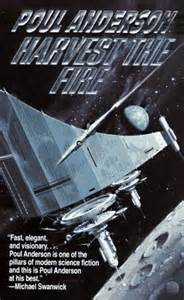
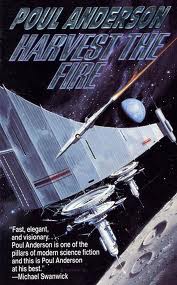
This morning, I have finished rereading Poul Anderson's Harvest The Fire. Today, while the sky is blue, I will walk, then swim. Tomorrow I might start to reread Anderson's The Fleet Of Stars, unless a long awaited novel by SM Stirling at last arrives by post.
Proserpina is one of Anderson's most imaginative creations. Venator says that it is always night there but the Proserpinans carve vast colorful habitats inside this large asteroid and can simulate a sky on a ceiling. Jesse Nicol, dissatisfied in the Inner Solar System, goes to Proserpina to become one of their poets.
Showing posts with label Harvest The Fire. Show all posts
Sunday, 27 September 2015
Saturday, 26 September 2015
Some Details... II
"'...to know I'm a murderer, that's like a -, a -' Groping, he seized on an archaic symbol. '- a cancer in me.'" (Harvest The Fire, p. 138)
Cancer as an archaic symbol!
Nicol and Falaire lie on a bed in a spaceship cabin surrounded by:
"The moving, three-dimensional illusion of a forest..." (p. 137)
- with night sky, warm breeze, sounds of leaves and spice-like odors. They are used to such illusions and able to relax with them.
In a dreambox, Nicol sees:
from a point in space where the Sun is only the brightest star but star light is almost twice as bright as the Moon seen from Nauru;
some surface details and lights on Proserpina;
scenes of underground Proserpinan life, where a ceiling simulates a sky;
engineering projects to expand living space and exploit resources;
captains in taverns, returned from the comets;
a duel to the death, in spacesuits with swords...
Anderson intends us to admire the Lunarians but I cannot buy into everything that they do.
Cancer as an archaic symbol!
Nicol and Falaire lie on a bed in a spaceship cabin surrounded by:
"The moving, three-dimensional illusion of a forest..." (p. 137)
- with night sky, warm breeze, sounds of leaves and spice-like odors. They are used to such illusions and able to relax with them.
In a dreambox, Nicol sees:
from a point in space where the Sun is only the brightest star but star light is almost twice as bright as the Moon seen from Nauru;
some surface details and lights on Proserpina;
scenes of underground Proserpinan life, where a ceiling simulates a sky;
engineering projects to expand living space and exploit resources;
captains in taverns, returned from the comets;
a duel to the death, in spacesuits with swords...
Anderson intends us to admire the Lunarians but I cannot buy into everything that they do.
Some Details In Harvest The Fire
English has become Anglo, not Anglic.
The Lunarian Lirion is both a gourmet and a gourmand. (p. 74)
Falaire knows of Rapa Nui. (p. 128) I didn't - although, of course, I recognize the name "Easter Island."
The Lunarian secret society has an appropriate name, the Scaine Croi in Lunarian, the Loose Knife in Anglo. The conspirators cleverly give this name a literal meaning in order to entrap a pilot for their anti-matter hijack.
Within the Solar System, we are used to differentiating the inner planets from the outer planets with the asteroids between. Beyond that, we usually think, are interstellar space and other planetary systems but Poul Anderson opens up a whole new realm: the cybercosm reigns among the inner planets whereas Lunarians, adapted to live on the Moon, colonize Proserpina in the Kuiper Belt.
Anderson's contributions to science fiction remained original and creative right to the end of his long career.
The Lunarian Lirion is both a gourmet and a gourmand. (p. 74)
Falaire knows of Rapa Nui. (p. 128) I didn't - although, of course, I recognize the name "Easter Island."
The Lunarian secret society has an appropriate name, the Scaine Croi in Lunarian, the Loose Knife in Anglo. The conspirators cleverly give this name a literal meaning in order to entrap a pilot for their anti-matter hijack.
Within the Solar System, we are used to differentiating the inner planets from the outer planets with the asteroids between. Beyond that, we usually think, are interstellar space and other planetary systems but Poul Anderson opens up a whole new realm: the cybercosm reigns among the inner planets whereas Lunarians, adapted to live on the Moon, colonize Proserpina in the Kuiper Belt.
Anderson's contributions to science fiction remained original and creative right to the end of his long career.
Continuing To Reread Harvest The Fire
Recently, I mentioned the ubiquitous "maintainors." The Peace Authority can use them to spy on citizens!
"...pinniped..." (p. 80)
"'...poetaster.'" (p. 83)
"...Otterburn." (p. 95)
The corridor outside the Lunarian Falaire's apartment has been programmed to resemble space, black with stars and a constellation above each door. Inside, her "...single great chamber..." (p. 91) extrudes and reabsorbs walls on command. With such technology, does she need a "...housekeeper..."? (p. 92) Yes, but it is a robot with its station by "...the cuisinator..."
Anderson's entire text is rich with rare vocabulary and with imaginative details of a high tech civilization, in this case on the Moon. Lunar colonization is a major feature of the early part of Robert Heinlein's Future History. Anderson updates lunar colonization even though it has not yet happened in reality.
"...pinniped..." (p. 80)
"'...poetaster.'" (p. 83)
"...Otterburn." (p. 95)
The corridor outside the Lunarian Falaire's apartment has been programmed to resemble space, black with stars and a constellation above each door. Inside, her "...single great chamber..." (p. 91) extrudes and reabsorbs walls on command. With such technology, does she need a "...housekeeper..."? (p. 92) Yes, but it is a robot with its station by "...the cuisinator..."
Anderson's entire text is rich with rare vocabulary and with imaginative details of a high tech civilization, in this case on the Moon. Lunar colonization is a major feature of the early part of Robert Heinlein's Future History. Anderson updates lunar colonization even though it has not yet happened in reality.
Postcapitalism?
"...the status and encouragement of private ventures in a postcapitalist economy..." (Harvest The Fire, p. 75)
A contradiction? Maybe not. We know nothing about postcapitalism. Nineteenth century theoreticians assumed that collective labor would continue to be necessary to generate social wealth. Anderson instead imagines universal automation and nanotechnology controlled by self-evolving artificial intelligences. In the latter situation, I think that:
every human being being should have a substantial share in social wealth;
groups should have the resources for any ventures that they envisage;
but no group would be able to employ members of a work-force economically dependent on being employed.
It is this third point that differentiates postcapitalism and that is hardest to imagine. A character in Anderson's Starfarers says that he has the right to make money and to invest it, i.e., in the labor of others. Of course he does, provided that he is operating in an economy that is organized on that basis in the first place.
"Passage [to the Moon] would consume most of his small savings, and the cost of living would be higher; if he didn't want to exist in poverty, he'd need work, pay, to supplement his citizen's credit." (p. 88)
An economy in which someone who overspends his citizen's credit must choose between poverty and employment is still not postcapitalist.
A contradiction? Maybe not. We know nothing about postcapitalism. Nineteenth century theoreticians assumed that collective labor would continue to be necessary to generate social wealth. Anderson instead imagines universal automation and nanotechnology controlled by self-evolving artificial intelligences. In the latter situation, I think that:
every human being being should have a substantial share in social wealth;
groups should have the resources for any ventures that they envisage;
but no group would be able to employ members of a work-force economically dependent on being employed.
It is this third point that differentiates postcapitalism and that is hardest to imagine. A character in Anderson's Starfarers says that he has the right to make money and to invest it, i.e., in the labor of others. Of course he does, provided that he is operating in an economy that is organized on that basis in the first place.
"Passage [to the Moon] would consume most of his small savings, and the cost of living would be higher; if he didn't want to exist in poverty, he'd need work, pay, to supplement his citizen's credit." (p. 88)
An economy in which someone who overspends his citizen's credit must choose between poverty and employment is still not postcapitalist.
Friday, 25 September 2015
O Brave New World?
Poul Anderson, Harvest The Fire (New York, 1997).
Aldous Huxley's Savage would prefer the miseries of the conflicted old world to the pleasures of the dystopian New World. Huxley said in his later written Introduction that he should have offered his characters and readers a third choice, a small community dedicated to sanity.
In Harvest The Fire, a man called "Venator" (Latin for "Hunter") has been downloaded into the cybercosm but temporarily resurrected as:
"...a set of ongoing electrophotonic processes in a neural network that received its information through the sensors of the machine it walked in." (p. 61)
Venator reasonably asks:
"Who in their right minds would want a return of...?" (p. 63)
Here I will list the phenomena that Venator refers to:
war;
poverty;
rampant criminality;
disease;
famine;
cancerously swelling population;
necessity to work no matter how nasty or deadening the work might be;
mass lunacy;
private misery;
death in less than a hundred years.
I would regard a world freed from these evils as utopian, not dystopian. It would be an opportunity to learn, explore and create, not an occasion for indolence and boredom leading to suicide or extinction! Anderson's text implies that some of his characters are rightly discontented in this utopian scenario. Only when we learn that the cybercosm regards the actions of free human beings as a threat to itself do I start to agree with them.
Aldous Huxley's Savage would prefer the miseries of the conflicted old world to the pleasures of the dystopian New World. Huxley said in his later written Introduction that he should have offered his characters and readers a third choice, a small community dedicated to sanity.
In Harvest The Fire, a man called "Venator" (Latin for "Hunter") has been downloaded into the cybercosm but temporarily resurrected as:
"...a set of ongoing electrophotonic processes in a neural network that received its information through the sensors of the machine it walked in." (p. 61)
Venator reasonably asks:
"Who in their right minds would want a return of...?" (p. 63)
Here I will list the phenomena that Venator refers to:
war;
poverty;
rampant criminality;
disease;
famine;
cancerously swelling population;
necessity to work no matter how nasty or deadening the work might be;
mass lunacy;
private misery;
death in less than a hundred years.
I would regard a world freed from these evils as utopian, not dystopian. It would be an opportunity to learn, explore and create, not an occasion for indolence and boredom leading to suicide or extinction! Anderson's text implies that some of his characters are rightly discontented in this utopian scenario. Only when we learn that the cybercosm regards the actions of free human beings as a threat to itself do I start to agree with them.
Harvest The Fire, Prologue
See here.
The simulated Borges refers to Martin Fierro, Karnak and Cambaluc.
I have quoted here how World War I came to be called "Terran Planetary War, Phase One" in an unfortunate later addition to Robert Heinlein's Future History. In Anderson's Harvest The Fire, it is called "...the first Global War." (p. 13) Future historians, particularly those for whom Earth is not the only occupied planet, are bound to view WWI and WWII differently. They might have had interplanetary conflicts, not "World Wars" but "Wars Between Worlds."
In the terminology of Anderson's last future history:
a "dreambox" generates a fully realistic virtual reality based on a standard program chosen from "'...many millions of different milieus and situations...'" (p. 13);
a "quivira" generates an equally realistic but entirely new virtual reality by working with the "cybercosm" (the conscious AI internet).
Dreamboxes contain simulations of many historical figures but not of Borges who is by now little known. Therefore, Nicol, using a quivira, pays extra for a sophotect (an AI) to:
scan world databases;
synthesize a personality and a setting.
Nicol meets Borges.
The simulated Borges refers to Martin Fierro, Karnak and Cambaluc.
I have quoted here how World War I came to be called "Terran Planetary War, Phase One" in an unfortunate later addition to Robert Heinlein's Future History. In Anderson's Harvest The Fire, it is called "...the first Global War." (p. 13) Future historians, particularly those for whom Earth is not the only occupied planet, are bound to view WWI and WWII differently. They might have had interplanetary conflicts, not "World Wars" but "Wars Between Worlds."
In the terminology of Anderson's last future history:
a "dreambox" generates a fully realistic virtual reality based on a standard program chosen from "'...many millions of different milieus and situations...'" (p. 13);
a "quivira" generates an equally realistic but entirely new virtual reality by working with the "cybercosm" (the conscious AI internet).
Dreamboxes contain simulations of many historical figures but not of Borges who is by now little known. Therefore, Nicol, using a quivira, pays extra for a sophotect (an AI) to:
scan world databases;
synthesize a personality and a setting.
Nicol meets Borges.
Issues In Fictions
I am extremely impressed with the range of issues covered by the posts so far this month:
time
history
prehistory
civilization
the Aeneid
Greeks and Romans
Tacitus
the sciences
AI
the creation of life
surviving the end of the universe
quantum indeterminacy
chaos
the Crusades
the Knights Templar
Odysseus
Frankenstein
superheroes
future histories
I have begun to reread Harvest The Fire (New York, 1997), Volume III of Poul Anderson's later Harvest of Stars future history. In the Prologue:
Jorge Luis Borges wrote Ficciones
Harvest The Fire is a science fiction novel by Anderson;
in Harvest The Fire, Jesse Nicol, living in our future, experiences the interactive fiction of a virtual reality in which he converses with the simulated Borges;
Nicol presents his real future history to Borges as a work of imaginative fiction;
Borges comments, "'You seem to have invented a world as complete as Tolkien's...'" (p. 21);
Nicol reflects that his account almost is a fiction, "...as far short as it fell of the richness of reality." (p. 28)
How many fictions within fictions are there here? Within Anderson's novel, there is Nicol's virtual reality and, within that, there is Nicol's almost fictitious account of Anderson's fictional future history.
Anderson maintains the consistency of his future history, e.g. p. 6 of Harvest Of Stars (London, 1994) introduces a gadget called a "maintainor" and more of these gadgets appear on p. 10 of Harvest The Fire. Such background details give future histories body and verisimilitude.
time
history
prehistory
civilization
the Aeneid
Greeks and Romans
Tacitus
the sciences
AI
the creation of life
surviving the end of the universe
quantum indeterminacy
chaos
the Crusades
the Knights Templar
Odysseus
Frankenstein
superheroes
future histories
I have begun to reread Harvest The Fire (New York, 1997), Volume III of Poul Anderson's later Harvest of Stars future history. In the Prologue:
Jorge Luis Borges wrote Ficciones
Harvest The Fire is a science fiction novel by Anderson;
in Harvest The Fire, Jesse Nicol, living in our future, experiences the interactive fiction of a virtual reality in which he converses with the simulated Borges;
Nicol presents his real future history to Borges as a work of imaginative fiction;
Borges comments, "'You seem to have invented a world as complete as Tolkien's...'" (p. 21);
Nicol reflects that his account almost is a fiction, "...as far short as it fell of the richness of reality." (p. 28)
How many fictions within fictions are there here? Within Anderson's novel, there is Nicol's virtual reality and, within that, there is Nicol's almost fictitious account of Anderson's fictional future history.
Anderson maintains the consistency of his future history, e.g. p. 6 of Harvest Of Stars (London, 1994) introduces a gadget called a "maintainor" and more of these gadgets appear on p. 10 of Harvest The Fire. Such background details give future histories body and verisimilitude.
Saturday, 18 August 2012
Harvest The Fire II
Harvest The Fire (New York, 1995) is an excellent addition to Poul Anderson's "Harvest of Stars" series which otherwise would have comprised just three long novels. By contrast, Harvest The Fire is short, a quick read, evocatively illustrated by Vincent Di Fate (so that consequently the text is even shorter than we expect), poetic and elegaic. It is about a poet, frustrated but possibly finding fulfillment. At the very end, he appropriately comments that:
Homer celebrated a bygone age;
Shakespeare dramatised Cleopatra and Macbeth;
Fitzgerald drew on Khayyam;
Kipling told of India;
he, an Earthman, might become a bard of the colony world Proserpina, inspired by stars, comets and the cosmic vastness that is indifferent to humanity although humanly inhabited.
This short novel is about a crime, or a military action, that would be possible only in a high tech future, the hijacking of a consignment of antimatter. I share Anderson's consistent value judgement that, in human affairs, unpredictable, even dangerous, diversity and self-determination are preferable to unadventurous, even if comfortable, conformity and social control. So it is a good thing that the Proserpinans appropriate the anti-matter energy source that would have been denied to them by the World Federation.
Proserpina was discovered in Volume II and colonised between Volumes. Now, in Volume III, its future prosperity and expansion are ensured. A line quoted by Anderson in Trader To The Stars is again appropriate:
"The world's great age begins anew..."
Our poet reflects:
"Contentment...peace, prosperity, but also adventure and achievement. For most people. Their doings may be old in history, but to each generation they are new, a dawn, a boat, a mountain, an ancient monument, a young sweetheart, enough.
"Not for me, with my irrational, inchoate yearnings. For me, the passions will be in wild sports and wilder carousals..." (p. 147)
Earth is peaceful but a few want danger and should be able to find it.
More on metamorphs:
On the lunar surface, someone in a spacesuit (of course) leads an expensive vacuum-adapted "...moonwolf on a leash." (p. 46) An animal naked on the Moon: it made me feel cold to read about it and still seems wrong somehow...
Homer celebrated a bygone age;
Shakespeare dramatised Cleopatra and Macbeth;
Fitzgerald drew on Khayyam;
Kipling told of India;
he, an Earthman, might become a bard of the colony world Proserpina, inspired by stars, comets and the cosmic vastness that is indifferent to humanity although humanly inhabited.
This short novel is about a crime, or a military action, that would be possible only in a high tech future, the hijacking of a consignment of antimatter. I share Anderson's consistent value judgement that, in human affairs, unpredictable, even dangerous, diversity and self-determination are preferable to unadventurous, even if comfortable, conformity and social control. So it is a good thing that the Proserpinans appropriate the anti-matter energy source that would have been denied to them by the World Federation.
Proserpina was discovered in Volume II and colonised between Volumes. Now, in Volume III, its future prosperity and expansion are ensured. A line quoted by Anderson in Trader To The Stars is again appropriate:
"The world's great age begins anew..."
Our poet reflects:
"Contentment...peace, prosperity, but also adventure and achievement. For most people. Their doings may be old in history, but to each generation they are new, a dawn, a boat, a mountain, an ancient monument, a young sweetheart, enough.
"Not for me, with my irrational, inchoate yearnings. For me, the passions will be in wild sports and wilder carousals..." (p. 147)
Earth is peaceful but a few want danger and should be able to find it.
More on metamorphs:
On the lunar surface, someone in a spacesuit (of course) leads an expensive vacuum-adapted "...moonwolf on a leash." (p. 46) An animal naked on the Moon: it made me feel cold to read about it and still seems wrong somehow...
Metamorphs
The third "Harvest of Stars" novel, Harvest The Fire, reveals more about "metamorphs." Here, the word means not shape changers but beings with modified genomes.
In particular, "Intellects" are human beings whose ancestors were modified for a brainpower that has subsequently been made obsolete by computers but, like other metamorphs, they continue to breed although their kind no longer has any place in society. Hence, disaffection and alienation.
One Intellect, intelligent enough, and also intellectually intrigued enough, to hack into state secrets of the cybercosm, is hired to do so by Lunarians, another group of metamorphs who are adapted to live and breed in lunar gravity and thus are also able to colonise the asteroids but are discouraged from such interplanetary expansionism by the cybercosm which wants to robotize, then phase out, space travel.
Anderson imagined conflicts of interest in future societies which, having transcended our current political and economic differences, then find new issues to fight about! The Intellects must have intellectual/mental/computational abilities comparable to those of Frank Herbert's "Mentats" who, far from being made obsolete by computers were, on the contrary, bred to replace computers that had been destroyed in a Jihad: similar beings but with an opposite origin.
In particular, "Intellects" are human beings whose ancestors were modified for a brainpower that has subsequently been made obsolete by computers but, like other metamorphs, they continue to breed although their kind no longer has any place in society. Hence, disaffection and alienation.
One Intellect, intelligent enough, and also intellectually intrigued enough, to hack into state secrets of the cybercosm, is hired to do so by Lunarians, another group of metamorphs who are adapted to live and breed in lunar gravity and thus are also able to colonise the asteroids but are discouraged from such interplanetary expansionism by the cybercosm which wants to robotize, then phase out, space travel.
Anderson imagined conflicts of interest in future societies which, having transcended our current political and economic differences, then find new issues to fight about! The Intellects must have intellectual/mental/computational abilities comparable to those of Frank Herbert's "Mentats" who, far from being made obsolete by computers were, on the contrary, bred to replace computers that had been destroyed in a Jihad: similar beings but with an opposite origin.
Friday, 17 August 2012
Harvest The Fire
Incredibly, Poul Anderson keeps the series going. Despite the cosmic climax of Harvest of Stars and despite the comparable culmination of the succeeding volume, The Stars Are Also Fire, the future history presented in these two long novels provides sufficient background material to generate a narrative framework and what has by now become a familiar setting for two further novels. Of these two additional volumes, the first, Harvest The Fire (New York, 1995), begins:
"Once in his drifting to and fro across Earth, Jesse Nicol found a quivira left over from olden times." (p. 9)
Jesse Nicol is a new character but two features of this opening sentence are familiar: a future Earth on which there is freedom to drift and a virtual reality machine called a "quivira." Nicol generates a virtual interview with Jorge Luis Borges. The cybercosm scans databases "...to synthesize a personality and a setting..." (p. 16) The cybercosm is conscious but it is not made clear whether the simulated Borges has a temporary consciousness of being interviewed by Nicol. Generation of such a temporary consciousness does occur in virtual realities in other Anderson works.
Authentically, the virtual Borges gives Nicol a signed copy of one of his books. Nicol finds this "...heartbreaking.." and afterwards "...glanced down at his hand, as if it held a book." (pp. 29, 30) The cybercosm could have completed the illusion by printing a facsimile book with a forged signature.
Anderson readers are confident that, when this author extends, e.g., the "Harvest Of Stars" sequence or the earlier Technic History, the new work will be a substantial addition to the existing series whereas the appearance of the word Foundation or Dune in a new sf title signifies only the monotony of a recurring decimal.
"Once in his drifting to and fro across Earth, Jesse Nicol found a quivira left over from olden times." (p. 9)
Jesse Nicol is a new character but two features of this opening sentence are familiar: a future Earth on which there is freedom to drift and a virtual reality machine called a "quivira." Nicol generates a virtual interview with Jorge Luis Borges. The cybercosm scans databases "...to synthesize a personality and a setting..." (p. 16) The cybercosm is conscious but it is not made clear whether the simulated Borges has a temporary consciousness of being interviewed by Nicol. Generation of such a temporary consciousness does occur in virtual realities in other Anderson works.
Authentically, the virtual Borges gives Nicol a signed copy of one of his books. Nicol finds this "...heartbreaking.." and afterwards "...glanced down at his hand, as if it held a book." (pp. 29, 30) The cybercosm could have completed the illusion by printing a facsimile book with a forged signature.
Anderson readers are confident that, when this author extends, e.g., the "Harvest Of Stars" sequence or the earlier Technic History, the new work will be a substantial addition to the existing series whereas the appearance of the word Foundation or Dune in a new sf title signifies only the monotony of a recurring decimal.
Subscribe to:
Posts (Atom)