Comments on the post "Mountebanks And Bacaudae" raised the question: can space be polluted? Googling "Pollution of Space" reveals some articles on the subject. See here. The passage in Poul Anderson's Orion Shall Rise (London, 1988) that I had in mind was:
"'...we will never, never see Earth turned into a residential garden supplied by industrial parks throughout the Solar System. It is in the nature of man that he fouls his own nest.'" (p. 337)
The first sentence says not that space will be polluted but that space industries will not be used to make a pollution-free environment on Earth. However, the second sentence does imply that mankind will generate waste and destruction in any environment, here or elsewhere. If parts of the Moon are colonized but others are used to dump nuclear waste, will these areas encroach on each other - especially if rival groups are involved? We need palaces, not slums, off Earth. Anderson gave us the example of the Selenarchs in Harvest Of Stars. His "Sunjammer" shows how orbiting instruments could be damaged by chemical contamination of near-Earth space.
Showing posts with label "Sunjammer" by Poul Anderson. Show all posts
Tuesday, 21 April 2015
Friday, 17 April 2015
Solar Flare II
OK. I have answered the questions that I asked in "Solar Flare." I just had to reread carefully. Some readers must be thinking that it is too obvious to be stated.
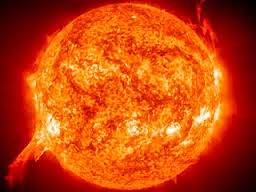
If the cargo had remained unshielded, then the solar flare would have detonated it, killing the herdship pilot and contaminating near-Earth space. The only solution was to haul the cargo away from near-Earth space, then to jettison the gas into space, and to do all this before the flare arrived - a race against time.
Removing the cargo from near-Earth space prevents contamination of that space. Jettisoning the gas prevents any explosion even further out. Doing all this as quickly as possible minimizes the period during which the pilot is vulnerable to an explosion caused by the flare. Even if a heavily armored man survived the explosion, he would soon be killed by flare radiation.
However, shielding the cargo with the sliced up sail prevents an explosion even after the arrival of the flare. By hauling the cargo away from the Sun until the flare subsides, the pilot saves the isonitrate to be collected by tugs. Future cargos will be shielded to prevent a repeat disaster. This time, only the sail must be sacrificed - and parts of it might sell as souvenirs! (Anderson's heroes always solve economic as well as technical problems.)
Solar Flare
(See recent posts.)
How To Save Lives, Prevent The Cargo From Exploding And Also Avoid Having To Jettison It In Space
Get crew from several ships to cut the sail into fifteen-yard squares.
Layer the squares within a welded framework to shield the cargo section.
Keep shield, cargo section and hauling herdship facing directly into the blast of the solar flare.
The herdship pilot, loaded with anti-fatigue pills and psychodrugs, must continually counteract gravity which tries to swing the ensemble into orbit.
I have done my best to understand both the danger and the means taken to avert it but still have some questions which arise purely from my lack of scientific and technical knowledge:
we are told that the herdship's own internal shielding "...drank up..." (p. 242) lethal radiation which seems to mean that the herdship crew would have been safe in any case?;
they haul the cargo to where a tug can collect it in the Moon's shadow whereas their previous plan had been to "...valve it out..." (p. 225) at a safe distance from Earth and Moon so why has the use of the improvised sail shield changed this part of the plan?
I am sure that the answers to these questions are obvious to readers with any knowledge of celestial mechanics.
Isonitrate II
I never thought that "isonitrate" would warrant a second post.
An interplanetary industrial process:
scoopships collect substances, including metal atoms, from the Jovian atmosphere;
an orbital station processes these complexes into dangerously explosive isonitrate;
unmanned sailships/sunjammers, moved outward by light pressure or inward by gravity, take months to tack between orbits;
a sail is a metal-coated carbon compound sheet, continually eroded by micrometeorites and eventually replaced;
each sailship also has sensors, automata, signaling equipment and motors that are powered by solar batteries and controlled by a pilot computer;
the motors control rotation and precession of the sail;
one sailship cargo is a ten yard diameter sphere containing cold, liquefied, high pressure, high energy isonitrate, shaded by the sail to prevent boiling;
Earth pays the asterite Beltline Transportation Company well for this cargo, needed to start several chemical syntheses;
Beltline herdships/maintenance ships stay close to the orbits of sail and power craft;
thus, when an isonitrate cargo is endangered by an imminent solar flare, a herdship crew is on hand to detach the sail and other mass, then hook the cargo to their ship and haul it to a safe distance from Earth and Moon before valving it out.
I have learned far more about these processes by summarizing them than by merely reading about them. Readers without a scientific or technical background are at a disadvantage with this kind of hard sf.
Thursday, 16 April 2015
Isonitrate
"'Cargo of...I say, this is an odd one. She's carrying eight hundred metric tons of isonitrate from the Sword's Jovian-orbit plant.'" (NESFA Vol 3, p. 224)
I thought that I was going to have to google "isonitrate." However, Golescu asks, "'Isonitrate what?'" (ibid.) and is answered:
"An important industrial chemical,' West explained. 'Alkali complex of 2, 4 benzoisopro -'" (ibid.) -
- at which point Golescu interrupts, saying that he is sorry he asked. I took this to mean that isonitrate was invented for story purposes by Anderson but then googled to make sure and found something that seems to be a different meaning of the word.
At any rate, Anderson's isonitrate will explode if, as expected, the sun flares, so it has to be hauled out of the danger area or should I say volume. The gaseous metallic-complex molecules would cause billions of dollars of economic damage by contaminating orbiting photocells, monitors, spectrometers, weather satellites, manned space stations and cybernets controlling radio relays or Mossbauer clocks. (Someone might have better luck than I did on googling "Mossbauer clock.")
This story is overly technical even for Anderson but, of course, the characters are real people arguing politics and wanting to get back home safe and sound.
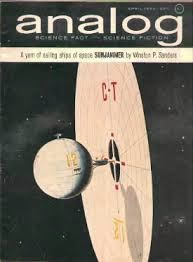
"Sunjammer"
Over breakfast, I make a big decision. Should I continue to reread previously read stories in the third NESFA collection of Poul Anderson's short works or instead return, without further delay, to rereading his future history novel, Starfarers?
It is impossible to read or reread anything by Anderson without learning something. In the second paragraph of "Sunjammer" (NESFA Vol 3, pp. 221-243), we read that the Andromeda galaxy is one and a half million light years away. I thought that it was two million. To settle the matter, I check Wiki, which says two and a half million! Lesson learned: we really do only have approximations for cosmic distances.
In the same paragraph, Earth seen from space is described as "...a cabochon of clear and lovely blue..." and Luna as "...a tarnished pearl beyond." (p. 221)
Two thoughts:
beautiful, well-observed descriptions, as in the phrase that generated the title, A Stone In Heaven (see here);
another to me unfamiliar word.
I will reread the rest of "Sunjammer."
Subscribe to:
Posts (Atom)