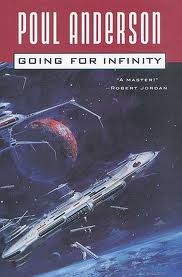
Let us consider the unique evolution of Poul Anderson's eight future histories in more detail. Since the first two histories have FTL, aliens and interstellar empires whereas the last two have STL, no aliens and human-AI interaction, that leaves four intermediate histories, none with FTL. It is as if Anderson deconstructs future histories, then rebuilds them from first principles.
In the Maurai History, mankind recovers from nuclear war and has barely resumed space travel by the end of the series - although the related time travel novel, There Will Be Time, tells us about an interstellar future.
In Tales Of The Flying Mountains, mankind colonizes the asteroids and is just beginning extrasolar colonization by the end of the series.
In the Rustum History, several extrasolar planets are colonized.
In the Kith History, there is interstellar trade. This history exists in two versions. In the first, there is a Star Empire and a journey to the galactic center at relativistic speeds by political exiles. In the second, there is a long journey to visit an alien civilization. So much time elapses that the theme of the rise and fall of civilizations returns.
In the last two histories, AI takes over.
Showing posts with label The Kith History. Show all posts
Sunday, 28 February 2016
Sunday, 31 May 2015
Empires
There is:
an oppressive Solarian Empire in "Genius;"
an oppressive Star Empire in the first Kith History;
a comparatively benign Terran Empire in the History of Technic Civilization;
an all-encompassing Galactic Empire in Isaac Asimov's future history;
an Empire of the Known Universe in the Dune History;
etc.
But surely the entire idea of an interstellar empire is hopeless to begin with - especially one that either rules the entire galaxy or has an individual Emperor?
Poul Anderson makes three significant contributions:
he describes the Fall of the real historical Roman Empire in more than one work;
his Terran Empire is the least implausible of the interstellar empires, becoming increasingly credible and substantial as the series proceeds;
he shows us several interstellar scenarios in which there is no question of a multi-system imperialism ever arising.
Thus, as ever, he covers all the bases.
an oppressive Solarian Empire in "Genius;"
an oppressive Star Empire in the first Kith History;
a comparatively benign Terran Empire in the History of Technic Civilization;
an all-encompassing Galactic Empire in Isaac Asimov's future history;
an Empire of the Known Universe in the Dune History;
etc.
But surely the entire idea of an interstellar empire is hopeless to begin with - especially one that either rules the entire galaxy or has an individual Emperor?
Poul Anderson makes three significant contributions:
he describes the Fall of the real historical Roman Empire in more than one work;
his Terran Empire is the least implausible of the interstellar empires, becoming increasingly credible and substantial as the series proceeds;
he shows us several interstellar scenarios in which there is no question of a multi-system imperialism ever arising.
Thus, as ever, he covers all the bases.
Saturday, 30 May 2015
Two Volumes? II
See previous post.
But then, thinking this through again - and please tell me if I get anything wrong -, that tax-hungry Dominancy is presented in Chapter 21 of Starfarers which is the altered form of "Ghetto." It becomes necessary to compare the texts of "Ghetto," collected in Maurai And Kith, and of Starfarers, Chapter 21. We find several textual alterations including this one: the regime that is called "the Dominancy" in Starfarers had been called "the Star Empire" in the original version. That explains why members of its highest caste are called the Star-Free.
Thus, in the original version of the History, it was to be understood that the increased taxation introduced in "Ghetto" had preceded the physical suppression that was later referred back to in "The Horn of Time the Hunter." Did that suppression occur during the long period when Envoy was away from Earth in Starfarers?
Poul Anderson wrote:
"...I made "Ghetto," much revised, a part of my novel Starfarers. I was going to incorporate "The Horn of Time the Hunter" as well, but Karen convinced me that it was too dark."
-Poul Anderson, Going For Infinity (New York, 2002), p. 137.
I think that:
the several stories that Anderson revised for later republication should be preserved in both versions;
the way to do this with the Kith stories is to publish both a three-story collection and the later novel;
thus, in the original History, the Star Empire oppressively taxes and later physically suppresses the Kith, whereas, in the Starfarers future history, the Dominancy oppressively taxes the Kith but is later superseded by the Governance and other regimes.
But then, thinking this through again - and please tell me if I get anything wrong -, that tax-hungry Dominancy is presented in Chapter 21 of Starfarers which is the altered form of "Ghetto." It becomes necessary to compare the texts of "Ghetto," collected in Maurai And Kith, and of Starfarers, Chapter 21. We find several textual alterations including this one: the regime that is called "the Dominancy" in Starfarers had been called "the Star Empire" in the original version. That explains why members of its highest caste are called the Star-Free.
Thus, in the original version of the History, it was to be understood that the increased taxation introduced in "Ghetto" had preceded the physical suppression that was later referred back to in "The Horn of Time the Hunter." Did that suppression occur during the long period when Envoy was away from Earth in Starfarers?
Poul Anderson wrote:
"...I made "Ghetto," much revised, a part of my novel Starfarers. I was going to incorporate "The Horn of Time the Hunter" as well, but Karen convinced me that it was too dark."
-Poul Anderson, Going For Infinity (New York, 2002), p. 137.
I think that:
the several stories that Anderson revised for later republication should be preserved in both versions;
the way to do this with the Kith stories is to publish both a three-story collection and the later novel;
thus, in the original History, the Star Empire oppressively taxes and later physically suppresses the Kith, whereas, in the Starfarers future history, the Dominancy oppressively taxes the Kith but is later superseded by the Governance and other regimes.
Friday, 29 May 2015
Two Volumes?
Of Poul Anderson's three Kith short stories, two were incorporated in different forms into his novel, Starfarers. Should there therefore be two Kith volumes? -
a collection of all three stories in their original forms;
the novel.
These two volumes would constitute alternative versions of the Kith History. Both versions culminate with a ship returning from an unusually long exploratory voyage, either five or ten thousand years/light years. But they are different ships with different missions.
In the short story, "The Horn of Time the Hunter," the exiled Kith ship, the Golden Flyer, has explored the fringes of the galactic nucleus. We are not told what her crew found there except that it was neither wisdom nor the Elder Race. The story ends before they reach the Solar System but, en route, they have found, on an extrasolar planet, human colonists who have adapted to living in water. As in Anderson's Technic History, enough time has elapsed for human beings to adapt to different planetary environments.
This story also summarizes some future history that diverges in detail from the course of events presented in Starfarers. In the novel, a political regime called the Dominancy persecutes the Kith with exorbitant taxes whereas in "The Horn of Time...," a regime called the Star Empire physically attacks the Kith so that those who are not captured flee from the Solar System and meet in council at Tau Ceti, a rendezvous point in both versions of the History.
This mention of the Star Empire reads like a reference to an earlier installment of the series and, of course, even if such an installment did not exist at the time when "The Horn..." was written, Anderson could have added such a "prequel" later.
The viewpoint character of "The Horn..." is Jong Errifrans of the Golden Flyer and in "Ghetto," incorporated into Starfarers, Kenri Shaun recalls his friend, Jong Errifrans of the Golden Flyer.
a collection of all three stories in their original forms;
the novel.
These two volumes would constitute alternative versions of the Kith History. Both versions culminate with a ship returning from an unusually long exploratory voyage, either five or ten thousand years/light years. But they are different ships with different missions.
In the short story, "The Horn of Time the Hunter," the exiled Kith ship, the Golden Flyer, has explored the fringes of the galactic nucleus. We are not told what her crew found there except that it was neither wisdom nor the Elder Race. The story ends before they reach the Solar System but, en route, they have found, on an extrasolar planet, human colonists who have adapted to living in water. As in Anderson's Technic History, enough time has elapsed for human beings to adapt to different planetary environments.
This story also summarizes some future history that diverges in detail from the course of events presented in Starfarers. In the novel, a political regime called the Dominancy persecutes the Kith with exorbitant taxes whereas in "The Horn of Time...," a regime called the Star Empire physically attacks the Kith so that those who are not captured flee from the Solar System and meet in council at Tau Ceti, a rendezvous point in both versions of the History.
This mention of the Star Empire reads like a reference to an earlier installment of the series and, of course, even if such an installment did not exist at the time when "The Horn..." was written, Anderson could have added such a "prequel" later.
The viewpoint character of "The Horn..." is Jong Errifrans of the Golden Flyer and in "Ghetto," incorporated into Starfarers, Kenri Shaun recalls his friend, Jong Errifrans of the Golden Flyer.
Tuesday, 26 May 2015
The Two Kith Future Histories
The Original History
The Kith trade between stars at sub-light speeds.
They maintain Kith Town on Earth, where they are increasingly oppressed.
One banished Kith ship, returning from an exploratory mission to the galactic center, finds descendants of human colonists who have become aquatic.
The Starfarers History
The zero-zero drive makes relativistic interstellar travel possible.
Envoy embarks on a long exploratory mission.
The Kith trade between stars at sub-light speeds.
They maintain Kith Town on Earth, where they are increasingly oppressed.
Selador, the son of a Kithman, founds a Terrestrial religion that opposes space travel.
The Seladorians become a persecuted but growing minority.
Kith trade declines.
Kith visiting Earth find Seladorians everywhere.
Envoy returns to an Earth that has been united by Seladorianism for three thousand years.
The Envoy crew and the Kith remnant begin to build an interstellar civilization in cooperation with quantum intelligences encountered during Envoy's exploratory mission.
The Kith trade between stars at sub-light speeds.
They maintain Kith Town on Earth, where they are increasingly oppressed.
One banished Kith ship, returning from an exploratory mission to the galactic center, finds descendants of human colonists who have become aquatic.
The Starfarers History
The zero-zero drive makes relativistic interstellar travel possible.
Envoy embarks on a long exploratory mission.
The Kith trade between stars at sub-light speeds.
They maintain Kith Town on Earth, where they are increasingly oppressed.
Selador, the son of a Kithman, founds a Terrestrial religion that opposes space travel.
The Seladorians become a persecuted but growing minority.
Kith trade declines.
Kith visiting Earth find Seladorians everywhere.
Envoy returns to an Earth that has been united by Seladorianism for three thousand years.
The Envoy crew and the Kith remnant begin to build an interstellar civilization in cooperation with quantum intelligences encountered during Envoy's exploratory mission.
Friday, 8 May 2015
Unpacking A Future
Any sf story set at a future date implies a fictitious history linking the reader's present to that future. Poul Anderson unpacks such a future in Starfarers. On p. 172, we reach Chapter 21, a revised version of "Ghetto," originally the opening episode of the very short Kith History.
The Kith series could have been indefinitely extended with innumerable installments featuring different crews and colonies. Instead, "Kith," so short that it had to share a volume with the Maurai History, was collected as just two stories set in different periods, thus barely qualifying as a "future history."
A third story was added later. Two of the three are incorporated as chapters of Starfarers. The newer material, set before, during and after the Kith period, presents a substantial Stapledonian scenario with eventual cosmic consequences of consciousness and technology. Starfarers is a one volume future history like the same author's Tales Of The Flying Mountains and Genesis.
Wells wrote one future history. Stapledon wrote one future history and one cosmic history. Anderson wrote several single works or series that count as future histories and also several, like Tau Zero, that are cosmic in scope.
The Kith series could have been indefinitely extended with innumerable installments featuring different crews and colonies. Instead, "Kith," so short that it had to share a volume with the Maurai History, was collected as just two stories set in different periods, thus barely qualifying as a "future history."
A third story was added later. Two of the three are incorporated as chapters of Starfarers. The newer material, set before, during and after the Kith period, presents a substantial Stapledonian scenario with eventual cosmic consequences of consciousness and technology. Starfarers is a one volume future history like the same author's Tales Of The Flying Mountains and Genesis.
Wells wrote one future history. Stapledon wrote one future history and one cosmic history. Anderson wrote several single works or series that count as future histories and also several, like Tau Zero, that are cosmic in scope.
Friday, 17 April 2015
Reviewing STL Future Histories
Here are three pieces of science fiction jargon:
sf;
STL;
future histories.
Poul Anderson's sf (science fiction) includes six STL future histories (fictitious histories assuming slower than light interstellar travel):
Flying Mountains, about asteroid colonization;
Rustum, about extrasolar colonization;
the Directorate, also about extrasolar colonization;
Kith, about interstellar trade and exploration;
the Harvest Of Stars tetralogy, about human-AI interaction:
Genesis, about human-AI interaction and post-human AI.
The arrival of the third NESFA collection of Poul Anderson's short works has diverted me from posting about Starfarers, the Kith future history novel. Instead, there have been posts on Rustum and Flying Mountains.
Tales Of The Flying Mountains is a single volume future history series comprising seven installments linked by a long introductory and interstitial conversation presented in a Prologue, six Interludes and an Epilogue. Four of these installments are re-presented in NESFA collections.
In NESFA Volume 2:
"The Rogue," with part of its introductory Interlude, under its original title, "Industrial Revolution";
"Say It With Flowers."
In NESFA Vol 3:
"Sunjammer";
"What'll You Give?" whose title had been translated into French for Tales...
That leaves only "Nothing Succeeds Like Failure," "Ramble With A Gamblin' Man," and "Recruiting Nation" which, I think, will not appear in any NESFA collections because they were first published in Tales... and therefore had not originally been published as "short works."
In "Sunjammer," which I have just reread, a sailship transports isonitrate to Earth whereas, in "What'll You Give?" a scoopship collects the ingredients for isonitrate from the Jovian atmosphere, so I will reread "What'll You Give?" next.
sf;
STL;
future histories.
Poul Anderson's sf (science fiction) includes six STL future histories (fictitious histories assuming slower than light interstellar travel):
Flying Mountains, about asteroid colonization;
Rustum, about extrasolar colonization;
the Directorate, also about extrasolar colonization;
Kith, about interstellar trade and exploration;
the Harvest Of Stars tetralogy, about human-AI interaction:
Genesis, about human-AI interaction and post-human AI.
The arrival of the third NESFA collection of Poul Anderson's short works has diverted me from posting about Starfarers, the Kith future history novel. Instead, there have been posts on Rustum and Flying Mountains.
Tales Of The Flying Mountains is a single volume future history series comprising seven installments linked by a long introductory and interstitial conversation presented in a Prologue, six Interludes and an Epilogue. Four of these installments are re-presented in NESFA collections.
In NESFA Volume 2:
"The Rogue," with part of its introductory Interlude, under its original title, "Industrial Revolution";
"Say It With Flowers."
In NESFA Vol 3:
"Sunjammer";
"What'll You Give?" whose title had been translated into French for Tales...
That leaves only "Nothing Succeeds Like Failure," "Ramble With A Gamblin' Man," and "Recruiting Nation" which, I think, will not appear in any NESFA collections because they were first published in Tales... and therefore had not originally been published as "short works."
In "Sunjammer," which I have just reread, a sailship transports isonitrate to Earth whereas, in "What'll You Give?" a scoopship collects the ingredients for isonitrate from the Jovian atmosphere, so I will reread "What'll You Give?" next.
Saturday, 11 April 2015
Relativistic Interstellar Trade
Time dilation as usually encountered in sf, e.g., in Poul Anderson's Tau Zero, requires time-consuming acceleration at the beginning of an interstellar journey and deceleration at the other end whereas, in Anderson's Starfarers (New York, 1999), the zero-zero drive can jump instantly from normal velocity to near light speed and back down again, thus giving explorers and traders the maximum benefit of time dilation. In the Kith ship Fleetwing:
"'Ninety-seven light-years took us eight zero-zero months.'" (p. 127)
- although the outward bound Envoy is much faster because its engine has a bigger "'...quantum gate...'" (p. 126).
(I have yet to reread the passage explaining the technicalities of the zero-zero drive.)
Fleetwing visits the outermost extrasolar colony, on the planet Aerie, for a change from the Quadrangle Trade where its crew had sold:
biochemicals from the seas of an uninhabitable planet;
rare isotopes from another planetary system;
arts and crafts from Feng Huang;
Terrestrial biostock.
On Aerie, they trade and also make a documentary to sell among the heart stars. The Kith speak Kithic whereas Xyrese is spoken widely among the heart stars. On Aerie, government is by town meetings scattered across the occupied continent but the Magistrate from his castle provides militia and a teleconference court of appeal.
The wonders of Poul Anderson's imagined universes are endless.
"'Ninety-seven light-years took us eight zero-zero months.'" (p. 127)
- although the outward bound Envoy is much faster because its engine has a bigger "'...quantum gate...'" (p. 126).
(I have yet to reread the passage explaining the technicalities of the zero-zero drive.)
Fleetwing visits the outermost extrasolar colony, on the planet Aerie, for a change from the Quadrangle Trade where its crew had sold:
biochemicals from the seas of an uninhabitable planet;
rare isotopes from another planetary system;
arts and crafts from Feng Huang;
Terrestrial biostock.
On Aerie, they trade and also make a documentary to sell among the heart stars. The Kith speak Kithic whereas Xyrese is spoken widely among the heart stars. On Aerie, government is by town meetings scattered across the occupied continent but the Magistrate from his castle provides militia and a teleconference court of appeal.
The wonders of Poul Anderson's imagined universes are endless.
Sunday, 10 June 2012
Starfarers and Kith
These are details that I noticed when rereading. I expect there will be more.
When we see a name on an ancient monument, we know that the named person is dead but, when Kith traders see the names Jean Kilbirnie and Timothy Cleland on Monument Stone in the Kith village on the planet Harbor in the system of Tau Ceti, they know that Jean and Tim, unaged, are on a ten thousand year round trip, still alive but as inaccessible as if they were dead.
They are celebrated both because they were on the first expedition to Harbor, where the Kith meet and hold Fairs, and because they are of "...our future in the cosmos." (1) They literally will come again, not for a long time but, barring accidents, that time is known. Their contract stipulates five Earth years maximum at their destination before they return. Here, two temporal perspectives meet: the time since an ancient (dead) monument was erected and the time stipulated in a (living) contract.
The pre-Kithic text with its date in a long superceded calender is preserved unchanged although the bronze plate on which it is inscribed has had to be replaced. Experiencing change whenever they return to a familiar planet like Harbor, where machines tend their archaic properties, the Kith value their past and the traditions differentiating them from transient planet dwellers. Jean and Tim, major characters in the novel, are "starfarers" who departed long before, and will return long after, Kithhood but, by incorporating their names into this chapter which is a new story about the Kith, Anderson, with the literary economy that I have mentioned elsewhere, incorporates the entire Kith history into the longer story being told in Starfarers.
Addendum, 12/6/12: Those who have read further in the novel will know that Jean and Tim do not necessarily return after all but we are unaware of that when we read about Monument Stone. At this stage, their eventual return is still expected.
Addendum, 13/6/12: Later, a Kith crew names a newly discovered planet after Brent, another semi-mythical member of the Envoy crew. Their names live for millennia while mere months elapse for them.
(1) Anderson, Poul, Starfarers, New York, 1999, p. 124.
When we see a name on an ancient monument, we know that the named person is dead but, when Kith traders see the names Jean Kilbirnie and Timothy Cleland on Monument Stone in the Kith village on the planet Harbor in the system of Tau Ceti, they know that Jean and Tim, unaged, are on a ten thousand year round trip, still alive but as inaccessible as if they were dead.
They are celebrated both because they were on the first expedition to Harbor, where the Kith meet and hold Fairs, and because they are of "...our future in the cosmos." (1) They literally will come again, not for a long time but, barring accidents, that time is known. Their contract stipulates five Earth years maximum at their destination before they return. Here, two temporal perspectives meet: the time since an ancient (dead) monument was erected and the time stipulated in a (living) contract.
The pre-Kithic text with its date in a long superceded calender is preserved unchanged although the bronze plate on which it is inscribed has had to be replaced. Experiencing change whenever they return to a familiar planet like Harbor, where machines tend their archaic properties, the Kith value their past and the traditions differentiating them from transient planet dwellers. Jean and Tim, major characters in the novel, are "starfarers" who departed long before, and will return long after, Kithhood but, by incorporating their names into this chapter which is a new story about the Kith, Anderson, with the literary economy that I have mentioned elsewhere, incorporates the entire Kith history into the longer story being told in Starfarers.
Addendum, 12/6/12: Those who have read further in the novel will know that Jean and Tim do not necessarily return after all but we are unaware of that when we read about Monument Stone. At this stage, their eventual return is still expected.
Addendum, 13/6/12: Later, a Kith crew names a newly discovered planet after Brent, another semi-mythical member of the Envoy crew. Their names live for millennia while mere months elapse for them.
(1) Anderson, Poul, Starfarers, New York, 1999, p. 124.
Saturday, 21 April 2012
A Missing Ancient Race
In some works of fiction, an older, wiser race intervenes benevolently in the destinies of less evolved beings.
(i) In EE Smith's badly written Lensman series, the Arisians organize the Galactic Patrol against the Eddorians.
(ii) In the Green Lantern comics, the Oans became the Guardians of the Universe who organize the Green Lantern Corps against the Qwardians.
(iii) In Julian May's Galactic Milieu Trilogy, the Lylmik organize the Galactic Milieu.
(iv) In Poul Anderson's Time Patrol series, humanity will evolve into the Danellians who will organize the Time Patrol against Neldorians, Exaltationists and chaos.
(v) Isaac Asimov's humans only galaxy did not allow for any older race but the mentally powerful Second Foundation usurped its functions, guiding history to a greater goal.
(vi) In Poul Anderson's History of Technic Civilization, many believe that the Ancients Went Beyond and Will Return.
(ii) In the Green Lantern comics, the Oans became the Guardians of the Universe who organize the Green Lantern Corps against the Qwardians.
(iii) In Julian May's Galactic Milieu Trilogy, the Lylmik organize the Galactic Milieu.
(iv) In Poul Anderson's Time Patrol series, humanity will evolve into the Danellians who will organize the Time Patrol against Neldorians, Exaltationists and chaos.
(v) Isaac Asimov's humans only galaxy did not allow for any older race but the mentally powerful Second Foundation usurped its functions, guiding history to a greater goal.
(vi) In Poul Anderson's History of Technic Civilization, many believe that the Ancients Went Beyond and Will Return.
However, Anderson maintains a credible ambiguity about the Ancients. Their expected Return is merely a belief, a fiction within the fiction. One version of the belief even divides the Foredwellers into consciousness-affirming Elders and entropy-embracing Others. But that is merely a ruse by an agent of a foreign imperialism who is trying to foment strife and even to incite an Empire-destroying jihad.
The agent, Aycharaych, is the last surviving member of an ancient race, the Chereionites, who, he privately claims, were indeed the Ancients whose ruins are found on many planets. It seems that they have departed not into transcendence but into extinction, leaving Aycharaych the sole heir of their technologically preserved heritage. But why should that have happened?
It seems that Anderson created Aycharaych as a telepathic opponent for Dominic Flandry merely to give Flandry the problem of how to lie to a telepath. However, Aycharaych, like Flandry himself, was a sufficiently interesting character that he returned several times. It became necessary to provide him with an origin and appropriate to locate that origin on an ancient, dying world. It was then logical to identify the ancient Chereionites with the Ancients. But that was sufficient for Anderson's story purposes. He did not present surviving Ancients secretly guiding or guarding galactic history. Instead, he left the idea of the Ancients as a myth in his characters' minds so that, in the last Flandry novel, a Wodenite convert to Jerusalem Catholicism seeks among Ancient inscriptions for evidence of an extraterrestrial Incarnation. We do not think that Fr Axor will find such evidence but it is plausible that he and others continue to look for it. While Flandry engages in Imperial conflict, his fellow beings continue to believe in Christianity and other religions. That is what we expect. This reads like real history.
Added, March 2012:
There is always more to be said about Anderson. I am reminded that in "The Horn of Time the Hunter," a spaceship of the Kith interstellar traders travels at a relativistic sub-light speed ten thousand light years to the fringes of the galactic nucleus and back in search of "...the Elder Races that must dwell somewhere..." but does not find them. (1)
In Tau Zero, another relativistic spaceship, accelerating uncontrollably, survives this universe and settles on a planet in the next universe. A character comments:
"...I'd like us to become - oh, the elders. Not imperialists; that's ridiculous; but the people who were there from the beginning and know their way around, and are worth learning from. Never mind what physical shape the younger races have. Who cares? But let's make this, as nearly as possible, a human galaxy, in the widest sense of the word 'human.' Maybe even a human universe.
" I think we've earned that right." (2)
They have not. To me, "a human universe" does sound imperialistic. But here we see a potential Elder Race in an early universe.
(1) Poul Anderson, The Horn of Time, New Jersey, 1968, p. 16.
(2) Poul Anderson, Tau Zero, London, 1973, p. 186.
Subscribe to:
Posts (Atom)