Some of us knew of "The Golden Apples of the Sun" by Ray Bradbury before we heard of "The Song of Wandering Aengus" by WB Yeats. The last line of Yeats' poem is the title of Bradbury's short story. It would be appropriate to bind both in a short volume with appropriate illustrations and some discussion of their content. A Lancaster comrade of Irish descent sings "Aengus" at parties.
If Heinlein, Anderson, Niven etc are hard sf writers, then who are soft? At least Bradbury, Simak and Lewis. Bradbury surely writes poetry in prose rather than speculative fiction? Instead of studying the Sun from a safe distance with a spectroscope, Bradbury's characters fly close enough to scoop some matter out of it. The captain uses a "...robot Glove..." (The Golden Apples Of The Sun, London, 1970, p. 167), really a waldo although not named as such, to control the giant hand that moves the Cup.
"'What time is it?' asked someone." (p. 165)
Wittgenstein discussed the time on the sun philosophically.
A soft sf writer can write about a Cup scooping solar matter but how do hard sf writers treat it? Alan Moore has Earth people colonizing Sun spots but this is just an out there idea. In The Mote In God's Eye by Larry Niven and Jerry Pournelle, a spaceship protected by a force field flies into a star. In "Iron," Poul Anderson has kzinti in a refidgerated space tug called Sun Defier flying close to a red dwarf to scoop closely orbiting asteroids:
"'Damn near half the sky a boiling red glow...the cabin is a furnace you can barely endure...'" (The Man-Kzin Wars, pp. 148-149)
This is Anderson's hard sf equivalent of The Golden Apples...
Showing posts with label Larry Niven and Jerry Pournelle. Show all posts
Wednesday, 6 April 2016
Monday, 14 March 2016
Religion And Politics In Fiction
A novel can be written by a Catholic or about Catholics or both. In his hard sf, Poul Anderson respects his Catholic characters. In his fantasy novel, Three Hearts And Three Lions, the protagonist converts to Catholicism because of his experiences in another universe.
We could list other Catholics in sf and have already mentioned some. See here and here. However, the greatest possible respect for Catholicism is shown in Larry Niven's and Jerry Pournelle's fantasy novel, Escape From Hell, where Hell is reorganized in accordance with Vatican II! Can you Adam and Eve it? (The entertaining British rhyming slang.) Well, as a matter of fact, no, I do not believe it! But Niven and Pournelle have logic on their side. Dante wrote in accordance with the Catholic beliefs of his period. Therefore, if the beliefs change or develop, then so should the Inferno.
I can usually enjoy fiction despite disagreeing with the author's politics - always in the case of Poul Anderson. There are some sticking points with a few other writers, e.g.:
the later Heinlein lectures and hectors instead of entertaining;
Frederick Forsyth parodies a left wing College lecturer and makes unnecessary auctorial asides, on one occasion implying that, since some atheists are against the Bomb, all theists should be for it;
I have already mentioned a scene that I found problematic in Jerry Pournelle's CoDominium future history -
Falkenberg orders a massacre.
copied from here.
But these occasions are few and far between.
We could list other Catholics in sf and have already mentioned some. See here and here. However, the greatest possible respect for Catholicism is shown in Larry Niven's and Jerry Pournelle's fantasy novel, Escape From Hell, where Hell is reorganized in accordance with Vatican II! Can you Adam and Eve it? (The entertaining British rhyming slang.) Well, as a matter of fact, no, I do not believe it! But Niven and Pournelle have logic on their side. Dante wrote in accordance with the Catholic beliefs of his period. Therefore, if the beliefs change or develop, then so should the Inferno.
I can usually enjoy fiction despite disagreeing with the author's politics - always in the case of Poul Anderson. There are some sticking points with a few other writers, e.g.:
the later Heinlein lectures and hectors instead of entertaining;
Frederick Forsyth parodies a left wing College lecturer and makes unnecessary auctorial asides, on one occasion implying that, since some atheists are against the Bomb, all theists should be for it;
I have already mentioned a scene that I found problematic in Jerry Pournelle's CoDominium future history -
Falkenberg orders a massacre.
copied from here.
But these occasions are few and far between.
Sunday, 13 March 2016
Tomorrow Is Yesterday
Poul Anderson's Psychotechnic History begins in the aftermath of that historical turning point, World War III. This war is not in our history - yet - but is certainly in our minds, in the collective imagination and in many works of fiction. However, it did not happen in our 1958. With the mere passage of time, the earliest installments of a future history series cease to be a possible future and become instead an alternative past. Future history becomes alternative history - unless the author takes the precaution of beginning his narrative much further in the future, as Anderson did with his second such series, the History of Technic Civilization.
If there is a hereafter and if people in that hereafter can meet those who die after them, then they will eventually hear what will sound like the plot of a fantastic future history novel. Larry Niven's and Jerry Pournelle's character, Allen Carpenter, is told that:
during the Cold War, the US supported Muslim insurgents against the USSR;
the US gave the insurgents weapons and money;
the insurgents built organizations;
the US invaded Iraq;
the USSR collapsed;
the Cold War ended;
Muslim terrorists hijacked planes and flew them into the World Trade Center and the Pentagon;
there were more wars...
We do not know what will happen in our future but we do know that, whatever it is, it will be at least as fantastic as that.
If there is a hereafter and if people in that hereafter can meet those who die after them, then they will eventually hear what will sound like the plot of a fantastic future history novel. Larry Niven's and Jerry Pournelle's character, Allen Carpenter, is told that:
during the Cold War, the US supported Muslim insurgents against the USSR;
the US gave the insurgents weapons and money;
the insurgents built organizations;
the US invaded Iraq;
the USSR collapsed;
the Cold War ended;
Muslim terrorists hijacked planes and flew them into the World Trade Center and the Pentagon;
there were more wars...
We do not know what will happen in our future but we do know that, whatever it is, it will be at least as fantastic as that.
More Hard Fantasy
See here.
Robert Heinlein initiated hard fantasy.
John W Campbell edited it.
Anderson followed Heinlein's lead.
James Blish also wrote it.
Escape From Hell by Niven & Pournelle is in this category.
Has the Inferno been constructed by higher technology or effortlessly created ex nihilo by the will of a supernatural being?
If the former, sf.
If the latter, fantasy.
If the latter with logical consequences, then hard fantasy.
I think that Escape... is hard fantasy but it is always possible that a surprise ending will cause us to recategorize the novel.
Anderson's two Operation... novels are major contributions to this sub-genre.
Robert Heinlein initiated hard fantasy.
John W Campbell edited it.
Anderson followed Heinlein's lead.
James Blish also wrote it.
Escape From Hell by Niven & Pournelle is in this category.
Has the Inferno been constructed by higher technology or effortlessly created ex nihilo by the will of a supernatural being?
If the former, sf.
If the latter, fantasy.
If the latter with logical consequences, then hard fantasy.
I think that Escape... is hard fantasy but it is always possible that a surprise ending will cause us to recategorize the novel.
Anderson's two Operation... novels are major contributions to this sub-genre.
Saturday, 12 March 2016
Getting To Grips With Hell
Poul Anderson wrote an imaginative account of Hell, thus contributing to a long literary tradition. Contemplating "Hell" means both reflecting on moral choices and envisaging a postmortem realm. In my opinion, the summit of this combination is CS Lewis' The Great Divorce. Lewis imaginatively restated Christianity twice, in Narnia and Ransom, and also re-imagined the hereafter.
I have bought but not yet read Escape From Hell by Larry Niven and Jerry Pournelle. It is the sequel to their, not Dante's, Inferno, described by Poul Anderson as "A dazzling tour de force" whereas Thomas M Disch told me that it was rubbish compared with the original.
Turning from future histories to the supposed future life, by reading Niven & Pournelle's sequel, I expect to learn something about theological speculations and also maybe to make comparisons with works by Anderson, Blish, Heinlein, Gaiman, Lewis etc.
I have bought but not yet read Escape From Hell by Larry Niven and Jerry Pournelle. It is the sequel to their, not Dante's, Inferno, described by Poul Anderson as "A dazzling tour de force" whereas Thomas M Disch told me that it was rubbish compared with the original.
Turning from future histories to the supposed future life, by reading Niven & Pournelle's sequel, I expect to learn something about theological speculations and also maybe to make comparisons with works by Anderson, Blish, Heinlein, Gaiman, Lewis etc.
Thursday, 3 March 2016
Comparing American Future Histories
We will probably continue to compare American future histories while also continuing to emphasize, as has already been clearly demonstrated, that Poul Anderson is the master of this particular sf sub-genre. To this end, I must finish rereading Larry Niven's and Jerry Pournelle's The Mote In God's Eye, then perhaps read or reread more volumes in Pournelle's CoDominium History.
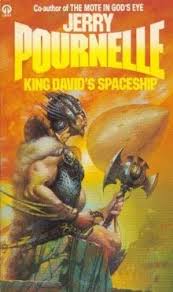
As it happens, I have copies of The Mercenary and King David's Spaceship. Since each of these works has been read maybe once and not recently, I am spared the trouble of seeking out other titles on Amazon for a while.
Since King David's Spaceship begins with a noisy crowd in the Blue Bottle and Imperial Navy officers buying drinks, we are in familiar territory, remembering, e.g., the opening passage of Anderson's "Sargasso of Lost Starships." Human beings cross interstellar distances faster than light, settle on terrestroid planets like Ansa or Prince Samual's World, build communities with hostelries like the Golden Planet or the Blue Beetle, then find that they are ruled by an Emperor in another planetary system, on Terra or Sparta.
Having enjoyed this fictional scenario in well-written works by Anderson, we expect to enjoy it again when it is re-presented by another writer - but the new writer must earn his keep. He does.
As it happens, I have copies of The Mercenary and King David's Spaceship. Since each of these works has been read maybe once and not recently, I am spared the trouble of seeking out other titles on Amazon for a while.
Since King David's Spaceship begins with a noisy crowd in the Blue Bottle and Imperial Navy officers buying drinks, we are in familiar territory, remembering, e.g., the opening passage of Anderson's "Sargasso of Lost Starships." Human beings cross interstellar distances faster than light, settle on terrestroid planets like Ansa or Prince Samual's World, build communities with hostelries like the Golden Planet or the Blue Beetle, then find that they are ruled by an Emperor in another planetary system, on Terra or Sparta.
Having enjoyed this fictional scenario in well-written works by Anderson, we expect to enjoy it again when it is re-presented by another writer - but the new writer must earn his keep. He does.
Dilemma?
Poul Anderson's many fictional characters face moral issues, e.g., Nicholas van Rijn as a merchant and Dominic Flandry as an Intelligence officer. Anderson knew better than to treat such issues simplistically and there is one hypothetical moral dilemma that I do not think that he ever posed.
The dilemma goes: either you kill a lot of people now or you do nothing in which case many more people, maybe even including those that you would have killed, are instead killed by someone else. What do you do? I responded to one fictional example here.
How often does anyone face such a dilemma? How could anyone be sufficiently certain either that there were only two choices or that these were those two choices? In Larry Niven's and Jerry Pournelle's The Mote In God's Eye, Admiral Kutuzov sterilizes a planet in order to prevent a sector rebellion. Although the Imperial Parliament and Navy approve his action, surely Kutuzov is guilty of war crime and genocide by any civilized standard? What value is there in a peace bought entirely through force and intimidation? The Empire has surely forfeited its right to any loyalty from the population of that sector?
The dilemma goes: either you kill a lot of people now or you do nothing in which case many more people, maybe even including those that you would have killed, are instead killed by someone else. What do you do? I responded to one fictional example here.
How often does anyone face such a dilemma? How could anyone be sufficiently certain either that there were only two choices or that these were those two choices? In Larry Niven's and Jerry Pournelle's The Mote In God's Eye, Admiral Kutuzov sterilizes a planet in order to prevent a sector rebellion. Although the Imperial Parliament and Navy approve his action, surely Kutuzov is guilty of war crime and genocide by any civilized standard? What value is there in a peace bought entirely through force and intimidation? The Empire has surely forfeited its right to any loyalty from the population of that sector?
Wednesday, 2 March 2016
Aleriona, Moties And Draka
One Aleriona who is bred to think like human beings and not allowed to
procreate, in order not to disrupt his own society, is lonely and tries
to befriend the captured Heim, thus giving the latter an escape
opportunity.
-copied from here.
This Aleriona sounds like Niven's and Pournelle's Motie Mediators who can go mad from identifying with human points of view. Mediators must be sterile so that they will not put the interests of their children over those of their Masters, like the idea of a celibate priesthood.
Anderson's Aleriona have a Final Society, like Stirling's Draka.
However, none of this should be interpreted to imply that The Star Fox by Poul Anderson, The Mote In God's Eye by Larry Niven and Jerry Pournelle and Drakon by SM Stirling are interchangeable works. On the contrary! Anyone who has not already read these three novels should be encouraged to do so and to appreciate their diversity.
All three works involve interstellar travel but in entirely different ways. Anderson and Niven & Pournelle present ingeniously imaginative aliens whereas Stirling speculates about what humanity might do to itself.
-copied from here.
This Aleriona sounds like Niven's and Pournelle's Motie Mediators who can go mad from identifying with human points of view. Mediators must be sterile so that they will not put the interests of their children over those of their Masters, like the idea of a celibate priesthood.
Anderson's Aleriona have a Final Society, like Stirling's Draka.
However, none of this should be interpreted to imply that The Star Fox by Poul Anderson, The Mote In God's Eye by Larry Niven and Jerry Pournelle and Drakon by SM Stirling are interchangeable works. On the contrary! Anyone who has not already read these three novels should be encouraged to do so and to appreciate their diversity.
All three works involve interstellar travel but in entirely different ways. Anderson and Niven & Pournelle present ingeniously imaginative aliens whereas Stirling speculates about what humanity might do to itself.
Souls
Poul Anderson's composite Didonians are one intelligent species who are constitutionally incapable of believing that they possess immortal souls. They already know that each individual consciousness is transient and that it has three constituents that can be combined with others to form consciousnesses with overlapping memories. Anderson's Ythrians of the New Faith believe that what matters is how they die, not that anything happens afterwards.
One of Niven's and Pournelle's Moties says that some Moties believe in souls and that others do not:
"'Like humans, Moties do not care to think their lives are purposeless. Or that they can and will be terminated.'"
-Larry Niven and Jerry Pournelle, The Mote In God's Eye (London, 1979), p. 79.
I think we are told that, in one Motie religion, an individual's soul is divided between her descendants? (Addendum: This is confirmed on p. 493 but it had first been mentioned earlier.)
As I understand it, what happened in human religion was this -
(i) We seem to leave the body and sometimes meet (dream about) the dead temporarily in sleep - therefore permanently in death. However, souls in Hades, Hel or Sheol were merely conscious of not being alive. This lingering on was unpleasant but unavoidable.
(ii) When society divided into classes, social stratification was projected into the hereafter: warriors in Valhalla and drowned sailors in Aegir's hall but everyone else in Hel.
(iii) Rightings of wrongs and social reversals in the hereafter. Thus, a happy hereafter for the righteous was a third and later stage of ideas about survival after death.
One of Niven's and Pournelle's Moties says that some Moties believe in souls and that others do not:
"'Like humans, Moties do not care to think their lives are purposeless. Or that they can and will be terminated.'"
-Larry Niven and Jerry Pournelle, The Mote In God's Eye (London, 1979), p. 79.
I think we are told that, in one Motie religion, an individual's soul is divided between her descendants? (Addendum: This is confirmed on p. 493 but it had first been mentioned earlier.)
As I understand it, what happened in human religion was this -
(i) We seem to leave the body and sometimes meet (dream about) the dead temporarily in sleep - therefore permanently in death. However, souls in Hades, Hel or Sheol were merely conscious of not being alive. This lingering on was unpleasant but unavoidable.
(ii) When society divided into classes, social stratification was projected into the hereafter: warriors in Valhalla and drowned sailors in Aegir's hall but everyone else in Hel.
(iii) Rightings of wrongs and social reversals in the hereafter. Thus, a happy hereafter for the righteous was a third and later stage of ideas about survival after death.
Comparing Empires
The more I learn about Niven and Pournelle's Empire of Man, the more I prefer Anderson's Terran Empire. In just one year:
there have been more revolts in the Trans-Coal Sack Sector;
a former colony and an armed outie system have allied against the Empire;
the population of the militarily occupied New Chicago resents Imperial paternalism;
the Viceroy must "...get on with the reconquest of Trans-Coalsack." (Mote, p. 455)
Must he? Why should outies oppose the Empire unless because the Empire threatens to incorporate them? Surely the purposes of extrasolar colonization are to:
travel far beyond the reach of any home-based tyranny;
preserve cultural identity;
reestablish freedom;
ensure human diversity;
spread humanity through so much space that it cannot possibly destroy itself or be destroyed.
The Terran Empire grows to a defensible size and no further whereas the Empire of Man aims to reunite all of humanity under one government by force if necessary. (p. 4)
there have been more revolts in the Trans-Coal Sack Sector;
a former colony and an armed outie system have allied against the Empire;
the population of the militarily occupied New Chicago resents Imperial paternalism;
the Viceroy must "...get on with the reconquest of Trans-Coalsack." (Mote, p. 455)
Must he? Why should outies oppose the Empire unless because the Empire threatens to incorporate them? Surely the purposes of extrasolar colonization are to:
travel far beyond the reach of any home-based tyranny;
preserve cultural identity;
reestablish freedom;
ensure human diversity;
spread humanity through so much space that it cannot possibly destroy itself or be destroyed.
The Terran Empire grows to a defensible size and no further whereas the Empire of Man aims to reunite all of humanity under one government by force if necessary. (p. 4)
Tuesday, 1 March 2016
Life And Death
There are times when it is appropriate to debate religion and times when it is appropriate to be quiet and listen - or even to read the service.
Dominic Flandry:
"'Will the captain read the service?' she asked...
"She handed him the prayerbook. Me? he thought. But I never believed - She was watching. They all were. His finger stained the pages as he read aloud the majestic words."
-Poul Anderson, Young Flandry (New York, 2010), p. 444.
Rod Blaine:
"Do I believe any of this? Rod wondered."
-Larry Niven and Jerry Pournelle, The Mote In God's Eye (London, 1979).
Rod hears:
"'Eternal rest...'
"'I am the Resurrection...'
"'I heard a voice from Heaven...'
"'Day of wrath, and doom impending...'
"'Unto Almighty God we commend the souls...'" (pp. 390-391)
It is generally accepted in society that we attend marriages and funerals of friends and colleagues, irrespective of their religious tradition. This unites us - most of us. Only a few sectarians disagree.
Rod rightly questions but rightly keeps quiet during a funeral service. There are appropriate channels to continue questioning. One of the chaplains is his confessor. When Rod inwardly philosophizes:
"...there's got to be some purpose in this universe..." (p. 391)
- he begins a discussion in which I would argue otherwise. Our inner conflicts imply that we have evolved without any design or purpose.
Dominic Flandry is less reflective. His nearest approach to deep questioning is when he asks his dead fiancee to help him believe...and adds that he is sorry.
Dominic Flandry:
"'Will the captain read the service?' she asked...
"She handed him the prayerbook. Me? he thought. But I never believed - She was watching. They all were. His finger stained the pages as he read aloud the majestic words."
-Poul Anderson, Young Flandry (New York, 2010), p. 444.
Rod Blaine:
"Do I believe any of this? Rod wondered."
-Larry Niven and Jerry Pournelle, The Mote In God's Eye (London, 1979).
Rod hears:
"'Eternal rest...'
"'I am the Resurrection...'
"'I heard a voice from Heaven...'
"'Day of wrath, and doom impending...'
"'Unto Almighty God we commend the souls...'" (pp. 390-391)
It is generally accepted in society that we attend marriages and funerals of friends and colleagues, irrespective of their religious tradition. This unites us - most of us. Only a few sectarians disagree.
Rod rightly questions but rightly keeps quiet during a funeral service. There are appropriate channels to continue questioning. One of the chaplains is his confessor. When Rod inwardly philosophizes:
"...there's got to be some purpose in this universe..." (p. 391)
- he begins a discussion in which I would argue otherwise. Our inner conflicts imply that we have evolved without any design or purpose.
Dominic Flandry is less reflective. His nearest approach to deep questioning is when he asks his dead fiancee to help him believe...and adds that he is sorry.
Monday, 29 February 2016
Space Battleships
"Lenin's bridge was enormous."
-Larry Niven and Jerry Pournelle, The Mote In God's Eye (London, 1979), p. 319.
Through prose and screen science fiction, we have become very familiar with a kind of vehicle that might never in fact exist: large faster than light interstellar spacecraft, often used for combat. Destruction occurs on stellar scales.
Flandry and a few other survivors fight on in a wrecked hulk in Ensign Flandry. Kirk destroys the Enterprise. Captain Rod Blaine must watch his ship, MacArthur, destroyed from the bridge of Lenin.
"Space battles are lovely to see." (p. 320)
That might be a matter of taste. But we have all seen Star Wars so perhaps we can judge for ourselves?
(I meant to save a few draft posts to publish tomorrow but the immediate future of this lap top has become uncertain so let's have five posts today.)
-Larry Niven and Jerry Pournelle, The Mote In God's Eye (London, 1979), p. 319.
Through prose and screen science fiction, we have become very familiar with a kind of vehicle that might never in fact exist: large faster than light interstellar spacecraft, often used for combat. Destruction occurs on stellar scales.
Flandry and a few other survivors fight on in a wrecked hulk in Ensign Flandry. Kirk destroys the Enterprise. Captain Rod Blaine must watch his ship, MacArthur, destroyed from the bridge of Lenin.
"Space battles are lovely to see." (p. 320)
That might be a matter of taste. But we have all seen Star Wars so perhaps we can judge for ourselves?
(I meant to save a few draft posts to publish tomorrow but the immediate future of this lap top has become uncertain so let's have five posts today.)
Why Empires?
Why are there so many interstellar "Empires" in American sf? Notable examples are the works of Poul Anderson, Isaac Asimov, Marion Zimmer Bradley, Frank Herbert, H Beam Piper and Larry Niven & Jerry Pournelle. Although James Blish's Cities In Flight features an interstellar "Hruntan Empire," the main emphasis of this series is on trade by the flying cities.
Empires resonate with much past Terrestrial history. The word "empire" evokes a realm both vast and powerful - although also oppressive and militaristic. It seems both implausible and unimaginative as a future form of social organization.
Poul Anderson wrote well about interstellar empires, then moved on to other kinds of fictional futures. "The Star Plunderer" makes the founding of the Terran Empire by Manuel Argos seem plausible and the Dominic Flandry novels make interstellar Imperial administration seem credible.
Greg Bear wrote:
"...Rome has been much abused. Lay off Rome for a while. And give me no spaceships in feudal settings...unless, of course, you are Poul Anderson, but you are most likely not."
-Greg Bear, "Tomorrow Through The Past" IN SFWA Bulletin, Fall 1979, pp. 38-41 AT pp. 40-41.
I agree that Poul Anderson made even feudalism with spaceships work. I can accept Niven and Pournelle's Empire of Man as part of a literary tradition and as the setting for their First Contact novel but sf must move on, as Anderson did.
Empires resonate with much past Terrestrial history. The word "empire" evokes a realm both vast and powerful - although also oppressive and militaristic. It seems both implausible and unimaginative as a future form of social organization.
Poul Anderson wrote well about interstellar empires, then moved on to other kinds of fictional futures. "The Star Plunderer" makes the founding of the Terran Empire by Manuel Argos seem plausible and the Dominic Flandry novels make interstellar Imperial administration seem credible.
Greg Bear wrote:
"...Rome has been much abused. Lay off Rome for a while. And give me no spaceships in feudal settings...unless, of course, you are Poul Anderson, but you are most likely not."
-Greg Bear, "Tomorrow Through The Past" IN SFWA Bulletin, Fall 1979, pp. 38-41 AT pp. 40-41.
I agree that Poul Anderson made even feudalism with spaceships work. I can accept Niven and Pournelle's Empire of Man as part of a literary tradition and as the setting for their First Contact novel but sf must move on, as Anderson did.
Merseians And Moties
Poul Anderson's Ensign Flandry is the opening volume of the Dominic Flandry series, a major part of Anderson's History of Technic Civilization. In Ensign Flandry, the title character is given a guided tour of the planet Merseia but must leave in a hurry. Merseian supremacism threatens the Terran Empire. The problem is ideological.
Larry Niven's and Jerry Pournelle's The Mote In God's Eye is the opening volume of the Moties diptych, a major part of Pournelle's CoDominium future history. In Mote..., crew members and passengers from the human spaceship, MacArthur, are given a guided tour of the planet Mote Prime but must leave in a hurry. The Motie breeding cycle threatens the Second Empire of Man. This problem is biological.
I appreciate two works simultaneously without implying that there is any textual one-to-one correspondence. Both series are Heinleinian future histories although with a structural difference. Whereas Anderson's Psychotechnic History and, I think, Pournelle's CoDominium History were consciously modeled on Robert Heinlein's Future History, the Technic History grew into a vaster Heinleinian template by the fusion of two originally independent series.
A future history comprises several successive periods, e.g., -
Heinlein: technological advances, interplanetary imperialism, the Prophets, the Covenant, the first mature culture;
Asimov: Robots, Empire, Foundation;
Cities In Flight: the Vegan Tyranny, the Earthman culture, the Web of Hercules, new universes;
The Seedling Stars: Port Authority; extrasolar colonies; a far future "Watershed";
Psychotechnic: UN, Solar Union, Stellar Union, Galactic civilization;
Technic: several periods, including Commonwealth (van Rijn) and Empire (Flandry);
Niven: interplanetary exploration; UN and Belt, Man-Kzin Wars, Known Space, the Thousand Worlds;
Pournelle: CoDominium, First Empire, Secession Wars, Second Empire.
(Blog readers will recognize Asimov's as another fused future history.)
James Blish and Poul Anderson also link the future to the past -
After Such Knowledge:
Roger Bacon, possibly inspired by a demon, invents scientific method;
demons manifest in the twentieth century;
a Jesuit biologist suspects demonic influence on an extrasolar planet in the twenty first century.
The Boat Of A Million Years:
immortals live through history into an indefinite future.
Larry Niven's and Jerry Pournelle's The Mote In God's Eye is the opening volume of the Moties diptych, a major part of Pournelle's CoDominium future history. In Mote..., crew members and passengers from the human spaceship, MacArthur, are given a guided tour of the planet Mote Prime but must leave in a hurry. The Motie breeding cycle threatens the Second Empire of Man. This problem is biological.
I appreciate two works simultaneously without implying that there is any textual one-to-one correspondence. Both series are Heinleinian future histories although with a structural difference. Whereas Anderson's Psychotechnic History and, I think, Pournelle's CoDominium History were consciously modeled on Robert Heinlein's Future History, the Technic History grew into a vaster Heinleinian template by the fusion of two originally independent series.
A future history comprises several successive periods, e.g., -
Heinlein: technological advances, interplanetary imperialism, the Prophets, the Covenant, the first mature culture;
Asimov: Robots, Empire, Foundation;
Cities In Flight: the Vegan Tyranny, the Earthman culture, the Web of Hercules, new universes;
The Seedling Stars: Port Authority; extrasolar colonies; a far future "Watershed";
Psychotechnic: UN, Solar Union, Stellar Union, Galactic civilization;
Technic: several periods, including Commonwealth (van Rijn) and Empire (Flandry);
Niven: interplanetary exploration; UN and Belt, Man-Kzin Wars, Known Space, the Thousand Worlds;
Pournelle: CoDominium, First Empire, Secession Wars, Second Empire.
(Blog readers will recognize Asimov's as another fused future history.)
James Blish and Poul Anderson also link the future to the past -
After Such Knowledge:
Roger Bacon, possibly inspired by a demon, invents scientific method;
demons manifest in the twentieth century;
a Jesuit biologist suspects demonic influence on an extrasolar planet in the twenty first century.
The Boat Of A Million Years:
immortals live through history into an indefinite future.
Subscribe to:
Posts (Atom)