Showing posts with label "The Star Plunderer" by Poul Anderson. Show all posts

Monday, 29 February 2016

Why Empires?

Why are there so many interstellar "Empires" in American sf? Notable examples are the works of Poul Anderson, Isaac Asimov, Marion Zimmer Bradley, Frank Herbert, H Beam Piper and Larry Niven & Jerry Pournelle. Although James Blish's Cities In Flight features an interstellar "Hruntan Empire," the main emphasis of this series is on trade by the flying cities.

Empires resonate with much past Terrestrial history. The word "empire" evokes a realm both vast and powerful - although also oppressive and militaristic. It seems both implausible and unimaginative as a future form of social organization.

Poul Anderson wrote well about interstellar empires, then moved on to other kinds of fictional futures. "The Star Plunderer" makes the founding of the Terran Empire by Manuel Argos seem plausible and the Dominic Flandry novels make interstellar Imperial administration seem credible.

Greg Bear wrote:

"...Rome has been much abused. Lay off Rome for a while. And give me no spaceships in feudal settings...unless, of course, you are Poul Anderson, but you are most likely not."
-Greg Bear, "Tomorrow Through The Past" IN SFWA Bulletin, Fall 1979, pp. 38-41 AT pp. 40-41.

I agree that Poul Anderson made even feudalism with spaceships work. I can accept Niven and Pournelle's Empire of Man as part of a literary tradition and as the setting for their First Contact novel but sf must move on, as Anderson did.

Friday, 7 November 2014

More Visuals

Let's appreciate some more of the visual content of Poul Anderson's "The Star Plunderer."

When the human slaves are being taken from Earth:

"They herded us aboard a tender after dark. It was like a scene from some ancient hell - night overhead and around, lit by many score of burning houses like uneasy torches out there in the dark, and the long, weary line of humans stumbling toward the tender with kicks and blows from the guards to hurry them along."
-Poul Anderson, Rise Of The Terran Empire (New York, 2011), p. 330.

When the freed slaves in their captured spaceship attack Gorzun:

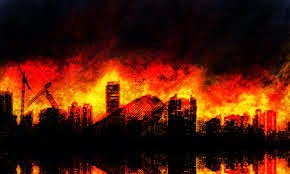
"Flame and ruin exploded beneath us. Spaceships burst open and toppled to crush buildings under their huge mass. Stone and metal fused, ran in lava between crumbling walls. The ground opened and swallowed half the town. A blue-white hell of atomic fire winked through the sudden roil of smoke. And the city died." (p. 359)

And when they return to Earth:

"It was winter in Earth's northern hemisphere when the Revenge came home. I walked out into snow that crunched under my feet and watched my breath smoking white against the clear pale blue of the sky. A few others had come out with me. They fell on their knees and kissed it. They were a wild-looking gang, clad in whatever tatters of garment they could find, the men bearded and long-haired, but they were the finest, deadliest fighting crew in the Galaxy now. They stood there looking at the gentle sweep of hills, at blue sky and ice-flashing trees and a single crow hovering far overhead, and tears froze in their beards.
"Home." (p. 360)

Imagine these scenes on a cinema screen or on a double page spread when you turn the page in a graphic novel. But I would want either kind of adaptation to reproduce the narrative and the individual scenes accurately. Manuel should be shorter than Reeves and Kathryn because that is how he is described. The tall gray four-armed Gorzuni, of course, present no problem for CGI. We have seen ERB's Tharks reproduced accurately in an otherwise inauthentic film.

A graphic adaptation can include visual details that are harder to spot in a film. For example, by looking back and forth between the first and third scenes presented here, we should be able to recognize some of the weary prisoners being herded towards the tender in the first scene as they later appear, wild, tattered, bearded and long-haired, in the third scene.

Without contradicting a prose text, visual adaptations can add details that we recognize as appropriate. The obsequious Mr Collins looks apologetic, not indignant, when he is rudely interrupted by his patroness, Lady Catherine de Bourgh, in a TV adaptation of Pride And Prejudice.

Is anyone planning to film Poul Anderson's works?

Thursday, 6 November 2014

Military Necessity

We all know that, during a war, a military commander orders his men to kill the enemy. That is what a war is. However, he also causes deaths in another way. He must order his men into action, knowing in advance that some of them will be killed. Therefore, he must calculate whether the losses on his side will be acceptable. But, in any case, he knows that there will be losses.

When the slaves revolt, the ship's armory is guarded by two Gorzuni with "...a portable shield against blaster bolts." (Rise Of The Terran Empire, p. 352) Manuel says:

"'We need a direct charge to draw their attention, while a few of us use the zero gravity to soar "overhead" and come down on them from "above"'"..."'John, lead the main attack.'" (ibid.)

Reeves initial response is "'Like hell!'...It would be murder." (ibid.)

But his second response is to lead the attack. It is instantly ripped apart and repelled although, in that instant, Manuel's flying attack succeeds. As it happens, Reeves survives with a mere burn but both of them had known that some men would die and that Reeves would be in front.

There is an issue here that is not addressed in the story. Reeves and the reader later learn that Manuel has become engaged to Reeves' fiancee who therefore breaks off her engagement to Reeves. Was this in Manuel's mind when he ordered Reeves to lead the attack? I do not think so. Manuel is Captain; Reeves is First Mate. They have not adopted these titles yet but this is already their de facto relationship. Manuel simply orders the First Mate to lead the direct charge while he himself leads the flying attack. He would have had neither time nor inclination to consider personal issues.

Phrases And Visuals

"Gorzun rolled black and white against a wilderness of stars."
-Poul Anderson, Rise Of The Terran Empire (New York, 2011), p. 357.

I have been tracking the phrase "...a wilderness of stars..." through Poul Anderson's works and here it is again.

Like most people, I enjoy good films. Like some people, I also enjoy good graphic fiction (comic strips). Films and comics are visual, unlike novels. Works like "The Star Plunderer" lend themselves to visual adaptation. Manuel's mutineers have switched off the lights and the twice Terran artificial gravity in the Gorzuni spaceship. Some have naval zero G training. While Manuel melts the lock of the cage holding the male slaves, Reeves:

"...could dimly see the tangle of free-floating naked bodies churning and screaming in the vast gloom. A scene from an ancient hell. The fall of the rebel angels. Man, child of God, had stormed the stars and been condemned to Hell for it.
"And now he was going to burst out!" (p. 351)

As the captured ship, now named the Revenge, attacks Gorzun, the men of Sol see:

"...mountains...snow and glaciers and a churning sea lit by three hurtling moons. Blackness and cold and desolation." (pp. 357-358)

Anderson's descriptions are vivid enough to convey how well these scenes would look if drawn or filmed.

Why Do Aliens Enslave Human Beings?

Are human women in any particular danger from alien barbarians? Yes, because the barbarians sell them -

"...at high prices to the human renegades and rebels."
-Poul Anderson, Rise Of The Terran Empire (New York, 2011), p. 333.

In fact, they are "...the luxury trade..." (ibid.).

Poul Anderson really was able to rationalize every cliche and absurdity of pulp magazine covers. Apart from women as such, human beings with qualifications like a degree in nuclear engineering are valued by aliens who have acquired space technology and weaponry without understanding them whereas untrained human beings merely do jobs that should be automated and do not last ten years, being easily replaced.

Why do some of us like fiction that combines futuristic technology and extraterrestrial environments with past social relationships like feudalism, imperialism and slavery? Whatever the reason, Poul Anderson knew how to make it work. Slavery appears twice in his History of Technic Civilization. When the Empire has expelled the barbarians, it reintroduces slavery as one part of its penal system.

I value Poul Anderson's works because he excels not only at this kind of space opera but also at serious speculative sf and sometimes even combines them.

"...Rome has been much abused. Lay off Rome for a while. And give me no spaceships in feudal settings...unless, of course, you are Poul Anderson, but you are most likely not."
-Greg Bear, "Tomorrow Through The Past" IN SFWA Bulletin, Fall 1979.

Ice Mountains And Blue Skies

Fiction is experience and imagination. Fantasy and science fiction are imagination but also experience.

"The engines began to thrum. Under way, outward bound to the ice mountains of Gorzun, no more to see blue skies and green grass, no clean salt smell of ocean and roar of wind in tall trees. Now we were slaves and had nothing to do but wait."
-Poul Anderson, Rise Of The Terran Empire (New York, 2011), p. 336.

It turns out that they do have something to do, to plan rebellion, but they are not at that stage yet. Anderson almost poetically expresses Terrestrial experience of sky, grass, ocean, wind and trees - and contrasts this familiar environment with the imagined ice mountains of another planet. Of course, "...ice mountains..." sound cold and hostile, especially when the characters are being taken there as slaves. Voluntary space travelers - explorers, traders or colonists - would view an extraterrestrial environment more positively.

And it turns out that even a slave might be able to take a positive view:

first, trained human slaves are valued, therefore might work in better conditions;
secondly, some slave owners can be decent individuals;
thirdly, there is the possibility of escape or rebellion.

Manuel, working for the Gorzuni:

notices Reeves' uniform and rank before the latter has to strip;
certainly notices when Reeves calls him a "'...filthy bastard...'" (p. 334);
can point out the few Gorzuni who understand Anglic;
has introduced the captain to marijuana;
is the de facto ship's engineer.

He is already well on his way towards organizing a slaves' revolt.

Wednesday, 5 November 2014

The Star Plunderer

"I had some shelter from behind which to shoot in a fragment of wall looming higher than the rest, like a single tooth left in a dead man's jaw..."
-Poul Anderson, Rise Of The Terran Empire (New York, 2011), p. 327.

What an image! The dead man's jaw is Earth and the single tooth is a slightly higher fragment of a shattered wall. And readers of this story, "The Star Plunderer," in Planet Stories, would not have paused to appreciate the image because they would have read on to find out who was shooting at whom.

This is science fiction, and specifically space opera, because gray four-armed barbarians are attacking Terra. They are firing slugs of a sickly-sweet gas which makes the narrator ill and dizzy whenever a slug bursts on his helmet. Why? Two of his comrades sprawl like corpses. Not dead. Like corpses.

"They'd taken direct hits and they'd sleep for hours." (p. 328)

The barbarians, described as Baldics but also as Gorzuni, want slaves, as John, the narrator, reminds his still active comrade, Kathryn, when she says that they might "'...blow us to the Black Planet.'" (ibid.) This science fictional phrase for death is also used in Anderson's "Sargasso of Lost Starships," published the same year but set two centuries later.

This text merits further study but not tonight. However, one closing question: who is the Star Plunderer of the title?

Monday, 3 November 2014

The Baldic League

Savages on a hundred planets got spaceships and nuclear weapons while remaining savages. (As the Technic History developed, both its author and its readers came to understand that the savages were armed by unscrupulous traders within the Polesotechnic League.) There are engineers who sacrifice to their converters and generals who depend on astrology so trained human beings are valuable slaves.

Some kings formed the Baldic League which defeated Solar forces because the Commonwealth had been weakened by civil wars. (We know that its first internal conflict was the Babur War.) Some human extrasolar colonists have reverted to barbarism and joined the Baldics against Earth. After the first sack of Terra, the League split because its founders were dead and their sons fought over the inheritance. One League faction conquers the outer Solar System and raids the inner planets for slaves while the Commonwealth government hides or no longer exists.

Manuel Argos, a slave on Gorzun, knows enough practical engineering to get a master in whose factories he learns more. His master sells him to the captain of a slaver ship where Argos easily becomes the de facto engineer, systematically sabotaging the engines until he can identify fellow slaves with technical training who will help him to take control of the ship. The days of the already divided Baldic League are numbered.

Manuel Argos

Manuel Argos:

is primarily of Mediterranean-Anatolian descent but also "A blend of all humanity, such as was not uncommon these days" (Rise Of The Terran Empire, p. 343);

is the self-educated son of, probably, a space prospector and, definitely, a day laborer on Venus;

shipped out for Sirius at thirteen;

has been a spaceman, miner, docker, soldier, politician, hunter and machinist;

has also had some unspecified "darker" occupations;

fought in human civil wars and also against the Baldic League;

is captured in a Gorzuni raid on Alpha Centauri;

at forty, returns to the Solar System as a slave;

leads a slave revolt and founds an Empire;

proposes to disarm other races but to treat them as equals, to collect tribute, not to expand indefinitely, to rule from good breeding stock with hard training and to revive archaisms like an Emperor and an aristocracy because these are effective symbols.

Wednesday, 25 June 2014

The Two Dark Ages Of Technic Civilization

Poul Anderson wrote one short story, "The Star Plunderer," set during the Time of Troubles between the Solar Commonwealth and the Terran Empire and another, "A Tragedy of Errors," set during the Long Night between the Terran Empire and the Allied Planets.

The Long Night is the Troubles writ large, a second social breakdown but on a vaster interstellar scale. During the Troubles, the Commonwealth government collapses while the Baldic League, uniting alien Gorzuni with human barbarians, occupies the outer Solar System and raids Earth for slaves. An entire series could have been set during the Troubles which end when Manuel Argos leads a slave revolt, attacks Gorzun and founds the Terran Empire, whose Fall a thousand years later precipitates the Long Night.

We know less about the Long Night, just that, throughout the four hundred light year diameter sphere that had been the Empire, Imperial rule ceases and interstellar travel is significantly reduced although there is no reason why some isolated planets cannot have retained their own technologies and civilizations. Sandra Miesel's Chronology of Technic Civilization tells us that, in the middle of the fourth millennium:

"War, piracy, economic collapse, and isolation devastate countless worlds."
Sandra Miesel, "Chronology of Technic Civilization" IN Poul Anderson, Rise Of The Terran Empire (New York, 2011), pp. 663-672 AT p. 671.

Countless worlds but not necessarily all. "A Tragedy of Errors" features a potential series character, Roan Tom, who gains economic power on the colony planet Kraken, which later joins the Allied Planets.

A notable feature of the Long Night is that the former Imperial volume of space is not, as expected, occupied by the rival Roidhunate of Merseia. It seems that "The Empire and Merseia wear each other out." (ibid.) We see the beginning of Merseian demoralization at the end of The Game Of Empire, the last work set before the Long Night.

Saturday, 14 June 2014

Gorrazan II

Poul Anderson, Rise Of The Terran Empire (New York, 2011) -

We see Gorzun attacked by Terrans.

Manuel Argos leads his crew of liberated human slaves in their captured Gorzuni ship renamed the Revenge. Knowing the native language, he talks his way past a guardian warship on the transonic communicator. The narrator wonders whether Manuel is human.

Using captured maps, the "'...men of Sol...'" (p. 358):

destroy a spaceport;
destroy a second spaceport and the spaceship above it;
surviving space interceptors and ground missiles, destroy a third base;
traversing hyperspace within a planetary system (tricky), destroy the three colonies on the next planet.

The men howl like wolves. Realizing that a racist empire cannot remain stable, Manuel declares that all races will be equal and that, as in the Roman Empire, worthy individuals will be able to become citizens.

Poul Anderson, Flandry's Legacy (New York, 2012) -

We see Gorzun, now called Gorrazan, attacked by Merseians.

Qanryf Bryadan Arrowswift, Vach Hallen, leads a squadron to Gorrazan and destroys defense ships while broadcasting propaganda. From Bryadan's cruiser Tryntaf, Afal Uroch the Lucky of the Vach Rueth leads an escadrille of twenty six-male Fangryf-type gunboats "...midway between Terran Comet and Conqueror classes..." (p. 309).

The Merseians fly around the planet, defeating defense craft. Uroch flies between peaks as his pursuers crash into them. His and the eighteen other surviving Merseian craft hide in a hurricane which brings them to the shore where they destroy their target, thus helping the Liberation Council against the Folkmoot. They fight their way back into space and rejoin the Tryntaf.

This account presents slightly more information about the Gorrazani.