Showing posts with label "The Mercenary" by Jerry Pournelle. Show all posts

Friday, 11 March 2016

Future Politics

"'Nationalism everywhere,' the President sighed. 'Why?'
"No one had an answer to that."
-Jerry Pournelle, The Mercenary (London, 1977), p. 42.

This sounds like the "old and protean enemy" of the early period of Poul Anderson's Psychotechnic History. See here and here.

In The Mercenary:

Democrats and Republicans have become two wings of the currently ruling Unity Party which supports the Codominium which keeps the peace by preventing nationalist wars;

Unity are opposed by the Patriot Party, the violently left wing Liberation Party and the growing Freedom Party;

a Patriot electoral victory will mean the US leaving the CD and war;

a Freedom victory will mean a relaxation of security, a Patriot coup and war;

Liberation causes riots but remains an electoral minority.

We know that something bad is bearing down if we know anything about the later course of this future history but it will be interesting to see whether Pournelle can present it convincingly enough. I echo the President's question: why all the nationalism?. 

Expectations

An opening passage generates expectations that are confirmed or confounded by the ensuing narrative. Unusually, the opening paragraph of A Circus Of Hells tells us exactly what we are about to receive:

"The story is of a lost treasure guarded by curious monsters, and of captivity in a wilderness, and of a chase through reefs and shoals that could wreck a ship. There is a beautiful girl in it, a magician, a spy or two, and the rivalry of empires."
-Poul Anderson, Young Flandry (New York, 2010), p. 197.

However, the reefs, shoals and magician are not exactly as we expect them to be.

The opening sentence of the main text of A Knight Of Ghosts And Shadows also unusually directly addresses the reader about the contents of the novel, like a friend recommending or lending the book:

"Every planet in the story is cold..."
-Poul Anderson, Sir Dominic Flandry: The Last Knight Of Terra (New York, 2012), p. 342.

Both openings use the word "story," although an omniscient narrator usually presents us with fictional "facts" and does not draw attention to their fictionality. If we did not know it already, the opening of A Knight... makes clear that this is a science fictional novel involving interplanetary travel - and the word "cold" sets the tone.

In his Prologue to The Mercenary (London, 1977), Jerry Pournelle raises two subsequently confounded expectations. First, we expect John Falkenberg to be forcibly transported to a hellish colony planet. Next, when a mistake has been rectified, we expect Chapter I to describe the beginning of his Space Navy career. Instead, Chapter I jumps to twenty seven years later and addresses CoDominium politics - although we do learn that meanwhile Colonel Falkenberg has built a distinguished career. Pournelle has two stories to tell: the career of an individual and a history of the future.

To Space, To Fight

Science fiction heroes usually go to space willingly although James Blish's Crispin DeFord is press ganged by an Okie city. Jerry Pournelle's John Falkemberg seems to be in the same boat as DeFord, shuffling forward in a line of involuntary transportees but this turns out to have been a mistake. The Bureau of Relocation is authorized only to transport Falkenberg to Lunar Base because he has been appointed to CoDominium Navy Service. Should "...gangland youth..." on p. 15 of The Mercenary (London, 1977) have read "gangling youth"?

Thus, he goes willingly not only to space but also to fight, like Robert Heinlein's Matt Dodson joining the Space Patrol or Poul Anderson's Dominic Flandry joining the Terran Space Navy. The CD Navy is more akin to the Patrol than to the Terran Navy because it is charged not with defending an interstellar empire but with preventing nuclear war on Earth.

As in several future histories, humanity must survive the near future threat of nuclear annihilation if it is to have any longer term future in the galaxy. Unfortunately, in this fictitious history, the legacy of that threat follows mankind into space.

Space Travel In Science Fiction

Space travel in science fiction has two contradictory aspects. It is an exciting adventure but also becomes a routine matter in a complicated technological society where attention is instead focused on more mundane issues like survival and earning a living.

Thus, Poul Anderson's Eric Wace grows up in a slum near the regular earthquake noise of a spaceport but gets into space leaving the slum behind. Jerry Pournelle's John Christian Falkenberg is in a queue of involuntary colonists at a spaceport at the beginning of The Mercenary.

In the opening paragraph, unpleasant smells and incessant noise assault Falkenberg. In the next, he sees dingy white walls and bright sunshine. Thus, we note a well controlled third person point of view narration and direct appeals to three of the senses. We are in familiar Heinleinian-Andersonian territory and want to accompany this new viewpoint character out of the solar system.

Space And Stars

Starman Jones by Robert Heinlein
A Life for The Stars by James Blish
The Game Of Empire by Poul Anderson
The Mercenary by Jerry Pournelle

These are the titles of:

a Scribner Juvenile by Heinlein;
the one Okie juvenile novel by Blish;
a Technic History novel by Anderson;
a CoDominium future history volume by Pournelle.

These four works also have in common early references to space travel and to a teenage protagonist, the right hooks to catch a certain kind of reader. Personally, if I read the first page, then I will continue to read. Anderson's character Diana sits under the sun Patricius and two moons in a place where the population drifts "...in and out on the tides of space." (Flandry's Legacy, p. 195)

Pournelle's fifteen year old character, John Christian Falkenberg, is in a spaceport and is described as "...a gangland youth..."
-Jerry Pournelle, The Mercenary (London, 1977), p. 15.

Many people glancing at these opening pages will read no further but some of us want to know about the tides of space and to accompany Falkenberg into a spaceship. I already know about Diana Crowfeather but let's learn more about this gangland youth.

Thursday, 3 March 2016

Comparing American Future Histories

We will probably continue to compare American future histories while also continuing to emphasize, as has already been clearly demonstrated, that Poul Anderson is the master of this particular sf sub-genre. To this end, I must finish rereading Larry Niven's and Jerry Pournelle's The Mote In God's Eye, then perhaps read or reread more volumes in Pournelle's CoDominium History.

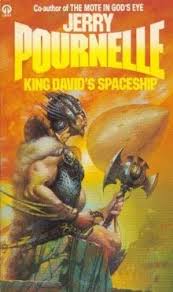
As it happens, I have copies of The Mercenary and King David's Spaceship. Since each of these works has been read maybe once and not recently, I am spared the trouble of seeking out other titles on Amazon for a while.

Since King David's Spaceship begins with a noisy crowd in the Blue Bottle and Imperial Navy officers buying drinks, we are in familiar territory, remembering, e.g., the opening passage of Anderson's "Sargasso of Lost Starships." Human beings cross interstellar distances faster than light, settle on terrestroid planets like Ansa or Prince Samual's World, build communities with hostelries like the Golden Planet or the Blue Beetle, then find that they are ruled by an Emperor in another planetary system, on Terra or Sparta.

Having enjoyed this fictional scenario in well-written works by Anderson, we expect to enjoy it again when it is re-presented by another writer - but the new writer must earn his keep. He does.