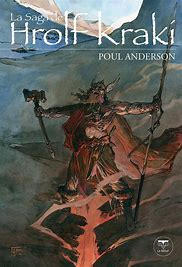
Showing posts with label Hrolf Kraki's Saga. Show all posts

Saturday, 14 November 2015

Between Books II

(The Peshawar Club.)

I have been doing "blog maintenance," which improves earlier posts but does not add any new ones. It will also take some time to complete the job.

Meanwhile, maybe the next Poul Anderson volume to be reread should be The Demon Of Scattery? It describes events post-Mother Of Kings and is narrated during The Broken Sword. Thus, these three Viking volumes are set centuries after War Of The Gods and Hrolf Kraki's Saga but before The Last Viking Trilogy.

SM Stirling's The Stone Dogs cannot arrive tomorrow because there is no post on Sunday. Stirling's The Peshawar Lancers is extremely enjoyable to reread but I am determined not to google every unfamiliar word like sambhur. There are too many of them, in any case.

In ...Lancers, the King estate has a church, a temple, a mosque and a gurdwara and the Kings' business agent in Delhi is a Jew. Admirable pluralism, also to be found in Anderson's Terran Empire although not in its rival imperium, the Merseian Roidhunate. In Europe right now, terrorist fanatics are trying to destroy our pluralism and start a race war. These are bad times.

Wednesday, 11 November 2015

Gunnhild And Hrolf Kraki

Hrolf Kraki's Saga is a retold saga full of Norse gods, heroes and the supernatural whereas Mother Of Kings is a biographical historical novel with a fantasy element recognizing the title character's role and reputation as a witch but with only two appearances by a single supernatural being: heroic fantasy as against historical fiction. Hrolf and the other leading characters in his saga are heroes; Gunnhild, Mother of Kings, is a villainness unopposed by any hero.

Without time to post at length this morning, I invite blog readers to reread earlier posts on both works and to appreciate the diversity of Poul Anderson's works even when the common theme is the retelling of Northern legends.

Friday, 30 October 2015

The First War And Later Events

"The gods themselves fought the first war that ever was."
-Poul Anderson, War of The Gods (New York, 1999), Chapter I, p. 9.`

There is a beginning.

"Saxo places Hadding three generations before Hrolf Kraki."
-War Of The Gods, Afterword, p. 301.

Thus, War Of The Gods, about Hadding, precedes Anderson's Hrolf Kraki's Saga.

"Great and rich was the Thraandlaw, a home for heroes. Hither had come Hadding from the South, to fell a giant, and win a king's daughter. Hence had gone Bjarki to the South, he who became the right hand of Hrolf Kraki."
-Poul Anderson, Mother Of Kings (New York, 2003), Book Two, Chapter XXII, p. 184.

Thus, Mother Of Kings, about Gunnhild, comes third.

"'It's said he fathered Gunnhild, the queen of King Eirik Blood-ax -'
"Skafloc gripped the tiller hard. 'The witch-queen?'
"Mananaan nodded. 'Yes...'"
-Poul Anderson & Mildred Downey Broxon, The Demon Of Scattery (New York, 1980), p. 193.

Skafloc and Mananaan converse in the untitled Prologue and Epilogue of The Demon Of Scattery during their voyage to Jotunheim described in The Broken Sword. Thus, The Broken Sword and The Demon Of Scattery are, chronologically, the fourth and fifth volumes of this sequence although everything in ...Scattery between Prologue and Epilogue is an extended flashback.

Mananaan's father, Lir, was a God of the City of Ys and Skafloc sees:

"...the drowned tower of Ys..."
-Poul Anderson, The Broken Sword (London, 1977), Chapter V, p. 31.

Thus, Poul and Karen Anderson's four-volume The King Of Ys precedes The Broken Sword and, indeed, since it features the decline of the Roman Empire, is set several centuries before Mother Of Kings and about a century before Hrolf Kraki's Saga.

The title character of Anderson's The Last Viking Trilogy is Eirik Blood-Ax's father's great-great-grandson, Harald Hardrada, who refers somewhere in the Trilogy to Gunnhild and falls in battle in 1066.

Skafloc also saw:

"...the sea maidens tumbling in the sea and singing..." (ibid.)

Christian priests drive the last merpeople from Europe in the fourteenth century in Anderson's The Merman's Children.

One long literary sequence alternating between historical fiction, historical fantasy and heroic fantasy.

Monday, 17 June 2013

Time Out With Beowulf

For Father's Day, my daughter, Aileen, gave me Seamus Heaney's translation of Beowulf, the edition whose cover is attached, and took me to the Man of Steel (comments on the latter on Comics Appreciation blog) so I am taking time out from Nicholas van Rijn and Dominic Flandry for Beowulf.

The text of Heaney's translation is straightforward and transparent, like a modern novel, something to be read by fans of Poul Anderson. Beowulf is a minor character in Anderson's retelling of Hrolf Kraki's Saga, just as the historical Macbeth is mentioned in his Last Viking Trilogy, which is about the historical Harald Hardrada.

In the twentieth century, fantasy and science fiction became literary ghettos. It is good to be reminded that Poul Anderson's works are integral to the European literary tradition, English-speaking North Americans being an extension of that tradition. 

Tuesday, 8 January 2013

Skafloc, Gunnhild, Hadding And Hrolf

Of Poul Anderson's five Viking fantasies:

The Demon Of Scattery (with Mildred Downey Broxon) opens with a reference to Skafloc (The Broken Sword) and ends with a reference to Gunnhild (Mother Of Kings);

Book Two of Mother Of Kings closes with references to Hadding (War Of The Gods) and Hrolf Kraki (Hrolf Kraki's Saga).

Thus, these five fantasies enhance each other and need to be republished in uniform editions, to be preceded by The King Of Ys Tetralogy (with Karen Anderson), set earlier, and followed by The Last Viking Trilogy, set later.

I am grateful to the many viewers of this blog - 41 page views by 10.45 AM today. I hope that they do not expect frequent new posts. Reading, for the first time, Mother Of Kings has slowed to a crawl because of other retirement activities: meditation; gym; walking; Latin classes; family outings; social occasions; another blog; no part time work at present but an imminent family visit of indeterminate length to Leicester where I will not have access to a computer.

Leicester, historically associated with Simon de Montfort, the "Father of Parliament," is close to Nottingham (the latter historically associated with Robin Hood) and has the only Jain Temple in the Western Hemisphere, with side chapels for different Jain sects.

Comments on posts are welcomed and will be acknowledged (after a delay).

Later: 72 page views by the end of the day.

Monday, 1 October 2012

The Dancer From Atlantis

In writing these notes on Poul Anderson's works, I have gone straight from Hrolf Kraki's Saga to The Dancer From Atlantis (London, 1977). Thus, we have moved backwards in time by a couple of millennia but also forwards from mythologically based fiction (fantasy) to scientifically based fiction (sf) because the premise of Dancer is technological time travel, not supernatural magic.

In Dancer, only Chapter One and the concluding section of Chapter Twenty are set in the present at the time of writing, the late twentieth century; none in the future. Thus, Chapters Two to Nineteen and over half of Chapter Twenty are set in the past, nearly all of that in a single period. Anderson realises that period and its inhabitants. Thus, he writes historical fiction.

However, the viewpoint character and his three companions have been technologically transported from later periods. Thus, Anderson also writes science fiction. I think that the composite term, "historical science fiction," is applicable to Dancer and to several other works by Anderson.

As mentioned in the previous post, the formula of Dancer is that the hero:

(i) starts in the here and now;
(ii) is transported to another time;
(iii) has adventures then;
(iv) returns.

For the central character, Duncan Reid, (i) and (ii) occupy Chapter One. (iii) starts in Chapter Three. Chapter Two is more of (i) and (ii) but for his companions, the Russian Oleg, the Hun Uldin and a woman called Erissa. Of necessity, each is the viewpoint character for their (i) "here and now," but the point of view returns to Duncan from the beginning of Chapter Three.

Finally, we may note here that time travel paradox begins to operate at the end of Chapter Two. When "...the vortex..." takes Erissa, she is praying to " '...God Duncan...' " (p. 20). The past-ward moving space-time vehicle seizes the middle-aged Erissa only twenty four years after it stops so it stops during her earlier life and Duncan will meet the younger Erissa.

Sunday, 30 September 2012

Hrolf's Peace And Doom

At last, we learn what has really happened in Poul Anderson's Hrolf Kraki's Saga (New York, 1973):

"The Father of Victories must cast down whoever might bring a stop to war." (p. 260)

Hrolf made peace but too soon. That was why Odin opposed him. With the benefit of historical hindsight, Anderson (not the tenth century narrator) concludes:

"Long would the years and hundreds of years be until Denmark was whole again. Now watchfires burned anew to warn of foes on their way. Vikings, outlaws, wild men harried dwellers throughout the North...N othing but a tale was left of a day which had been." (p. 261)

- like Camelot and Ys. We know what happened in history. This is one tale of how it happened.

Back To The Saga


After a short passage of novelistic narration, the text of Poul Anderson's Hrolf Kraki's Saga (New York, 1973) returns to saga-style story-telling. The narrator, no longer omniscient, does not know how a character feels:

"It may be that she was hurt...Or maybe she was only shallow...She is dead these hundreds of years and cannot speak." (pp. 241-242)

A modern omniscient narrator does not occupy the same timeline as either the characters or the reader.

Sometimes, in Anderson's fantasies, characters spontaneously speak in verse - have even developed this ability as a social skill - but the text informs us that a "Bjarkamaal" (a "call-to-arms" verse, explained earlier) puts two and a half pages of blank verse into Hjalti's mouth (pp. 243-244; 254-255).

Skuld's dark human and trollish army surrounds Hrolf's seat of government exactly like the giants and the dead attacking Asgard at the Ragnarok. Hrolf responds:

" 'Let us strive for only one thing, that our fearlessness live on in memory - for hither indeed have the strongest and bravest warriors sought from everywhere about.' " (p. 245)

This is exactly like the end of Camelot. After a last drink together, now knowing that they will die, Hrolf's warriors strive to kill as many of the enemy as they can before they are overwhelmed, as in the climactic scene of Anderson's Time Patrol story, "The Sorrow of Odin the Goth." An enemy weakened by his victory is an enemy badly harmed. ("Too high had the cost been. Winning was ashen." (p. 256))

Hrolf's men, fighting murderers and outlaws, are militarily superior but simply outnumbered, cleaving through the middle of the enemy host but leaving its flanks unscathed. Through witchcraft, the dead continue to fight. Bjarki and the troll-bear, like Thor and Jormungand, kill each other.

"Nothing did he want but to fell as many as might be before he also went down." (p. 252)

Heroism indeed.

The Strands Come Together


Two of the magic swords mentioned in Poul Anderson's Hrolf Kraki's Saga (New York, 1973) are wielded in the book itself, by Hrolf and Bjarki. The others are Sighurd's and Tyrfing. Hrolf says:

" 'The sword Tyrfing goes about in the world, and each owner gets victory from it, but he becomes an evildoer and in the end the sword is his bane.' " (p. 223)

Thus, he summarizes Anderson's first fantasy novel, The Broken Sword.

At last, away from bewitchment and with the benefit of hindsight, Hrolf begins to recognize the yeoman Hrani:

" 'That could have been old Odin. Truly - only now do I know what I saw - he was a man with one eye.' " (p. 224)

Too late to regain Odin's good will, the Danes decide to avoid battle "...for Odin is the Father of Victories..." although Hrolf comments, " ' His own doom sets the life of every man, and not yonder spook.' " (p. 224)

So now, thanks to all their fighting, Denmark have seven years of peace. We would regard this as a positive outcome but to them it is also negative. At peace, they can no longer win wealth or fame in battle and Odin may now be against them. The Saga draws to its end. We may expect a last battle in which the heroes meet their doom.

Feuds

When believers in an unchanging human nature ask me what moral progress mankind has made, I reply that the rule of law has replaced the rule of men. In Poul Anderson's Hrolf Kraki's Saga (New York, 1973), set during the European Dark Ages, warriors pledge loyalty to a king. Things go well if the king is a good one but not otherwise.

"The feuds from this day would grind on for years." (p. 219)

If your kinsman was killed, you accepted weregild or sought vengeance. In either case, this was primarily a private transaction, not an issue for public concern. In Anderson's short story, "The Man Who Came Early," it does not matter that a time traveler who cannot adjust to Viking society does not survive because he is a man of no account.

Feuds could last for generations. British courts must occasionally deal with families who still interact on this basis. Defense in court: "Yes, I smashed his window but it was because he damaged my car." This is legally and socially unacceptable and can result in members of a feuding family being ordered by the court to move to another town and not to return whence they came.

Now, we take it for granted that, whether a tramp is killed or the Prime Minister is assassinated, there will be a murder investigation. Almost certainly, more effort will be invested in the investigation in the latter case. Nevertheless, the last man to be hanged in Britain was executed for killing an anonymous tramp, someone who was of no account socially. Since then, we have abolished the death penalty. War in Europe is now unthinkable though, unfortunately, still not elsewhere.

We have made some progress.

Narratives And Northern Lights


Poul Anderson's Hrolf Kraki's Saga (New York, 1973) refers to:

"...a vast, shuddering sheaf of northlights, from which rays of wan red and glacier green fanned out over half the sky." (p. 239)

- so it is appropriate to illustrate it with an image of them.
(Cross reference: it is said that the Lights can steal souls but a Neil Gaiman character, the Alderman, is old enough to know - how rarely that happens.)

Just after that:

"Once an owl went soundlessly by, and Hjalti thought of fieldmice huddled in fear of those wings...like men in fear of the Powers.
"He lifted his head. Not him!" (p. 239)

Here is an apt comparison of men fearing the Powers with mice fearing an owl - and Hjalti's heroic defiance.

Here also is novelistic narrative. No longer is a Danish woman addressing a tenth century English court. Instead, the omniscient author directly tells the reader what Hjalti thought and how he responded. We have at last got right inside a character's mind.

The novel began and will end with saga-style narrative:

"Here ends the saga of Hrolf Kraki and his warriors." (p. 261)

Peace

In Poul Anderson's Hrolf Kraki's Saga (New York, 1973), we see not only the adventures of war but also the benefits of peace, won by warfare:

years of happiness;
the welfare and safety of folk;
righteous laws and judgments;
good harvets;
burgeoning markets;
growth of towns;
sowing of new fields;
man dwelling at peace with his neighbor;
troopers attending the king but also looking after their own ships and farms;
Bjarki taking fine gifts to his parents in the Uplands;
Svipdag seeking furs in Finland;
Hjalti sailing to England;
warriors trading up Russian rivers, along the Rhine and among the Franks;
every night a feast in the king's hall;
boards buckling under meat;
horns always filled;
skalds chanting;
wanderers yarning;
Hrolf giving gifts;
weapon drill, care of steel, hunting, fishing, fowling, wrestling, horse and boat races, stallion fights, draughts, gambling, children.
 
The narrator tells us that in all this "...are no tales to tell - only, afterward, memories." (p. 235) Again, a comment made in a fantasy novel rings true in reality.

"There is nothing to tell about those seven years of peace, save that Denmark has never forgotten them." (p. 236)

I suggest that the summary of those years has told us a great deal!

Strange Gods


In Poul Anderson's Hrolf Kraki's Saga (New York, 1973), the witch-king worshiped "...strange gods..." which were never "...of much use to him..." (pp. 228-229).

Hrolf stops offering to the gods for two reasons:

he had never liked hanging or drowning men and had offered only beasts (in Anderson's Time Patrol, Carl, mistaken for Woden, allows only fruit to be offered at his leman's burial mound but, in War Of The Gods, King Hadding hangs himself in offering to Odin);

in any case, Odin has become an enemy - the king and his men now trust in their own strength.

Abhoring human sacrifice and trusting one's own strength are secular virtues but secularism denies the gods' existence. By acknowledging their existence but regarding them as enemies, Hrolf remains within a Pagan world-view. Under his kingship:

"Everyone could do what he thought best." (p. 229)

Thus, pluralism, another secular virtue. The king and his men still think best to offer at graves and "...to the little beings which haunt house and home-acre..." but no longer to "...any Powers..." (p. 229).

The White Christ who troubles the old gods in other Anderson fantasies is not mentioned.

Skuld

In Poul Anderson's Hrolf Kraki's Saga (New York, 1973), Skuld, Hrolf Kraki's disaffected half-sister, mobilizes two forces against him:

(i) the socially and politically disaffected, "'...many who've no love for him, chieftains he's humbled, berserkers he's sent away, outlaws skulking hungry...'" and the people of other nations (p. 234);

(ii) "'...the Old Life...the brotherhood of Beast, Tree, and Waters...,'" threatened by man whose "'...works will cover the world - never again will it know freedom or wild magics...'" (pp. 232-233).

Here, Anderson writes fantasy but with modern knowledge as when, in another series, a Witch-Queen of Ys seems to sense the interstellar spaces. In his A Midsummer Tempest, the Fair Folk of Oberon and Titania are driven back by a premature Industrial Revolution. Skuld in effect foresees that Revolution centuries earlier and makes a pact with a Power from the sea - Aegir? She sells him on the idea that, motivated by hatred of Hrolf, she will not replace one human king with another but will use people against civilization. The disaffected will not come into their own but, manipulated by her, will also lose what they want. This is indeed a conflict of Ragnarok-like proportions.

Trolls, Namings And Sayings


Later in Hrolf Kraki's Saga (New York, 1973), we are told something about unsavory witchcraft (See earlier post, "Witchcraft"):

" 'Night after night he was at work on his witching stool, with his kettles and runestaves and bones.' " (p. 206)

The witch king is said to worship a boar which, when it attacks, is described as a "...troll-boar..." (p. 209)

- so here is a second troll-beast. (See earlier post, "Beast.")

King Hrolf comes slightly more to the fore in Chapter VI (of VIII) and it is here that he gains his nickname "Kraki" so it as if his character is still forming before us. The bestowal of the name by which a hero will later be known is always a significant event.

Hrolf's mother, Yrsa, utters a memorable phrase:

" 'Like old times? No, dead years can no more be reborn than dead men.' " (p. 213)

Fantasy characters can comment on life in ways recognizable to the reader.

Hrolf says:

" 'Men seek fame that their memory may not die with them.' " (p. 217)

Men live for different purposes:

in this age, celebrity fame may be fleeting;
Christian contemporaries and successors of Dark Age Pagans lived for a reward in Heaven;
some people amass wealth to bequeath to their heirs;
Buddhists seek to end rebirth;
some, skeptical about a hereafter, study and meditate in order to realize whatever understanding and enlightenment are possible before death.

Anderson comments on his characters:

"To us, their behavior seems insanely egoistic; but to them, each was first a member of his family and only second - however greedy for wealth and fame - himself." (p. xx)

Among Pagans, Jews and Christians, family transmits tradition. A fellow University student commented that the transition from Judaism to Catholicism to Protestantism to secularism is a move away from the family towards the individual. I am happy to live at the secular end of that transition.

Saturday, 29 September 2012

Odin In The Saga


I have been saying that Odin appears in two fantasies by Poul Anderson, The Broken Sword and War Of The Gods. Having read Hrolf Kraki's Saga only once many years ago, I had not remembered that Hrolf, while on a perilous journey, is advised three times by a tall, gray-bearded, spear-carrying, blue-cloaked yeoman hight Hrani wearing a broad-brimmed hat, who is old but wanders widely and laughs like a wolf. Two ravens are aloft and a wolf howls nearby.

Why do Hrolf and his warriors not recognise Hrani? Is it that the knowledge of Odin's appearance has been handed down to those who hear the stories but was not generally known at the time? Or does Odin cloud their minds? He does do this to some extent:

his house is not easy to see, standing in deep shadow like another darkness, and is of indeterminate size;
their experiences in the house are dreamlike;
they sense uncanniness;
Hrani is wise and a good story teller;
he regards Hrolf with "...an eye..." (p. 191);
they accept his unwelcome advice without question until afterwards.

Whatever the explanation, here is another appearance by Odin, adding a greater unity to Anderson's Dark Ages novels.

Beast


What is the "beast" killed by Bjarki on p. 177 of Poul Anderson's Hrolf Kraki's Saga (New York, 1973)? Described as a "troll-being" and "monster," it attacks at night, killing cattle and any men who go against it, so that, to their relief, King Hrolf orders his warriors to stay indoors but Bjarki, armed with the magic sword Lovi, goes to face it.

It is featherless, huge, clawed, beaked, tailed and crested, hisses and has a rank smell. When it swoops, Bjarki has difficulty pulling his sword from its sheath and attributes this to "Witchcraft!" (p. 177) However, he hauls Lovi out and then easily kills the monster. We are to understand that the sword, when it can be used, always kills. However, any man other than Bjarki would have been flattened by the beast's impact on his shield.

Drinking the troll-being's blood and eating its heart bestows strength and courage on Bjarki's formerly weak and cowardly servant. No further explanation is given here but there is an attack involving witchcraft-controlled trolls later in the novel so there might be some additional elucidation then. We are to understand that elves ride elven horses so perhaps trolls are accompanied by trollish monsters?


Friday, 28 September 2012

An Ancient Triad

Still rereading Hrolf Kraki's Saga and looking a short way forward (or rather backwards) -

If I remember it correctly, the final battle is like a mini-Ragnarok. The Danes know that they can lose, especially when supernatural evil is deployed against them, but this is where they should be. Their highest loyalty is to King Hrolf and they should be with him when it counts, whatever the outcome. "For how can man die better..." etc.

After that, the question is what to reread next. Imaginatively, I am still in Poul Anderson's pasts, not back in his futures. Before Hrolf Kraki's Dark Ages was the Fall of the Roman Empire, a period that included the flooding of the city of Ys. Set earlier than Poul and Karen Anderson's King of Ys tetralogy are three novels by Poul Anderson:

Conan The Rebel, a heroic fantasy set in a prehistoric civilisation;
The Dancer From Atlantis, a science fiction (sf) novel about time travelers in Atlantis;
The Golden Slave, a historical novel set during the Roman Republic.

These works are unconnected, in no way a trilogy, but they do happen to be three novels set in ancient times and they also represent Anderson's three genres of fantasy, sf and historical fiction.

Whenever a new Doctor Who season starts, I tell people to read the real stuff: The Time Machine; The Time Patrol; The Time Traveler's Wife. The Dancer From Atlantis is also pertinent:

a man from the future, Sahir, in a malfunctioning space-time vehicle, the anakro;

a language teaching device;

time traveling companions accidentally collected from earlier periods, wanting to return home;

Doctor Who also had a story set in Atlantis.

(Also, see here.)

I expect to reread some of these works before returning to any of Anderson's futures.

What Is Distasteful?


The text of Poul Anderson's Hrolf Kraki's Saga (New York, 1973) is preceded, after the table of contents, by:

"The Doom of the Skjoldungs," an Introduction by Lin Carter;
"The Skjoldungs," a genealogy;
 "The History of Hrolf Kraki," a Foreword by Poul Anderson.

Anderson hopes that his readers "...will bear with...the midnight of the Dark Ages. Slaughter, slavery, robbery, rape, torture, heathen rites bloody or obscene..." (pp. xix-xx)

He rightly contrasts his reconstructed Saga with "...The Lord Of The Rings, work of a civilized, Christian author...," although, as he adds, Tolkien derived his Trilogy from similar sources. (p. xix)

Anderson does not really show us a lot of slaughter etc but one section that I did find distasteful was the kind of harm that it was imagined could be inflicted by magic. A very unpleasant imagination was at work there.

Anderson proves his case that, in the Dark Ages, the only way to have a period of peace was to have a strong king who began his reign by fighting some of his neighbors to establish which of them was in control. I agree with him that:

"...we today need a reminder that we must never take civilization for granted." (p. xx)

He also mentions "...what we today feel as a lack of psychological depth...," (p. xx) which corresponds to my discussion of the narrative techniques of sagas and novels. See here and here.

Novelistic Story Telling

Despite its story telling techniques derived from sagas, Poul Anderson's Hrolf Kraki's Saga (New York, 1973) sometimes reads like a novel. Chapter V, "The Tale Of Bjarki," Section 4, describes "...Bjarki's trek..." and almost gives us his point of view:

"He had pushed on hard in his eagerness, and at nightfall found himself on a lonely stretch of heathland, soaked through." (p. 168)

Remember this is being narrated not by the omniscient author who can display a character's inner thoughts and feelings directly to the reader but by a Danish woman to an English court centuries after the events described so we expect from her a more objective, external, factual account along the lines of the opening phrase:

"There was a man..." (p. 3)

Possibly, Bjarki told someone that he had been eager, then soaked. Possibly, this information was included in the oral tradition transmitted by the Danish woman Gunnvor to the court of King Aethelstan. But this amount of subjective experiential detail seems unlikely.

Anderson is writing a novel. Sometimes the framing device of the saga recedes further into the background and the modern author directly addresses his readers, although he nevertheless stops short of the kind of direct incursion into Bjarki's mind that would be involved in telling us, for example, that Bjarki wondered if he would receive hospitality, remembered having received it on similar occasions in the past etc.