(The Peshawar Club.)
I have been doing "blog maintenance," which improves earlier posts but does not add any new ones. It will also take some time to complete the job.
Meanwhile, maybe the next Poul Anderson volume to be reread should be The Demon Of Scattery? It describes events post-Mother Of Kings and is narrated during The Broken Sword. Thus, these three Viking volumes are set centuries after War Of The Gods and Hrolf Kraki's Saga but before The Last Viking Trilogy.
SM Stirling's The Stone Dogs cannot arrive tomorrow because there is no post on Sunday. Stirling's The Peshawar Lancers is extremely enjoyable to reread but I am determined not to google every unfamiliar word like sambhur. There are too many of them, in any case.
In ...Lancers, the King estate has a church, a temple, a mosque and a gurdwara and the Kings' business agent in Delhi is a Jew. Admirable pluralism, also to be found in Anderson's Terran Empire although not in its rival imperium, the Merseian Roidhunate. In Europe right now, terrorist fanatics are trying to destroy our pluralism and start a race war. These are bad times.
Showing posts with label War Of The Gods. Show all posts
Saturday, 14 November 2015
Friday, 30 October 2015
The First War And Later Events
"The gods themselves fought the first war that ever was."
-Poul Anderson, War of The Gods (New York, 1999), Chapter I, p. 9.`
There is a beginning.
"Saxo places Hadding three generations before Hrolf Kraki."
-War Of The Gods, Afterword, p. 301.
Thus, War Of The Gods, about Hadding, precedes Anderson's Hrolf Kraki's Saga.
"Great and rich was the Thraandlaw, a home for heroes. Hither had come Hadding from the South, to fell a giant, and win a king's daughter. Hence had gone Bjarki to the South, he who became the right hand of Hrolf Kraki."
-Poul Anderson, Mother Of Kings (New York, 2003), Book Two, Chapter XXII, p. 184.
Thus, Mother Of Kings, about Gunnhild, comes third.
"'It's said he fathered Gunnhild, the queen of King Eirik Blood-ax -'
"Skafloc gripped the tiller hard. 'The witch-queen?'
"Mananaan nodded. 'Yes...'"
-Poul Anderson & Mildred Downey Broxon, The Demon Of Scattery (New York, 1980), p. 193.
Skafloc and Mananaan converse in the untitled Prologue and Epilogue of The Demon Of Scattery during their voyage to Jotunheim described in The Broken Sword. Thus, The Broken Sword and The Demon Of Scattery are, chronologically, the fourth and fifth volumes of this sequence although everything in ...Scattery between Prologue and Epilogue is an extended flashback.
Mananaan's father, Lir, was a God of the City of Ys and Skafloc sees:
"...the drowned tower of Ys..."
-Poul Anderson, The Broken Sword (London, 1977), Chapter V, p. 31.
Thus, Poul and Karen Anderson's four-volume The King Of Ys precedes The Broken Sword and, indeed, since it features the decline of the Roman Empire, is set several centuries before Mother Of Kings and about a century before Hrolf Kraki's Saga.
The title character of Anderson's The Last Viking Trilogy is Eirik Blood-Ax's father's great-great-grandson, Harald Hardrada, who refers somewhere in the Trilogy to Gunnhild and falls in battle in 1066.
Skafloc also saw:
"...the sea maidens tumbling in the sea and singing..." (ibid.)
Christian priests drive the last merpeople from Europe in the fourteenth century in Anderson's The Merman's Children.
One long literary sequence alternating between historical fiction, historical fantasy and heroic fantasy.
-Poul Anderson, War of The Gods (New York, 1999), Chapter I, p. 9.`
There is a beginning.
"Saxo places Hadding three generations before Hrolf Kraki."
-War Of The Gods, Afterword, p. 301.
Thus, War Of The Gods, about Hadding, precedes Anderson's Hrolf Kraki's Saga.
"Great and rich was the Thraandlaw, a home for heroes. Hither had come Hadding from the South, to fell a giant, and win a king's daughter. Hence had gone Bjarki to the South, he who became the right hand of Hrolf Kraki."
-Poul Anderson, Mother Of Kings (New York, 2003), Book Two, Chapter XXII, p. 184.
Thus, Mother Of Kings, about Gunnhild, comes third.
"'It's said he fathered Gunnhild, the queen of King Eirik Blood-ax -'
"Skafloc gripped the tiller hard. 'The witch-queen?'
"Mananaan nodded. 'Yes...'"
-Poul Anderson & Mildred Downey Broxon, The Demon Of Scattery (New York, 1980), p. 193.
Skafloc and Mananaan converse in the untitled Prologue and Epilogue of The Demon Of Scattery during their voyage to Jotunheim described in The Broken Sword. Thus, The Broken Sword and The Demon Of Scattery are, chronologically, the fourth and fifth volumes of this sequence although everything in ...Scattery between Prologue and Epilogue is an extended flashback.
Mananaan's father, Lir, was a God of the City of Ys and Skafloc sees:
"...the drowned tower of Ys..."
-Poul Anderson, The Broken Sword (London, 1977), Chapter V, p. 31.
Thus, Poul and Karen Anderson's four-volume The King Of Ys precedes The Broken Sword and, indeed, since it features the decline of the Roman Empire, is set several centuries before Mother Of Kings and about a century before Hrolf Kraki's Saga.
The title character of Anderson's The Last Viking Trilogy is Eirik Blood-Ax's father's great-great-grandson, Harald Hardrada, who refers somewhere in the Trilogy to Gunnhild and falls in battle in 1066.
Skafloc also saw:
"...the sea maidens tumbling in the sea and singing..." (ibid.)
Christian priests drive the last merpeople from Europe in the fourteenth century in Anderson's The Merman's Children.
One long literary sequence alternating between historical fiction, historical fantasy and heroic fantasy.
Tuesday, 8 January 2013
Skafloc, Gunnhild, Hadding And Hrolf
Of Poul Anderson's five Viking fantasies:
The Demon Of Scattery (with Mildred Downey Broxon) opens with a reference to Skafloc (The Broken Sword) and ends with a reference to Gunnhild (Mother Of Kings);
Book Two of Mother Of Kings closes with references to Hadding (War Of The Gods) and Hrolf Kraki (Hrolf Kraki's Saga).
Thus, these five fantasies enhance each other and need to be republished in uniform editions, to be preceded by The King Of Ys Tetralogy (with Karen Anderson), set earlier, and followed by The Last Viking Trilogy, set later.
I am grateful to the many viewers of this blog - 41 page views by 10.45 AM today. I hope that they do not expect frequent new posts. Reading, for the first time, Mother Of Kings has slowed to a crawl because of other retirement activities: meditation; gym; walking; Latin classes; family outings; social occasions; another blog; no part time work at present but an imminent family visit of indeterminate length to Leicester where I will not have access to a computer.
Leicester, historically associated with Simon de Montfort, the "Father of Parliament," is close to Nottingham (the latter historically associated with Robin Hood) and has the only Jain Temple in the Western Hemisphere, with side chapels for different Jain sects.
Comments on posts are welcomed and will be acknowledged (after a delay).
Later: 72 page views by the end of the day.
The Demon Of Scattery (with Mildred Downey Broxon) opens with a reference to Skafloc (The Broken Sword) and ends with a reference to Gunnhild (Mother Of Kings);
Book Two of Mother Of Kings closes with references to Hadding (War Of The Gods) and Hrolf Kraki (Hrolf Kraki's Saga).
Thus, these five fantasies enhance each other and need to be republished in uniform editions, to be preceded by The King Of Ys Tetralogy (with Karen Anderson), set earlier, and followed by The Last Viking Trilogy, set later.
I am grateful to the many viewers of this blog - 41 page views by 10.45 AM today. I hope that they do not expect frequent new posts. Reading, for the first time, Mother Of Kings has slowed to a crawl because of other retirement activities: meditation; gym; walking; Latin classes; family outings; social occasions; another blog; no part time work at present but an imminent family visit of indeterminate length to Leicester where I will not have access to a computer.
Leicester, historically associated with Simon de Montfort, the "Father of Parliament," is close to Nottingham (the latter historically associated with Robin Hood) and has the only Jain Temple in the Western Hemisphere, with side chapels for different Jain sects.
Comments on posts are welcomed and will be acknowledged (after a delay).
Later: 72 page views by the end of the day.
Saturday, 29 September 2012
Odin In The Saga
Why do Hrolf and his warriors not recognise Hrani? Is it that the knowledge of Odin's appearance has been handed down to those who hear the stories but was not generally known at the time? Or does Odin cloud their minds? He does do this to some extent:
his house is not easy to see, standing in deep shadow like another darkness, and is of indeterminate size;
their experiences in the house are dreamlike;
they sense uncanniness;
Hrani is wise and a good story teller;
he regards Hrolf with "...an eye..." (p. 191);
they accept his unwelcome advice without question until afterwards.
Whatever the explanation, here is another appearance by Odin, adding a greater unity to Anderson's Dark Ages novels.
Thursday, 27 September 2012
Differences
Poul Anderson's earliest heroic fantasy, The Broken Sword, differs in several respects from his later War Of The Gods and Hrolf Kraki's Saga.
(i) Whereas they are faithful retellings of Norse stories about Odin's descendants, it is a fanciful sequel to Norse stories about a magical sword.
(ii) Whereas they are firmly grounded in Scandinavian and North European geography, much of its action occurs in the invisible and apparently even impalpable halls of English elves.
(iii) When creating a new narrative, Anderson's imagination is not confined to Norse mythology. Thus, in The Broken Sword, Irish, Greek and Chinese supernatural beings coexist with those of the Vikings.
(iv) Those are national mythologies but the new internationalism of the Roman Empire is supernaturally represented by the White Christ before whom the old gods retreat. Christianity, absent from War Of The Gods, affects Hrolf Kraki's Saga only in that the stories of Hrolf, Frodhi, Hroar, Helgi, Svipdag, Bjarki, Yrsa, Skuld and Vogg are recounted in an English Christian court several centuries later.
Thus, in different works, we appreciate both creative invention and imaginative reconstruction.
(i) Whereas they are faithful retellings of Norse stories about Odin's descendants, it is a fanciful sequel to Norse stories about a magical sword.
(ii) Whereas they are firmly grounded in Scandinavian and North European geography, much of its action occurs in the invisible and apparently even impalpable halls of English elves.
(iii) When creating a new narrative, Anderson's imagination is not confined to Norse mythology. Thus, in The Broken Sword, Irish, Greek and Chinese supernatural beings coexist with those of the Vikings.
(iv) Those are national mythologies but the new internationalism of the Roman Empire is supernaturally represented by the White Christ before whom the old gods retreat. Christianity, absent from War Of The Gods, affects Hrolf Kraki's Saga only in that the stories of Hrolf, Frodhi, Hroar, Helgi, Svipdag, Bjarki, Yrsa, Skuld and Vogg are recounted in an English Christian court several centuries later.
Thus, in different works, we appreciate both creative invention and imaginative reconstruction.
Wednesday, 26 September 2012
Ravens III
This is one of the few Anderson novels that I have not yet read. However, it is possible to know exactly where it fits in his works. Like the first and second volumes of the trilogy, it is historical fiction, not fantasy. Thus, there can be no gods, giants, elves, dwarves or magic that works. (Indeed, in what has already been read, a sea voyage to the North discovers not Jotunheim but icebergs and must turn back.)
Secondly, since the title character and the events of his life are historical, we already know exactly how the story must end for King Harald Hardrada of Norway at the Battle of Stamford Bridge in the North East of England on the 25th of September, 1066. We have the Norns' knowledge of what will be. But this inevitability and foreknowledge are appropriate.
Reading Anderson requires a dictionary although we can now easily google obscure phrases. This, without explanation:
"All men must dree their weirds." (p. 132)
We know "weird" by now but what is "dree"? It sounded familiar but I had to google it. All men must accept their fates. And that applies particularly in this case to Harald Hardrada, trying to conquer England and knowing already the possible outcomes.
Odin
(ii) In his science fiction, a time traveler regularly visiting a Dark Age tribe is mistaken for Odin and has to play that role to the end.
(iii) In his heroic fantasy, Odin connives to get the Eddic sword Tyrfing reforged and also prevents a second War between Aesir and Vanir.
Thus, we encounter the original of Odin, a man mistaken for Odin and Odin. The god permeates three genres and four works.
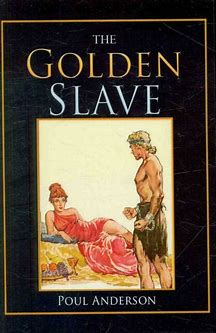
In (i) the historical novel, The Golden Slave (New York, 1980), the central character, leading a slave mutiny, is helped by a large man with red hair and beard who grabs and kills with a hammer, then declares:
" 'They call me Tjorr...' " (p. 128)
I immediately thought, "OK. Where's Odin?" He had been with us from the beginning. The central character, introduced in the second sentence, is called "Eodan." Tjorr goes on to say something equally significant, although I did not realize this on first reading:
" 'I am of the Rukh-Ansa...' " (p. 128)
"Ansa" is another name for "Aesir." As Anderson writes in the Epilogue:
"It was told from olden days, and written in the books of Snorri Sturlason, that the Asa or Ansa folk fared from the land of Tanais to the North. They soon became overlords...who themselves came to be worshiped as gods after they died. The first Asa king was called Odin, and he was the chief of the gods." (pp. 281-282)
And the Author's Note at the beginning of the novel informs us that the "...tradition described in the epilogue may be found..." in the Heimskringla and Saxo Grammaticus. (p. 6)
Thus, Saxo, a source for Anderson's fantasies featuring Odin as a god, is cited here instead as a source for the idea that Odin was a man, later deified. We read in Anderson's Hrolf Kraki's Saga (see here) that there was a temple of the high gods at Upsala but, according to the tradition described in the epilogue, Upsala was first the center from which the human Ansa ruled.
In the novel, we see Eodan lead his men from Tanais. He has encountered Zoroastrianism and we are to understand that the good-evil conflict in that religion informs the gods-giants conflict in Norse religion. Of necessity, Eodan loses an eye during the novel. He says at the end:
" 'I gave it for wisdom.' " (p. 279)
Tuesday, 25 September 2012
Frodi And Frodhi
At some point, which I can't find right now, in Anderson's War Of The Gods, Hadding names his grandfather as Skjold. Does this mean that he is claiming to be that close in time to the Skjold who was a son of Odin and the founder of the dynasty? I think it is more likely that this is another case of two men with the same name but will see if I can delve deeper into the Skjoldung lineage.
Monday, 24 September 2012
Ravens II
When reading Poul Anderson's War Of The Gods, I noted that the sail of the Danish King Hadding's ship bore the emblem of a raven which is also the symbol of Odin. This is explained in Anderson's earlier work Hrolf Kraki's Saga (New York, 1973) where a later Danish king also has "...raven sail unfurled..." (p. 54) War... tells us that the Danish kings were Skjoldungs, but the Saga adds that their ancestor, Skjold, was believed to be a son of Odin.
War Of The Gods explains a phrase used in the Saga. The Danish kings' enemies have reason to fear not only "...a raven banner..." but also "...a host in the swine-array of battle..." (p. 62). The swine-array, taught by Gangleri/Odin to Hadding, is a wedge shaped formation so named because it rips through an unprepared host like a boar's tusks.
In Hrolf Kraki's Saga, Chapter II, "The Tale of Frodhi," the usurper Frodhi is overthrown by his nephews Hroar and Helgi. In Chapter III, "The Tale of the Brothers," Helgi, reigning jointly with his brother, begets Yrsa who, according to the family tree at the beginning of the book, will become the mother of the title character, Hrolf Kraki. Thus, although Hrolf is not yet on stage, Chapter II (of VIII) has brought him significantly closer. However, as Anderson says in the Foreword, the real hero of the saga is Skjold's line of descent, not any single Skjoldung.
Saga And War III
Both Hrolf Kraki's Saga (New York, 1973) and War Of The Gods by Poul Anderson retell ancient stories but the latter flows more smoothly as a novel which is why earlier I remembered it as "better written." In War..., a single narrative recounts the career of the Danish king Hadding from infancy to death. By contrast, the Saga, its story reconstructed from fragmentary manuscripts, is episodic, covering seven generations of the Danish dynasty with the title character not born till the sixth.
However, Anderson writes in the Foreword:
"The hero is no one of them, but rather the blood of Skjold the Sheaf-Child, which coursed through many different hearts." (p. xx)
(Hadding was an earlier Skjoldung.)
In Chapter II, "The Tale of Frodhi," the two young sons of a deposed king, who have been living as farm hands, implausibly get physically close enough to their usurping uncle to overthrow him. Their foster father and brother-in-law, who have sworn loyalty to the usurper, give the boys limited but sufficient help without breaking their oaths of loyalty as legalistically interpreted. As Anderson comments:
"Love, loyalty, honesty beyond the most niggling technicalities, were only for one's kindred..." (p. xix)
"...we today need a reminder that we must never take civilization for granted." (p. xx)
War... is sufficiently unified by its single central character whereas Anderson unifies the Saga by inventing a tenth century narrator in the court of a Christian king. The king's bishop patronizingly allows the recital of a heathen story because, by understanding heathens, Christians might bring them to the Faith. The narrator explains details like how halls were built in the Northlands.
Both the Saga and War... have mythological settings. The Saga summarizes the myth of how Odin's son, Skjold, and the goddess Gefion founded the kingdom whereas War... begins with the war between Aesir and Vanir. All Skjoldungs are descendants of Odin of the Aesir and Hadding is also an incarnation of Njord of the Vanir.
However, Anderson writes in the Foreword:
"The hero is no one of them, but rather the blood of Skjold the Sheaf-Child, which coursed through many different hearts." (p. xx)
(Hadding was an earlier Skjoldung.)
In Chapter II, "The Tale of Frodhi," the two young sons of a deposed king, who have been living as farm hands, implausibly get physically close enough to their usurping uncle to overthrow him. Their foster father and brother-in-law, who have sworn loyalty to the usurper, give the boys limited but sufficient help without breaking their oaths of loyalty as legalistically interpreted. As Anderson comments:
"Love, loyalty, honesty beyond the most niggling technicalities, were only for one's kindred..." (p. xix)
"...we today need a reminder that we must never take civilization for granted." (p. xx)
War... is sufficiently unified by its single central character whereas Anderson unifies the Saga by inventing a tenth century narrator in the court of a Christian king. The king's bishop patronizingly allows the recital of a heathen story because, by understanding heathens, Christians might bring them to the Faith. The narrator explains details like how halls were built in the Northlands.
Both the Saga and War... have mythological settings. The Saga summarizes the myth of how Odin's son, Skjold, and the goddess Gefion founded the kingdom whereas War... begins with the war between Aesir and Vanir. All Skjoldungs are descendants of Odin of the Aesir and Hadding is also an incarnation of Njord of the Vanir.
Sunday, 23 September 2012
Saga And War II
In Poul Anderson's Hrolf Kraki's Saga (New York, 1973), when a king is killed in battle, the foster father of the king's two sons hides them with a wizard on an island. In Anderson's War Of The Gods, when a king is killed in battle, the foster father of the elder of the king's two sons hides them with a giant in the hills.
That is the sort of thing that happened in those days, apart from the giants. Kings were killed in battle and a young son of a slain king was immediately in danger. To be brought up in secret and to claim the kingdom on coming of age was part of the heroic legend.
The Saga has a narrator who, introduced in the very short, one and a half page, Chapter I, "Of The Telling," reminds us of her existence in the course of the text by addressing King Aethelstan's court, and thus also the reader, in the first person:
" '...long after the tale I will tell you...' " (p. 7)
" 'I have spoken of jarls. They are not the sames as English earls...' " (p. 11)
A dramatic or graphic adaptation would be able periodically to show us the story-teller addressing the court.
In Anderson's fantasies, we expect to find verse either alternating with the prose or concealed within it. On pages 8-11, the narrator recites a lay which is laid out on the page with a peculiar long gap between two of the words in the middle of each line. I do not know the reason for this except that it must reproduce the presentation of the verse in the original texts.
For concealed verse, we find this when the wizard addresses the king's sons:
" 'I heard them whisper in the dark, I hear them still in the gray. Rise up, Hroar and Helgi Halfdansson, and keep to my woods this day!' " (p. 20)
That is the sort of thing that happened in those days, apart from the giants. Kings were killed in battle and a young son of a slain king was immediately in danger. To be brought up in secret and to claim the kingdom on coming of age was part of the heroic legend.
The Saga has a narrator who, introduced in the very short, one and a half page, Chapter I, "Of The Telling," reminds us of her existence in the course of the text by addressing King Aethelstan's court, and thus also the reader, in the first person:
" '...long after the tale I will tell you...' " (p. 7)
" 'I have spoken of jarls. They are not the sames as English earls...' " (p. 11)
A dramatic or graphic adaptation would be able periodically to show us the story-teller addressing the court.
In Anderson's fantasies, we expect to find verse either alternating with the prose or concealed within it. On pages 8-11, the narrator recites a lay which is laid out on the page with a peculiar long gap between two of the words in the middle of each line. I do not know the reason for this except that it must reproduce the presentation of the verse in the original texts.
For concealed verse, we find this when the wizard addresses the king's sons:
" 'I heard them whisper in the dark, I hear them still in the gray. Rise up, Hroar and Helgi Halfdansson, and keep to my woods this day!' " (p. 20)
Hrolf Kraki's Saga And War Of The Gods
(i) Poul Anderson's Hrolf Kraki's Saga (New York, 1973) summarises the origin of the Skjoldungs who figure in this book and in his War Of Gods.
(ii) Like War Of The Gods, the Saga presents, in an early Chapter, a political geography of Northern Europe of the time.
(iii) Of one Skjoldung king of Denmark, it is said:
"...that a maiden might carry a sackful of gold from end to end of his realm and be safe." (p. 7)
This claim was made of Cyrus the Great in Anderson's Time Patrol Series. The same claim, without the sack of gold, was made of King Hadding in War Of The Gods.
(iv) Hadding makes peace between Skjoldungs and Ynglings although the Saga tells us that between these dynasties there was "...scant love and much bloodshed." (p. 7)
I expect to find more cross-references but have only reread as far as page 7 of the Saga.
(ii) Like War Of The Gods, the Saga presents, in an early Chapter, a political geography of Northern Europe of the time.
(iii) Of one Skjoldung king of Denmark, it is said:
"...that a maiden might carry a sackful of gold from end to end of his realm and be safe." (p. 7)
This claim was made of Cyrus the Great in Anderson's Time Patrol Series. The same claim, without the sack of gold, was made of King Hadding in War Of The Gods.
(iv) Hadding makes peace between Skjoldungs and Ynglings although the Saga tells us that between these dynasties there was "...scant love and much bloodshed." (p. 7)
I expect to find more cross-references but have only reread as far as page 7 of the Saga.
Literary Styles
Poul Anderson's The Broken Sword (London, 1977; original publication, 1954) begins and ends in the style of a saga:
"There was a man called Orm the Strong, a son of Ketil Asmundsson who was a yeoman in the north of Jutland." (p. 15)
"Here ends the sage of Skafloc Elven-Fosterling." (p. 208)
His Hrolf Kraki's Saga (New York, 1973) begins and ends in the same style:
"There was a man called Eyvind the Red, who dwelt in the Danelaw of England while Aethelstan was king. His father was Svein Kolbeinsson, who had come there from Denmark..." (p. 3)
"Here ends the saga of Hrolf Kraki and his warriors." (p. 261)
Chapter I of his War Of The Gods (New York, 1999) begins with the subject matter of an Edda:
"The gods themselves fought the first war that ever was." (p. 9)
However, its human action begins, in Chapter II, in the style of a novel:
"Up into the hills that rise north of the Scania lowlands came a small troop riding." (p. 15)
Let us compare the three texts so far. In The Broken Sword, Hrolf Kraki's Saga and War Of The Gods, Chapter I, a narrator directly addresses the reader and starts his story at the beginning. The gods are close to the beginning of all things and here they begin war, an important social institution for the Vikings. Neither Orm nor Eyvind will turn out to be our hero. Orm is Skafloc's father. Eyvind's Danish wife will recount Hrolf Kraki's Saga. These are the things that we need to be told first.
By contrast, War Of The Gods, like Paradise Lost after its opening invocation, "plunges into the midst of things" (in media res). We have yet to learn who the "...small troop..." are. We soon learn that this troop, en route to visit a giant, guards the two sons of a recently slain king. Thus, we learn what is going on while it is going on. Major events, including a battle, have already occurred but one of the characters soon recounts this to another and thus to the reader.
In accordance with the conventions of a novel, we expect the narrative, even if it is in the third person, to be presented from the point of view of a single one of its protagonists. The likeliest candidate is Braki Halldorsson, who fares at the head of the troop. Our expectation is only partly fulfilled. Certainly, we do not hear the voice of a distanced story-teller informing us equally about all of the characters and events. On the other hand, the point of view remains collective:
"...uneasiness was upon them." (p. 16)
"...Braki and his following...sat down, feeling bolder than before." (p. 19)
"Braki's followers loosened their grip on their weapons. Things were going as he had promised them." (p. 18)
Thus, when, after this third quotation, the text relates:
"Once this giant had murderously raided farms..." (p. 18)
it is telling us what Braki's followers knew and could reflect on as they relaxed while his earlier promise to them was fulfilled. This is different from a literary style in which the narrator or story-teller simply recounts the giant's deeds directly to the reader.
In War Of The Gods, the human story ends with the hero's followers finding his body. There is no conclusion in which we could be told about the succession or subsequent events. The novel as a whole ends in novelistic style with dialogue when Njord of the Vanir tells Odin of the Aesir:
" '...from this day to the last, we are brothers.' " (p. 298)
"There was a man called Orm the Strong, a son of Ketil Asmundsson who was a yeoman in the north of Jutland." (p. 15)
"Here ends the sage of Skafloc Elven-Fosterling." (p. 208)
His Hrolf Kraki's Saga (New York, 1973) begins and ends in the same style:
"There was a man called Eyvind the Red, who dwelt in the Danelaw of England while Aethelstan was king. His father was Svein Kolbeinsson, who had come there from Denmark..." (p. 3)
"Here ends the saga of Hrolf Kraki and his warriors." (p. 261)
Chapter I of his War Of The Gods (New York, 1999) begins with the subject matter of an Edda:
"The gods themselves fought the first war that ever was." (p. 9)
However, its human action begins, in Chapter II, in the style of a novel:
"Up into the hills that rise north of the Scania lowlands came a small troop riding." (p. 15)
Let us compare the three texts so far. In The Broken Sword, Hrolf Kraki's Saga and War Of The Gods, Chapter I, a narrator directly addresses the reader and starts his story at the beginning. The gods are close to the beginning of all things and here they begin war, an important social institution for the Vikings. Neither Orm nor Eyvind will turn out to be our hero. Orm is Skafloc's father. Eyvind's Danish wife will recount Hrolf Kraki's Saga. These are the things that we need to be told first.
By contrast, War Of The Gods, like Paradise Lost after its opening invocation, "plunges into the midst of things" (in media res). We have yet to learn who the "...small troop..." are. We soon learn that this troop, en route to visit a giant, guards the two sons of a recently slain king. Thus, we learn what is going on while it is going on. Major events, including a battle, have already occurred but one of the characters soon recounts this to another and thus to the reader.
In accordance with the conventions of a novel, we expect the narrative, even if it is in the third person, to be presented from the point of view of a single one of its protagonists. The likeliest candidate is Braki Halldorsson, who fares at the head of the troop. Our expectation is only partly fulfilled. Certainly, we do not hear the voice of a distanced story-teller informing us equally about all of the characters and events. On the other hand, the point of view remains collective:
"...uneasiness was upon them." (p. 16)
"...Braki and his following...sat down, feeling bolder than before." (p. 19)
"Braki's followers loosened their grip on their weapons. Things were going as he had promised them." (p. 18)
Thus, when, after this third quotation, the text relates:
"Once this giant had murderously raided farms..." (p. 18)
it is telling us what Braki's followers knew and could reflect on as they relaxed while his earlier promise to them was fulfilled. This is different from a literary style in which the narrator or story-teller simply recounts the giant's deeds directly to the reader.
In War Of The Gods, the human story ends with the hero's followers finding his body. There is no conclusion in which we could be told about the succession or subsequent events. The novel as a whole ends in novelistic style with dialogue when Njord of the Vanir tells Odin of the Aesir:
" '...from this day to the last, we are brothers.' " (p. 298)
Bifrost
Poul Anderson's War Of The Gods (New York, 1999) is a biographical novel in that it recounts a man's life from infancy to death. The framing sequence in its opening and closing Chapters, I and XXXV, summarises much of Norse mythology and reveals to Anderson's readers that the man Hadding whose life and death are recounted in Chapters II-XXXIV is an incarnation of the god, Njord. By sacrificing himself to Odin in Chapter XXXIV, Hadding has resolved a renewed conflict between two divine races, Odin's Aesir and Njord's Vanir. Now, they will face the end of all things together.
At the very end of the novel, Odin and Njord are about to walk up the rainbow to Asgard. Odin relates what a spaewife told him:
" 'When the new world arises from the sea and Baldr returns from the dead, you will be there to help build its peace.' " (p. 298)
A myth of universal peace following a cosmic dissolution - although Odin and Thor will not return. Myths recognise death and renewal but this myth also recognises that some deaths at least are permanent. When Fenris Wolf swallows Odin and a son of Odin avenges his father by placing a foot on the Wolf's lower jaw, seizing the upper jaw and tearing the Wolf apart, it is plausible that, in an earlier version of the myth, Odin re-emerged from the sundered Wolf but that is not in the myth that we inherit. Norse mythology also uniquely includes a failed Resurrection. The gods' attempt to rescue Baldr from Hel was unsuccessful.
Sheila and I visited a surprisingly accurate spaewife in Northern Ireland. She smiled knowingly and clearly "saw" what she said because she insisted on it even when we contradicted her. In each such case, events proved her right. One of her sisterhood told Odin about the Ragnarok.
Saturday, 22 September 2012
In The End
"All of our best and oldest legends recognize that time passes and that people grow old and die. The legend of Robin Hood would not be complete without the final blind arrow shot to determine the site of his grave. The Norse legends would lose much of their power were it not for the knowledge of an eventual Ragnarok, as would the story of Davy Crockett without the existence of an Alamo." (1)
- and Beowolf, fifty years older, was fatally wounded when he killed a dragon.
A myth does not have the happy ending of a fairy tale or a romantic novel. Imaginative in content but realistic in meaning, it addresses both life and death. Poul Anderson shows well the passage of time when retelling the Norse myth of Hadding in War Of The Gods (New York, 1999):
nearing fifty, Hadding remains straight and broad-shouldered, retains most of his teeth and does not yet seem old although, of course, there are signs of age;
his queen dies in childbirth;
his children grow and have children;
his adult daughter plots against him - like the King of Ys' daughter in the Andersons' tetralogy;
after killing an enemy in single combat, he thinks, " 'Yes...I am old...I wanted one last victory that was wholly mine, as a man among men...' " (p. 258);
when he counsels that it is better to build and trade than to burn and take, men remark, "...how the wild young rover had become the mild old grandfather. But some said, 'It's as though he's bidding us farewell.' " (p. 275)
Maturity can bring wisdom. Hadding had fought to gain his kingdom, had fought to build a peaceful realm, had fought to maintain it... However, he counsels his warlike son that peace and work strengthen the Danes:
" '...I have striven to uphold the law...men should turn to it before they turn to the sword...I'd be foolish to tell men they cannot fight abroad when they stand to gain thereby. But, Frodi, the king's care should always first and foremost be for the kingdom.'" (p. 263)
Life has been lived; lessons learned.
Hadding: I have done what I could. All things end.
Eirik: Memory dies not, the memory of what a man did in his life.
They "...speak of bygone times...all their years..." (p. 291)
(1) Moore, Alan, "The Mark of the Batman: An Introduction" IN Miller, Frank, The Dark Knight Returns, London, 1986.
Hrolf And Hadding
King Hadding of Denmark had a son called Frodi;
Hrolf Kraki, the hero of a saga, had a great-uncle called Frodi;
Saxo Grammaticus identified the Frodis;
Poul Anderson thought that this identification was mistaken;
Anderson retold Hrolf Kraki's Saga in 1973;
twenty four years later, he retold the story of Hadding as War Of The Gods.
In terms of Anderson's development as a writer, War Of The Gods is clearly a much later work - and I think better written although I have yet to reread Hrolf Kraki's Saga. For the purpose of arranging Anderson's heroic fantasies into a sequential reading order, it makes sense, even if we do not accept the identification of the Frodis, to go with Saxo's chronology for Hrolf and Hadding and thus to place Saga before War.
Both Hrolf and Hadding are Skjoldungs so it makes sense to know which came first. I expect to know more after rereading both books.
Peace And War
Poul Anderson's War Of The Gods (New York, 1999) shows not only wars and happy endings, with the hero marrying the king's daughter whom he has rescued, but also what follows: long years of peace, idle warriors longing for a return to military campaigns and some marital conflict between hero and heroine.
Hadding leads a fleet that harries the Wends and returns with booty because:
"...he could not well keep strength in being if he never used it." (p. 229)
Eventually, Hadding's peace is broken. Anderson shows how an outlaw with a big enough following may challenge a king, law breaker potentially becoming law maker.
Anderson's readers become used to noting what he is doing with language, particularly in the rhythm. In an earlier book, much of the dialogue was blank verse sometimes ending with a rhyme despite being laid out as prose. When told that the outlaw Tosti is leading an invasion, Hadding comments:
" 'We have heard of him before...Soon the world will hear no more.' " (p. 238)
Readers expecting only prose might miss this rhyming couplet.
Hadding leads a fleet that harries the Wends and returns with booty because:
"...he could not well keep strength in being if he never used it." (p. 229)
Eventually, Hadding's peace is broken. Anderson shows how an outlaw with a big enough following may challenge a king, law breaker potentially becoming law maker.
Anderson's readers become used to noting what he is doing with language, particularly in the rhythm. In an earlier book, much of the dialogue was blank verse sometimes ending with a rhyme despite being laid out as prose. When told that the outlaw Tosti is leading an invasion, Hadding comments:
" 'We have heard of him before...Soon the world will hear no more.' " (p. 238)
Readers expecting only prose might miss this rhyming couplet.
Golden Ages
"...the Great King had given so much law to his dominions that it was said a virgin with a sack of gold could walk unmolested across all Persia." (1)
"At last a maiden could walk alone, mile after mile, without fear." (2)
Poul Anderson knew that such Golden Ages did not exist.
"Manse Everard entered Pasargadae as if into a springtime of hope." (3)
- but the author immediately adds:
"Not that any actual era lends itself to such flowery metaphors." (3)
The first quotation is set in real history and includes the important qualification, "...it was said..." The second does not include such a qualification but is set in the mythical history of King Hadding of Denmark. In that history, after a climactic battle and its immediate aftermath, Anderson spends more than a page describing in detail fourteen years of peace:
"For season after season, their lands lay at peace. Spring came with a shout of wind and rush of rain, sunlight smote through..." (4)
- etc. I have already commended Anderson's ability to describe the weather and the seasons as experienced by populations living closer to them than we do and this passage in Chapter XXVI of War Of The Gods is particularly idyllic.
(1) Anderson, Poul, "Brave To Be A King" IN Anderson, The Time Patrol, New York, 1991, pp. 34-68 AT p. 40.
(2) Anderson, Poul, War Of The Gods, New York, 1999, p. 218.
(3) "Brave To Be A King", p. 41.
(4) War Of The Gods, p. 217.
"At last a maiden could walk alone, mile after mile, without fear." (2)
Poul Anderson knew that such Golden Ages did not exist.
"Manse Everard entered Pasargadae as if into a springtime of hope." (3)
- but the author immediately adds:
"Not that any actual era lends itself to such flowery metaphors." (3)
The first quotation is set in real history and includes the important qualification, "...it was said..." The second does not include such a qualification but is set in the mythical history of King Hadding of Denmark. In that history, after a climactic battle and its immediate aftermath, Anderson spends more than a page describing in detail fourteen years of peace:
"For season after season, their lands lay at peace. Spring came with a shout of wind and rush of rain, sunlight smote through..." (4)
- etc. I have already commended Anderson's ability to describe the weather and the seasons as experienced by populations living closer to them than we do and this passage in Chapter XXVI of War Of The Gods is particularly idyllic.
(1) Anderson, Poul, "Brave To Be A King" IN Anderson, The Time Patrol, New York, 1991, pp. 34-68 AT p. 40.
(2) Anderson, Poul, War Of The Gods, New York, 1999, p. 218.
(3) "Brave To Be A King", p. 41.
(4) War Of The Gods, p. 217.
Friday, 21 September 2012
Wedge
In Poul Anderson's War Of The Gods (New York, 1999), Gangleri (Odin) teaches King Hadding's men a new battle array:
"He spread them on the field as a great wedge. Hadding and Gunnar made the first row...Four men behind them made the second row, eight behind these the third, and thus until the last...it clove into the disordered foe, scattering those it did not straightway overrun...the wedge of men lived on throughout Northern lands. It came to be known as the swine array, for it ripped through an unready host like the tusks of a wild boar." (pp. 194-198)
I have remembered and noted this detail only because it connected with something in my experience. Once, I saw British police suddenly forming themselves into a wedge and driving it through a mass picket line, thus dividing the pickets into two groups and pushing them apart and away from the picketed entrance. On another occasion, however, with a bigger crowd, the pressure of the crowd was so great that it pushed the wedge back and the police were forced to retreat. There is strength in tactics but also strength in numbers.
In a later battle, Hadding's chieftains formed "...the men into a wedge..." whereas "...the foe formed their straight ranks." (p. 210) The two big men in the front row smash with axes, the four men in the second row strike right, left and ahead and the weight behind presses them forward so that the swine array splits the enemy ranks.
Oland
"A narrow strait...Beyond it, low and ling-worn, stretched the long island called Oland." (2)
Time Patrol members visited Oland in 43 AD. King Hadding fought a battle opposite it a few centuries later. But these were in different timelines.
The Time Patrol series is science fiction and the history protected by the Patrol differs from ours only in that it includes Sherlock Holmes as a real person. War Of The Gods is heroic fantasy and its history differs from ours by including gods and giants as real beings. Imagine a world in which twenty first century history books about Denmark included the information that Hadding became king with help from a man called Gangleri now known to have been the god Odin and that Hadding killed a giant after Thor had refused to do so even when the local king had called on him with mighty offerings.
So these are different Olands. Nevertheless, the reader appreciates this faint echo of the Time Patrol in a very different part of the same author's imagination.
(1) Anderson, Poul, "Star of the Sea" IN Anderson, The Time Patrol, New York, 1991, pp. 291-398 AT p. 361.
(2) Anderson, Poul, War Of The Gods, New York, 1999, p. 210.
Subscribe to:
Posts (Atom)