Showing posts with label The Sign Of The Raven. Show all posts

Sunday, 27 January 2013

Stamford Bridge


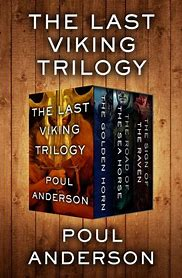
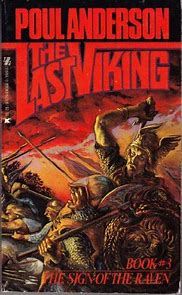
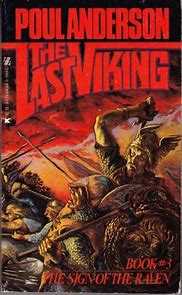
There is an unattested story that, during the Battle of Stamford Bridge, one giant Norseman delayed the entire English army at the bridge, killing many, until a man from the other side floated down the river to underneath where he was standing and stabbed him from below. In The Sign Of The Raven (New York, 1980), Poul Anderson makes this giant Viking a real person, Gunnar Geiroddsson, whose story had been carefully prepared, starting in the previous volume. Unaccountably, en route to England, Gunnar threw his ship's cage of chickens into the sea during a storm, explaining afterwards that this was a sacrifice to Ran.

Harald, who has been the central character throughout  the trilogy, falls at last:

"Thunder and night rolled over him." (p. 265)

- and Anderson neatly summarises what happened to the survivors afterwards. If Harald had defeated Harold, then William, - no mean feat -, then his wife would have become the first Queen Elizabeth of England.

In 1088, Elizabeth, now an Abbess back home in Kiev, hears from a visitor, Jon Ulfsson, how Norway has been changing: towns; trade; guilds; churches; chimneys; glass windows; fine clothes. She pronounces that:

" 'The old North died at Stamford Bridge.' " (p. 281)

- and, when Jon leaves, she listens:

"...till the hoofbeats faded into stillness." (p. 282)

- a haunting conclusion.

Dreams


I have discussed in previous posts how Poul Anderson wrote some works of historical fiction (The Golden Slave, Rogue Sword), some of historical fantasy (Hrolf Kraki's Saga, The War Of The Gods) and some of the former with elements of the latter (The King Of Ys, Mother Of Kings).

The Last Viking, including the volume The Sign Of The Raven (New York, 1980), is historical fiction. This is clear throughout and particularly when a sea expedition to the North encounters neither the world serpent nor frost giants but a whale and ice bergs. In historical fiction, the hero can encounter a god or a saint or have sight of the hereafter provided that he immediately afterwards awakes from a dream.

However, I am wondering if a tiny element of fantasy has crept in. In the Pagan worldview, a bad dream is a real warning that should be taken seriously. Before sailing to claim the kingdom of England by force, Harald Hardrada dreams that St Olaf:

"...looked on him with wrath and warned him that God did not stand behind this faring." (p. 194)

A guardsman in the invasion fleet dreams that a giant troll-wife prophesies a feast for the birds on the ships, then:

"...word went from ship to ship of many men who had had such warnings." (p. 199)

It sounds as if these dreams mean something and thus that, possibly, St Olaf and the troll are real supernatural beings intervening in human affairs. But that is as far as it goes: either a very small element of fantasy or just a lot of bad dreams on the eve of a battle.

History Repeats Itself


In the second last chapter of Poul Anderson's The Sign Of The Raven (New York, 1980), Harald Hardrada  encroaches, attacking places with familiar names, like Scarborough and York. Recalling his successful sieges as leader of the Varangian Guard in Volume I, he captures the walled Scarborough by setting fire to its thatched roofs.

This makes him remark to his English ally:

"' Your folk are as brave as any I've met; but they seem never to make ready for danger till too late.'" (p. 223)

- to which the ally replies:

" 'It's our great fault...' " (p. 223)

As I write, people in England are complaining that the government is never prepared for expected or predictable bad weather - a Motorway is closed by snow because it has not been gritted.

On p. 225, Harald's name is misspelled "Harold," potentially causing confusion with his opponent, Harold Godwinsson. Harald and his ally are about to attack York. After that, in the concluding chapter, their next stop will be Stamford Bridge.

Aesthetics


There is an entirely unexpected philosophical discussion in Poul Anderson's The Sign Of The Raven (New York, 1980), Chapter XI, "How The Host Was Gathered." Let me try to summarize it:

Harald: The scores of longships are a brave sight.
Elizabeth: Weapons and warships are the loveliest artifacts.
Harald: Not books or icons?
Elizabeth: Books and icons are holy. However, the instruments of death, neither gilded nor covered with twined serpents but serving a purpose, are clean and strong, like God's purposive creations - men, animals, mountains, sunsets etc.

That is quite a thought. As it happens, I do not believe that men etc were created for any purpose but nevertheless I can find some common ground with Elizabeth. She mentions:

"'...not only the aim of salvation but also the common purpose of eating and walking and working, of staying alive.'" (p. 182)

That common purpose I believe we were not made for but were naturally selected for so it makes sense to find an aesthetic in common between organisms selected for survival and artifacts constructed for a purpose. And I did not expect to have that discussion when starting to read The Sign Of The Raven.

Where Do You Wander?


In Poul Anderson's The Sign Of The Raven (New York, 1980), even Harald Hardrada can reflect on life when faced with the death of an old friend:

"Now we are the old ones, he told himself. It is our turn to stand as a wall between man and eternity, and one by one we are pulled away into we know not what. Oh Ulf my sworn brother, where do you wander tonight?" (p. 177)

Despite Harald's official and nominal Christianity, he here expresses the oldest human attitude to death, the slight contradiction between "...we know not what..." and "...where do you wander...?"

As I understand it, there have been three basic stages in beliefs about the hereafter.

(i) We were thought to leave our bodies temporarily in sleep and permanently at death. We dream about the dead, thus seem to meet them in their realm, which is a mere absence of life: Sheol; Hades; Hel. Homer has Achilles say that it is better to be a slave among the living than king among the dead.

(ii) When society divided into classes, these social divisions were projected into the hereafter. In the Viking version, warrior heroes go to Valhalla but the rest, including even the peaceful god Balder, still go to Hel (not Hell).

(iii) In Egyptian and Biblical mythology, there emerged the idea that goodness would be rewarded and suffering compensated for in the hereafter, e.g., that the roles of rich and poor would be reversed, as in a New Testament parable.

(Of course, the Indians developed the alternative idea that souls do not go anywhere else but endlessly return here until they are released from reincarnation. It is as if every possibility has been imagined, then intellectually elaborated.)

Harald is right back at stage (i). Chapter X, "How Ulf Uspaksson Fared Alone," ends with Harald's extraordinary dream, incorporating elements from several mythologies, about Ulf's journey through the hereafter. (Read it.) Even when writing not historical fantasy but historical fiction, it is always possible to include fantastic dreams. This one reminds me of a dream that was had by Anderson's character, Eodan, near the end of The Golden Slave, especially because centuries pass in both.

I agree with one aspect of (i): death is the absence of life. But, since the absence of consciousness is unconsciousness, the dead should not be aware of absence.
Saturday, 26 January 2013

Wisdom


Despite all the bloodthirstiness and superstition, it is possible to find some wisdom among the characters in Poul Anderson's The Sign Of The Raven (New York, 1980).

Ulf:

" 'As for me, I believe what I see with my own eyes, and doubt any man's bare word.' " (p. 149)

King Svein of Denmark, quoted by the English outlaw, Osric:

" '...I have learned to be content, and to remain by my own holdings however small...' " (p. 154)

Thus, Svein at least does not join in the scramble to secure the kingship of England. This shows that others could have done likewise. Those in any age who take a more enlightened view than their contemporaries are the leaven for a better future. In some respects, we are now in that future and, in other ways, it still lies ahead.

Wisdom II


Incredibly, what I called "wisdom" in the previous post suddenly strikes Thora, Harald Hardrada's usually bloodthirsty leman in Poul Anderson's The Sign Of The Raven (New York, 1980). Sailing at sunset, she suddenly interprets:

"'...blood in the west, and night in the east, like a sign...'" (p. 163)

Reflecting on the planned conquest of England, she asks:

"'...of a sudden I wonder how wise this is. Have we not enough already?'" (p. 163)

They have but it is incredible that she of all people should ask this. When Harald replies, "'No...While I live, never enough...,'" he clearly sets out the irrationality of his own perspective while she realizes that she no longer wants him to risk falling in battle. (p. 163)

Almost immediately, they see a bright three-tailed light in the sky, clearly not "'A new star...'" (nova), as Harald calls it, but a comet, which he interprets as St Michael's newly drawn sword presaging war on Earth. (pp. 164-165) But Thora sees it as drawn "'...against us...' " (p. 165)

Somehow, the horror of all the fighting and killing has suddenly got to her. Yes, people sometimes do learn and change.

Wisdom III


In Poul Anderson's The Sign Of The Raven (New York,1980), there is still much wisdom to be found if we heed the dialogue instead of rushing ahead with the war-like plot. When Harald Hardrada comments that his life-long friend, Ulf, is not the man he was, Ulf replies:

" 'Belike not. I draw near the end of my days. It seems better to sit and think what has been done, and try to make peace with the Powers, than play at still being a youth.' " (p. 169)

We can still do some of the things of youth but these need not include offensive warfare which, of course, is the subject under discussion.

Meanwhile, my much heralded and long delayed visit from the historic city of Lancaster to the historic city of Leicester is expected to start on Tuesday 29 January and to last for about five days. It is to be hoped that blog viewers will still find older posts of interest since there will be no new ones during that period but I will be reflecting on the history of England that is brought vividly to life by Poul Anderson's novels.

The Build Up


In Chapter VIII of Poul Anderson's The Sign Of The Raven, all the pieces are falling into place:

Harald Hardrada has given up on Denmark so will try to grab England;
William of Normandy has a strong claim to the English crown;
Edward the Confessor is dying;
Harold of Wessex is becoming more prominent;
Westminster Abbey is dedicated;
I recognise the names of Edgar Atheling, Edwin and Morkar, who will be in place when the Conqueror arrives.

It will not now be long until the two decisive battles that are destined to settle the fate of England for the next thousand years. After recounting the wars of the gods in other works, Anderson here presents a turning point in the English and European history that continues to the present day. 

Who Should Be King?


In Poul Anderson's The Sign Of The Raven (New York, 1980), Harold asks the dying Edward who should succeed him, hears "...a voiceless whisper, and then a rattling...," then, turning to those present, says:

" 'Now I take you here to witness, that the king has given me the kingdom and all power in England.' " (p. 142)

This sounds like dishonesty on Harold's part. However, at the Witan, all the chiefs name Harold, the people shout their assent and no one speaks for either Duke William or Harald Hardrada. That should have ended the matter. Instead, two battles were fought and the will of the Witan was overturned.

Rome backs William and Harold aims to get the English bishops on his side. Again, the Church looks like a political instrument, not like an independent agent with any superior moral authority.

Oaths


In Poul Anderson's The Sign Of The Raven (New York, 1980), Harold of England, an enforced guest of William of Normandy, swears on a consecrated jewel to uphold William's claim to the English crown. "William's half brother, Bishop Odo the crafty..." has hidden saintly relics under the jewel to make the oath even more binding (p. 134).

Harold, returned home, rightly argues that:

" 'A forced oath is no oath...' " (p. 135)

- and gets Bishop Wulfstan to absolve him of the oath. I agree that Odo was dishonest but are he and Wulfstan anything more than political tools of the rulers of Normandy and England respectively? In these circumstances, how could the Church claim to be an independent agent?

Looking Back


Aging, the characters in Poul Anderson's The Sign Of The Raven (New York, 1980) reflect on their lives and on life:

Ulf:

" 'In these late years, everything we have done seems one halloo, with naught to show for it and the world much the same whether we won or lost.' " (p. 83)

Harald:

"It was saddening how all in life, power and friends, horses and ships and love, could become simple habit." (p. 99)

Ulf:

" 'I min' one Moorish maid down in Miklagardh...many years agone; ah, yes, t'be young!' " (p. 109)

And, after a battle, each dead man:

"...crept into the night from which he had come." (p. 108)

Haakon hopes to defeat Harald but, with the norn's knowledge, we know that Harald will not die at this battle in Chapter VI, "How They Fought in Sweden." Looking ahead, we can see that Harald will have domestic problems in Chapter VII, "How Ellisif Was Angry," and that the enemies whom he should fear the most gather their forces in Chapter VIII, "Of Harold Godwinsson and Tosti." Chapter VIII begins in 1064. Not long to go.

The Rule of Men Or The Rule Of Law


In Poul Anderson's The Sign Of The Raven (New York, 1980), Harald Hardrada imposes his will on his people. Some are killed. Others lose hands or feet and everything they own. Houses are burned. Women and children are driven into the snow. Kine killed are left for crows.

A sheriff is present because he is:

" '...the king's sworn man; yet I've not hidden from him that this work turns my guts.' " (p. 122)

Which is right? To keep an oath to the king or to rebel against his injustice? We no longer have this dilemma, living under the rule of law. The last man to be hanged in England was executed for the murder of an anonymous tramp, a man of no social standing with no kin to take vengeance or to claim weregild. At least according to the law, the convicted murderer would have suffered no worse fate if he had assassinated the King or the Prime Minister. I think that we have made some moral and social progress.

William And Conan


At last, in Poul Anderson's The Sign Of The Raven (New York, 1980), we meet Duke William of Normandy, of whom it is said:

" 'When banditry becomes as vast as his, men name it conquest.' " (p. 129)

William will soon be known, of course, as William the Conqueror.

 What is surprising at least to me is that he fights a local war against a Count Conan of Brittany. I had not realised that there was a real life Conan, let alone one so historically recent. Anderson wrote Conan The Rebel about Robert E Howard's prehistoric character and Brittany is Armorica of which Poul and Karen Anderson's character Grallon became Duke after losing his Kingship when the city of Ys was inundated (non rex sed dux, not king but duke). Yet more interconnections.

Two Women And Three Hereafters


In Poul Anderson's The Sign Of the Raven, Harald Hardrada's leman, Thora, is scornful when Harald makes peace with his enemies and gleeful when he returns from strengthening his kingdom by killing its inhabitants whereas his wife, Elizabeth, hopes for peace and is on the verge of returning home and entering a convent when he comes back from burning and plundering. Amazingly, Harald retains the undeserved loyalty of both of these women.

His protestations that his actions are necessary ring hollow. Even then, it was possible to win support by ruling wisely and benevolently.

Where does Harald belong in a hypothetical hereafter? Valhalla, where he could notionally go after dying in battle at Stamford Bridge, is a glorification of violence. The Christian Hell, which Elizabeth foresees for him, would be endless, pointless torture. I propose a realm where each of us, you and I as well as Harald, would see the consequences of our Earthly actions and have the opportunity to do something about it. The even more hypothetical custodians of such a realm cannot be omnipotent because, if they were that, then they would have ordered the here and now differently. Why was Harald from an early age always restless for more that could only be gained, as he thought, by fighting for it?

We fulfill our cosmic role as the consciousness of the universe simply by existing. Beyond that, let us learn in harmony.

Friday, 25 January 2013

In Vino Veritas


In Poul Anderson's The Sign Of The Raven (New York, 1980),another short Latin phrase:

" 'In vino veritas.' " (p. 75)

 - In wine, the truth.

In Chapter II, "How They Fought at the River Niss," Harald's fleet destroys a Danish fleet twice its size. The bloody slaughter of common yeomen by skilled warriors is described in detail.

In Chapter III, "How a War Was Lost," it is learned that the Danish King Svein somehow escaped and has mustered an army too big for the Norse to engage. Yet again, Harald has failed to resolve the issue between himself and Svein.

In Chapter IV, "Of Haakon Ivarrson," through the power of "In vino veritas," it is learned that Haakon Jarl, although he had fought well on Harald's side, had also helped Svein to escape so now Haakon and his family must flee for their lives from Harald's wrath.

Chapter V, which I have yet to read, is called "How Peace Was Made," so perhaps this will at last present the resolution of the long conflict between Harald and Svein? I will read on to find out.

Meanwhile, here is something else to look out for in Anderson's works: more short but meaningful phrases in Latin.

Towards Stamford Bridge


The last date mentioned in the Foreword of Poul Anderson's The Sign Of The Raven is 1061, only five years left: five years to be covered in fourteen chapters, which are followed by an Epilogue entitled "Of Olaf the Quiet." Chapter I establishes that Harald Hardrada has a son called Olaf who might well be described as "Quiet."

Chapter XIV is called "How They Fought at Stamford Bridge." It is because of what happens at Stamford Bridge that the Epilogue is about Olaf, not about Harald's later years. He is not going to have any.

In Chapter II, "How They Fought at the River Niss," Harald sets off to a battle that is meant to settle matters at last between him and his old enemy, Svein of Denmark. Historically, I do not know how or even whether this conflict came to be resolved so I will shortly read further to find out. Historical fiction teaches us some history, especially if it is supplemented by a reading of some historical non-fiction.

This Volume brings to a close not only Anderson's Last Viking Trilogy but also his eight volumes set in the Viking period. For me, it also brings to an end a reading or rereading of his twenty one novels and several short stories set in the past so I expect after this to return to his futuristic science fiction.  

The Beginning Of The End


At last a start on reading Poul Anderson's The Sign Of the Raven, Vol 3 of his The Last Viking Trilogy. The Volume begins with a welcome thirteen page Foreword summarising Vols 1 and 2. I would not have remembered all of those details. Presumably an omnibus edition of the trilogy would omit the lengthy Forewords to Vols 2 and 3, thus reducing the page count.

In a recent post, I referred to Vol 3 as comprising 282 pages by the conventional means of simply reading the page number of the last page. However, the text of the novel begins on p. 23 so the real length of the novel is 260 pages. I think that, as an agreed publishing convention, the text of a novel should always be paginated from p. 1 and the preceding pages from p. i. In this case, pp. 1-22, which should be i-xxii, comprise:

p. 1, three paragraphs quoted from the novel;
p. 2, a list of titles by Bram Stoker available from the same publisher;
p. 3, the title page;
p. 4, publishing information;
p. 5, dedication;
p. 6, blank;
pp. 7-19, Foreword;
pp. 20-21, maps;
p. 22, a poem attributed to Sighvat.

There is no Table of Contents.

p. 1 is unnecessary and should have been the title page, p. 2 should have been other titles by the same author and p. 6 could have been the Contents.

The Foreword reminds us that the familiar names, Macbeth, Duncan and Malcolm, had appeared in the previous Volume. It also reminds us that Catholic clergy reproached Harald because he kept Orthodox clergy for his Russian wife. Well done, Harald. He appointed bishops himself. This was the Investiture Contest which, waged between Popes and Emperors, split Western Christendom and recurred again in the Church of England. If church and state had been separate, if during feudalism bishops had not been  landholders wielding political power, then the conflict would have been unnecessary.

Wednesday, 26 September 2012

Ravens III


Odin's symbol, the raven, appears on the banners and sails of his descendants, the Skjoldungs, in Poul Anderson's War Of The Gods and Hrolf Kraki's Saga (New York, 1973) and the title of Volume III of his Last Viking Trilogy is The Sign Of The Raven.

This is one of the few Anderson novels that I have not yet read. However, it is possible to know exactly where it fits in his works. Like the first and second volumes of the trilogy, it is historical fiction, not fantasy. Thus, there can be no gods, giants, elves, dwarves or magic that works. (Indeed, in what has already been read, a sea voyage to the North discovers not Jotunheim but icebergs and must turn back.)

Secondly, since the title character and the events of his life are historical, we already know exactly how the story must end for King Harald Hardrada of Norway at the Battle of Stamford Bridge in the North East of England on the 25th of September, 1066. We have the Norns' knowledge of what will be. But this inevitability and foreknowledge are appropriate.

Reading Anderson requires a dictionary although we can now easily google obscure phrases. This, without explanation:

"All men must dree their weirds." (p. 132)

We know "weird" by now but what is "dree"? It sounded familiar but I had to google it. All men must accept their fates. And that applies particularly in this case to Harald Hardrada, trying to conquer England and knowing already the possible outcomes.