For Father's Day, my daughter, Aileen, gave me Seamus Heaney's translation of Beowulf, the edition whose cover is attached, and took me to the Man of Steel (comments on the latter on Comics Appreciation blog) so I am taking time out from Nicholas van Rijn and Dominic Flandry for Beowulf.
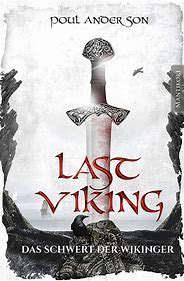
The text of Heaney's translation is straightforward and transparent, like a modern novel, something to be read by fans of Poul Anderson. Beowulf is a minor character in Anderson's retelling of Hrolf Kraki's Saga, just as the historical Macbeth is mentioned in his Last Viking Trilogy, which is about the historical Harald Hardrada.
In the twentieth century, fantasy and science fiction became literary ghettos. It is good to be reminded that Poul Anderson's works are integral to the European literary tradition, English-speaking North Americans being an extension of that tradition.
Showing posts with label The Last Viking Trilogy. Show all posts
Monday, 17 June 2013
Wednesday, 5 June 2013
Ensign Flandry III
Poul Anderson's A Midsummer Tempest is explicitly Shakespearean as the title proclaims. And we read about Macbeth in the Last Viking Trilogy. It is good to have hints of Shakespeare also in Ensign Flandry. Asked what the planet Starkad is like, Flandry remembers sea, winds, mountains, city, ocean floor, two races, billions of years, and ends, "...the great globe itself..." (Ensign Flandry, London, 1976, p. 192).
Later, exhausted, he thinks, "To sleep...to sleep, perchance to dream..." (p. 206)
Anderson devises clever ruses by which Flandry, a prisoner, forbidden to act, nevertheless manages to travel on one of the ships that explores the mystery surrounding Starkad and to monitor events as the fleet engages Merseians.
Yet again, Anderson recognizes that grass as we know it will not grow on another planet but something like it might:
"...a meadow of long silvery quasigrass." (p. 211)
It is a pity that Max Abrams does not reappear in the series (although his daughter does meet Flandry a long time later). Abrams is Flandry's mentor and, like Martin Schuster, Falkayn's first boss, represents yet another of the great Terrestrial religions, Judaism.
Ridenour re-appears although merely as an externally observed character. He is curt with Flandry but that is because he is busy on a doomed planet. It is good that he re-appears later in the series and then as a view point character.
When Flandry tells the Starkadian Dragoika that her planet is doomed, he learns something:
"He had not known she could weep." (p. 207)
But she also appears later in the series and has a son who joins Flandry's profession.
It occurs to me that Flandry's conversation with Miriam Abrams includes some elaboration of Chunderban Desai's theory about historical cycles so I will check on that next.
Later, exhausted, he thinks, "To sleep...to sleep, perchance to dream..." (p. 206)
Anderson devises clever ruses by which Flandry, a prisoner, forbidden to act, nevertheless manages to travel on one of the ships that explores the mystery surrounding Starkad and to monitor events as the fleet engages Merseians.
Yet again, Anderson recognizes that grass as we know it will not grow on another planet but something like it might:
"...a meadow of long silvery quasigrass." (p. 211)
It is a pity that Max Abrams does not reappear in the series (although his daughter does meet Flandry a long time later). Abrams is Flandry's mentor and, like Martin Schuster, Falkayn's first boss, represents yet another of the great Terrestrial religions, Judaism.
Ridenour re-appears although merely as an externally observed character. He is curt with Flandry but that is because he is busy on a doomed planet. It is good that he re-appears later in the series and then as a view point character.
When Flandry tells the Starkadian Dragoika that her planet is doomed, he learns something:
"He had not known she could weep." (p. 207)
But she also appears later in the series and has a son who joins Flandry's profession.
It occurs to me that Flandry's conversation with Miriam Abrams includes some elaboration of Chunderban Desai's theory about historical cycles so I will check on that next.
Friday, 25 January 2013
In Vino Veritas
" 'In vino veritas.' " (p. 75)
- In wine, the truth.
In Chapter II, "How They Fought at the River Niss," Harald's fleet destroys a Danish fleet twice its size. The bloody slaughter of common yeomen by skilled warriors is described in detail.
In Chapter III, "How a War Was Lost," it is learned that the Danish King Svein somehow escaped and has mustered an army too big for the Norse to engage. Yet again, Harald has failed to resolve the issue between himself and Svein.
In Chapter IV, "Of Haakon Ivarrson," through the power of "In vino veritas," it is learned that Haakon Jarl, although he had fought well on Harald's side, had also helped Svein to escape so now Haakon and his family must flee for their lives from Harald's wrath.
Chapter V, which I have yet to read, is called "How Peace Was Made," so perhaps this will at last present the resolution of the long conflict between Harald and Svein? I will read on to find out.
Meanwhile, here is something else to look out for in Anderson's works: more short but meaningful phrases in Latin.
21?
Why did I write in the previous post that Poul Anderson wrote twenty one novels set in the past? Partly to encourage any readers of that post to think about which twenty one I meant. I have been told that Poul and Karen Anderson regarded their The King Of Ys as one novel too long to be published in a single volume. In fact, it is published as a tetralogy of which each volume is quite thick.
There are two meanings of "trilogy": (i) one work in three parts and (ii) three related works. Thus, Tolkien's The Lord Of The Rings is a single narrative whereas James Blish's After Such Knowledge is three discrete novels. Ys, albeit a tetralogy, not a trilogy, is a work of type (i), not (ii).
By a novel, I mean a long prose fiction. How long? In practice, it is usually long enough to be published as a discrete volume, I would say 100+ pages minimum. A few novels can be collected in one omnibus volume although Ys would indeed be too long for that treatment. Because of their length and because of the need to publish them as separate volumes, I find it convenient to continue to think of Ys as four novels, not one.
My proposed twenty one follow classifications suggested in previous posts:
3 BC;
4 Ys;
8 Vikings;
3 14th century;
1 Time Patrol;
2 others - The Corridors Of Time and The Boat Of A Million Years.
There Will Be Time is a time travel novel whose action is equitably distributed through the past, present and future. Because of its passages set in Constantinople in particular, it could count as a twenty second novel of the past.
There are two meanings of "trilogy": (i) one work in three parts and (ii) three related works. Thus, Tolkien's The Lord Of The Rings is a single narrative whereas James Blish's After Such Knowledge is three discrete novels. Ys, albeit a tetralogy, not a trilogy, is a work of type (i), not (ii).
By a novel, I mean a long prose fiction. How long? In practice, it is usually long enough to be published as a discrete volume, I would say 100+ pages minimum. A few novels can be collected in one omnibus volume although Ys would indeed be too long for that treatment. Because of their length and because of the need to publish them as separate volumes, I find it convenient to continue to think of Ys as four novels, not one.
My proposed twenty one follow classifications suggested in previous posts:
3 BC;
4 Ys;
8 Vikings;
3 14th century;
1 Time Patrol;
2 others - The Corridors Of Time and The Boat Of A Million Years.
There Will Be Time is a time travel novel whose action is equitably distributed through the past, present and future. Because of its passages set in Constantinople in particular, it could count as a twenty second novel of the past.
Monday, 24 December 2012
Hyperborea
In the concluding Chapter of Volume II, that claimant, who has by now been King of Norway for many years, leads an Arctic expedition in search of Hyperborea, Jotunheim or whatever else is to be found to the North. A learned Saracen had told him that the world was round. He might:
sail over the top to Vinland or Cathay;
find Hyperborea, believed by the Greeks to be " '...a land of ageless springtime, beyond the north wind...' " (Anderson, The Road Of The Sea Horse, New York, 1980, p. 247);
find the Norse Giant Land, the World Serpent, Ydhun's apples, the well of youth or unicorns in fields where flowers are stars.
What they do find is cold, darkness, fog, icebergs and a whale until they turn back to be well rewarded by their King but with a story that will be recorded only in "...some monkish chronicle..." - and in a Poul Anderson novel (p. 253).
Subscribe to:
Posts (Atom)