OK. I am gathering together the posts quoting Poul Anderson's descriptions of the Milky Way. So far, they are:
The Milky Way
Mirkheim Miscellany
The Milky Way From The Dronning Margrete
Finishing Ensign Flandry Again
Mimir And The Milky Way
Descriptions, Including The Milky Way
Three Senses On Aeneas And The Milky Way
Any relevant new links will be added below:
Windhome And The Milky Way
Night Sky On Aeneas
The Milky Way As An Icefall
The End Of A Novel II
Curdled Silver
Supernova Ships And The Milky Way
Across The Milky Way
Bellatrix And The Milky Way
Cairncross And The Milky Way
Icy Sweep And Blue Jewel
The Milky Way In A Stone In Heaven
Radiant Road
Battle Sun And The Milky Way
The Frosty Glitter Of The Milky Way
Argent Flood Of The Milky Way
Sebastian Tombs And The Milky Way Etc
The Milky Way From Van Rijn's Yacht
Gandarian Street And The Milky Way
Life On Nerthus
The Milky Way And Ginnungagap
Starting The Jumps
Shadow And Milky Way
Constellations And Conscience
The Winter Of The World: Some Details
Concluding Details, Josserek And Van Rijn
The Sigman's Spaceship
Anderson And Blish
Columbus' Egg And The Milky Way
The Sea
Across The Sky
Furniture And Stars
On An Asteroid
Death And Aftermath II
Nebulae And Night
Latin, Poetry And The Milky Way
Olympus Mons And The Milky Way
Guthrie On Demeter And The Milky Way
Home Brew And The Milky Way
Moon And Milky Way
Milky Way And Magellanic Clouds
The Winter Road
Catastrophe At Hades
A Freakishly Huge Moon
The Farthest Star
Arrival
Mars And The Milky Way
On Mars
Fenn And Guthrie
The Fleet Of Stars: Concluding Observations From The Current Rereading
The Milky Way And A Moment
Ghostliness And The Milky Way
"Gorgeous Flow" (Julian May)
Some Anderson-May Parallels
An Infinitely Cold Cataract
Orbit Unlimited: A Few Details
Rustum Orbit
The Milky Way On Rustum
Ghost Road
Milky Way, Steak And Revolutionaries (SM Stirling)
"Home"
The Unexpected And The Cosmic Setting
The Unexpected II
Three Senses In Space
Frosty Cataract
One Frozen Waterfall
Cold, Curdled Milky Way
The Permanent Frontier
The Milky Way Spilled
Mirkheim, Chapter XIX
Mirkheim, The Last Chapter, Continued
Curdled Silver II
Rochefort And The Milky Way
Frostiness And Warmth
Galactic Vastness And The Milky Way
Cosmic Summary
Orichalc And The Ocean Of Stars
A River Of Silver
The Heaven
The Milky Way Cascaded
Several Details In The Devil's Game
The Milky Way; Falkayn's Family
A Beautiful Paragraph
Crowd And Torrent
The Milky Way In An Ebon Mirror
Lost To Sight
Thursday, 1 March 2018
The Milky Way Thread
Friday, 9 June 2023
Individuals In The Time Stream
Friday, 30 November 2018
The Fleet Of Stars: Concluding Observations From The Current Rereading
"...the galactic river encompassed him." (30, p. 382)
On Mars, download Guthrie visits David and Helen Ronay shortly after the violent deaths first of their daughter, Kinna, then of Kinna's fiance, Fenn. Despite the somberness of this occasion, the natural setting seems hopeful:
"The sky was pale rose, bright with morning." (31, p. 392)
Life is always ending and beginning. See:
Sunset And Morning
Quit While You're A Head
By contrast with the Ronays:
"...grief of the Terran kind was unknown to Lunarians." (31, p. 394)
They really are different - can we say "alien"?
Chuan describes the attempted massive deception not as a "'...conspiracy...'" ("'That is an ugly word, captain.'") but as:
"'...a stratagem for a noble purpose and an end too great for you to imagine.'" (31, p. 396)
Buddhists have a concept of "skillful means." Thus, a hermit, realizing that a deer in a remote wood had not learned to fear human beings, tried to teach it that fear, and thus to save its life, by running toward it, waving his arms and yelling. His threatening behavior was a pretense but for a good end. But how much deception might be justified as "skillful means"? Chuan's explanation sounds sanctimonious:
"'Humans...organic beings, limited, fallible, reckless, greedy, often hideously cruel - should not run loose in the universe.'" (31, pp. 396-397)
Greedy? Cruel? Not when we are civilized and have no reason to fight for survival or to hoard limited resources. Do we fight for the air that we breathe? Yes, if we are in a space station and down to the last oxygen cylinder.
Chuan's false dichotomy between, on the one hand, a population intellectually stimulated not by the real universe but by an elaborate fiction dishonestly presented as the cosmic reality and, on the other hand:
"'...your warriors, hunters, butchers, bandits, carousers, criminals, grovelers in superstition, blood sacrificers - your leftover animality...'" (31, pp. 398-399)
- is fatuous. There are never just two options, one bad, the other worse. When discussing alternative social arrangements, we should never have been told that there was only one, demonstrably worse, alternative: totalitarianism.
But something much more interesting is happening:
"...things went on around the great black hole - monstrous forces, convulsions in space-time - which the scientists at Proserpina could not account for or even give a name to." (31, p. 396)
"'...what's really going on at the core of the galaxy.'
"Chuan's self-control wavered for a moment. 'I don't know what it is. I cannot comprehend. But the great equation, the ultimate summation, is clearly incomplete. I suspect that the new knowledge, the new physics, can lead to - a power to transform the universe.' He shuddered." (31, p. 397)
Often, Anderson underlines dialogue with the Pathetic Fallacy. Here, Chuan's wavering and shuddering serve the same purpose. But, if the great equation is now seen to be incomplete, then everyone needs to cooperate to understand what is really happening in reality.
Signing off till next month, tomorrow.
Tuesday, 2 August 2016
Titles
"Time" is a frequent word in sf titles, and not necessarily in time travel fiction, e.g., Anderson's "The Horn of Time the Hunter." (And see here.) Anderson's The Corridors Of Time is appropriate and evocative and not only because there are literal corridors through time in the novel. See here. Does remembering your childhood feel like peering down a long corridor?
Andre Norton's The Crossroads Of Time evokes choices, decisions and historical turning points and implies the question: could there be a literal junction in the temporal dimension? Time is abstract but we like to compare it to a medium like water. Thus, I am currently reading Volume I of SM Stirling's time travel/alternative history trilogy:
Island In the Sea Of Time
Against The Tide Of Years
On The Oceans Of Eternity
"Against the tide of years" sounds like growing old. "On the oceans of eternity" sounds like realizing that a single life is short compared with everything before and after it.
Gregory Benford's Galactic Center Saga comprises "universe as water" titles:
- In the Ocean of Night (1977)
- Across the Sea of Suns (1984)
- Great Sky River (1987)
- Tides of Light (1989)
- Furious Gulf (1994)
- Sailing Bright Eternity (1996)
Sunday, 17 May 2015
The Sea Of Space
"Her gaze went back to the blackness; stars and nebulae and cold galactic river." (p. 176)
Poul Anderson regularly describes stars seen from space and I usually skip past such passages but now realize that I could instead compile a long comparative list of these descriptions by Anderson and other sf writers.
How often is the universe compared to water? Nearly every title on Gregory Benford's Galactic Center series makes this comparison:
In The Ocean Of Night
Across The Sea Of Suns
Great Sky River
Tides Of Light
Furious Gulf
Sailing Bright Eternity
James Blish wrote evocatively:
"It was the empty ocean of space that washes between galaxies."
-Earthman, Come Home (London, 1963), p. 56.
"...the Rift turned and eventually faded out into a rill of emptiness, soaking into the sands of the stars." (p. 59)
And, in Anderson:
"...Rax...had drifted about until it stranded at last on this tolerant shore." -Young Flandry (New York, 2010), p. 214.
"...a brawling, polyglot, multiracial population, much of it transient, drifting in and out on the tides of space." -Flandry's Legacy (New York, 2012), p. 195.
Space has no tides but we get the idea.
Monday, 8 October 2012
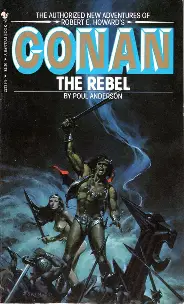
Conan The Rebel, Chapters I-III
The prehistoric civilisation has a mixture of, to us, partly familiar place names, races and gods. We recognise the serpentine Set and Mitra of the Sun. The name of the river Styx half suggests that the characters are already in the underworld. (They are not but that connotation is certainly present.) In the city of Khemi at night, sacred pythons seek for prey but slither away in alarm from the sound of footsteps. Nevertheless, "...the streets after sunset held their special perils." (p. 10)
There is an intolerance uncharacteristic of polytheism:
" '...the infidels who acknowledge you not...' " (p. 2)
" 'Cursed be Mitra and the Hyborians that follow him...' " (p. 3)
We can see one way that some nations moved from polytheism towards monotheism. A temporal ruler who extended his power over several realms came to be called not just "King" but "King of Kings." Similarly, a god was flattered when his worshipers called him Lord not, e.g., of the Nile Valley but of the whole Universe. Set is addressed in this way but acknowledges that he has not yet attained that level of power:
" 'You have called me lord of the universe, but you know how many and diverse are the gods of earth, sea, sky, and underworld. You know how few of them own me their master, how few of their peoples look on me as aught but a devil.' " (p. 3)
Since Set's servant sleeps on a mattress "...stuffed with the tresses of sacrificial maidens...," let us agree that he is indeed a devil. (p. 1) He is referred to, very inappropriately, as " 'He Who Is...,' " the highest of divine titles. (p. 14)
The viewpoint character of Chapters I and II is the centuries-old Topathis, a priest in Set's temple and head of the Black Ring of magicians. Set shows him the approaching Conan and Belit as on a television screen. They do not appear in their own right until Chapter III. Before that, we learn of the preparations being made against them.
Set tells Topathis that the conflict must remain terrestrial " '...for if the great gods intervened, that could bring on the Last Strife.' " (p. 3) This recalls Odin avoiding a too early Ragnarok in Anderson's The Broken Sword and also the US and USSR backing opposite sides in local wars but avoiding Mutually Assured Destruction on the global scale - a situation that Anderson reflected in the conflict between Terrans and Merseians in his main future history series and that Star Trek also reflected with the Federation and Klingons.
In Chapter II, we learn of a hidden axe, believed to be a Mitran relic with which a leader will free a people, thus a counterpart of the magical swords in other Anderson fantasies.
Monday, 12 February 2024
The Environment And The War
The People Of The Wind, XVII.
We are shown some glimpses of the Avalonian environment even during the onslaught of the second attack. The planetary environment, of course, includes the moon, Morgana. When Morgana is bombarded, its mountains crumble and its valleys run molten. Later, the moon is:
"...murky-spotted and less bright than formerly. So much had it been scarred." (XIX, p. 660)
During the attack, Terran Meteor boats, including Rochefort's, attack a missile launch silo which:
"...lay beyond the mountains, in the intensely green gorge of a river." (p. 631)
When the boats have finished:
"A set of craters gaped between cliffs which sonic booms had brought down in rubble. Rochefort wished he could forget how fair that canyon had been." (ibid.)
On the Scorpelunan plateau, where the invaders establish their bridgehead:
Tuesday, 9 April 2019
"Among Thieves": Continued
Comparing the Double Kingdom and Kolresh to the elephant and the whale (see here), Rusch argues that the two together, foot soldiers and space nomads, can conquer Earth. He is practicing a massive deception but why can he not take Queen Ingra into his confidence?
Apparently a mutation makes peace with Kolresh impossible. Maybe we will learn more about this as we (re)read further?
"A wind sighed over the slow thunder on the beach. A line of sea birds crossed the sky, thin and black against glowing bronze." (p. 169)
Three senses. Slightly earlier:
"...the copper spires of the little palace reached up to the evening star and the hours-long sunset of Ostarik blazed gold across great quiet waters." (p. 164)
References to the evening star always evoke peace even though this is not the evening star of Earth.
"He found a bench on the glistening edge of the strand, and sat down and looked across a steady march of surf, turned to molten gold by the low sun and the incandescent western clouds." (p. 167)
Space opera but with lyrical passages.
When Unduma returns to Earth, we learn that the towers of Capital City rear above the Zambesi River, that not Anglic but Tierrans is spoken, that the Premier of the Federation Parliament is Ngu Chilongo and that the Minister of Defence is Mustafa Lefarge. As in his stories where Sweden is the dominant world power, Anderson sets out to confound his readers' expectations.
Monday, 6 March 2023
Pale River And Talking Wind
The War Of Two Worlds, VI.
"She looked up toward the sky, where the Great Bear wheeled and Andromeda's nebula was a tiny whorl of silver impossibly far away and the Galactic belt's clustered suns ran like a pale river between the constellations." (p. 57)
I quote this passage because it is yet another description of the Milky Way that I seem to have missed before.
This chapter nearly concludes with another familiar theme:
"That night we slept on pine boughs with the wind talking in the trees overhead." (p. 59)
What did the wind talk about?
This has been an interlude. The text must return to the action. The very last sentence of the chapter reads:
"Our interlude was ended, and we started out next day for the new capital of North America." (ibid.)
Addendum: I had not missed that description of the Milky Way. It is here.
Thursday, 28 February 2019
The Milky Way On Rustum
Dan Coffin lives in the Rustumite lowlands which are usually cloud-covered. Visiting the plateau of High America, he sees the night sky:
"Stars crowded the dark, sparks of frozen fire which melted into the Milky Way; tonight the great torrent gleamed like sea-glow." (p. 136)
He also sees the Hercules Mountains, the frozen Emperor River, the two moons and three sister planets which are copper, silver and amber.
The place names are poignant for the reader because we have read them in previous stories but will not read them again (except by rereading) since this is the last Rustum story.
Saturday, 1 August 2015
Carl's Golden Age
"...a blue-cloaked spearman who rode through the sky on a mount that was not a horse." (Time Patrol, pp. 368-369)
He takes the chief's daughter, Jorith, as his leman and becomes "...a great trader." (p. 370) There are ten years of peace with amber, furs, honey and tallow from the North, also wine, glass, metalwork, cloth and pottery from the South and West. However, two years after Jorith's union with Carl, she dies immediately after bearing their son, Dagobert.
This is the period that the Wanderer's Goths look back to. Their chiefs after Winnithar are of divine descent:
Winnithar;
Jorith with Carl;
Dagobert;
Tharasmund;
Hathawulf.
We follow five generations from 300 to 372, a fictional history in a single novel - "The Sorrow Of Odin The Goth" fills 133 pages of Time Patrol. Winnithar and his wife Salvalindis do not join the general migration south but:
"When the wagons had creaked away, the Wanderer sought those two out, one last time; and was kind to them, for the sake of what had been and of her who slept by the River Vistula." (p. 384)
"...what had been..." The ten years of peaceful trade are already a memory.
Thursday, 24 July 2025
Night In Stygia
If the fifth dimension is spatial, then we say that the timelines coexist in parallel with each other. If it is temporal, then we say that they succeed each other. If it is something else, then we do not know what to say.
It would be strange to read Poul Anderson's canon in chronological order of fictitious events starting with Conan The Rebel and we would not usually advise anyone to do this. But when we do begin to read the novel, we find Anderson's characteristic detailed descriptiveness: