Monday, 22 July 2019
Sensations And Ideas
During their escape, Charlie and Hector swim:
"The sea was cool. It tasted less salty than a terrestrial ocean. Sunlight skipped across waves." (10, p. 112)
Three sentences: three senses.
Next, they are back with the rebel fleet:
"Whitecaps marched before a fresh breeze which sang in tackle, filled out sails, and drove the fleet swiftly in the direction of sunrise. Everywhere Charlie looked, he saw vessels." (11, p. 113)
Two sentences: three senses but with sound replacing taste.
Dzenko thinks that three Feats have generated so much support that the remaining two are less important. Charlie opposes assassinations and argues that commoners should benefit from the revolution. He has started to have ideas about what should happen but has not yet gained a position that would enable him to implement his ideas.
Tuesday, 3 November 2015
Dead Leaves And Drows
-Poul Anderson, Mother Of Kings (New York, 2003), Book One, Chapter VIII, p. 321.
"...drows..." is one of those words that sounds familiar and that can be understood in a general sense from its context. However, it is good to check it.
Gunnhild and her ally, with guards far enough behind not to overhear, are walking in a borderland between cultivation and wilderness. We should look out for references to at least three senses:
"The sky was an unbounded blue overhead,..." (p. 320)
- sight and color -
"...full of wings between strewn clouds,..." (ibid.)
- more sights and maybe the wingbeats are audible? -
"...the calls of wanderbirds blowing down..." (ibid.)
- in any case, the calls can be heard -
"...like dead leaves off branches." (ibid.)
That was unexpected. Here is an image, of falling leaves, but Gunnhild is not seeing the leaves. They are a metaphor for the bird calls.
"A breeze drifted to and fro,..." (ibid.)
- so she feels the air moving -
"...a touchy chilly,..." (ibid.)
- in fact, she feels cold -
"...smelling of wet earth." (ibid.)
- and a fourth sense is addressed, with hints of wetness and earthiness.
The descriptive passage continues with wan sunlight and shimmering fjord but we have already found more than three senses.
Sunday, 8 June 2025
Duplications
Three Senses On Nike (21 April 2018)
Three Senses On Nike (8 June 2025)
Just over seven years between them so, of course, I had forgotten the first post. But there are some slight differences between the two posts so maybe both are worth preserving? The first post links to many others through the short story, "Eutopia," which takes us from a future history series to alternative histories. History is an important aspect of Poul Anderson's works which also include ordinary historical fiction in which, e.g., explorers into Northern waters find not Utgard or the World Serpent but icebergs. It is all one multiverse.
Sunday, 19 June 2022
Three Senses And A Temporal Conundrum
"The door opened. Sunlight struck bright and bleak into the silk merchant's shop. Autumn air streamed after it, full of chill and street noises." (p. 269)
Three senses.
Through the still open door, Emil Volstrup sees cobblestones, arches, a Saracen and swallows but:
"...none of it seemed real any longer. Why should it? Whatever he saw could at any instant cease ever having been. Everything around him could. He himself." (p. 270)
It is logically possible to exist until time t1, then not exist after t1, but it is not possible to exist until t1, then, at t1, cease having existed until t1. That is contradictory.
In a sufficiently altered history, there would be no Emil Volstrup in 1137 (or whatever that year was called) but there would not be an Emil Vostrup who existed into that year, then, at some instant within it, ceased to exist - let alone ceased ever having existed.
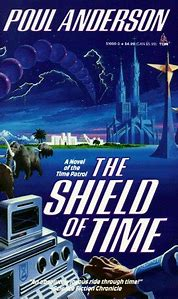
Some passages in the Time Patrol series would have to be rewritten before I could regard them as logically coherent. However, I could not have written such a series in the first place.
Monday, 10 July 2023
Three Senses In Aquilo
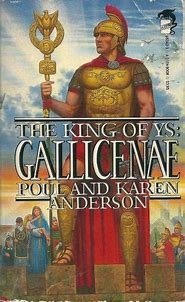
Gallicenae, XI, 1.
Gratillonius settles the veteran, Drusus, in Aquilo where he will lead a strong reserve force. While they speak, there is:
summer warmth
Thursday, 1 March 2018
The Milky Way Thread
OK. I am gathering together the posts quoting Poul Anderson's descriptions of the Milky Way. So far, they are:
The Milky Way
Mirkheim Miscellany
The Milky Way From The Dronning Margrete
Finishing Ensign Flandry Again
Mimir And The Milky Way
Descriptions, Including The Milky Way
Three Senses On Aeneas And The Milky Way
Any relevant new links will be added below:
Windhome And The Milky Way
Night Sky On Aeneas
The Milky Way As An Icefall
The End Of A Novel II
Curdled Silver
Supernova Ships And The Milky Way
Across The Milky Way
Bellatrix And The Milky Way
Cairncross And The Milky Way
Icy Sweep And Blue Jewel
The Milky Way In A Stone In Heaven
Radiant Road
Battle Sun And The Milky Way
The Frosty Glitter Of The Milky Way
Argent Flood Of The Milky Way
Sebastian Tombs And The Milky Way Etc
The Milky Way From Van Rijn's Yacht
Gandarian Street And The Milky Way
Life On Nerthus
The Milky Way And Ginnungagap
Starting The Jumps
Shadow And Milky Way
Constellations And Conscience
The Winter Of The World: Some Details
Concluding Details, Josserek And Van Rijn
The Sigman's Spaceship
Anderson And Blish
Columbus' Egg And The Milky Way
The Sea
Across The Sky
Furniture And Stars
On An Asteroid
Death And Aftermath II
Nebulae And Night
Latin, Poetry And The Milky Way
Olympus Mons And The Milky Way
Guthrie On Demeter And The Milky Way
Home Brew And The Milky Way
Moon And Milky Way
Milky Way And Magellanic Clouds
The Winter Road
Catastrophe At Hades
A Freakishly Huge Moon
The Farthest Star
Arrival
Mars And The Milky Way
On Mars
Fenn And Guthrie
The Fleet Of Stars: Concluding Observations From The Current Rereading
The Milky Way And A Moment
Ghostliness And The Milky Way
"Gorgeous Flow" (Julian May)
Some Anderson-May Parallels
An Infinitely Cold Cataract
Orbit Unlimited: A Few Details
Rustum Orbit
The Milky Way On Rustum
Ghost Road
Milky Way, Steak And Revolutionaries (SM Stirling)
"Home"
The Unexpected And The Cosmic Setting
The Unexpected II
Three Senses In Space
Frosty Cataract
One Frozen Waterfall
Cold, Curdled Milky Way
The Permanent Frontier
The Milky Way Spilled
Mirkheim, Chapter XIX
Mirkheim, The Last Chapter, Continued
Curdled Silver II
Rochefort And The Milky Way
Frostiness And Warmth
Galactic Vastness And The Milky Way
Cosmic Summary
Orichalc And The Ocean Of Stars
A River Of Silver
The Heaven
The Milky Way Cascaded
Several Details In The Devil's Game
The Milky Way; Falkayn's Family
A Beautiful Paragraph
Crowd And Torrent
The Milky Way In An Ebon Mirror
Lost To Sight
Sunday, 28 August 2016
Three Features In Two Sentences
"The clouds piled higher in the west, snow-bright on top, blue-black in their depths. The wind piped louder and colder." (p. 393)
This is a mobile scene, clouds and wind heightening. These two sentences display three features that we have already noticed in Poul Anderson's texts:
an appeal to at least three of the senses;
an active role for the wind;
the pathetic fallacy, although I will have to explain the context for this.
Three Senses
We see the clouds mounting, bright above but black below.
We hear the wind loudening.
We also feel the same wind coldening.
The Wind
It pipes again, like a Greek chorus commenting on the action.
The Pathetic Fallacy
While the clouds are piling higher, the magicians are trying to rescue Valeria Matuchek who meanwhile is on a broomstick flying uncontrollably out of the Solar System. What is about to happen is that, on the one hand, they will successfully reverse her path (good) but, on the other hand, she will now be flying not back to Earth but towards the stick's original destination, the Moon (bad). Thus, only partial success. The skyscape symbolizes this. Brightness is hope but blackness, loudness and cold are continued danger. In Anderson's works, every word and phrase counts.
Wednesday, 9 May 2018
Three Senses On The Winged Cross
"The flitter set me off atop the Winged Cross, where Van Rijn keeps what he honestly believes is a modest little penthouse apartment. A summer's dusk softened the mass of lesser buildings that stretched to the horizon and beyond; Venus had wakened in the west and Chicago Integrate was opening multitudinous lights. This high up, only a low machine throb reached my ears. I walked among roses and jasmine to the door."
-Poul Anderson, "The Master Key" IN Anderson, David Falkayn: Star Trader (Riverdale, NY, 2010), pp. 273-327 AT pp. 275-276.
Notice that this narrator addresses us while van Rijn is still alive, unlike Hloch or Arinnian writing centuries later. The following installment of the Technic History begins:
"Elfland is the new section of Lunograd."
-Poul Anderson, Satan's World IN Anderson, David Falkayn: Star Trader (Riverdale, NY, 2010), pp. 329-598 AT I, p. 329.
Again, present tense. Some texts in the Technic History are historical whereas others are contemporary.
Friday, 22 January 2021
Three Senses On Avalon
"The wind murmured, caressed [Nat's] face with coolness, blew him an odor of leaves and distances, a smoky whiff of Thuriak's body." (p. 414)
Three senses: odors on a cool, murmuring wind. And we have discussed smells of distance before. Indeed, the link shows that we have discussed this passage before. Maybe it is time to stop blogging for this evening, especially since there is other reading to return to. We approach the end of the Earth Book but might then find something to say about Flandry's Legacy.
Sunday, 19 April 2020
Grass And Three Senses On Harbor
When the narrator lands his interplanetary space boat on Harbor:
"...long grass rustled in the wind, gardens and wild groves, sunlight streaming out of a high blue sky. When I stepped from the boat, the fresh vivid scent of the land leaped to meet me. I could hear the sea growling beyond the horizon." (p. 256)
We notice:
grass, not psuedograss;
three senses;
a high blue sky. (High is heaven and holy.)
The few public posts are spare-time occupations for whoever wants them and machinery is "...owned in common." (ibid.) Let us hope that this will be the model for future extra-planetary colonies. Harbor is idyllic and, of course, will prove to be too idyllic for some Andersonian characters.
Monday, 28 August 2017
Three Senses In One Sentence
"The thin air was crisp in the mouth and lungs, like a dry white wine, scented with sap and meadowsweet and an intense green savor."
-SM Stirling, The Given Sacrifice (New York, 2014), Chapter Fifteen, p. 293.
Thus, the air tastes like wine while its scent evokes the taste (savor) of green growth. Here, the color is evoked, not seen, although the passage immediately goes on to present an intensely green meadow starred with blue, crimson and gold with, beyond that, the deeper green of forest fading to blue and rising to white mountain tops. See it.
Thursday, 17 November 2016
Three Senses In Tartessos
"A leafless forest of mast and spar and rigging lifted against the bright stars and crescent moon, and that light and the lanterns atop the wall reflected from the rippling waters. A creak and groan of timber sounded through the night, wind in the tracework of rigging, call of a watchman, the sound of waves slapping like wet hands at the planking of hulls. There was a thick smell of the sea, of brackish water and tar, bilges and cargoes."
-SM Stirling, On The Oceans Of Night (New York, 2000), Chapter Four, p. 74.
The sounds are meticulously listed. Waves like wet hands! What were the cargoes?
Monday, 4 December 2017
Three Senses In Todenangst
"The mild humid warmth of a Willamette summer came in through the open panes, carrying scents of woodsmoke and greenery and flowers, to mingle with the stone and beeswax scents of the building. The silver-gray tile of the wall was divided by thin upright panels of stylized ceramic vines and flowers and birds in blue and crimson and green; niches held the fruits of her maternal grandmother's expeditions and patronage -here a celadon vase made in old China, there a blue-robed, gold-crowned modern Madonna with a soft secret smile as she gazed down at the Child in her arms."
-SM Stirling, Prince Of Outcasts (New York, 2017), Chapter Four, pp. 57-58.
The single bodily sensation is delineated by four words: the warmth is mild, humid and of summer.
There are five scents:
smoke;
green plants;
flowers;
stone;
beeswax -
- and seven colors:
silver-gray;
blue;
crimson;
green;
celadon;
another blue;
gold.
A sensory feast.
The Madonna, celebrated here by a statue, appeared to one of our protagonists in an earlier volume of the Emberverse series and we saw a pagan predecessor, the goddess Niaerdh, in the mythological passages of Poul Anderson's "Star of the Sea."
Wednesday, 3 September 2025
Five Senses On The Caithness Coast
The Merman's Children, Book Four, II.
Shadowed wavelets are dimly silver. Reflected sunlight warms the cliffs. Roasting seal and auk smell good. Guts growl. When eaten, the food is savoury. When night falls, crackling flames flicker red, yellow and blue with a coal-glow core and the smoke is pungent. (Five senses.)
When Tauno follows his sister's spoor, an upward footpath reveals heather sloping down towards gray moorland whitened by snow patches and rime. The trail enters a dale sheltering a croft with oats, barley and sheep. Hayricks and buildings huddle before a Viking grave-mound and a Pictish keep. Dogs bay but flee from the scent of a merman. (Three senses.)
OK. I have passed over interactions first between Tauno and Eyjan, then between Eyjan and four men, because I have been focusing on the colours, bodily sensations, odours, tastes and sounds in which Poul Anderson's text is rich. However, Eyjan's feline yowling and a man's shout convey a different kind of sensation.
Saturday, 20 December 2025
Four Senses On Ivanhoe
See Shadows Lay Thick which outlines three senses on Ivanhoe but I had missed something because the concluding sentence of the immediately preceding paragraph reads:
"Wind, shrill in the lanes, bore sounds of feet, hoofs, groaning cartwheels, an occasional call or the whine of a bone flute." (p. 130)
There were four senses but I was so focused on a single paragraph that I had missed the one before it. This time, we notice first the perennial wind and secondly that those words, "shrill," "groaning" and "whine," exacerbate the unEarthly uneasiness of this extrasolar environment. Poul Anderson's detailed descriptions are inexhaustible. Rereading, we always find more.
Friday, 7 December 2018
Four Senses On The First Page
We expect and find at least three senses in a Poul Anderson descriptive passage. As Carl rides across green farm lands, light from the low sun slants through the forest and shadows lengthen. Then:
"He saw the buildings ahead as an outlined darkness against the trees beyond, heard noises of cattle and sheep and a barking dog drift through the quiet, and felt his pony break into a trot as it smelled hay and shelter. A wandering sunset breeze ruffled Carl's long hair." (p. 13)
Since Carl sees the light and darkness, hears several animals and feels both his pony and the breeze while the pony smells hay, we are treated to four senses with the anticipation of food at the end of the journey. We do not yet know who Carl is or whether he lives in the past, present or future although travel by horse suggests the past.
Friday, 10 June 2016
Four Or More Senses
clouds catching sunlight;
a breeze sweet with young grass;
trees making a rustling roof above the trail;
shafts of light in the shade;
a red squirrel among the green and gold;
birds trilling;
a spring glittering and gurgling;
the day growing warm;
smells of life.
Every time Anderson describes such a scene, it remains fresh. If Hadding had picked and eaten a strawberry, then we would have had five senses. And there is one more sensuous experience. The comely young giantess uses magic to make herself small enough for sex with Hadding. He will go into the world a conquering hero fully initiated into manhood.
Tuesday, 28 August 2012
Contrasts
The Fleet Of Stars is Volume IV of a hard sf tetralogy of imaginative speculation about the future of society, artificial intelligence, interstellar travel and the cosmos. Three Hearts And Three Lions is the first of four more loosely connected fantasy novels about parallel universes where history was different and magic works.
The Harvest Of Stars tetralogy, culminating in The Fleet Of Stars, uses the terms "chaos" and "chaotic" in their modern scientific senses whereas Three Hearts... presents a supernatural/magical cosmic conflict between Law and Chaos that is also to be found in Michael Moorcock's fantasies and, under the names of "Order" and "Chaos," in DC Comics including Neil Gaiman's The Sandman which I have previously compared to Anderson's works. (I have just found a character's name common to Three Hearts... and The Sandman: Alianora.)
Despite all the differences, the reader remains conscious of being in just another part of Anderson's imagination. We need not worry that, if we enjoy one of the genres in which he works, we will dislike others simply because they are different.
Sunday, 7 September 2025
Three Senses And The Widowmaker
There Will Be Time, I.
"...we stood on the Stockton's screened porch. Lighted windows and buzzing conversation at our backs didn't blot out a full moon above the chapel of Holberg College, or the sound of crickets through a warm and green-odorous dark." (p. 16)
A detailed description appealing to three of the senses.
Robert Anderson thinks that Tom Havig, a thirty-plus year old science teacher, could have served his country better by staying at home during World War II:
"But the crusade had been preached, the wild geese were flying, the widowmaker whistled beyond the safe dull thresholds of Senlac." (ibid.)
Evocative language, recalling Kipling:
Thursday, 6 August 2026
Targovi's Tendrils And Clawed Feet
The Game Of Empire, CHAPTER SIXTEEN.
Targovi watches Pele Zachary who sets out:
"...on an overcast afternoon, when odors of wilderness lay rank and dank in windless heat." (p. 358)
Three senses - and we usually read about wind, not windlessness!
Observing with Tigery senses, he follows Pele while remaining out of sight:
"Targovi's tendrils picked the faint traces of her individual scent-complex out of the air. Yes, she was definitely bound for the field." (p. 360)
His tendrils also detect vibrations. He has a hunting animal's abilities to blend into the background, to move without sound, to bound up a tree with clawed feet and to soar from tree to tree above the Zacharians that he is following but he must return to the ground as they approach habitation in order not to be noticed by the arboreal Cynthians who will not expect to see their familiar outworld itinerant trader clambering about among the trees of their village.
Of the three kinds of beings mentioned in this post, only the Zacharians are a kind of humanity. Cynthians are from Cynthia but also have settlements on Daedalus and elsewhere. Tigeries are originally from Starkad, now destroyed, but currently settled on Imhotep.
See also: