Showing posts sorted by relevance for query Fictions Within Fictions. Sort by date Show all posts

Friday, 23 August 2024

Fictions Within Fictions

If we regard "Sargasso of Lost Starships" as a fiction within the fiction of Poul Anderson's Technic History, then we can imagine sequels that would not need to be consistent with any events occurring later in the Technic History. There could be a Black Nebula series and collection which could then be filmed as "Technic History: Non-Canonical."

Fictions within fictions are a vast untapped source of potential creativity. Fictional characters have to read something. Often they refer to works that we have read, like Alice In Wonderland or Sherlock Holmes, but they must read something else as well. Poul Anderson's Time Patrol series cannot be published or sold in the version of New York inhabited by Time Patrolman Manse Everard so what did Poul Anderson write instead of the Time Patrol series in the Time Patrol timeline? This is not a question that anyone usually even thinks of.

We do know, because we are told, that Wells' The Time Machine and Anderson's Maurai future history series and There Will Be Time are published in the There Will Be Time timeline. 

In Alan Moore's Watchmen, which is a comic strip, a character reads a comic strip. We see and read what he sees and reads and eventually want to know the outcome of this secondary or subsidiary story as well as that of the primary story. Both were filmed but separately, the inner story as an animation.

In Stieg Larsson's Millennium Trilogy, a very minor character is an actor who plays an irascible police inspector in a popular TV series. Thus, there could be two TV series, one of Millennium, the other about the inspector, with the same actor playing both the actor and the inspector.

But the truth is that authors and script writers are fully occupied with what they are already writing about.

Thursday, 11 June 2015

Fictions Within Fictions

Adventure fiction sometimes refers to adventure fiction. There are two ways to do this:

(i) one fictional character referring to another, e.g., James Bond saying that he likes Nero Wolfe (Bond does say this);

(ii) fictions within the fiction.

(i) Usually, when a fictional character refers to, e.g., Sherlock Holmes, we understand that Holmes is as fictional to the character referring to him as he is to us. There are exceptions. For example, Holmes is real in Poul Anderson's Time Patrol series and in CS Lewis' Narnia Chronicles.

In SM Stirling's In The Courts Of The Crimson King, an archaeologist is unhappy when his exploits on Mars begin to resemble those of a certain whip-wielding cinematic archaeologist and, when held captive, he reflects that adventure fiction heroes locked in dungeons always escaped instead of having to be rescued...

(ii) Fictional characters can also refer to fictions that exist in their world but not in ours. Flandry says:

"'...an undertaking such as [Magnusson's] would be the most audacious ever chronicled outside of cloak-and-blaster fiction.'" -Poul Anderson, Flandry's Legacy (New York, 2012), pp. 450-451.

In a completer History of Technic Civilization, we would like to read:

one of their cloak-and-blaster novels;
media coverage of the Mirkheim crisis;
one of Andrei Simich's poems about a hero of Dennitza;
and a lot more.

Shakespeare presents more than one "play within the play." In Alan Moore's Watchmen, a comic about superheroes, a boy reads a pirate comic and we read it over his shoulder, becoming as involved with the fiction within the fiction as we are with the fiction. In our world, i.e., on Earth Real, Watchmen was dramatized as a feature film and the comic within the comic was dramatized as a short animated film. Following these Shakespearean and Moorean precedents, Anderson might have presented a cloak-and-blaster novel to be derided by Flandry for its inaccuracies and implausibilities.

Busy long weekend starting tomorrow so maybe less posts.

Friday, 25 September 2015

Issues In Fictions

I am extremely impressed with the range of issues covered by the posts so far this month:

time
history
prehistory
civilization
the Aeneid
Greeks and Romans
Tacitus
the sciences
AI
the creation of life
surviving the end of the universe
quantum indeterminacy
chaos
the Crusades
the Knights Templar
Odysseus
Frankenstein
superheroes
future histories

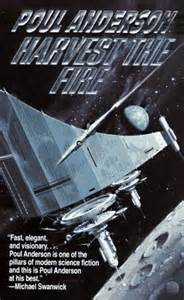
I have begun to reread Harvest The Fire (New York, 1997), Volume III of Poul Anderson's later Harvest of Stars future history. In the Prologue:

Jorge Luis Borges wrote Ficciones

Harvest The Fire is a science fiction novel by Anderson;

in Harvest The Fire, Jesse Nicol, living in our future, experiences the interactive fiction of a virtual reality in which he converses with the simulated Borges;

Nicol presents his real future history to Borges as a work of imaginative fiction;

Borges comments, "'You seem to have invented a world as complete as Tolkien's...'" (p. 21);

Nicol reflects that his account almost is a fiction, "...as far short as it fell of the richness of reality." (p. 28)

How many fictions within fictions are there here? Within Anderson's novel, there is Nicol's virtual reality and, within that, there is Nicol's almost fictitious account of Anderson's fictional future history.

Anderson maintains the consistency of his future history, e.g. p. 6 of Harvest Of Stars (London, 1994) introduces a gadget called a "maintainor" and more of these gadgets appear on p. 10 of Harvest The Fire. Such background details give future histories body and verisimilitude.

Monday, 6 January 2025

Fictions Within Fictions

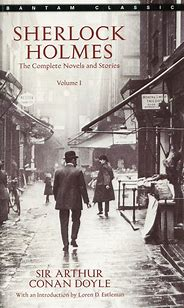
Fictional characters are usually fictions to each other although there are exceptions. This includes fictional detectives who refer to each other in general and to Sherlock Holmes in particular. In Poul Anderson's Time Patrol series, Holmes is sometimes referred to by name in contexts where he might be just the familiar fictional character but he also appears, without being named, as a real person. It is the responsibility of the reader to recognize him. At least two other Anderson works hint at a real Holmes in their pasts and his Old Phoenix multiverse allows familiar figures, again including Holmes, to be fictional in one universe but real in another.

This brings us to Hercule Poirot's companion, Captain Hastings, who says:

"'Obvious, my dear Watson,' I quoted lightly."
-Agatha Christie, "The Adventure of the Cheap Flat" IN Christie, Poirot Investigates (London, 1981), pp. 48-64 AT p, 51.

We are expected to notice that Hastings misquotes first because Holmes says, "Elementary," not "Obvious," and secondly because, although Holmes does say both "Elementary" and "my dear Watson," he never, in our hearing, says both together.

In these ways, all fiction can refer to all previous fiction. Thus, Poul Anderson refers to Shakespearean characters, Holmes, James Bond, Clark Kent, Huckleberry Finn, Sancho Panza, a Lensman and HG Wells. (I acknowledge that Wells is an author, not a character.)

Saturday, 20 February 2021

Ri

A Knight Of Ghosts And Shadows, XIV.

Ri is:

"'...the hero of some funny ychan fairy tales, who went to live on Mesyatz. I used to beg Trohdwyr for stories about Ri when I was a child.'" (p. 522)
 
The ychani are Dennitzan Merseians and Mesyatz is the Dennitzan moon.
 
So a screen adaptation of A Knight Of Ghosts And Shadows could be accompanied by an animated series about Ri, such as children on Dennitza might watch. There is plenty of scope for fictions within fictions. The film of Watchmen was accompanied by an animation of the comic book that a character reads in the graphic novel. In Stieg Larsson's Millennium Trilogy, Christer Malm's boyfriend is an actor who stars as a Police Inspector in a TV series so the same actor could play the boyfriend in Millennium and the Inspector in  - whatever that TV series is called. (I can look it up.)

Some installments of the Technic History are works of fiction within the History. Thus, e.g., an accurate biography of Manuel Argos might show us to what extent "The Star Plunderer" is a fictionalized account.

Saturday, 31 July 2021

Fictions Within Fictions

In Olaf Stapledon's Last And First Men, one of the Last Men on Neptune downloads (so to say) the history of the future into the mind of a twentieth century author who thinks that he is writing fiction and indeed that author's brain distorts its Neptunian inspiration to such an extent that most of what he writes is in fact fiction.

In Poul Anderson's There Will Be Time, the time traveler, Jack Havig, informs Robert Anderson of a future civilization which Robert's relative, Poul, fictionalizes as "the Maurai Federation," making mistakes as often as not when using his imagination to fill in the gaps.

In Anderson's Harvest Of Stars, Jesse Nicol summarizes the future history of Anderson's Harvest Of Stars and The Stars Are Also Fire for the benefit of a virtual reality reconstruction of Jorge Borges who compares the summarized history to a work by Tolkien. Nicol, presenting his account as fiction, reflects that it almost is because it falls so far short of reality.

Thursday, 16 July 2020

True Stories

"Iron."

When the kzinti had invaded the human-colonized Alpha Centaurian System:

"Out of the years that followed have come countless stories of heroism, cowardice, resistance, collaboration, sabotage, salvage, ingenuity, intrigue, atrocity, mercy. Some are true." (2, p. 34)

We note perhaps three points here. First, that comprehensive list encompassing the entire gamut from heroism to cowardice and from resistance to collaboration summarizes our whole species for us. We recognize humanity throughout. But did some of the "mercy" come from kzinti?

Secondly, are the stories of resistance exaggerated? No because, in the very next sentence:

"Certainly, when the human hyperdrive armada entered the Centaurian System, Tiamat might well have been destroyed, had not the Belter freedom fighters taken it over from within." (ibid.)

Thirdly, most interesting is the comment: "Some are true." But others are not? Of course, from our point of view, all of these stories are fictions. However, the narrator of this story seems to imply that some of the Man-Kzin Wars stories to be written by other authors might be fictions within the fiction. It is always possible to imply this. Some new Sherlock Holmes stories start by telling us not to trust Watson's accounts. The new authors respect their source but are not limited by it.

Friday, 2 October 2020

Fictions And Futures

Fictional futures are diverse but also kind of parallel, at least in our imaginations. We can find similarities despite the vast differences between HG Wells' AD 802,701 and Poul Anderson's AD 2497. I could write a long list of futuristic speculations but so could any sf reader. And we imagine further works of fiction to link the existing ones despite their diversity. But, of course, sf writers have already done this. There are different ways to do it. Sometimes two originally independent series have been fitted into a single timeline, e.g.:

van Rijn and Flandry;
Robots and Foundation;
Lucas Garner and Beowulf Shaeffer;
Sherlock Holmes and the Time Patrol.
 
Usually, works of fiction by different authors remain fictions to each other, e.g.:
 
Anderson's Tom Barlow is relieved not to have emerged in an Orwellian dictatorship;
 
Wells' Star-Begotten refers to his The War Of The Worlds as a work of fiction - written by someone like Olaf Stapledon;
 
Stapledon's Last Men In London manages to be a work of fiction within itself because its author among the First Men, who imagines that he is writing fiction, distorts most of the information that he mentally receives from his Neptunian observer;
 
Anderson's Maurai future history is fiction within his There Will Be Time, again based on information received from a time traveler - while another such time traveler had given Wells the time travel idea.

Saturday, 10 January 2026

Textuality

When I commended Poul Anderson and Ian Fleming for their treatment of age in their characters, Dominic Flandry and James Bond, respectively, I also wrote that one of those authors, Fleming, played some clever tricks with his character's age. Fleming was able to do this because of a feature of fictional texts that we can discuss in connection with:

Arthur Conan Doyle
Rider Haggard
Ian Fleming
Poul Anderson

Sometimes a fictional text exists both in our real world and in its own fictional world, the most obvious example being Dr. Watson's memoirs. If we read the Holmes series in order, then, while we are reading The Sign Of Four, we not only remember having read A Study In Scarlet but also understand that Watson's public has also read that earlier volume. It is word for word the same text whether, to us, written by Conan Doyle or, to them, by Watson. Since the publication of the text has become an event in the alternate world, that event can itself influence events that are yet to be recounted in subsequent texts. In "The Adventure of the Empty House," Holmes states that something written by Watson in "The Final Problem" was not literally true and this helps to explain how Holmes survived at Reichenbach.

Allan Quatermain reads Rider Haggard's She, then posts to Haggard his own account of his earlier encounter with She, She And Allan. Clever, certainly.

Dornford Yates' first person narrator, Richard Chandos, meets Jenny, whom he later marries, in She Fell Among Thieves. In Ne'er-Do-Well, Chandos refers not only to earlier events but also to She Fell Among Thieves as a published text.

In Casino Royale, Bond is said to have been active in the Secret Service before the War whereas, in You Only Live Twice, he is said to have joined the Royal Navy and thus also the Secret Service during the War and then only by lying about his age. However, this information as given in You Only Live Twice is imparted in an obituary written by M. Thus, this "Obit." is a text within the text. Further, it refers to other such texts. A former friend and colleague of Commander Bond had written some popular but inaccurate accounts of his exploits. Thus, all ten previous volumes are reduced to the level of fictions within the fiction. When, in the last volume, The Man With With The Golden Gun, Bond, returned like Holmes from apparent death, telephones Secret Service headquarters, he is initially dismissed as another nut who thinks that he is James Bond - a statement that could have been made either in our world or in his.

In Poul Anderson's Technic History, all twelve instalments collected in The Earth Book Of Stormgate have been written and in some cases previously published in Technic civilization. Most have been gathered together by the editor, Hloch, although three have been specially written for the Earth Book. Subsequently, John Henry Reeves' account of the Imperial Founder, Manuel Argos, may be historical fiction but is nevertheless published as presenting an authentic picture of an important age.

Friday, 12 July 2013

Philosophy II

In Aycharaych's fiction, Elders and Others have opposite approaches to the heat death of the universe: attempted transcendence as against resigned acceptance. In the terminology that I suggested in "Philosophy," Elders back energy and consciousness whereas Others back inertia and unconsciousness. In this kind of context, first letters are often capitalized. Thus:

Energy and Consciousness;
Inertia and Unconsciousness.

Aycharaych's fiction also posits a next stage for individual consciousness. Might it be recorded, duplicated and merged so that what had been a discrete personality becomes instead just one set of memories and skills within a more comprehensive node of consciousness, so to say? In The Day Of Their Return, these questions are fictions within the fiction whereas, in Anderson's later works, the Harvest Of Stars tetralogy and Genesis, they are addressed as real issues for the characters. As I have said before, Anderson gives the impression of addressing every possibility.

Aycharaych's fiction has Elders and Others waging a cosmic conflict. I cannot help asking whether the cosmos is not vast enough to incorporate many ways, as our single planet is. His attempt to mislead and misdirect on a cosmic scale is similar to that of the Teramind in The Fleet Of Stars, although the latter would not have entailed violence.

In these posts, I try to mention every point, however minor, in Anderson's works that catches my attention, knowing that other readers would focus on different details. On Aeneas, the nord use of Anglic without articles extends to Ivar writing, "Noneless..." instead of "Nonetheless..." (Captain Flandry, Riverdale, NY, 2010, p. 211).

In a previous post, I missed one expression of Aenean religiosity. When Jao explains that Riverfolk coffins float down the river to the Sea of Orcus, she adds that a seer who is there now "'...will call back the Old Shen from the stars. Will our dead then rise from the waters?'" (p. 169)

"The sea will give up her dead..." No one else mentions resurrection in connection with the Return but Jao, like, it seems, every other Aenean, has a creative religious imagination.

Tuesday, 9 November 2021

Alternative Fictions

Poul Anderson's Afterword to The Broken Sword ends by saying that a further story might someday be told but it never was. Robert Heinlein never wrote the Stories To Be Told in his Future History. See also SM Stirling on his Lords of Creation series here. We know of planned films that were never made.

Thus, there are not only alternative histories within the fiction that we read but also alternative fictions that we never read. The latter are collected in the Library of Dreams in Neil Gaiman's The Sandman where there are titles like:

Tarzan On Mars
Alice's Adventures Beyond The Moon
The Emperor Over The Sea
 
Imagine one. It is there.

Wednesday, 27 January 2016

Worlds Within Worlds

Two Observations About Alternative Histories

(i) Persons and events that are fictions in one history may be realities in another. Thus, Poul Anderson's A Midsummer Tempest is set in the seventeenth century of an Earth where Shakespeare was the Great Historian, not the Great Dramatist. Figures as diverse as Sherlock Holmes, Huckleberry Finn, Winston Churchill, Nicholas van Rijn and the Prince Rupert of the Rhine from the Shakespearean history congregate in the Old Phoenix, an inn between the worlds.

(ii) Every work of fiction is set in an alternative history, one that did not contain the author imagining its events. For example, SM Stirling imagined one of his Draka:

"...loose in our world. Or at least something very like our timeline; one without an S.M. Stirling, who imagined the Draka." (Drakas!, p. 284)

DC Comics had fun with a multiverse including:

Earth 2, inhabited by the original versions of the superheroes;
Earth 1, inhabited by the current versions of the superheroes;
Earth X, conquered by Nazis resisted by super-powered Freedom Fighters;
other Earths inhabited by superheroes bought from former competitors;
Earth Prime, inhabited by comic book writers mentally tuning in to the other Earths.

In Drakas!, edited by SM Stirling, Anne Marie Talbott contributes a story in which Stirling's Draka character Gwen crosses to an Earth where Drakas are fictions and indeed seems to meet the author of this story.

Saturday, 10 January 2026

Some Further Reflections On Textuality

In Poul Anderson's Technic History, The Man Who Counts is a historical novel so it is someone else's imagining of what van Rijn, Wace, some Diomedeans etc thought, felt, said and did. In particular, the thoughts and conversations must be fictions within the fiction. A hypothetical sequel with van Rijn reminiscing about his experiences on Diomedes might present a different perspective on events. This could include differences of opinion about matters of fact between different narrators. Look around the world for examples of that now! Without becoming embroiled here and now in any current conflicts, we can nevertheless draw attention to the continuing relevance of good sf. Intelligent beings responding to their natural and social environments should be relevant to other intelligent beings in other environments. It is an sf writer's job to imagine how different they might be.

In Ian Fleming's The Spy Who Loved Me, the first person narrator/heroine, with help from Fleming, tells us what Bond had told her that he had believed to be the case at the time when they met so there is plenty of scope for a gap between the original "facts" and narrative as it comes to us! - which could help to iron out some prima facie inconsistences between this volume and the next.

Thursday, 17 September 2015

Superheroes

See here. Poul Anderson did not write superheroes but easily could have done. They exist in prose as well as in comic strips and on screen. The first superhero was an extraterrestrial, therefore an sf character. Pseudo-scientific rationales can be concocted for superpowers. The psychic time travel in Anderson's There Will Be Time is a superpower. His characters, Joel Weatherfield and the Danellians, are super-human beings with sf explanations, extraterrestrial and extra-temporal, respectively.

"Superheroes" as a hybrid genre also presents magical and supernatural explanations for superpowers but Anderson did all that as well. He wrote fantasies featuring Conan, Norse gods and other supernatural beings.

I have said all or most of this before. These current reflections are prompted by concurrently reading David Lagercrant's The Girl In The Spider's Web which ingeniously incorporates Marvel Comics superheroes as fictions within the fiction. Our heroine is not super-powered but has been inspired to develop her human talents to a super-normal level by reading these characters while suffering injustice - a classic superhero "origin story."

Poul Anderson turned his hand to many kinds of work, including original stories about characters created by other authors. Isabel Allende wrote a Zorro novel and I wish that Anderson had written a Superman novel.

Tuesday, 27 May 2025

Fictions Within The Fiction

The Game Of Empire, CHAPTER EIGHT.

"We can imagine Ensign Helen Kittredge on leave - let us say, on Ansa..." (p. 278)

So we do not know that she was on Ansa. This is an unusual way to present a narrative.

"Surely Ensign Kittredge joins in the customary cheers." (p. 280)

Or maybe she doesn't?

"We would like to imagine that Ensign Kittredge is spared [death by thirst or radiation]." (p. 284)

However, the narrator has already told us the little that is known of the fate of the light battleship, Zeta Sagittari, whose crew had included Helen in energy weapons control:

"What we know is simply that she was lost." (p. 283)

Knowing only this, he has nevertheless just, in his own words, postulated the destructive effects of "...a hit astern." (p. 283)

Poul Anderson is summarizing. There could have been a whole sub-series of war stories written and published on Helen's home planet, Vixen.

Thursday, 14 January 2021

Factual Fiction?

(Bad alternative title. Good cover.)

Poul Anderson, The Man Who Counts IN Anderson, The Earth Book Of Stormgate (New York, 1979), pp. 147-290.

Hloch tells us that there are "Several historical novels..." (p. 146) about Nicholas van Rijn and that, of these, The Man Who Counts, included in the Earth Book, "...appears to be reasonably factual..." (ibid.) A novel is a long prose fiction so how can it be factual?

If we say that a book about, e.g., George Washington is both a historical novel and historically accurate, then we mean that the plot and characterization are fully consistent with known history whereas the conversations and many other narrative details are, of course, invented. If there were no invention, then there would be no fiction. So we can accept that van Rijn was stranded on Diomedes, fomented a war, eventually escaped etc but that the dialogue which we read in The Man Who Counts was composed by a Terran or Hermetian novelist. "The Star Plunderer" and "Sargasso of Lost Starships" are historical fictions within the Technic History although not in the Earth Book.

Of the twelve works collected in the Earth Book:

seven are previously published texts - a chapter of an autobiography, two chapters of Tales Of The Great Frontier, three short stories by Judith Lundgren and one novel;

two were private documents - part of a correspondence and a section of a notebook;

three were specially written for the Earth Book.

In fact, Christopher Holm, a character in The People Of The Wind, becomes one of the authors of the Earth Book.

Sunday, 29 December 2019

Living With Inconsistencies

Poul Anderson: 

"Perfect consistency is possible only to God himself, and a close study of scripture will show that he doesn't always make it." (1)
-copied from here.

Inconsistencies impossible in reality can occur in fiction. In a World War II series by Dennis Wheatley, Gregory Sallust's London apartment is destroyed by a bomb in an earlier volume but remains intact in a later volume. Sallust does not notice because he is in the story so his memory must have changed accordingly. On reflection, such discrepancies could occur in reality provided that our memories and all other evidence were to change as well. (Wheatley had the same interesting conservative politics as Dornford Yates and was an inspiration for Ian Fleming.)

In the eleventh of his twelve James Bond novels, Ian Fleming not only contradicts biographical information as given in the first volume but also ingeniously relegates the previous ten volumes to the status of inaccurate fictions within the fiction, written by a former friend and colleague of Commander Bond.

A prima facie contradiction in Poul Anderson's Dominic Flandry series is addressed here.

Yates' Mansel and Chandos: pre-War and between the Wars; individual criminals.
Sallust: World War II; the Gestapo.
Bond: the Cold War and its aftermath; SMERSH, then SPECTRE.
Flandry: the Terran Empire; Merseia.

Heroes and villains fiction is an endless cycle: each hero defeats successive individual villains, then is succeeded by another hero created by another author. For post-Bond fiction that tries to break out of this cycle, see:

Bond, UNCLE and The Prisoner 
007, No 6 and V

Reader Responses To Inconsistencies
(i) Some do not notice.
(ii) Some do not care: "It's only fiction."
(iii) Some care. Of course there can be different versions of a story but when either a single work or a series is presented to us as a coherent narrative, then it should be coherent. Inconsistency is an aesthetic interference condition like a painting showing a salmon leaping upstream when the color of the foliage in the background indicates that it is the season when the salmon should be leaping downstream. The Baker Street Irregulars find explanations for contradictions in the Holmes canon. We should do the same for Anderson, although he has less contradictions.

Friday, 24 September 2021

Historical Fictions Within A Future History

In Poul Anderson's Technic History:

The Man Who Counts is a historical novel originally published either on Terra or on Hermes with different authors' names given;

"Margin of Profit" and "Rescue on Avalon" are stories taken from A.A. Craig's Tales of the Great Frontier;

"Esau," The Season of Forgiveness" and "Wingless" are stories written by Judith Dalmady/Lundgren for the Avalonian periodical, Morgana;

"A Little Knowledge" was specially written for the Earth Book by Christopher Holm;

"Day of Burning" and "Lodestar" were specially written by Holm and Hloch;

"The Star Plunderer" is possibly and "Sargasso of Lost Starships" is probably historical fiction.

Most of these accounts are believed to be based on fact but Poul Anderson would have been free to write other accounts contradicting them in their details. Maybe there was not really a John Henry Reeves who had known Manuel Argos - and so on.

Saturday, 24 October 2020

Two Poul Andersons

Poul Anderson, Orion Shall Rise (London, 1988).

"Those who remember other tales from the world of the Maurai will perhaps notice what appear to be inconsistencies with them in this book. However, consistency is not an either-or matter. New data and insights often cause us to revise our ideas about the past and even the present. Surely the future is not exempt." (AUTHOR'S NOTE on an unnnumbered page somewhere between the title page and the PROLOGUE, beginning on p. 1)

Logically, consistency is either-or and not a matter of appearance but there can be differences of interpretation and understanding. The Poul Anderson who addresses us in the signed "Author's Note" at the beginning of Orion Shall Rise is simply the author standing outside the text whereas the Poul Anderson who addresses us in the Foreword to There Will Be Time is embedded in the text, coexisting with his informant, Robert Anderson, and thus also, although he does not meet him, with the time traveler, Jack Havig. This second Poul Anderson informs us that the Maurai stories and There Will Be Time are fictions within the fiction. Writing them, he changed some details and speculated about others. We can therefore regard Orion Shall Rise as a more accurate account although we must still accept that "Maurai" is a name invented by the fictional Poul Anderson.

Saturday, 8 August 2020

Other Worlds

Have we had adventures in other worlds and forgotten about them? See Reality. In one sense, yes. We have always imagined adventures in other worlds and the only other worlds that we know about are those that are imagined. Dominic Flandry owes whatever reality he has to his author and readers.

I have deliberately illustrated this post with the MKW work that Larry Niven has declared to be non-canonical. Its events do not happen in the Known Space universe.

What sf works do sf characters read? In Poul Anderson's Technic History, "The Star Plunderer" and "Sargasso of Lost Starships" may be fictions within the fiction. Other stories are fictionalized accounts of real events, published in the Avalonian magazine, Morgana. There are novels called Outlaw Blastman and Planet of Sin. In one of Jerry Pournelle's and SM Stirling's contributions to Larry Niven's MKW, the kzinti have some pornographic titles and a cheap, trashy sf adventure called Energy Swords at the Black Sun.

How far can a bear walk into the wood? Only to the center because, after that, he is walking back out. But there is a magical wood where, when you have walked to the center, you keep walking further into the center...