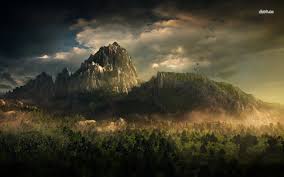
A while ago, I suggested a possible screen adaptation of the opening section of Poul Anderson's Dominic Flandry story, "The Game of Glory." A shorter passage in the novel, Ensign Flandry, has also made an impression. I imagine this single paragraph read aloud as part of an audio or audiovisual presentation of extracts from Anderson's works.
Castle Afon in the old Merseian capital, Ardaig, is the Roidhun's official primary residence. Brechdan Ironrede, Protector of the Roidhun's Grand Council, i.e., Prime Minister of a unified Merseia, receives representatives of the Terran Empire in the audience chamber of Castle Afon:
"Entering the audience chamber, a human was at first dazed, as if he had walked into a dream. He needed a moment to make sense of what he saw. The proportions of long, flagged floor, high walls, narrow windows arched at both top and bottom, sawtoothed vaulting overhead, were wrong by every Terran canon and nonetheless had a rightness of their own. The mask helmets on suits of armor grinned like demons. The patterns of faded tapestries and rustling battle banners held no human symbology. For this was Old Wilwidh, before the machine came to impose universal sameness. It was the wellspring of Merseia. You had to see a place like this if you would understand, in your bones, that Merseians would never be kin to you."
- Poul Anderson, Young Flandry (New York, 2010), p. 141.
The omniscient narrator concludes this paragraph with a forceful assertion of the kind that would normally be expressed as an opinion by one of the characters: "...Merseians would never be kin to you." No? Human colonists and Merseian immigrants are well integrated on the planet Dennitza, a human mother even singing a Merseian lullaby.
The green-skinned Brechdan, who is also the Hand of the Vach Invory, stands in a black robe "...beneath a dragon carved in black wood..." (ibid.) (Try to picture the scene.)
Each Merseian, at least in the dominant Wilwidh culture, is identified by a personal name, by Vach membership, by military or civil rank and also by a nickname, like "Ironrede." Brechdan's bailiff, Chwioch, in his red tunic, green trousers and high-collared cape, is "...called the Dandy..." (p. 23). A dying cyborg spy says:
"'Will you remember my name? I was Dwyr of Tanis, once called the Merry. They made me into this...Remember Dwyr...Now let me die. If you open the main plate you can turn off my heart.'" (p. 132)
There is something irreconcilable in the Wilwidh culture. Brechdan says to a human Intelligence officer:
"'Commander...your young man makes me proud to be a sentient creature. What might our united races not accomplish? Hunt well.'" (p. 145)
- but Brechdan and his ilk can conceive of only one kind of inter-racial union. Speaking to a fellow Merseian, he acknowledges that he likes the Terrans, adding:
"'They were magnificent once. They could be again. I would love to see them our willing subjects...Unlikely, of course. They're not that kind of species. We may be forced to exterminate.'" (p. 92)
Be forced to! (Like Doctor Who's opponents, the Daleks, who say "Exter-minate!" as often as Nazis said "Seig Heil!")
Later, approaching the "farce" of a welcoming festival for a Terran delegation, Brechdan, even more callously, thinks:
"If we must exterminate the Terrans, we will at least have rid the universe of much empty chatter." (p. 93)
Chatter is preferable to war and enslavement, Hand.
Showing posts sorted by relevance for query old Wilwidh. Sort by date Show all posts
Thursday, 15 May 2014
Sunday, 9 February 2020
An Arctic Shore And Lafdiguan Ancestry
The Game Of Empire, CHAPTER ELEVEN.
Here are some telling details that I have noticed as if for the first time. How much do we know about Qanryf Bryadan Arrowswift, Vach Hallen, or Afal Uroch the Lucky, Vach Rueth? (See More Merseian Names.) Not a great deal but a little more than nothing.
Of Bryadan:
"Faint but marrow-thrilling, the energies driving the Tryntaf pulsed through him. Air from the ventilators,
cold because his home was on an arctic shore of the Wilwidh Ocean, bore a likewise half-sensed exhilaration in reeks of ozone and oil. Telltales flashed, meters quivered, displays danced through his cave of control machines." (p. 306)
I have quoted three sentences because they gave us three senses but the interesting, to me, detail was "...an arctic shore of the Wilwidh Ocean..."
Of Uroch, his face:
"...was youthful, handsome, the green of the complexion slightly yellow because of partial Lafdiguan ancestry." (ibid.)
Handsome to fellow Merseians, of course!
My point here is that these two place names, "Wilwidh," and "Lafdigu," are already full of significance for the consecutive reader of Poul Anderson's Technic History. In particular:
"The mask helmets on suits of armor grinned like demons. The patterns of faded tapestries and rustling battle banners held no human symbology. For this was Old Wilwidh, before the machine came to impose universal sameness. It was the wellspring of Merseia. You had to see a place like this if you would understand, in your bones, that Merseians would never be kin to you."
-Poul Anderson, Ensign Flandry IN Young Flandry (Riverdale, NY, 2010), pp. 1-192 AT CHAPTER FOURTEEN, p. 141.
At least that is the view of Max Abrams because he is the viewpoint character here.
The Hand of the Vach Hallen introduces Chee Lan to:
"'...my comrade: Olgor hu Freylin, his rank Warmaster in the Republic of Lafdigu, here in Ardaig as agent of his country.'"
-Poul Anderson, "Day of Burning" IN Anderson, David Falkayn: Star Trader (Riverdale, NY, 2010), pp. 209-272 AT p. 230.
"Cnif was typical of the problem, crossed [Flandry's] mind. The stout, yellowish, slightly flat-faced male belonged to no Vach; his ancestors before unification had lived in the southern hemisphere of Merseia, in the Republic of Lafdigu, and to this day their descendants maintained peculiarities of dress and custom, their old language and many of their old laws. But Cnif was born in a colony; he had not seen the mother world until he came there for advanced education, and many of its ways were strange to him."
-Poul Anderson, A Circus Of Hells IN Young Flandry, pp. 193-365 AT CHAPTER THIRTEEN, p. 286.
Anderson skilfully evokes all that backstory by casually informing us that the Wilwidh has an arctic shore and that Uroch's ancestry is part-Lafdiguan.
And Andersonian scholarship is becoming hard work! I need a lunch break.
Here are some telling details that I have noticed as if for the first time. How much do we know about Qanryf Bryadan Arrowswift, Vach Hallen, or Afal Uroch the Lucky, Vach Rueth? (See More Merseian Names.) Not a great deal but a little more than nothing.
Of Bryadan:
"Faint but marrow-thrilling, the energies driving the Tryntaf pulsed through him. Air from the ventilators,
cold because his home was on an arctic shore of the Wilwidh Ocean, bore a likewise half-sensed exhilaration in reeks of ozone and oil. Telltales flashed, meters quivered, displays danced through his cave of control machines." (p. 306)
I have quoted three sentences because they gave us three senses but the interesting, to me, detail was "...an arctic shore of the Wilwidh Ocean..."
Of Uroch, his face:
"...was youthful, handsome, the green of the complexion slightly yellow because of partial Lafdiguan ancestry." (ibid.)
Handsome to fellow Merseians, of course!
My point here is that these two place names, "Wilwidh," and "Lafdigu," are already full of significance for the consecutive reader of Poul Anderson's Technic History. In particular:
"The mask helmets on suits of armor grinned like demons. The patterns of faded tapestries and rustling battle banners held no human symbology. For this was Old Wilwidh, before the machine came to impose universal sameness. It was the wellspring of Merseia. You had to see a place like this if you would understand, in your bones, that Merseians would never be kin to you."
-Poul Anderson, Ensign Flandry IN Young Flandry (Riverdale, NY, 2010), pp. 1-192 AT CHAPTER FOURTEEN, p. 141.
At least that is the view of Max Abrams because he is the viewpoint character here.
The Hand of the Vach Hallen introduces Chee Lan to:
"'...my comrade: Olgor hu Freylin, his rank Warmaster in the Republic of Lafdigu, here in Ardaig as agent of his country.'"
-Poul Anderson, "Day of Burning" IN Anderson, David Falkayn: Star Trader (Riverdale, NY, 2010), pp. 209-272 AT p. 230.
"Cnif was typical of the problem, crossed [Flandry's] mind. The stout, yellowish, slightly flat-faced male belonged to no Vach; his ancestors before unification had lived in the southern hemisphere of Merseia, in the Republic of Lafdigu, and to this day their descendants maintained peculiarities of dress and custom, their old language and many of their old laws. But Cnif was born in a colony; he had not seen the mother world until he came there for advanced education, and many of its ways were strange to him."
-Poul Anderson, A Circus Of Hells IN Young Flandry, pp. 193-365 AT CHAPTER THIRTEEN, p. 286.
Anderson skilfully evokes all that backstory by casually informing us that the Wilwidh has an arctic shore and that Uroch's ancestry is part-Lafdiguan.
And Andersonian scholarship is becoming hard work! I need a lunch break.
Friday, 8 May 2020
The Old Ways
If globalization ends the old ways, then how much more will interstellar contact?
See:
Old Wilwidh
The old order changeth...
In Poul Anderson's Psychotechnic History:
"It was old Khazak that fought, the planet of warriors, and, even as he hewed and danced and slew, Janazik thought bleakly that he was trying to end the gory magnificence of that age; he was bringing civilization and with it the doom of his own kind. Khazak of the future would not be the same world."
-"Star Ship," p. 298.
His old comradeship with Anse ends a few pages later.
See:
Old Wilwidh
The old order changeth...
In Poul Anderson's Psychotechnic History:
"It was old Khazak that fought, the planet of warriors, and, even as he hewed and danced and slew, Janazik thought bleakly that he was trying to end the gory magnificence of that age; he was bringing civilization and with it the doom of his own kind. Khazak of the future would not be the same world."
-"Star Ship," p. 298.
His old comradeship with Anse ends a few pages later.
Friday, 18 March 2016
A Multiversal Wavefront
Poul Anderson refers to Old Wilwidh on Merseia. Jerry Pournelle and SM Stirling refer to Old Kzin. We think of Old England. Evocative language. The use of this adjective with a capital initial conveys that its hearers or readers are aware of history, time and change.
One pocket universe comprises the Old Phoenix. Another might be a control room where an observer monitoring screens and instruments detects a multiversal wavefront with details manifesting alternately as Martians, Merseians, Moties, kzinti etc. Multi-dimensional patterns emerge. A Solar Commonwealth morphs into a CoDominium, each succeeded by a different First Empire:
"'Those two worlds - and many more, for all I know - are in some way the same. The same fight was being waged, here the Nazis and there the Middle World, but in both places, Chaos against Law, something old and wild and blind at war with man and the works of man. In both worlds it was the time of need for Denmark and France. So Ogier came forth in both of them, as he must.'"
-Poul Anderson, Three Hearts And Three Lions (London, 1977), p. 155.
The observer in my hypothetical control room must dispatch agents to crucial moments where they intervene to prevent inter-cosmic chaos. Although the observer knows of a single timeline protected by a Time Patrol, he oversees multiple timelines.
"'Once the crisis was past in both worlds, the job done...well, equilibrium had been re-established. There was no unbalanced force to send me across space-time. So I stayed.'" (ibid.)
Our history does not record Ogier opposing the Nazis - or the Merseians, kzinti etc - but what might occur without our knowledge?
One pocket universe comprises the Old Phoenix. Another might be a control room where an observer monitoring screens and instruments detects a multiversal wavefront with details manifesting alternately as Martians, Merseians, Moties, kzinti etc. Multi-dimensional patterns emerge. A Solar Commonwealth morphs into a CoDominium, each succeeded by a different First Empire:
"'Those two worlds - and many more, for all I know - are in some way the same. The same fight was being waged, here the Nazis and there the Middle World, but in both places, Chaos against Law, something old and wild and blind at war with man and the works of man. In both worlds it was the time of need for Denmark and France. So Ogier came forth in both of them, as he must.'"
-Poul Anderson, Three Hearts And Three Lions (London, 1977), p. 155.
The observer in my hypothetical control room must dispatch agents to crucial moments where they intervene to prevent inter-cosmic chaos. Although the observer knows of a single timeline protected by a Time Patrol, he oversees multiple timelines.
"'Once the crisis was past in both worlds, the job done...well, equilibrium had been re-established. There was no unbalanced force to send me across space-time. So I stayed.'" (ibid.)
Our history does not record Ogier opposing the Nazis - or the Merseians, kzinti etc - but what might occur without our knowledge?
Wednesday, 10 December 2025
Two Incomplete Planetary Unifications
This similarity between Ythrians and Merseians differentiates them from Terrans.
Van Rijn informs Coya that not all of Hirharouk's crew are of his choth and some have no choth:
"'Ythrians got as much variation as the Commonwealth - no, more, because they not had time yet for technology to make them into homogeneouses.'"
-"Lodestar," p. 347.
Dominic Flandry reflects that Cnif hu Vanden, Merseian xenophysiologist:
"...belonged to no Vach; his ancestors before unification had lived in the southern hemisphere of Merseia, in the Republic of Lafdigu, and to this day their descendants maintained peculiarities of dress and custom, their old language and many of their old laws. But Cnif was born in a colony; he had not seen the mother world until he came there for advanced education, and many of its ways were strange to him."
-Poul Anderson, A Circus Of Hells IN Anderson, Young Flandry (Riverdale, NY, January 2010), pp. 193-365 AT CHAPTER THIRTEEN, p. 286.
A yellow tinge to Merseian green skin shows Lafdiguan ancestry and their national language is not Eriau.
The tapestries and banners in the audience chamber of Castle Afon in Ardaig display:
"...Old Wilwidh, before the machine came to impose universal sameness. It was the wellspring of Merseia."
-Poul Anderson, Ensign Flandry IN Young Flandry, pp. 1-192 AT CHAPTER FOURTEEN, p. 141.
But the machine has not imposed much sameness according to Flandry's reflection on Cnif!
Both Ythrians and Mersians acquired interstellar technology from Technic civilization.
Sunday, 20 August 2023
The First Grand Survey
-Poul Anderson, "Wings of Victory" IN Anderson, The Van Rijn Method (Riverdale, NY, December 2009), pp. 75-102 AT p. 79.
Participants in the first Grand Survey do not know that it is the first such interstellar survey just as participants in the Great War did not know that it was the First World War. The Terran Empire will have a Sector Alpha Crucis. The rogue planet, Satan, will swing round Beta Crucis. Rereading the earlier Technic History instalments, we appreciate their later significance.
After three years, the Olga under Captain Gray, discovers Ythri. Poul Anderson's Technic History series might have included a Grand Survey collection that would have constituted a "higher and greater Star Trek." This is a description that the British publisher, Charles Monteith, applied to James Blish's Cities in Flight but the Grand Survey comes even closer to the Enterprise's five-year mission.
"A ship of the first Grand Survey noted [Valenderay's] existence."
-Poul Anderson, "Day of Burning" IN Anderson, David Falkayn: Star Trader (Riverdale, NY, March 2010), pp. 209-272 AT p. 211.
Valenderay is the supernova that threatens Merseia.
"When the Survey team arrived [on Merseia], the Wilwidh culture stood on the brink of a machine age."
-ibid., p. 232.
Merseia, dominated by old Wilwidh, will be the main opponent of the Terran Empire.
"They found [Paradox] during the first Grand Survey."
Poul Anderson, "A Little Knowledge" IN David Falkayn: Star Trader, pp. 599-630 AT p. 601.
Paradox is not major player but is a fascinating detail of the Technic History. Hloch, compiler of The Earth Book of Stormgate, compares "A Little Knowledge" to a dewdrop reflecting the glade wherein it lies.
Have I missed any Grand Survey references?
Thursday, 12 June 2014
Loss Of Hope
When I read my first Dominic Flandry story, "The Game of Glory," not yet knowing that this was an installment of a series, let alone of a series within a series, I never suspected that I would one day discuss the politics of the Terran Empire. But it's good, isn't it?
"early 4th millennium ...The Empire and Merseia wear each other out."
-Sandra Miesel, CHRONOLOGY OF TECHNIC CIVILIZATION IN Poul Anderson, Flandry's Legacy (New York, 2012), pp. 795-804 AT p. 803.
The Terran Empire was already worn out and losing the will to live so how did it nevertheless manage to wear out the expansionist Merseian Roidhunate? Anderson shows us the moment when the Merseians lost hope, and it was within Dominic Flandry's lifetime.
The Merseian-backed Magnusson Rebellion has just been thwarted. On the Roidhun's Grand Council, Odhar the Curt counsels:
"'Console yourselves with the thought that we invested little treasure or effort in the venture. Our net loss is minor.'" (p. 447)
So the racial supremacists of Old Wilwidh need consolation? The Protector of the Council responds:
"'Except for hope,' Tachwyr mumbled. He drew his robe close about him; the room felt chill. 'I dreamed that I would live to behold -' He straightened. 'By adversity, the God tempers the steel of the Race. Let us get on with our quest.'" (ibid.)
When Magnusson's rising was announced, Tachwyr had thought that, after years of misery:
"This is the day when victory begins." (p. 268)
Now, he mumbles, feels chill and loses hope. This is the turning point for Merseia.
"early 4th millennium ...The Empire and Merseia wear each other out."
-Sandra Miesel, CHRONOLOGY OF TECHNIC CIVILIZATION IN Poul Anderson, Flandry's Legacy (New York, 2012), pp. 795-804 AT p. 803.
The Terran Empire was already worn out and losing the will to live so how did it nevertheless manage to wear out the expansionist Merseian Roidhunate? Anderson shows us the moment when the Merseians lost hope, and it was within Dominic Flandry's lifetime.
The Merseian-backed Magnusson Rebellion has just been thwarted. On the Roidhun's Grand Council, Odhar the Curt counsels:
"'Console yourselves with the thought that we invested little treasure or effort in the venture. Our net loss is minor.'" (p. 447)
So the racial supremacists of Old Wilwidh need consolation? The Protector of the Council responds:
"'Except for hope,' Tachwyr mumbled. He drew his robe close about him; the room felt chill. 'I dreamed that I would live to behold -' He straightened. 'By adversity, the God tempers the steel of the Race. Let us get on with our quest.'" (ibid.)
When Magnusson's rising was announced, Tachwyr had thought that, after years of misery:
"This is the day when victory begins." (p. 268)
Now, he mumbles, feels chill and loses hope. This is the turning point for Merseia.
Tuesday, 22 January 2019
Alien Halls
David Falkayn in the audience chamber of Castle Afon on Merseia:
a high gaunt hall;
strange proportions;
windows arched above and below;
stone walls;
woven tapestries;
battle banners hanging from rafters;
echoes;
hearth fire large enough to roast an elephant;
demon-masked, armored troopers with curved swords, barbed pikes and guns;
winter-chill air;
gravity slightly higher than Terrestrial;
ice-blue sky glimpsed outside;
Morruchan Long-Ax, the Hand of the Vach Dathyr, on a dais.
Centuries later, Max Abrams in the same audience chamber:
strange proportions;
windows arched above and below;
faded tapestries;
rustling banners;
unhuman symbology;
suits of armor with mask helmets grinning like demons;
Old Wilwidh, the wellspring of Merseia;
Brechdan Ironrede, the Hand of the Vach Invory and Protector of the Roidhun's Grand Council, black-robed, holding a spear, beneath a carved black wooden dragon.
In a different timeline, Carl Donnan in the hall of the Dragar on Vorlak:
a single long room;
massive dark timbers;
carved screens;
gaping sea monsters' heads carved on beam-ends;
fluorescent globes;
extraplanetary booty of polished cups, shields, crowns and guns;
bronze plaques of Dragar emblems;
flames roaring up a chimney;
at the far end, the shadowed statue of the Overmaster;
battle banners hanging from dim rafters;
open doors;
noise of surf;
shrill birds;
a saurian's roar;
cold unfamiliar smells;
Dragar enthroned, holding golden goblets, down the length of the hall;
wooden serpents trellised on the throne of Hlott Luurs, the Draga of Tolbek and president of the Dragar Council;
beside Hlott, Ger Nenna, an imperial scholar-bureaucrat representing the Overmaster.
a high gaunt hall;
strange proportions;
windows arched above and below;
stone walls;
woven tapestries;
battle banners hanging from rafters;
echoes;
hearth fire large enough to roast an elephant;
demon-masked, armored troopers with curved swords, barbed pikes and guns;
winter-chill air;
gravity slightly higher than Terrestrial;
ice-blue sky glimpsed outside;
Morruchan Long-Ax, the Hand of the Vach Dathyr, on a dais.
Centuries later, Max Abrams in the same audience chamber:
strange proportions;
windows arched above and below;
faded tapestries;
rustling banners;
unhuman symbology;
suits of armor with mask helmets grinning like demons;
Old Wilwidh, the wellspring of Merseia;
Brechdan Ironrede, the Hand of the Vach Invory and Protector of the Roidhun's Grand Council, black-robed, holding a spear, beneath a carved black wooden dragon.
In a different timeline, Carl Donnan in the hall of the Dragar on Vorlak:
a single long room;
massive dark timbers;
carved screens;
gaping sea monsters' heads carved on beam-ends;
fluorescent globes;
extraplanetary booty of polished cups, shields, crowns and guns;
bronze plaques of Dragar emblems;
flames roaring up a chimney;
at the far end, the shadowed statue of the Overmaster;
battle banners hanging from dim rafters;
open doors;
noise of surf;
shrill birds;
a saurian's roar;
cold unfamiliar smells;
Dragar enthroned, holding golden goblets, down the length of the hall;
wooden serpents trellised on the throne of Hlott Luurs, the Draga of Tolbek and president of the Dragar Council;
beside Hlott, Ger Nenna, an imperial scholar-bureaucrat representing the Overmaster.
Tuesday, 28 June 2016
In The Hall Of The Mountain King, Whether On Earth Or On Merseia
The hall of troll-king Illrede:
in a mountain cave;
vast;
hewn out of rock;
stolen gems and tapestries on the walls;
expensive goblets and cloths on ebony and ivory tables;
fires burning down the length;
rich garments on troll lords and ladies;
elf, dwarf and goblin thralls carrying trenchers of human, Faerie and animal meat and cups of southern wine;
snarling music;
smoky air;
ruddy light;
guards, "...moveless as heathen idols...," (The Broken Sword, p. 64) with glinting spears;
gobbling, guzzling, quarrelling trolls;
a thunderous din;
quiet lords in carven seats;
Illrede, fat and wrinkled, with long green tendrils for a beard and wearing a gold crown.
Colorful, barbaric and vividly imagined. Since trolls are large, green, humanoid and hostile, comparisons with Poul Anderson's alien Merseians are inevitable. In the audience chamber of Castle Afon:
"The mask helmets on suits of armor grinned like demons. The pattern of faded tapestries and rustling battle banners held no human symbology. For this was Old Wilwidh, before the machine came to impose universal sameness. It was the well-spring of Merseia. You had to see a place like this if you would understand, in your bones, that Merseains would never be kin to you." (Young Flandry, p. 141)
in a mountain cave;
vast;
hewn out of rock;
stolen gems and tapestries on the walls;
expensive goblets and cloths on ebony and ivory tables;
fires burning down the length;
rich garments on troll lords and ladies;
elf, dwarf and goblin thralls carrying trenchers of human, Faerie and animal meat and cups of southern wine;
snarling music;
smoky air;
ruddy light;
guards, "...moveless as heathen idols...," (The Broken Sword, p. 64) with glinting spears;
gobbling, guzzling, quarrelling trolls;
a thunderous din;
quiet lords in carven seats;
Illrede, fat and wrinkled, with long green tendrils for a beard and wearing a gold crown.
Colorful, barbaric and vividly imagined. Since trolls are large, green, humanoid and hostile, comparisons with Poul Anderson's alien Merseians are inevitable. In the audience chamber of Castle Afon:
"The mask helmets on suits of armor grinned like demons. The pattern of faded tapestries and rustling battle banners held no human symbology. For this was Old Wilwidh, before the machine came to impose universal sameness. It was the well-spring of Merseia. You had to see a place like this if you would understand, in your bones, that Merseains would never be kin to you." (Young Flandry, p. 141)
Saturday, 22 September 2018
Some Parallels
See Mortality And Fear.
A relevant passage in James Blish's Mission To The Heart Stars (London, 1980), CHAPTER ELEVEN:
"'If you have an unstable culture and a short lifetime, you gain more than just personal freedom and the right to put up an argument. You gain a creativity, such as that mankind has been pouring out in torrents for most of its recorded history. The Heart Stars have lost it. I think they will never get it back.'" (p. 123)
Also comparable:
"...this was Old Wilwidh, before the machine came to impose universal sameness. It was the well-spring of Merseia. You had to see a place like this to understand, in your bones, that Merseians would never be kin to you."
-Poul Anderson, Ensign Flandry IN Anderson, Young Flandry (Riverdale, NY, 2010), pp. 1-192 AT CHAPTER FOURTEEN, p. 141.
and:
"'Were the peoples of the Hegemony of Malis to survive to the last moment of the heat death, they could never be brother creatures to us.'"
-Blish, op. cit., p. 125.
Finally:
"'The sea people and the land people are now to live side by side in amity and partnership, although they differ so sharply from each other that they might as easily inhabit different planets. Having made this accomodation, they are now both in a position to understand and live with other races of like mind elsewhere.'"
-Blish, p. 126.
These sea people and land people are dolphins and Earthmen but they could equally be Poul Anderson's two races of Starkadians especially when members of these latter races have to be evacuated to Imhotep.
For previous comparisons, see here.
A relevant passage in James Blish's Mission To The Heart Stars (London, 1980), CHAPTER ELEVEN:
"'If you have an unstable culture and a short lifetime, you gain more than just personal freedom and the right to put up an argument. You gain a creativity, such as that mankind has been pouring out in torrents for most of its recorded history. The Heart Stars have lost it. I think they will never get it back.'" (p. 123)
Also comparable:
"...this was Old Wilwidh, before the machine came to impose universal sameness. It was the well-spring of Merseia. You had to see a place like this to understand, in your bones, that Merseians would never be kin to you."
-Poul Anderson, Ensign Flandry IN Anderson, Young Flandry (Riverdale, NY, 2010), pp. 1-192 AT CHAPTER FOURTEEN, p. 141.
and:
"'Were the peoples of the Hegemony of Malis to survive to the last moment of the heat death, they could never be brother creatures to us.'"
-Blish, op. cit., p. 125.
Finally:
"'The sea people and the land people are now to live side by side in amity and partnership, although they differ so sharply from each other that they might as easily inhabit different planets. Having made this accomodation, they are now both in a position to understand and live with other races of like mind elsewhere.'"
-Blish, p. 126.
These sea people and land people are dolphins and Earthmen but they could equally be Poul Anderson's two races of Starkadians especially when members of these latter races have to be evacuated to Imhotep.
For previous comparisons, see here.
Thursday, 23 April 2020
Alien Audience Chambers
See:
Alien Halls
The Audience Chamber Of Castle Afon
In The Hall Of The Mountain King...
Old Wilwidh
To these, we add the audience chamber on Erulan:
roof lost in dusk;
narrow windows;
thick-piled rugs;
bloody lances of sunlight;
gold;
jewels;
banners;
tapestries;
lines of rigid guards;
a swarm of prostrating slaves;
enthroned nobles;
blowing trumpets;
thundering kettledrums;
the robed, crowned Arkulan.
Human beings have conquered barbarians and have become barbarized. The text, "What shall it profit a man...?" is quoted twice to good effect in the Psychotechnic History.
Tuesday, 21 February 2023
Religions In Two Future Histories
In Poul Anderson's Psychotechnic History, the Cosmic religion remains in the background whereas, in Anderson's Technic History, we learn comparatively more about:
Mahayana Buddhism
Jerusalem Catholicism
Dennitzan Orthochristianity
Ivanhoan religions
Diomedean beliefs
the Ythrian Old and New Faiths
Merseian polytheism
the Wilwidh religion of "the God"
Djana's Christian-Wilwidh blend
Ikranankan demonism and polytheism
Cosmenosis
Didonian mysticism
eclectic Aenean millenarianism
probably more
The Psychotechnic History is like a draft of a future history. The Cosmic religion maybe prefigures Cosmenosis.
Saturday, 24 September 2022
Surnames
A Stone In Heaven, XI.
Around Dukeston on Ramnu, clans do not share a territory. Instead, a single family owns a small patch of land and passes a surname down the generations. Thus, Yewwl of the Kulembarach clan meets a fellow Ramnuan called Ayon Oressa'ul.
In the dominant Wilwidh Ocean culture on Merseia, an individual is known by his personal name, his (changeable) nickname and his Vach. However, other laws and customs survive. Thus, in Ensign Flandry, Dominic Flandry meets Tachwyr the Dark but also Lannawar Belgis whose full name sounds like a personal name and a surname. Lannawar mentions his old friend, Ralgo Tamuar. Centuries before, in "Day of Burning," Chee Lan had met Dagla Quick-to-Anger, Hand of the Vach Hallen, but also Olgor hu Freylin, Warmaster in the Republic of Lafdigu. Again, Lafdiguans seem to use surnames. David Falkayn dealt with Morruchan Long-Ax, Hand of the Vach Dathyr, but also with the disreputable (black, not green) Haguan Eluatz, head of the Gethfennu, organized crime.
So how many intelligent species in the galaxy use surnames? We know of at least one other...
Saturday, 4 January 2020
An Addendum On Merseian Nicknames
See More Merseian Names.
One (?) more: Iriad the Wayfarer in "Day of Burning," p. 250.
When I suggested in Merseian Scenery that, if Lannawar Belgis had had a Wilwidh-style nickname, then it might have been "the Able," this was because he was described as such:
"...perhaps he just wasn't ambitious. For certainly he was able, as his huge fund of stories from his years in space attested. He was also a likeable old chap."
-Poul Anderson, Ensign Flandry IN Anderson, Young Flandry (Riverdale, NY, 2010), pp. 1-192 AT CHAPTER ELEVEN, p. 105.
This passage suggests some other possible nicknames, e.g., the Raconteur or the Spacefarer, but not the Ambitious.
If this practice were to be adopted by our species, then what nickname would each of us have? A fellow student, once starting to introduce some of us from around a table, began, "That's Karen 'I'm everybody's," Paul 'I'm not really here...," then stopped because even he could sense that the others did not want to hear their characters publicly dissected like that!
One (?) more: Iriad the Wayfarer in "Day of Burning," p. 250.
When I suggested in Merseian Scenery that, if Lannawar Belgis had had a Wilwidh-style nickname, then it might have been "the Able," this was because he was described as such:
"...perhaps he just wasn't ambitious. For certainly he was able, as his huge fund of stories from his years in space attested. He was also a likeable old chap."
-Poul Anderson, Ensign Flandry IN Anderson, Young Flandry (Riverdale, NY, 2010), pp. 1-192 AT CHAPTER ELEVEN, p. 105.
This passage suggests some other possible nicknames, e.g., the Raconteur or the Spacefarer, but not the Ambitious.
If this practice were to be adopted by our species, then what nickname would each of us have? A fellow student, once starting to introduce some of us from around a table, began, "That's Karen 'I'm everybody's," Paul 'I'm not really here...," then stopped because even he could sense that the others did not want to hear their characters publicly dissected like that!
Wednesday, 19 November 2014
Mornings
This is ironic. Olgor hu Freylin, Warmaster in the Republic of Lafdigu in the southern hemisphere of Merseia (notice the non-Wilwidh type name) says:
"'...the most reasonable postulate is that none of the starfaring races have mental powers we do not. They simply have longer histories.'"
-Poul Anderson, David Falkayn: Star Trader (New York, 2010), p. 234.
Merseia will discover to its profit that at least one other race does have superior mental powers...
Meanwhile, Poul Anderson describes mornings on other planets, making us feel that we already know the places. On Merseia:
"Korych rose through winter mists that turned gold as they smoked past city towers and above the river. Kettledrums rolled their ritual from Eidh Hill. Shutters came down off windows and doors, market circles began to fill, noise lifted out of a hundred small workshops. Distantly, but deeper and more portentous, sounded the buzz of traffic and power from the new quarters, hoot of ships on the bay, whine of jets overhead, thunder of rockets as a craft left the spaceport for the moon Seith." (p. 242)
And later on Hermes:
"Still below the horizon, Maia, sun of Hermes, made the tops of steeples and towers in Starfall shine as if gilded. When it rose out of Daybreak Bay, its light struck westward over the Palomino River and straight along Olympic Avenue to Pilgrim Hill. There the brightness lost itself among trees, gardens, and buildings, the gray stone mass of the Old Keep, the fluid lines and many-paned walls of the New Keep, the austere erectness of Signal Station. A beam went past an upper balcony on the New Keep, through the French doors beyond, and across the bed of Sandra Tamarin-Asmundsen."
-Poul Anderson, Rise Of The Terran Empire (New York, 2011), p. 47.
We have already been told that Korych is the sun of Merseia and that is evident in any case. There are gold mists in Ardaig and gilded steeples and towers in Starfall. Work begins in Ardaig. We have never heard of Eidh Hill but feel that we are familiar with its drum ritual. The use of place names generates a feeling of familiarity. In Starfall, Maia light shines across the River and along the Avenue, both named, and penetrates the New Keep where it focuses on a single person who is already known to us so that the feeling of familiarity is not entirely misplaced.
"'...the most reasonable postulate is that none of the starfaring races have mental powers we do not. They simply have longer histories.'"
-Poul Anderson, David Falkayn: Star Trader (New York, 2010), p. 234.
Merseia will discover to its profit that at least one other race does have superior mental powers...
Meanwhile, Poul Anderson describes mornings on other planets, making us feel that we already know the places. On Merseia:
"Korych rose through winter mists that turned gold as they smoked past city towers and above the river. Kettledrums rolled their ritual from Eidh Hill. Shutters came down off windows and doors, market circles began to fill, noise lifted out of a hundred small workshops. Distantly, but deeper and more portentous, sounded the buzz of traffic and power from the new quarters, hoot of ships on the bay, whine of jets overhead, thunder of rockets as a craft left the spaceport for the moon Seith." (p. 242)
And later on Hermes:
"Still below the horizon, Maia, sun of Hermes, made the tops of steeples and towers in Starfall shine as if gilded. When it rose out of Daybreak Bay, its light struck westward over the Palomino River and straight along Olympic Avenue to Pilgrim Hill. There the brightness lost itself among trees, gardens, and buildings, the gray stone mass of the Old Keep, the fluid lines and many-paned walls of the New Keep, the austere erectness of Signal Station. A beam went past an upper balcony on the New Keep, through the French doors beyond, and across the bed of Sandra Tamarin-Asmundsen."
-Poul Anderson, Rise Of The Terran Empire (New York, 2011), p. 47.
We have already been told that Korych is the sun of Merseia and that is evident in any case. There are gold mists in Ardaig and gilded steeples and towers in Starfall. Work begins in Ardaig. We have never heard of Eidh Hill but feel that we are familiar with its drum ritual. The use of place names generates a feeling of familiarity. In Starfall, Maia light shines across the River and along the Avenue, both named, and penetrates the New Keep where it focuses on a single person who is already known to us so that the feeling of familiarity is not entirely misplaced.
Monday, 16 September 2024
Multi-Species History
Tolkien's Middle Earth History is of Elves, Dwarves and Men. Poul Anderson's Technic History is of Terrans, Ythrians and Merseians. Terrans recover from the Chaos and move out into space, making first contact with, among others, Ythrians and Merseians. Terrans build their Empire, Ythrians build their Domain and Merseians build their Roidhunate, although human beings and Ythrians live together on Avalon in the Domain while human beings and Merseians live together on Dennitza in the Empire. All three realms interpenetrate with, but do not much interact with, the Dispersal of Ymir. When we are informed that Qanryf Bryyadan Arrowswift, Vach Hallen, likes cold air from the spaceship ventilator because his home is on the arctic shore of the Wilwidh Ocean, we get a concrete sense that this future history is indeed Merseian, not just human.
Human Avalonians are Ythrianized, many joining choths. The Empire falls but meanwhile the Roidhunate has been demoralized. Human beings later build other civilizations but we do not know what becomes of the other species. We would like to know more but we have learned a lot.
Tomorrow, we, editorially speaking, are scheduled to visit Andrea above the Old Pier Bookshop.
Saturday, 4 January 2020
Lafdigu
In Ardaig on Merseia, Chee Lan meets the darker skinned Olgor hu Freylin, Warmaster in the Republic of Lafdigu on the southern continent.
In the Merseian scientific base on Talwin, Dominic Flandry meets the slightly yellow-complexioned xenophysiologist Cnif hu Vanden, an extra-planetary colonial, descended from Lafdiguans, belonging to no Vach, his people retaining their old language and laws as well as peculiar dress and customs.
That is all that we are told of Lafdigu. It remains a rich future historical detail, reflecting the interplanetary and interstellar stages of Merseian history.
Another Merseian not of the Wilwidh culture and speaking a different language is yqan Lannawar Belgis whom Flandry meets while on Merseia. Tachwyr's tailtip jerks at Lannawar's garrulousness.
I started out to post about Lafdigu and, as often happens, found that there was more to be said.
In the Merseian scientific base on Talwin, Dominic Flandry meets the slightly yellow-complexioned xenophysiologist Cnif hu Vanden, an extra-planetary colonial, descended from Lafdiguans, belonging to no Vach, his people retaining their old language and laws as well as peculiar dress and customs.
That is all that we are told of Lafdigu. It remains a rich future historical detail, reflecting the interplanetary and interstellar stages of Merseian history.
Another Merseian not of the Wilwidh culture and speaking a different language is yqan Lannawar Belgis whom Flandry meets while on Merseia. Tachwyr's tailtip jerks at Lannawar's garrulousness.
I started out to post about Lafdigu and, as often happens, found that there was more to be said.
Subscribe to:
Posts (Atom)