Showing posts sorted by relevance for query "The Star Beast". Sort by date Show all posts

Friday, 26 July 2013

What Else Is In The Star Beast?


Poul Anderson's "The Star Beast" has an unexpected hero: a decadent Earthman unexpectedly performs the typically Andersonian action-adventure-fiction feat of seizing his guard's gun, knocking the guard out, escaping disguised in the guard's uniform and saving the day.

Apart from this and, of course, more importantly, the issues discussed in previous posts, a large part of this story is a vivid description of what it would be like to be, or to become, a tiger. This is similar to man becoming wolf (were-wolf) in Anderson's Operation Chaos, although that is fantasy whereas "The Star Beast" is sf. This transformation is accomplished technologically.

The tiger lacks color and perspective but sees at night, hears insects, leaves, breeze, wings and small animals' scurryings, smells grass, fungus, decay, fur and blood, feels with hairs and whiskers, lives comfortably in a damp cave, kills rabbit, deer, wild dog and hibernating bear although, crippled by his fight with the bear, he can no longer catch game and instead attacks a human being, by now beginning to forget that he had been one.

Who is the "Star Beast" of the title: the man who becomes a tiger or the fanatic who returns from the stars to sabotage the Solar utopia?

Wednesday, 24 July 2013

The Star Beast

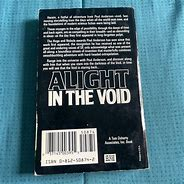
The Star Beast is a juvenile science fiction novel by Robert Heinlein whereas "The Star Beast" is an adult science fiction short story by Poul Anderson, published in Super Science Stories in 1950 and republished in several Anderson collections, including Alight In The Void (New York, 1993).

"The Star Beast" occupies just forty two pages of Alight In The Void so is not a novel but nevertheless, in the pulp tradition, is divided into chapters with individual titles:

Chapter I, Therapy for Paradise
Chapter II, "Tiger, Tiger!"
Chapter III, Dark Victory

The opening sentence:

"The rebirth technician thought he had heard everything in the course of some three centuries." (p. 61)

- informs us that we are dealing with characters who live for several centuries and who practice something called "rebirth" although this seems to be more technological than spiritual. Indeed, it turns out not to be the Buddhist concept of rebirth.

The rebirth technician informs Harol, who wants to spend a couple of years as a tiger, that an animal whose ontogeny opposed its phylogeny would not be viable. I had to use a dictionary for both these words and to try to understand the distinction that was being made. Like some later, longer works by Anderson, this story shows a future in which artificial intelligence has rendered human intelligence redundant. I will continue to reread it with interest.

Thursday, 24 September 2026

"The Star Beast" And "Son of the Sword"

Poul Anderson's collection, Alight In The Void, also includes "The Star Beast" which we read so long ago that maybe we can now reread it with fresh eyes and a fresh mind while at the same time not repeating anything that we have posted about it before in:

blog search result for "The Star Beast"

- and for Issues In The Star Beast

- but we are not about to do any of that this evening!

The same remark applies to "Son of the Sword," which we discussed in a few posts back in July, 2013.

For now, we wish you all good night at least in this part of the world.

Friday, 26 July 2013

Issues In The Star Beast II


Poul Anderson's "The Star Beast," published in 1950, addresses an issue that recurs in several of Anderson's later novels, Harvest Of Stars, Genesis, The Boat Of A Million Years and Starfarers: might technology make humanity obsolete?

"There are no real human scientists anymore. How can there be, when the electronic brains and the great machines which are their bodies can do it all so much quicker and better - can do things we would never even have dreamed of, things of which man's highest geniuses have only the faintest glimmer of an understanding? That has paralyzed us..."

(Poul Anderson, "The Star Beast" IN Anderson, Alight In The Void, New York, 1993, pp. 61-102 AT p. 64)

As often with Anderson, I want to quote just one or two sentences but find that an entire paragraph is full of condensed meaning. This passage does not make clear whether these "electronic brains" are elaborate unconscious computers or conscious intelligent artifacts but, in any case, although I am a philosopher, not a scientist, I would be fascinated, not "paralyzed," by the situation described. I can think of life-long projects for at least three teams of human scientists/philosophers:

group I to continue building a model of the universe with the human intellect aided by telescopes, space probes and unconscious computers that merely process data as they do now;
group 2 to find ways to enhance human understanding in order to increase that "faintest glimmer of understanding" of what the electronic brains are doing - I am sure that, with advanced nutrition, education and technology, the entire planetary population will be able to surpass what had been the "genius" levels (Aristotle, Shakespeare, Einstein, Beethoven) of previous generations;
group 3 to compare the humanly conceived model with the electronic brains' theories, to discuss the differences, attempt a synthesis, redirect human efforts in directions suggested by the machines etc.

There really would be no end to it.

The passage quoted goes on to mention a second reason for "paralysis" which I will discuss in a further post.

Saturday, 2 June 2018

Forms And Thoughts

James Blish's pantropists adapt human beings to different planetary environments but also realize that, if they change the form too radically, then the resultant organism will no longer be any kind of human being. A man given the form of a cockroach will think like a cockroach. Gas giant planets:

"'...are the potential property of other races...'"
-James Blish, The Seedling Stars (London, 1972), Book Four, p. 190.

Here they agree with Poul Anderson's Terran Empire which sells Jupiter to the Ymirites.

(James Blish coined the term "gas giant" for a type of planet.)

I mention this because, both in "The Star Beast" by Poul Anderson and in The Council Of Shadows by SM Stirling, a man in the form of a tiger has to remember why he should not eat the woman in front of him. In Stirling's novel, we are confident that the hero will not eat the heroine. However, "The Star Beast" ends on a note of uncertainty:

"Time stretched into a horrible eternity while they stood facing each other - the lady and the tiger."
-Poul Anderson, "The Star Beast" IN Anderson, Strangers From Earth (London, 1965), pp. 112-148 at p. 148.

I suspect that such ambiguity was rare in the space operatic Super Science Stories.

Monday, 15 December 2025

Adzel And Lummox

Robert Heinlein's Future History stops short of regular faster than light (FTL) interstellar travel which was due to take off right after the end of Volume IV. The concluding Volume V backtracks to the fate of the first STL interstellar spaceship. I do not accept anything after Volume V as a valid continuation of the Future History, Heinlein's name on the cover or no Heinlein's name on the cover.

Regular inter-species contact due to FTL travel begins very early in Poul Anderson's Technic History. The first collection in this future history series was entitled Trader To The Stars. The third story to be collected in his The Earth Book Of Stormgate features a giant quadrupedal Wodenite studying planetology on Earth.

Some of Heinlein's Scribner Juveniles do show routine interstellar inter-species relations, most notably perhaps The Star Beast which begins with the narrative point of view of a large intelligent extraterrestrial that is being kept as a pet in a backyard on Earth. This organism, Lummox, resembles Anderson's Wodenite, Adzel, but with more legs and eyes.

Since starting to write this post, I have checked among a few Heinlein titles on a bookshelf upstairs and have been somewhat astonished to find a copy of The Star Beast. Do I want to reread this juvenile novel after all these years to make a comparison with Poul Anderson? I am reluctant to reread any sf from that long ago. Damon Knight gave The Star Beast the highest praise by saying that it was worth rereading but added a damning comment on much sf:

"This is a novel that won't go bad on you. Many of science fiction's triumphs, even from as little as ten years ago, are unreadable today; they were shoddily put together, not meant for re-use. But Heinlein is durable."
-copied from here.

Knight continues by stating that he has read this book twice and will again for pleasure.

Which supposed triumphs rapidly became unreadable? It is the main contention of this blog that even Poul Anderson's hastily written works are worth rereading and that all of his works bear constant re-use. How durable is his predecessor, Heinlein? Let's find out.

Sunday, 28 July 2013

The Ultrawave Series


If a series is more than one work, thus at least two works, then maybe I have found an "ultrawave series" by Poul Anderson. "Earthmen, Beware!" and "The Star Beast" depend on different applications, mental and technological, of an "ultrawave," which is very similarly described in both stories although I have found one difference:

"'The important thing is that these effects are transmitted with no measurable time lag...'"

("Earthman, Beware!" IN Anderson, Alight In The Void, 1993, pp. 29-60, AT p. 46)

"The transmitter field was generated. At the speed of light, Harol flashed around the world..."

("The Star Beast" IN Alight In The Void, pp. 61-102, AT p. 66)

However, maybe the superhuman Joel Weatherfield detected a deeper level of the ultrawave? According to his account, which mostly matches "The Star Beast":

ultrawave radiation is unrelated to electromagnetism;

vibrating energy fields produce detectable effects without time lag in similar apparatuses elsewhere (this sounds like James Blish's instantaneous Dirac transmitter);

in order to attract his people to Earth, the stranded alien Joel broadcasts pulses representing stars, with intensity standing for absolute brightness and time separation standing for distance;

however, receiving no reply, he realizes that he must instead use his telepathy which turns out to be another part of the ultrawave spectrum.

There is more but it is proving difficult to unravel at nearly midnight so further discussion of the ultrawave will have to be postponed till a later post.

Saturday, 27 February 2016

Star Trek And The Future Histories

David Birr explains this bizarre cover image in a comment here.

Star Trek TV series, films and novels have become a future history and a cultural reference point. When I told a friend about a "reality storm" in Neil Gaiman's The Sandman, he remarked that that sounded like something out of Star Trek, then laughed when I told him that one of the characters had said that that sounded like something out of Star Trek.

A narrator in Robert Heinlein's The Number Of The Beast compares the bridge of Lazarus Long's spaceship to the bridge of the Enterprise - although I would prefer not to refer to The Number Of The Beast.

Isaac Asimov scientifically advised Star Trek. James Blish adapted episodes as short stories and wrote the first Star Trek novel. At a Memorial evening for James Blish in London, Charles Monteith of Faber and Faber described Blish's Cities in Flight future history as "a higher and greater Star Trek."

Larry Niven adapted a Known Space story as a Star Trek animated episode. Niven and Jerry Pournelle place a Chief Engineer from New Scotland on a Navy spaceship and say that this ethnicity is common among Engineers.

If Kirk were in Intelligence and Vulcan were in the Klingon Empire, then Star Trek would parallel Poul Anderson's Flandry series. Many sf stories about spaceship crews exploring extrasolar planets could be adapted as Star Trek episodes.

Addendum: Are Moties like intelligent tribbles?

Tuesday, 16 December 2025

Two Ambassadors


In the Hotel Universe, Lunograd, Chee Lan, bounding along a slideway:

"...bowled over His Excellency, the Ambassador of the Epopoian Empire. He cawed his indignation."
-Poul Anderson, Satan's World (January 2009), pp. 235-424 AT IV, p. 259.

The Epopoian is beaked.

In Robert Heinlein's The Star Beast, the Department of Spatial Affairs must cope with problems like:

"...the terrible, hushed-up occasion when a member of the official family of the Ambassador from Llador had been found, dead and stuffed, in a curiosity shop in the Virgin Islands."
-quoted in Alexei Panshin, Heinlein In Dimension, III., p. 70.

(I am rereading The Star Beast but have not reached that part yet.)

Again Anderson's Technic History and a Heinlein Juvenile occupy the same territory, in this case future extraterrestrial ambassadors. I don't believe it. Future interstellar relations will not exactly reproduce Terrestrial international relations. We must expect the unexpected.

Sunday, 28 July 2013

Previous Posts

I have been reading Poul Anderson's Alight In The Void which collects:

"Terminal Quest"
"Earthman, Beware!"
"The Star Beast"
"Son of the Sword"
"Flight To Forever"

I have commented on the first four in recent posts and posted a two-part Chronology of "Flight to Forever" on June 30 and July 1, 2012. "Flight to Forever" is, appropriately, the culminating story of Anderson's time travel collection, Past Times. Therefore, when Anderson's short story collections are rationalized, it need not also appear in any other volume such as Alight In The Void.

When discussing "Earthman, Beware!," (here) I referred to an earlier post on Anderson's Brain Wave. That was "The Galactic Connection," June 15, 2012.

"The Star Beast" raises the issue of the social consequences of universally distributed abundant wealth. This and similar or related issues were discussed in earlier posts:

April, 2012
"Issues In Mirkheim"
"Something Is Rotten In Technic Culture?"
"Interstellar Wealth"
"Organic And Post-Organic"
"The Commonalty"

June, 2012
"Thulean Economics"
"Serious Issues"
"Judgment Day Economics"
"Starfarers Economics"

August, 2012
"Demetrian Economics And Ecology"
"Questions And Comments"

Tuesday, 16 December 2025

A Prescient Narrator

We have seen that authors of fiction need to understand and control their narrative points of view and that Poul Anderson does this well.

It seems that an omniscient narrator recounts the course and consequences of the Council of Hiawatha on pp. 138-143 of Chapter IX in:

Poul Anderson, Mirkheim IN Anderson, Rise Of The Terran Empire (Riverdale, NY, March, 2011), pp. 1-291.

The account is not part of the dialogue of any of the characters and there is no indication within the text that the information is imparted from any particular perspective within subsequent history. It is as objectively factual as the author can make it - I think. On the other hand, there is an element of interpretation and commentary as well as of fictional "fact." When Home Companies magnates gain political power within the Solar Commonwealth, the narrator states that the Commonwealth has become:

"...the corporate state." (p. 142)

- a phrase that has connotations as well as denotations!

But it would be hard to eliminate that level of commentary. In any case, it is not van Rijn or any other actor in the plot of the novel that tells readers about Hiawatha. The passage is an extended interruption to a conversation between van Rijn and Bayard Story.

There might be more purely impersonal and factual narration in the opening passage of the Prologue which describes a supernova 500,000 years ago, long before any human social interactions? However, in this case, a plural first person pronoun comes on-stage:

"There may have been lesser worlds and moons as well; we cannot now say. We simply know that the giant stars rarely have attendants..." (p. 1)

This narrator is not omniscient and acknowledges some limits to his knowledge but is a scientifically informed individual living within Technic civilization and addressing some of his own contemporaries.

Robert Heinlein's The Star Beast has a narrator who not only recounts the points of view of different individual characters but also informs us of the fact that an extrasolar crustacean species as yet unknown to humanity will be long dead eleven thousand years hence when Terrestrials eventually reach that planet: an unprecedented degree of prescience in any narrator!

Thursday, 18 December 2025

Interplanetary Politics


After comparing several aspects of Robert Heinlein's The Star Beast with diverse passages in works by Poul Anderson, let's close for tonight with CS Lewis.

"'You know that there is an interplanetary conference in progress?'
"She answered smugly, 'I make it a rule never to pay attention to politics.'"
-The Star Beast, CHAPTER XIV, p. 142.

Lewis the fictional character and first person narrator as opposed to Lewis the author reflects that he and his fictional friend Ransom:

"...were both getting more and more involved in what I could only describe as inter-planetary politics."
-CS Lewis, Perelandra IN Lewis, The Cosmic Trilogy (London, 1990), pp. 145-348 AT 1, p. 150.

And there are interstellar politics in Anderson's Technic History as when the Merseians regard diplomacy as continuation of war by other means.

We need only add, before retiring for the night - it is after midnight again - that Lewis' "interplanetary politics," like Heinlein's, involve Earth, Mars and Venus but otherwise are completely different!

But read all three authors.

Thursday, 25 July 2013

Reviewing The Past

Some readers might notice that this post repeats some points that had already been made in greater detail in several much earlier posts. However, I think that these reflections on Poul Anderson's works remain so fresh that they bear repetition - and may be of interest to any readers who have either forgotten or not read the earlier posts?

In a recent post, I think that I comprehensively summarized what I called Anderson's "pre-futuristic " works into ten groups. By "pre-futuristic," I mean any narrative set in a past or a present as opposed to a future - although, by their own internal logic, some of these narratives do continue into the future as well:

time travelers visit both the past and the future;
immortals who endure through history survive into the future;
Englishmen taken into space in the historical past are found by fellow Earthmen in a spacefaring future.

It seems that there is no limit to what Anderson can imagine.

The ten "pre-futuristic" groups were:

BC;
Ys;
Vikings;
Last Viking;
14th century;
Many Times;
Many Timelines;
Time Patrol;
fantasies;
detectives.

Of these:

Ys (with Karen Anderson) is a tetralogy;
The Last Viking is a trilogy;
the Time Patrol is a series, most recently published as one omnibus collection and one long novel;
"Many Timelines" is four novels and two short stories connected by common characters;
"Vikings" is five novels connected by common references - and the first Viking volume refers to Ys;
"BC" and "14th century" can each be described as "three novels of different genres classified together only because of the period in which they are set."

However, the difference between a single century and everything BC stretches the word "period" to its limit! The BC "triad," so to call it, covers:

heroic fantasy set in another author's fictitious prehistoric civilization;
science fictional time travel to Atlantis;
historical fiction set during the Roman Republic.

Thus, extraordinarily comprehensive both in periods and in genres. I have not yet read or even seen copies of any of Anderson's three contemporary detective novels, although there are one or two detective short stories in one of the collections. I am currently rereading the collection, Alight In The Void, and will shortly return to the short story, "The Star Beast."

Tuesday, 16 December 2025

Death On Mars

Men die colonizing Mars:

"...a mummified corpse in the wreck of a burst sealtent..."
-Poul Anderson, "Un-Man" IN Anderson, The Psychotechnic League (New York, 1981), pp. 31-129 AT III, p. 39.

Stefan Rostomily dies in a cave-in when a diggings collapses and bursts his helmet open. (p.47)

"...on Mars, a prospector abandoned his wrecked sandmobile and got ready to attempt the long trek back to Outpost. He would never make it."
-Robert Heinlein, The Star Beast (London, 1974), CHAPTER II, p. 18.

Another strong Heinlein-Anderson parallel, this time involving Anderson's Psychotechnic History.

(Lummox, the title character of The Star Beast, has no hands but is consistently drawn with them.)

Will deaths on Mars be with us soon?

Saturday, 29 August 2020

Tiw's Beast

First, a real animal exists. Then, it is mythologized. In scriptures and works of fantasy, the myth comes first.

In "Star of the Sea," I, the god Frae rides the bull, Earthshaker, whose bellow makes wells spout and wakes dead kings. Because the bull's might scatters the foe and fructifies the earth, possession of Earthshaker is part of the marriage negotiations between Frae and Niaerdh.

Next, we see a real bull in a historical context but are also told what is believed about it:

"They walked by a paddock where a bull stood, Tiw's beast, his horns mighty beneath the sun."
-7, p. 533.

An incarnation of Earthshaker. He belongs to a different god. Mythology changes. "Star of the Sea" chronicles the changes from Niaerdh, on whose brow shines the morning star, to "Mary, mother of God..." (IV, p. 639), Stella Maris, Star of the Sea. Poul Anderson understands and imaginatively enters each stage of this development.

Thursday, 25 July 2013

Issues In The Star Beast

Poul Anderson's "The Star Beast" convinces me that, even if humanity builds a peaceful civilization on Earth or in the Solar System, it should retain some means of defense against interstellar invasion.

Such invasion does seem extremely unlikely:

do other civilizations even exist?;

if they do, surely a civilization with an advanced technology will either overcome any warmongering tendencies that it may have or, alternatively, will have destroyed itself long before it has got anywhere near to attacking anyone else?;

surely anyone capable of interstellar travel already possesses far more wealth then they can possibly hope to gain by crossing an interstellar distance and attacking someone else?

However, if interstellar travel is possible, then some human beings might colonize extra-solar planets and one of those colonies could be irrational enough to attack the home planet, which is what happens in this story. Even if we need not fear extraterrestrials, and we do not know that for sure, we might still need to fear each other - although I also remain convinced that the production and distribution of abundance will make theft and war obsolete.

But that leads to another issue which Anderson addresses here and in later works and to which I will return in a further post.

Technology In The Star Beast II


(Continued.)

(xi) Useless, repetitive memories can be taken out of the record.

(xii) The apparent acceleration of time with age worsens after two centuries but then flattens out as the nervous system adapts.

(xiii) However, both that apparent acceleration and the lack of incentive cause stasis, unproductiveness and procastination.

(xiv) The creator and the transmitter enable people to live apart but stay in touch so communities are obsolete.

(xv) Most people want few children.

(xvi) Robot ships can take recordings to the extra-solar colonies. Thus, those who want a more dynamic life leave Earth.

(xvii) Human labor remains necessary for some public services: psychiatry; supervision of the stations; entertainment; handicrafts, to be duplicated by the creators.

(xviii) Some people work a few hours per week or month either to pass the time or to acquire credit with which to buy services.

(xvix) The few remaining government functions are the responsibility of one man, the Coordinator.

(xx) The Solar language has no word for "crime." There is no motive for theft or violence, whether individual or collective, because everyone has a matter creator. Independence prevents friction. Psychoses have been removed from the records.

(xxi) Sol has no defenses because it is thought that no one would invade over light years at half light speed and, even if they did, they could be given anything they wanted from the matter creators.

(xxii) A forest covers Earth now that there are neither cities nor agriculture.

Wednesday, 17 December 2025

North American Union And Diamond Dust

Twilight World And Maurai informs us that:

"In Twilight World, the remnants of the United States and Canada merge as the North American Union..."

Both Rapid Technological Advances And Geopolitics and Alaric Wayne II refer to that same North American Union.

In North American Future History, the US and Canada amalgamate as the North American Federation.

In The Maurai Period, there is a North West Union.

In Pun And Gun, a North American Intelligence officer interrogates a rebel asterite.

In Robert Heinlein's The Star Beast, the North American Union is one part of Earth which is the leading planet in the Federated Community of Civilizations, usually referred to as the Federation.

Again, we find terminologies common to different fictional futures.

While searching for the North America in Tales Of The Flying Mountains, we find yet another description of the Milky Way:

"...the Milky Way girdled the universe with diamond dust..."
-Poul Anderson, Tales Of The Flying Mountains (New York, 1984), p. 104.

Thursday, 10 July 2025

Futuristic SF

See Down In Flames by Larry Niven, an alternative perspective on Niven's Known Space future history.

On a bookshelf upstairs, I find old works of futuristic sf, including:

just about everything by Poul Anderson;

Olaf Stapledon's Last And First Men;

James Blish's Cities In Flight, The Seedling Stars and the diverse works that constitute his "Haertel Scholium";

Niven's Known Space volumes plus A World Out Of Time and The Integral Trees (there should be another volume entitled The Smoke Ring);

Robert Heinlein's five Future History volumes plus Double Star, The Door Into Summer and a surprising (to me) number of his Juveniles -

Time For The Stars
Starman Jones
The Star Beast
Podkayne Of Mars

There are others, of course, but these are the most notable, in my opinion.

The point is: do I currently want to reread and post about any of these works apart from Anderson's? Answer: not really for the time being. Although reading and sometimes rereading all of them was a major part of my life for a long time.

I am checking out the Prologue of The Integral Trees but might leave it at that.

It is all futuristic fiction whoever wrote it and whether or not it forms part of a future history series. I thought that Niven could have taken his "State" series, A World Out Of Time etc, a bit further.

We remain editorially fascinated by Anderson's main future history series.

Wednesday, 16 April 2025

Interstellar SF

"Interstellar sf" can mean just any story or novel featuring interstellar travel at any speed and on any scale. Thus, in Poul Anderson's Tau Zero, a single relativistic spaceship accelerates indefinitely so that the journey becomes intergalactic, then cosmic, but we are not informed of any other journeys between stars in the volume of space around Sol.

Robert Heinlein presents three accounts of early interstellar travel -

in his Future History, Orphans Of The Sky, a first interstellar expedition (spaceship Vanguard);

in his Future History, Methuselah's Children, a first interstellar round trip, developing FTL en route (spaceship New Horizons);

in his Juvenile Future History, Time For The Stars, a first interstellar round trip, developing FTL en route (first spaceship Avant-Garde.)

James Blish has two first interstellar journeys: 

FTL round trip to Proxima Centauri in "Common Time";

STL one-way trip to Beta Sol in "Darkside Crossing."

Poul Anderson's works do not feature a first interplanetary or a first interstellar journey as far as I know.

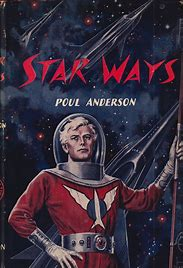
However, interstellar sf can mean narratives with a background of regular FTL travel in an interstellar civilization. Such civilizations emerge in Anderson's Psychotechnic and Technic Histories and also exist in one-off works like After Doomsday and World Without Stars. Heinlein's juvenile novels with this kind of background are The Star Beast, Starman Jones, Starship Troopers and Citizen Of The Galaxy. "Stars" is a much used word. We have since had Star Trek and Star Wars and Anderson's Psychotechnic History includes Star Ways.

Although interstellar distances allow a lot of space for different things to happen, these works do not usually form a consistent series because they diverge in details like the means of FTL used and the course of future historical events.