Larry Niven wrote a few "Leshy Circuit" stories in which slower than light (STL) interstellar ramjets trade between Earth and a handful of extra-solar colonies. A very long novel could be written in which a single spaceship makes two circuits, beginning and ending on Earth and visiting Earth at mid-point. Thus, the space travelers would interact with decades or centuries of social change on several planets.
In both "The Star Beast" and "Conversation in Arcady" by Poul Anderson, an STL ship returns to a changed, by now utopian, Earth. In the latter story, a ship had left an overcrowded Earth to make a fresh start, made a long search for a Paradisal planet to colonize and, having found one, returned to Earth, expecting to excite some interest, to say the least.
MEANWHILE, back on Earth -
A fiendish idea for technological weaponry is an instrumentality that kills people but does not damage property. Thus, a population could be exterminated and their country immediately appropriated. After some such weapon has been used, a much reduced world population benefits from high-tech automation and robotics that had been designed to support much greater numbers - so this fortunate few neither works nor strives for anything. Needless to say, there is mutual incomprehension between the man with a mission from the stars and the indolent couple who visit his landed space boat out of idle curiosity. The woman wants sex with a space traveler and the man wants interesting conversation. Neither wants to colonize another planet.
As often, in other and longer works, Anderson presents a thesis and an antithesis without a synthesis. The synthesis would be a world population both benefiting from automation and exploring the universe. Some intelligences, whether organic or artificial, would have to remain alert to potential dangers like technological breakdowns, depleted resources, cometary strikes, hostile returning spacecraft, unforeseen side effects of technology, social stagnation etc. It would be possible to seek out new worlds not for survival but for knowledge. For me, this, not "Arcady," would be the real utopia.
(Having just traveled with Poul Anderson from the deepest vault of an ancient library in an alternative Jerusalem to a future high tech civilization with interstellar travel, I feel a little dizzy.)
Showing posts with label The Star Beast. Show all posts
Wednesday, 21 August 2013
Friday, 26 July 2013
What Else Is In The Star Beast?
Apart from this and, of course, more importantly, the issues discussed in previous posts, a large part of this story is a vivid description of what it would be like to be, or to become, a tiger. This is similar to man becoming wolf (were-wolf) in Anderson's Operation Chaos, although that is fantasy whereas "The Star Beast" is sf. This transformation is accomplished technologically.
The tiger lacks color and perspective but sees at night, hears insects, leaves, breeze, wings and small animals' scurryings, smells grass, fungus, decay, fur and blood, feels with hairs and whiskers, lives comfortably in a damp cave, kills rabbit, deer, wild dog and hibernating bear although, crippled by his fight with the bear, he can no longer catch game and instead attacks a human being, by now beginning to forget that he had been one.
Who is the "Star Beast" of the title: the man who becomes a tiger or the fanatic who returns from the stars to sabotage the Solar utopia?
Issues In The Star Beast III
"'...I get gloomy spells where nothing seems worthwhile anymore, life is a dreadful farce...it's boredom. When you have everything without working for it, life can become horribly flat.'"
(Poul Anderson, Alight In The Void, New York, 1993, p. 82)
"'...can become...'" I agree with that.
Looking forward into an era of horror, chaos, savagery and death (death which had been prevented or at least indefinitely postponed), another character thinks:
"Maybe it was for the best...Maybe Earth had really gone into a twilight of purposeless ease. True it was that there had been none of the old striving and hoping and gallantry that had made man what he was. No art, no science, no adventure...Maybe this shock and challenge was what Earth needed..." (p. 98)
This paragraph is worth reading in full although it is longer than I want to quote here. However, it presents a false dichotomy. Why should having everything without working for it prevent art and science? Science began when a leisured, aristocratic class was freed from the necessity of physical toil. At least some of the global population would not be "bored," God forbid, but would welcome the opportunities to learn and create full time when freed from the obligation to work for a living. Types who could not adjust would die out but a new humanity would emerge, one that was sufficiently challenged by the universe, not by the shock of horror, chaos and savagery.
In other words, this is a good story but I do not agree with it.
(Poul Anderson, Alight In The Void, New York, 1993, p. 82)
"'...can become...'" I agree with that.
Looking forward into an era of horror, chaos, savagery and death (death which had been prevented or at least indefinitely postponed), another character thinks:
"Maybe it was for the best...Maybe Earth had really gone into a twilight of purposeless ease. True it was that there had been none of the old striving and hoping and gallantry that had made man what he was. No art, no science, no adventure...Maybe this shock and challenge was what Earth needed..." (p. 98)
This paragraph is worth reading in full although it is longer than I want to quote here. However, it presents a false dichotomy. Why should having everything without working for it prevent art and science? Science began when a leisured, aristocratic class was freed from the necessity of physical toil. At least some of the global population would not be "bored," God forbid, but would welcome the opportunities to learn and create full time when freed from the obligation to work for a living. Types who could not adjust would die out but a new humanity would emerge, one that was sufficiently challenged by the universe, not by the shock of horror, chaos and savagery.
In other words, this is a good story but I do not agree with it.
Issues In The Star Beast II
"There are no real human scientists anymore. How can there be, when the electronic brains and the great machines which are their bodies can do it all so much quicker and better - can do things we would never even have dreamed of, things of which man's highest geniuses have only the faintest glimmer of an understanding? That has paralyzed us..."
(Poul Anderson, "The Star Beast" IN Anderson, Alight In The Void, New York, 1993, pp. 61-102 AT p. 64)
As often with Anderson, I want to quote just one or two sentences but find that an entire paragraph is full of condensed meaning. This passage does not make clear whether these "electronic brains" are elaborate unconscious computers or conscious intelligent artifacts but, in any case, although I am a philosopher, not a scientist, I would be fascinated, not "paralyzed," by the situation described. I can think of life-long projects for at least three teams of human scientists/philosophers:
group I to continue building a model of the universe with the human intellect aided by telescopes, space probes and unconscious computers that merely process data as they do now;
group 2 to find ways to enhance human understanding in order to increase that "faintest glimmer of understanding" of what the electronic brains are doing - I am sure that, with advanced nutrition, education and technology, the entire planetary population will be able to surpass what had been the "genius" levels (Aristotle, Shakespeare, Einstein, Beethoven) of previous generations;
group 3 to compare the humanly conceived model with the electronic brains' theories, to discuss the differences, attempt a synthesis, redirect human efforts in directions suggested by the machines etc.
There really would be no end to it.
The passage quoted goes on to mention a second reason for "paralysis" which I will discuss in a further post.
Thursday, 25 July 2013
Issues In The Star Beast
Poul Anderson's "The Star Beast" convinces me that, even if humanity builds a peaceful civilization on Earth or in the Solar System, it should retain some means of defense against interstellar invasion.
Such invasion does seem extremely unlikely:
do other civilizations even exist?;
if they do, surely a civilization with an advanced technology will either overcome any warmongering tendencies that it may have or, alternatively, will have destroyed itself long before it has got anywhere near to attacking anyone else?;
surely anyone capable of interstellar travel already possesses far more wealth then they can possibly hope to gain by crossing an interstellar distance and attacking someone else?
However, if interstellar travel is possible, then some human beings might colonize extra-solar planets and one of those colonies could be irrational enough to attack the home planet, which is what happens in this story. Even if we need not fear extraterrestrials, and we do not know that for sure, we might still need to fear each other - although I also remain convinced that the production and distribution of abundance will make theft and war obsolete.
But that leads to another issue which Anderson addresses here and in later works and to which I will return in a further post.
Such invasion does seem extremely unlikely:
do other civilizations even exist?;
if they do, surely a civilization with an advanced technology will either overcome any warmongering tendencies that it may have or, alternatively, will have destroyed itself long before it has got anywhere near to attacking anyone else?;
surely anyone capable of interstellar travel already possesses far more wealth then they can possibly hope to gain by crossing an interstellar distance and attacking someone else?
However, if interstellar travel is possible, then some human beings might colonize extra-solar planets and one of those colonies could be irrational enough to attack the home planet, which is what happens in this story. Even if we need not fear extraterrestrials, and we do not know that for sure, we might still need to fear each other - although I also remain convinced that the production and distribution of abundance will make theft and war obsolete.
But that leads to another issue which Anderson addresses here and in later works and to which I will return in a further post.
Technology In The Star Beast II
(xi) Useless, repetitive memories can be taken out of the record.
(xii) The apparent acceleration of time with age worsens after two centuries but then flattens out as the nervous system adapts.
(xiii) However, both that apparent acceleration and the lack of incentive cause stasis, unproductiveness and procastination.
(xiv) The creator and the transmitter enable people to live apart but stay in touch so communities are obsolete.
(xv) Most people want few children.
(xvi) Robot ships can take recordings to the extra-solar colonies. Thus, those who want a more dynamic life leave Earth.
(xvii) Human labor remains necessary for some public services: psychiatry; supervision of the stations; entertainment; handicrafts, to be duplicated by the creators.
(xviii) Some people work a few hours per week or month either to pass the time or to acquire credit with which to buy services.
(xvix) The few remaining government functions are the responsibility of one man, the Coordinator.
(xx) The Solar language has no word for "crime." There is no motive for theft or violence, whether individual or collective, because everyone has a matter creator. Independence prevents friction. Psychoses have been removed from the records.
(xxi) Sol has no defenses because it is thought that no one would invade over light years at half light speed and, even if they did, they could be given anything they wanted from the matter creators.
(xxii) A forest covers Earth now that there are neither cities nor agriculture.
Technology In The Star Beast
(i) Spaceships can travel at only half light speed so there are extra-solar colonies but little contact with them.
(ii) The ultrawave, linked to wave mechanics, not to electromagnetism, and generated by the existence of both a receiver and a transmitter, can transmit energy without loss over many astronomical units.
(iii) The robot-controlled Power Station on Mercury dark side transmits solar energy to the entire Solar System.
(iv) Every part of the Station is recorded so that, if it goes wrong, it is dissolved and recreated in the matter bank.
(v) Any body can be scanned atom by atom, dissolved to energy, transmitted by ultrawave with the scanning signal and recreated by the receiver.
(vi) Transmitter Station in Brazil holds records of addresses and coordinates all transmitters and receivers.
(vii) Signals can be recorded and reproduced from any matter bank. Thus, everyone has a duplicator or matter creator from which he can produce any material goods.
(viii) Everyone's body is recorded in its prime. When an individual has lived for as long as he wants, his neural pattern is recorded and superimposed on the record, then his aged body is dissolved in the matter bank to produce a new body with continuity of memory.
(ix) Records are altered to eliminate disease.
(x) Perfect specimens are recorded with ego-patterns removed so that neural patterns can be superimposed on them.
(There is more but it is time for me to turn in.)
(ii) The ultrawave, linked to wave mechanics, not to electromagnetism, and generated by the existence of both a receiver and a transmitter, can transmit energy without loss over many astronomical units.
(iii) The robot-controlled Power Station on Mercury dark side transmits solar energy to the entire Solar System.
(iv) Every part of the Station is recorded so that, if it goes wrong, it is dissolved and recreated in the matter bank.
(v) Any body can be scanned atom by atom, dissolved to energy, transmitted by ultrawave with the scanning signal and recreated by the receiver.
(vi) Transmitter Station in Brazil holds records of addresses and coordinates all transmitters and receivers.
(vii) Signals can be recorded and reproduced from any matter bank. Thus, everyone has a duplicator or matter creator from which he can produce any material goods.
(viii) Everyone's body is recorded in its prime. When an individual has lived for as long as he wants, his neural pattern is recorded and superimposed on the record, then his aged body is dissolved in the matter bank to produce a new body with continuity of memory.
(ix) Records are altered to eliminate disease.
(x) Perfect specimens are recorded with ego-patterns removed so that neural patterns can be superimposed on them.
(There is more but it is time for me to turn in.)
Wednesday, 24 July 2013
The Star Beast
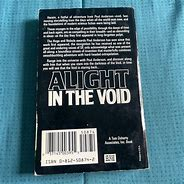
The Star Beast is a juvenile science fiction novel by Robert Heinlein whereas "The Star Beast" is an adult science fiction short story by Poul Anderson, published in Super Science Stories in 1950 and republished in several Anderson collections, including Alight In The Void (New York, 1993).
"The Star Beast" occupies just forty two pages of Alight In The Void so is not a novel but nevertheless, in the pulp tradition, is divided into chapters with individual titles:
Chapter I, Therapy for Paradise
Chapter II, "Tiger, Tiger!"
Chapter III, Dark Victory
The opening sentence:
"The rebirth technician thought he had heard everything in the course of some three centuries." (p. 61)
- informs us that we are dealing with characters who live for several centuries and who practice something called "rebirth" although this seems to be more technological than spiritual. Indeed, it turns out not to be the Buddhist concept of rebirth.
The rebirth technician informs Harol, who wants to spend a couple of years as a tiger, that an animal whose ontogeny opposed its phylogeny would not be viable. I had to use a dictionary for both these words and to try to understand the distinction that was being made. Like some later, longer works by Anderson, this story shows a future in which artificial intelligence has rendered human intelligence redundant. I will continue to reread it with interest.
"The Star Beast" occupies just forty two pages of Alight In The Void so is not a novel but nevertheless, in the pulp tradition, is divided into chapters with individual titles:
Chapter I, Therapy for Paradise
Chapter II, "Tiger, Tiger!"
Chapter III, Dark Victory
The opening sentence:
"The rebirth technician thought he had heard everything in the course of some three centuries." (p. 61)
- informs us that we are dealing with characters who live for several centuries and who practice something called "rebirth" although this seems to be more technological than spiritual. Indeed, it turns out not to be the Buddhist concept of rebirth.
The rebirth technician informs Harol, who wants to spend a couple of years as a tiger, that an animal whose ontogeny opposed its phylogeny would not be viable. I had to use a dictionary for both these words and to try to understand the distinction that was being made. Like some later, longer works by Anderson, this story shows a future in which artificial intelligence has rendered human intelligence redundant. I will continue to reread it with interest.
Subscribe to:
Posts (Atom)